Physics › Electricity › Current-voltage characteristics
Current-voltage characteristics
Three current-voltage characteristics are required: an ohmic conductor at constant temperature, a filament lamp and a semiconductor diode. Only the first obeys Ohm's law. Resistance at a point on any of them is the ratio V/I of the coordinates, never the gradient of the tangent.
Choose your exam board to show the notes and questions relevant to your specification. You can change this setting at any time, and content for other boards remains available.
Builds on Current, charge and potential difference.
IN THIS TOPIC
- Sketch and interpret the I-V characteristics of an ohmic conductor, a filament lamp and a semiconductor diode, and explain the shape of each.
- Quote Ohm's law as the special case I ∝ V under constant physical conditions, and read resistance off any characteristic as V/I at a point.
- Treat the meters as ideal, with zero resistance in the ammeter and infinite resistance in the voltmeter.
COMMON MISCONCEPTION
Ohm's law applies to everything.
Ohm's law is a special case, not a universal law: only ohmic conductors at constant temperature have current proportional to pd. Filament lamps and diodes do not, so their resistance varies.
Current-voltage characteristics
A current-voltage characteristic shows how current varies with potential difference for a component. To obtain one, vary the pd across the component, record the current through it, and plot one against the other. Unless a question states otherwise the meters are ideal: zero resistance in the ammeter and infinite resistance in the voltmeter, so neither alters the quantity it measures.
Exam papers place either quantity on the horizontal axis, and the same component's curve appears reflected when the axes are swapped. Read the axis labels before describing the shape.
The ohmic conductor
A metal wire held at constant temperature gives the simplest characteristic of all, a straight line through the origin.
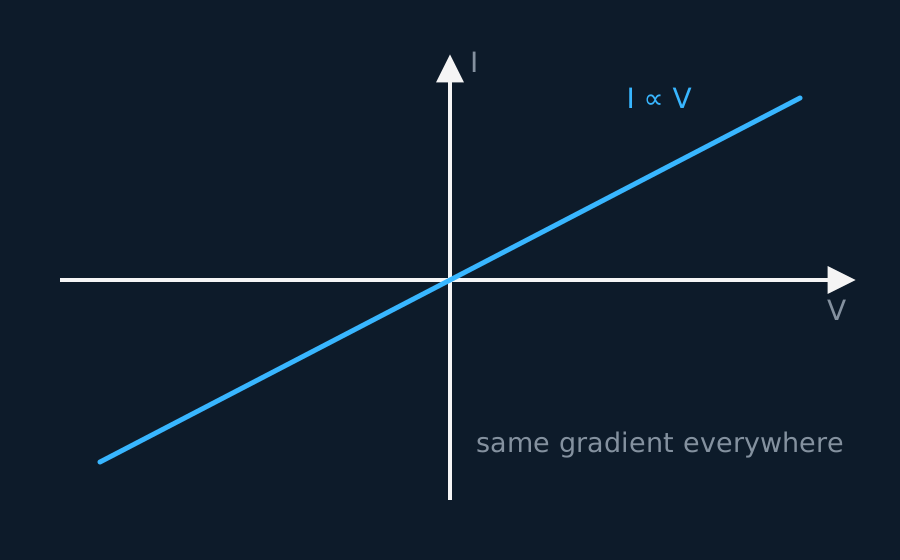
That straight line is Ohm's law: current is proportional to pd, I ∝ V, provided physical conditions, principally temperature, stay constant. The condition is essential, because the law describes only the case in which V/I stays fixed. The two components below are not ohmic.
The filament lamp
A lamp's filament runs white-hot, and the current itself does the heating. More current means a hotter filament, whose metal ions vibrate more violently, obstructing the charge carriers more often, so the resistance rises with the current.
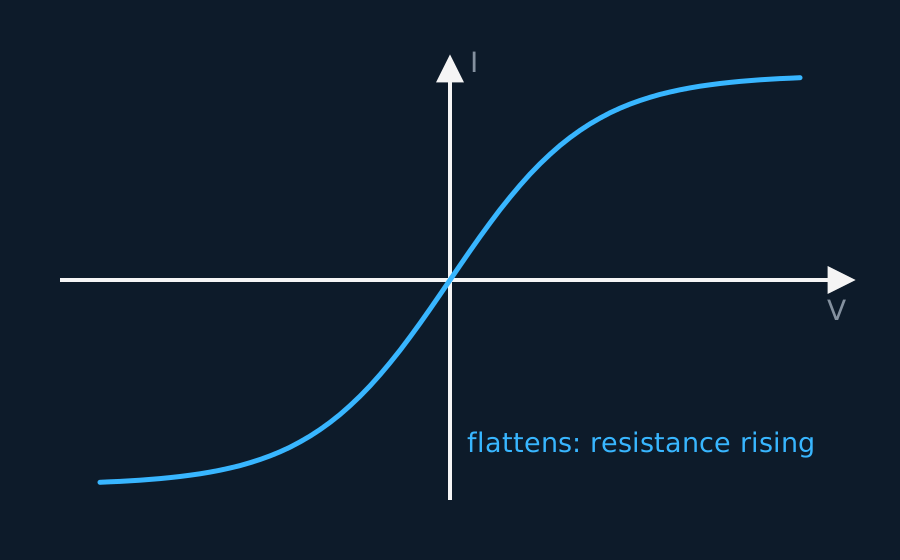
The graph shows that behaviour: steep near the origin, where the filament is coolest, and flattening as V increases and the filament's temperature rises. The curve is symmetrical about the origin because the filament behaves the same way for either direction of current.
The diode
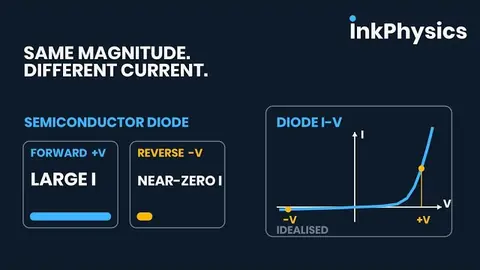
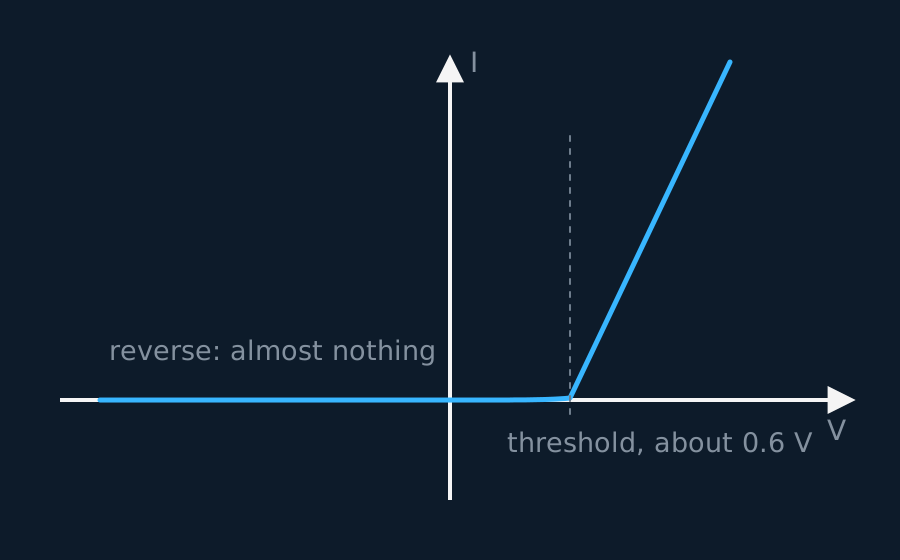
A semiconductor diode conducts in one direction only. In reverse bias, and in forward bias below a threshold pd of about 0.6 V, it passes almost no current; above the threshold the current rises very steeply for small increases in pd. The arrow in the circuit symbol points in the direction in which conventional current is allowed to pass, so check its orientation when sketching a circuit.
Reading resistance from the graph
At any point on any characteristic the definition still applies: R = V/I, the ratio of the two coordinates at that point. Along the ohmic line that ratio comes out the same everywhere, which is what ohmic means. Along the lamp's curve it grows as you move outwards.
On a curve, the gradient of the tangent is not the resistance: on a curve the two are different numbers, and only the ratio of the coordinates gives the resistance.
WORKED EXAMPLE
A diode, above and below its knee
From a diode's characteristic: at 0.65 V the current is 20 mA; at 0.40 V it is too small to read. Find the resistance at each point.
At 0.65 V the ratio gives R = V/I = 0.65/0.020 = 33 Ω, a diode conducting freely past its threshold.
At 0.40 V the current is effectively zero, so V/I is enormous. Below the threshold a diode is an open switch for all practical purposes.
One component gives two very different resistances, each read as the ratio of coordinates. A diode therefore has no single resistance, and any value quoted must state the operating point it applies to.
GUIDED PRACTICE
A wire at a higher steady temperature
A metal wire's I-V characteristic is drawn cold. Predict, with a reason, how the graph changes if the whole experiment is repeated with the wire held at a higher steady temperature.
Show the working
In hotter metal the ions vibrate more violently, so the electrons scatter more often and the resistance rises.
Higher resistance gives a shallower straight line, with less current at every pd. The line stays straight because the temperature is held constant. A filament lamp's characteristic curves because the current raises the filament's temperature as the pd increases.
ASSESSMENT FOCUS
- State the resistance as V/I at that point, using the coordinates, not the gradient of the tangent. On a curve the two are different quantities.
- Give the lamp explanation as a chain, in order: the current heats the filament, the lattice ions vibrate with larger amplitude, the charge carriers collide with them more often, and the resistance rises. Each step carries credit.
- Quote Ohm's law with its condition: I ∝ V provided physical conditions, principally temperature, remain constant. The condition is part of the statement.
- Check which quantity is on each axis before describing a shape. With V on the vertical axis every curve is reflected, so the diode's steep rise appears as a flat section.
CHECK YOURSELF
From a filament lamp's characteristic: at 2.0 V the current is 0.50 A, and at 12 V it is 1.5 A. Find the resistance at each point, and explain the change.
Show a hint
Resistance is a ratio of coordinates, taken twice.
Show the answer
At 2.0 V, R = V/I = 2.0 / 0.50 = 4.0 Ω. At 12 V, R = 12 / 1.5 = 8.0 Ω.
Resistance has doubled because the larger current runs the filament far hotter. Its ions vibrate harder, the carriers collide with them more often, and each volt now drives proportionally less current.
R is the ratio V over I at a point, never the gradient of a curve.
WORKBOOK
Printable practice for this topic: original exam-style questions with room to work, and a fully worked answer book. Free to use; please do not redistribute or sell.
Or read them with their mark schemes on the current-voltage characteristics questions page.
WHERE TO GO NEXT
- Gradients and areas under graphs is the maths this lesson leans on, worked through step by step.
USED LATER IN
CHECK YOUR PROGRESS
Rate how confident you feel with each objective for this lesson. Ratings are saved in this browser, on this device, unless you sign in.
- Sketch and interpret the I-V characteristics of an ohmic conductor, a filament lamp and a semiconductor diode, and explain the shape of each.
- Quote Ohm's law as the special case I ∝ V under constant physical conditions, and read resistance off any characteristic as V/I at a point.
- Treat the meters as ideal, with zero resistance in the ammeter and infinite resistance in the voltmeter.
Open the full revision checklist to track your progress across the whole unit.