Physics › Electricity › Current, charge and potential difference
Current, charge and potential difference
Electric current is the rate of flow of charge, I = ΔQ/Δt, and potential difference is the energy transferred per unit charge, V = W/Q. One volt is one joule per coulomb. A charge accelerated from rest through a pd in a vacuum gains kinetic energy qV, which is what an electron gun exploits.
Choose your exam board to show the notes and questions relevant to your specification. You can change this setting at any time, and content for other boards remains available.
Current, charge and the direction problem, part 1 of 2. Part 2 is Charge carriers, drift speed and resistance.
IN THIS TOPIC
- Use I = ΔQ/Δt, and give the coulomb as one ampere second.
- Use V = W/Q, where one volt is one joule per coulomb.
- Calculate the speed of a charge accelerated from rest through a pd in a vacuum, using eV = ½mv².
COMMON MISCONCEPTION
A 12 V battery gives every electron 12 joules.
A volt is a joule per coulomb, not per electron. One electron carries only 1.60 × 10⁻¹⁹ C, so 12 V gives it 12 × 1.60 × 10−19 = 1.9 × 10⁻¹⁸ J.
Current is a rate
Electric current is the rate of flow of charge.
The current is the charge passing one cross-section of the wire per second. One ampere is one coulomb per second, so one coulomb is one ampere second. Rearranged, ΔQ = IΔt, which is the form used in most calculations.

Describe the drawing
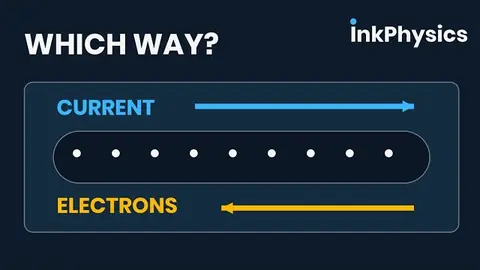
Electrons drift left along the wire, one dot crossing the counting line every second and a half at this pace. Each dot stands for an enormous cohort of carriers rather than a single electron (one electron at that rate would be a current of about 10⁻¹⁹ A), and the current is the charge all of them carry past the line each second. Conventional current points the other way, a bookkeeping choice made before anyone knew what moved. The real drift in copper is under a millimetre per second; slowed further here so you can see it. The signal, though, travels at nearly light speed, which is why the lamp is instant while the electrons crawl.
Charge is quantised. Every electron carries a charge of magnitude 1.60 × 10⁻¹⁹ C, negative in sign, a constant printed in the data booklet, and any measured charge is a whole-number multiple of it. Dividing a charge in coulombs by that constant gives the number of electrons.
A current needs carriers, and which particles do the carrying depends on the material. A metal is a lattice of fixed positive ions sitting in a sea of delocalised electrons, loose from any one atom and free to drift through the whole structure. A current in a wire is that electron population on the move, and nothing else in the metal travels at all.
An electrolyte conducts by moving matter instead. Melt an ionic solid or dissolve one in water, copper sulfate solution being the standard case, and the ions themselves come free of each other. Both signs then drift, in opposite directions: positive ions towards the negative electrode, negative ions towards the positive one. The two flows add rather than cancel, because negative charge going one way counts the same as positive charge going the other, and the total is the current the ammeter in the leads reads. Electrons carry it through the wires, ions carry it through the liquid, and the same coulombs per second pass through each.
The difference in carrier has a measurable consequence. Ions are matter, so a current through an electrolyte transports substance as well as charge, plating copper onto one electrode and stripping it off the other. A current through a copper wire moves no copper anywhere.
Potential difference
Potential difference is the energy transferred per unit charge.
The volt is therefore a joule per coulomb. A 1.5 V cell transfers 1.5 J to each coulomb that passes through it; a component with 1.5 V across it takes 1.5 J from each coulomb. In a resistor, that electrical energy is transferred mainly to internal energy.
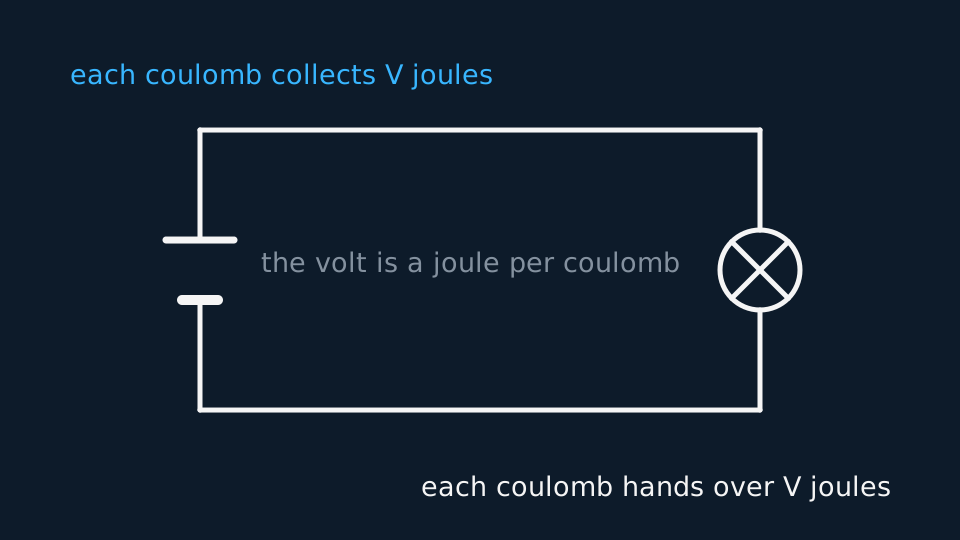
Rearranged, W = VQ, and with Q = It that becomes W = VIt. Those two forms convert between electrical quantities and joules.
For a charged particle accelerated from rest through a potential difference V in a vacuum, the work done on it is |q|V and no energy is transferred to a lattice, so the gain in kinetic energy is |q|V. Hence , for an electron , provided the particle starts from rest, the path is a vacuum, and relativistic effects are negligible. This is the equation used for an electron gun and for the first stage of a linear accelerator.
WORKED EXAMPLE
The speed out of an electron gun
An electron starts from rest and crosses a pd of 2.0 kV in a vacuum. Find its speed. (e = 1.60 × 10⁻¹⁹ C, me = 9.11 × 10⁻³¹ kg.)
Every joule of work becomes kinetic energy, so eV = ½mv2 and v = .
v = √(2 × 1.60 × 10−19 × 2000 / (9.11 × 10⁻³¹)) = 2.7 × 10⁷ m s−1.
This is about 9% of the speed of light, and roughly 1011 times the drift speed in the wire feeding the gun. The energy per unit charge is the same in both cases; in the wire the carriers collide repeatedly with the lattice, so the energy is transferred to internal energy instead of accumulating as kinetic energy.
WORKED EXAMPLE
From current to charge to energy
A 6.0 V battery drives 0.50 A through a lamp for one minute. Find the charge that passes and the energy transferred.
Charge first. Q = It = 0.50 × 60 = 30 C, with the minute converted to 60 seconds.
Now the energy. W = VQ = 6.0 × 30 = 180 J.
Checking the result against the definitions: 30 C passed through the circuit, and the battery transferred 6.0 J to each coulomb, which the lamp then transferred to light and internal energy.
The direction problem has moved to the next part of this lesson.
The drift equation has moved to the next part of this lesson.
Resistance, defined has moved to the next part of this lesson.
ASSESSMENT FOCUS
- Substitute time into ΔQ = IΔt in seconds. Convert any time given in minutes or hours before substituting.
- “How many electrons?” means divide the charge by 1.60 × 10⁻¹⁹ C. A typical answer lies between 1019 and 1021; a much smaller result indicates a power-of-ten slip.
- Be able to write the definitions as sentences. Current is the rate of flow of charge, and potential difference is the work done per unit charge; both are asked for in words as well as in symbols.
- Use W = VQ, or W = VIt when a time is given, whichever matches the quantities supplied.
- State the conditions alongside eV = ½mv2: from rest, in a vacuum, with all the work transferred to kinetic energy. Use qV for a particle other than an electron, and do not use the accelerating pd in a resistance calculation, since no energy is dissipated along the path.
CHECK YOURSELF
A lamp carries a current of 0.25 A for 2.0 minutes. (a) How much charge passes through it? (b) How many electrons is that?
Show a hint
Convert the time to seconds first. Then use the charge on one electron.
Show the answer
(a) = 0.25 × 120 = 30 C.
(b) Each electron carries 1.60 × 10⁻¹⁹ C, so N = 30 / (1.60 × 10⁻¹⁹) = 1.9 × 10²⁰ electrons. At numbers of this order the quantisation of charge is not detectable, and the charge behaves as a continuous quantity.
Current is charge per second; potential difference is joules per coulomb.
One volt is one joule per coulomb, not one joule per electron.
WORKBOOK
Printable practice for this topic: original exam-style questions with room to work, and a fully worked answer book. Free to use; please do not redistribute or sell.
Or read them with their mark schemes on the current, charge and potential difference questions page.
USED LATER IN
CHECK YOUR PROGRESS
Rate how confident you feel with each objective for this lesson. Ratings are saved in this browser, on this device, unless you sign in.
- Use I = ΔQ/Δt, and give the coulomb as one ampere second.
- Use V = W/Q, where one volt is one joule per coulomb.
- Calculate the speed of a charge accelerated from rest through a pd in a vacuum, using eV = ½mv².
Open the full revision checklist to track your progress across the whole unit.