Physics › Maths bridge › Gradients and areas under graphs
Gradients and areas under graphs
A gradient is the change in y over the change in x, so its unit is the y-axis unit over the x-axis unit. The area under a graph has the two units multiplied. What each means physically depends on the axes: on a velocity-time graph the gradient is acceleration and the area is displacement.
Gradient and area
The gradient is dy/dx and has units equal to the y-axis unit divided by the x-axis unit. The area between a curve and the x-axis is the integral of y with respect to x and has units equal to the product of the axis units. The physical meaning of each depends on the plotted quantities, so state what the gradient or area means for those axes before calculating it.
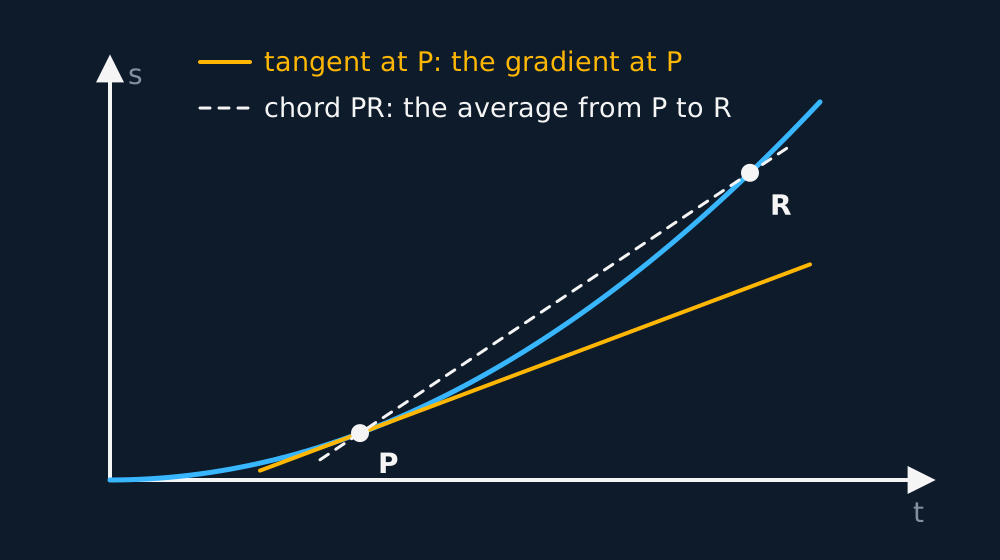
On a curve, the gradient at a point is the gradient of the tangent drawn there, not of a chord between two convenient points. Draw the tangent long, and read its rise and run from widely separated points to keep the percentage error down.
Both readings in practice
WORKED EXAMPLE
A velocity-time graph, both ways
A velocity-time graph rises in a straight line from 2.0 m s−1 to 8.0 m s−1 over 4.0 s. Find the acceleration and the distance covered.
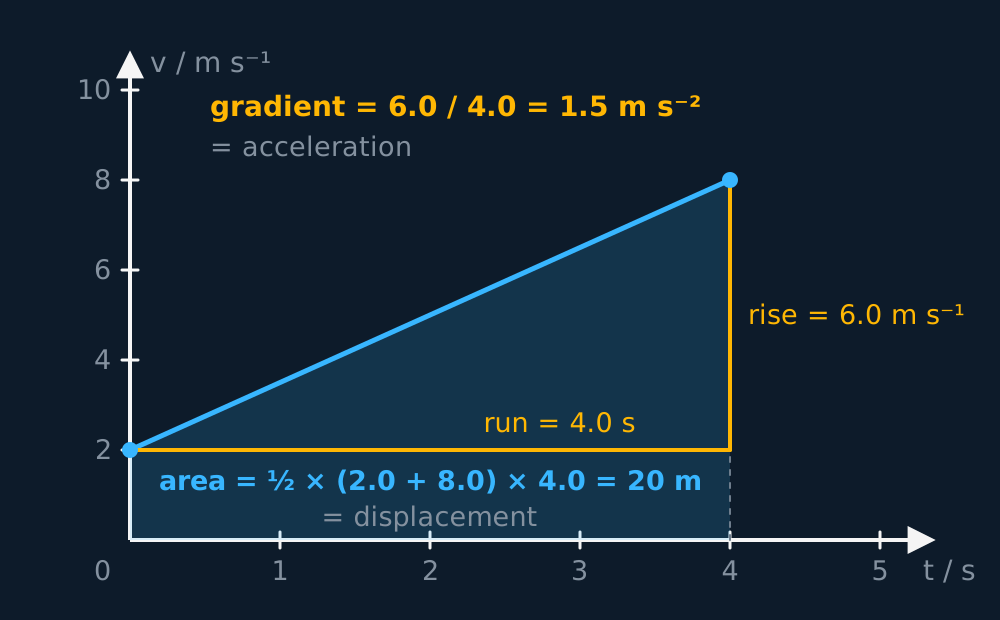
Gradient first. Rise over run is (8.0 − 2.0)/4.0 = 1.5 m s−2, and the unit came straight off the axes, velocity over time.
The area under the line is a trapezium, ½ × (2.0 + 8.0) × 4.0 = 20 m. Area under velocity-time is displacement, and the unit m s−1 × s = m confirms it.
GUIDED PRACTICE
Say it, then find it
A graph plots charge (in coulombs) on the y axis against time (in seconds) on the x axis for a discharging capacitor. State what the gradient of the tangent at any point represents, with its unit, before opening the working.
Show the working
The gradient is the rate of change of charge with time, which is the current, measured in coulombs per second, otherwise known as amperes.
Its sign is negative during discharge, because the charge is falling; the magnitude of the tangent's gradient is the size of the current at that instant.
Gradient and area on common graphs
| Graph (y against x) | Gradient | Gradient unit | Area under the graph | Area unit |
|---|---|---|---|---|
| displacement-time | velocity | m s−1 | not used | |
| velocity-time | acceleration | m s−2 | displacement | m |
| acceleration-time | not used | change in velocity | m s−1 | |
| momentum-time | resultant force | N | not used | |
| force-time | not used | impulse (change in momentum) | N s | |
| force-extension | stiffness k, on the straight section | N m−1 | work done in stretching | J |
| stress-strain | Young modulus, on the straight section | Pa | work done per unit volume | J m−3 |
| charge-time | current | A | not used | |
| current-time | not used | charge | C | |
| charge-p.d. for a capacitor | capacitance | F | energy stored | J |
| power-time | not used | energy transferred | J |
Where physics leans on this: Motion graphs and SUVAT · Charging and discharging · Density and Hooke's law. All eight skills: the maths bridge.