Physics › Electricity › Resistivity and temperature
Resistivity and temperature
Resistance belongs to one particular wire, while resistivity, ρ = RA/L, belongs to the material itself and is measured in ohm metres. Warming a metal raises its resistance as the lattice ions vibrate harder, and an ntc thermistor does the opposite because heat frees extra charge carriers.
Choose your exam board to show the notes and questions relevant to your specification. You can change this setting at any time, and content for other boards remains available.
Resistivity and superconductivity, part 1 of 2. Part 2 is Light-dependent resistors and superconductivity.
Builds on Current, charge and potential difference and Stress, strain and the Young modulus.
IN THIS TOPIC
- Move between a wire's resistance and its material's resistivity with ρ = RA/L, in Ω m.
- Say what warming does to a metal's resistance, and why an ntc thermistor does the opposite.
- Give thermistor applications, reading a resistance-temperature graph as the calibration.
COMMON MISCONCEPTION
A material has a resistance.
Resistance belongs to a particular object and depends on its dimensions: R = ρL/A. Resistivity is the material's own property, the same for any sample of that material.
From the object to the material
Resistance is a property of one particular object. Make the wire longer and R rises in proportion, because the carriers undergo more collisions with the lattice on the way through; make it fatter and R falls in inverse proportion to the area, because a larger cross-sectional area provides more parallel conducting paths. Dividing out the geometry leaves a property of the material itself, in the same way that dividing out a sample's dimensions turns a spring constant into the Young modulus.
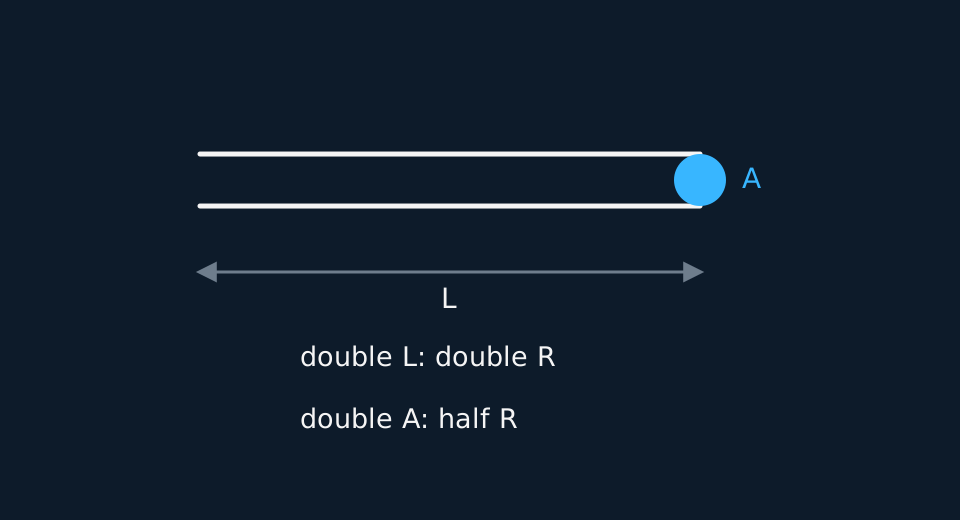
Resistivity ρ belongs to the material alone, at a stated temperature, and its unit is the ohm metre, Ω m, not ohms per metre. The values span a very wide range. Copper is near 1.7 × 10⁻⁸ Ω m, good insulators reach 1016 Ω m, and those two lie some twenty-four orders of magnitude apart.
WORKED EXAMPLE
Scaling a wire without a calculator
A wire has resistance R. A second wire of the same material is twice as long and twice the diameter. Find its resistance in terms of R.
Work through R = ρL/A one factor at a time. Doubling the length doubles the resistance.
Doubling the diameter quadruples the area, since A depends on d2, and that divides the resistance by four.
Together, R × 2/4 = R/2. No numbers were needed. Proportional reasoning like this comes up as often as the plug-in version.
Metals and temperature
Warm a metal and its resistivity rises. The lattice ions vibrate with greater amplitude, the drifting carriers collide with them more often, and the same pd drives less current. Over everyday ranges the rise is roughly linear. It is the same mechanism that curved the filament lamp's characteristic.
Required practical 5 pins the number down. Measure the wire's diameter with a micrometer at several places and average, take V and I readings for a series of lengths, then plot R against L. The gradient is ρ/A, so ρ comes out as gradient × A. Nearly all the uncertainty arrives through the diameter, because A depends on d2 and so doubles whatever percentage error d carries.
Thermistors
A thermistor is a semiconductor component whose resistance falls steeply as it warms; only this negative temperature coefficient (ntc) type is considered. Heating a semiconductor frees extra charge carriers, and the flood of new carriers outweighs the extra lattice collisions, so the net resistance drops.
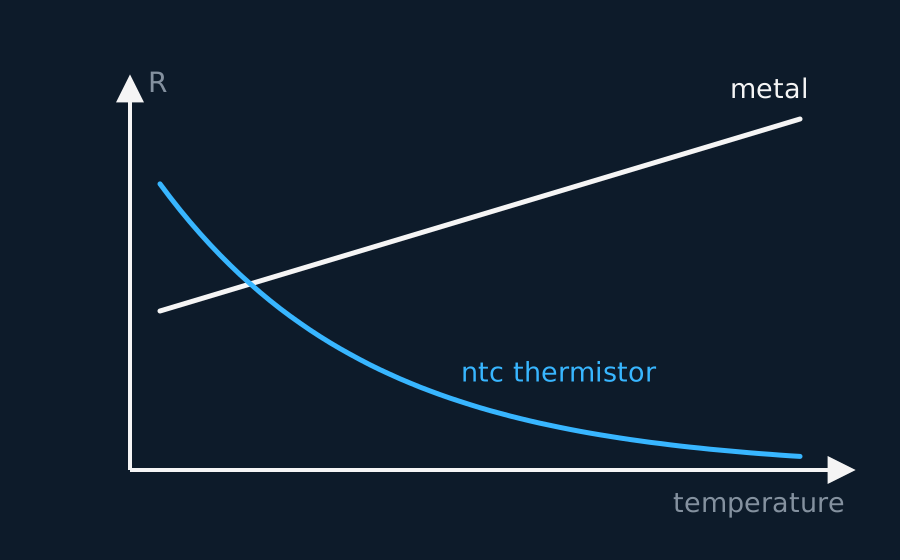
That steep, reliable fall is what makes the component useful. A thermistor works as a resistance thermometer. Put one where the temperature matters, such as a car engine, an incubator or a smart thermostat, and read the temperature off the resistance, with the component's own resistance-temperature graph as the calibration.
GUIDED PRACTICE
A thermistor warms up
A thermistor connected to a steady 6.0 V supply has resistance 1200 Ω when cool and 400 Ω when warm. Find the current in each case, and state the direction of the change.
Show the working
Cool: I = 6.0/1200 = 5.0 mA. Warm: I = 6.0/400 = 15 mA.
Warming the thermistor tripled the current. Falling resistance with rising temperature is the ntc signature, the opposite of the metal wire, because heat here liberates charge carriers instead of merely scattering them.
Light-dependent resistors has moved to the next part of this lesson.
Superconductivity has moved to the next part of this lesson.
ASSESSMENT FOCUS
- The unit of resistivity is the ohm metre, Ω m, not Ω m−1. The unit is examined directly.
- Use the terms precisely: R is the resistance of the wire and ρ is the resistivity of the material. “The resistivity of the wire is 5 Ω” confuses both the quantity and the unit.
- Doubling a wire's diameter quarters its resistance, because A depends on d2. Check whether the value given is a radius or a diameter, and square it.
- Give the thermistor mechanism in terms of carrier number: heating frees more charge carriers, so n rises and the resistance falls. Reduced lattice vibration is not the mechanism.
- In the resistivity practical, take the micrometer reading to the nearest 0.01 mm at several points and average. Asked which measurement dominates the uncertainty, answer the diameter, and say why.
CHECK YOURSELF
A wire of length 2.5 m and diameter 0.40 mm has a resistance of 1.2 Ω. Find the resistivity of its material.
Show a hint
Area from the diameter first, in metres, then rearrange the resistivity equation.
Show the answer
Area first, from the diameter. A = πd2/4 = π × (0.40 × 10⁻³)2 / 4 = 1.26 × 10⁻⁷ m2.
= 1.2 × 1.26 × 10−7 / 2.5 = 6.0 × 10⁻⁸ Ω m, a value typical of a pure metal.
R belongs to the wire.
ρ belongs to the material.
WORKBOOK
Printable practice for this topic: original exam-style questions with room to work, and a fully worked answer book. Free to use; please do not redistribute or sell.
Or read them with their mark schemes on the resistivity and temperature questions page.
WHERE TO GO NEXT
- Required practical 5: resistivity of a wire puts this topic in the lab, and the written papers ask about it.
- Combining uncertainties is the maths this lesson leans on, worked through step by step.
CHECK YOUR PROGRESS
Rate how confident you feel with each objective for this lesson. Ratings are saved in this browser, on this device, unless you sign in.
- Move between a wire's resistance and its material's resistivity with ρ = RA/L, in Ω m.
- Say what warming does to a metal's resistance, and why an ntc thermistor does the opposite.
- Give thermistor applications, reading a resistance-temperature graph as the calibration.
Open the full revision checklist to track your progress across the whole unit.