Physics › Nuclear physics › Rutherford scattering and the nuclear model
Rutherford scattering and the nuclear model
Geiger and Marsden fired alpha particles at thin gold foil, and a very few deflected through more than ninety degrees. In their 1909 trial about one in eight thousand bounced back off a platinum plate. That most passed straight through means an atom that is mostly empty space, and the rare rebounds mean a nucleus that is small, massive and positive. The model was revised again as protons, neutrons and quarks were found.
Choose your exam board to show the notes and questions relevant to your specification. You can change this setting at any time, and content for other boards remains available.
Rutherford scattering and the nuclear atom, part 1 of 2. Part 2 is Alpha, beta and gamma radiation.
Builds on Constituents of the atom and Stable and unstable nuclei and Quarks and the hadrons built from them.
IN THIS TOPIC
- Describe the alpha scattering results, and argue from them to a small, massive, positive nucleus.
COMMON MISCONCEPTION
An atom is a tiny solid ball, packed with matter all the way through.
An atom is mostly empty space, not solid: most alpha particles passed straight through the foil, and nearly all the mass and all the positive charge sit in a tiny nucleus.
The alpha scattering experiment
In 1909, Geiger and Marsden fired alpha particles at gold foil about 0.4 µm thick, roughly a thousand atoms, and counted where they went. The apparatus was simple enough to sketch from memory. A radium source sat in a lead block drilled with a narrow channel, so that a thin, well-defined beam of alphas emerged in one direction only. The beam struck the foil, and around the foil a zinc sulfide screen on a movable microscope caught whatever came off it, each arriving alpha announcing itself as a tiny flash of light to be counted by eye, angle by angle, for months.
Three design choices carry the physics. The whole chamber is evacuated, because alpha particles are exhausted by a few centimetres of air and any gas would scatter and stop the beam before the foil could. The foil is gold, because gold hammers thinner than any other metal. And the foil is thin, so that an alpha is unlikely to pass close to more than one nucleus on its way through and a large deflection can be read as the result of a single encounter rather than an accumulation of many.

Describe the drawing
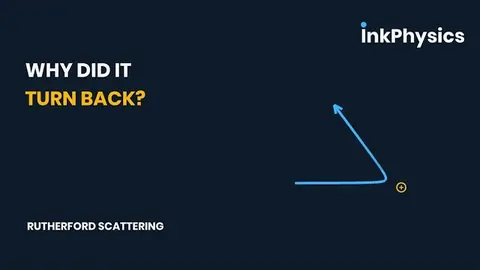
Alpha particles stream at the foil for the whole loop. Nearly every one sails straight through as though the atom were empty space, a few are nudged, and once, just once, one meets a nucleus nearly head on and comes straight back the way it came. In Geiger and Marsden's 1909 trial about one alpha in eight thousand bounced back off a platinum plate, and results like that are how we know the atom is almost entirely empty, with its mass and positive charge packed into a tiny nucleus.
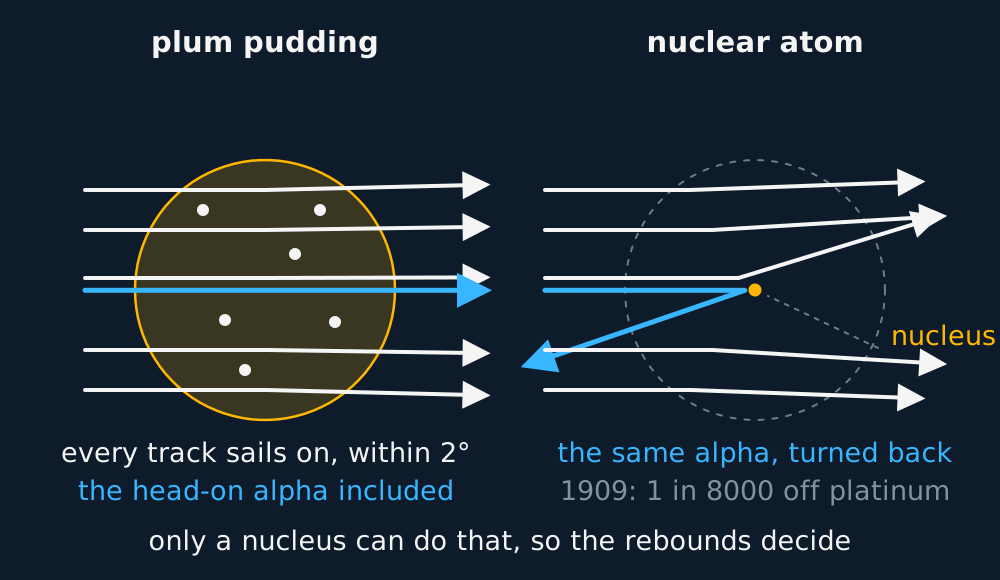
The expectation was firm. In the plum pudding picture of the day, an atom was a ball of spread-out positive charge with electrons dotted through it, and charge spread that thinly can only nudge a fast, heavy alpha. Every alpha should have passed through with at most a tiny deflection. Most did. But a very few deflected through more than 90 degrees, and some came almost straight back along their own track. In Geiger and Marsden's 1909 trial, about 1 in 8000 bounced back off a platinum plate. Rutherford's often-quoted reaction, that it was like firing a shell at tissue paper and having it bounce back, is the right reaction to have: on the accepted model the result was impossible.
From the observations to the nuclear atom
Rutherford's reading of the results still stands, and it runs one observation at a time. Most alphas fly straight on, undeflected, so most of the atom is empty space. A tiny fraction deflect violently, so somewhere in the atom there is a region of charge concentrated enough to repel an alpha head-on; the deflected alphas are repelled rather than swallowed, and electrons are thousands of times too light to matter, so that region is positive. And an alpha that rebounds must have hit something at least as heavy as itself, or it would have knocked the target aside and carried on, so the region is massive as well, holding nearly all the atom's mass.
Describe the drawing
Two panels share one beam of six parallel alpha tracks. On the left, the plum pudding atom: a large ball of dilute positive charge with electrons dotted through it, and every track crosses the whole ball to emerge barely nudged, none bent past two degrees, the cyan head-on track included. On the right, the nuclear atom: a dashed outline of mostly empty space around a tiny amber nucleus, where four tracks run straight through, a near miss bends visibly as it passes, and the same cyan head-on alpha hooks around the nucleus and returns almost along itself. Only the nuclear panel can produce that returning track, so the one-in-eight-thousand rebounds decide between the models.
How rare the rebounds are measures how small the target is. Each alpha crossed a thousand or so atoms of foil, yet only a tiny fraction passed close enough to a nucleus to be turned back, and working the geometry through gives a nucleus around ten thousand times smaller than its atom: a radius of order 10−14 m against the atom's 10−10 m. Scale the atom up to a cathedral and the nucleus is a fly at the centre of it, with the electrons a faint charge in the surrounding space. The alphas that bounce back are the ones that run almost head-on into the fly.
GUIDED PRACTICE
Each observation, its own conclusion
State the two key observations of the alpha scattering experiment, and the conclusion about the atom that each one supports.
Show the working
Most alpha particles passed straight through the foil with little or no deflection, so most of the atom is empty space.
A very small fraction deflected through more than 90 degrees, some almost straight back, so the atom's positive charge and nearly all its mass are concentrated in a very small nucleus. Each observation supports its own conclusion, and both pairs are needed for the full argument.
A model that keeps changing
The nuclear atom of 1911 was not the final model, and how the model has changed with the evidence is itself examinable content. The nucleus gained protons, and then, with Chadwick's experiments of 1932, neutrons; electron scattering later measured the nuclear radius properly, as the nuclear radius lesson shows; and deep inelastic scattering showed the proton itself has structure, the quarks you met in the particles unit.
Each step arrived the same way: a new probe found a surprise in the data, and the picture was revised. Alpha particles found the nucleus, electrons sized it, and still higher energies opened the nucleons themselves. None of the earlier models was foolish; each was the best account of the evidence then available, held exactly until a measurement disagreed with it. Scientific knowledge of the nucleus is therefore provisional, and it advances when a new experiment forces a revision.
One thing the scattering experiment could not say is what an unstable nucleus does about its instability. The radiations it emits, and the absorption tests that tell them apart, are the second part of this lesson.
Three radiations, three absorption tests has moved to the next part of this lesson.
The inverse-square law for gamma has moved to the next part of this lesson.
Background, risk and benefit has moved to the next part of this lesson.
ASSESSMENT FOCUS
- Scattering answers pair evidence with conclusion. Most alphas undeflected means mostly empty space, and a tiny fraction rebounding means a small, massive, positive nucleus. Either observation alone supports only half of the model.
- The design choices are examinable, so have a reason ready for each. Evacuated chamber, because air would stop the alphas; thin foil, so each deflection is a single encounter; a narrow collimated beam, so the undeflected direction is known.
- Keep the orders of magnitude to hand. An atom is about 10−10 m across and its nucleus of order 10−14 m, so the nucleus is around ten thousand times smaller. Quote the ratio as well as the two sizes.
- Asked how ideas about the atom have changed, answer with the pattern rather than a date list. A new probe produced a surprise, and the model was revised to fit: plum pudding to nuclear atom, then neutrons, then quarks.
CHECK YOURSELF
In the alpha scattering experiment, state what was observed for the great majority of alpha particles and for a tiny minority, and the conclusion each observation supports. Explain also why the experiment is carried out in an evacuated chamber.
Show a hint
Two observations, each with its own conclusion; then remember what a few centimetres of air does to an alpha.
Show the answer
The great majority passed straight through the foil with little or no deflection, so most of the atom is empty space.
A very small fraction deflected through more than 90 degrees, a few almost straight back, so the positive charge and nearly all the mass are concentrated in a tiny nucleus, around ten thousand times smaller than the atom.
Alpha particles are stopped by a few centimetres of air, so without a vacuum the beam would be scattered and absorbed before reaching the foil, and the deflections measured would belong to the air rather than the gold.
Most alphas missed, so the atom is nearly all empty space.
The rare rebounds mark a nucleus that is tiny, massive and positive.
Every revision of the model began as a surprise in somebody's data.
WORKBOOK
Printable practice for this topic: original exam-style questions with room to work, and a fully worked answer book. Free to use; please do not redistribute or sell.
Or read them with their mark schemes on the Rutherford scattering and the nuclear model questions page.
USED LATER IN
CHECK YOUR PROGRESS
Rate how confident you feel with each objective for this lesson. Ratings are saved in this browser, on this device, unless you sign in.
- Describe the alpha scattering results, and argue from them to a small, massive, positive nucleus.
Open the full revision checklist to track your progress across the whole unit.