Physics › Turning points › Corpuscles, waves and Young's fringes
Corpuscles, waves and Young's fringes
Newton's corpuscles and Huygens' waves both explained reflection and refraction, disagreeing only over the speed of light in glass. Young's double slit produced dark fringes where two beams overlapped, which streams of particles cannot do. Newton's authority and the weak diffraction evidence delayed acceptance of the wave theory for decades.
Choose your exam board to show the notes and questions relevant to your specification. You can change this setting at any time, and content for other boards remains available.
The nature of light, part 1 of 2. Part 2 is Electromagnetic waves and the speed of light.
Builds on Interference and Young's double slit and Cathode rays and the electron gun.
IN THIS TOPIC
- Compare Newton's corpuscular theory with Huygens' wave theory, and say why Newton's was preferred.
- Explain the significance of Young's fringes, and why acceptance of the wave theory was delayed.
COMMON MISCONCEPTION
A theory backed by a great enough scientist counts as proved.
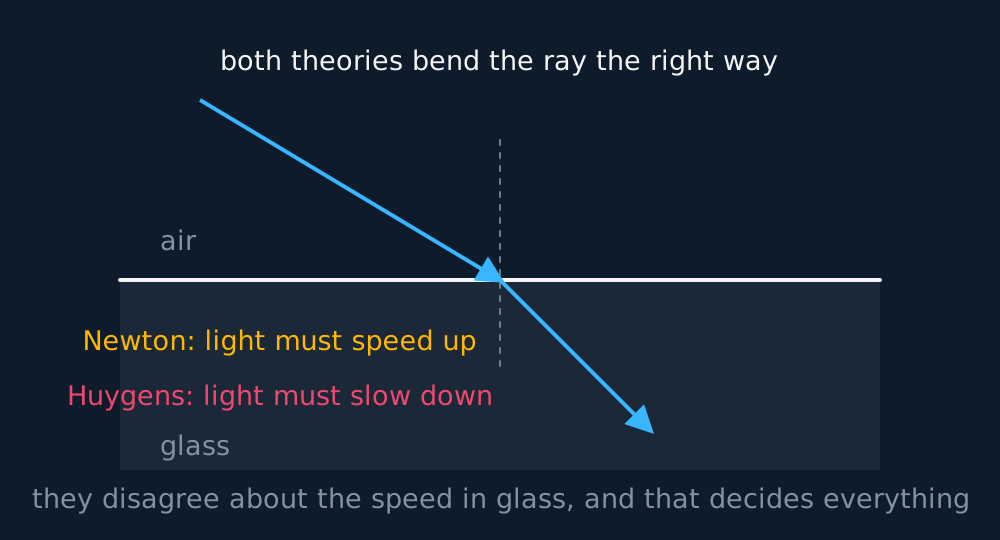
Authority is not evidence: Newton's particle theory predicted light travels faster in glass, wave theory predicted slower, and Foucault's measurement found it slower, deciding for waves.
Corpuscles against waves
Newton argued that light is a stream of tiny particles, corpuscles. The theory had genuine successes. Particles travel in straight lines, so shadows come out sharp, and they bounce like billiard balls, so reflection is easy. Refraction it could manage too, provided the glass attracts the corpuscles as they cross the surface, pulling them towards the normal. That requires light to travel faster in glass than in air.
His contemporary Christiaan Huygens proposed the opposite. Light is a wave, with each point on a wavefront acting as a source of new wavelets. Waves reflect and refract just as well, but they bend towards the normal by slowing down in the denser medium. So there stood two theories, both fitting the everyday facts, disagreeing about one number nobody could yet measure, the speed of light in glass.
Two reasons kept the corpuscular theory in front for a hundred years. Newton's scientific authority helped the corpuscular model retain support, while the limited diffraction evidence then available weakened the case for a wave model: light appeared to cast perfectly sharp shadows, and the faint edge-bending Grimaldi had reported in the 1660s was too weak at everyday apertures to force a wave reading.
Young's fringes
In 1801 Thomas Young lit two narrow slits with one source and looked at what fell on a screen beyond. Not two bright stripes, but a whole ladder of them, alternating bright and dark fringes. The explanation needs no equations, only overlap. Light spreading from the two slits meets on the screen. Where crest arrives with crest the light reinforces and the screen glows. Where crest arrives with trough, the two lights cancel and the screen is dark.
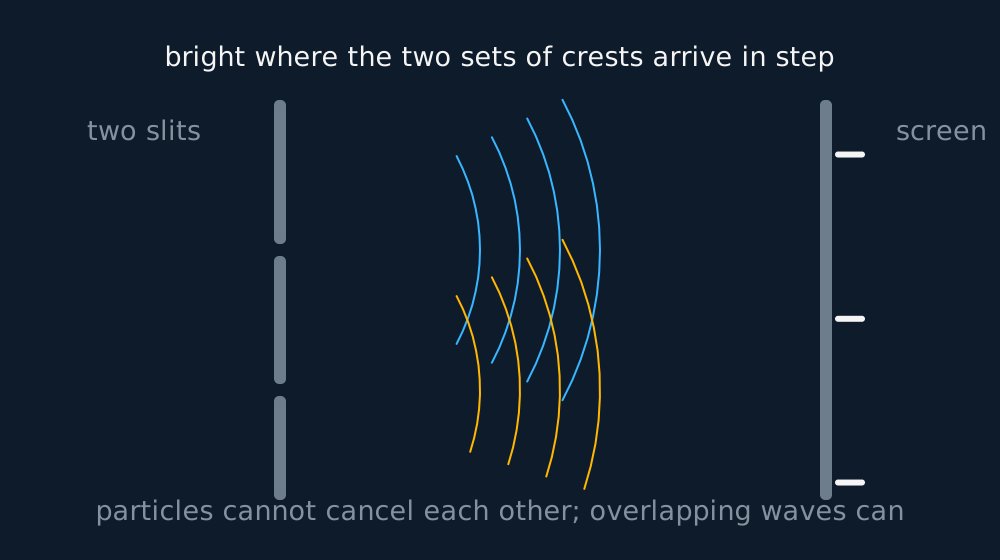
That cancellation is the fatal fact. Two streams of particles can only ever add, since more corpuscles mean more light. Only waves can arrive out of step and produce darkness from two lights. Acceptance was still slow. Newton's standing remained influential, the corpuscular school offered alternative accounts of the fringes, and the wave theory was only generally accepted as further interference and diffraction results accumulated over the following decades.
Two later results settled it. Terrestrial measurements of the speed of light showed it travelling slower in water than in air, as the wave theory required and the corpuscular theory forbade; and Maxwell calculated the speed of a wave of electric and magnetic fields from two electrical constants and obtained the speed of light, a prediction Hertz confirmed by producing such waves directly and measuring the same speed.
Maxwell's two constants has moved to the next part of this lesson.
ASSESSMENT FOCUS
- Compare the theories as a table in prose. Both explain reflection and refraction. Corpuscles need light faster in glass, waves need it slower, and that speed disagreement is the sentence most often asked for.
- Give two reasons for Newton's theory being preferred. No convincing diffraction of light had been demonstrated, its known edge effects being too weak to force a wave reading, and Newton's scientific authority was enormous.
- Young's fringes score through cancellation. Only waves can arrive out of step and produce darkness from two sources, whereas particle streams can only add.
- "Delayed acceptance" is a separate mark from the physics: cite Newton's standing and the decades of further interference work needed before the wave picture won.
CHECK YOURSELF
Explain why Young's 1801 experiment did not immediately overturn the corpuscular theory, and name the two later results that settled the wave theory's victory.
Show a hint
One reason is about people. The two results are a speed comparison and a prediction confirmed.
Show the answer
Newton's scientific authority helped the corpuscular theory retain support, and one experiment could not displace a century of consensus. Acceptance of the wave picture was delayed for decades.
Foucault's rotating-mirror measurements showed light travelling slower in water than in air, as the wave theory required and the corpuscular theory forbade.
Maxwell's c = 1/√(μ0ε0) then matched the measured speed of light, and Hertz produced electromagnetic waves directly at that same speed. Light was a wave, and an electromagnetic one.
Corpuscles need light faster in glass. Waves need it slower. The measured speed decides between them.
Young's dark fringes are two lights cancelling, which particles cannot do.
WORKBOOK
Printable practice for this topic: original exam-style questions with room to work, and a fully worked answer book. Free to use; please do not redistribute or sell.
Or read them with their mark schemes on the corpuscles, waves and Young's fringes questions page.
CHECK YOUR PROGRESS
Rate how confident you feel with each objective for this lesson. Ratings are saved in this browser, on this device, unless you sign in.
- Compare Newton's corpuscular theory with Huygens' wave theory, and say why Newton's was preferred.
- Explain the significance of Young's fringes, and why acceptance of the wave theory was delayed.
Open the full revision checklist to track your progress across the whole unit.