Physics › Waves › Interference and Young's double slit
Interference and Young's double slit
Two coherent sources reinforce where their path difference is a whole number of wavelengths and cancel where it is an extra half wavelength. Young's double slit turns that into evenly spaced fringes, and the fringe spacing gives the wavelength of the light. The sources must be coherent, or the fringes shift about and wash out.
Choose your exam board to show the notes and questions relevant to your specification. You can change this setting at any time, and content for other boards remains available.
Builds on Diffraction and the single slit.
IN THIS TOPIC
- Predict constructive or destructive interference from a path difference.
- Explain what coherence means, and why a pattern you can see needs it.
- Use , keeping straight which of the three lengths is the large one.
- Describe the white-light pattern, and give a specific laser safety precaution.
COMMON MISCONCEPTION
Shine two lights on the same spot and you simply get a brighter spot.
Ordinary lamps have no constant phase difference, so no steady fringes form; only coherent sources hold a fixed phase relationship long enough for a stable pattern.
Superposition and path difference
When two waves occupy the same place, their displacements add. Two crests arriving together make a larger crest, constructive interference; a crest arriving with a trough makes cancellation, destructive interference. Whether a given point gets reinforcement or cancellation depends on the path difference, how much further that point sits from one source than from the other.
Watch Finding the path difference, a worked question on the InkPhysics YouTube channel

Describe the drawing
Two sources pulse in step, and circular wavefronts pour out of each. Where crest meets crest the reinforcement keeps happening along the same directions, so steady amber rays emerge and hold through the churn: sinθ = nλ/d picks them out. Right: plane waves meet a gap. Much wider than the wavelength, they carry on nearly straight with a slight curl at the edges; comparable to it, they fan out as near-circular wavefronts, which is why two narrow slits behave as the two sources on the left.
A whole number of wavelengths of path difference delivers the two waves in phase. An extra half wavelength delivers them in antiphase. For the dark places to stay dark, the sources must be coherent, meaning the same frequency and a constant phase difference between them. Two separate lamps emit light in random, unrelated bursts, so their pattern reshuffles billions of times a second and the eye sees an even glow. A laser is the convenient source, its light coherent and effectively monochromatic. The older arrangement puts one lamp behind a single slit and splits that light into two.
Young's double slit
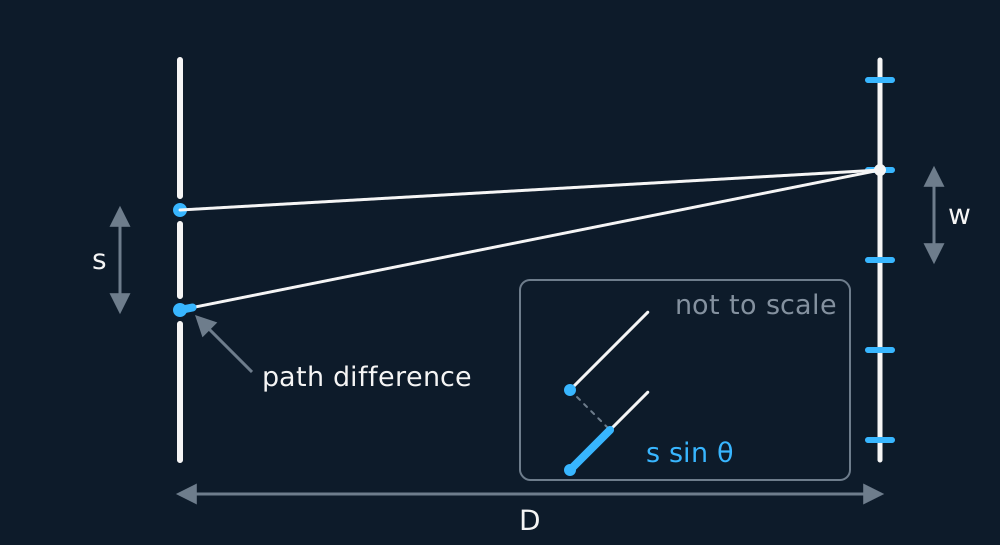
Illuminate two narrow slits, a distance s apart, with coherent light and view a screen a distance D away. Each slit diffracts, the two spreading waves overlap, and the screen shows fringes, bright wherever the path difference is and dark in between.
Describe the drawing
Two slits a distance s apart, a screen a distance D away, and rays from both slits to the first bright fringe. The extra length the lower ray travels is the path difference between the two complete routes, marked in cyan where it leaves the slit; at the true angle it is only a few pixels long, so the same construction is repeated in the panel beside it at an angle chosen to be readable, where a perpendicular dropped from one slit onto the other slit's ray cuts off exactly that extra piece, s sin theta. The fringe spacing on the screen is w.
The fringe spacing w, centre of one bright fringe to the centre of the next, comes straight from the geometry.
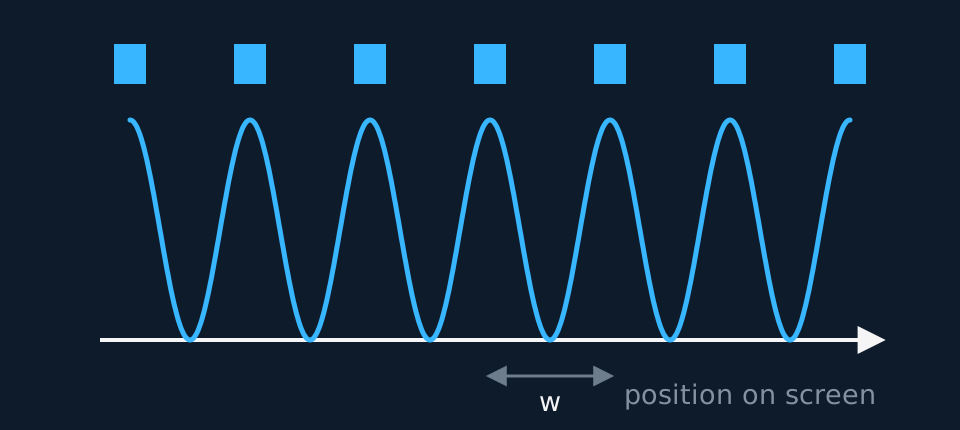
Because w is the same between every pair of neighbours, the fringes come out evenly spaced, and, in the idealised treatment, equally bright. A longer wavelength widens the spacing, and so does a more distant screen or a closer pair of slits. Visible wavelengths are a few hundred nanometres, so with slits a millimetre apart you need D of a metre or more before w is worth measuring.
WORKED EXAMPLE
A laser of wavelength 650 nm illuminates two slits 0.50 mm apart, and fringes form on a screen 3.0 m away. Find the fringe spacing.
Convert to metres first, so m and m.
= (650 × 10− 9 × 3.0) / (0.50 × 10− 3) = 3.9 × 10− 3 m. Fringes 3.9 mm apart are comfortably visible and can be measured with a millimetre rule.
GUIDED PRACTICE
Working backwards to the slits
Fringes of spacing 2.6 mm appear on a screen 2.4 m from a pair of slits lit with 520 nm light. Rearrange w = λD/s for the slit separation and find it.
Show the working
s = λD/w = (5.20 × 10−7 × 2.4)/(2.6 × 10−3) = 4.8 × 10⁻⁴ m, about half a millimetre.
Check it against the shape of the formula. A tiny λ upstairs and a small w downstairs must leave a slit separation of only a fraction of a millimetre. An answer in centimetres means a power of ten has slipped.
INDEPENDENT PRACTICE
Interference you can hear
Two loudspeakers play the same 680 Hz tone in phase; sound travels at 340 m s−1. At a listening point, the paths from the speakers differ by 0.75 m. What is heard there?
Show the working
λ = 340/680 = 0.50 m, so the path difference is 0.75/0.50 = 1.5 wavelengths.
A half-integer number of wavelengths puts the waves in antiphase, so you get destructive interference and a quiet spot.
White light, and a word on safety
Replace the laser with white light and every wavelength draws its own set of fringes with its own spacing. The central fringe, where the path difference is zero for every colour, stays white. The fringes either side are spectra, with blue on the inner edge of each, because the shorter wavelength has the smaller spacing, and red on the outer edge. A few fringes out, the overlapping colours merge and the pattern fades.
Lasers make the experiment easy and also make it the one place in the optics lab where care is compulsory. Never stare into the beam or point it at anyone, keep it away from reflective surfaces, and stand behind the laser while it is on. A school laser is a Class 2 visible one, whose safety case counts on the natural blink and aversion response limiting an accidental glance to a fraction of a second; deliberately staring into the beam or a mirror-like reflection defeats that protection, which is why the rule is absolute.
ASSESSMENT FOCUS
- Coherent means constant phase difference and the same frequency. Include the word constant: “in phase” is a stronger claim and is wrong as a definition, since coherent sources need only hold a fixed phase difference.
- Convert nm and mm to metres before anything goes into ; mixed units here move the answer by powers of ten.
- Know each symbol's place. The two small lengths are w and s, the fringe spacing and the slit separation, and D is the large one. Swapping w and s is the error to watch for, and w landing near a millimetre is the sanity check.
- Double-slit fringes are evenly spaced and equally bright. Keep that phrase clear of the single-slit pattern, whose central maximum is wider and brighter than its neighbours.
- Asked for a laser safety precaution, name a specific one: do not look along the beam, or clear reflective objects off the bench. “Be careful” names no precaution and describes no hazard.
CHECK YOURSELF
In a double-slit experiment, light of wavelength 630 nm falls on slits 0.45 mm apart, and the screen is 2.0 m away. Calculate the fringe spacing.
Show a hint
Put every length into metres before you substitute.
Show the answer
m, m, D = 2.0 m.
= (630 × 10− 9 × 2.0) / (0.45 × 10− 3) = 2.8 × 10− 3 m, so the bright fringes sit 2.8 mm apart.
Bright where the paths differ by nλ.
Dark where they differ by (n + ½)λ.
WORKBOOK
Printable practice for this topic: original exam-style questions with room to work, and a fully worked answer book. Free to use; please do not redistribute or sell.
Or read them with their mark schemes on the interference and Young's double slit questions page.
WHERE TO GO NEXT
- Required practical 2: interference: double slit and diffraction grating puts this topic in the lab, and the written papers ask about it.
- Trigonometry and resolving vectors is the maths this lesson leans on, worked through step by step.
CHECK YOUR PROGRESS
Rate how confident you feel with each objective for this lesson. Ratings are saved in this browser, on this device, unless you sign in.
- Predict constructive or destructive interference from a path difference.
- Explain what coherence means, and why a pattern you can see needs it.
- Use , keeping straight which of the three lengths is the large one.
- Describe the white-light pattern, and give a specific laser safety precaution.
Open the full revision checklist to track your progress across the whole unit.