Physics › Turning points › Quanta and the photoelectric effect
Quanta and the photoelectric effect
The ultraviolet catastrophe was the wave-theory prediction that intensity rises without limit at short wavelengths, and Planck's quanta of size hf removed it. Photoelectric emission then contradicts wave theory in three ways: a threshold frequency, no measurable delay, and a maximum kinetic energy set by frequency and not by intensity. Einstein's photons account for all three.
Choose your exam board to show the notes and questions relevant to your specification. You can change this setting at any time, and content for other boards remains available.
Quanta and wave-particle duality, part 1 of 2. Part 2 is Matter waves and electron microscopes.
Builds on The photoelectric effect and the photon and Electromagnetic waves and the speed of light.
IN THIS TOPIC
- Describe the ultraviolet catastrophe and Planck's resolution in terms of quanta.
- State the three failures of classical wave theory over photoelectricity, and why Einstein's answer mattered.
COMMON MISCONCEPTION
Waves are waves and particles are particles, and nothing is ever both.
Everything shows both behaviours: light diffracts as a wave yet exchanges energy in photons, and electrons diffract through crystals. Which behaviour appears depends on the experiment.
The ultraviolet catastrophe
The trouble began in a furnace. Classical wave theory, applied to the radiation inside a hot cavity, made a clean prediction for the black-body curve, and the prediction was absurd. Waves were free to carry any amount of energy, so ever-shorter wavelengths should carry ever more of it, and the predicted intensity climbs without limit towards the ultraviolet. A glowing coal should blast out unlimited ultraviolet and beyond. It plainly does not, and the failure earned the name ultraviolet catastrophe.
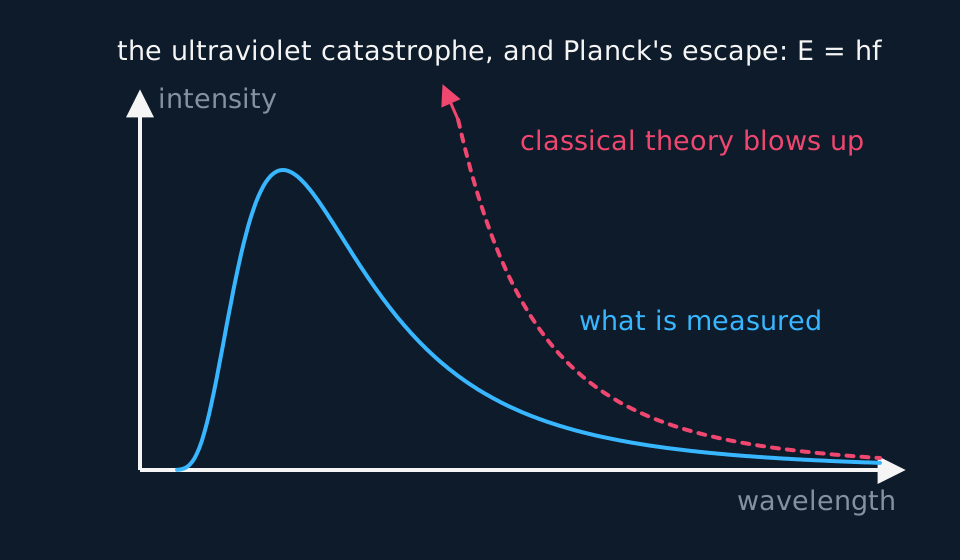
In 1900 Max Planck found the escape, and disliked it. Suppose energy is exchanged only in quanta, indivisible packets of size E = hf. At high frequencies each quantum is large, so the short-wavelength modes receive little energy and the curve turns over, exactly as measured. Planck introduced h as a mathematical device and did not claim a physical interpretation for it.
WORKED EXAMPLE
The price of a packet
Calculate the energy of one quantum of red light, frequency 4.5 × 10¹⁴ Hz, and of one quantum of ultraviolet at 1.5 × 10¹⁵ Hz (h = 6.63 × 10⁻³⁴ J s).
Red: E = hf = 6.63 × 10−34 × 4.5 × 1014 = 3.0 × 10⁻¹⁹ J.
Ultraviolet: E = 6.63 × 10−34 × 1.5 × 1015 = 9.9 × 10⁻¹⁹ J, more than three times the energy per quantum.
That difference is Planck's argument. The higher the frequency, the larger the energy of a single quantum, so the far ultraviolet modes of a warm cavity are rarely excited at all and the predicted catastrophe does not occur.
Einstein and the photoelectric verdict
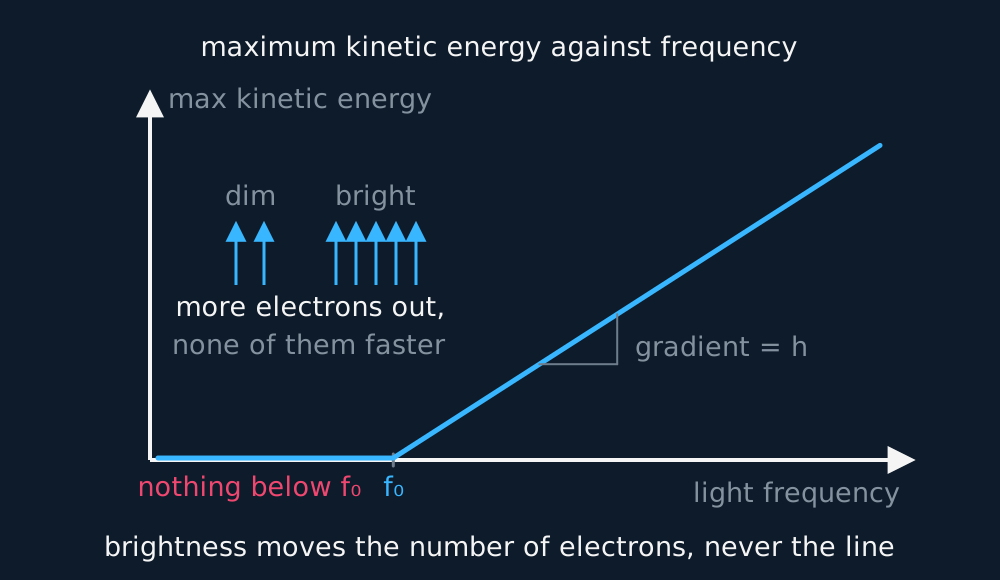
The meaning arrived in 1905, through the photoelectric effect met in the core course. Classical wave theory fails three ways there, and an exam answer is expected to list all three. It cannot explain the threshold frequency: a dim source above the material's threshold frequency ejects electrons, while a source below it ejects none, however intense. It cannot explain why emission is instant, with no time needed to soak up wave energy. And it cannot explain why brighter light changes the number of electrons while leaving their maximum kinetic energy untouched.
Einstein's resolution took Planck's quanta literally. Light itself travels as photons of energy hf, and one photon transfers its energy to one electron, all or nothing. Every photoelectric observation follows from that. The significance the specification names is that electromagnetic radiation, established as a wave, also behaves as particles.
Describe the drawing
Maximum kinetic energy of the emitted electrons against light frequency: the graph runs flat along zero up to the threshold frequency, then climbs as a straight line whose gradient is Planck's constant. Above the axis, two arrows stand for the electrons a dim source ejects each second and five for a bright one: intensity multiplies the number of electrons while the line, and so the maximum kinetic energy, stays exactly where it was, which is Einstein's photon argument in one picture.
GUIDED PRACTICE
One packet, one electron
An ultraviolet lamp emits radiation of frequency 2.0 × 10¹⁵ Hz. Calculate the energy of one photon, and explain in the photon model why doubling the lamp's intensity doubles the number of electrons a photoemissive surface releases each second without changing their maximum kinetic energy.
Show the working
E = hf = 6.63 × 10−34 × 2.0 × 1015 = 1.3 × 10⁻¹⁸ J.
Doubling the intensity doubles the number of photons arriving per second, so twice as many electrons receive a photon. Each photon still transfers the same energy hf, so the maximum kinetic energy of the emitted electrons is unchanged.
The ultraviolet catastrophe and the photoelectric failures have the same cause. In each, the wave theory allows energy to be exchanged in any amount, whereas the measurements require it to be exchanged in quanta of hf. Electromagnetic radiation therefore has particle as well as wave behaviour, and the question of whether matter has wave behaviour is taken up next.
Matter waves has moved to the next part of this lesson.
Microscopes from matter waves has moved to the next part of this lesson.
ASSESSMENT FOCUS
- The ultraviolet catastrophe fits in one sentence. Classical wave theory lets every wavelength carry any energy, so it predicts intensity rising without limit at short wavelengths, contrary to the measured curve.
- Planck's proposal is about exchange. Energy is emitted and absorbed in quanta of E = hf, which limits the energy in the high-frequency modes. Use the word "quanta", and say what h sets the size of.
- There are three photoelectric failures. Threshold frequency, instant emission, and intensity affecting the number of electrons but not their maximum kinetic energy. Einstein's photon answers each one, and the significance is light's particle nature.
CHECK YOURSELF
State what the ultraviolet catastrophe was and how Planck's quanta remove it. Then calculate the energy of one quantum of frequency 6.0 × 10¹⁴ Hz, and explain in the photon model why light below the threshold frequency ejects no electrons however intense it is.
Show a hint
Catastrophe, cure, calculation, then remember each electron deals with exactly one photon.
Show the answer
Classical theory let every wavelength carry any energy, predicting intensity climbing without limit into the ultraviolet. If energy is exchanged only in quanta of hf, the high-frequency quanta are too large to be commonly excited, and the curve turns over as measured.
E = hf = 6.63 × 10−34 × 6.0 × 1014 = 4.0 × 10⁻¹⁹ J.
One photon deals with one electron. Below the material's threshold frequency each photon carries less than the energy needed to free an electron, and brighter light delivers more photons of that same energy rather than more energetic ones, so no electron is emitted.
Planck quantised energy at E = hf, and Einstein made the packets real as photons.
Photoelectricity fails wave theory three ways: the threshold, the instant emission, and intensity moving the number of electrons, never their maximum kinetic energy.
WORKBOOK
Printable practice for this topic: original exam-style questions with room to work, and a fully worked answer book. Free to use; please do not redistribute or sell.
Or read them with their mark schemes on the quanta and the photoelectric effect questions page.
CHECK YOUR PROGRESS
Rate how confident you feel with each objective for this lesson. Ratings are saved in this browser, on this device, unless you sign in.
- Describe the ultraviolet catastrophe and Planck's resolution in terms of quanta.
- State the three failures of classical wave theory over photoelectricity, and why Einstein's answer mattered.
Open the full revision checklist to track your progress across the whole unit.