Physics › Turning points › Millikan's oil drop experiment
Millikan's oil drop experiment
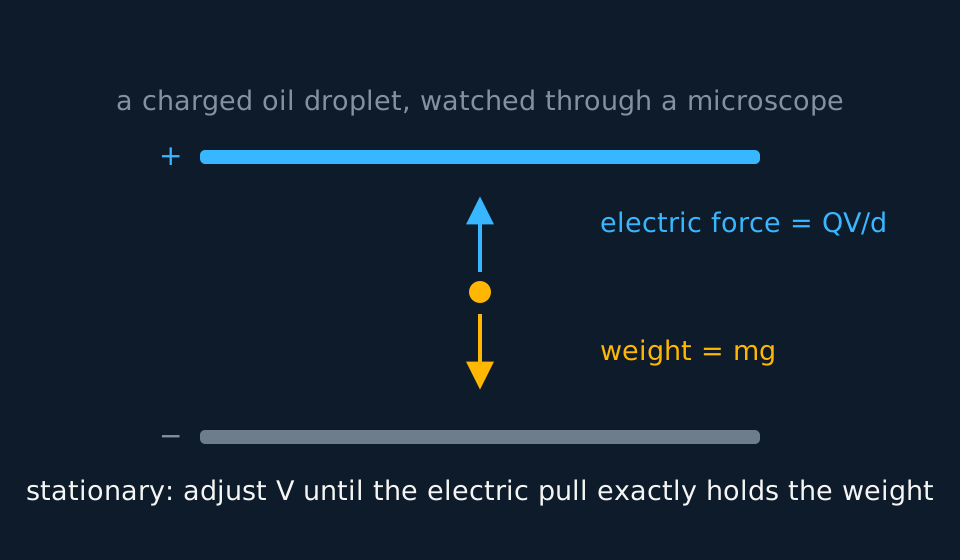
Millikan's oil drop experiment found that every droplet's charge was a whole-number multiple of e = 1.6 × 10⁻¹⁹ C, the charge on the electron. A droplet held stationary between parallel plates gives QV/d = mg. Switching the field off and timing the terminal fall gives the radius through Stokes' law F = 6πηrv, and from it the mass.
Choose your exam board to show the notes and questions relevant to your specification. You can change this setting at any time, and content for other boards remains available.
Builds on The specific charge of the electron and Coulomb's law and electric field strength.
IN THIS TOPIC
- Use the balance condition QV/d = mg for a stationary charged droplet.
- Use Stokes' law and terminal speed to find a droplet's radius and mass.
- Explain what Millikan's results showed, namely that charge is quantised in units of e.
COMMON MISCONCEPTION
Electric charge comes in any amount you like, like water from a tap.
Charge is quantised: Millikan's droplets only ever carried whole-number multiples of 1.6 × 10⁻¹⁹ C, so charge comes in units of the electron charge, never in arbitrary amounts.
Holding a droplet still
Thomson's ratio left a gap, because e and m were only ever known combined. Robert Millikan's idea, perfected around 1913, was to measure the charge alone, one droplet at a time. An atomiser sprays a mist of oil above a pair of horizontal plates. Friction in the spray leaves some droplets charged, a few drift through a small hole, and a microscope watches them in the illuminated space between the plates.
With a pd V across plates a distance d apart, the uniform field E = V/d exerts a force QE on a droplet of charge Q. Adjust V until one droplet hangs perfectly still, and the electric force exactly supports the weight:
WORKED EXAMPLE
Reading a droplet's charge
A droplet of mass 3.69 × 10⁻¹⁵ kg hangs stationary between plates 5.0 mm apart when the pd is 565 V. Find its charge.
Q = mgd/V = (3.69 × 10−15 × 9.81 × 5.0 × 10−3) / 565.
Q = 3.2 × 10⁻¹⁹ C, which is exactly twice 1.6 × 10⁻¹⁹ C. This droplet carries two electrons' worth of charge.
Heavier droplets or wider plate separations need a larger pd, and the masses here are a few picograms, so a few hundred volts is enough to hold a droplet still.
Weighing the invisible
One term in the balance equation has no obvious source, the droplet's mass, far too small for any scale. Millikan's solution is the part examined most often. Switch the field off and watch the droplet fall. Within milliseconds it reaches terminal speed, where the viscous drag of the air balances its weight, and for a small sphere that drag is given by Stokes' law:
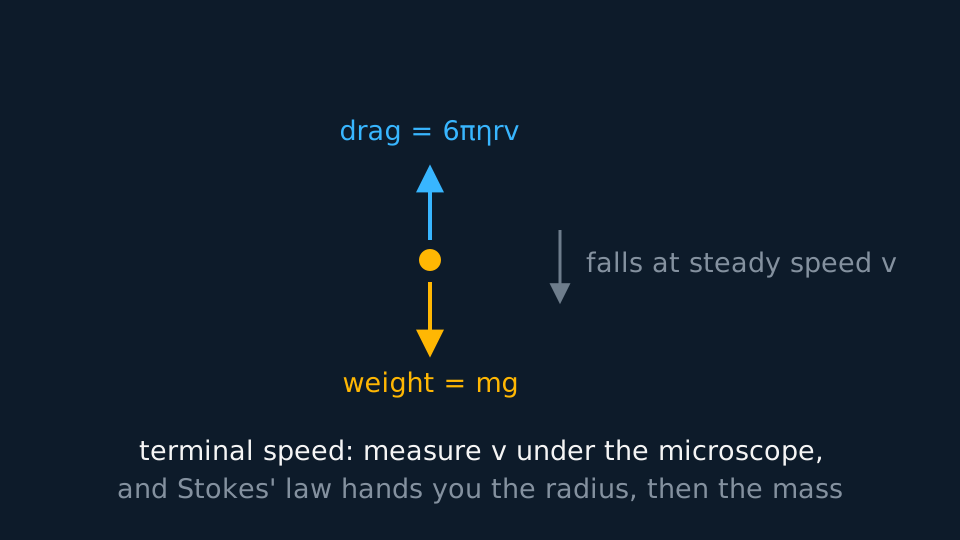
with η the viscosity of air and r the droplet's radius. At terminal speed, 6πηrv equals the weight, and the weight itself is (4/3)πr3ρg with ρ the oil's density. One measured speed therefore pins down r, and from r the mass. Timing a speck across the microscope's graduations weighs it.
GUIDED PRACTICE
From a stopwatch to a mass
A droplet falls at a steady 2.4 × 10⁻⁴ m s−1 with the field off. Using η = 1.8 × 10⁻⁵ Pa s and oil density 880 kg m−3, find its radius and mass.
Show the working
Setting 6πηrv = (4/3)πr3ρg and cancelling gives r = = √(9 × 1.8 × 10−5 × 2.4 × 10−4 / (2 × 880 × 9.81)) = 1.5 × 10⁻⁶ m.
m = (4/3)πr3ρ = 1.2 × 10⁻¹⁴ kg: a droplet three micrometres across, weighed from a timed terminal speed and a viscosity value.
Charge is quantised
Millikan ran the measurement on droplet after droplet, hundreds of them, charged by chance in the spray. The charges that came out were not spread smoothly. Every single droplet carried a whole-number multiple of one value, 1.6 × 10⁻¹⁹ C. Nothing ever landed in between.
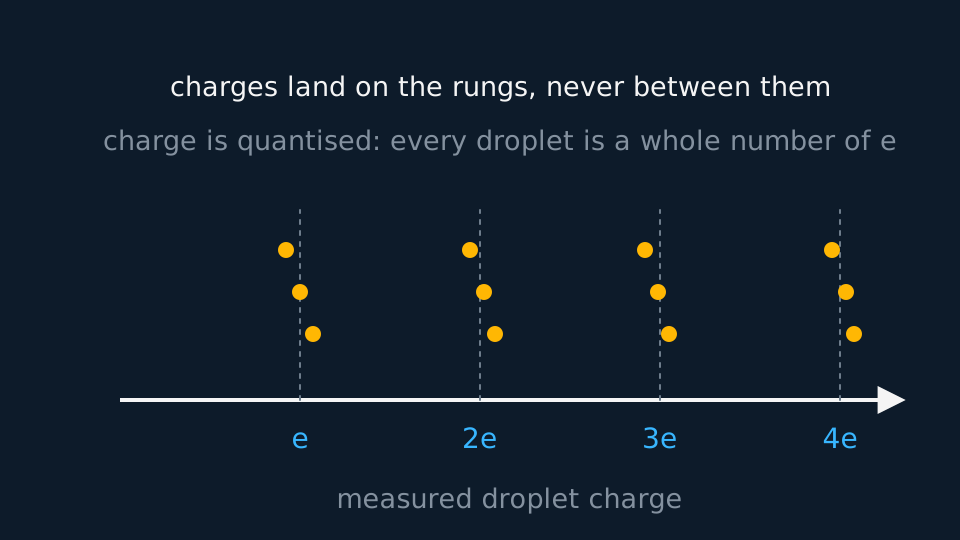
Millikan found that measured droplet charges were integer multiples of a smallest value, e. This provided evidence that free charge is quantised: any measured charge is a whole number of electronic charges added or missing. Combined with Thomson's ratio, that completed the electron. The charge was now measured directly, and the mass followed at once from e divided by e/m.
Be careful what the experiment proves. Millikan measured e and showed that droplet charges come in whole multiples of it. He did not, and could not, show that no smaller charge exists anywhere. Physics later found quarks, carrying ±⅓ e and ±⅔ e, though they stay confined inside hadrons and no free quark has ever been caught. Every free particle anyone has measured still carries a whole number of e, so Millikan's finding holds for all free charge.
INDEPENDENT PRACTICE
Completing the electron
Using Millikan's e = 1.60 × 10⁻¹⁹ C and Thomson's e/m = 1.76 × 10¹¹ C kg−1, find the mass of the electron.
Show the working
m = e ÷ (e/m) = 1.60 × 10⁻¹⁹ / (1.76 × 10¹¹) = 9.1 × 10⁻³¹ kg.
Two experiments, sixteen years apart, and one division between them. This was the first measured mass of a fundamental particle, about one two-thousandth of a hydrogen atom, exactly as Thomson's comparison predicted.
ASSESSMENT FOCUS
- QV/d = mg anchors the whole topic, so name every symbol as you write it, and remember V/d is the field strength between parallel plates, imported from the electric fields unit. The booklet prints it in the Turning points section, so it is supplied rather than recalled.
- The field-off measurement exists to find m, and it scores as a chain. Terminal speed, Stokes' drag 6πηrv set equal to the weight, radius from the speed, mass from the radius. Stokes' law itself carries conditions, a small sphere moving slowly through a fluid, and a droplet satisfies both.
- "Explain the significance of Millikan's results" wants quantisation in full. Every measured charge is a whole-number multiple of 1.6 × 10⁻¹⁹ C, so charge comes only in units of e.
- The classic follow-up pairs the two experiments. Millikan's e divided by Thomson's e/m gives the electron's mass, and that one-line division is worth practising until it is automatic.
CHECK YOURSELF
A droplet weighing 3.84 × 10⁻¹⁴ N hangs stationary between plates 6.0 mm apart with 480 V across them. Find the droplet's charge, and state how many electrons' worth it carries.
Show a hint
Rearrange QV/d = mg for Q. The weight mg is given whole.
Show the answer
Q = (weight × d)/V = (3.84 × 10−14 × 6.0 × 10−3) / 480 = 4.8 × 10⁻¹⁹ C.
4.8 × 10⁻¹⁹ / (1.6 × 10⁻¹⁹) = 3, so the droplet carries three electrons' worth of charge.
A non-integer answer here means an arithmetic slip.
Hold the droplet still and QV/d = mg gives its charge. Let it fall and Stokes' law weighs it.
Every droplet carried a whole multiple of e, so free charge is quantised in units of the electronic charge.
WORKBOOK
Printable practice for this topic: original exam-style questions with room to work, and a fully worked answer book. Free to use; please do not redistribute or sell.
Or read them with their mark schemes on the Millikan's oil drop experiment questions page.
CHECK YOUR PROGRESS
Rate how confident you feel with each objective for this lesson. Ratings are saved in this browser, on this device, unless you sign in.
- Use the balance condition QV/d = mg for a stationary charged droplet.
- Use Stokes' law and terminal speed to find a droplet's radius and mass.
- Explain what Millikan's results showed, namely that charge is quantised in units of e.
Open the full revision checklist to track your progress across the whole unit.