Biology › Cells, microscopy and biological organisation › Prokaryotic cells and viruses
Prokaryotic cells and viruses
A bacterium is a living cell with no nucleus and no membrane-bound organelles. A virus is acellular and replicates only inside a host cell, which is why it is not classed as living.
Before this Cell ultrastructure and the organelles · Sizes and the resolving limits of microscopes
COMMON MISCONCEPTION
Bacteria are simple cells and viruses are just very small bacteria.
A virus is acellular. It has no cytoplasm or ribosomes and cannot carry out independent metabolism or protein synthesis. It replicates only within a host cell. Antibiotics target bacterial structures or processes and therefore do not treat viral infections.
What you should be able to do
- Describe the structure of a prokaryotic cell and give a function for each part.
- Compare prokaryotic and eukaryotic cells, including DNA, ribosomes and cell wall.
- Explain what a plasmid is and why it is not part of the main chromosome.
- Describe binary fission and calculate numbers of bacteria after a given time.
- Describe the structure of a virus, using HIV, and justify the claim that viruses are not living.
- Describe the lytic cycle and latency, using lambda phage, and explain why antiviral drugs must act on a stage of virus replication.
Prokaryotic cell structure
Prokaryotic cells are the bacteria and the archaea, and they are small, typically 0.5 to 5 µm across, against 10 to 100 µm for a eukaryotic cell. A whole bacterium is about the size of a mitochondrion, a similarity the endosymbiotic theory accounts for.
Describe the drawing
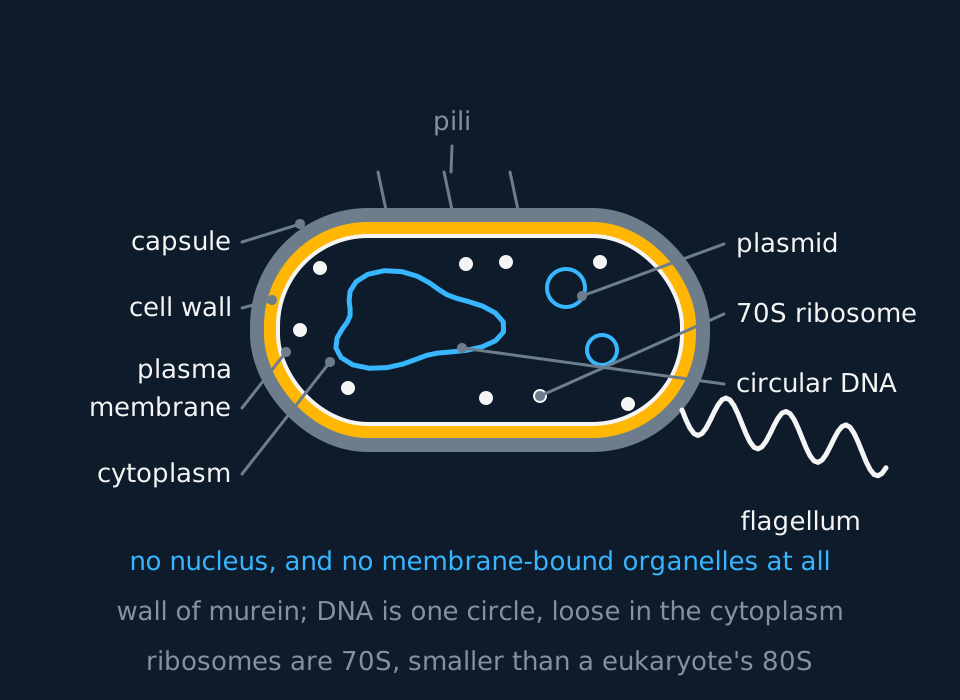
A prokaryotic cell drawn as a rod with rounded ends. From the outside in there is a slime capsule, a murein cell wall drawn as a thick band, and the plasma membrane. Inside the cytoplasm lie a single circular chromosome drawn as a closed loop with no envelope round it, two smaller circles of plasmid DNA, and scattered ribosomes. Short pili project from the top surface and a long flagellum trails from one end. Nothing inside the cell is wrapped in its own membrane.
Start at the outside. The cell wall is made of murein, also called peptidoglycan, a mesh of polysaccharide chains cross-linked by short peptides. It is not cellulose and it is not chitin, and the difference is exactly what penicillin exploits: the drug blocks the cross-linking, so a growing bacterium builds a wall too weak to resist osmotic entry of water and bursts. Human cells have no cell wall, so the drug has no equivalent target in them.
Bacteria fall into two groups by the structure of that wall, and the Gram stain tells them apart. A Gram-positive wall is a thick layer of murein, which holds the purple crystal violet stain. A Gram-negative wall has only a thin layer of murein, covered by an outer membrane containing lipopolysaccharide; the purple washes out, and the cells take up the red counterstain instead. The outer membrane also keeps many antibiotics away from the murein, so penicillin, and the enzyme lysozyme, act far more strongly on Gram-positive bacteria than on Gram-negative ones.
Outside the wall, many species secrete a capsule of slime. It holds water, helps the cell stick to surfaces and to other bacteria, and makes phagocytosis harder for a white blood cell. The capsule is one reason some strains are dangerous and closely related ones are not.
Inside the wall is the plasma membrane, and inside that the cytoplasm, where the main differences from a eukaryotic cell lie. There is no nucleus. In the bacteria this course describes, the DNA is a single circular molecule, lying free in the cytoplasm in a region called the nucleoid, with no envelope and no histone proteins wound into it (the other prokaryote domain, the archaea, breaks that tidy rule: many species carry histone proteins, and chromosome arrangements vary). There is no endoplasmic reticulum, no Golgi apparatus, no mitochondrion and no lysosome. The electron transport chain and ATP synthase sit in the plasma membrane itself, so the one membrane holding the cell together is also the membrane it respires on. Older textbooks drew the chain on infoldings called mesosomes; the infoldings were made by the fixing chemicals and are not there in a living bacterium. The only structure in there that a eukaryotic cell also has is the ribosome, and even that is smaller, at 70S against the eukaryote's 80S.
Three extras appear in many species. Pili are short protein projections that attach the cell to surfaces or, as a sex pilus, to another bacterium so that a plasmid can pass across. Plasmids are small circles of DNA, separate from the main chromosome, carrying a handful of genes that are useful rather than essential, such as resistance to an antibiotic. They replicate independently and can be passed from one bacterium to another, which is how resistance spreads through a population far faster than mutation alone could manage. A flagellum is a long protein filament, anchored in the membrane and rotated by a molecular motor, which drives the cell forward. It is not the same structure as a eukaryotic flagellum and does not move the same way: this one spins, like a propeller.
- Prokaryotic cell
- A cell with no nucleus and no membrane-bound organelles, whose DNA is a single circular molecule free in the cytoplasm.
- Plasmid
- A small circular molecule of DNA, separate from the main chromosome, which replicates independently and often carries genes such as antibiotic resistance.
- Capsule
- A layer of slime outside the cell wall which retains water, aids attachment and gives some protection from phagocytosis.
- Nucleoid
- The region of a prokaryotic cell occupied by its circular DNA, with no surrounding membrane.
Comparing prokaryotic and eukaryotic cells
Answer a comparison in matched pairs: a statement about the prokaryote beside the corresponding statement about the eukaryote. "Prokaryotes have no nucleus" states only one side of the comparison.
| Feature | Prokaryotic (bacterium) | Eukaryotic |
|---|---|---|
| Size | 0.5–5 µm | 10–100 µm |
| Nucleus | Absent | Present, with a double envelope |
| DNA | One main circular DNA molecule, not associated with histone proteins in the standard A-level bacterial model | Several linear molecules wound round histones |
| Plasmids | Often present | Absent from the cytoplasm |
| Membrane-bound organelles | None | Mitochondria, ER, Golgi, lysosomes and more |
| Ribosomes | 70S, smaller | 80S in the cytoplasm |
| Cell wall | Murein (peptidoglycan) | Cellulose in plants, chitin in fungi, none in animals |
| Division | Binary fission | Mitosis or meiosis |
Two rows need care. The DNA row is not simply 'circular against linear'. The absence of histone association is a separate point, as is the presence of one main chromosome rather than several.
The organelle row does not mean a bacterium has nothing inside it: it has ribosomes, enzymes, food stores and often internal membranes. What it lacks is any compartment sealed off by its own membrane.
One overlap is worth stating. Mitochondria and chloroplasts contain circular DNA not associated with histones, and 70S ribosomes: prokaryotic features within a eukaryotic cell. A complete answer to where 70S ribosomes occur in a leaf therefore includes the chloroplasts and mitochondria as well as any bacteria on the surface.
Binary fission and population growth
A prokaryote does not use mitosis. It has no nucleus to break down, no spindle and no set of chromosomes to line up. Instead it divides by binary fission, and the sequence is short: the circular DNA replicates, any plasmids replicate separately and in variable numbers, the cell grows and the two DNA circles move apart, then the cytoplasm divides and new wall material is laid down between the daughter cells.
Each daughter cell receives one copy of the chromosome. Plasmids are not distributed equally, so two daughters of the same cell can differ in the number of plasmid copies, and therefore in the number of resistance genes they carry.
Fission is rapid. Escherichia coli in warm conditions with ample nutrients divides about every 20 minutes, so the population doubles three times an hour.
Doubling every twenty minutes
A single bacterium is placed in nutrient broth at 37 °C, where it divides every 20 minutes. Calculate how many bacteria are present after 4 hours, assuming none die.
Show the working
First count the divisions. Four hours is 240 minutes, and 240 ÷ 20 = 12 divisions.
Each division doubles the population, so the number is 2 raised to the number of divisions: 2¹² = 4096.
The general form is N = N₀ × 2ⁿ, where N₀ is the number you started with and n the number of divisions. Starting with 50 cells instead of one would give 50 × 4096 = 204 800.
Raise 2 to the power of the number of divisions; do not multiply by it. Real cultures depart from this pattern once nutrients run low and waste accumulates, so unlimited exponential growth models only the early growth phase.
Virus structure
A virus particle is between about 20 and 300 nm across, mostly smaller than the resolving limit of a light microscope, so viruses were not observed until the electron microscope was developed. Size is not the reason a virus is excluded from the definition of living; its structure is.
A virus consists of genetic material, either DNA or RNA, enclosed in a protein coat called a capsid, with attachment proteins on the outside. Some viruses also have a lipid envelope, derived from the membrane of the host cell the particle left. There is no cytoplasm, no ribosome, no mitochondrion and no enzyme system for respiration. A virus cannot make a protein, cannot release energy from food and cannot reproduce by itself. It is acellular, meaning not made of cells, and it is an obligate intracellular parasite, meaning it can only be copied by hijacking a host cell's ribosomes and enzymes.
The attachment proteins determine host specificity. Each type binds to a particular receptor molecule on a particular host cell, by the same complementary-shape interaction as a substrate binding an enzyme. Influenza therefore infects airway epithelium rather than liver tissue, and a virus of tobacco plants cannot attach to human cells.
Describe the drawing
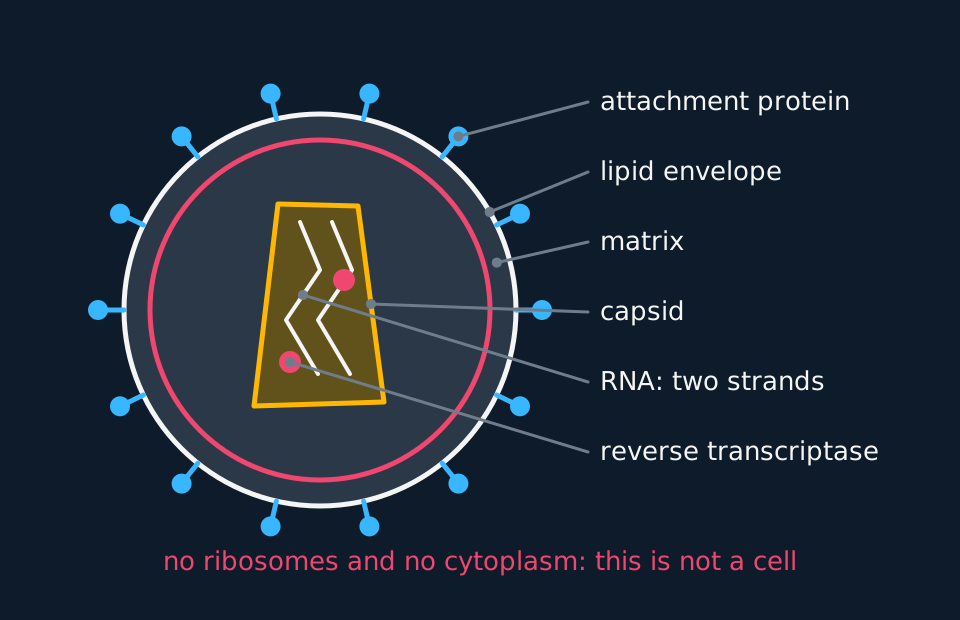
A human immunodeficiency virus particle drawn in section as a sphere. Glycoprotein attachment spikes stand out all round the outside. Below them is the lipid envelope taken from a host cell membrane, and inside that a matrix layer. A cone-shaped protein capsid sits in the centre holding two single strands of RNA and two molecules of reverse transcriptase. There is no cytoplasm, no ribosome and no membrane-bound organelle anywhere in the particle.
HIV is built in layers. On the outside are glycoprotein attachment proteins, which bind to the CD4 receptor found on helper T cells. Beneath them is the lipid envelope taken from the host membrane, and inside that a layer of matrix protein. At the centre a cone-shaped capsid holds two single strands of RNA and several molecules of the enzyme reverse transcriptase. That enzyme catalyses the synthesis of DNA from the viral RNA template, the reverse of the usual direction of information flow, and the DNA copy is then inserted into the host chromosome. A virus that replicates in this way is a retrovirus.
- Virus
- An acellular infectious particle consisting of nucleic acid within a protein capsid, sometimes with a lipid envelope, which can only replicate inside a host cell.
- Capsid
- The protein coat surrounding a virus's genetic material.
- Attachment protein
- A protein on a virus's surface with a shape complementary to a receptor on its host cell, which determines which cells it can infect.
- Reverse transcriptase
- An enzyme carried by retroviruses such as HIV which catalyses the synthesis of DNA from an RNA template.
TRY IT: Arguing that something is not alive
A student writes that viruses are living because they reproduce and they evolve. Evaluate that claim.
Check your answer
Both observations are correct and the conclusion still does not follow, because of the way replication occurs.
Viruses replicate only inside host cells because they lack ribosomes and independent metabolism. A virus cannot synthesise its own capsid proteins and cannot release energy from respiration; both are carried out by host-cell machinery using the viral nucleic acid as the template. Outside a host cell a virus particle is metabolically inactive and can be crystallised.
Evolution is a weaker argument still. Viral genomes mutate and are selected, which is why influenza vaccines are reformulated every year, but selection acts on any replicating information and does not require the replicator to be alive.
Viruses are classed as non-living, which AQA's specification states outright, though some biologists place them at the boundary, showing some characteristics of life only while inside a cell. In an answer, state that a virus is acellular and name the missing structures: no cytoplasm, no ribosomes, no metabolism.
The lytic cycle and latency
Pearson Edexcel Biology B asks for the lytic cycle of a virus and for latency. The standard example is lambda (λ) phage, a double-stranded DNA virus whose host is the bacterium Escherichia coli. A phage, short for bacteriophage, is any virus that infects bacteria.
In the lytic cycle the virus replicates at once and the host cell is destroyed at the end of it. It runs in five stages.
| Stage | What happens |
|---|---|
| 1 Attachment | Attachment proteins on the tip of the phage tail bind to specific receptor molecules on the surface of the bacterium |
| 2 Injection | The phage DNA is injected through the wall and membrane; the empty capsid stays outside |
| 3 Replication | Viral genes are transcribed and translated on the host's ribosomes, using the host's ATP, amino acids and nucleotides; the viral DNA is copied many times and capsid proteins are made |
| 4 Assembly | New capsids form and each is packed with a copy of the viral DNA |
| 5 Lysis | A viral enzyme breaks down the cell wall from inside, the cell bursts, and the new phages are released to infect neighbouring cells |
Describe the drawing
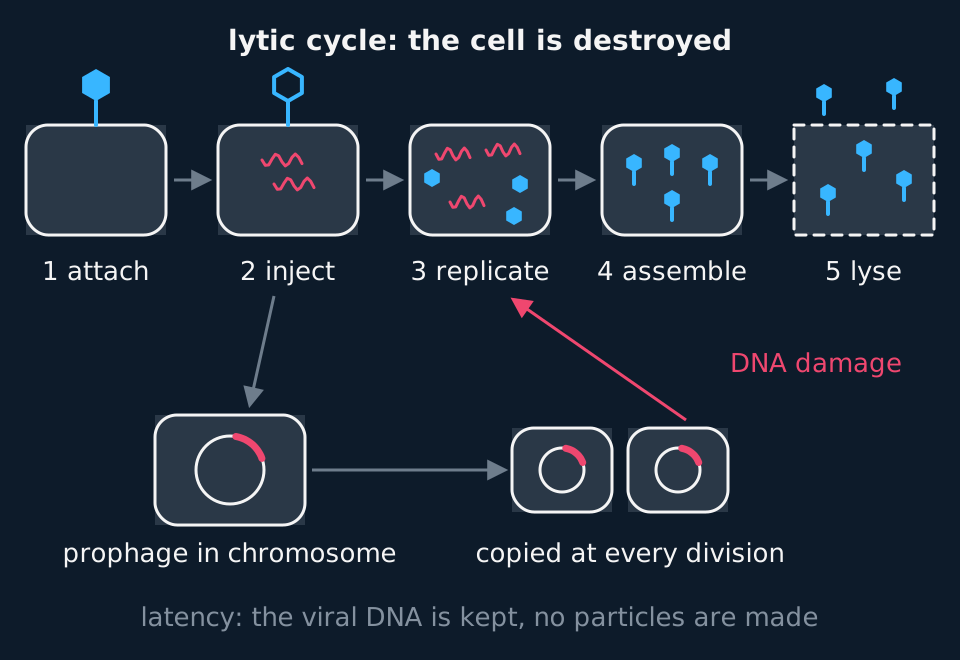
Five panels across the top show the lytic cycle of lambda phage in a bacterium. In the first a phage, an angular head on a tail, attaches to the cell surface. In the second it has injected its DNA, drawn as wavy lines inside the cell, while the empty head stays outside. In the third the viral DNA has been copied several times and separate capsid heads have been made. In the fourth complete phages are assembled inside the cell, and in the fifth the cell wall, drawn dashed, has broken open and new phages are escaping. Below, an arrow from the injection stage leads to the latent route: a cell whose circular chromosome carries the phage DNA as a prophage, then two daughter cells each inheriting it after division. A coloured arrow labelled DNA damage, such as ultraviolet light, leads from the latent cells back up to the replication stage of the lytic cycle.
Viruses of animals follow the same sequence with two differences. The whole particle usually enters the cell, by endocytosis or by its envelope fusing with the cell-surface membrane, and the capsid is then removed to free the nucleic acid. And an enveloped virus often leaves by budding, wrapping itself in a piece of host membrane as it goes, so the cell may survive for a time while it releases virus.
In latency the viral genome stays in the host cell without new particles being made, and the cell lives on. Lambda can take this route instead. After injection its DNA can be inserted into the E. coli chromosome at a particular site, where it is called a prophage. A repressor protein, coded for by one of the phage's own genes, keeps the genes needed for the lytic cycle switched off. Every time the bacterium divides by binary fission the prophage is replicated with the chromosome, so every daughter cell inherits it. This latent route in a phage is called the lysogenic cycle.
Latency ends when the repressor is lost. Damage to the bacterium's DNA, for example by ultraviolet light, leads to the repressor being destroyed. The prophage is then cut out of the chromosome and enters the lytic cycle, and the cell bursts.
Latency is common in viruses of humans. Herpes simplex virus stays latent in the nuclei of sensory neurones, as a separate circle of DNA rather than inserted into a chromosome, and stress, fever or strong sunlight can reactivate it, so a cold sore returns in the same place. The chickenpox virus can reactivate decades after the original infection as shingles. HIV inserts a DNA copy of its genome into the chromosome of a helper T cell, and in some cells that copy stays silent for years.
- Lytic cycle
- Viral replication in which the virus attaches, injects or releases its nucleic acid, replicates it, assembles new particles and then bursts the host cell to release them.
- Latency
- A state in which a viral genome remains in a host cell without new virus particles being made, until a trigger reactivates it.
- Prophage
- The DNA of a phage such as lambda inserted into the chromosome of its host bacterium and copied with it at each division.
- Bacteriophage
- A virus that infects bacteria, often called a phage.
Why antivirals target replication
A virus is not a living cell, so it has no metabolism of its own to block. An antibiotic works by stopping something a bacterium does for itself: building a murein wall, translating on its 70S ribosomes, running its own enzymes. A virus does none of these. It follows that an antiviral drug must work by inhibiting virus replication, which means blocking one of the stages of the cycle above.
Selectivity is the difficulty. A virus replicates with the host cell's own ribosomes and enzymes, and a drug that stopped those would harm the patient as much as the virus. The useful targets are therefore the molecules a virus codes for itself, which differ from anything the host cell needs to stay alive.
| Stage blocked | How the drug works | Example |
|---|---|---|
| Entry | Prevents the HIV envelope fusing with the membrane of a helper T cell | Enfuvirtide |
| Copying the genome | A nucleotide analogue stops the viral DNA polymerase or reverse transcriptase | Aciclovir (herpes), zidovudine (HIV) |
| Integration | Inhibits integrase, the enzyme that inserts HIV DNA into the host chromosome | Raltegravir |
| Assembly | Inhibits the viral protease that cuts long HIV polypeptides into working proteins, including those of the capsid, so new particles cannot mature | HIV protease inhibitors |
| Release | Inhibits neuraminidase, which frees new influenza particles from the cell surface | Oseltamivir |
Aciclovir shows how selective a drug can be. It is inactive until an enzyme coded by the herpes virus adds a phosphate group to it, so it is switched on almost only in infected cells.
Two limits follow from the same reasoning. A drug that blocks replication cannot touch a latent virus, because nothing is being replicated, so aciclovir shortens an outbreak of cold sores without removing the virus, and treatment for HIV is taken for life. And because many viral genomes mutate quickly, a single drug selects for resistant variants. HIV is treated with a combination of drugs acting at different stages, so that a variant would need several mutations at once to escape all of them.
- Antiviral
- A drug that inhibits a stage of virus replication, such as entry, copying of the genome, assembly or release, ideally by targeting a molecule coded for by the virus.
In the exam
- Answer comparison questions in pairs. 'A bacterium's DNA is circular and not associated with histones, whereas a eukaryote's is linear and wound round histones' is one complete point; name both sides.
- 70S is the prokaryotic ribosome and 80S the eukaryotic cytoplasmic one. The smaller cell carries the smaller number.
- Name murein for the bacterial wall. Cellulose is the plant wall material and chitin the fungal one.
- 'Viruses are very small' does not explain why they are not living. State the acellular structure: no cytoplasm, no ribosomes, no organelles, no metabolism of their own.
- For HIV, learn all five parts, which are attachment proteins, lipid envelope, matrix, capsid, and RNA with reverse transcriptase, and give a function for each.
- Binary fission questions are usually 2ⁿ calculations. Work out the number of divisions first, then use it as the power.
- Name the lytic stages in order: attachment, injection, replication, assembly, lysis. For latency, say the viral genome is kept in the cell and no new particles are made, and name what ends it.
- For antivirals, link the two facts: no metabolism of its own, so the drug must block a stage of replication. Name the stage.
Check yourself
A patient is treated with an antibiotic for a bacterial chest infection and recovers. Two months later she has influenza, and asks for the same antibiotic. Explain, in terms of cell structure, why it will not help her, and why some bacterial infections no longer respond to it either.
Answer
An antibiotic works by attacking a structure or process that bacteria have and human cells do not. Many, penicillin among them, prevent the cross-linking of murein in the bacterial cell wall, so a dividing cell builds a wall too weak to resist the water entering by osmosis and bursts. Others bind to the 70S ribosome and block translation, leaving the 80S ribosomes in her cytoplasm alone. That second selectivity is real but not perfect, because her mitochondria carry ribosomes of prokaryotic ancestry, remodelled but still similar enough for some of these drugs to affect, which is one reason drugs of this class can have side effects the drugs that block wall-building do not.
Influenza is a virus. It has no cell wall to weaken, no ribosomes to block and no metabolism to interfere with. It is acellular, and its proteins are made on the ribosomes of her own infected cells. There is nothing there for the drug to act on, so it can do nothing but disturb the useful bacteria she already has.
Resistance in bacteria is a separate matter and comes largely from plasmids. A mutation producing an enzyme that breaks the antibiotic down gives its carrier a selective advantage whenever the drug is present, and because such genes often sit on plasmids they can be passed directly between bacteria rather than only to daughter cells.
That is why a resistant strain can appear in a population within months, and why prescribing an antibiotic for a viral infection makes the problem worse without treating anything.
Questions
Question 15 marks
Describe the lytic cycle of lambda (λ) phage in a bacterial cell.
Mark scheme
- B1 attachment proteins on the phage bind to specific receptors on the surface of the bacterium
- B1 the phage injects its DNA into the cell, leaving the capsid outside
- B1 the viral DNA is replicated and viral proteins are made using the host's ribosomes, enzymes, nucleotides and ATP
- B1 new phage particles are assembled from the capsid proteins and copies of the DNA
- B1 a viral enzyme breaks down the cell wall so the cell bursts, or lyses, releasing the new phages
Question 24 marks
Compare the genetic material and the ribosomes of a bacterial cell with those of a eukaryotic cell.
Mark scheme
- B1 a bacterium has one circular DNA molecule, whereas a eukaryote has several linear ones
- B1 bacterial DNA is not wound round histone proteins, whereas eukaryotic DNA is
- B1 bacterial DNA lies free in the cytoplasm in the nucleoid, whereas eukaryotic DNA is enclosed by a nuclear envelope
- B1 bacterial ribosomes are 70S and smaller, whereas the ribosomes in eukaryotic cytoplasm are 80S
Question 34 marks
A student writes that a virus is simply a very small cell. Explain why this statement is wrong, referring to the structure of a virus in your answer.
Mark scheme
- B1 a virus is acellular: it has no cytoplasm and no cell-surface membrane of its own
- B1 it has no ribosomes, so it cannot make any protein for itself
- B1 it has no enzyme system for respiration, so it has no metabolism and cannot release energy from food
- B1 it consists only of DNA or RNA inside a protein capsid with attachment proteins outside, sometimes within a lipid envelope taken from a host cell
Question 44 marks
A student argues that viruses are living because they reproduce and they evolve. Evaluate this argument, referring to the structure of a virus.
Mark scheme
- B1 viruses do replicate, and their genomes do mutate and undergo natural selection, which supports the claim
- B1 replication happens only inside a host cell, using the host's ribosomes and enzymes, because a virus has no cytoplasm, no ribosomes and no metabolism of its own
- B1 outside a host cell a virus particle is metabolically inert and can even be crystallised, unlike any accepted living organism
- A1 judgement: because a virus cannot replicate or release energy independently of a host, most biologists classify it as non-living or as lying at the boundary of life, so the claim is not well supported by its structure
Question 54 marks
A culture is started with 150 bacteria, which divide by binary fission at a steady rate. Three hours later, with none of them having died, the culture contains 9600 bacteria. Calculate how many divisions have taken place, and calculate the time between one division and the next, in minutes.
Mark scheme
- M1 uses N = N₀ × 2ⁿ, so 2ⁿ = N ÷ N₀ = 9600 ÷ 150 = 64
- A1 64 = 2⁶, so n = 6 divisions
- M1 time between divisions = time elapsed ÷ number of divisions, with three hours as 180 minutes: 180 ÷ 6
- A1 30 minutes between one division and the next
Question 64 marks
Lambda phage can remain latent in a population of bacteria for many generations and then destroy the cells. Explain how.
Mark scheme
- B1 the phage DNA is inserted into the bacterial chromosome, as a prophage
- B1 a repressor protein keeps the genes of the lytic cycle switched off, so no new particles are made and the cell survives
- B1 the prophage is replicated with the chromosome at each binary fission, so every daughter cell inherits it
- B1 DNA damage, for example by ultraviolet light, removes the repressor; the prophage is cut out and enters the lytic cycle, so the cells burst
Question 73 marks
A culture is started with 200 bacteria which divide by binary fission every 30 minutes. Calculate how many bacteria are present after 5 hours, assuming that none of them die.
Mark scheme
- M1 number of divisions = 300 minutes divided by 30, giving 10 divisions
- M1 uses N = N₀ × 2ⁿ, so the calculation is 200 × 2¹⁰
- A1 an answer of 204 800 bacteria
Question 83 marks
A drug is designed to bind to the glycoprotein attachment proteins on the surface of HIV. Suggest why this drug would prevent HIV entering helper T cells, and suggest why it would have no effect on the influenza virus.
Mark scheme
- B1 the attachment proteins of HIV normally bind to the CD4 receptor found on helper T cells
- B1 with the drug bound to them the attachment proteins can no longer bind that receptor, so the virus cannot get into the cell
- B1 influenza carries different attachment proteins, which the drug is not complementary to, so it does not bind them
Question 93 marks
Explain how penicillin kills a growing bacterium, and explain why the drug is harmless to the patient's own cells.
Mark scheme
- B1 penicillin blocks the cross-linking of the murein, or peptidoglycan, cell wall
- B1 a growing bacterium therefore builds a wall it cannot hold together, so the cell bursts
- B1 human cells have no cell wall at all, so there is nothing in them for the drug to act on
Question 103 marks
Describe the stages of binary fission, in order, from a single bacterial cell to two daughter cells.
Mark scheme
- B1 the circular DNA molecule replicates, and any plasmids replicate separately and in variable numbers
- B1 the cell grows and the two DNA circles move apart to opposite ends of the cell
- B1 the cytoplasm divides and new cell wall material is laid down between the two daughter cells
Question 113 marks
Describe the structure of a bacterial flagellum, and describe how it moves the cell.
Mark scheme
- B1 a flagellum is a long protein filament, anchored in the cell membrane
- B1 it is rotated by a molecular motor embedded in the membrane
- B1 the rotation, like a propeller, drives the bacterium forward through its surroundings
Question 123 marks
Explain why plasmids, rather than mutations arising in the main chromosome, are responsible for antibiotic resistance spreading rapidly through a bacterial population.
Mark scheme
- B1 a plasmid carrying a resistance gene can be copied and passed directly from one bacterium to another, not only to daughter cells produced by division
- B1 this horizontal transfer spreads the gene through a population far faster than waiting for the same mutation to arise independently by chance in many separate cells
- B1 plasmids replicate independently of the main chromosome, so a cell can carry, and pass on, several copies at once
Question 133 marks
Bacteria have been observed since the 1670s, but a virus was not observed until the electron microscope was developed in the 1930s. Suggest why viruses were not seen so much earlier.
Mark scheme
- B1 a virus particle is typically between about 20 and 300 nm across
- B1 that is smaller than the resolving limit of a light microscope, about 200 nm
- B1 so a virus could not be distinguished from its surroundings until an instrument with a shorter wavelength, and therefore finer resolution, became available
Question 143 marks
Compare the cell wall of a bacterium with the cell wall of a plant cell, referring to the material each is built from and one consequence of the difference.
Mark scheme
- B1 a bacterial wall is built from murein (peptidoglycan), whereas a plant cell wall is built from cellulose
- B1 because the two materials are chemically different, an antibiotic such as penicillin, which blocks murein cross-linking, has no effect on a plant cell wall
- B1 both walls nonetheless resist the pressure created when water enters the cell by osmosis, stopping the cell bursting
Question 153 marks
Explain why antiviral drugs must work by inhibiting virus replication.
Mark scheme
- B1 viruses are not living cells, so they have no metabolism, ribosomes or cell wall of their own for a drug to act on
- B1 the only processes that can be blocked are the stages of replication inside the host cell, such as entry, copying of the genome, assembly or release
- B1 the drug should target a molecule coded for by the virus, such as reverse transcriptase or a viral protease, so that the host cell's own processes are not harmed
Question 162 marks
Name the substance from which a bacterial cell wall is built, and name the structure that carries genes such as antibiotic resistance and can be passed between bacteria.
Mark scheme
- A1 murein, also accepted as peptidoglycan
- A1 a plasmid, which is a small circle of DNA
Question 172 marks
Some bacteria secrete a capsule of slime outside the cell wall. State two ways in which the capsule benefits the bacterium.
Mark scheme
- B1 any one of: it retains water, it helps the cell stick to surfaces or to other bacteria, or it makes phagocytosis by a white blood cell harder
- B1 any second, different benefit from the same list
Question 182 marks
State two features that distinguish a plasmid from a bacterium's main chromosome.
Mark scheme
- B1 any one of: a plasmid is much smaller and carries far fewer genes, its genes are useful rather than essential, it replicates independently of the main chromosome, or it can be passed between bacteria
- B1 any second, different feature from the same list
Question 192 marks
Aciclovir stops herpes simplex virus copying its DNA. A patient treated with aciclovir for a cold sore recovers, but the cold sore returns months later in the same place. Suggest why.
Mark scheme
- B1 the virus remains latent in the patient's sensory neurones, where its DNA is not being copied
- B1 aciclovir acts only on replicating virus, so it cannot remove the latent DNA, which is later reactivated
Question 202 marks
In a model of phage infection, one phage infects one bacterium, and each lytic cycle releases 100 phages, every one of which infects a new bacterium. Assuming no phage is lost, calculate the number of phages released at the end of the third cycle.
Mark scheme
- M1 the number is multiplied by 100 at each cycle, so 100 × 100 × 100, or 100³
- A1 1 000 000 phages
Question 212 marks
New influenza particles stay attached to the surface of the infected cell until the viral enzyme neuraminidase cuts them free. Oseltamivir inhibits neuraminidase. Suggest how oseltamivir slows the spread of influenza in the body.
Mark scheme
- B1 new virus particles are not released from the infected cell
- B1 so fewer particles reach and infect other cells; the drug blocks the release stage of replication
Worth remembering
- Bacterium: no nucleus, no membrane-bound organelles, one main circular DNA molecule not associated with histones, 70S ribosomes, murein wall.
- Plasmids are small extra DNA circles, replicated separately and shared between cells.
- Mitochondria and chloroplasts also contain circular DNA and 70S ribosomes.
- Binary fission doubles the population each time: N = N₀ × 2ⁿ.
- A virus is acellular: capsid, genetic material, attachment proteins, sometimes an envelope and, in a retrovirus such as HIV, reverse transcriptase; no ribosomes and no cytoplasm.
- Lytic cycle: attach, inject, replicate, assemble, lyse. Latency: the genome stays, as a prophage in lambda, until a trigger such as DNA damage.
- No metabolism to poison, so antivirals block replication: entry, genome copying, integration, assembly or release.
CHECK YOUR PROGRESS
Rate how confident you are with each objective for this lesson. Ratings are saved in this browser, on this device, unless you sign in.
- Describe the structure of a prokaryotic cell and give a function for each part.
- Compare prokaryotic and eukaryotic cells, including DNA, ribosomes and cell wall.
- Explain what a plasmid is and why it is not part of the main chromosome.
- Describe binary fission and calculate numbers of bacteria after a given time.
- Describe the structure of a virus, using HIV, and justify the claim that viruses are not living.
- Describe the lytic cycle and latency, using lambda phage, and explain why antiviral drugs must act on a stage of virus replication.
Open the full revision checklist to see every objective in the curriculum in one place.
Practise this lesson
Practise prokaryotic cells and viruses with 21 original questions and point-by-point mark schemes
WORKBOOK
The questions from this topic, on paper with room to work, and a separate book of mark schemes. Free to use; please do not redistribute or sell.
Used later in The five kingdoms, species concepts and viruses