Biology › Classification, biodiversity and conservation › The five kingdoms, species concepts and viruses
The five kingdoms, species concepts and viruses
Each kingdom is defined by a set of features covering cellular organisation, cell wall material, nutrition and storage products, and those features place an unfamiliar organism. The biological, morphological and ecological species concepts are compared, and viruses are classified by the type of nucleic acid in their genome.
Before this Classification and phylogeny · Prokaryotes and viruses · Speciation and isolation
COMMON MISCONCEPTION
Anything that is green and does not move is a plant, and anything that grows in the soil and is not green is a fungus.
Kingdoms are distinguished by combinations of features. Fungi are eukaryotic, usually have chitin cell walls and absorb organic nutrients; plants are multicellular eukaryotes with cellulose cell walls and typically photosynthesise. Colour alone is not a reliable classifier.
What you should be able to do
- State the characteristic features of each of the five kingdoms and use them to place an unfamiliar organism.
- Explain why the presence of a nucleus is the first division made, and what separates the three kingdoms that have cell walls.
- Distinguish the biological, morphological and ecological species concepts, and say which one to use when the others fail.
- Explain why viruses are placed in no kingdom at all.
- Classify a virus by whether its genome is DNA or RNA and single-stranded or double-stranded, giving a named example of each.
Five kingdoms, feature by feature
A kingdom is identified by a set of features covering cellular organisation, the material of the cell wall, the method of nutrition and the carbohydrate storage product. Those features place an unfamiliar organism; a list of example organisms does not. Prerequisite: classification, phylogeny and molecular evidence.
The scheme is Robert Whittaker's five kingdoms of 1969, and its first division is on cellular organisation. Prokaryotae have no nucleus. Their DNA is circular and lies free in the cytoplasm rather than being wrapped in a nuclear envelope, they have no membrane-bound organelles of any kind, their ribosomes are the smaller 70S type, and the wall of a bacterium is made of peptidoglycan, which is a polymer of sugars cross-linked by short peptides and is found nowhere else in nature. That feature is specific in both directions: archaea build their walls from other materials, so peptidoglycan identifies a bacterium rather than every member of this kingdom. They are unicellular, usually a few micrometres across, and they divide by binary fission rather than by mitosis. They feed in every way there is: absorbing organic material, photosynthesising, and in some cases oxidising inorganic molecules such as ammonium, which is what the nitrifying bacteria of the nitrogen cycle are doing.
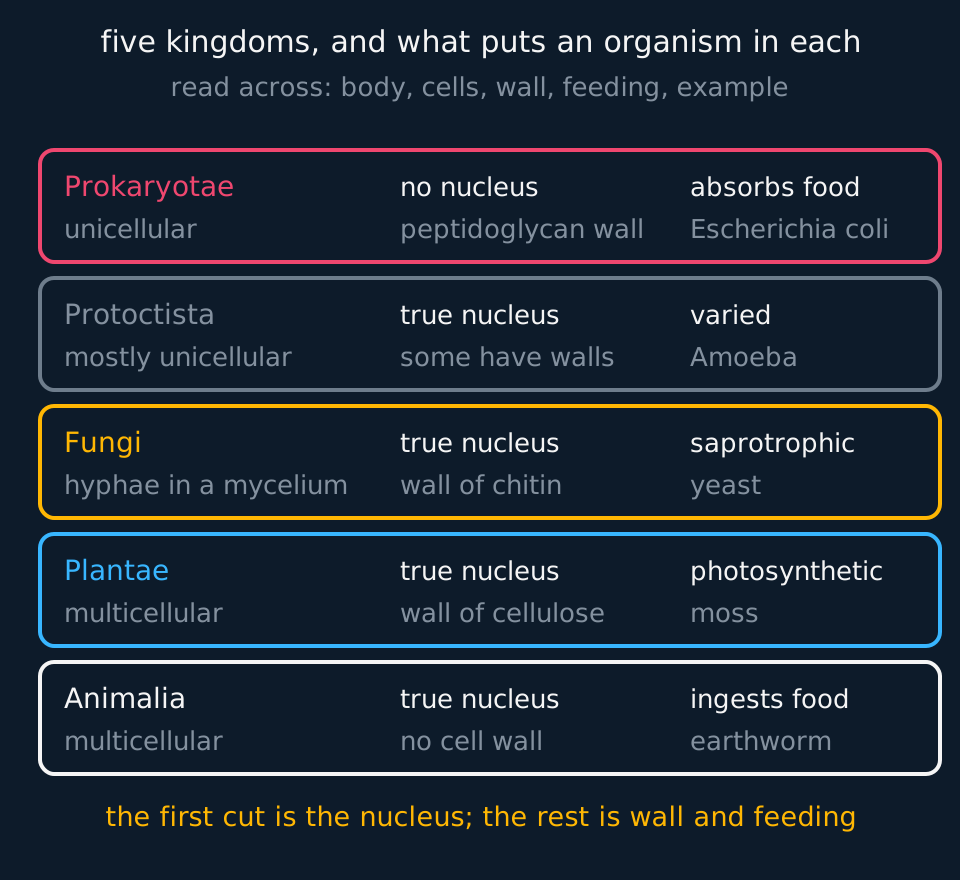
Protoctista is defined by exclusion. Its members are eukaryotes, so they have a nucleus and membrane-bound organelles, and the definition is negative: a eukaryote that is not a fungus, a plant or an animal. Most are unicellular, such as Amoeba, Paramecium and Plasmodium; some are large and multicellular, such as the seaweeds, which are kept out of the plant kingdom because they lack roots, stems, leaves and the tissues that go with them. Some photosynthesise, some ingest food, some absorb it, and some do more than one. Cell walls are present in some and absent in others. A grouping this mixed is not a natural one, and modern classifications have broken it into several kingdoms; it survives at A level because the specifications still name it.
Fungi are eukaryotic and are built either as single cells, as in yeasts, or as long threads called hyphae that spread into a network called a mycelium. The hyphae are often not divided into separate cells at all, so a length of hypha can contain many nuclei in shared cytoplasm. The wall is made of chitin, not cellulose, and the wall material separates a fungus from a plant. No fungus photosynthesises. They feed saprotrophically, by secreting enzymes onto dead organic matter and absorbing the soluble products, or parasitically by doing the same to a living host, and they store carbohydrate as glycogen rather than as starch. They reproduce by spores, which are produced in enormous numbers and carried on the wind.
Plantae are multicellular eukaryotes whose cells have a wall of cellulose, a large permanent central vacuole, and, in the tissues exposed to light, chloroplasts containing chlorophyll. They are autotrophic: they make their own organic molecules by photosynthesis and store carbohydrate as starch. They do not move from place to place, they are differentiated into tissues and organs, and the ones you meet most have roots, stems and leaves with vascular tissue running through them.
Animalia are multicellular eukaryotes with no cell wall, so their cells can change shape. They are heterotrophic and, unlike fungi, they ingest their food, taking it inside the body and digesting it there, usually in a gut. They store carbohydrate as glycogen. Nearly all move at some stage of the life cycle, and nearly all have nervous coordination, which the other four kingdoms lack.
- Kingdom
- The largest of the taxonomic groups within a domain, and the level at which organisms are separated by features such as the presence of a nucleus, the material of the cell wall and the method of nutrition.
- Saprotrophic nutrition
- Feeding by secreting enzymes onto dead organic material outside the body and absorbing the soluble products, which is how fungi and many bacteria feed.
- Autotroph
- An organism that makes its own organic molecules from inorganic ones, in almost all cases by photosynthesis.
- Heterotroph
- An organism that obtains organic molecules by consuming other organisms or their remains.
The traditional five-kingdom model groups organisms as Prokaryotae, Protoctista, Fungi, Plantae and Animalia. Molecular evidence later separated prokaryotes into the domains Bacteria and Archaea; the other four traditional kingdoms lie within Eukarya. The two schemes use different ranks and are not directly interchangeable. Both are taxonomic systems, and modern classification aims to reflect evolutionary relationships.
Exam-board note: OCR Biology A requires the five-kingdom features and the three domains, so both schemes are examinable.
Three species concepts
More than one definition of a species is in use, because no single definition can be applied to every organism. Cambridge International names three, and a question can ask for any of them.
The biological species concept is the one to give first: a group of organisms with similar characteristics that can breed with one another to produce fertile offspring, and which are reproductively isolated from other such groups. Give both halves of the definition. The concept identifies a biological boundary, the gene pool: members of one species exchange alleles and members of two species do not. Its limitations are all of the same kind. The interbreeding test cannot be applied to an organism that reproduces asexually, cannot be applied to a fossil, and does not resolve cases where two named species produce fertile hybrids.
The morphological species concept groups organisms by observable structure: individuals that look alike, in the features a specialist counts as important, are put in one species. This is what Linnaeus did, it is what a field guide uses, and it is the only concept available for fossils and for museum specimens. Its weakness is that structure can mislead in both directions. Members of one species can look very different, as male and female birds of many species do, and as a caterpillar and a butterfly do; and two genuinely separate species can look nearly identical, which is what cryptic species are, and several mosquito species that differ in whether they carry malaria were separated only after their appearance had said they were one.
The ecological species concept groups organisms by the niche they occupy: a species is a set of organisms whose adaptations fit the same particular set of resources and conditions. This is useful exactly where the other two fail, in bacteria and in organisms that reproduce asexually, because a niche can be described whether or not anything interbreeds. Its weakness is that niches are hard to define sharply and often overlap, and that one species can occupy different niches at different stages of its life, which is true of any insect with a larval stage.
| Concept | What defines the species | Where it fails |
|---|---|---|
| Biological | Members interbreed to give fertile offspring, and are reproductively isolated from other groups | Asexual organisms, fossils, fertile hybrids |
| Morphological | Members share observable structural features | Sexes and life stages that differ, and cryptic species that do not |
| Ecological | Members occupy the same niche | Niches overlap, and one species can occupy several |
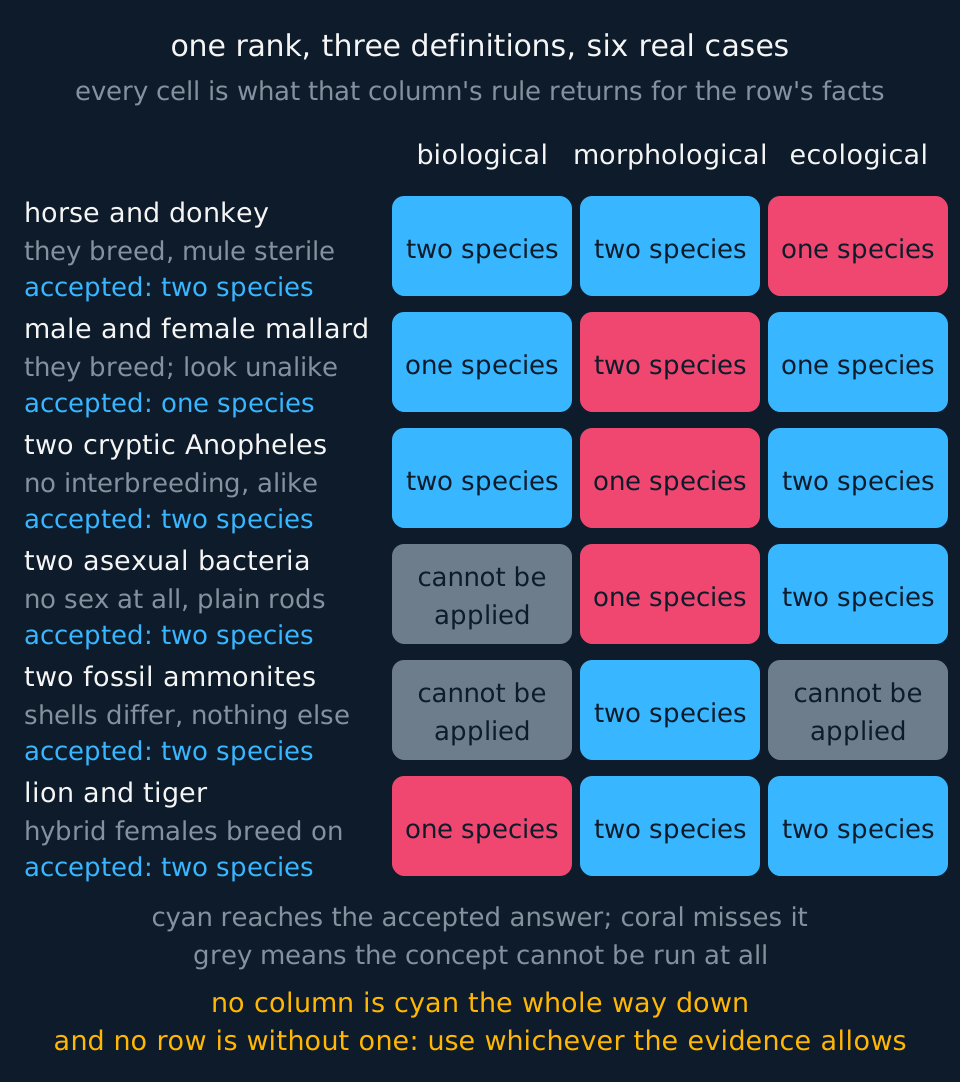
In practice biologists apply whichever concept the available evidence allows, and increasingly add a fourth, comparing DNA sequences and drawing the boundary where sequence similarity falls off. In an answer, name the biological concept first, then name whichever alternative applies to the organism in the question.
- Morphological species concept
- The definition of a species by shared observable structural features, used where interbreeding cannot be tested, as with fossils.
- Ecological species concept
- The definition of a species by the niche its members occupy, useful for organisms that reproduce asexually.
Viruses and their classification
Every kingdom above is defined by features of cells, and a virus is not a cell and is not made of cells, so viruses are placed in no kingdom. A virus particle is a length of nucleic acid inside a protein coat called a capsid, in some viruses enclosed in an envelope derived from the membrane of the host cell in which the particle was assembled. It has no cytoplasm, no ribosomes, no organelles and no membrane it synthesises itself. It carries out no metabolism, so it does not respire, does not grow and does not respond to anything. It reproduces only inside a living host cell, using that cell's ribosomes, enzymes and nucleotides, which makes it an obligate intracellular parasite. Most definitions of life require several of the things a virus does not do, which is why the usual sentence is that viruses are on the boundary of the living and the non-living rather than that they are alive.
Because the cellular features are unavailable, viruses are classified by the genome. The first division is whether that genome is DNA or RNA, and no virus has both. The second is whether the nucleic acid is double-stranded or single-stranded. That gives four groups, each of which contains known viruses.
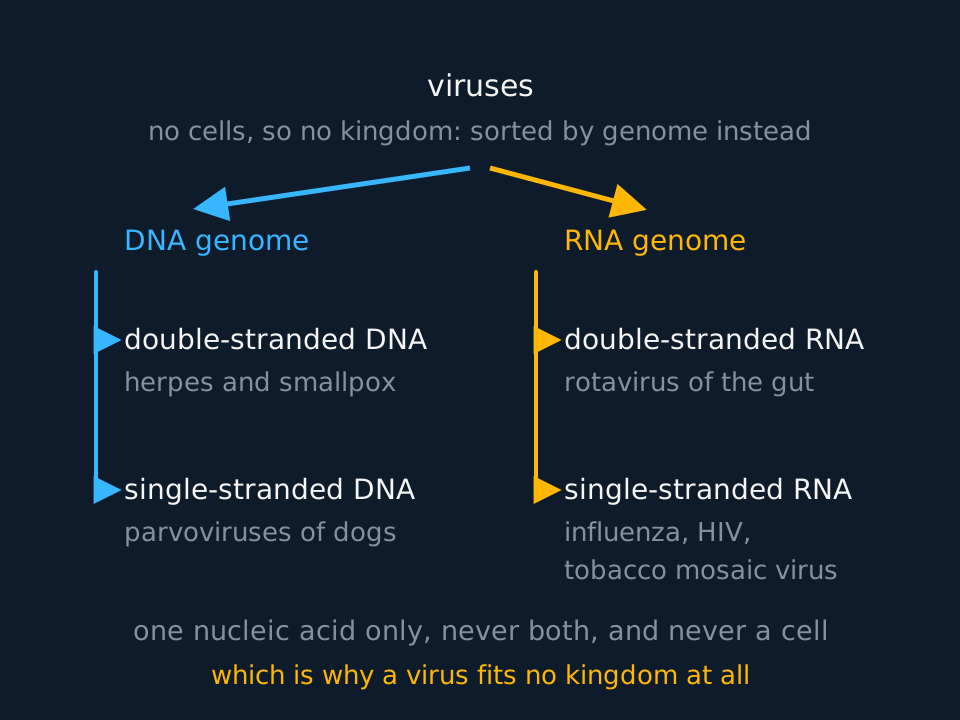
Double-stranded DNA viruses include the herpes viruses and the smallpox virus, and they behave most like a cell's own genetic material. Single-stranded DNA viruses are smaller and less common, the parvovirus that causes a serious disease in dogs among them. Double-stranded RNA viruses include rotavirus, the commonest cause of severe diarrhoea in young children worldwide. Single-stranded RNA viruses include influenza, tobacco mosaic virus, the coronaviruses, and the retroviruses such as the human immunodeficiency virus, which carry the enzyme reverse transcriptase and copy their RNA into DNA once inside a host cell.
Two consequences follow. Many RNA viruses have high mutation rates because their polymerases have limited proofreading, which is why influenza needs a new vaccine most years and why an antiviral drug can be defeated within a single course of treatment. Rates differ between groups: coronaviruses encode proofreading activity, so no universal no-proofreading rule holds. And because a virus has no metabolism of its own, it provides no target for an antibiotic: antibiotics act on bacterial ribosomes, cell walls and enzymes, none of which a virus possesses. An antibiotic prescribed for a viral infection has no effect on the virus and selects for resistance in the bacteria the patient is carrying.
- Virus
- An acellular particle consisting of nucleic acid inside a protein capsid, sometimes with a lipid envelope, which can reproduce only inside a living host cell.
- Capsid
- The protein coat that encloses the nucleic acid of a virus.
TRY IT: Placing three unfamiliar organisms
Three organisms are described. A: multicellular, made of threads containing many nuclei, with walls containing chitin, feeding by secreting enzymes onto dead leaves. B: unicellular, about 2 micrometres long, no nucleus, wall containing peptidoglycan, oxidising ammonium ions as its energy source. C: a particle 100 nanometres across consisting of single-stranded RNA in a protein coat, reproducing only inside the cells of a plant.
Place each one, giving the features you used.
Check your answer
A is in the kingdom Fungi. The threads are hyphae and the many nuclei in shared cytoplasm are typical of them; the chitin wall rules out Plantae, whose walls are cellulose; and secreting enzymes onto dead material and absorbing the products is saprotrophic nutrition, which no plant or animal uses.
B is in the kingdom Prokaryotae. The absence of a nucleus settles it on its own, and peptidoglycan in the wall confirms it, since that material is found in no other kingdom. Oxidising ammonium is a form of nutrition available to no eukaryote.
C is a virus and belongs to no kingdom. It is not a cell: there is no cytoplasm, no membrane of its own and no ribosomes, and it can reproduce only inside a host cell. Classified by genome it is a single-stranded RNA virus, and tobacco mosaic virus is the standard example of a plant virus of that kind.
Give a feature and the conclusion that follows from it, rather than a resemblance. 'It looks like a mould' names no feature; 'the wall contains chitin, so it is a fungus and not a plant' does.
In the exam
- Place an organism by features, in this order: nucleus first, then the cell wall and its material, then the method of nutrition. Name features rather than similar organisms.
- Chitin means fungus and cellulose means plant. Peptidoglycan means prokaryote, and no cell wall at all means animal.
- Fungi and animals are both heterotrophic, so that word alone does not separate them. Fungi absorb after digesting outside the body; animals ingest and digest inside it.
- Protoctista is defined by exclusion. A eukaryote that is not a fungus, a plant or an animal is placed in Protoctista.
- For a species definition, lead with the biological concept and give both of its halves: fertile offspring, and reproductive isolation from other groups. Bring in the morphological or ecological concept when the organism in the question cannot be bred.
- Viruses are classified by nucleic acid because they have no cell structures to classify. Say DNA or RNA first, then double-stranded or single-stranded.
Check yourself
A soil sample yields an organism that is multicellular, has cell walls, does not photosynthesise, and grows as a branching network of threads through the soil. Explain how you would decide whether it belongs to the kingdom Fungi or the kingdom Plantae, and explain why the same reasoning could not be used to place a virus found in the same sample.
Answer
The absence of photosynthesis already points away from Plantae, since plants are autotrophic and contain chlorophyll in chloroplasts, but it is not conclusive on its own because a few parasitic plants have lost the ability.
The decisive test is the material of the cell wall. A fungal wall is made of chitin and a plant wall is made of cellulose, and no kingdom shares those two materials, so identifying the wall polysaccharide settles the question.
Two further features would confirm it. Fungal threads are hyphae and often contain many nuclei in shared cytoplasm rather than being divided into separate uninucleate cells; and a fungus feeds saprotrophically, secreting enzymes onto the dead material around it and absorbing the soluble products, which can be shown by testing the surrounding soil for digestive enzymes.
Storage carbohydrate is a further check: fungi store glycogen and plants store starch, so an iodine test on the tissue distinguishes them.
None of this works for a virus, because every one of those features is a feature of cells and a virus is not made of cells. It has no cell wall, no cytoplasm, no organelles and no metabolism of its own, so there is no nutrition to classify and no wall to test.
A virus is classified instead by its genome: first as a DNA or an RNA virus, since no virus has both, and then by whether that nucleic acid is double-stranded or single-stranded. It is placed in no kingdom at all.
Questions
Question 15 marks
The genome of tobacco mosaic virus is a single strand of RNA 6400 nucleotides long, and its capsid is built from 2130 identical protein subunits of 158 amino acids each. Calculate the number of nucleotides needed to code for one subunit, calculate that number as a percentage of the genome, and state what the percentage shows about how so small a genome can build a coat of 2130 proteins.
Mark scheme
- M1 three nucleotides code for one amino acid, so the number needed = 158 × 3
- A1 474 nucleotides, accepting 477 where a stop codon is counted as well
- M1 percentage of the genome = 474 ÷ 6400 × 100
- A1 7.4 per cent, to two significant figures
- B1 the coat protein is coded once and translated over and over, so a few per cent of the genome supplies every subunit of the capsid, which is why a particle built from many copies of one protein needs so little nucleic acid to specify it
Question 24 marks
Explain why viruses are not placed in any of the five kingdoms, and describe how they are classified instead.
Mark scheme
- B1 the kingdoms are defined by features of cells, and a virus is not a cell: it has no cytoplasm, no ribosomes and no organelles
- B1 a virus carries out no metabolism of its own and can reproduce only inside a living host cell, so it has no nutrition or respiration to classify
- B1 viruses are classified instead by their genome, first as DNA viruses or RNA viruses, since no virus contains both
- B1 and then by whether that nucleic acid is double-stranded or single-stranded, giving four groups, with a named example such as single-stranded RNA for influenza or human immunodeficiency virus
Question 34 marks
Identify the kingdom each of the four organisms in the table belongs to, and give the feature that decides each one.
| Organism | Nucleus | Cell wall | How it feeds | Body |
|---|---|---|---|---|
| W | absent | peptidoglycan | oxidises ammonium ions as its energy source | one cell about 2 µm long, dividing by binary fission |
| X | present | none | engulfs bacteria and digests them in vacuoles | one cell about 200 µm across, moving by flowing |
| Y | present | cellulose | photosynthesises | many cells, up to 2 m long, held to rock by a holdfast, with no roots, stems, leaves or vascular tissue |
| Z | present | none | takes food into a gut and digests it there | many cells, differentiated into tissues, with nervous coordination |
Mark scheme
- B1 W is in the Prokaryotae, decided by the absence of a nucleus, and confirmed by the peptidoglycan wall, which is found in no other kingdom
- B1 X is in the Protoctista: it has a nucleus, so it is not a prokaryote, and it is a single cell with no wall that ingests its food, so it is neither a fungus nor a plant nor an animal, and Protoctista is the kingdom left
- B1 Y is in the Protoctista as well, not the Plantae: it photosynthesises and has cellulose walls, but it has no roots, stems, leaves or vascular tissue, which is what keeps the seaweeds out of the plant kingdom
- B1 Z is in the Animalia, decided by the absence of a cell wall together with ingestion of food into a gut, and confirmed by nervous coordination, which the other four kingdoms lack
Question 44 marks
Evaluate the biological species concept as a definition of a species.
Mark scheme
- B1 in support: it names a real biological boundary rather than a judgement about appearance, because a group whose members breed with one another to give fertile offspring shares a gene pool, and members of two such groups do not
- B1 in support: it has two halves that are both creditable, interbreeding to produce fertile offspring and reproductive isolation from other such groups, so it says why the boundary matters and not only where it lies
- B1 against: the breeding test cannot be run on anything that reproduces asexually, such as a bacterium, nor on a fossil or a museum specimen, and it gives an awkward answer wherever two named species produce fertile hybrids
- B1 a judgement: it is the definition to give first wherever sexual reproduction can be observed, but it cannot be the only one, which is why the morphological concept is used for fossils and the ecological concept for organisms that never interbreed at all
Question 54 marks
Compare the biological species concept with the ecological species concept, referring to what each one uses to define a species and to which organisms each one can be applied.
Mark scheme
- B1 the biological species concept defines a species by whether its members interbreed to produce fertile offspring and are reproductively isolated from other such groups, whereas the ecological species concept defines a species by the niche its members occupy
- B1 the biological concept can only be applied where interbreeding can actually be observed or tested, whereas the ecological concept can be applied to organisms that reproduce asexually, since a niche can be described whether or not anything interbreeds
- B1 the biological concept fails on fossils and on species that produce fertile hybrids, whereas the ecological concept fails where niches overlap, or where one species occupies different niches at different life stages, such as an insect with a larval stage
- B1 in practice the biological concept is given first wherever sexual reproduction can be observed, and the ecological concept is brought in specifically for the cases, such as bacteria, that the biological concept cannot handle at all
Question 64 marks
Describe the structure of a virus particle, and describe why a virus is described as an obligate intracellular parasite.
Mark scheme
- B1 a virus particle consists of a length of nucleic acid, either DNA or RNA, enclosed within a protein coat called a capsid
- B1 in some viruses the capsid is further enclosed in an envelope derived from the membrane of the host cell in which the particle was assembled
- B1 a virus has no cytoplasm, no ribosomes and no organelles of its own, and carries out no metabolism, so it cannot respire, grow or respond to anything by itself
- B1 it can reproduce only inside a living host cell, using that cell's own ribosomes, enzymes and nucleotides, which is why it is described as an obligate intracellular parasite
Question 74 marks
Four viruses are described. Influenza carries single-stranded RNA. Herpes simplex virus carries double-stranded DNA. Rotavirus carries double-stranded RNA. Canine parvovirus carries single-stranded DNA. Identify which one virus belongs to each of the four genome-based groups used to classify viruses.
Mark scheme
- B1 double-stranded DNA: herpes simplex virus
- B1 single-stranded DNA: canine parvovirus
- B1 double-stranded RNA: rotavirus
- B1 single-stranded RNA: influenza
Question 84 marks
A student says that anything green and not moving is a plant, and anything growing in the soil that is not green is a fungus. Discuss whether these two rules correctly classify organisms.
Mark scheme
- B1 what is right: most plants are green, due to chlorophyll in their chloroplasts, and do not move from place to place, and many fungi do grow in soil and are not green, so the rules describe a common pattern
- B1 against: a seaweed is green and does not move but is classified in Protoctista rather than Plantae, since it lacks roots, stems, leaves and vascular tissue, so 'green and stationary' is not sufficient on its own
- B1 against: many soil organisms that are not green are not fungi at all; bacteria and various Protoctista also live in soil without photosynthesising, so 'in soil and not green' does not identify a fungus specifically either
- B1 judgement: a kingdom is defined by a combination of features, cellular organisation, cell wall material and method of nutrition among them, not by a single visible trait, so a rule based on colour and movement alone will misclassify organisms that share the trait without sharing the kingdom
Question 93 marks
State three features that would place an organism in the kingdom Fungi rather than in the kingdom Plantae.
Mark scheme
- B1 the cell wall contains chitin rather than cellulose
- B1 it does not photosynthesise and has no chloroplasts or chlorophyll, feeding saprotrophically or parasitically instead
- B1 either of: the body is made of hyphae forming a mycelium, often with many nuclei in shared cytoplasm; or carbohydrate is stored as glycogen rather than as starch
Question 103 marks
Explain why the presence or absence of a nucleus is used as the first division made when organisms are placed into kingdoms.
Mark scheme
- B1 it separates the Prokaryotae, whose DNA lies free in the cytoplasm as a circular molecule, from the four eukaryotic kingdoms whose DNA is enclosed in a nuclear envelope
- B1 the difference is not a single feature but a whole cell organisation: prokaryotes also lack membrane-bound organelles and have smaller 70S ribosomes
- B1 it is therefore the deepest division in the living world and reflects the oldest split in ancestry, so it is the division to make before any other
Question 113 marks
Two populations of a fossil shellfish are known only from their shells. Suggest which species concept a palaeontologist must use to decide whether they are one species or two, and suggest one problem with the decision.
Mark scheme
- B1 the morphological species concept, which groups organisms by shared observable structural features, because the biological concept cannot be used
- B1 no breeding test is possible on fossils, so whether the two populations could have produced fertile offspring can never be established
- B1 structure can mislead: members of one species can differ in appearance, as males and females and different growth stages do, while two separate species can look nearly identical
Question 123 marks
Compare the way a fungus obtains its food with the way an animal obtains its food.
Mark scheme
- B1 both are heterotrophic, since neither can make organic molecules from inorganic ones
- B1 a fungus secretes enzymes onto material outside its body and absorbs the soluble products, which is saprotrophic or parasitic nutrition, whereas an animal takes food into the body and digests it internally
- B1 the fungus therefore never handles solid food, which suits a body made of narrow hyphae, whereas an animal needs a gut and, in nearly all cases, the ability to move to its food
Question 133 marks
Explain why a seaweed is classified in the kingdom Protoctista rather than in the kingdom Plantae, even though it photosynthesises and has cellulose cell walls.
Mark scheme
- B1 Protoctista is a kingdom defined by exclusion: it holds every eukaryote that is not a fungus, a plant or an animal, rather than by a single positive feature shared by all its members
- B1 a seaweed photosynthesises and has cellulose cell walls, both features shared with Plantae, but it lacks roots, stems, leaves and the vascular tissue that goes with them, which the Plantae in this scheme are defined as having
- B1 because it fails the specific requirements of the Plantae despite the resemblance in nutrition and wall material, a seaweed is placed in the kingdom left over, Protoctista, along with organisms that share almost nothing else in common with it
Question 143 marks
Several species of mosquito look almost identical but differ in whether they are able to carry malaria. Suggest why relying on the morphological species concept alone would be a poor way to distinguish them, and suggest one additional kind of evidence that could separate them.
Mark scheme
- B1 the morphological species concept groups organisms by their observable structure, but two genuinely separate species, called cryptic species, can look nearly identical to each other despite being reproductively isolated
- B1 mosquito species that differ in a property as important as whether they transmit malaria could therefore be wrongly treated as a single species if only their appearance is compared, with serious practical consequences for disease control
- B1 comparing DNA sequence between the populations, or testing directly whether they interbreed to produce fertile offspring, could separate species that look alike but are not exchanging alleles
Question 153 marks
Explain why an antibiotic prescribed for a viral infection has no effect on the virus itself, and explain one consequence of prescribing it anyway.
Mark scheme
- B1 antibiotics act on structures and processes that are specific to bacteria, such as bacterial ribosomes, bacterial cell walls and bacterial enzymes
- B1 a virus possesses none of these; it has no ribosomes, no cell wall and no metabolism of its own for an antibiotic to act on, so the antibiotic has no target inside it
- B1 the antibiotic instead reaches the bacteria the patient happens to be carrying elsewhere in or on the body, and any of those that survive by chance, because they carry a resistance allele, are more likely to breed and spread it, so unnecessary prescribing selects for antibiotic resistance without treating the viral infection at all
Worth remembering
- Prokaryotae have no nucleus and no membrane-bound organelles, and a bacterial wall is made of peptidoglycan.
- Protoctista are the eukaryotes left over: mostly unicellular, varied in nutrition, and not fungi, plants or animals.
- Fungi have walls of chitin, grow as hyphae forming a mycelium, feed saprotrophically and store glycogen.
- Plantae have walls of cellulose and chloroplasts, photosynthesise and store starch.
- Animalia have no cell wall, ingest their food and digest it internally, and are the only kingdom with nervous coordination.
- The biological species concept turns on fertile offspring; the morphological concept on shared structure; the ecological concept on a shared niche.
- Viruses are acellular and belong to no kingdom, and are classified as DNA or RNA and as double-stranded or single-stranded.
CHECK YOUR PROGRESS
Rate how confident you are with each objective for this lesson. Ratings are saved in this browser, on this device, unless you sign in.
- State the characteristic features of each of the five kingdoms and use them to place an unfamiliar organism.
- Explain why the presence of a nucleus is the first division made, and what separates the three kingdoms that have cell walls.
- Distinguish the biological, morphological and ecological species concepts, and say which one to use when the others fail.
- Explain why viruses are placed in no kingdom at all.
- Classify a virus by whether its genome is DNA or RNA and single-stranded or double-stranded, giving a named example of each.
Open the full revision checklist to see every objective in the curriculum in one place.
Practise this lesson
WORKBOOK
The written questions from this topic, on paper with room to work, and a separate book of mark schemes. The question that is set on a diagram stays on this page, where the diagram can be drawn. Free to use; please do not redistribute or sell.