Biology › Enzymes and metabolic control › Enzyme action and specificity
Enzyme action and specificity
A catalyst increases the rate of a reaction without being used up and without changing the position of equilibrium, and an enzyme does so through an active site a few amino acids across. Activation energy, the lock-and-key and induced-fit models, and the basis of enzyme specificity are covered here.
Before this Protein structure and function: tertiary structure and the four bonds that hold it · Globular proteins and why they are soluble
COMMON MISCONCEPTION
Enzymes speed up reactions by giving them energy, a push to get them going.
An enzyme supplies no energy: it sits in solution at the same temperature as everything around it. It offers an alternative route with a lower activation energy, so a far larger fraction of molecules already have enough thermal energy to react.
What you should be able to do
- State what an enzyme does to the activation energy of a reaction, and what it leaves alone.
- Describe the active site as a product of tertiary structure rather than of any one amino acid.
- Set out the lock-and-key and induced fit models, and give the evidence that decided between them.
- Use 'enzyme-substrate complex' and 'complementary' correctly in an explanation of specificity.
- Explain why changing one amino acid far from the active site can still stop an enzyme working.
What a catalyst changes
Energetically favourable reactions often proceed very slowly. Hydrogen peroxide in a brown bottle decomposes into water and oxygen over months, because before a molecule breaks down it must first pass through a strained, partly broken arrangement. Only the small fraction of molecules with sufficient kinetic energy at any instant can reach that intermediate state, and the energy required is the activation energy.
Adding a piece of liver to the same peroxide causes rapid effervescence. Liver contains catalase, one of the fastest enzymes measured: a single molecule of it converts millions of hydrogen peroxide molecules every second. Only a protein has been added, and it is recovered unchanged at the end of the reaction.
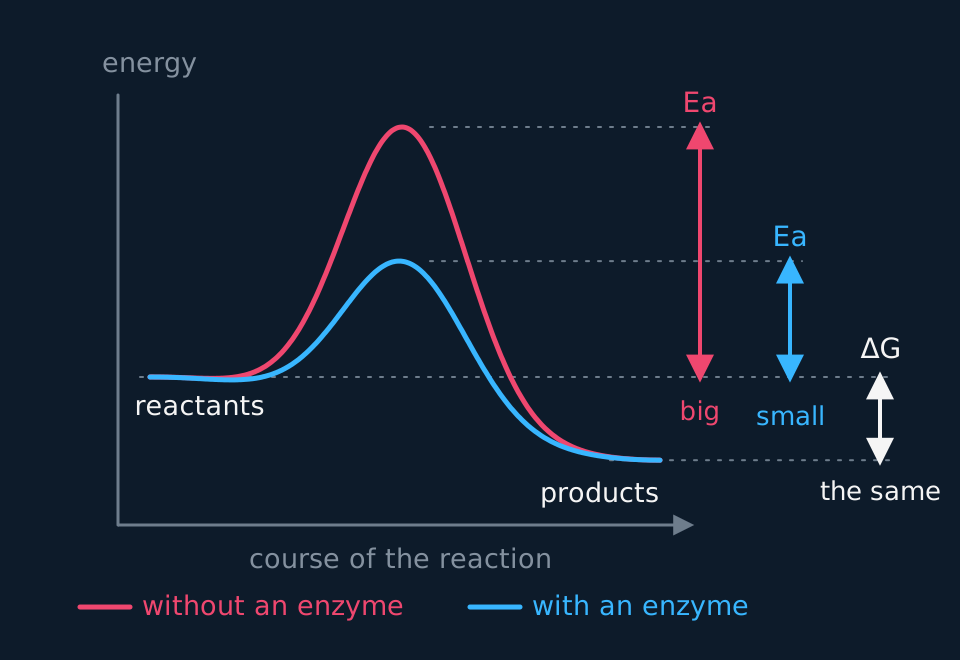
Describe the drawing
Energy plotted against the course of a reaction, with two routes drawn between the same reactant level and the same lower product level. The coral route without an enzyme climbs to a high peak; the cyan route with an enzyme climbs to a much lower peak in the same place. Vertical double arrows on the right measure the two activation energies, large and small, and the overall energy change, which is identical for both routes.
The quantities that do not change are examinable. Reactants start at the same energy on either route and products finish at the same energy, so the overall energy change is identical. An enzyme therefore cannot make a reaction release more energy, cannot make an unfavourable reaction favourable, and cannot shift an equilibrium: it catalyses the forward and reverse reactions to the same degree, so the position of equilibrium is unaltered.
What an enzyme changes is the time taken to reach that position, which can be the difference between a reaction taking a century and taking a second.
- Catalyst
- A substance that increases the rate of a reaction by lowering its activation energy, and which is not used up in the process.
- Activation energy
- The minimum energy that colliding particles must have for a reaction to take place.
- Enzyme
- A globular protein that acts as a biological catalyst, with an active site complementary to its substrate.
The word globular matters in that definition. Enzymes fold into compact shapes with hydrophilic side chains outwards, so they dissolve in cytoplasm and plasma, and their sequences are irregular, so the surfaces they present are irregular too. Collagen has neither property, which suits it to a structural role rather than a catalytic one.
Enzymes catalyse reactions in two settings. Most act inside the cell that made them, as catalase does in liver cells: these are intracellular enzymes. Others are secreted and act outside the cell, as the digestive enzymes amylase and trypsin do in the gut: these are extracellular enzymes. The lesson on cofactors and where enzymes work compares the two.
The active site is formed by the tertiary structure
A typical enzyme is a few hundred amino acids long. The reaction happens in a dent on its surface perhaps a dozen amino acids across, and those amino acids are usually far apart in the chain. Lysozyme, the enzyme in tears and egg white that hydrolyses bacterial cell walls, is 129 amino acids long, and the two side chains that carry out the catalysis are the 35th and the 52nd: seventeen residues apart in the sequence, and adjacent once the chain has folded.
The active site is therefore not identifiable in the primary structure; it is created by the tertiary structure. Anything that disturbs the fold disturbs the site, however far from the site the disturbance begins.
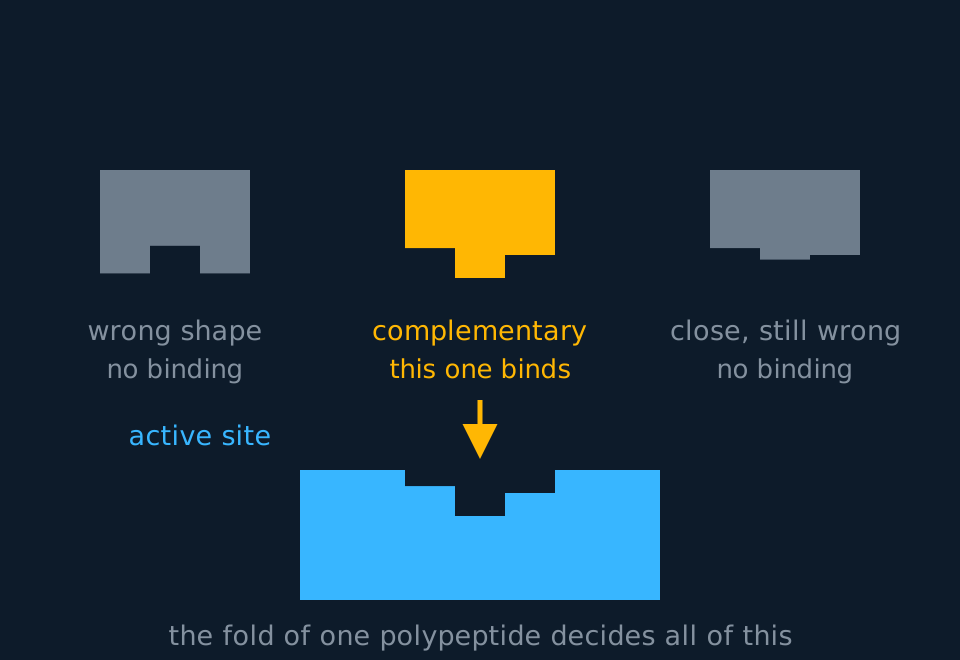
Describe the drawing
A large enzyme block along the bottom with a stepped notch cut into its upper surface, the active site. Above it sit three molecules whose undersides are stepped in three different ways. The left one and the right one do not match the notch and are drawn in grey; the middle one matches it step for step, is drawn in amber, and an arrow shows it moving down into the site.
A substrate bound in the active site forms an enzyme-substrate complex. Use that term rather than 'joining' or 'reacting with' the enzyme, which describe something different.
When the reaction is complete, the products are held in the active site for a moment as an enzyme-product complex. They are no longer complementary to the site, so they are released, leaving the enzyme unchanged and free to bind another substrate molecule.
- Active site
- The region of an enzyme, formed by its tertiary structure, to which the substrate binds.
- Substrate
- The molecule on which an enzyme acts.
- Enzyme-substrate complex
- The temporary structure formed when a substrate binds to the active site.
- Specificity
- The property of an enzyme that it catalyses only one reaction, or one class of reaction, because only a substrate complementary to its active site can bind.
A mutation forty residues away
A single base substitution changes one amino acid in an enzyme. The changed amino acid is forty residues away from the active site along the chain. The enzyme no longer works. Explain how that is possible.
Show the working
Begin at the site of the change rather than at the active site. A different amino acid means a different R group, so the interactions available at that point along the chain are different: a hydrogen bond or an ionic bond that used to form may not form, a hydrophobic side chain may be replaced by a charged one, a cysteine that used to make a disulfide bridge may be gone.
Those interactions are what hold the tertiary structure, and tertiary structure is not local. Folding brings distant parts of the chain into contact, so a bond that fails at residue 90 can move residue 50 by a fraction of a nanometre.
If one of the residues that moved lines the active site, the site is now a different shape, the substrate is no longer complementary to it, no enzyme-substrate complex forms, and the reaction proceeds only at its uncatalysed rate. The distance quoted in the question is distance along the sequence; folding brings distant residues together in three dimensions.
The lock-and-key and induced-fit models
Emil Fischer proposed the first model in 1894. A substrate fits its enzyme, he suggested, as a key fits a lock: one rigid shape and one rigid complementary shape, with no other combination binding. As a simplified account of specificity it remains useful, and it explains why lactase does not hydrolyse sucrose.
As an account of catalysis the model is incomplete. A rigid site that binds a substrate explains why the substrate is held. It does not explain why binding increases the rate. The substrate must be altered once bound, and a site that does not move cannot alter it.
Three lines of evidence supported a revised model. When enzyme structures began to be solved by X-ray crystallography in the 1960s, several were recorded in both states and were not the same shape: hexokinase closes around a bound glucose molecule, shifting by a large fraction of a nanometre. Second, molecules built to resemble the strained half-reacted transition state rather than the relaxed substrate bind far more tightly than the substrate itself, which only makes sense if the site is shaped to grip the strained form. Third, many enzymes accept a family of related substrates: lipases hydrolyse triglycerides with a range of different fatty acid tails, which a strictly rigid complementary site would not permit.
The revised model was induced fit, which Daniel Koshland had proposed in 1958. The active site is close to complementary before binding and moulds to the substrate as it arrives, because the substrate's arrival makes it move. The closed site's tightest grip, as the transition-state evidence above shows, is reserved for the strained halfway form rather than the relaxed substrate, which is exactly what a catalyst should hold hardest.
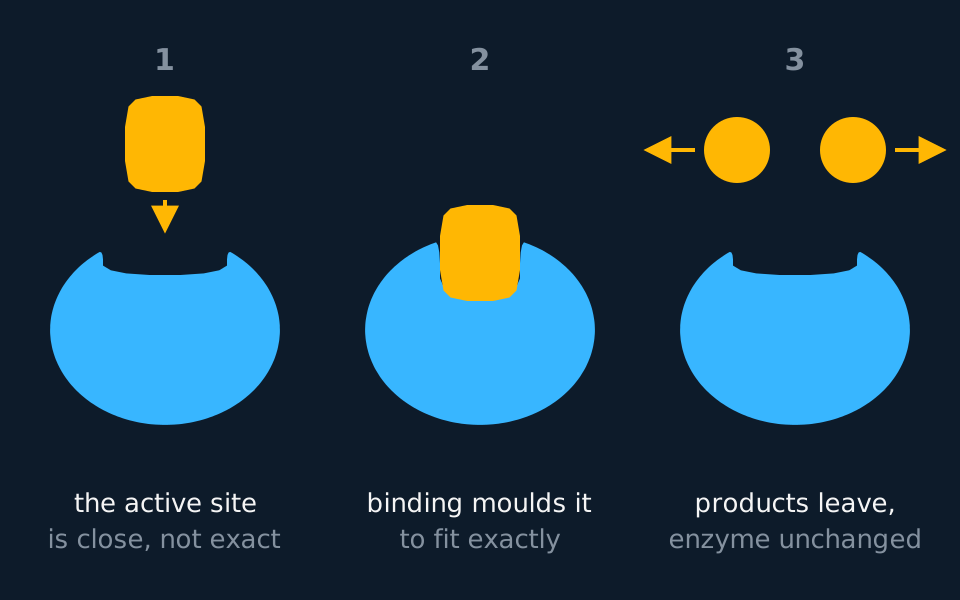
Describe the drawing
Three panels showing one enzyme. In the first the enzyme is a rounded body with a wide shallow bay in its top and the substrate, a smaller narrower block, is arriving above it. In the second the bay has narrowed and deepened so that it holds the substrate exactly, forming the enzyme-substrate complex. In the third two product pieces are moving away and the bay has returned to the wide shallow shape it had in the first panel.
| Lock and key | Induced fit | |
|---|---|---|
| Active site before binding | Already exactly complementary | Close to complementary, not exact |
| What moves | Nothing | The active site, as the substrate binds |
| Explains specificity | Yes | Yes |
| Explains why the rate rises | No | Yes: binding strains the substrate |
| Supported by structures? | Not by crystal structures of enzymes with and without substrate | Yes: hexokinase closes around glucose |
Both models say the enzyme finishes unchanged, and both explain specificity, though 'one enzyme, one substrate' is too strict a summary: as the lipase example shows, the accurate version is one enzyme, one reaction or one class of closely related substrates. Do not present the models as rivals over specificity. They differ over whether the site is rigid, and over whether the model has anything to say about catalysis.
How the active site lowers activation energy
Four mechanisms operate within a closed active site, and any of them lowers the activation energy. They are alternatives rather than a required set: which of them a particular enzyme uses, and in what combination, varies between enzymes.
Binding holds two substrates in the right orientation: in solution they collide in every wrong way first, and in an active site they are already lined up. Closing also strains the bonds that are about to break, so they are partly broken before the reaction starts. The pocket excludes water. And charged R groups lining it can donate or accept protons, creating a local chemical environment no beaker could reproduce.
An answer on how an active site lowers activation energy names these mechanisms and says what each does; the chemistry behind them is not required. They establish the point that matters: the enzyme provides an alternative route with a lower activation energy and does not supply energy to the substrate.
TRY IT: Evaluating a conclusion about catalase
Hydrogen peroxide decomposes into water and oxygen on its own at room temperature, slowly. A student adds catalase, sees the mixture foam, and writes that catalase 'makes the decomposition possible'. Comment on that conclusion.
Check your answer
The decomposition already occurs without catalase, as peroxide left alone still releases oxygen. What catalase changes is the rate.
The reaction releases energy overall, so it is energetically favourable with or without catalase. Its slowness comes from a high activation energy: at room temperature only a tiny proportion of molecules have enough energy at any moment to reach the transition state. Catalase provides an alternative route with a lower activation energy, so a much larger proportion of collisions are now successful and the rate rises enormously.
The same mass of peroxide yields the same volume of oxygen either way; catalase changes the time taken, not the yield. State that catalase increases the rate of the decomposition.
In the exam
- On an explain command, state that the enzyme 'lowers the activation energy'. 'Speeds up the reaction' restates the question.
- Do not write that an enzyme gives energy to a reaction, provides activation energy, or makes a reaction possible. State that it provides an alternative route with a lower activation energy.
- Use complementary rather than 'the same shape'. A substrate is complementary to the active site, as a foot is to a footprint.
- Where a question names induced fit, include the statement that 'the active site changes shape as the substrate binds'. A lock-and-key description does not answer an induced-fit question.
- Give the chain of causation in order for mutation questions: R group → bonds between R groups → tertiary structure → active site shape → substrate no longer complementary. Include the intermediate steps.
Check yourself
An industrial process converts substrate S into product P using an enzyme. At 25 °C the reaction reaches equilibrium with 90% P and 10% S. A colleague suggests doubling the amount of enzyme in order to push the yield above 90%. Evaluate that suggestion.
Answer
It will not raise the yield. An enzyme changes the rate at which equilibrium is reached, not the position of equilibrium.
The 90:10 split is fixed by the energy difference between S and P. An enzyme lowers the activation energy of the route between them, and it lowers it by the same amount in both directions, so the forward and reverse reactions are both speeded up in the same proportion and the balance point does not move. Doubling the enzyme will get the mixture to 90% P sooner, which may well be worth doing, but it will stop there.
To change the yield you have to change something the equilibrium responds to: remove P as it forms or alter the temperature, remembering that a temperature high enough to shift the equilibrium may also be high enough to denature the enzyme. Adding enzyme affects rate; yield depends on the position of equilibrium.
Questions
Question 14 marks
Explain why a given enzyme catalyses only one reaction, using the terms active site, complementary and enzyme-substrate complex in your answer.
Mark scheme
- B1 the active site is a region formed by the tertiary structure of the enzyme, with a particular shape
- B1 only a substrate whose shape is complementary to the active site can bind to it
- B1 when it binds, an enzyme-substrate complex forms and the reaction is catalysed
- B1 a molecule that is not complementary cannot enter the site, so no complex forms and that reaction is not catalysed
Question 24 marks
Compare the lock-and-key model of enzyme action with the induced fit model.
Mark scheme
- B1 in lock and key the active site is already exactly complementary to the substrate, whereas in induced fit it is only close to complementary before binding
- B1 in lock and key nothing moves, whereas in induced fit the active site changes shape as the substrate binds
- B1 both models account for specificity, but only induced fit accounts for the rise in rate, because the closing of the site strains the substrate's bonds
- B1 induced fit is supported by crystal structures of enzymes with and without their substrate, such as hexokinase closing around glucose, which lock and key is not
Question 34 marks
Explain four ways in which a closed active site can lower the activation energy of a reaction it catalyses.
Mark scheme
- B1 binding holds the substrate or substrates in the correct orientation for the reaction, reducing the energy wasted in collisions that would otherwise occur the wrong way round
- B1 as the site closes around the substrate it strains the bonds that are about to break, so they are partly broken before the reaction proper begins
- B1 the active site can exclude water from the reaction, creating a local chemical environment a beaker of solution could not reproduce
- B1 charged R groups lining the site can donate or accept protons directly, taking part in the catalysis chemically rather than only holding the substrate
Question 44 marks
A biochemist adds extra enzyme to a reaction mixture already at equilibrium, and claims that, because the reaction now proceeds faster in both directions, more product will eventually be formed than before. Evaluate this claim.
Mark scheme
- B1 the claim is incorrect: adding more enzyme increases the rate at which equilibrium is reached in both directions, but does not move the position of equilibrium itself
- B1 the enzyme lowers the activation energy of the same route for the forward and the reverse reaction by the same amount, so both are speeded up in the same proportion
- B1 the ratio of product to reactant at equilibrium is fixed by the energy difference between them, which the enzyme does not change
- B1 judgement: more enzyme will bring the mixture to the same equilibrium sooner, which may be commercially useful, but it will not shift the balance towards more product
Question 54 marks
An enzyme in a 2.0 cm³ sample converts 4.5 × 10⁻⁴ mol of substrate to product in 30 seconds. Calculate the rate of reaction in mol s⁻¹, and calculate how many moles would be converted in 2 minutes at that same rate.
Mark scheme
- M1 rate = amount converted ÷ time taken: 4.5 × 10⁻⁴ ÷ 30
- A1 1.5 × 10⁻⁵ mol s⁻¹
- M1 moles converted in 2 minutes = rate × 120 s
- A1 1.8 × 10⁻³ mol
Question 64 marks
A single amino acid is changed within an enzyme's active site itself, rather than forty residues away. Explain why a change at the active site is more likely to abolish activity than a similarly sized change elsewhere in the protein, and explain one way the enzyme could still work despite the change.
Mark scheme
- B1 the active site's amino acids form the surface directly responsible for binding the substrate, and in induced fit, for straining it
- B1 a change there is more likely to alter the shape or the charge of that surface directly, rather than only indirectly through a knock-on effect on folding elsewhere
- B1 a change elsewhere in the protein may or may not disturb a bond that holds the fold together, so its effect on the site is less certain
- B1 the enzyme could still work if the new amino acid's R group is similar enough in size and properties to the original that the site remains complementary to the substrate
Question 73 marks
Explain why enzymes are globular proteins, and why a fibrous protein such as collagen could not act as an enzyme.
Mark scheme
- B1 a globular protein folds with hydrophilic side chains facing outwards, so it dissolves in cytoplasm or plasma where the reaction happens
- B1 its amino acid sequence is irregular, so the surface it presents is irregular and can carry an active site of a particular shape
- B1 a fibrous protein has a repetitive sequence and forms long insoluble strands, so it is neither soluble nor able to present such a pocket
Question 83 marks
A molecule built to resemble the strained, half-reacted form of a substrate binds to its enzyme far more tightly than the substrate itself does. Suggest what this tells us about the shape of the active site and which model of enzyme action it supports, and suggest why such a molecule would slow the enzyme down.
Mark scheme
- B1 the active site must be complementary to the strained transition state rather than to the relaxed substrate
- B1 this supports induced fit, in which the site moulds around the substrate and strains the bonds that are about to break
- B1 the molecule occupies the active site, so substrate cannot bind there and fewer enzyme-substrate complexes form
Question 93 marks
A base substitution changes one amino acid in an enzyme, forty residues away from the active site along the chain, and the enzyme stops working. Explain how a change that far from the active site can destroy the enzyme's activity.
Mark scheme
- B1 the new amino acid has a different R group, so a bond that held the fold at that point, a hydrogen bond, an ionic bond or a disulfide bridge, may no longer form
- B1 those bonds hold the tertiary structure, and folding brings distant parts of the chain into contact, so a bond lost at one residue can move residues that line the active site
- B1 the active site is then a different shape, the substrate is no longer complementary to it, and no enzyme-substrate complex can form
Question 103 marks
Describe three lines of evidence that led to the lock-and-key model being replaced by the induced fit model.
Mark scheme
- B1 X-ray crystallography caught enzymes in two shapes: hexokinase closes around a glucose molecule, which a rigid site could not do
- B1 molecules built to resemble the strained, half-reacted transition state bind far more tightly than the substrate itself, so the site must be shaped to grip the strained form
- B1 some enzymes accept a family of related substrates, as lipases hydrolyse triglycerides with a range of fatty acid tails, and a lock that accepts several keys is a poor lock
Question 113 marks
Describe what happens to the shape of an induced-fit active site, from before the substrate binds to the formation of the enzyme-substrate complex.
Mark scheme
- B1 before binding, the active site is close to complementary to the substrate but not an exact fit
- B1 as the substrate binds, the active site moulds around it, changing shape to become more closely complementary
- B1 once bound, the enzyme-substrate complex is formed, with the substrate's bonds strained by the closing of the site
Question 123 marks
Sucrase hydrolyses sucrose but has no effect on lactose, a different disaccharide. Suggest, in terms of active site shape, why sucrase does not catalyse the hydrolysis of lactose.
Mark scheme
- B1 the active site of sucrase has a particular shape, formed by its tertiary structure, that is complementary to sucrose
- B1 lactose has a different molecular shape, so it is not complementary to the active site and cannot bind there to form an enzyme-substrate complex
- B1 without an enzyme-substrate complex forming, the reaction is not catalysed, so lactose is hydrolysed only at its uncatalysed rate
Question 132 marks
State what an enzyme does to the activation energy of a reaction, and state one quantity that an enzyme does not change.
Mark scheme
- B1 an enzyme lowers the activation energy of the reaction
- B1 it does not change the energy of the reactants or of the products, and so does not move the position of equilibrium
Question 142 marks
A single molecule of catalase can decompose 6 × 10⁶ molecules of hydrogen peroxide per second. Calculate how many hydrogen peroxide molecules one catalase molecule decomposes in 5 minutes, giving your answer in standard form.
Mark scheme
- M1 convert the time to seconds: 5 × 60 = 300 s, and multiply the rate by it
- A1 6 × 10⁶ × 300 = 1.8 × 10⁹ molecules
Question 152 marks
Name the model of enzyme action in which the active site is already exactly complementary to the substrate before binding, and name the model in which the active site changes shape as the substrate binds.
Mark scheme
- B1 lock and key
- B1 induced fit, named by Koshland
Worth remembering
- An enzyme lowers activation energy. It does not change the energy of the reactants or of the products, and it does not move an equilibrium.
- The active site is built by tertiary structure, so anything that changes the fold changes the site.
- Substrate and active site are complementary, not identical.
- Induced fit: the site moulds around the substrate as it binds, and that moulding is where the catalysis comes from.
- A catalyst finishes the reaction in the state it started it, ready to go again.
CHECK YOUR PROGRESS
Rate how confident you are with each objective for this lesson. Ratings are saved in this browser, on this device, unless you sign in.
- State what an enzyme does to the activation energy of a reaction, and what it leaves alone.
- Describe the active site as a product of tertiary structure rather than of any one amino acid.
- Set out the lock-and-key and induced fit models, and give the evidence that decided between them.
- Use 'enzyme-substrate complex' and 'complementary' correctly in an explanation of specificity.
- Explain why changing one amino acid far from the active site can still stop an enzyme working.
Open the full revision checklist to see every objective in the curriculum in one place.
Practise this lesson
Practise enzyme action and specificity with 15 original questions and point-by-point mark schemes
WORKBOOK
The questions from this topic, on paper with room to work, and a separate book of mark schemes. Free to use; please do not redistribute or sell.