Biology › Evolution and speciation › Evidence for evolution, resistance and genetic drift
Evidence for evolution, resistance and genetic drift
Antibiotic and pesticide resistance are cases in which selection can be measured over a few generations. Genetic drift, bottlenecks and the founder effect change allele frequencies without selection. Palaeontology, comparative anatomy, comparative biochemistry and biogeography provide independent evidence of common ancestry.
Before this Natural selection and variation · Population genetics and the Hardy-Weinberg principle · Pathogens, disease and immunity
COMMON MISCONCEPTION
Bacteria become resistant because the antibiotic makes them mutate.
Resistance variants may exist before treatment, arise during replication or arrive by horizontal gene transfer. Antibiotics select resistant cells because susceptible cells are killed or inhibited, so resistant descendants form a larger proportion of the population.
What you should be able to do
- Explain the origin of antibiotic resistance in a bacterial population without implying the antibiotic caused it.
- Distinguish vertical from horizontal transfer of a resistance gene, and say why the second is faster.
- Give the biological reason a prescribed course of antibiotics is finished.
- Describe pesticide resistance and explain why a refuge of untreated crop slows it.
- Set out the fossil, anatomical, biochemical and biogeographical evidence for common ancestry.
- Distinguish genetic drift and the founder effect from natural selection, and say when each matters most.
- Outline what Darwin and Wallace each contributed to the formulation of the theory of natural selection, and what neither of them could explain.
- Distinguish bactericidal from bacteriostatic antibiotics, using the action of penicillin and tetracycline.
- Explain the contributory causes of hospital-acquired infections and the codes of practice on prescribing and infection control that follow from them.
- Compare the effect of different antibiotics on a lawn of bacteria by the area of the zone of inhibition, working aseptically, and say what the comparison cannot show.
How antibiotic resistance arises
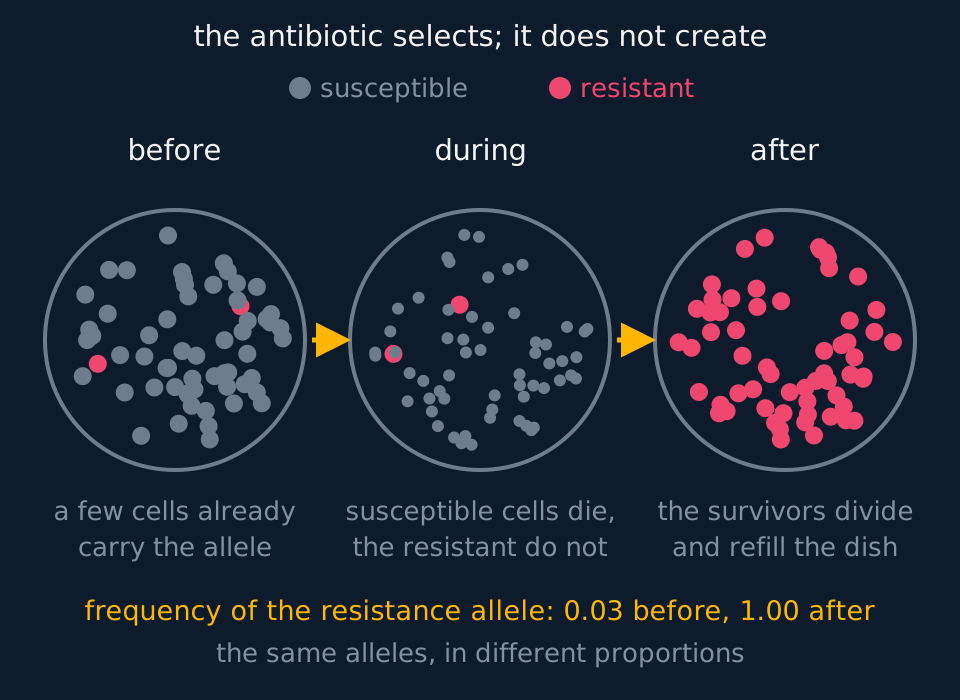
A bacterial population may contain resistance variants before treatment; additional variants can arise during replication or arrive by horizontal gene transfer. An antibiotic inhibits susceptible bacteria more strongly than resistant bacteria, so resistant cells leave a larger proportion of the descendants. The antibiotic selects existing or newly arising variation; it does not direct bacteria to acquire the required mutation.
The numbers make pre-existing variants likely. Bacteria divide quickly, and Escherichia coli can manage it in twenty minutes under favourable conditions. A low mutation rate per base per division, multiplied by a population of 10⁹ cells in a single infection, gives a high probability that some cells carry a mutation affecting a protein the drug acts on.
Describe the drawing
Three circular dishes of bacteria in a row. In the first, sixty cells are drawn and two of them are coral, marking cells that already carry a resistance allele before any antibiotic is given. In the second, the grey susceptible cells are shrunken and dying while the two coral cells are untouched. In the third the dish is full again and every cell is coral. Arrows run between the dishes and the allele frequency is printed underneath as rising from zero point zero three to one.
The mechanisms of resistance are named separately, since a question may ask how a stated mutation causes resistance. A mutation may change the shape of the drug's target protein so the drug no longer binds. This is how streptomycin and rifampicin resistance work, by altering the ribosome and RNA polymerase. It may produce an enzyme that destroys the drug: β-lactamase hydrolyses the β-lactam ring of penicillins. It may increase production of an efflux pump that removes the drug faster than it enters, or reduce the permeability of the cell envelope.
The selection that follows is severe: for a susceptible cell, relative fitness in the presence of the drug is close to zero. Susceptible cells are inhibited or killed while resistant cells are not, and because the susceptible cells were also competitors for nutrients, the survivors grow into space and resources previously shared. Within hours the population is rebuilt from the survivors and most cells carry the resistance allele. No cell changed its genotype in response to the drug.
- Antibiotic
- A substance produced by a microorganism, or a synthetic derivative of one, that kills or inhibits the growth of bacteria.
- Antibiotic resistance
- The ability of a bacterium to survive and reproduce in a concentration of an antibiotic that would kill or inhibit others of its species.
- Vertical gene transfer
- Passing genes from a parent cell to its daughter cells by binary fission.
- Horizontal gene transfer
- Passing genes between bacteria that are not parent and offspring, most often on a plasmid transferred by conjugation.
Resistance often carries a cost. A ribosome altered so that streptomycin cannot bind is usually less efficient, and a cell running efflux pumps expends ATP on them. In the absence of the drug, resistant strains are often at a small disadvantage, so resistance frequencies can fall when use of an antibiotic is reduced across a population. The effect is limited: compensatory mutations can restore the lost efficiency while retaining the resistance.
Bactericidal and bacteriostatic antibiotics
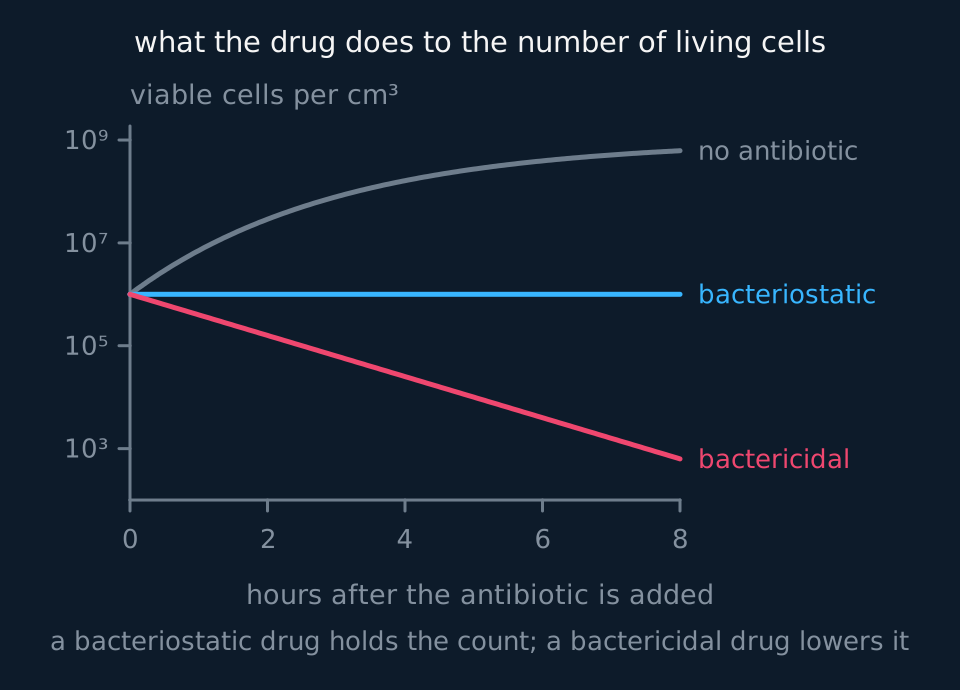
Antibiotics fall into two groups by what they do to the bacteria they reach. A bactericidal antibiotic kills bacteria, so the number of living cells falls while the drug is present. A bacteriostatic antibiotic stops bacteria growing and dividing without killing them, so the number of living cells stays roughly where it was, and the infection is cleared by the patient's phagocytes and antibodies. Pearson Edexcel Biology B names penicillin as the example of the first and tetracycline as the example of the second.
Describe the drawing
A graph of the number of living bacteria per cubic centimetre, on a logarithmic scale from ten cubed to ten to the ninth, against hours after an antibiotic is added. Three cultures start at ten to the sixth. The grey culture with no antibiotic rises towards ten to the ninth. The cyan culture given a bacteriostatic antibiotic stays level at ten to the sixth. The coral culture given a bactericidal antibiotic falls steadily to below ten cubed after eight hours.
Penicillin acts on the cell wall. The wall of a bacterium is peptidoglycan (murein): long polysaccharide chains joined to one another by short peptide cross-links, which give the wall its strength. Penicillin binds to and inhibits the enzymes, transpeptidases, that form those cross-links. A growing cell is constantly opening its wall to insert new material, so in the presence of penicillin it goes on building wall that cannot be cross-linked and is weak. The cytoplasm has a lower water potential than the fluid outside, water enters by osmosis, and with no strong wall to resist the pressure the cell bursts. That is osmotic lysis, and it is why penicillin is bactericidal. It also explains two limits on the drug: it affects only bacteria that are growing and making new wall, and it does not act on human cells, which have no cell wall.
Tetracycline acts on protein synthesis. It enters the bacterial cell and binds to the small (30S) subunit of the 70S ribosome, where it stops tRNA molecules carrying amino acids from binding. No further amino acids are added to the growing polypeptide, so the cell cannot make the enzymes and structural proteins it needs to grow and divide. The cell is not destroyed, and the binding is reversible: if the drug is removed before the immune system has cleared the bacteria, they start to grow again. Human cells are much less affected because their cytoplasmic ribosomes are the larger 80S type and bacteria take up the drug far more readily than human cells do.
- Bactericidal antibiotic
- An antibiotic that kills bacteria, so the number of living cells falls while it is present. Penicillin is an example.
- Bacteriostatic antibiotic
- An antibiotic that stops bacteria growing and dividing without killing them, leaving the immune system to remove them. Tetracycline is an example.
| Bactericidal: penicillin | Bacteriostatic: tetracycline | |
|---|---|---|
| Effect on the bacteria | Kills them | Stops growth and division |
| Viable count while the drug is present | Falls | Stays about level |
| Target | Transpeptidases that cross-link the peptidoglycan wall | 30S subunit of the 70S ribosome |
| What happens to the cell | Weak wall, water enters by osmosis, the cell bursts | Protein synthesis stops, so the cell cannot grow or divide |
| If the drug is removed early | Cells already lysed stay dead | Surviving cells can grow again |
The difference matters clinically because a bacteriostatic drug only holds the population still. Clearing the infection is left to the patient's white blood cells, so where those are few or cannot reach the bacteria well, a bactericidal drug is normally preferred. Examples are a patient whose neutrophil count has been lowered by chemotherapy, and infections of the heart valves or of the membranes around the brain. There is a second consequence. Penicillin kills only growing cells, so giving a bacteriostatic drug alongside it can reduce its effect, since the cells it would have killed have stopped growing.
The two groups are not absolute. Whether a drug kills or only inhibits can depend on its concentration and on the species of bacterium, and a drug is classed by what it does at the concentrations used in treatment.
A clear zone round an antibiotic disc on an agar plate, the result of the core practical on the effect of different antibiotics, shows that growth was prevented but cannot show which kind of drug prevented it. To find out, sterile technique is used to transfer a sample from the clear zone to fresh agar or broth with no antibiotic and incubate it. Growth means the cells were alive and only held back, so the drug was bacteriostatic at that concentration; no growth means they had been killed. Counting viable cells at intervals after adding the drug, as in the figure, gives the same answer quantitatively.
Two processes behind a rise in resistance
A rise in the frequency of resistance involves two distinct processes, which a complete answer separates.
The first is vertical transfer: a resistant cell divides and both daughters are resistant. This makes the frequency of a resistance allele rise within a population, and it is ordinary natural selection running at the speed bacteria divide.
The second is horizontal transfer, which has no equivalent in sexual inheritance between parent and offspring. Resistance genes are very often carried on plasmids, small circular loops of DNA separate from the main chromosome, and a plasmid can be copied and passed to another bacterium through a conjugation tube, including one of a different species. A plasmid may carry resistance to several antibiotics at once, which is how multiple resistance appears in one step. Bacteria also take up free DNA by transformation, and bacteriophages move DNA between cells by transduction.
A rise in resistance therefore involves both an increase in the number of resistant lineages and movement of the genes between lineages and species. The second accounts for a resistance gene first recorded in a harmless gut bacterium later appearing in a pathogen. MRSA, meticillin-resistant Staphylococcus aureus, rests on an acquired gene, mecA, encoding a penicillin-binding protein that β-lactam antibiotics cannot inhibit.
Describe the drawing
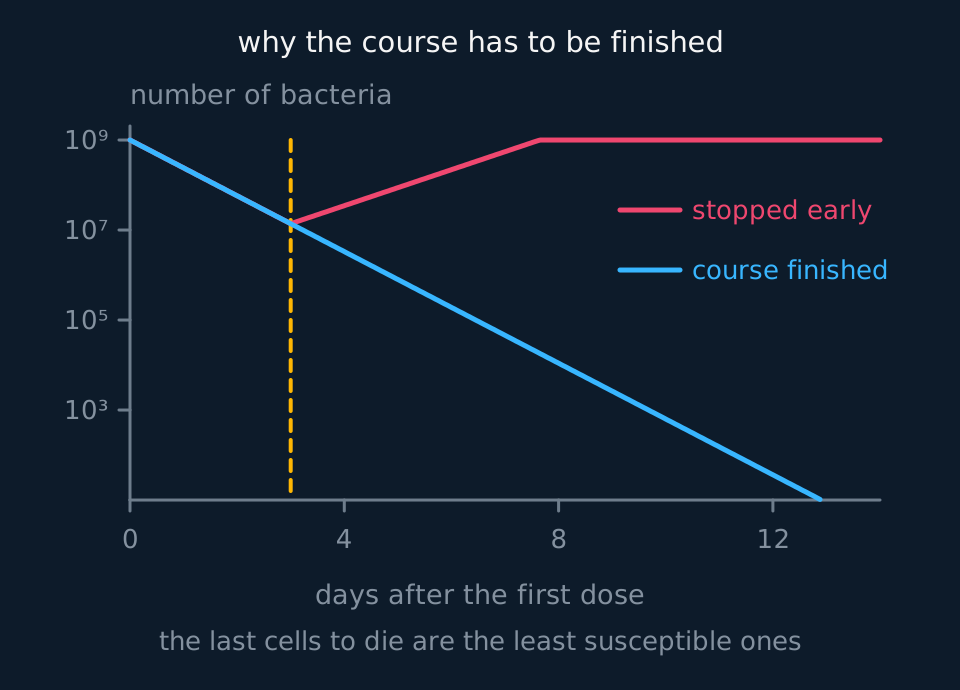
A graph of bacterial numbers on a logarithmic scale from ten cubed to ten to the ninth against days after the first dose. Two curves lie on top of each other for the first three days as the population falls. At an amber dashed line marking day three the coral curve turns and climbs back to its starting height, while the cyan curve carries on falling until it leaves the bottom of the scale.
Treatment duration acts on the same distribution. The cells in an infection are not equally susceptible, and the most susceptible are inhibited first. Treatment stopped when symptoms resolve leaves a non-random sample of cells: the least susceptible, including any carrying partial resistance. Those cells can regrow, and the population that follows is less susceptible than the one that started.
The evidence on duration is more qualified than the usual summary suggests. Since around 2017 a number of clinicians have argued that unnecessarily long courses prolong selection on a patient's other bacteria, and shorter evidence-based courses are now prescribed for several infections. Patients should take antibiotics exactly as prescribed; the appropriate duration depends on the infection, the drug and current clinical evidence.
Hospital-acquired infections and codes of practice
A hospital-acquired infection (HAI) is one a patient picks up while in hospital: it was neither present nor incubating when they were admitted, and for counting purposes it is usually one that appears 48 hours or more after admission. The two best-known examples are MRSA and Clostridioides difficile, still often written Clostridium difficile or C. diff.
C. difficile shows how antibiotic use itself causes infection. It is an anaerobic bacterium that forms spores and can live in the gut in small numbers, held down by competition from the much larger population of harmless gut bacteria. A broad-spectrum antibiotic kills many of those competitors while C. difficile survives, so it multiplies and releases toxins that damage the lining of the colon, causing diarrhoea and in severe cases life-threatening colitis. Its spores survive for long periods on surfaces and are not killed by alcohol hand gel.
The contributory causes explain why hospitals concentrate infections, and resistant ones in particular:
Heavy antibiotic use. Patients in hospital receive antibiotics far more often than people in the community, so selection for resistance is strong and continuous, and broad-spectrum drugs clear the way for C. difficile.
Vulnerable patients. Many patients are elderly, recovering from surgery or have immune systems weakened by illness or treatment, so a smaller dose of a pathogen is enough to cause disease.
Breaches of the body's barriers. Surgical wounds, urinary catheters, intravenous cannulas and ventilator tubes give bacteria a route past the skin and mucous membranes.
Transmission between patients. Patients are close together and staff move from one to the next, so bacteria are carried on hands, clothing and shared equipment. Some patients and staff carry Staphylococcus aureus, including MRSA, in the nose or on the skin without any symptoms, and patients are moved between wards and between hospitals.
Each cause has led to a part of the codes of practice hospitals now follow. These fall into two groups: rules on prescribing antibiotics, often called antimicrobial stewardship, and rules on infection prevention and control.
Prescribing codes reduce the selection pressure. Antibiotics are prescribed only where a bacterial infection is likely, never for a viral one. A sample is taken for culture and sensitivity testing before treatment where possible, so a broad-spectrum drug started on suspicion can be changed to a narrow-spectrum one that targets the organism found. Prescriptions are reviewed after two or three days and stopped or changed if they are not needed, which in England is the basis of the national guidance called Start Smart then Focus. Some antibiotics are held in reserve and used only on a microbiologist's advice, so resistance to them is not selected for while other drugs still work.
Infection prevention and control codes break the chain of transmission:
| Contributory cause | Code of practice that follows from it |
|---|---|
| Bacteria carried between patients on hands | Hand hygiene before and after every patient contact; soap and water, not gel alone, where C. difficile is suspected |
| Bacteria carried on clothing and equipment | Disposable gloves and aprons changed between patients; bare below the elbows; equipment cleaned between patients or kept for one patient |
| Spores and bacteria surviving on surfaces | Cleaning schedules, with chlorine-based disinfectants that kill spores on wards with C. difficile |
| Carriers admitted without symptoms | Screening on admission, such as nose swabs for MRSA, with carriers treated with antiseptic washes and nasal ointment |
| Infected patients spreading bacteria to others | Isolation in a side room, or nursing infected patients together as a group with their own staff |
| Routes past the skin | Aseptic technique for surgery and for inserting lines and catheters, sterilised instruments, and devices removed as soon as they are no longer needed |
| Antibiotic use selecting for resistance and for C. difficile | The prescribing codes above |
Surveillance ties the two together. In England hospitals must report cases of MRSA bloodstream infection and C. difficile infection, so a rise on one ward or in one hospital is noticed and investigated. Both fell substantially in the years after these codes were brought in, but the measures arrived together, so the data cannot show how much each one contributed.
- Hospital-acquired infection
- An infection that a patient acquires while in hospital, which was not present or incubating on admission. MRSA and Clostridioides difficile are examples.
- Infection prevention and control
- The hospital practices that stop pathogens spreading between patients, such as hand hygiene, screening, isolation and cleaning.
Pesticide and herbicide resistance
The same mechanism operates in agricultural populations. Each case has four components: variation already present, a severe and uniform selection pressure applied by people, a short generation time, and a large population.
Insecticide resistance in mosquitoes is one example. Anopheles carrying a mutation in the voltage-gated sodium channel, the target of pyrethroids, in a change called knockdown resistance, survive treated bed nets that kill their neighbours. Pyrethroid resistance is now widespread across sub-Saharan Africa, within a couple of decades of nets being distributed at scale.
Warfarin resistance in rats shows a different outcome. Warfarin blocks the enzyme VKORC1, which recycles vitamin K, so poisoned rats bleed to death, and a resistance allele spread rapidly through British rat populations after warfarin was introduced in the 1950s. But homozygous resistant rats need far more vitamin K than they can normally obtain, so where warfarin is used the heterozygote is the fittest genotype and the population settles at an intermediate allele frequency rather than going to fixation. That is heterozygote advantage, the same pattern as in the sickle-cell allele.
Herbicide resistance follows from the same mechanism, and glyphosate-resistant weed populations are established on farmland in North America and Australia. The agricultural response is designed around the biology: rotating chemicals with different modes of action so no single pressure is applied for long, and, for insect-resistant Bt crops, planting a refuge of non-Bt plants alongside. The refuge keeps susceptible insects breeding, so a rare resistant survivor is likely to mate with a susceptible one and produce heterozygous offspring, which the toxin still kills where resistance is recessive.
| Antibiotic resistance | Pesticide resistance | |
|---|---|---|
| Population under selection | Bacteria in a patient or on a farm | Insects or weeds in a treated field |
| Source of the resistant allele | Mutation, or a gene acquired on a plasmid | Mutation already present in the population |
| Speed | Days to weeks; generation time about 20 minutes | Years to decades; one to many generations a year |
| Why the selection is so strong | The drug kills nearly all susceptible cells | The dose is set to kill nearly all susceptible individuals |
| Slowed by | Prescribing less, finishing prescribed courses, hygiene, rotating drugs | Rotating chemicals, refuges of untreated crop, integrated pest management |
Four independent lines of evidence
Resistance observed in a bacterial population demonstrates the mechanism. The claim that the same mechanism produced the diversity of life rests on separate evidence, drawn from fields whose findings could have conflicted and do not.
Palaeontology. The fossil record puts organisms in an order: simple prokaryote-like forms in the oldest rocks, and major groups appearing in a sequence matching the order predicted by their anatomy. Transitional fossils exist where the argument most needs them: Tiktaalik between lobe-finned fish and tetrapods, Archaeopteryx between theropod dinosaurs and birds, and a series of whale ancestors with progressively reduced hind limbs. The record is incomplete, because fossilisation requires rapid burial and soft tissues rarely survive. State that limitation alongside the evidence.
Comparative anatomy. The pentadactyl limb is the standard case. The forelimb of a human, a bat, a whale and a horse is built on the same plan of bones: one upper arm bone, two forearm bones, wrist bones and digits, although in the horse the ulna is reduced and only one digit is fully formed. The limbs perform different functions. Independent origins would not predict the shared arrangement; descent with modification from a common ancestral limb does. Structures like this are homologous: same origin, different function, evidence of divergent evolution. Analogous structures, such as the wing of a bird and the wing of an insect, perform the same function with different underlying structures, and are evidence of convergent evolution rather than of relatedness.
Comparative biochemistry. Living organisms share core molecular systems: a nearly universal genetic code, the same set of twenty amino acids in proteins, and ATP as the immediate energy currency. A small number of variant genetic codes are known, in some mitochondria and some protoctists, and these are themselves derived from the standard code. Conserved molecules can be compared between species. Cytochrome c is identical in humans and chimpanzees, differs by about a dozen amino acids between humans and horses, by around twenty between humans and a tuna, and by more than forty between humans and yeast, a pattern matching the branching order the fossils and the anatomy already gave. Ribosomal RNA does the same job over greater distances, and it was rRNA comparison that separated the archaea from the bacteria. Where mutations accumulate at a steady rate, the number of differences estimates the time since two lineages diverged: a molecular clock.
Biogeography. The distribution of species across the land masses follows their history rather than their climates. Most of Australia's native land mammals other than bats are marsupials, filling niches that placentals fill elsewhere, because the continent became isolated before placental mammals spread there. Its native placentals are bats, which could fly in, and rodents that reached it from Asia far more recently. Oceanic islands hold endemic species closely related to those on the nearest mainland, among them the Galápagos finches and the Hawaiian Drosophila, and, before humans arrived, characteristically lacked whole groups such as native land mammals and amphibians that cannot cross an ocean.
Exam-board note. OCR Biology A asks explicitly for fossil, DNA and molecular evidence in module 4 (4.2.2(e)), alongside Darwin and Wallace. AQA covers the same material largely through DNA and amino acid sequence comparison in its classification content, and Cambridge International examines molecular evidence alongside classification. The argument in each case is that the lines of evidence are independent and agree, rather than that any one of them is decisive alone.
Darwin, Wallace and the formulation of the theory
Exam-board note: OCR Biology A requires the historical contributions of Darwin and Wallace to the formulation of the theory. Neither man originated the idea that species change. That had been in circulation for decades, and Jean-Baptiste Lamarck had published a mechanism for it in 1809, in which characteristics acquired during an organism's life were passed on. What was missing was a mechanism that worked, and both Darwin and Wallace arrived at the same one independently.
Charles Darwin sailed as naturalist on HMS Beagle from 1831 to 1836 and spent the voyage collecting and recording. The observations that mattered most came from South America and the Galápagos: fossils of extinct giant mammals that plainly resembled the living animals of the same continent, mockingbirds and finches that differed from island to island, and giant tortoises whose shell shape a resident could use to say which island an animal came from. Back in England he read Thomas Malthus on human population in 1838, and the missing piece arrived with it: populations produce far more offspring than can survive, so most of them must die before breeding, and which ones die is not random. Darwin then spent twenty years gathering evidence, including eight years on barnacles, breeding pigeons, and corresponding with animal breeders and gardeners across the country, and published nothing on natural selection.
Alfred Russel Wallace was a working collector who funded his own expeditions by selling specimens, first in the Amazon and then across the Malay Archipelago. He noticed the same regularities Darwin had, and rather more sharply on distribution. The faunal boundary now called the Wallace Line is his: it runs between Borneo and Sulawesi and on between Bali and Lombok, and puts an Asian fauna on one side of a strait a few tens of kilometres wide and a quite different one on the other. In 1858, ill with fever on Ternate, he wrote a short essay setting out natural selection and posted it to Darwin, whom he knew as a correspondent, asking him to pass it on if he thought it worth anything.
What happened next is why the theory carries both names. Darwin, recognising that Wallace had reached the same mechanism, put the matter to his friends Charles Lyell and Joseph Hooker, and on 1 July 1858 the Linnean Society of London heard Wallace's essay read alongside extracts from Darwin's unpublished work of 1844 and a letter he had written in 1857. Neither man was present. Darwin then wrote On the Origin of Species at speed and published it in November 1859, which is why it is his book that changed the argument. The two men remained on good terms, and it was Wallace who later published a book called Darwinism.
Two limitations of their account are examinable. Neither of them knew how inheritance worked: Mendel's paper appeared in 1866 and was ignored until 1900, so Darwin was left with a blending theory that should have destroyed variation within a few generations, and he never solved it. And neither had any idea where new variation came from, because mutation was not described until the twentieth century. The modern synthesis of the 1930s and 1940s, which married natural selection to Mendelian genetics and to population mathematics, produced the version of the theory taught today.
Changes in allele frequency that selection did not cause
Not every change in a gene pool is adaptive. A difference between populations requires evidence of a fitness effect before it can be described as an adaptation.
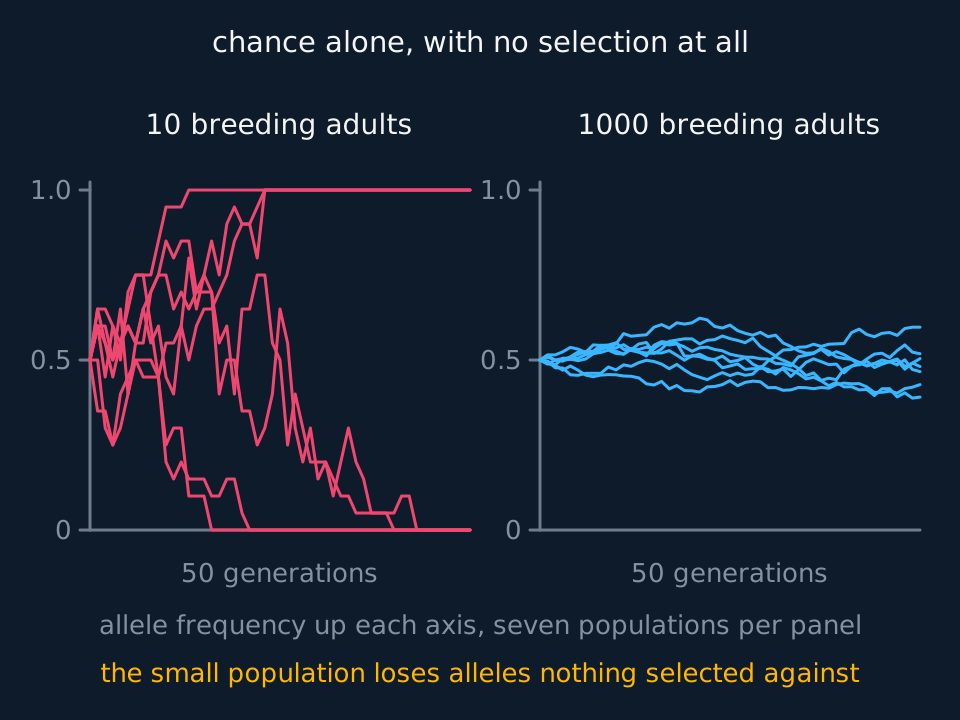
Genetic drift is change in allele frequency caused by chance alone. In any finite population the alleles reaching the next generation are a sample of those in this one, and a sample deviates from the population it is drawn from. Which individuals breed, which gametes combine and which juveniles die from causes unrelated to their genotype all change allele frequencies without any difference in fitness. The smaller the population, the larger the expected deviation, for the same statistical reason that ten coin tosses depart further from half than a thousand do.
Describe the drawing
Two graphs side by side, each plotting allele frequency from zero to one against fifty generations for seven separate populations that all started at one half. In the left panel, for ten breeding adults, the coral traces wander widely and some reach zero or one and stay there. In the right panel, for a thousand breeding adults, the cyan traces stay in a narrow band close to one half throughout.
Drift eventually leads to fixation, with one allele reaching a frequency of 1 while the other is lost, and a lost allele can only return by mutation or migration. And drift can fix a mildly harmful allele or lose a mildly beneficial one, because in a small population chance overwhelms a small fitness difference. Conservation genetics treats small population size as a threat for that reason.
- Genetic drift
- A change in allele frequencies from one generation to the next caused by chance sampling of gametes, rather than by selection. Its effect is greatest in small populations.
- Genetic bottleneck
- A sharp reduction in population size that leaves the survivors carrying only a fraction of the original genetic diversity.
- Founder effect
- The reduced and unrepresentative genetic diversity of a population established by a small number of individuals separated from a larger population.
A bottleneck is drift acting through a sharp reduction in population size. Northern elephant seals were hunted down to a few dozen animals in the 1890s; the species has recovered to hundreds of thousands but retains little genetic variation, because the alleles lost were not present in the survivors and later breeding cannot restore them. Cheetahs show the same pattern from an older event, to the point that unrelated individuals accept skin grafts from one another.
The founder effect is the same sampling process at the establishment of a population rather than during its history. When a few individuals colonise an island or found a settlement, the alleles they carry are a small sample of the parent gene pool, and any allele they happen to carry at unusual frequency will be at that frequency in all their descendants. Hence conditions far commoner in some human populations than in the world at large: Ellis-van Creveld syndrome among the Old Order Amish, descended from around two hundred eighteenth-century founders, and variegate porphyria among Afrikaners, traceable to a single seventeenth-century couple. No selection for those alleles is involved.
TRY IT: Telling drift and selection apart from data
Two island populations of the same beetle species are studied. Island P holds about 60 beetles; island Q holds about 40 000. Both were colonised from the same mainland population 200 years ago. A gene has two alleles. On the mainland their frequencies are 0.5 and 0.5. On island P they are 0.93 and 0.07; on island Q they are 0.51 and 0.49. There is no evidence that the allele affects survival or reproduction on either island.
Explain the difference between the two islands.
Check your answer
The difference is caused by genetic drift, not selection: the question states that the allele does not affect survival or reproduction, so no selection pressure acts on it and the change cannot be adaptive.
Island P holds a very small population. Each generation the alleles passed on are a small random sample of those present, and small samples deviate a great deal from what they are drawn from. Over two hundred years of such sampling the frequency has drifted far from 0.5 and is now near fixation.
Island Q holds a large population, so the sampling error each generation is tiny and the frequency has stayed close to where it started.
The founder effect may also contribute on island P: if the colonists were few, the frequency was probably already unrepresentative before drift began.
A complete answer names the mechanism, links its magnitude to population size, and states that the data support no adaptive explanation.
Core practical 15: investigate the effect of different antibiotics on bacteria
optional
Pearson Edexcel Biology A (9BN0) sets Core Practical 15: Investigate the effect of different antibiotics on bacteria, printed between statements 6.14 and 6.15. Paper discs, each carrying one antibiotic, are laid on a lawn of bacteria spread over agar. Each antibiotic diffuses out of its disc, and where it is concentrated enough to stop growth a clear zone of inhibition forms. The sizes of the zones compare how well the antibiotics stop that bacterium growing under the conditions of the plate.
The apparatus: a broth culture of a bacterium that your school's risk assessment approves, from a recognised supplier; sterile nutrient agar plates; a sterile pipette and a sterile spreader; commercially prepared antibiotic discs, either single discs or a multi-antibiotic disc with several arms, each carrying a fixed amount of one antibiotic and printed with its code; plain sterile paper discs; sterile forceps; a Bunsen burner; tape; a marker pen; a ruler; an incubator; and disinfectant. The antibiotics are used only on these prepared discs.
| Step | What to do | Why |
|---|---|---|
| 1 | Disinfect the bench, wash your hands, and label the base of each plate round its edge. Work beside a lit Bunsen burner, or as your school's practice directs | The flame is usually said to keep airborne microorganisms away from an open plate; lids can be swapped, bases cannot |
| 2 | Flame the neck of the culture bottle, take the volume the method gives with a sterile pipette, and flame the neck again before replacing the cap. Lift the lid only far enough to add the culture, spread it over the whole surface, and replace the lid | An even lawn gives every disc the same density of bacteria |
| 3 | With sterile forceps, place the antibiotic discs and one plain disc well apart, press each gently into full contact with the agar, and do not move a disc once it is down. Mark each position on the base | The plain disc is the negative control; a disc that is moved leaves antibiotic in two places |
| 4 | Tape the lid with two or four short strips, never all the way round. Invert the plate and incubate it for two to three days at no higher than the temperature the school's risk assessment sets, well below body temperature | Sealing all round can make the plate anaerobic and favour anaerobic bacteria; a lower temperature avoids favouring organisms that grow well in people |
| 5 | Without opening the plate, measure the diameter of each clear zone across its disc, twice at right angles | Zones are rarely perfect circles |
The independent variable is the antibiotic. The dependent variable is the area of the zone of inhibition. Control the bacterium and the age and volume of culture spread, the depth and batch of agar, the time between spreading the culture and placing the discs, the spacing of the discs, and the incubation temperature and time. The amount of antibiotic on each disc is fixed by the manufacturer. The plain disc shows that the paper alone does not stop growth. Set up at least three plates.
Take the mean of the two diameters for each zone and then across the plates, halve it for the radius r, and calculate the area of the zone as πr². Where bacteria grow up to the edge of a disc, record no zone.
Comparing four antibiotics
These results are invented to show the processing. Antibiotics P, Q, R and S were tested against one bacterium on three plates. The mean zone diameters were 22 mm for P, 14 mm for Q and 18 mm for S. R and the plain disc had bacteria growing up to their edges on every plate. Calculate the area of each zone, rank the antibiotics, and compare P with Q.
Show the working
The radii are 11, 7 and 9 mm. Areas: P π × 11² = 380 mm²; Q π × 7² = 154 mm²; S π × 9² = 254 mm²; R has no zone.
Ranked by zone area: P, S, Q, then R. At the amount on its disc R did not inhibit this bacterium, which is resistant to it under these conditions.
P's zone has 380 ÷ 154 = 2.5 times the area of Q's, though its diameter is only 22 ÷ 14 = 1.6 times as large. State whether a comparison uses diameters or areas.
The ranking holds for these discs on this agar, and it does not decide which antibiotic a doctor should prescribe. Different discs carry different amounts of drug, and antibiotics diffuse through agar at different rates, so a large zone does not by itself show a more effective antibiotic. Clinical laboratories judge each antibiotic's zone against a published breakpoint for that antibiotic, not against the other zones. A clear zone also cannot show whether the bacteria were killed or only stopped from dividing; the subculture test for that, in the section on bactericidal and bacteriostatic antibiotics, means opening a grown plate, which is done only where the school's risk assessment allows it. Colonies growing inside a clear zone may be resistant cells selected by the antibiotic, or contaminants, and either is a reason to keep the plate shut.
| Source of error | Effect | Improvement |
|---|---|---|
| Discs placed at different times after spreading | Bacteria have a head start round later discs, so their zones are smaller | Place every disc within a few minutes and treat every plate alike |
| A disc not in full contact with the agar | Little antibiotic diffuses out, giving a small or lopsided zone | Press each disc down gently with sterile forceps |
| Discs out of date or stored warm | Some antibiotic has broken down, so zones are too small | Use discs within date, stored as the supplier directs |
| Arms of a multi-antibiotic disc close together | Zones merge and cannot be measured | Use single discs spaced well apart |
| Contamination from the air or hands | Colonies that are not the culture | Open the lid as little as possible beside the flame; incubate an uninoculated plate alongside, which should grow nothing |
Risk assessment. Treat every culture as a possible pathogen, use only the culture your school's risk assessment approves, and never culture organisms from yourself or your surroundings. Anyone allergic to penicillin or another antibiotic says so before the practical. Handle discs only with forceps, and wash your hands afterwards. The plate selects for resistant bacteria, which is one more reason it stays taped once incubated and is examined through the lid, never opened unless the risk assessment allows it. Report a spill at once and leave it to be dealt with by the school's procedure. Tie long hair back near the Bunsen burner. Every plate and culture is killed by autoclaving or pressure-cooking before disposal. Check the CLEAPSS guidance and your school's risk assessment before starting; where they differ from this page, follow them.
- Zone of inhibition
- The clear area round a disc on a lawn of bacteria, where a substance diffusing from the disc has stopped the bacteria growing.
- Antibiotic disc
- A small disc of absorbent paper carrying a fixed amount of one antibiotic, laid on a lawn of bacteria to test whether that antibiotic stops them growing.
In the exam
- In a resistance answer, put the variation before the drug: state that resistance variants were already present or arose independently of treatment, then that the antibiotic selected among them.
- Where a question mentions a plasmid, name horizontal gene transfer by conjugation and state that it can move the gene between species.
- Give the reason for completing a prescribed course as the removal of the least susceptible cells, rather than as killing all the bacteria.
- In an evidence question, give two named lines of evidence and state that they are independent of each other.
- Define drift as a chance change with no fitness difference involved, and link its magnitude to population size. Where a question states that the allele has no effect on survival, selection is excluded by the question.
- Bottleneck and founder effect are both drift. The bottleneck happens to an existing population; the founder effect happens when a new one starts.
- Darwin and Wallace reached natural selection independently and it was read jointly in 1858; neither knew how inheritance worked, and neither knew where new variation came from.
- Bactericidal kills; bacteriostatic stops growth and division and leaves the killing to the immune system. Give penicillin and tetracycline with their targets: the cross-links of the cell wall, and the 70S ribosome.
- For a hospital-acquired infection question, link each code of practice to the cause it removes: hand hygiene to transmission on hands, screening to symptomless carriers, narrow-spectrum prescribing to selection pressure.
- A larger zone of inhibition means the antibiotic stopped growth over a wider area of the plate. It does not show whether the bacteria were killed, and it does not by itself rank antibiotics for treatment.
Check yourself
A hospital finds that the proportion of Staphylococcus aureus isolates resistant to a particular antibiotic has risen from 4% to 61% over eight years. A newspaper reports that 'the bacteria have learned to fight off the drug'. Explain what has actually happened, and describe two different processes that could have contributed to the rise.
Answer
No bacterium learned or changed anything. The alleles conferring resistance were already present in a small minority of cells, or arose by random mutation during the eight years; either way they were not produced in response to the drug, and the rise in the proportion of resistant isolates is a change in allele frequency produced by selection.
Use of the antibiotic in the hospital is the selection pressure. Susceptible cells are killed and resistant cells survive and reproduce, so each course of treatment leaves behind a population in which the resistance allele is commoner. Repeated over eight years, that raises the proportion of resistant isolates.
First process: vertical transfer. A resistant cell divides by binary fission and both daughter cells inherit the allele, so resistant lineages increase in number within the hospital's bacterial population.
Second process: horizontal transfer. Resistance genes are often carried on plasmids, which can be passed by conjugation to unrelated bacteria, including bacteria of other species. A previously susceptible cell can therefore become resistant without any mutation of its own, and this can move resistance into the population far faster than division alone.
A third contribution is migration rather than change within the population: resistant strains may be introduced from outside the hospital.
Questions
Question 14 marks
Compare vertical and horizontal gene transfer as ways in which antibiotic resistance spreads among bacteria.
Mark scheme
- B1 vertical transfer passes the gene from a parent cell to its daughter cells at binary fission, whereas horizontal transfer passes it between bacteria that are not parent and offspring
- B1 vertical transfer raises the frequency of the allele within one population as resistant lineages increase, whereas horizontal transfer puts the gene into cells that never carried it and never mutated
- B1 vertical transfer is confined to descendants of the original resistant cell, whereas a plasmid passed through a conjugation tube can carry the gene to bacteria of a different species, which is how a gene first seen in a harmless gut bacterium turns up later in a pathogen
- B1 a single plasmid may carry resistance to several antibiotics, so horizontal transfer can produce multiple resistance in one step, which vertical transfer cannot
Question 24 marks
Describe three independent lines of evidence for common ancestry, and describe why the agreement between such lines matters.
Mark scheme
- B1 the fossil record places organisms in an order, with simple prokaryote-like forms in the oldest rocks and major groups appearing in a sequence matching that predicted by their anatomy, including transitional forms such as Tiktaalik between lobe-finned fish and tetrapods
- B1 comparative anatomy: the forelimb of a human, a bat, a whale and a horse is built on the same plan of bones, used for entirely different jobs, which modification of one ancestral limb explains and independent design does not
- B1 comparative biochemistry: all life uses the same genetic code, the same twenty amino acids and ATP, and conserved molecules such as cytochrome c differ at more positions between more distantly related species
- B1 these lines come from fields that could have contradicted one another and do not, so their agreement is the argument
Question 34 marks
Explain how genetic drift changes the allele frequencies of a population, and explain why its effect is largest in a small population.
Mark scheme
- B1 the alleles reaching the next generation are a sample of those present in this one, decided by which individuals happen to breed and which gametes happen to meet
- B1 events such as which juvenile happens to be standing under a falling branch have nothing to do with fitness, so the frequencies shift with no selection acting at all
- B1 a small sample deviates further from what it is drawn from than a large one, for the same reason that ten coin tosses stray further from half than a thousand do, so the change each generation is larger in a small population
- B1 drift can therefore fix one allele and lose the other altogether, including a mildly beneficial one, because in a small population chance overwhelms a small difference in fitness, and a lost allele returns only by mutation or migration
Question 44 marks
Glyphosate-resistant weed populations have become established on farmland in North America. Explain how repeated use of a single herbicide leads to a weed population the herbicide no longer controls, and explain why farmers are advised to rotate between herbicides with different modes of action.
Mark scheme
- B1 a rare mutation giving resistance is already present in the weed population before the herbicide is used
- B1 the herbicide is a severe selection pressure: susceptible plants are killed while resistant plants survive and reproduce
- B1 applied year after year, the herbicide removes susceptible weeds every season, so the frequency of the resistance allele in the weed population's gene pool rises
- B1 rotating between herbicides with different modes of action means no single selection pressure is applied for long, so a mutation giving resistance to one herbicide is not favoured every year, slowing the rise in frequency of any one resistance allele
Question 54 marks
Compare homologous structures with analogous structures, using the forelimb of a bat and the forelimb of a human as one example and the wing of a bird and the wing of an insect as the other.
Mark scheme
- B1 homologous structures, such as the forelimb of a bat and of a human, share the same underlying bone arrangement but perform different functions, which is evidence of divergent evolution from a common ancestor
- B1 analogous structures, such as the wing of a bird and the wing of an insect, perform the same function but have different underlying structures, which is evidence of convergent evolution rather than of common ancestry
- B1 independent origins would not be expected to produce the shared bone arrangement seen in the bat and human forelimb, whereas descent with modification from one ancestral limb explains it directly
- B1 analogous structures arise because unrelated lineages face the same functional problem, such as flight, and evolve similar solutions independently rather than because they share a recent common ancestor
Question 64 marks
The Galápagos Islands are volcanic islands about 1000 km off the coast of South America and have never been joined to a continent. More than a dozen species of finch live there and nowhere else. DNA comparisons show that these species are more closely related to one another than to any bird on the mainland. The species differ mainly in the size and shape of their beaks, each suited to the food it eats. Explain how this pattern provides evidence that these species evolved from a common ancestor.
Mark scheme
- B1 the islands were never joined to the mainland, so the first finches must have arrived across the sea, and the close relationship of all the species to one another points to a single founding population
- B1 populations on different islands were separated by sea, so there was little or no gene flow between them
- B1 different food on different islands meant different selection pressures: birds whose beaks suited the available food survived and reproduced more and passed on their alleles, so beak form changed in each population
- B1 over many generations the populations became so different that they could no longer interbreed, giving several species descended from one ancestor, which is why they are most closely related to one another
Question 74 marks
Cytochrome c differs from the human sequence by about a dozen amino acids in the horse, about twenty in the tuna, and by more than forty in yeast. Explain what this pattern shows about the evolutionary relationships between humans and these species, and explain the principle of a molecular clock.
Mark scheme
- B1 the number of differences increases with evolutionary distance from humans in the order predicted by anatomy and the fossil record, so the horse is more closely related to humans than the tuna, which is more closely related than yeast
- B1 this agreement between an independent source of evidence, molecular sequence comparison, and the branching order already given by anatomy and fossils supports common ancestry, since the two kinds of evidence could have disagreed and do not
- B1 where mutations accumulate at a roughly steady rate over time, the number of sequence differences between two species estimates how long ago they diverged from a common ancestor, which is the principle of a molecular clock
- B1 more amino acid differences therefore indicate an older common ancestor and a longer time since the two lineages diverged
Question 84 marks
Penicillin is bactericidal and tetracycline is bacteriostatic. Describe how each antibiotic acts on a bacterial cell to produce this effect.
Mark scheme
- B1 penicillin inhibits the enzymes (transpeptidases) that form the peptide cross-links between the polysaccharide chains of the peptidoglycan (murein) cell wall
- B1 a growing cell therefore makes a weak wall; water enters by osmosis and the cell bursts (osmotic lysis), so the cell is killed
- B1 tetracycline binds to the 30S subunit of the bacterial 70S ribosome and prevents tRNA carrying amino acids from binding, so translation stops
- B1 without new proteins the cell cannot grow or divide, but it is not destroyed, so the effect is to hold the population still rather than to kill it
Question 94 marks
Three flasks of broth were inoculated with the same bacterium. Antibiotic X was added to flask 1, antibiotic Y to flask 2 and nothing to flask 3. The number of living bacteria was estimated at intervals by dilution plating. The results are in the table, which is constructed for this question. Use the results to explain which antibiotic is bacteriostatic and which is bactericidal, and describe how a sample from flask 2 could be used to confirm your answer.
| Time / hours | Flask 1 (X): living cells per cm³ | Flask 2 (Y): living cells per cm³ | Flask 3 (none): living cells per cm³ |
|---|---|---|---|
| 0 | 1.0 × 10⁶ | 1.0 × 10⁶ | 1.0 × 10⁶ |
| 2 | 1.6 × 10⁵ | 1.1 × 10⁶ | 1.5 × 10⁷ |
| 4 | 2.5 × 10⁴ | 0.9 × 10⁶ | 1.9 × 10⁸ |
| 6 | 4.0 × 10³ | 1.0 × 10⁶ | 6.2 × 10⁸ |
Mark scheme
- B1 Y is bacteriostatic: the number of living cells in flask 2 stays at about 1 × 10⁶ throughout, so the cells are alive but not dividing
- B1 X is bactericidal: the number of living cells in flask 1 falls about 250-fold, from 1.0 × 10⁶ to 4.0 × 10³, in six hours, so cells are being killed
- B1 flask 3 is the control and shows the bacteria grow in this broth without an antibiotic, so the level count in flask 2 is caused by Y
- B1 transfer a sample from flask 2 by aseptic technique into fresh broth or agar with no antibiotic and incubate it; growth shows the cells were inhibited, not killed
Question 104 marks
Explain why infections with antibiotic-resistant bacteria such as MRSA are more common in hospitals than in the wider community.
Mark scheme
- B1 antibiotics are used far more heavily in hospitals, so there is a strong, continuous selection pressure favouring resistant bacteria
- B1 many patients are elderly, recovering from surgery or immunocompromised, so they are more easily infected
- B1 wounds, catheters, cannulas and ventilator tubes give bacteria a route past the skin and mucous membranes
- B1 patients are close together and staff and equipment move between them, so bacteria are transmitted on hands and surfaces, including from symptomless carriers
Question 114 marks
Describe codes of practice for antibiotic prescription in hospitals, and explain how they reduce hospital-acquired infections caused by resistant bacteria.
Mark scheme
- B1 antibiotics are prescribed only when a bacterial infection is likely, and not for viral infections
- B1 a sample is cultured and tested for sensitivity, so a narrow-spectrum antibiotic that targets the identified bacterium can replace a broad-spectrum one
- B1 the prescription is reviewed after two or three days and stopped if not needed, and some antibiotics are kept in reserve for use only on specialist advice
- B1 each of these reduces how often and how widely antibiotics are used, so the selection pressure for resistant strains is lower and harmless competing bacteria are not killed
Question 124 marks
A student tested four antibiotics on a lawn of bacteria and concluded that the antibiotic giving the largest zone of inhibition would be the best one to treat an infection caused by this bacterium. Explain why this conclusion may not be valid.
Mark scheme
- B1 the discs may carry different amounts of each antibiotic, so the zones do not compare equal doses
- B1 antibiotics diffuse through agar at different rates, so zone size reflects diffusion as well as how strongly the antibiotic acts on the bacterium
- B1 a clear zone does not show whether the antibiotic is bactericidal or bacteriostatic, which affects whether it suits a patient whose immune system is weakened
- B1 conditions on an agar plate differ from those in the body: the antibiotic must reach the site of infection and must not harm the patient, which the plate does not test
Question 133 marks
Explain the biological reason a patient is told to finish a prescribed course of antibiotics.
Mark scheme
- B1 the bacteria in an infection are not all equally susceptible, and the most susceptible cells are the ones killed first
- B1 if treatment stops when the symptoms go, the cells left alive are a biased sample: the least susceptible ones, including any carrying partial resistance
- B1 those cells reproduce, so the population that regrows is less susceptible than the one treatment started with, whereas finishing the course removes the tail of the distribution as well as its head
Question 143 marks
A crop is engineered to make a toxin that kills a pest insect, and resistance to that toxin is recessive. Farmers growing it are required to plant a refuge of untreated plants alongside. Suggest how the refuge slows the spread of resistance.
Mark scheme
- B1 the refuge produces no toxin, so susceptible insects go on breeding there in large numbers instead of being killed
- B1 a rare resistant survivor emerging from the treated crop is therefore far more likely to mate with a susceptible insect than with another resistant one
- B1 the offspring of such a pairing are heterozygous, and because resistance is recessive the toxin still kills them, so the allele is not passed on and its frequency rises far more slowly
Question 153 marks
Streptomycin kills bacteria by binding to their ribosomes. In resistant strain A, a mutation has changed the amino acid sequence of one ribosomal protein. Strain B makes an enzyme that chemically modifies the streptomycin molecule. Strain C has more copies of a membrane protein that pumps streptomycin out of the cell. Explain how each change allows the bacteria to survive treatment with streptomycin.
Mark scheme
- B1 strain A: the changed sequence changes the tertiary structure of the ribosome where the drug binds, so streptomycin no longer fits and translation continues
- B1 strain B: the modified streptomycin has a different shape, so it no longer binds to the ribosome
- B1 strain C: the drug is removed as fast as it enters, so its concentration inside the cell stays too low to stop enough ribosomes
Question 163 marks
A warfarin-resistance allele in British rats spread rapidly after warfarin was introduced but settled at an intermediate frequency rather than reaching fixation. Homozygous resistant rats need far more vitamin K than they can normally obtain. Suggest why the resistance allele did not spread to fixation where warfarin is used.
Mark scheme
- B1 homozygous resistant rats suffer from a shortage of vitamin K and are at a disadvantage even where warfarin is used, because they cannot obtain enough of it
- B1 heterozygotes are resistant to warfarin without needing unusually large amounts of vitamin K, so heterozygotes have the highest fitness of the three genotypes: a heterozygote advantage
- B1 selection therefore favours an intermediate allele frequency at which both homozygous genotypes are at a disadvantage relative to heterozygotes, rather than driving the allele to fixation or eliminating it
Question 173 marks
Outline the roles played by Charles Darwin and Alfred Russel Wallace in the formulation of the theory of natural selection.
Mark scheme
- B1 both men independently arrived at the same mechanism of natural selection from their own observations, Darwin from the Beagle voyage and from reading Malthus, Wallace from his own collecting in the Amazon and the Malay Archipelago, without knowing of each other's theory until Wallace wrote to Darwin in 1858
- B1 their work was presented jointly to the Linnean Society in July 1858, and it was Darwin who then published On the Origin of Species in 1859, which is why the theory is usually associated with his name alone despite its joint origin
- B1 neither man knew how inheritance worked or where new variation came from, since Mendel's work was not recognised until 1900 and mutation was not described until the twentieth century, so the modern synthesis of the 1930s and 1940s later supplied the missing mechanisms
Question 183 marks
The Old Order Amish population is descended from around two hundred eighteenth-century founders, and Ellis-van Creveld syndrome, caused by a recessive allele, is far more common among them than in the world population as a whole, with no evidence that the allele affects survival or reproduction. Suggest why this recessive allele is unusually common in this population.
Mark scheme
- B1 the founding population was small, so by chance the frequency of the allele among the individuals who founded the population was higher than its frequency in the larger population they came from: the founder effect
- B1 that unrepresentative frequency has been carried through many generations of a population that has largely bred within itself, keeping the allele common
- B1 no selection is shown, since the question gives no evidence that carriers or affected individuals differ in fitness, so the high frequency is better explained by chance sampling at founding than by any advantage the allele confers
Question 193 marks
Compare a genetic bottleneck with a founder effect as causes of reduced genetic diversity in a population.
Mark scheme
- B1 a bottleneck happens when a large existing population is sharply reduced in size, so the survivors carry only a sample of the original population's alleles, whereas a founder effect happens when a small number of individuals establish a new population separate from a larger source population that continues to exist
- B1 both are forms of genetic drift and both leave the resulting population with lower genetic diversity than before, because in each case only a fraction of the original alleles is carried forward
- B1 in a bottleneck the reduction happens to one continuous population, whereas in a founder effect two populations exist afterwards, the small founding one and the larger source population it came from, so the two differ in the fate of the original population rather than in the mechanism reducing diversity
Question 203 marks
Explain the difference between a bactericidal antibiotic and a bacteriostatic antibiotic, and explain why a patient treated with a bacteriostatic antibiotic still depends on their immune system.
Mark scheme
- B1 a bactericidal antibiotic kills bacteria, so the number of living bacteria falls while the drug is present
- B1 a bacteriostatic antibiotic stops bacteria growing and dividing but does not kill them, so the number of living bacteria stays about the same
- B1 the bacteria that remain alive must be removed by phagocytes and antibodies, and they can grow again if the drug is withdrawn before they are cleared
Question 213 marks
On a ward with cases of Clostridioides difficile infection, staff are told to wash their hands with soap and water rather than rely on alcohol gel, and surfaces are cleaned with a chlorine-based disinfectant. Explain these measures, and explain why treatment with broad-spectrum antibiotics increases a patient's risk of this infection.
Mark scheme
- B1 C. difficile forms spores, which are not killed by alcohol gel; washing with soap and water removes them physically from the hands
- B1 the spores survive for long periods on surfaces, and a chlorine-based disinfectant kills them, breaking transmission between patients
- B1 a broad-spectrum antibiotic kills many of the harmless gut bacteria that compete with C. difficile, so it can multiply and release toxins
Question 223 marks
A hospital introduces screening of all patients on admission for MRSA. Suggest how this reduces MRSA infection in the hospital, and suggest why a fall in cases after it was introduced might not be caused by screening alone.
Mark scheme
- B1 nose or skin swabs identify patients carrying MRSA without symptoms, who would otherwise not be recognised as a source of infection
- B1 carriers can be isolated in a side room and treated with antiseptic washes and nasal ointment, so MRSA is not passed to other patients
- B1 other measures such as hand hygiene, cleaning and prescribing rules may have been introduced or improved at the same time, so the fall cannot be attributed to screening without a comparison in which only screening changed
Question 233 marks
In an investigation of the effect of different antibiotics on bacteria, discs of antibiotics X and Y were placed on a lawn of bacteria. The mean diameter of the zone of inhibition was 21 mm for X and 13 mm for Y; the results are invented for this question. Calculate the area of each zone, and the ratio of the area of the X zone to the area of the Y zone.
Mark scheme
- M1 radii 10.5 mm and 6.5 mm, half of each diameter
- M1 areas π × 10.5² = 346 mm² and π × 6.5² = 133 mm²
- A1 ratio 346 ÷ 133 = 2.6; accept 2.6 to 2.61, or 2.6 : 1
Question 242 marks
State what a genetic bottleneck is, and state one species that still shows the effect of one.
Mark scheme
- B1 a sharp reduction in population size that leaves the survivors carrying only a fraction of the original genetic diversity
- B1 northern elephant seals, hunted down to a few dozen animals in the 1890s, now number well over a hundred thousand and remain strikingly uniform genetically
Question 252 marks
A patient whose neutrophil count has been lowered by chemotherapy develops a bacterial infection. Suggest why a doctor would choose a bactericidal antibiotic rather than a bacteriostatic one.
Mark scheme
- B1 a bacteriostatic antibiotic only stops the bacteria dividing, so the living bacteria must still be destroyed by the patient's phagocytes
- B1 with few neutrophils the bacteria would not be cleared and could grow again, whereas a bactericidal drug kills them without relying on the immune system
Worth remembering
- Resistance variants precede the antibiotic or arise independently of it. The drug selects among variation; it does not induce the mutation that defeats it.
- Vertical transfer spreads resistant cells; horizontal transfer on plasmids spreads the gene itself, between species as well as within one.
- Take antibiotics exactly as prescribed. The least susceptible cells are the last to be removed, and unnecessary extra exposure also applies selection.
- Fossils, homologous structures, conserved molecules and biogeography are independent lines of evidence, and their agreement is the argument for common ancestry.
- Homologous means same structure, different function, common ancestry. Analogous means same function, different structure, convergent evolution.
- Drift changes allele frequencies by chance, with the largest effect in small populations. A bottleneck and a founder event are both forms of drift.
- Penicillin is bactericidal: it blocks cross-linking of the wall and growing cells burst. Tetracycline is bacteriostatic: it binds the 70S ribosome and stops protein synthesis.
- Hospitals concentrate antibiotic use, vulnerable patients and routes of transmission; their codes of practice cut the selection pressure and break the chain of transmission.
CHECK YOUR PROGRESS
Rate how confident you are with each objective for this lesson. Ratings are saved in this browser, on this device, unless you sign in.
- Explain the origin of antibiotic resistance in a bacterial population without implying the antibiotic caused it.
- Distinguish vertical from horizontal transfer of a resistance gene, and say why the second is faster.
- Give the biological reason a prescribed course of antibiotics is finished.
- Describe pesticide resistance and explain why a refuge of untreated crop slows it.
- Set out the fossil, anatomical, biochemical and biogeographical evidence for common ancestry.
- Distinguish genetic drift and the founder effect from natural selection, and say when each matters most.
- Outline what Darwin and Wallace each contributed to the formulation of the theory of natural selection, and what neither of them could explain.
- Distinguish bactericidal from bacteriostatic antibiotics, using the action of penicillin and tetracycline.
- Explain the contributory causes of hospital-acquired infections and the codes of practice on prescribing and infection control that follow from them.
- Compare the effect of different antibiotics on a lawn of bacteria by the area of the zone of inhibition, working aseptically, and say what the comparison cannot show.
Open the full revision checklist to see every objective in the curriculum in one place.
Practise this lesson
WORKBOOK
The written questions from this topic, on paper with room to work, and a separate book of mark schemes. The question that is set on a diagram stays on this page, where the diagram can be drawn. Free to use; please do not redistribute or sell.
Used later in Artificial selection and selective breeding