Biology › Evolution and speciation › Speciation and reproductive isolation
Speciation and reproductive isolation
Speciation begins when gene flow between two parts of a population stops or falls sharply. Mutation, selection and drift then change allele frequencies independently in each part until the two populations are reproductively isolated. Allopatric and sympatric routes, prezygotic and postzygotic isolating mechanisms, and the limits of the biological species concept are covered here.
Before this Natural selection and variation · Evidence for evolution, resistance and drift · Meiosis and the origin of variation
COMMON MISCONCEPTION
Two organisms belong to different species if they look different enough.
Appearance is evidence about a boundary, not the boundary. Male and female eclectus parrots were described as separate species for a century and are one; chiffchaffs and willow warblers look almost identical but almost never interbreed. What matters is whether the gene pools are still connected.
What you should be able to do
- State the biological species concept and identify situations in which it cannot be applied.
- Explain what reproductive isolation means and why it defines the boundary between species.
- Describe allopatric speciation as a sequence, from one gene pool to two.
- Describe sympatric speciation, and explain why polyploidy is the most direct route to it.
- Classify isolating mechanisms as prezygotic or postzygotic and give an example of each.
- Discuss the timescale of speciation and why the boundary between two species is often not sharp.
What a species is, and the cases the definition cannot handle
The definition to quote is the biological species concept: a species is a group of organisms with similar characteristics that can interbreed to produce fertile offspring, and which are reproductively isolated from other such groups. 'Interbreed' excludes organisms that merely resemble each other. 'Fertile' excludes the mule, a healthy animal produced by a horse and a donkey and almost always unable to breed. 'Reproductively isolated' states the criterion that separates one species from another: the absence of gene flow between them.
- Species
- A group of organisms with similar characteristics that can interbreed to produce fertile offspring, and which are reproductively isolated from other such groups.
- Gene flow
- The movement of alleles between populations, by migration of individuals or of gametes, which keeps their gene pools similar.
- Reproductive isolation
- The state in which two populations cannot exchange alleles because of features of the organisms themselves, such as courtship, breeding time or place, gamete compatibility or hybrid fertility, so they stay separate even where they meet.
- Speciation
- The formation of a new species from an existing one, in which gene flow between populations is reduced or stopped, their gene pools diverge, and they become reproductively isolated.
Several specifications also require the limitations of the concept, which are set out below.
Describe the drawing
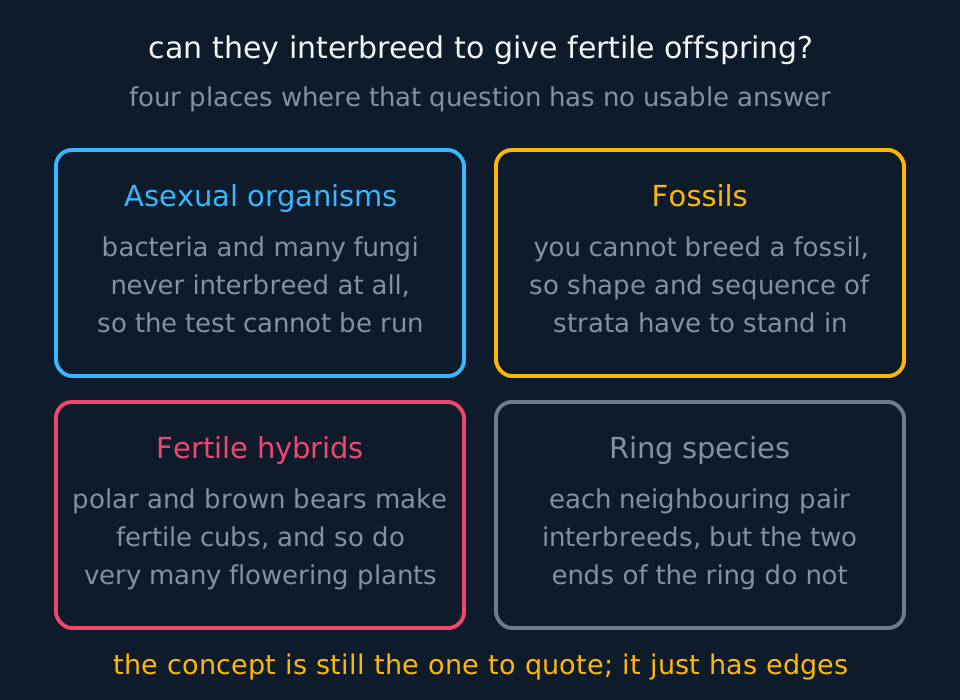
Four bordered cards arranged two by two, each naming a case the interbreeding test cannot decide. Asexual organisms never interbreed, so the test cannot be run at all. Fossils cannot be bred, so shape and position in the rock have to stand in. Polar and brown bears and many flowering plants make fertile hybrids across what are called separate species. In a ring species each neighbouring pair interbreeds while the two ends of the ring do not.
Take them in turn. Asexual organisms such as bacteria, many fungi and dandelions reproducing apomictically never interbreed at all, so prokaryotes in particular are grouped by sequence similarity instead. Fossils cannot be bred, so palaeontologists work from morphology and stratigraphy and treat the resulting species as working hypotheses. Fertile hybrids across a recognised boundary are commoner than the definition suggests: polar and brown bears produce fertile offspring and have exchanged genes repeatedly, and among flowering plants hybridisation between named species is routine. And ring species give the problem in its purest form: a chain of populations in which each interbreeds with its neighbours while the two ends, living side by side, do not. The greenish warbler around the Tibetan plateau is the best-supported case; the herring gull complex in older textbooks no longer holds up to genetic scrutiny as originally described.
The concept therefore defines a discrete boundary where the underlying process is continuous. That is the expected result if species arise gradually: a process taking thousands of generations spends most of that time in states that are neither clearly one species nor clearly two. Which populations count as separate species can depend on the operational species concept used.
Allopatric speciation
Speciation requires two stages in sequence. First, gene flow between two parts of a population stops or falls sharply. Second, the two isolated gene pools diverge, until the differences are sufficient to keep them separate if the original obstacle is removed.
In allopatric speciation, from the Greek for 'other homeland', the first step is geography. A river changes course, sea level cuts an island from the mainland, a mountain range is uplifted, a few individuals are blown a thousand kilometres out to sea. The populations on either side are separated by something neither can cross, and no alleles pass between them.
A geographical barrier reduces or stops gene flow between populations. Mutation, genetic drift and different selection pressures then change allele frequencies independently. If genetic differences affecting courtship, gamete recognition, chromosome pairing or development accumulate, the populations may become reproductively isolated. They then remain separate gene pools even if geographical contact is restored.

Describe the drawing
An animation of allopatric speciation in five frames, drawn as a long grey landmass carrying a scatter of round organisms. First the whole range holds one cyan population with a double-headed arrow showing gene flow across it. Then a coral bar cuts the range in two and the arrow is gone. Then the organisms on the right turn amber while those on the left stay cyan, under different labelled conditions. Then the bar is removed and the two forms move back towards each other. Finally they sit side by side with a coral dashed line between them and no interbreeding.
The two populations can diverge for three reasons, all three of which belong in a complete answer, though their relative contributions vary from case to case. Different mutations occur in each, because mutation is a chance event and the two populations are no longer sharing them. Different selection pressures act on each, because the two environments are not identical: one side wetter, one side with a different predator, one side with a shorter growing season. And genetic drift acts separately in each, which matters a great deal if one of the populations is small, as it is when an island is colonised by a handful of founders.
Over generations the allele frequencies of the two populations diverge. Because reproductive behaviour, gamete recognition, chromosome structure and development are all under genetic control, differences in those systems accumulate as a by-product of divergence. No allele is selected for incompatibility with the other population, which is absent and so exerts no selection pressure; incompatibility accumulates as an incidental consequence of independent change.
The outcome is tested when the barrier is removed. If the two forms meet again and still interbreed freely, the gene pools merge and there is one species. If they meet and cannot produce fertile offspring, they are two species, and the separation now depends on features of the organisms rather than on geography. If they meet and interbreed with reduced success, individuals that mate with the wrong form leave fewer surviving offspring, so anything helping them tell each other apart is favoured. That is reinforcement, which can complete a separation that isolation started.
Darwin's finches are a documented example: a founding population reached the Galápagos from South America, spread to islands separated by water the birds rarely cross, and diverged into species with beaks suited to different foods, some of which now coexist on one island without interbreeding. Snapping shrimps provide a dated example, because the Isthmus of Panama closed at a known time and there are now pairs of close relatives on either side that will not breed when brought together.
Sympatric speciation and polyploidy
Sympatric speciation occurs without geographical separation: the two diverging populations live in the same area throughout. It was long regarded as improbable, because populations in the same place can continue to exchange alleles, and gene flow reduces divergence. Some mechanism must therefore lower gene flow from the start.
In animals the usual candidate is a shift in what the population uses or when it breeds. Rhagoletis pomonella, the apple maggot fly, fed on native hawthorn in North America until the nineteenth century, when some flies began to use introduced apples instead. The flies mate on the fruit they emerged from, and apples ripen earlier, so the two host races now largely breed at different times and places within one orchard. They are measurably genetically different and interbreed at a low rate: divergence in progress, roughly 150 years after the host shift. Cichlids in African crater lakes give further cases, where populations using different depths or diets have diverged with assortative mating by colour.
In plants, polyploidy can produce reproductive isolation in a single generation. Polyploidy, having extra whole sets of chromosomes, results from an error in meiosis or mitosis. An autopolyploid arises within one species: a diploid plant makes unreduced, diploid gametes, and when two of them fuse, or the chromosome number of a zygote doubles, the offspring is tetraploid. Crossed back to a normal diploid, that tetraploid gives triploids whose chromosomes cannot pair evenly at meiosis, so they are sterile, and the tetraploid is reproductively isolated from its own parents the moment it appears, while fertile with other tetraploids.
An allopolyploid arises from two species. Two related species hybridise; the hybrid is sterile, because it has one set of chromosomes from each parent and they cannot pair. The chromosome number then doubles, every chromosome acquires a partner, meiosis works again, and the result is a fertile plant that cannot breed with either parent. Spartina anglica, the cord-grass now covering large areas of British salt marsh, arose this way around 1890 from a hybrid between a native and an introduced American species. Bread wheat has three ancestral genomes by the same route, and perhaps a third of flowering plant species originated in a polyploidy event.
| Allopatric | Sympatric | |
|---|---|---|
| What stops gene flow first | A physical or geographical barrier | Ecological, behavioural or temporal separation, or polyploidy |
| Where the populations live | Separate areas | The same area |
| Relative frequency | The common route in animals | Much rarer in animals, common in plants |
| Speed | Usually thousands of generations | Usually slow, but one generation for a polyploid |
| Examples | Galápagos finches; snapping shrimps across the Isthmus of Panama; Hawaiian fruit flies | Apple and hawthorn races of Rhagoletis; crater-lake cichlids; Spartina anglica |
The isolating mechanisms themselves
Whatever starts the separation, what maintains it is a set of features called isolating mechanisms. They are classified according to whether they act before or after a zygote is formed.
Describe the drawing
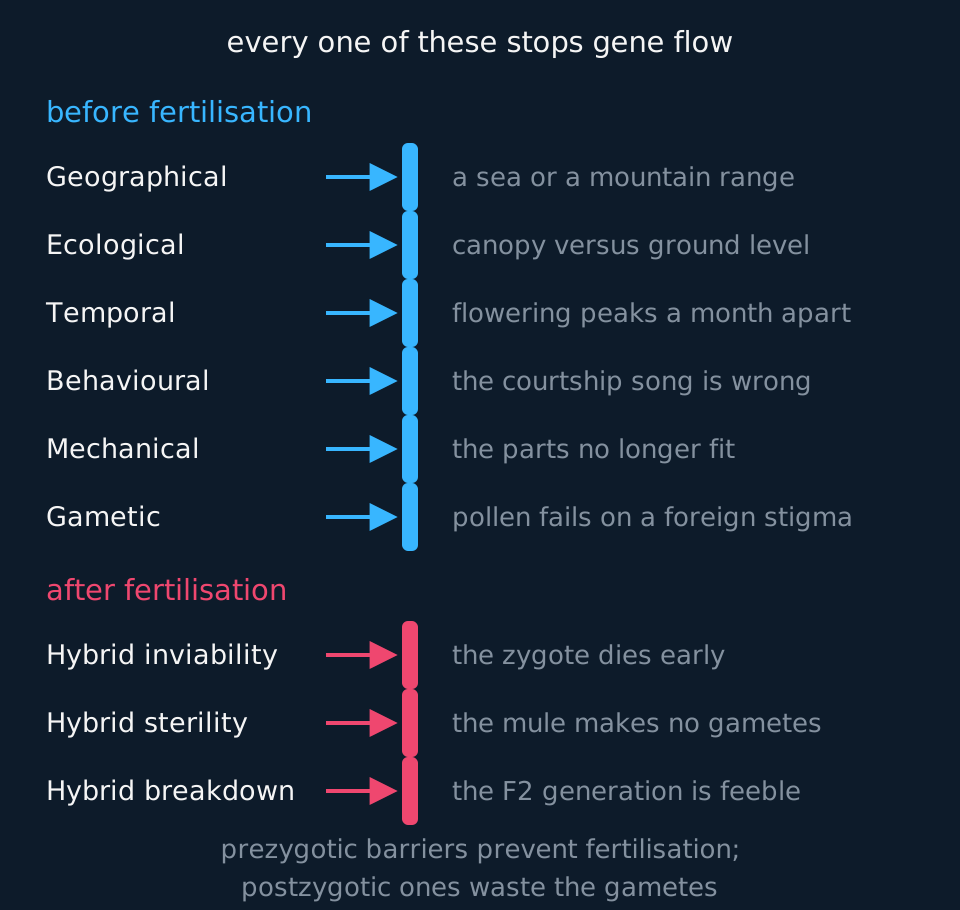
A list of nine reproductive barriers in two blocks. The upper block of six, headed before fertilisation, names geographical, ecological, temporal, behavioural, mechanical and gametic isolation; the lower block of three, headed after fertilisation, names hybrid inviability, hybrid sterility and hybrid breakdown. Each is drawn as a short arrow running into a solid bar, with a one-line example of that barrier printed to the right of it.
Prezygotic mechanisms prevent fertilisation. Geographical separation prevents contact but is a feature of where the populations live rather than of the organisms, so it does not maintain isolation once the populations meet again; the mechanisms below do. Ecological isolation places the populations in different parts of one area, as with Anopheles species breeding in sunlit and in shaded pools; temporal isolation separates them in time, so plants whose flowering peaks are a month apart exchange almost no pollen and corals spawning on different nights do not cross. Behavioural isolation is the commonest in animals, because courtship rituals, songs and pheromones are species-specific and a female that does not recognise the display does not respond. Mechanical isolation means the reproductive structures no longer fit. Gametic isolation means the gametes meet but fail: pollen that will not germinate on the wrong stigma, sperm that cannot bind the surface proteins of the wrong egg.
Postzygotic mechanisms act after fertilisation, so gametes and parental resources are used on offspring that leave no descendants. Hybrid inviability means the zygote forms but the embryo develops abnormally and dies, because two sets of developmental instructions that evolved apart no longer work together. Hybrid sterility means the hybrid is healthy but cannot make gametes, as in the mule again, because a horse contributes 32 chromosomes and a donkey 31, so the mule's 63 cannot pair at meiosis. Hybrid breakdown means the first hybrid generation is fine and the second is weak or infertile.
Exam-board note on terminology. AQA writes about reproductive separation and expects allopatric and sympatric speciation by name; OCR Biology A asks about the role of isolating mechanisms, naming geographical mechanisms (allopatric speciation) and reproductive mechanisms (sympatric speciation); Cambridge International treats geographical separation as the allopatric case and ecological and behavioural separation as the sympatric one. No specification uses the words prezygotic and postzygotic: they are a way of organising the mechanisms, not a term an examiner requires.
Timescale, and why the boundary is often not sharp
Speciation occurs over a period rather than at a moment. Two populations become progressively less able to exchange alleles, and for much of that period they are partially isolated rather than fully separate species.
The timescales vary by orders of magnitude. An allopolyploid plant is reproductively isolated in one generation, because its chromosomal isolation is complete the moment it forms. The apple and hawthorn races of Rhagoletis are perhaps 150 years in and are not there yet. The cichlid species flock of Lake Victoria appears to have radiated within about 15 000 years, which is fast for vertebrates. For most animal groups the usual estimate is between 10⁴ and 10⁶ generations.
The boundary is indistinct because the isolating mechanisms accumulate gradually and independently. Two populations may already fail to recognise each other's courtship signals while still producing fertile hybrids in captivity; another pair may hybridise readily where their ranges overlap while the hybrids leave few descendants. Grizzly and polar bears interbreed and the cubs are fertile, yet the two have distinct ecologies, morphologies and genomes and have been separate lineages for hundreds of thousands of years. Whether they are counted as one species or two depends on the operational species concept applied, not on an unmeasured fact.
Constructing a complete speciation answer
A species of lizard lives across a large valley. An earthquake diverts a river so that it now runs across the valley floor, and the lizards cannot cross it. Explain how this could lead to the formation of two species. (6 marks)
Show the working
Start with what the barrier does. The river splits the population, so the two halves are geographically isolated and gene flow between them stops: alleles cannot pass from one gene pool to the other.
Give the three sources of divergence. Different random mutations occur in each population. Conditions on the two sides are not identical, so different selection pressures act and different alleles are advantageous in each. Genetic drift changes allele frequencies independently in each as well.
Say what happens over time. The allele frequencies of the two gene pools become increasingly different over many generations, and the populations become phenotypically and genetically distinct.
Close on the definition. Eventually the differences include features affecting reproduction, such as courtship behaviour, breeding season and gamete compatibility, so that if the populations meet again they can no longer interbreed to produce fertile offspring. They are reproductively isolated, and are two species.
Two elements complete the answer: all three sources of divergence rather than selection alone, and a concluding statement of reproductive isolation. An answer that stops at 'they become very different' describes divergence, not speciation.
TRY IT: Deciding what the data can and cannot show
Two populations of a wind-pollinated grass grow a few metres apart. Population X grows on a normal soil; population Y grows on the spoil from an old copper mine and is tolerant of high copper concentrations. Population Y flowers on average three weeks earlier than population X. Hybrids can be produced by hand-pollination and are fertile.
Are X and Y separate species? Justify your answer, and explain what is happening to them.
Check your answer
Not yet, on the biological species concept. Hand-pollination produces fertile hybrids, so the two populations can still interbreed to produce fertile offspring and are not fully reproductively isolated.
But gene flow is already much reduced, by two mechanisms acting together. The three-week difference in flowering time is temporal isolation: when most of Y is shedding pollen, most of X is not receptive. And the two soils impose different selection pressures, so seedlings of the wrong type do badly where they land: copper-intolerant seedlings die on the spoil, and tolerant plants are typically poorer competitors on normal soil.
This is sympatric divergence in progress: adjacent populations, no physical barrier, ecological and temporal isolation. With continued selection the flowering times may separate further, since plants flowering at the same time as the other population waste pollen on crosses that give poorly adapted seedlings.
Answer the question directly: not yet, because fertile hybrids are possible, and then give the reasons why the accurate answer is 'not yet' rather than 'no'. Copper tolerance on mine spoil is well studied in Agrostis and Anthoxanthum, and is among the better evidence that sympatric divergence can begin over a few metres.
In the exam
- Give the species definition in full where it is asked for: similar characteristics, interbreed, fertile offspring, reproductively isolated. 'Fertile' and 'reproductively isolated' are separate requirements.
- In a speciation answer, state that gene flow between the populations stops or falls sharply. The rest of the explanation depends on that step.
- Name all three sources of divergence: different mutations, different selection pressures, and genetic drift.
- Allopatric means a geographical barrier; sympatric means no geographical barrier. A river or an island in the stem indicates the allopatric case.
- For sympatric speciation in plants, name polyploidy and give the reason it isolates: the polyploid cannot pair chromosomes evenly at meiosis with its parent species.
- Finish on reproductive isolation. An answer that ends with 'the populations became different' describes divergence rather than speciation.
Check yourself
Two populations of the same species of bird live on neighbouring islands. Ornithologists find that the two have distinct songs and that females of each population do not respond to the song of the other. When birds from the two islands are kept together in an aviary, a few pairs form and the offspring are healthy and fertile. Are these two species? Explain your answer, and predict what would happen if the two populations came into contact naturally.
Answer
On the biological species concept they are not yet two species, because they can interbreed to produce fertile offspring. The aviary result shows that no postzygotic barrier has developed.
But they are close, and the barrier that exists is behavioural and prezygotic. Song is a species-recognition signal, so if females do not respond to the other population's song, mating between the populations will be very rare in the wild even though it is possible in principle. Reproductive isolation in nature can be effectively complete while the physiological capacity to interbreed remains.
That is allopatric divergence in progress. The islands separate the gene pools; different mutations, different selection pressures and drift have made the populations diverge; song is one of the traits that diverged.
On natural contact, one of three things follows. If the song difference is enough, they coexist without interbreeding and are treated as two species. If it is not, hybrids form, gene flow resumes and the gene pools merge back into one. Or hybrids are produced but do less well than either parent type, perhaps because their song is intermediate and attracts fewer mates, so selection favours birds that discriminate most sharply, the song difference increases and the separation is completed. That third outcome is reinforcement.
Structure the answer in three steps: apply the definition, name the isolating mechanism and state when it acts, then use it to make the prediction.
Questions
Question 15 marks
A few individuals of a beetle species are carried by a storm to an island 400 km from the mainland and establish a population there. Describe how this could lead to the formation of a new species.
Mark scheme
- B1 the island population is geographically isolated from the mainland one, so gene flow between them stops and alleles no longer pass from one gene pool to the other
- B1 different random mutations occur in the two populations, and because they are no longer interbreeding those mutations are not shared
- B1 conditions on the island are not identical to those on the mainland, so different selection pressures act and different alleles are advantageous in each population
- B1 the island population is small and was founded by a sample of the mainland alleles, so genetic drift changes its allele frequencies by chance as well
- B1 over many generations the two gene pools diverge until the differences include features affecting reproduction, so the two forms could no longer interbreed to produce fertile offspring even if they met: they are reproductively isolated and are two species
Question 24 marks
An allopolyploid forms when two related plant species hybridise and the chromosome number of the hybrid later doubles. The hybrid carries one set of chromosomes from each parent species, and the chromosomes of the two species are not homologous. Explain why the hybrid is sterile, why the plant becomes fertile once its chromosome number has doubled, and why it is then a new species.
Mark scheme
- B1 in the hybrid no chromosome has a homologous partner to pair with at meiosis, so the chromosomes are shared out unevenly and the gametes do not carry complete sets, which makes the hybrid sterile
- B1 after doubling, every chromosome has an identical partner to pair with, so meiosis produces balanced gametes and the plant is fertile with others like itself
- B1 crossed with either parent species, it gives offspring whose chromosomes cannot pair evenly at meiosis, so those offspring are sterile
- B1 it cannot produce fertile offspring with either parent species, so it is reproductively isolated from both from the moment it forms, and is a new species by the biological species concept. Spartina anglica arose this way on British salt marsh around 1890
Question 34 marks
Isolating mechanisms are prezygotic if they stop a zygote forming, and postzygotic if a zygote forms but the hybrid dies or is sterile. Two species of frog breed in the same ponds. One spawns in early spring and the other about a month later. In the rare matings between them the eggs are fertilised, but the embryos die before hatching. Compare the two isolating mechanisms in this example, referring to the stage at which each acts and to what each costs the parents, and explain why both keep the two gene pools separate.
Mark scheme
- B1 the difference in breeding time is prezygotic, since the two species are rarely ready to mate at the same time, whereas the death of the embryos is postzygotic, since fertilisation happens but the hybrid does not survive
- B1 the prezygotic mechanism acts before any gametes are used, whereas the postzygotic one wastes eggs, sperm and the development of an embryo
- B1 the difference in timing prevents most matings, and the death of the embryos stops the few that do occur from producing offspring, so together they are more complete than either alone
- B1 neither produces a fertile hybrid, so no offspring carries alleles from one species' gene pool into the other's: there is no gene flow
Question 44 marks
Two forms of a fish live at different depths in one lake. They breed at the same time of year, but each spawns only over the substrate at its own depth, and the two differ in colour. Kept together in a tank, fish of the two forms produce fertile offspring. Suggest whether these are two species, and suggest what is keeping the gene pools apart in the lake.
Mark scheme
- B1 either conclusion, justified: not yet two species if the test is whether they can produce fertile offspring, since the tank crosses show no postzygotic barrier; or effectively two species if the test is reproductive isolation in nature, since they do not interbreed in the lake
- B1 gene flow in the lake is nevertheless much reduced, because the two forms spawn in different places, which is ecological isolation acting before any gametes meet
- B1 the difference in colour may act as a behavioural barrier as well, if each form recognises and prefers a mate of its own colour, so matings between the forms are rare even where the fish do meet
- B1 this is sympatric divergence in progress: there is no geographical barrier, and if the separation persists the two gene pools may diverge far enough for reproductive isolation to become complete
Question 54 marks
Describe two situations in which the biological species concept cannot be applied, and describe how biologists classify organisms in each case instead.
Mark scheme
- B1 asexual organisms such as bacteria and many fungi never interbreed at all, so the interbreeding test cannot be applied to them
- B1 such organisms are instead grouped by the similarity of their DNA or rRNA sequence
- B1 fossils cannot be tested for interbreeding because the organisms are dead, so the concept cannot be applied to them directly
- B1 palaeontologists classify fossil species from their morphology and from stratigraphy, the order and position of the rock layers they are found in, treating the resulting species as working hypotheses
Question 64 marks
Polar bears and brown bears can produce fertile offspring and have exchanged genes repeatedly where their ranges overlap, yet biologists usually treat them as two species. Suggest why this fertile-hybrid case is a difficulty for the biological species concept, and suggest what other evidence, besides interbreeding, could be used to decide whether they are one species or two.
Mark scheme
- B1 the biological species concept requires interbreeding to produce fertile offspring and reproductive isolation from other groups, but polar and brown bears meet the first condition while apparently failing the second, so the definition gives contradictory guidance in this case
- B1 this shows the concept defines a discrete boundary although real populations can show partial or graded reproductive isolation rather than being either completely interbreeding or completely isolated
- B1 additional evidence could include the frequency of hybridisation actually observed in the wild, since rare hybridisation alongside mostly within-form mating differs from freely interbreeding populations
- B1 additional evidence could also include differences in ecology, morphology or DNA sequence that have persisted despite some gene flow, indicating that each population maintains a largely separate gene pool
Question 74 marks
A diploid plant occasionally produces an unreduced, diploid gamete. Fusion of two such gametes produces a tetraploid plant, with four copies of every chromosome. Explain why this tetraploid is fertile, and why it is a new species, separate from the diploid population it came from.
Mark scheme
- B1 at meiosis every chromosome in the tetraploid has homologous partners to pair with, so it produces balanced diploid gametes and is fertile with itself and with other tetraploids
- B1 a cross with a diploid plant joins a diploid gamete to a haploid one, giving a triploid
- B1 the triploid has three copies of each chromosome, which cannot pair evenly at meiosis, so its gametes are unbalanced and it is largely sterile
- B1 the tetraploid cannot produce fertile offspring with the diploids, so it is reproductively isolated from them from the moment it forms, which makes it a new species in a single generation
Question 84 marks
The apple maggot fly, Rhagoletis pomonella, fed only on native hawthorn in North America until apple trees were introduced, and some flies began to use apples instead. Describe how this host shift could lead towards sympatric speciation, without a geographical barrier.
Mark scheme
- B1 flies mate on the fruit they emerged from as larvae, so hawthorn flies tend to mate with other hawthorn flies and apple flies with other apple flies, even where both host trees grow in the same orchard
- B1 apples ripen earlier than hawthorn fruit, so the two host races are further separated because they tend to breed at slightly different times of year, adding temporal isolation to the host preference
- B1 gene flow between the two host races is greatly reduced by these two factors even though no physical barrier separates them, so mutation, selection and drift can begin to make the allele frequencies of the two races diverge independently
- B1 over enough generations the two races could accumulate enough genetic difference, including differences affecting host and mate choice, to become reproductively isolated and count as two species, though after roughly 150 years the two races are only measurably diverging and still interbreed at a low rate rather than being fully separate species yet
Question 94 marks
Grizzly bears and polar bears can produce fertile cubs when they interbreed, yet the two have distinct ecologies, appearances and genomes and have been separate lineages for hundreds of thousands of years. Discuss whether grizzly bears and polar bears should be classified as one species or as two.
Mark scheme
- B1 for one species: the biological species concept requires reproductive isolation, and fertile cubs show that gene flow between the two is still physically possible, which is the concept's central test
- B1 for two species: the two forms have been diverging independently for a very long time and differ substantially in ecology, morphology and genome, which an operational species concept based on overall similarity would treat as two species
- B1 the disagreement arises because the boundary between two recently diverged lineages is often genuinely gradual rather than sharp, since isolating mechanisms accumulate gradually rather than appearing all at once
- B1 a judgement: whichever the two are called depends on which operational definition is applied and on how much weight is given to interbreeding versus overall divergence, rather than on an unmeasured biological fact waiting to be discovered
Question 103 marks
Explain why sympatric speciation is harder to achieve than allopatric speciation.
Mark scheme
- B1 in allopatric speciation a physical barrier stops gene flow completely from the start, so the two gene pools change independently of each other
- B1 in sympatric speciation the two groups remain in the same place, so individuals can still meet and interbreed and gene flow can continue
- B1 gene flow mixes the alleles of the two groups and so erases the divergence as it accumulates, which means an ecological, behavioural or temporal separation, or else polyploidy, has to reduce interbreeding from the outset for divergence to build up at all
Question 113 marks
Two recently separated bird populations meet again after their geographical barrier disappears. Where the two forms interbreed, hybrid offspring survive less well than offspring of matings within either form. Explain how this could lead to complete reproductive isolation through the process called reinforcement.
Mark scheme
- B1 a bird that mates with the other form produces hybrid offspring that survive or reproduce less well, so it leaves fewer surviving offspring than one that mates within its own form
- B1 any heritable feature that helps an individual distinguish the two forms, such as a difference in song or courtship display, is therefore favoured by selection, because it reduces the chance of a costly hybrid mating
- B1 as those distinguishing features become more pronounced over generations, matings between the two forms become rarer still, until the two are completely reproductively isolated
Question 123 marks
In some crosses between related plant species, the first hybrid generation is healthy, but crossing those hybrids with each other gives a second generation containing many weak or infertile individuals. Explain why this pattern, called hybrid breakdown, is evidence of reproductive isolation between the parent species even though the first-generation hybrids themselves are fine.
Mark scheme
- B1 the two parent species have accumulated different gene combinations while evolving apart, and each parent's own combination works well together within itself
- B1 the first-generation hybrid inherits one complete set of alleles from each parent, so its two sets still work together reasonably well, which is why first-generation hybrids are often healthy
- B1 recombination during meiosis in the first-generation hybrid breaks up those parental combinations, so the second generation carries new mixtures of alleles from both species that have never been tested together by selection, and many of these combinations do not work well, producing weak or infertile offspring; gene flow between the species therefore cannot proceed past the first generation in practice
Question 133 marks
The cichlid fish species flock of Lake Victoria evolved into hundreds of species within about 15 000 years, an allopolyploid plant becomes a new species in a single generation, and many pairs of related animal species took somewhere between 10⁴ and 10⁶ generations to separate. Suggest why the timescale of speciation varies so much between these examples.
Mark scheme
- B1 an allopolyploid is reproductively isolated the instant it forms, because its chromosome number alone prevents fertile crosses with the parent species, so no time is needed for divergence to accumulate
- B1 most animal speciation instead depends on many mutations, selection differences and drift slowly changing courtship, gamete recognition or other traits in two separated populations, and accumulating enough difference for full reproductive isolation takes many generations
- B1 the cichlid flock is fast for an animal group because a large lake offers many different ecological opportunities such as depth and diet for strong divergent selection to act on quickly, and because sexual selection on colour can proceed rapidly once mate choice starts to differ
Question 142 marks
State the biological species concept in full, and state what reproductive isolation means.
Mark scheme
- B1 a group of organisms with similar characteristics that can interbreed to produce fertile offspring, and which are reproductively isolated from other such groups
- B1 reproductive isolation is the state in which two populations cannot exchange alleles because of features of the organisms themselves, such as courtship, breeding time or place, gamete compatibility or hybrid fertility, so they stay separate even where they meet
Question 152 marks
A prezygotic isolating mechanism stops a zygote forming between two species. In two related species of flowering plant, the flowers differ in shape, so an insect visiting one species carries pollen on a part of its body that does not touch the stigma of the other. Two species of sea urchin release sperm and eggs into the same water at the same time, but the sperm of one species cannot bind to the surface of the other species' eggs. Explain why each of these is a prezygotic mechanism, and suggest why the second kind matters most in animals that release their gametes into water.
Mark scheme
- B1 in the plants, pollen is not delivered to the stigma of the other species, so fertilisation cannot occur; in the sea urchins the gametes meet but cannot fuse; in both, no zygote forms
- B1 animals that spawn into water cannot choose a mate, so gametes of different species meet freely, and recognition between sperm and egg surfaces is the only point at which fertilisation by the wrong species can be stopped
Worth remembering
- A species: similar characteristics, interbreeds, fertile offspring, reproductively isolated from other groups.
- Speciation needs gene flow to stop, or fall sharply, first, and the isolated gene pools to diverge second.
- Divergence has three sources, in proportions that vary by case: different mutations, different selection pressures, and genetic drift acting separately in each population.
- Allopatric speciation starts with a geographical barrier; sympatric speciation starts with ecological, behavioural or temporal separation, or with polyploidy.
- Prezygotic mechanisms prevent fertilisation; postzygotic mechanisms act on the zygote or the hybrid.
- Polyploidy is the one route that makes a new species in a single generation, and it is overwhelmingly a plant phenomenon.
- The boundary between two species is often genuinely gradual, which is what a gradual process should produce.
CHECK YOUR PROGRESS
Rate how confident you are with each objective for this lesson. Ratings are saved in this browser, on this device, unless you sign in.
- State the biological species concept and identify situations in which it cannot be applied.
- Explain what reproductive isolation means and why it defines the boundary between species.
- Describe allopatric speciation as a sequence, from one gene pool to two.
- Describe sympatric speciation, and explain why polyploidy is the most direct route to it.
- Classify isolating mechanisms as prezygotic or postzygotic and give an example of each.
- Discuss the timescale of speciation and why the boundary between two species is often not sharp.
Open the full revision checklist to see every objective in the curriculum in one place.
Practise this lesson
WORKBOOK
The questions from this topic, on paper with room to work, and a separate book of mark schemes. Free to use; please do not redistribute or sell.
Used later in The five kingdoms, species concepts and viruses