Biology › Evolution and speciation › Artificial selection and selective breeding
Artificial selection and selective breeding
In artificial selection, breeders choose individuals with desired heritable characteristics and use them as parents. Repeating this over generations changes allele frequencies and the mean phenotype of the population. Crop disease resistance, hybrid maize and livestock breeding are covered here, together with reduced genetic diversity, inbreeding and animal-welfare concerns.
Before this Natural selection and variation · Continuous and discontinuous variation · Evidence for evolution, resistance and drift
COMMON MISCONCEPTION
Selective breeding creates the characteristic the breeder wants.
Selective breeding changes allele frequencies by choosing which individuals reproduce. It acts on heritable variation already present or arising during the programme; it does not direct mutations to produce a required characteristic.
What you should be able to do
- State the principle of artificial selection and set it against natural selection point by point.
- Describe how disease resistance is bred into a crop such as wheat or rice.
- Explain how inbred lines of maize are produced and why the cross between two of them outyields either parent.
- Describe how milk yield is improved in dairy cattle, using progeny testing and artificial insemination.
- Explain inbreeding depression and say why wild types and their alleles are worth keeping.
- Discuss the ethical objections to breeding an animal to an extreme.
Artificial selection compared with natural selection
Domesticated plants and animals are the products of selection applied by people over many generations. Maize was derived from a grass whose ears carry a dozen hard seeds. Cabbage, cauliflower, broccoli and Brussels sprouts were all derived from one species of wild cabbage, each by breeders selecting on a different part of the plant. Darwin opened On the Origin of Species with pigeon breeding as a case of selection his readers already accepted.
The procedure has three steps, repeated. Identify the individuals with the desired heritable characteristic. Breed only from those. Select again from their offspring, over as many generations as required. Artificial and natural selection share a dependence on heritable variation and on differential reproduction; they differ in what determines which individuals reproduce. The variation is already present in the population, and breeding changes the frequency of each allele in the next generation.
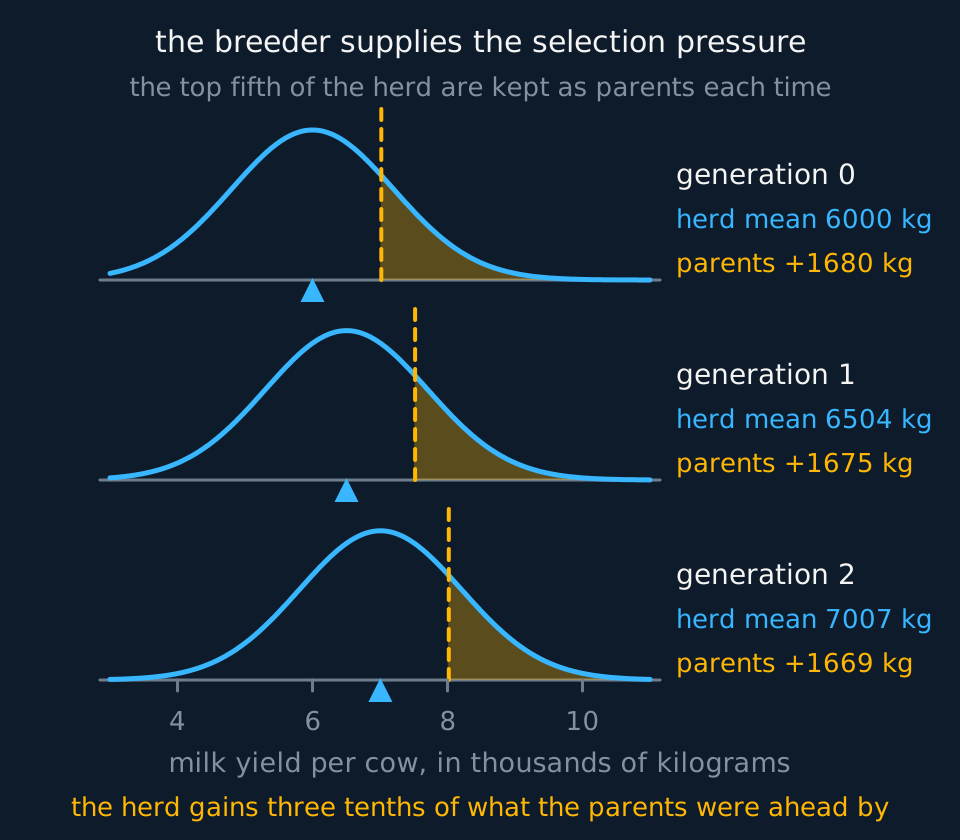
The figure also shows the limit on the rate of change. The chosen parents are well ahead of the herd mean, but the following generation gains only part of that difference, because a parent's yield reflects its feeding, housing and other environmental conditions as well as its genotype, and those are not inherited. The proportion of the difference that does carry across is the heritability of the characteristic, and it determines how fast the mean moves.
| Natural selection | Artificial selection | |
|---|---|---|
| Who or what selects | The environment | A breeder, choosing on a record or by eye |
| What is favoured | Whatever raises survival and reproduction | Whatever the breeder wants, which may reduce survival |
| Source of the variation | Mutation, meiosis and random fertilisation | Mutation, meiosis and random fertilisation, the same three |
| Speed | Usually slow, over many generations | Fast, because the selection is severe and deliberate |
| Effect on the gene pool | Allele frequencies change | Allele frequencies change, and usually narrow sharply |
- Artificial selection
- The breeding of organisms chosen by people for characteristics they want, so that the alleles for those characteristics become more common in the next generation. Also called selective breeding.
- Progeny testing
- Judging a breeding animal by measuring the performance of its offspring, used where the characteristic cannot be measured in the animal itself.
Three programmes the specifications name
Disease resistance in wheat and rice. Cereal crops are grown as large stands of genetically similar plants, which allows a fungal pathogen to spread rapidly, and a new race of rust or blast can cause severe losses across a growing region. Resistance alleles are often absent from the cultivated variety, so breeders screen wild relatives and old local varieties, whose populations have been exposed to these pathogens over long periods. Resistance in such material is not guaranteed, and where it is found it is often specific to particular pathogen races. A resistant wild plant is crossed with a high-yielding cultivated one, the offspring are screened by being deliberately infected, and the resistant ones are then backcrossed to the cultivated parent again and again. After several rounds the variety is the commercial one in nearly all respects and carries the resistance gene as well. Pathogen populations are themselves under selection for the ability to overcome the resistance, so new resistant varieties are required at intervals.
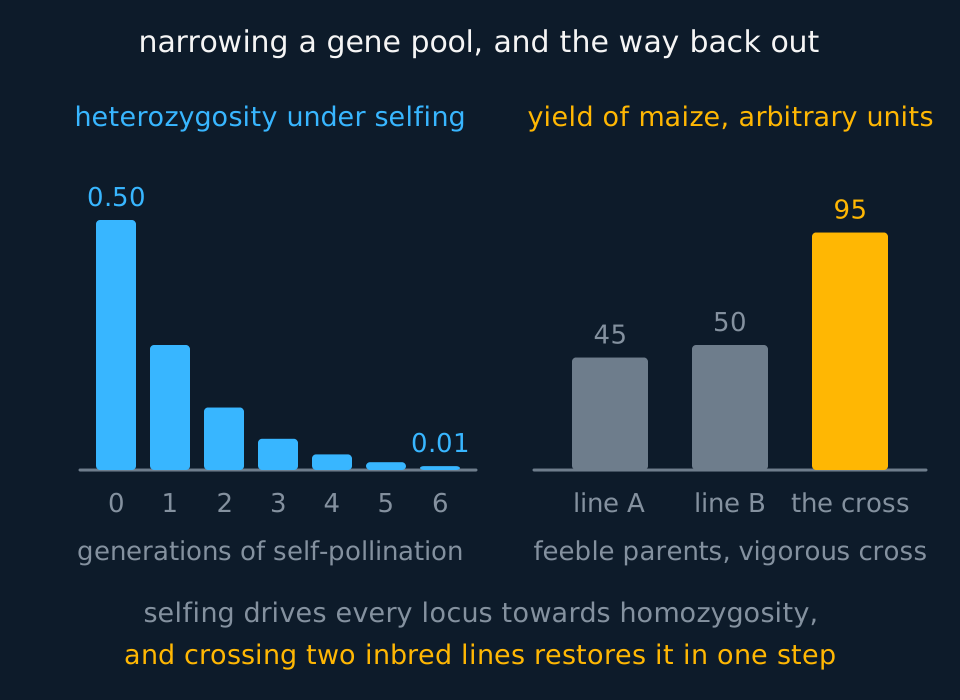
Maize, inbred and then hybridised. Maize breeding uses inbreeding as a deliberate step. Breeders self-pollinate a maize plant, then self-pollinate its offspring, and continue. Every generation of selfing halves the proportion of heterozygotes, so after six or seven generations the line is almost completely homozygous and every plant in it is near enough identical. Those inbred lines are feeble, small and low yielding, because the recessive alleles that were hidden in heterozygotes are now exposed in the homozygous state. Then two different inbred lines are crossed. The offspring are heterozygous at all the loci where the two parents differed, and they are uniform and higher yielding than either parent line. This is hybrid vigour. The effect is largest in maize and varies between crops and between pairs of lines. Growers obtain fresh hybrid seed each year rather than saving their own, because the following generation segregates and the uniformity is lost.
Milk yield in dairy cattle. The characteristic to be improved cannot be measured in half of the animals doing the breeding, because bulls do not lactate. So a bull is judged by progeny testing: he is mated to many cows, and the milk yields of his daughters are recorded and compared with the yields of the herds they are in. That estimate of his breeding value is far more useful than anything about the bull himself. A bull that tests well is then used on an enormous scale through artificial insemination, since one bull can father tens of thousands of calves, and semen can be frozen, stored and shipped between countries. Embryo transfer does the matching job on the female side, letting a cow of high breeding value produce many more calves than she could carry.
Milk yield per cow in the United Kingdom has roughly doubled since the middle of the twentieth century, with improved feeding and husbandry contributing alongside selection. A consequence is that a small number of bulls are ancestors of a large fraction of the world's Holstein cattle, which reduces the genetic diversity of the breed.
Reduced genetic diversity and its consequences
Artificial selection acts as a bottleneck. The breeder keeps a small number of parents, so alleles absent from those parents are lost, and drift removes further alleles in the small population that follows. Two consequences follow.
Inbreeding depression is the loss of vigour, fertility and disease resistance that follows repeated mating between close relatives. The mechanism is straightforward genetics. Relatives share alleles, so their offspring are more likely to be homozygous at any locus, and harmful recessive alleles that were hidden in heterozygotes are exposed. Small captive populations show it, pedigree breeds show it, and the inbred maize lines above are a deliberate demonstration of it.
Loss of variation for the future is the slower problem. A crop variety selected to the limit for yield under today's conditions holds a narrow set of alleles, and when the pathogen changes or the climate does, the alleles that would confer tolerance may not be present. Selection cannot act on variation that is absent, and that applies to a breeding programme as it applies to a wild population.
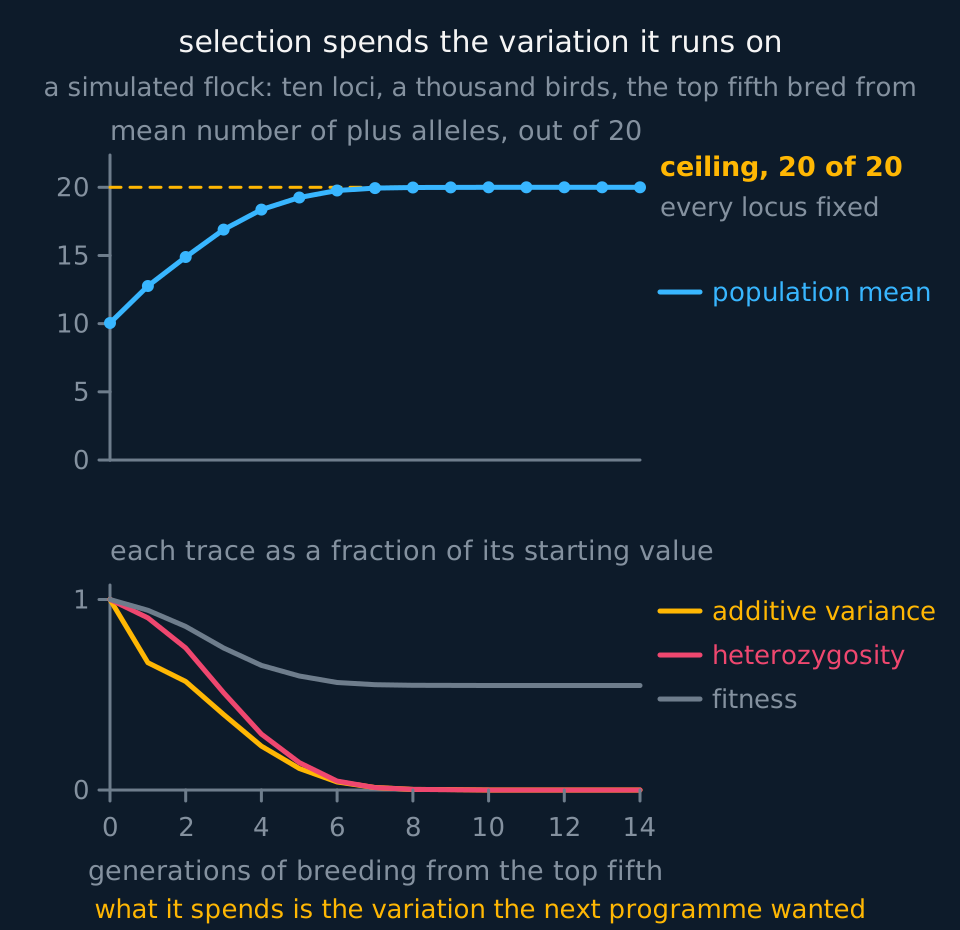
That is the argument for maintaining wild types. The wild relatives of crops, old local varieties, and rare breeds of farm animals hold alleles that current breeding programmes do not use but that may be needed later. Seed banks such as the Millennium Seed Bank and the Svalbard vault store such material, and the wild rice that supplied resistance to grassy stunt virus is a documented case of the reserve being used. Storage costs are low relative to breeding programmes, and alleles lost from all populations cannot be recovered.
- Inbreeding depression
- The reduction in vigour, fertility and disease resistance that follows repeated breeding between close relatives, caused by harmful recessive alleles becoming homozygous.
- Hybrid vigour
- The greater size, yield or vigour of the offspring of a cross between two inbred lines, compared with either parent line.
Animal-welfare and ethical considerations
Selective breeding raises questions that biology alone does not settle. A discussion of them should set out the evidence on each side before reaching a judgement.
Dog breeding is one case, because much of the selection is on appearance rather than on health or function. Breeding for a short flat face has left several breeds with airways too small for the head they sit in, so the dogs struggle to breathe and to cool themselves. Breeding for a long back and short legs has left another breed with a high rate of spinal disc disease. Breeding for a sloping back has been associated with hip problems. Closed breed registers, which forbid crossing to any dog outside the breed, restrict the breeding population, and the reported incidence of several inherited conditions is higher in some pedigree breeds than in mixed-breed dogs. The comparison depends on which breeds and which conditions are examined.
Farm animals raise similar questions. Dairy cows selected intensively for yield have higher recorded rates of lameness and mastitis, and broiler chickens selected for growth rate reach slaughter mass in half the time they took fifty years ago, with leg and heart problems that follow from carrying that mass on a skeleton the selection did not improve.
The arguments on the other side belong in the same answer. Selective breeding has contributed substantially to the yield increases behind the last century's food supply. Breeding for disease resistance reduces the use of pesticides and antibiotics. Some breeding is aimed squarely at welfare, such as selecting polled cattle that grow no horns, which removes the need to disbud calves. And breed standards can be rewritten: several kennel clubs have changed the wording of standards that rewarded the most extreme faces, which is evidence that the practice can be steered rather than only abandoned.
TRY IT: Arguing about a breeding decision
A poultry breeder has a flock in which egg number per year varies from 180 to 290. She keeps the twenty highest-laying hens and the sons of the highest-laying hens as breeding stock, and repeats this for eight generations. Egg number rises steadily for five generations and then stops rising, and the flock begins to show poor hatching success and higher chick mortality.
Explain the rise, explain why it stopped, and suggest what she should do next.
Check your answer
The rise is artificial selection. The variation in egg number was already present in the flock, and by breeding only from the highest layers she raised the frequency of the alleles associated with high laying in each generation. Egg number is a continuous characteristic controlled by many genes, so it responds gradually rather than in one step.
It stopped because the favourable alleles have become close to fixed. Once nearly every bird is homozygous for them there is no variation left for selection to act on, and selection cannot act on variation that is not there.
The poor hatching and higher chick mortality are inbreeding depression. Twenty hens and a few related males is a very small breeding population, so the birds are increasingly related, more loci are homozygous, and harmful recessive alleles that were hidden in heterozygotes are now expressed.
What she should do is introduce unrelated birds, from another flock or from a related breed, to restore heterozygosity and bring in alleles her flock has lost. Yield may dip for a generation while the incoming alleles are sorted out, and she should then select again from the larger population, keeping more breeding birds than twenty and avoiding matings between close relatives.
In the exam
- Avoid the word create. Selective breeding does not create a characteristic; it increases the frequency of alleles already present in the population.
- Describe a breeding programme as a repeated cycle: choose the parents with the desired characteristic, breed them, choose again from the offspring, repeat over many generations.
- For maize, give both halves: selfing produces homozygous but low-yielding inbred lines, and crossing two of them gives uniform, vigorous, higher-yielding offspring.
- For dairy cattle, name progeny testing and say why it is needed: the bull cannot be measured for the characteristic being selected.
- Give the genetics of inbreeding depression as well as its consequence: related parents give more homozygous offspring, so harmful recessive alleles are expressed.
- In a discuss question on breeding ethics, give evidence on both sides and a stated judgement: welfare costs on one side, food supply and welfare gains such as polled cattle on the other.
Check yourself
A wheat variety with a high yield is badly damaged by a new race of a fungal pathogen. A wild grass related to wheat is found to be resistant, but its yield is very low. Describe how a resistant, high-yielding variety could be produced by selective breeding, and explain two disadvantages of relying on selective breeding to protect a crop.
Answer
Cross the resistant wild plant with the high-yielding cultivated variety, so that the offspring carry alleles from both parents.
Screen the offspring by deliberately infecting them with the pathogen and keeping only the plants that survive, which selects for the resistance allele.
Cross those resistant offspring back to the high-yielding cultivated variety, and screen again for resistance. Repeating this backcross over several generations recovers the yield and other qualities of the commercial variety while keeping the resistance allele.
Select the best plants from the final generation, test them over several sites and seasons, and multiply up the seed of the chosen line for sale.
First disadvantage: it is slow and temporary. Each round of crossing, screening and backcrossing takes at least one growing season, so a new variety takes years, and the pathogen population is itself under selection to overcome the resistance, so the work has to be repeated.
Second disadvantage: it narrows the gene pool. Breeding from a small number of selected parents reduces genetic diversity, so the crop has fewer alleles available against the next new pathogen or a change in climate, and inbreeding also exposes harmful recessive alleles. This is the argument for keeping wild relatives and old varieties in seed banks, since the resistance in this question came from exactly such a plant.
Questions
Question 15 marks
A wild grass related to wheat is found to carry a gene giving resistance to a fungal disease that is destroying a high-yielding commercial wheat variety. Describe how plant breeders could use this wild plant to produce a resistant variety that keeps the high yield of the commercial variety.
Mark scheme
- B1 cross the resistant wild plant with the high-yielding commercial variety, so the offspring inherit alleles from both parents
- B1 screen the offspring by deliberately infecting them with the pathogen and keeping only the plants that survive, selecting for the resistance allele
- B1 cross the resistant offspring back to the high-yielding commercial variety, a backcross, and screen again for resistance
- B1 repeat the backcrossing and screening over several generations, so the proportion of the genome matching the commercial variety increases each round while the resistance allele is retained
- B1 select and test the resulting plants over several sites and seasons before releasing a new variety essentially identical to the original commercial variety except for the added resistance
Question 25 marks
Broiler chickens selected intensively for rapid growth now reach slaughter mass in about half the time they took fifty years ago, but with higher rates of leg and heart problems, because their skeletons and hearts have not been improved to keep pace with their growth rate. Discuss the arguments for and against continuing to select broiler chickens for faster growth.
Mark scheme
- B1 against: fast growth outpaces skeletal and cardiovascular development, causing leg deformities, lameness and heart failure in a high proportion of birds, a direct animal-welfare cost of the selection
- B1 against: birds cannot easily escape this trade-off, since the same genes are often linked to both the growth advantage and the physical strain, so selecting harder for growth tends to worsen the welfare problems
- B1 for: faster growth reduces the feed, land and time needed to produce each bird, lowering the cost of chicken as a food source and reducing the environmental resources used per bird produced
- B1 for: breeders can select simultaneously for growth rate and for leg strength or heart health if both are measured and included in the breeding programme, so the trade-off is not fixed by biology alone
- B1 a judgement: because the welfare cost falls directly and severely on the animal while the benefit is mainly economic, breeding programmes should give more weight to leg and heart health alongside growth rate, which some breeding companies have begun to do by including health traits in their selection targets
Question 34 marks
Describe how a farmer could use selective breeding to increase the mean mass of wool produced per sheep in a flock.
Mark scheme
- B1 identify and select the sheep in the flock that produce the greatest mass of wool
- B1 breed only from those selected sheep, so that only their alleles are passed on
- B1 measure the wool produced by the offspring and select the best of them as the next generation of parents
- B1 repeat the selection and breeding over many generations, so the alleles for high wool yield become more frequent and the mean of the flock rises
Question 44 marks
Maize breeders self-pollinate plants for several generations to produce inbred lines, then cross two inbred lines together. Explain why the inbred lines are low yielding and why the cross between them is not.
Mark scheme
- B1 each generation of self-pollination halves the proportion of heterozygotes, so after several generations the line is almost entirely homozygous
- B1 harmful recessive alleles that were masked in heterozygotes are now present in the homozygous state and are expressed, which is inbreeding depression
- B1 crossing two different inbred lines gives offspring that are heterozygous at every locus where the two lines differed, so those harmful recessive alleles are masked again
- B1 the offspring are therefore uniform and vigorous and outyield both parent lines, which is hybrid vigour
Question 54 marks
Some dog breeds have been selected for a very short, flat face. Discuss the arguments for and against continuing to breed dogs to such a standard.
Mark scheme
- B1 against: the selected shape causes ill health, because the airway is too small for the skull it sits in, so the dogs have difficulty breathing and cooling themselves
- B1 against: breeding within a closed register means matings between close relatives, so inbreeding depression raises the incidence of inherited disease
- B1 for: people value the appearance and temperament of particular breeds, and breeding to a standard is what keeps a breed recognisable and predictable
- B1 a judgement: the welfare cost falls on the animal and the benefit on the owner, so breed standards that reward the extreme should be rewritten and outcrossing allowed, which several kennel clubs have begun to do
Question 64 marks
A poultry breeder selects the highest-egg-laying hens as parents for six generations. Egg number rises for the first four generations and then stops increasing, even though the breeder continues to select the highest layers each generation. Suggest two reasons the response to selection slowed and then stopped.
Mark scheme
- B1 repeated selection has made the alleles favouring high egg number increasingly common in the flock, reducing the genetic variation for the characteristic
- B1 once the favourable alleles are close to fixed, with nearly every bird homozygous for them, very little genetic variation is left for selection to act on, and selection cannot act on variation that is not present
- B1 keeping only a small number of the highest-laying hens and their close relatives as breeding stock over six generations is a form of inbreeding
- B1 this raises homozygosity generally and can produce inbreeding depression, reduced vigour and fertility, which could offset or mask any further genetic gain in egg number even where some variation remains
Question 74 marks
A maize breeder starts self-pollinating a plant that is heterozygous at a particular locus. Assuming the proportion of heterozygotes halves with each generation of self-pollination, calculate the percentage of heterozygotes remaining after 5 generations of selfing, starting from 100%.
Mark scheme
- M1 the proportion of heterozygotes halves each generation, so after n generations the proportion remaining is 100% × (½)n
- M1 substitute n = 5: 100 × (½)5 = 100 ÷ 32
- A1 = 3.125%, which rounds to 3.1%
- A1 this shows why after six or seven generations of selfing an inbred line is described as almost completely homozygous: well under 5% of loci that started heterozygous remain so
Question 83 marks
Explain why bulls used to improve the milk yield of dairy herds are chosen by progeny testing rather than by measurement of the bull itself.
Mark scheme
- B1 milk yield cannot be measured in a bull, because bulls do not lactate
- B1 the bull is therefore mated to many cows and the milk yields of his daughters are recorded and compared with the herds they are kept in
- B1 those yields estimate the alleles the bull passes on, so a bull that tests well can then be used on a very large scale through artificial insemination
Question 93 marks
A wheat variety bred for the highest possible yield is grown across a whole region. Suggest why plant breeders keep collections of wild relatives and old local varieties of wheat.
Mark scheme
- B1 the high-yielding variety has been selected from a small number of parents, so its gene pool is narrow and many alleles are absent from it
- B1 wild relatives and old varieties hold alleles the commercial variety has lost, including alleles for resistance to pathogens and for tolerance of drought or cold
- B1 those alleles can be bred into the commercial variety by crossing and backcrossing when a new pathogen or a change in climate arrives, and selection cannot act on variation that is not there
Question 103 marks
Compare natural selection with artificial selection, using the agent of selection, the characteristics favoured and the effect on genetic diversity.
Mark scheme
- B1 in both, some individuals contribute more offspring than others, so the frequency of their alleles rises, and neither creates new alleles
- B1 in natural selection the environment decides, and what is favoured raises survival and reproduction, whereas in artificial selection a breeder decides, and what is favoured may reduce an organism's chance of surviving
- B1 artificial selection usually reduces genetic diversity far faster, because a very small number of parents is used deliberately
Question 113 marks
A small captive-breeding population of an endangered animal shows increasing rates of inherited disease after several generations of breeding between close relatives. Explain, in terms of alleles and genotypes, why this happens.
Mark scheme
- B1 close relatives share a higher than average proportion of their alleles, because they have recent common ancestors
- B1 mating between them therefore produces offspring that are more likely to be homozygous at any given locus than offspring of unrelated parents
- B1 harmful recessive alleles that were masked in heterozygous parents are exposed in the homozygous state in these offspring and are expressed, causing the reduced vigour, fertility and disease resistance seen as inbreeding depression
Question 123 marks
One bull of high breeding value for milk yield can father tens of thousands of calves through artificial insemination, and embryo transfer lets one cow of high breeding value produce far more calves than she could carry naturally. Explain how these two technologies increase the rate at which a dairy herd's milk yield can be improved, compared with natural mating.
Mark scheme
- B1 with natural mating, a single bull or cow can only be the parent of a small number of calves in its lifetime, so an individual of high breeding value contributes only a small proportion of the alleles in the next generation
- B1 artificial insemination lets semen from one high-breeding-value bull be used on very large numbers of cows, including abroad since semen can be frozen and shipped, so his favourable alleles spread through a much larger proportion of the next generation than natural mating would allow
- B1 embryo transfer does the equivalent job on the female side, letting a cow of high breeding value be the genetic mother of many more calves than she could carry and give birth to herself, again spreading her favourable alleles faster through the population
Question 133 marks
Some cattle breeds carry a dominant allele that prevents horns growing, the polled trait, removing the need to disbud (remove the horn buds of) calves. Suggest why breeding for the polled allele is an example of selective breeding that improves rather than harms animal welfare, and suggest a cross that would show whether a polled bull is heterozygous for the allele.
Mark scheme
- B1 disbudding causes the calf pain and a wound that could become infected, so an animal born polled avoids the procedure entirely, a direct welfare benefit rather than a cost, unlike breeding decided by appearance or productivity alone
- B1 because polled is dominant, breeding from polled parents raises the frequency of the polled allele in the population, so more calves are born hornless and disbudding becomes unnecessary for them
- B1 a test cross: mate the bull with several homozygous horned cows; if any calf is born horned, the bull must be heterozygous for the polled allele, since a homozygous polled bull could only pass on the polled allele
Question 143 marks
Compare disease-resistance breeding in wheat with milk-yield improvement in dairy cattle, referring to how the desired individuals are identified and how their alleles are then multiplied through the population.
Mark scheme
- B1 resistant wheat plants are identified by directly testing them, deliberately infecting offspring with the pathogen and keeping the survivors, whereas milk yield cannot be measured in the animal bred from, a bull, so bulls are instead judged indirectly by progeny testing, recording the yields of their daughters
- B1 a resistant wheat plant is multiplied by repeated crossing, backcrossing and growing seed from selected plants over several generations and seasons, whereas a bull identified as high breeding value is multiplied almost immediately and on a vastly larger scale through artificial insemination of many cows in a single breeding season
- B1 both programmes increase the frequency of favourable alleles by breeding selectively from the individuals carrying them, but a seed-propagated crop and an animal bred by artificial insemination differ greatly in how many offspring one selected individual can have, which is why livestock breeding can change a population's average much faster once an individual's value is known
Question 152 marks
State one example of a resistance allele from a wild relative being bred into a modern crop, and state where such genetic material is stored to keep it available for future breeding.
Mark scheme
- B1 wild rice supplied a resistance allele against grassy stunt virus, which was bred into commercial rice varieties, or another correctly named documented case
- B1 such material is stored in seed banks such as the Millennium Seed Bank or the Svalbard Global Seed Vault, which hold seed samples of wild relatives, old local varieties and rare breeds
Worth remembering
- Artificial selection depends on heritable variation and differential reproduction, as natural selection does, but the breeder rather than the environment determines which individuals reproduce.
- The variation is already there. Breeding changes allele frequencies; it does not create alleles.
- Crop resistance is bred in by crossing to a resistant wild relative, screening with the pathogen, then backcrossing to the commercial variety.
- Selfing maize halves heterozygosity every generation and gives low-yielding inbred lines; crossing two such lines gives hybrid vigour.
- Bulls are chosen by progeny testing and used through artificial insemination, because milk yield cannot be measured in the bull.
- Inbreeding depression follows from homozygosity exposing harmful recessive alleles, and wild relatives and old varieties are maintained as a reserve of alleles.
CHECK YOUR PROGRESS
Rate how confident you are with each objective for this lesson. Ratings are saved in this browser, on this device, unless you sign in.
- State the principle of artificial selection and set it against natural selection point by point.
- Describe how disease resistance is bred into a crop such as wheat or rice.
- Explain how inbred lines of maize are produced and why the cross between two of them outyields either parent.
- Describe how milk yield is improved in dairy cattle, using progeny testing and artificial insemination.
- Explain inbreeding depression and say why wild types and their alleles are worth keeping.
- Discuss the ethical objections to breeding an animal to an extreme.
Open the full revision checklist to see every objective in the curriculum in one place.
Practise this lesson
WORKBOOK
The same questions as the player, on paper with room to work, and a separate book of mark schemes. Free to use; please do not redistribute or sell.