Biology › Gene regulation, genomics and biotechnology › Genome analysis, genetic screening and gene therapy
Genome analysis, genetic screening and gene therapy
Genome sequencing determines base order; annotation identifies genes and regulatory regions. Probes, microarrays and sequencing can detect inherited variants, somatic variants and patterns of gene expression. These methods support screening, diagnosis, selection or dosing of some treatments, forensic analysis and somatic gene therapy, but each application has technical, ethical and statistical limits.
Before this DNA and RNA structure: complementary base pairing · The polymerase chain reaction and gel electrophoresis · Non-coding DNA and the genome · Monohybrid inheritance: recessive alleles and carriers
COMMON MISCONCEPTION
Gene therapy changes your DNA, so any children you have will inherit the change.
Somatic gene therapy alters selected body cells and is not normally inherited. Heritable genome editing would alter cells that contribute to future generations. In the UK its clinical use is not permitted; legal and regulatory positions differ between jurisdictions.
What you should be able to do
- Say what a genome project produces, and what still has to be done before a sequence becomes useful.
- Explain why predicting a proteome from a genome sequence is more direct in many bacteria than in a eukaryote, and where it is not.
- Explain how a DNA probe works and what a microarray adds to it, distinguishing genotyping from expression profiling.
- Distinguish genetic screening from genetic counselling, and state what non-directive counselling involves.
- Describe how a DNA profile is produced from variable number tandem repeats, and interpret a match probability correctly.
- Compare somatic with germ line gene therapy, and set out why the second is the more contested.
- Explain how a simpler organism's proteome identifies candidate vaccine antigens, and give the uses of profiling beyond forensics.
- Explain what personalised medicine is, using HER2 with trastuzumab and TPMT with azathioprine, and weigh its benefits against cost, unequal reference data and the fact that most conditions are polygenic.
Sequencing and annotation
The genome is the complete set of DNA in a cell, coding and non-coding alike. Sequencing determines the order of its bases; annotation, a separate process, identifies genes and regulatory regions within that sequence.
The original method, chain termination sequencing, copies a template in the presence of a few modified nucleotides that stop the polymerase wherever one is incorporated. That gives fragments of every possible length, each ending in a known base; separate them by length, read the terminating base of each in turn, and the sequence falls out. Modern high-throughput sequencing reads millions of fragments in parallel: the commonest platforms add one fluorescently labelled nucleotide at a time, others read long single molecules as they pass through a nanopore, and the reads are assembled by computer.
Costs have fallen by several orders of magnitude. The Human Genome Project ran from 1990 to 2003 and cost in the region of two billion pounds to produce one composite human sequence. A human genome can now be sequenced in about a day for a few hundred pounds, which is what made routine clinical and forensic use practicable.
Genome sequence allows researchers to predict coding regions, but annotation is still required. This is relatively direct in many bacteria. Viral genomes can be compact and may use overlapping genes, RNA processing or polyproteins, so sequence alone does not provide a simple list of mature proteins.
Predicting a eukaryotic proteome from a genome sequence is harder again. Introns must be identified and removed, alternative splicing allows one gene to give several polypeptides, large stretches are regulatory rather than coding, and post-translational modification alters the product further. The contrast between prokaryotic and eukaryotic genomes is a stated specification point on more than one board.
The uses are real enough. Sequencing pathogens identifies strains and tracks how an outbreak spreads, which is how variants of SARS-CoV-2 were followed almost in real time. Comparing genomes between species gives evidence about evolutionary relationships. Comparing them between individuals identifies the alleles associated with disease and, increasingly, which drug a particular patient will respond to. Public databases such as GenBank, UniProt and the Protein Data Bank hold these sequences and solved protein structures, so a new sequence can be compared with everything already known in minutes and a gene's likely function predicted from similar sequences.
One named application follows from that contrast. Where a bacterial genome can be annotated reliably, sequencing a pathogen produces a predicted list of the proteins it can make. Among those proteins are the surface ones an immune system would meet first, and a surface protein that every strain carries and that the host does not is a candidate antigen for a vaccine. Screening a list on a computer is faster and safer than culturing the organism to find out, which matters most for pathogens that are dangerous to grow or that will not grow in culture at all. The same route is far harder in a eukaryotic parasite, for the reasons given above for eukaryotic genomes.
Probes and microarrays
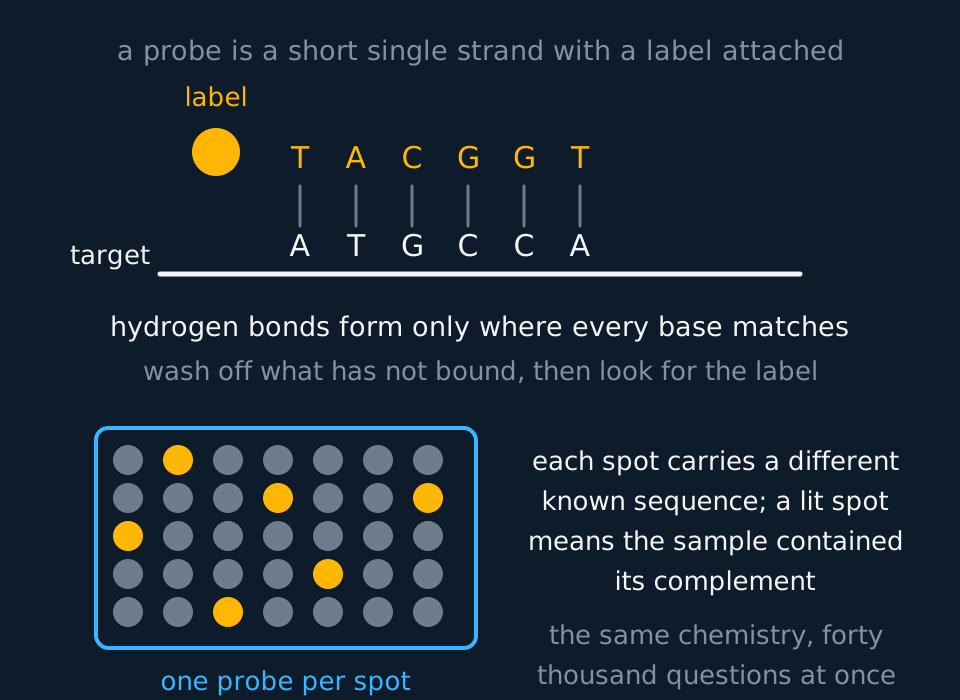
Once you know a sequence you can go looking for it, and the tool for that is a DNA probe: a short single strand of DNA, typically twenty to a few hundred bases, complementary to the sequence you are hunting, with a label attached. The label is either a radioactive isotope, detected by exposing photographic film, or a fluorescent tag, detected under ultraviolet light.
The method is hybridisation. Sample DNA is made single-stranded by heating, the labelled probe is added, and wherever the probe meets a complementary sequence it binds by hydrogen bonding between complementary bases. Unbound material is washed away, and the label shows where the probe stuck.
Describe the drawing
At the top, a short single-stranded DNA probe reading T A C G G T with a labelled tag drawn as a disc on one end, paired base by base against a longer target strand reading A T G C C A, with the hydrogen bonds drawn as short vertical ties between them. Below and to the left, a microarray is drawn as a grid of thirty-five spots, six of them lit and the rest dark, with a note that each spot carries a different known sequence and that a lit spot means the sample contained the complement of that sequence.
A DNA microarray is a small plate carrying thousands of different single-stranded probes fixed in a grid, each spot a known sequence at a known position. Labelled DNA from the sample is washed over it, unbound material is rinsed off, and the pattern of spots that fluoresce is read by a scanner. Because the position of each probe is known, the pattern is a direct read-out of which of those thousands of sequences the sample contains.
An array has two distinct applications, and they answer different questions. Washing DNA over it identifies which alleles the person carries, which is a genotype. Making cDNA from the mRNA of a tissue and washing that over it identifies which genes that tissue is transcribing, which is a pattern of expression. The second is how the expression profile of a tumour is compared with healthy tissue from the same patient, which in turn is how some cancers are now matched to a drug.
- DNA probe
- A short single-stranded length of DNA, labelled radioactively or fluorescently, with a base sequence complementary to a target sequence.
- Hybridisation
- The binding of a probe to a complementary single-stranded target sequence by hydrogen bonds between complementary bases.
- DNA microarray
- A plate carrying many different DNA probes at known positions, allowing thousands of sequences to be tested for at once.
Screening, counselling and what a result means
Genetic screening is testing an individual for particular alleles. In the United Kingdom every newborn is offered the heel-prick blood spot test in the first week of life, which as of 2025 screens for nine conditions including cystic fibrosis and sickle cell disease (the NHS reviews the list, so check the current one), because early treatment changes the outcome in every one of them. People may be screened as adult carriers before starting a family, as an unborn fetus by chorionic villus sampling or amniocentesis, as an embryo during IVF before implantation, or predictively for a condition that has not yet appeared.
Prenatal tests differ in timing and risk. Chorionic villus sampling takes a small sample of placenta, usually at 11 to 14 weeks, so the result comes early. Amniocentesis draws amniotic fluid containing fetal cells, usually from 15 weeks. Each carries a small risk of miscarriage, about one in two hundred or less. Pre-implantation genetic diagnosis tests one or a few cells removed from an embryo made by IVF, so that only an unaffected embryo is implanted. A positive prenatal result leaves parents deciding whether to continue the pregnancy, which is why counselling comes before the test as well as after it.
Genetic counselling is the conversation around the test. A counsellor explains what the test can and cannot show, works out the risk to the person and to any children, sets out the options, and supports whatever decision follows. The professional standard is that counselling is non-directive: the counsellor does not recommend a course of action, because the decision belongs to the family and the counsellor does not have to live with it.
What a positive result means differs greatly between conditions. Two contrasting examples follow.
A woman who tests positive for a pathogenic BRCA1 variant has a lifetime risk of breast cancer of roughly sixty to seventy per cent, against something like twelve to fifteen per cent for women in general. That is a large increase and it is not a diagnosis. Some women with the variant never develop cancer; most women who develop breast cancer do not carry it. The result changes what she might reasonably do, whether more frequent screening, risk-reducing surgery or nothing, and it does not tell her what will happen.
A person who tests positive for the Huntington's disease allele is in a different position. Penetrance is essentially complete, so the result does say that the disease will develop, though not when. The reason many people at risk choose not to be tested is precisely that: there is no treatment that changes the course of the disease, so the information alters the years before onset without altering the disease.
The ethical arguments are set out below on both sides rather than resolved. On one side, knowing allows planning, informed reproductive decisions and earlier surveillance, and withholding a test treats an adult as unable to handle information about their own body. On the other there is a recognised right not to know, testing one person discloses information about relatives who did not consent, and a predictive result can affect employment and insurance. In the UK, under the Code on Genetic Testing and Insurance as it stands in 2025, insurers may not require predictive results, with one agreed exception for Huntington's disease on life cover above half a million pounds; the code is voluntary and periodically reviewed. Prenatal screening carries a further argument, raised most sharply by disabled people's organisations: that screening for conditions such as Down's syndrome communicates a judgement about the worth of lives lived with them, whatever the intentions behind it.
Personalised medicine: matching the drug to the genotype
Conventional prescribing matches a drug to a diagnosis: patients with the same diagnosis receive the same molecule at a standard dose, and response and adverse effects are assessed afterwards. Personalised medicine, also called stratified medicine, uses the patient's genotype, or the genotype of their tumour, to select the drug and the dose before treatment begins. The branch dealing with drug handling is called pharmacogenomics. It uses sequencing, probes and microarrays.
The clinical literature increasingly uses 'stratified' rather than 'personalised', because no new molecule is designed for an individual patient. Patients who share a diagnosis are sorted into groups by genotype, and each group is treated differently. Three worked examples follow.
Which drug: HER2 and trastuzumab. Between one in six and one in five breast tumours carry extra copies of the HER2 gene and cover their surface with the growth factor receptor it codes for, so the pathway stimulating division is continuously active. Trastuzumab is a monoclonal antibody with a binding site complementary to that receptor. In a tumour that over-expresses HER2 it blocks the signal and marks the cells for destruction, and it substantially improved survival for that group of patients. In a tumour that does not over-express HER2, there is no target for the antibody, so the drug confers no benefit while still incurring cost and a risk of cardiac damage. The tumour is therefore tested before the drug is prescribed; a test whose purpose is to decide whether a particular drug should be used is called a companion diagnostic. The variant tested here is somatic, acquired by the tumour, rather than the germ-line genotype the patient inherited.
What dose: TPMT and azathioprine. Azathioprine and mercaptopurine, used in leukaemia, inflammatory bowel disease and after transplants, are broken down by the enzyme thiopurine methyltransferase. Roughly one person in three hundred inherits two low-activity alleles of the TPMT gene and cannot clear the drug; on a standard dose it accumulates until their bone marrow stops producing blood cells, which is a life-threatening reaction. Around one in ten carries a single low-activity allele and clears it slowly. Testing enzyme activity or genotype before the first prescription lets the deficient patient be given a small fraction of the usual dose, or a different drug, and the intermediate patient be started on a low dose and monitored. The drug is unchanged; the genotype determines the dose.
Where the case is weaker: warfarin. Warfarin, the anticoagulant, is handled by the enzyme CYP2C9 and acts on the enzyme VKORC1, and common variants of both genes shift the dose a patient needs by several times, which suggests a case for genotyping every patient before treatment. Trials comparing genotype-guided starting doses against the existing practice of starting at a low dose and adjusting on blood clotting tests have not shown a clear benefit, because the monitoring identifies the same patients within a week or two. The mechanism is well established and the clinical benefit is not: an improvement in outcome has to be measured rather than inferred from the mechanism.
| Test | What is read | What changes |
|---|---|---|
| HER2 status of a breast tumour | The tumour's own genotype and expression | Whether trastuzumab is given at all |
| TPMT activity or genotype | The patient's inherited alleles | The dose of azathioprine, or a switch to another drug |
| CYP2C9 and VKORC1 variants | The patient's inherited alleles | The predicted starting dose of warfarin, though monitoring reaches the same dose |
The benefits are worth stating plainly, since boards ask for them as an argument. Fewer patients are given a drug that was never going to work for them, so their disease is not left untreated during a trial of it. Serious adverse reactions, which fill a substantial number of hospital beds, are avoided rather than treated. Expensive drugs go to the patients who will respond, which is the only way health systems can afford them. And a drug that fails in an unselected trial can be rescued if the subgroup it helps can be identified.
The limitations belong in the same answer. Sequencing and testing cost money and staff time, and a companion diagnostic has to be paid for on top of the drug, so a health service has to be shown the saving before it will fund the test. The reference data are unequal: the great majority of the genomes in the databases that variant effects are estimated from come from people of European ancestry, so a variant common in West Africa or East Asia is more likely to be reported as of unknown significance, and risk scores built on those databases predict less well for the patients who already get worse care. And most conditions are not single-gene at all. Heart disease, diabetes and depression are polygenic, with hundreds of variants each contributing a very small amount, on top of diet, exercise, poverty and age, so a genome shifts a probability rather than naming a treatment. Personalised medicine works best where a single gene decides a single thing, and that describes a minority of medicine.
- Personalised medicine
- Choosing which drug to give a patient, and at what dose, using their genotype or the genotype of their tumour, rather than treating everyone with the same diagnosis alike; also called stratified medicine.
- Pharmacogenomics
- The study of how a person's genotype affects the way they respond to a drug, including how quickly they break it down.
- Companion diagnostic
- A test carried out to decide whether a particular drug should be given to a particular patient, such as testing a tumour for HER2 before prescribing trastuzumab.
DNA profiling, and the statistic that goes with it
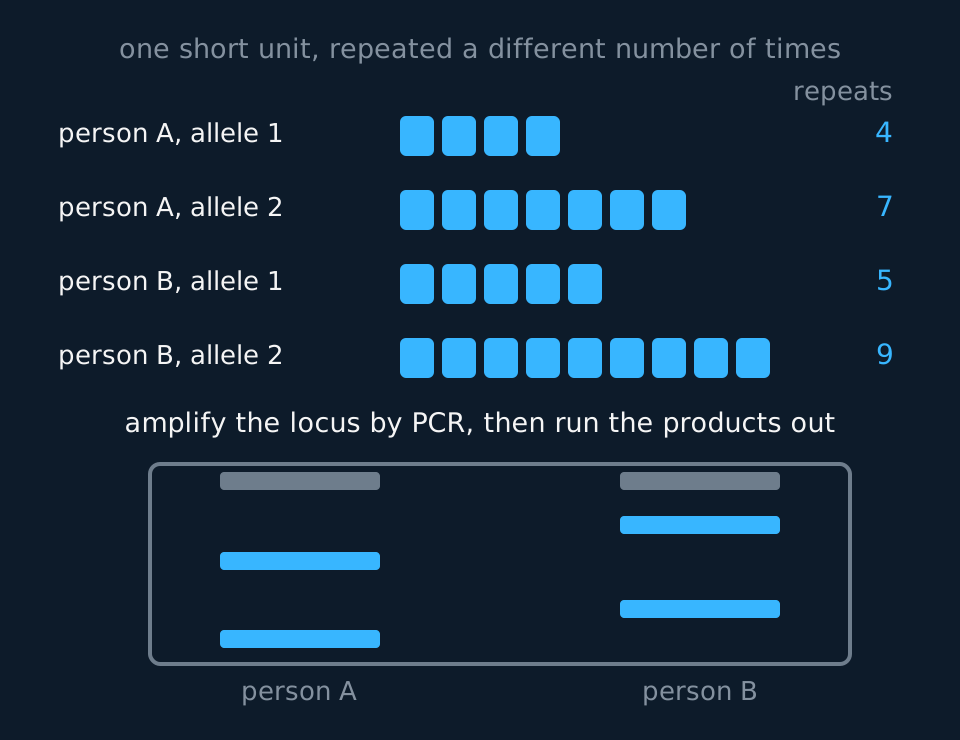
About 98 per cent of the human genome does not code for polypeptides, and scattered through it are short sequences repeated over and over, one after another. These are variable number tandem repeats (VNTRs). The sequence of the repeated unit is the same in everybody; the number of repeats at any given locus varies enormously between people and is inherited like any other allele, one from each parent.
That variation is the basis of DNA profiling. A sample is taken: blood, semen, saliva, a hair root, a few cells left on a surface. Its DNA is extracted and the chosen loci are amplified by PCR, using primers that bind to the constant sequences flanking each repeat region, so the length of each product depends only on how many repeats that person has. The products are separated by electrophoresis, and the pattern of lengths is the profile. The UK standard in use since 2014, called DNA-17, examines sixteen such loci plus a marker that indicates sex.
Describe the drawing
The upper half shows one locus in two people, drawn as a row of identical small blocks standing for a short sequence repeated over and over. Person A carries four repeats on one chromosome and seven on the other; person B carries five and nine, and the counts are printed at the right. The lower half shows the fragments run out on a gel: each person gives two bands, the longer allele stopping nearer the well and the shorter one running further, so the four bands sit at four different heights and the two people are told apart at a glance.
Because profiling uses non-coding repeats, a profile carries little information about the person: not their appearance, not their health, and not their ancestry in any detailed sense. That is a deliberate design choice, and it is part of why profiling is treated differently in law from whole-genome sequencing of suspects.
The match probability requires careful statement. A full profile at sixteen loci gives a probability of the order of one in a billion that an unrelated person chosen at random would match. That number is the probability of a matching profile given that the person is not the source. It is emphatically not the probability that the person is not the source given that the profile matches. Reversing those two is called the prosecutor's fallacy and has contributed to miscarriages of justice. State the conditional the correct way round when interpreting a match probability.
Three further limitations apply to any profile. Relatives share more alleles than strangers, so the one-in-a-billion figure does not apply to a brother. Degraded or very small samples give partial profiles at fewer loci, and the match probability weakens by orders of magnitude as loci drop out. And a match establishes that this person's DNA is in that sample; it says nothing about when it got there or how, which is a matter for other evidence entirely.
Reading a profile in a paternity case
At one locus a child has alleles of 8 and 12 repeats. The mother has 8 and 15. Man A has 11 and 12; man B has 9 and 15. Which man could be the father, and how confident should you be on this evidence alone?
Show the working
Work out what the child must have inherited. A child receives one allele at each locus from each parent. The mother carries 8 and 15, so the child's 8 can have come from her. The child's 12 cannot have come from the mother, because she does not carry it, so it must have come from the biological father.
The father must therefore carry a 12 allele at this locus. Man A has 11 and 12, so he could be the father. Man B has 9 and 15 and carries no 12 at all, so he is excluded at this locus. Exclusion is far stronger evidence than inclusion, though a laboratory confirms it at two or more loci, because a repeat number occasionally mutates between generations.
Confidence in man A is another matter. A 12-repeat allele at one locus is not rare; a substantial fraction of the population might carry one. All this result says is that man A is not excluded. A real paternity test examines fifteen or more loci, and it is the product of the probabilities across all of them that produces a figure worth acting on. One matching locus is consistent with paternity, and consistent is not the same as demonstrated.
Forensic work and paternity are the uses everyone names, and they are not the only ones the specifications ask for. In medical diagnosis a profile can identify which variant of a pathogen an infection is, or reveal that a tumour sample carries a mutation the surrounding tissue does not, which changes the treatment. In animal and plant breeding it establishes pedigree and identifies which individuals carry a wanted allele, so a breeder selects on the genotype instead of waiting a generation to see the phenotype; it also lets a breeder avoid mating close relatives, which is how inbreeding is kept down in small populations. And across a population, comparing profiles measures genetic variability: many different alleles at the loci examined means a varied gene pool, and few means a narrow one, which is the number a conservation programme watches when a species is down to its last individuals.
Gene therapy, and why one kind is contested
Gene therapy means treating a disease by altering the genetic material of the patient's cells, usually by supplying a working allele where the patient has two faulty ones, sometimes by silencing a harmful allele or by correcting it directly. Getting the DNA into cells requires a vector: most often a modified virus, stripped of the genes that let it cause disease and carrying the therapeutic gene instead, or a liposome, a small sphere of phospholipid that fuses with the cell-surface membrane.
Describe the drawing
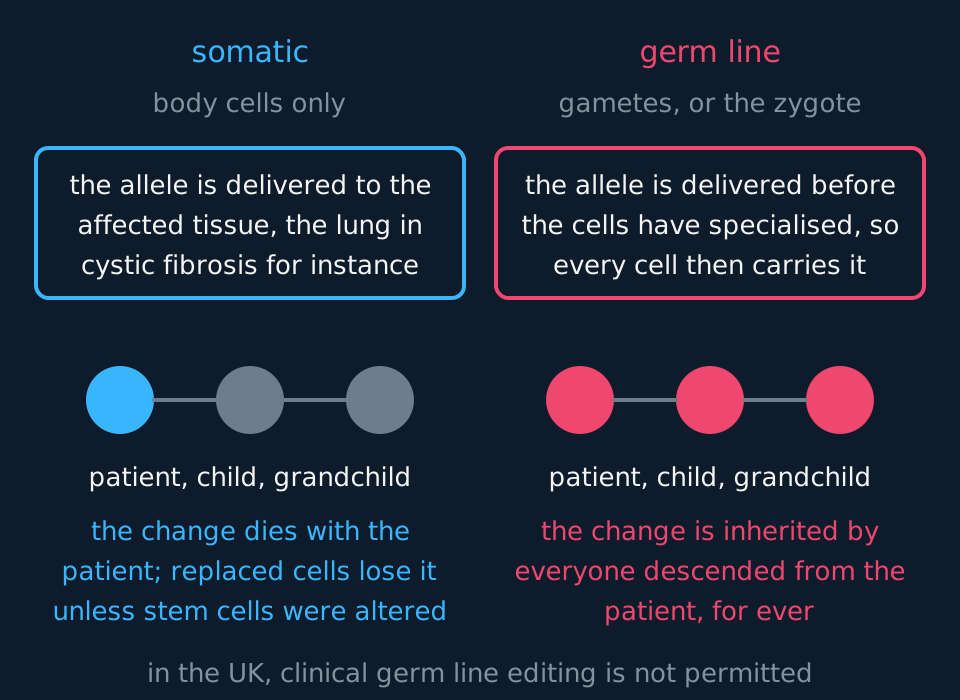
Two columns comparing the two kinds of gene therapy. The left column, somatic, describes delivering a working allele to the affected tissue only, and beneath it three discs stand for the patient, a child and a grandchild, with only the first filled in to show that only the patient is altered. The right column, germ line, describes delivering the allele to a gamete or a zygote before the cells have specialised, and all three discs are filled in to show the alteration passing down every generation.
Somatic gene therapy alters body cells. It has produced genuine treatments. Children with severe combined immunodeficiency have been treated by removing their bone marrow stem cells, inserting a working allele, and returning them; Luxturna, licensed in 2017, delivers a working RPE65 allele into the retina and restores useful vision in a form of inherited blindness; Casgevy, approved in the UK in 2023, uses gene editing on a patient's own blood stem cells to treat sickle cell disease and β-thalassaemia. Gene editing is genetic engineering that inserts, deletes or replaces DNA at a chosen site in the genome. In CRISPR-Cas9, a short guide RNA complementary to the target leads the Cas9 nuclease to cut both strands there, and the cell's repair of the cut either disrupts the sequence or copies in a supplied one. Cystic fibrosis remains the standard teaching example and the standard cautionary one: a working CFTR allele can be delivered to airway epithelium in a liposome or a virus, but epithelial cells are replaced continually, so the treatment has to be repeated and the clinical benefit so far has been small.
Somatic therapy has four limitations. Delivery is inefficient, the immune system may attack a viral vector, and a vector that inserts at random may land inside another gene: in an early trial for severe combined immunodeficiency several children later developed leukaemia because the vector had integrated beside a proto-oncogene. Cost raises a question of justice by itself, with single-dose treatments priced in the millions.
Germ line gene therapy alters a gamete, or a zygote, or an early embryo, so that every cell of the resulting person, including the cells that will make their gametes, carries the change. It is technically possible; in 2018 He Jiankui announced the birth of twin girls whose embryos he had edited, and was subsequently imprisoned in China for three years. In the United Kingdom, clinical use of heritable genome editing is not permitted. Laws and regulatory approaches differ between jurisdictions and can change, so name the jurisdiction and date when discussing legal status.
The case for is that some conditions cannot be treated any other way. A disease that has already damaged an organ during development cannot be undone by treating cells afterwards, and for a couple who both carry two copies of a recessive allele, no embryo selection is possible because every embryo will be affected. Correcting the allele once removes the disease from that family permanently rather than treating each generation in turn, which is arguably kinder and certainly cheaper.
The case against rests on four points that are usually made together. Consent cannot be obtained from the person who is altered, nor from any of their descendants, and they are the people who bear the risk. Editing is not perfectly precise, and an off-target change would be inherited along with the intended one, spreading a new problem through a family line. There is no agreed line between preventing disease and selecting for traits, and once the technique exists the pressure to move the line is unlikely to be zero. And because the technique would be expensive, an ability to give children biological advantages would follow wealth, which some argue would entrench inequality in a form no policy could later reverse.
A third position, held by several national academies, is that germ line editing is not wrong in principle but is not acceptable at present, because the safety data and the mechanisms of oversight do not yet exist. That is not a restatement of either side: 'not yet, under these stated conditions'.
TRY IT: Deciding which kind of therapy a case calls for
A couple are both carriers of an autosomal recessive condition that causes severe and irreversible brain damage during fetal development. They ask whether gene therapy could give them an unaffected child. Explain what somatic gene therapy could and could not do for them, what alternatives exist, and why germ line therapy is treated differently in law.
Check your answer
Somatic gene therapy could do very little here, and the reason is timing rather than technique. The damage happens during fetal development, so by the time a child could be treated the brain has already formed abnormally. Supplying a working allele to body cells afterwards cannot undo structural damage that has already occurred; at best it might slow further deterioration.
The alternative that already exists is selection rather than alteration. Both parents are carriers, so on average one embryo in four is affected and three in four are not. Pre-implantation genetic testing during IVF allows embryos to be tested and an unaffected one to be implanted. That involves no editing at all, and it is legal and regulated in the UK. Prenatal diagnosis by chorionic villus sampling or amniocentesis is the other route, with the decision that follows a positive result left to the parents.
Germ line therapy is treated differently because the change would be present in every cell of the resulting person, including the cells that form their gametes, and so would be inherited by every descendant. That raises questions somatic therapy does not: nobody in any future generation can consent, an off-target edit would be inherited alongside the intended one, and there is no way to withdraw the alteration if it turns out to be harmful. Set against that, supporters point out that embryo selection does not help every couple and that correcting an allele once removes the condition from the family permanently. In the United Kingdom, clinical use of heritable genome editing is not permitted; laws differ between jurisdictions and can change, so name the jurisdiction and date. The prohibition is a decision about risk and consent rather than a statement that the procedure is biologically impossible.
In the exam
- State that a genome project produces a base sequence and that locating genes is annotation, carried out afterwards.
- Predicting a proteome from a genome is relatively direct in many bacteria and is not in a eukaryote, because of introns, alternative splicing, regulatory DNA and post-translational modification. Name at least two of those.
- Give the mechanism by which a probe binds: hydrogen bonding to a complementary sequence.
- Distinguish screening from counselling. Screening is the test; counselling is the non-directive explanation of what the result means and what the options are.
- DNA profiling uses non-coding repeated sequences, which is why a profile reveals little about the person's characteristics.
- State a match probability as the chance of a match given that the person is not the source, not as the chance that they are not the source given a match.
- State the distinction between the two kinds of gene therapy: somatic changes are not inherited, germ-line changes would be.
- In an ethics question, give the arguments on both sides with the reason behind each, and name who holds them.
- Use a named example for personalised medicine: HER2 with trastuzumab determines whether a drug is given, and TPMT with azathioprine determines the dose.
- In an evaluation of personalised medicine, give the limitations as well: cost, reference databases drawn mostly from people of European ancestry, and the polygenic nature of most common conditions.
Check yourself
A biotechnology company offers a mail-order test which, from a saliva sample, reports on a microarray of 700 000 sites and returns a list of conditions the customer is 'at increased risk of'. Evaluate this service: explain what the technique can genuinely establish, three limitations of the information it provides, and one argument on each side of the question of whether such tests should be sold directly to the public.
Answer
What it can establish is real. Saliva contains cells, so DNA can be extracted and amplified by PCR. Washing the labelled DNA over a microarray whose spots carry known probe sequences shows, by hybridisation, which of those 700 000 variants the customer carries. As a determination of genotype at those sites the result is accurate for common variants, though calls of very rare variants on such arrays are often false positives and need confirming by sequencing.
The first limitation is that a variant associated with a condition is not a cause of it. Most of the associations reported by these tests come from studies that found a particular variant slightly more often in affected people than in unaffected ones. A relative risk of 1.3 against a background risk of 2 per cent moves the absolute risk to about 2.6 per cent, which is a difference most people would ignore if it were presented that way rather than as 'increased risk'.
The second is coverage of the wrong kind. An array tests the sites that were put on it and no others, so a negative result is not reassurance: a customer may carry a rare pathogenic variant in the very gene being reported on and be told nothing, because that variant was not among the 700 000. Nor does an array detect the insertions, deletions and structural changes that cause a great deal of genetic disease.
The third is that risk depends on far more than genotype, since environment, diet, age, smoking and family history all contribute, and no counselling is attached, so the customer receives a probability with nobody to explain what it means or what to do.
For direct sale, the strongest argument is autonomy: the information is about the customer's own body, adults are entitled to it without a doctor's permission, and some people act on it usefully. Against it, the strongest argument is harm from misunderstanding: a result presented without counselling can prompt unnecessary anxiety, unnecessary surgery or false reassurance, it discloses information about relatives who never consented, and the burden of sorting out the confusion falls on health services that had no part in selling the test.
Questions
Question 14 marks
Explain why the sequenced genome of a bacterium gives its proteome almost directly, while the sequenced genome of a human does not.
Mark scheme
- B1 bacterial genes are continuous, with no introns, so one gene gives one polypeptide and the coding sequence can be read straight off the DNA
- B1 human genes contain introns, which have to be identified and removed before the coding sequence is known
- B1 alternative splicing lets one human gene give several different polypeptides
- B1 large stretches of the human genome are regulatory rather than coding, and post-translational modification changes the polypeptide again after translation
Question 24 marks
Compare somatic gene therapy with germ line gene therapy, referring to which cells are altered, what is inherited, and how each stands in law.
Mark scheme
- B1 somatic therapy alters body cells such as bone marrow, retina or airway epithelium, whereas germ line therapy alters a gamete, a zygote or an early embryo
- B1 a somatic change is not inherited, because the cells that become sperm or eggs are untouched, whereas a germ line change is present in every cell of the resulting person, including those cells, and passes to every descendant
- B1 somatic treatment often has to be repeated, because cells that are not stem cells are replaced within weeks, whereas a germ line change is permanent and cannot be withdrawn from the family line
- B1 somatic therapy is licensed for several conditions, whereas clinical use of heritable genome editing is not permitted in the UK and is banned or unauthorised in most countries that regulate it; credit any named jurisdiction stated correctly
Question 34 marks
Trastuzumab is given only to patients whose breast tumour has been tested first, while patients starting azathioprine may have their TPMT genotype tested first. Explain what each test is for, and explain why the two tests read different genomes.
Mark scheme
- B1 trastuzumab is an antibody with a binding site complementary to the HER2 receptor, so it can only work on a tumour that over-expresses HER2 and the test decides whether the drug is given at all
- B1 TPMT is the enzyme that breaks azathioprine down, so a patient with two low-activity alleles would accumulate the drug and suffer bone marrow damage, and the test decides the dose rather than the drug
- B1 the HER2 test reads the genotype the tumour has acquired through mutation, which the rest of the patient's cells do not carry
- B1 the TPMT test reads alleles the patient inherited, which are present in every cell and will not change
Question 44 marks
A health minister proposes sequencing the genome of every newborn so that all later prescribing can be personalised. Evaluate this proposal.
Mark scheme
- B1 in favour, a drug that will not work for a patient can be avoided rather than trialled, and doses can be set to prevent adverse reactions such as the bone marrow damage caused by a standard thiopurine dose in a TPMT-deficient patient
- B1 against, the sequencing and the interpretation cost money and staff time that the health service must fund before any saving appears
- B1 against, the reference databases used to judge what a variant means are drawn mostly from people of European ancestry, so the benefit would be smaller for the patients already served worst
- B1 a supported judgement, for example that it is worth doing for the small set of single-gene drug-handling variants with clear evidence, but not as a prediction of common disease, which is polygenic and strongly environmental
Question 54 marks
Compare genetic screening with genetic counselling, referring to what each one does and to the meaning of non-directive.
Mark scheme
- B1 genetic screening is the laboratory test itself, carried out on an individual to look for particular alleles, whereas genetic counselling is the conversation around the test, explaining what it can and cannot show
- B1 counselling works out the risk to the person and to any children, and sets out the options available, which screening alone does not do
- B1 counselling is meant to be non-directive, meaning the counsellor does not recommend a course of action, because the decision belongs to the person or family being counselled
- B1 screening can happen without counselling, as in newborn heel-prick testing, but a positive predictive result for an adult-onset condition is normally accompanied by counselling before and after the test
Question 64 marks
A woman is found to carry a pathogenic BRCA1 variant; a separate patient is found to carry the allele for Huntington's disease. Compare what each result means for the person who receives it, referring to penetrance.
Mark scheme
- B1 the BRCA1 result raises the woman's lifetime risk of breast cancer from roughly twelve to fifteen per cent in the general population to about sixty to seventy per cent, which is a large increase but not a diagnosis, since some carriers never develop cancer
- B1 the Huntington's disease result is different because penetrance of the allele is essentially complete, so the result says the disease will develop at some point, though not when
- B1 the BRCA1 result changes what the woman might reasonably choose to do, such as more frequent screening or risk-reducing surgery, whereas nothing currently changes the course of Huntington's disease
- B1 both results are examples of predictive genetic testing, but the certainty of the outcome each one predicts is completely different, which is why many people at risk of Huntington's disease choose not to be tested
Question 74 marks
Describe how a DNA profile is obtained from a sample such as blood or saliva, using the terms variable number tandem repeat and PCR.
Mark scheme
- B1 DNA is extracted from the sample and a set of loci is chosen, each a variable number tandem repeat that differs in length between people
- B1 each locus is amplified by PCR, using primers that bind to the constant sequences flanking the repeat, so the length of the product depends only on how many repeats that person has
- B1 the amplified products are separated by gel electrophoresis according to their length
- B1 the pattern of fragment lengths obtained, one from each parent at every locus examined, is the profile, and the UK standard test examines sixteen such loci plus a marker that indicates sex
Question 84 marks
At one locus a mother has alleles of 9 and 14 repeats, and her child has alleles of 9 and 11 repeats. Man A has alleles of 11 and 16; man B has alleles of 7 and 14. Identify which man could be the father, identify which man is excluded, and identify what a single matching locus like this does and does not show.
| Person | Alleles at this locus (repeats) |
|---|---|
| Mother | 9, 14 |
| Child | 9, 11 |
| Man A | 11, 16 |
| Man B | 7, 14 |
Mark scheme
- B1 the child's allele of 9 repeats could have come from the mother, since she carries a 9
- B1 the child's other allele, 11 repeats, is not carried by the mother, so it must have come from the biological father, who must therefore carry an 11
- B1 man B, with alleles 7 and 14, carries no 11 at this locus and is excluded here, which is strong evidence against paternity (confirmed at further loci, since repeat numbers occasionally mutate), whereas man A, with alleles 11 and 16, could be the father, since he is not excluded
- B1 a single matching locus only shows that man A is not excluded, since an 11-repeat allele may be carried by a substantial fraction of the population; it does not by itself demonstrate paternity, which needs the same result repeated across fifteen or more loci
Question 94 marks
Explain how a fully sequenced and annotated bacterial genome can be used to identify a candidate antigen for a new vaccine without culturing the pathogen itself, and explain why the same approach is much harder for a eukaryotic parasite.
Mark scheme
- B1 annotation of a bacterial genome is relatively direct because bacterial genes are continuous with no introns, so the sequence can be translated straight into a predicted list of the proteins the bacterium can make
- B1 a surface protein that every strain carries and that the human host does not make is a candidate vaccine antigen among those predicted proteins, since it is one the immune system would meet first
- B1 screening the predicted protein list on a computer is faster and safer than growing the pathogen to find its surface proteins directly, which matters most for organisms dangerous to culture
- B1 the same route is much harder in a eukaryotic parasite because introns must be identified and removed, alternative splicing can give one gene several polypeptides, and much of the genome is regulatory rather than coding
Question 103 marks
Explain how a labelled DNA probe is used to find out whether a person carries a particular allele.
Mark scheme
- B1 the probe is a short single strand of DNA whose base sequence is complementary to the sequence being looked for, carrying a radioactive or a fluorescent label
- B1 the sample DNA is made single-stranded by heating and the probe is added, and hybridisation occurs wherever the probe meets a complementary sequence, held by hydrogen bonds between complementary bases
- B1 unbound probe is washed away, and the label is then detected, on photographic film or under ultraviolet light, only where the probe has bound
Question 113 marks
A profile from a crime scene matches a suspect, and the court is told that the probability of such a match in an unrelated person chosen at random is one in a billion. A lawyer says there is therefore a one in a billion chance that the suspect is innocent. Explain why that statement is wrong.
Mark scheme
- B1 the quoted figure is the probability of obtaining a matching profile given that the person is not the source of the sample
- B1 the lawyer has reversed it into the probability that the person is not the source given that the profile matches, which is a different quantity and is not what the figure measures; reversing the two is the prosecutor's fallacy
- B1 the chance that the suspect is not the source depends on how many other people could have left the sample and on the rest of the evidence, which the match probability does not include; accept that the figure assumes an unrelated person, and relatives share far more alleles
Question 123 marks
Explain the difference between what a DNA microarray shows when labelled DNA from a sample is washed over it, and what it shows when labelled cDNA made from a tissue's mRNA is washed over it.
Mark scheme
- B1 washing labelled DNA from a sample over a microarray identifies which alleles at each probed position that person carries, which is a measurement of genotype
- B1 washing labelled cDNA made from a tissue's mRNA over a microarray identifies which of those genes the tissue is transcribing at the time the sample was taken, which is a measurement of expression rather than genotype
- B1 the microarray itself works the same way in both cases, by hybridisation to a complementary sequence, so the difference lies entirely in what is used as the starting material
Question 133 marks
Explain why genotyping every patient's CYP2C9 and VKORC1 variants before starting warfarin has not been shown to give a clear benefit over the existing practice of adjusting the dose by monitoring, even though the mechanism linking genotype to dose is well established.
Mark scheme
- B1 common variants of CYP2C9 and VKORC1 do shift the dose of warfarin a patient needs by several times, which is a genuine and well-established mechanism
- B1 existing practice starts every patient on a low dose and adjusts it using blood clotting tests, and this monitoring identifies the correct dose for a given patient within a week or two in any case
- B1 because monitoring reaches the same dose about as quickly as genotyping would predict it, trials comparing the two approaches have not shown a clear improvement in outcome from genotyping first
Question 143 marks
Describe the two kinds of vector used to deliver a gene into a patient's cells in somatic gene therapy, and describe one limitation of using a viral vector.
Mark scheme
- B1 a modified virus, stripped of the genes that would let it cause disease and carrying the therapeutic gene instead, can be used to carry the gene into cells
- B1 alternatively a liposome, a small sphere of phospholipid that fuses with the cell-surface membrane, can be used to deliver the gene without any virus at all
- B1 a limitation of a viral vector is that the patient's immune system may attack it, or that a vector integrating at a random position in the genome may land inside another gene, such as a proto-oncogene, causing serious harm
Question 152 marks
State what a genome project produces, and state what annotation adds to that product afterwards.
Mark scheme
- B1 a sequence of bases for the organism, coding and non-coding alike
- B1 annotation locates the genes within that sequence and works out which non-coding regions do something, and it is a separate and slower job done afterwards
Worth remembering
- Sequencing gives you bases; annotation, done afterwards, gives you genes.
- In eukaryotes the genome does not give the proteome directly, because of introns, alternative splicing and post-translational modification.
- A probe is a short labelled single strand that binds a complementary sequence by hydrogen bonding; a microarray is thousands of probes at once.
- Screening is the test; counselling is the non-directive conversation about what the result means.
- DNA profiles use variable number tandem repeats in non-coding DNA, amplified by PCR and separated by electrophoresis.
- A match probability is the chance of a match given that the person is not the source, and reversing it is the prosecutor's fallacy.
- Somatic gene therapy is not inherited; germ line therapy would be, which is why the two are regulated separately.
- A bacterial genome can often be annotated to a predicted list of proteins, which is what makes computer screening for vaccine antigens possible. Viral genomes may use overlapping genes, RNA processing or polyproteins, so the same route is less direct there.
- Profiling is not only forensic: medical diagnosis, pedigree and allele selection in breeding, and genetic variability across a population.
- Personalised medicine sorts patients with the same diagnosis by genotype, then chooses the drug, as with HER2 and trastuzumab, or the dose, as with TPMT and azathioprine.
- Its limits are cost, reference data drawn mostly from people of European ancestry, and the polygenic nature of most common disease.
CHECK YOUR PROGRESS
Rate how confident you are with each objective for this lesson. Ratings are saved in this browser, on this device, unless you sign in.
- Say what a genome project produces, and what still has to be done before a sequence becomes useful.
- Explain why predicting a proteome from a genome sequence is more direct in many bacteria than in a eukaryote, and where it is not.
- Explain how a DNA probe works and what a microarray adds to it, distinguishing genotyping from expression profiling.
- Distinguish genetic screening from genetic counselling, and state what non-directive counselling involves.
- Describe how a DNA profile is produced from variable number tandem repeats, and interpret a match probability correctly.
- Compare somatic with germ line gene therapy, and set out why the second is the more contested.
- Explain how a simpler organism's proteome identifies candidate vaccine antigens, and give the uses of profiling beyond forensics.
- Explain what personalised medicine is, using HER2 with trastuzumab and TPMT with azathioprine, and weigh its benefits against cost, unequal reference data and the fact that most conditions are polygenic.
Open the full revision checklist to see every objective in the curriculum in one place.
Practise this lesson
WORKBOOK
The written questions from this topic, on paper with room to work, and a separate book of mark schemes. The question that is set on a diagram stays on this page, where the diagram can be drawn. Free to use; please do not redistribute or sell.