Biology › Gene regulation, genomics and biotechnology › Control of gene expression
Control of gene expression
A liver cell and a neurone carry the same genome and differ in which genes are transcribed. Transcription factors act at the promoter, DNA methylation and histone acetylation change the accessibility of chromatin, and small interfering RNA acts after transcription. The lac operon is the prokaryotic worked example.
Before this Transcription and the promoter region · RNA polymerase and the template strand · Protein tertiary structure and binding sites · Cell specialisation and stem cells
COMMON MISCONCEPTION
A liver cell keeps the genes it needs and throws the rest away.
A specialised cell keeps its whole genome: a neurone's nucleus holds the insulin gene complete, and a β cell holds every gene a neurone uses. Cells differ in which genes are transcribed, which is why a nucleus from an adult udder cell directed the development of a whole sheep in 1996.
What you should be able to do
- Explain what a transcription factor is and how one alters the rate of transcription of a particular gene.
- Describe how the lac operon switches on when lactose arrives, naming the regulatory gene, the promoter, the operator and the structural genes.
- Describe how oestrogen switches a gene on, and explain why a steroid hormone can take that route and a peptide hormone cannot.
- Explain how DNA methylation and histone acetylation change the accessibility of a gene, and say which way each one pushes.
- State precisely what epigenetic inheritance is known to involve, and where the evidence in humans runs out.
- Explain how small interfering RNA stops a protein being made from a gene that has already been transcribed.
One genome, two hundred cell types
A human body runs on something like twenty thousand protein-coding genes and contains over two hundred recognisably different kinds of cell. Every one of those cells, apart from mature red blood cells and the gametes, carries the whole genome, and transcribes perhaps half of it at any moment. Which subset is transcribed accounts for most of the differences between cell types.
Gene expression can be controlled at every stage between a gene and its protein: transcription blocked or accelerated, pre-mRNA spliced one way rather than another, mRNA destroyed before a ribosome reaches it, the finished polypeptide left inactive until it is wanted. Most regulation, and most of the regulation on these specifications, acts at transcription, because a process not started consumes no substrates.
- Gene expression
- The process by which the information in a gene is used to produce a functional product, usually a polypeptide.
- Transcription factor
- A protein that binds to a specific base sequence in DNA, usually in or near a promoter region, and so increases or decreases the rate of transcription of that gene.
- Promoter
- A region of DNA at the start of a gene to which RNA polymerase and transcription factors bind.
A transcription factor is a protein, so it is the product of a gene and is itself regulated by other transcription factors. Regulation in a eukaryote is therefore layered, and one signal arriving at the cell surface can change the transcription of hundreds of genes.
Differentiated cells retain the whole genome, and two experiments demonstrate it. A nucleus taken from an adult mammary gland cell and transferred into an egg cell whose own nucleus had been removed produced a whole sheep, born in 1996. Induced pluripotent stem cells, reported in 2006, were produced from differentiated cells using four transcription factors.
Transcription factors: the general mechanism
The mechanism is the same in each case. A transcription factor has a region whose tertiary structure is complementary to a specific short sequence of bases, usually in or beside the promoter of the gene it controls. It binds there by hydrogen bonds and ionic interactions with the exposed edges of the bases. Once bound, it either helps RNA polymerase attach and start transcribing, or gets in the way so that RNA polymerase cannot. Factors that increase the rate are activators and those that decrease it are repressors; both are transcription factors, so define a transcription factor as altering the rate of transcription rather than as switching genes on.
The specificity is of the same kind as an enzyme's: a binding site with a particular shape and charge distribution fits one short stretch of DNA in three billion base pairs closely enough for binding to persist. A change in the factor's shape removes that complementarity or creates it. Each example below applies that mechanism.
The lac operon
Escherichia coli uses glucose preferentially but can metabolise lactose, using enzymes that transport lactose into the cell and hydrolyse it. Synthesising those enzymes in the absence of lactose would consume amino acids and ATP without benefit, so the genes are transcribed at a low rate until lactose is present. The control circuit was described by François Jacob and Jacques Monod in 1961.
An operon is a group of structural genes transcribed together as a single mRNA, plus the control sequences that switch them. The lac operon has three structural genes: lacZ, which codes for β-galactosidase, the enzyme that hydrolyses lactose into glucose and galactose; lacY, which codes for lactose permease, the transport protein that lets lactose into the cell; and lacA, a transacetylase whose function is not settled. In front of them sit the promoter, where RNA polymerase binds, and the operator, a short sequence between the promoter and the genes.

Describe the drawing
The lac operon drawn as a length of bacterial DNA and animated through one full switching cycle. The regulatory gene lacI sits to the left, then the promoter, the operator, and the three structural genes lacZ, lacY and lacA. With no lactose present the repressor protein sits on the operator and RNA polymerase cannot bind the promoter. Lactose then enters, some is converted to allolactose, and that binds the repressor at a separate site; the repressor changes shape, loses its fit for the operator and drifts away. RNA polymerase moves along and transcribes all three genes as a single messenger RNA. When the lactose has been used up the repressor recovers its shape, binds the operator again and transcription stops.
Nearby, and transcribed at a steady rate, is the regulatory gene lacI. Its product is the lac repressor, a protein with two binding sites: one complementary to the operator, and one complementary to the inducer.
In the absence of lactose, the lac repressor binds to the operator and reduces transcription of the structural genes. When lactose is present, some is converted to allolactose. Allolactose binds to the repressor and changes its conformation, so its affinity for the operator falls. RNA polymerase can then transcribe lacZ, lacY and lacA. High expression also depends on low glucose through the cAMP-CAP system.
The three structural genes are transcribed as one long mRNA, ribosomes translate it, and the cell has all three enzymes within a few minutes. When the lactose has been metabolised, allolactose concentration falls, the repressor returns to its original conformation, it rebinds the operator, and transcription falls back to its low background rate.
Two points of precision. Allolactose is an isomer of lactose, formed by β-galactosidase from the small quantity of enzyme the repressed operon still produces, which is why transcription is never entirely absent. If a specification uses the simplified term 'lactose', state that convention in the answer. State the effect of the bound repressor in the terms the specification uses: it prevents RNA polymerase from binding to the promoter, so the structural genes are not transcribed. The mechanism of the block is still under investigation in the research literature, so the specification wording is the one to give.
The cAMP-CAP system is the second arm of the circuit and is not examined at A level in the same detail. Transcription runs strongly only when glucose is also scarce, a state signalled by a rise in cyclic AMP, which activates a protein called CAP that helps RNA polymerase bind the promoter. With glucose plentiful, transcription of the operon remains low even in the presence of lactose.
Cambridge International requires a related pair of terms. β-galactosidase is an inducible enzyme: it is synthesised only when its substrate is present, because a derivative of the substrate reduces the repressor's affinity for the operator. A repressible enzyme is regulated in the opposite direction: it is synthesised continuously until the product of its pathway accumulates, at which point the product binds a repressor protein and gives it a conformation that does bind its operator, so transcription falls. Bacterial enzymes that synthesise amino acids are regulated this way, so a cell supplied with an amino acid reduces transcription of the genes for the enzymes that make it. In one case a small molecule inactivates a repressor and in the other it activates one; in both, transcription is matched to the cell's requirement for the enzyme.
- Inducible enzyme
- An enzyme synthesised only when its substrate is present, because the substrate or a derivative of it inactivates the repressor of its gene, as allolactose does for β-galactosidase.
- Repressible enzyme
- An enzyme synthesised continuously until the product of its pathway accumulates and activates a repressor, switching transcription of its gene off.
Exam-board note: the lac operon is named in OCR Biology A, Edexcel Biology A and Cambridge International 9700 and is not named by AQA, whose specification requires repressors acting as transcription factors without naming this example.
Two mutations, two very different bacteria
Two mutant strains of E. coli are isolated. In strain 1 a mutation in lacI produces a repressor protein whose inducer-binding site no longer works. In strain 2 a mutation in the operator sequence means the repressor can no longer bind to it. Predict the behaviour of each strain in a medium containing lactose and in a medium containing none.
Show the working
Strain 1's repressor still binds the operator, because that site is untouched, but allolactose can no longer bind it, so nothing ever changes its shape. It stays on the operator permanently. The structural genes are never transcribed in either medium, so the bacterium grows on glucose and starves on lactose.
Strain 2 is the mirror image. Its repressor is normal but has nothing to bind to, so it never obstructs anything. The structural genes are transcribed continuously in both media. The cell survives, but wastes amino acids and ATP making enzymes for a substrate that is not there, and is out-competed by the wild type on glucose.
Oestrogen and the assembly of a transcription factor
Eukaryotes have no operons: genes with related functions are distributed across chromosomes rather than transcribed together. The mechanism of a protein binding DNA and altering the rate at which RNA polymerase transcribes a gene is the same. AQA names oestrogen as the worked example.
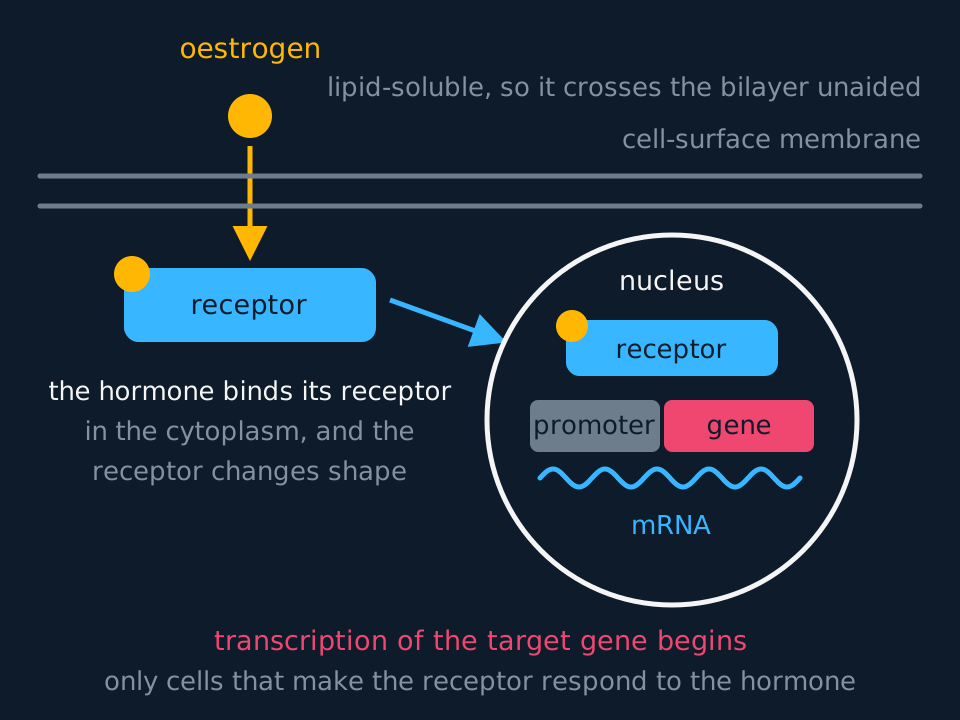
Oestrogen is a steroid and is therefore lipid-soluble, which determines the mechanism. It diffuses through the phospholipid bilayer without a channel or a carrier, so it reaches the inside of the cell and then the inside of the nucleus. A peptide hormone such as insulin can do none of that: it binds a receptor on the outside of the membrane and sends its message in by a second messenger.
Describe the drawing
The path a molecule of oestrogen takes to switch a gene on. It is drawn as an amber disc outside the cell, passing through the two lines of the phospholipid bilayer because it is lipid-soluble. Inside the cytoplasm it binds a receptor protein, drawn as a labelled block, and the two together form a hormone-receptor complex. An arrow carries that complex into the nucleus, drawn as a large circle, where it settles on the promoter region lying beside the target gene and transcription of that gene starts.
Inside a target cell, oestrogen binds to an oestrogen receptor, a protein that is itself an inactive transcription factor. Binding changes the receptor's tertiary structure and exposes its DNA-binding site. The hormone-receptor complex then binds to a specific base sequence beside the target gene, the oestrogen response element, and recruits RNA polymerase, so transcription of that gene starts or speeds up.
A convention to note: textbook diagrams and specification wording place the receptor in the cytoplasm, while most oestrogen receptor protein is in the nucleus before the hormone arrives. Give the cytoplasmic version where a question asks for the A-level pathway.
Only cells that make the receptor can respond to oestrogen at all, which is why the hormone reshapes receptor-rich breast and uterine tissue while tissues carrying few or no receptors barely respond, and why about three quarters of breast cancers are oestrogen-receptor positive and are treated with drugs such as tamoxifen, which occupies the hormone-binding site so the complex cannot form.
Cambridge International names a plant example that works by removing a repressor rather than by activating a factor. The genes for stem elongation and, in germinating barley, for amylase synthesis are repressed by DELLA proteins, which bind the transcription factors for those genes and prevent them acting. The hormone gibberellin binds its receptor, the complex attaches to the DELLA protein, and the DELLA protein, now tagged, is degraded by the cell's protein-degrading system. The transcription factors it was holding are then released, transcription increases, and the stem elongates. Several dwarf wheat varieties carry DELLA proteins that resist that degradation, so transcription is not de-repressed and the stems stay short; those varieties were central to the Green Revolution.
- Oestrogen response element
- A specific base sequence near a target gene to which an oestrogen-receptor complex binds, increasing the rate of transcription.
- Steroid hormone
- A lipid-soluble hormone that crosses the cell-surface membrane by simple diffusion and acts on an intracellular receptor.
Epigenetic control of transcription
Two metres of DNA fit inside a nucleus six micrometres across by being wound around histones, positively charged proteins that the negatively charged phosphate groups of the backbone stick to, and then coiled again and again. DNA wound tightly onto histones cannot be reached by RNA polymerase or by transcription factors, so how tightly it is wound is a control mechanism in its own right.
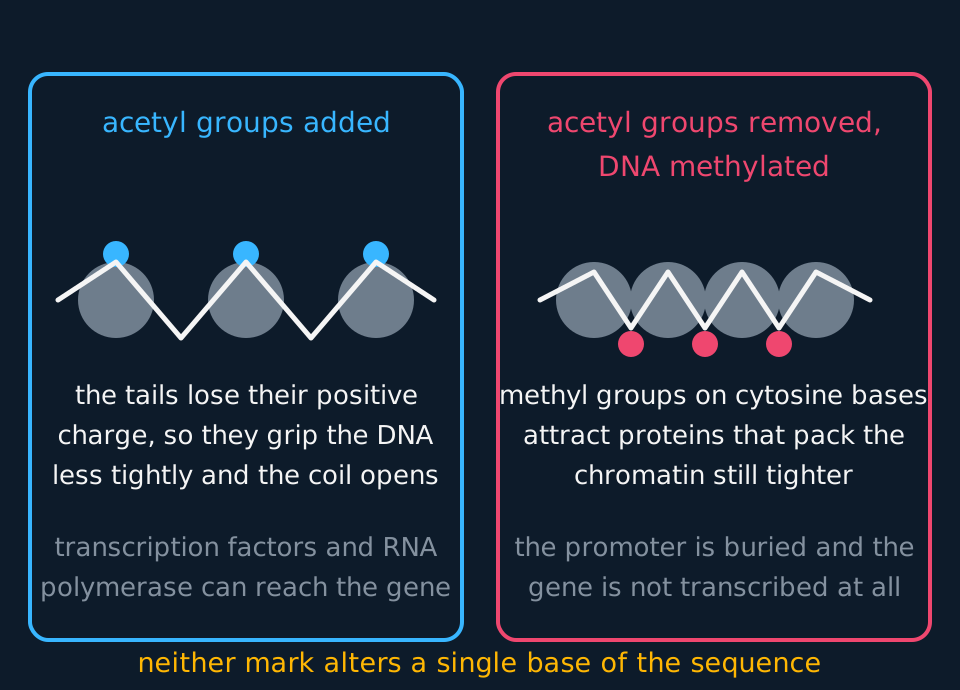
Histone acetylation is the first mark. Enzymes add acetyl groups to lysine residues on the histones' protruding tails, removing the positive charge from each lysine, so the tail's attraction to the DNA's phosphate groups weakens, the chromatin loosens and the promoter becomes accessible. Transcription goes up. Histone deacetylase enzymes remove the acetyl groups, the charge returns and the chromatin condenses. Decreased acetylation means decreased transcription. Like the methylation statement below, that describes the usual effect at a promoter, which is the case the specifications cover.
DNA methylation is the second. A methyl group is attached to a cytosine base, usually where a cytosine is followed by a guanine. Heavy methylation of a promoter silences the gene, partly by preventing transcription factors binding and partly by attracting proteins that recruit the deacetylases, so the two mechanisms are not independent, and the chromatin ends up shut either way.
Describe the drawing
Two panels comparing the same stretch of chromatin in its active and its silenced states. On the left the histone proteins, drawn as grey discs, are spaced well apart with acetyl groups marked on them and the DNA looping loosely between; the promoter is reachable and the gene is transcribed. On the right the same histones are packed tightly together with no acetyl groups, methyl groups are marked on the DNA itself, and the coil is drawn compressed so that nothing can reach the promoter. A line beneath states that neither mark changes the base sequence.
- Epigenetics
- Heritable changes in gene expression caused by chemical modifications to DNA and to the histones associated with it, without any change to the base sequence.
- Epigenome
- The full set of chemical marks on a cell's DNA and histones at a given time.
- Histone acetylation
- The addition of acetyl groups to histone tails, which reduces their positive charge, loosens the chromatin and increases transcription.
- DNA methylation
- The addition of methyl groups to cytosine bases; heavy methylation of a promoter reduces or prevents transcription of that gene.
The word 'heritable' in that definition covers two distinct claims, which are supported by different amounts of evidence.
Heritable through cell division is well established. When a cell replicates its DNA an enzyme copies the methylation pattern from the parent strand onto the new one, so a liver cell divides into two liver cells rather than into something undecided. That is how a differentiated cell stays differentiated through hundreds of divisions, and it is why the marks are called heritable at all.
Heritable through the germ line, meaning passed to a child in the gamete, is a different claim. Mammalian marks are erased twice: once in the primordial germ cells as gametes form, and again in the zygote shortly after fertilisation. Both erasures are extensive, so most marks a parent acquires during life cannot reach the child. A few regions escape. Imprinted genes, where whether an allele is expressed depends on which parent it came from, are the clear case, and their marks are erased and reset each generation according to the sex of the parent, so they do not accumulate across generations.
Three lines of evidence are relevant. In mice a handful of loci escape erasure, and a mother's diet can change her offspring's coat colour through methylation of one of them. In humans the evidence is observational: children conceived during the Dutch Hunger Winter of 1944 to 1945 show altered methylation at some loci decades later, and records from Överkalix in northern Sweden suggest associations between grandparents' food supply and grandchildren's health. None of that demonstrates a mechanism. A fetus in a starved uterus is directly exposed, other explanations were not excluded, and no molecular route from a grandparent's diet to a grandchild's epigenome has been shown in humans.
The defensible statement is therefore: epigenetic marks are reliably passed from a cell to its daughter cells, and that is how differentiation persists; whether experiences in one human generation routinely leave marks in the next is not established. Note also that the marks are attached to the DNA and its histones rather than altering the base sequence, so no gene is rewritten in either case.
TRY IT: Reading an epigenetics claim properly
A newspaper reports a study in which male mice were trained to fear a particular smell. Their sons, who had never met their fathers and had never smelled it, startled more at that smell than control mice did. The headline reads 'Fear is written into your children's DNA'. Write two criticisms of the headline as it stands, and state what would have to be shown for the underlying claim to be established.
Check your answer
The first criticism is the wording. Nothing in the study claims the base sequence changed, and 'written into DNA' says that it did. An epigenetic mark is a chemical group attached to DNA or to the histones around it; the gene underneath is untouched, which is precisely why the effect is in principle reversible and why it should not be described as a change to the DNA.
The second is that an association between a father's experience and his sons' behaviour does not by itself identify a route. Sperm carries more than a nucleus, and a laboratory offers other paths: differences in how the sons were handled, in the mothers, or in the environment the sperm came from. The mammalian germ line also erases most marks twice, so any claimed transmission has to explain how this one survived both erasures.
To establish the claim you would want the mark identified in the father's sperm, found again in the sons' relevant tissue, shown to survive both waves of reprogramming, and shown to produce or remove the behaviour when it is added or taken away. Until those results exist, the defensible summary is that an effect was observed and the mechanism is not identified.
RNA interference: post-transcriptional control
The mechanisms above act before or during transcription. RNA interference acts afterwards, by degrading an mRNA that has already been transcribed, so protein synthesis stops without any change to transcription.
Double-stranded RNA in the cytoplasm, whether from a virus, a transcribed repeat or a laboratory, is cut by an enzyme into fragments about twenty-one nucleotides long: small interfering RNA, or siRNA. One strand of each fragment is loaded into a protein complex and the other discarded. The complex then uses its single strand as a search template, and wherever it meets an mRNA whose bases are complementary it pairs with it and cuts it, leaving the pieces to cytoplasmic enzymes. The gene was transcribed; no protein is made.
Cells also transcribe their own short RNAs, microRNA, from their own genes. In animals these usually bind imperfectly, so instead of cutting the mRNA they slow its translation and speed its breakdown, and the effect is a reduction in the rate of protein synthesis rather than its abolition. One microRNA can regulate hundreds of different mRNAs.
- siRNA
- Small interfering RNA: short double-stranded RNA fragments, one strand of which guides a protein complex to a complementary mRNA so that the mRNA is broken down and cannot be translated.
- RNA interference
- The inhibition of gene expression by small RNA molecules binding to complementary mRNA.
Two applications. In the laboratory, siRNA is used to determine the function of a gene by silencing it and recording the consequences. In medicine, siRNA drugs are licensed: patisiran, licensed in 2018, silences transthyretin mRNA, faulty and normal alike, in patients whose faulty protein forms damaging deposits. The basis of the approach is specificity: a conventional drug binds a protein and can bind others of similar shape, while an siRNA is complementary to about twenty-one bases of sequence.
Exam-board note. AQA names RNA interference and requires its effect on translation; Edexcel Biology B lists non-coding RNA among the epigenetic modifications that change gene expression; OCR Biology A, Edexcel Biology A and Cambridge International 9700 do not list RNA interference.
In the exam
- Define a transcription factor with all three elements: it binds to DNA, at a specific base sequence, and changes the rate of transcription. 'It switches the gene on' supplies only the third.
- For the lac operon, name the parts: regulatory gene, promoter, operator, structural genes. The repressor binds the operator, not the promoter and not the genes.
- Allolactose, made from lactose, changes the shape of the repressor, so it no longer fits the operator; some specifications simplify this to lactose, so follow the wording your board uses. Say 'changes shape' or 'changes tertiary structure', because 'lactose removes the repressor' describes a mechanism that does not exist.
- Give lipid solubility as the reason oestrogen crosses the membrane, where a question asks why a steroid hormone acts differently from a peptide hormone.
- Increased methylation of DNA and decreased acetylation of histones both reduce transcription. State both in that direction.
- State that epigenetic marks do not change the base sequence. Methylation modifies a cytosine base chemically without altering the sequence, so it is not a mutation.
- State that siRNA acts on mRNA after transcription, not on transcription itself.
Check yourself
A drug inhibits histone deacetylase enzymes in a group of cells. Predict its effect on the transcription of genes in those cells, explain your reasoning in terms of charge, and suggest why such a drug is being investigated as a cancer treatment rather than as a general tonic.
Answer
Histone deacetylases remove acetyl groups from histone tails. Inhibiting them means acetyl groups accumulate, because they are still being added and are no longer being taken off.
An acetyl group neutralises the positive charge on a lysine residue in the histone tail. With more acetyl groups, the histones carry less positive charge, so they are attracted less strongly to the negatively charged phosphate groups of the DNA backbone. The chromatin becomes less condensed, promoter regions become accessible to transcription factors and to RNA polymerase, and transcription of the affected genes increases.
The cancer application follows from what has often gone wrong in a tumour cell. Tumour suppressor genes are frequently silenced by heavy methylation of their promoters and deacetylation of the associated histones rather than by any mutation, so the sequence is intact and re-opening the chromatin can restore the protein, and with it the control on division. Several such inhibitors are licensed for particular lymphomas.
The effect is not selective: the drug increases acetylation across the genome, so genes that were appropriately silenced are also transcribed, in every cell the drug reaches. That accounts for the side effects, and it is the general limitation of treatments that act on a control mechanism rather than on a specific gene.
Questions
Question 15 marks
Discuss the claim that experiences during a person's lifetime leave epigenetic marks which are then inherited by that person's children.
Mark scheme
- B1 inheritance of marks from a cell to its daughter cells is not in doubt: when a cell replicates its DNA an enzyme copies the methylation pattern of the parent strand onto the new one, which is how a differentiated cell stays differentiated through hundreds of divisions
- B1 for the claim, there is human evidence of a kind: children conceived during the Dutch Hunger Winter of 1944 to 1945 show altered methylation at some loci decades later, and records from Överkalix suggest associations between a grandparent's food supply and a grandchild's health
- B1 against the claim, mammalian marks are erased twice, once in the primordial germ cells as gametes form and again in the zygote after fertilisation, so most marks acquired during a parent's life cannot reach the child
- B1 against the claim, imprinted genes, which are the clearest case of marks that do survive, have those marks wiped and reset each generation according to the sex of the parent, which is the opposite of an experience accumulating down a family line
- B1 weighing them: the human evidence is observational, a fetus in a starved uterus is directly exposed rather than inheriting anything, and no molecular route from a grandparent's diet to a grandchild's epigenome has been demonstrated, so this is an open question rather than an established mechanism
Question 24 marks
Describe how the lac operon is switched on when lactose enters an Escherichia coli cell, naming the parts of the operon involved.
Mark scheme
- B1 the regulatory gene lacI is transcribed steadily whatever else is happening, and its product is the lac repressor, which binds to the operator
- B1 with the repressor on the operator, RNA polymerase cannot bind to the promoter, so the structural genes are transcribed only at a very low background rate
- B1 some of the lactose is converted to allolactose, which binds to the repressor's other binding site and changes the protein's tertiary structure, so the site that fitted the operator no longer fits it; a specification that simplifies the inducer to lactose accepts that name
- B1 the repressor leaves the operator, so RNA polymerase transcribes lacZ, lacY and lacA as one mRNA and the enzymes are made
Question 34 marks
Explain why oestrogen can act on a gene inside the nucleus while a peptide hormone such as insulin cannot.
Mark scheme
- B1 oestrogen is a steroid and therefore lipid-soluble
- B1 it diffuses straight through the phospholipid bilayer without a channel or a carrier, so it reaches the inside of the cell and then of the nucleus
- B1 there it binds an oestrogen receptor, changing the receptor's tertiary structure and exposing its DNA-binding site, so the complex binds the oestrogen response element and transcription of the target gene increases
- B1 insulin is a peptide and is not lipid-soluble, so it binds a receptor on the outside of the membrane and its message is carried inwards by a second messenger instead
Question 44 marks
A human body cell carries about 20 000 protein-coding genes. The table gives the number of them transcribed in a liver cell and in a neurone taken from the same person, and the number transcribed in both; the figures are constructed for this question rather than measured. Calculate the percentage of the genes transcribed in the liver cell that are also transcribed in the neurone, and calculate how many of the 20 000 genes are transcribed in neither cell.
| Genes transcribed | Number of protein-coding genes |
|---|---|
| in the liver cell | 9200 |
| in the neurone | 9600 |
| in both the liver cell and the neurone | 7400 |
Mark scheme
- M1 the shared genes are 7400 of the liver cell's 9200, so the percentage is 7400 ÷ 9200 × 100
- A1 80.4%, accepting 80%
- M1 the number transcribed in at least one of the two cells is 9200 + 9600 − 7400 = 11 400, subtracting the shared genes because they would otherwise be counted twice
- A1 20 000 − 11 400 = 8600 genes transcribed in neither cell, although both cells carry all 20 000
Question 54 marks
Compare the control of gene expression by a transcription factor with the control of gene expression by small interfering RNA, referring to the molecule each one binds, the stage at which each acts, and the direction in which each can change expression.
Mark scheme
- B1 a transcription factor is a protein that binds a specific base sequence of DNA, in or beside the promoter of the gene it controls, whereas one strand of siRNA, a short double-stranded RNA, pairs with a complementary base sequence in an mRNA molecule
- B1 a transcription factor acts at transcription, either helping RNA polymerase to bind and begin or obstructing it, whereas siRNA acts after transcription, guiding a protein complex that cuts the mRNA so it is never translated
- B1 a transcription factor can change transcription in either direction, since an activator raises the rate and a repressor lowers it, whereas RNA interference only reduces expression
- B1 in both cases the specificity comes from complementary binding to a particular sequence, but control at transcription is the cheaper of the two, because a gene left untranscribed costs the cell nothing while an mRNA destroyed by siRNA has already been paid for
Question 64 marks
Describe how the plant hormone gibberellin switches on the genes for stem elongation, using the term DELLA protein in your answer.
Mark scheme
- B1 DELLA proteins normally bind the transcription factors for the stem elongation genes and prevent them from activating transcription
- B1 gibberellin binds its own receptor, and the hormone-receptor complex then attaches to the DELLA protein
- B1 the tagged DELLA protein is broken down by the cell's protein-degrading system
- B1 the transcription factors that DELLA had been holding are released, so transcription of the stem elongation genes increases and the stem elongates
Question 74 marks
Explain how the birth of Dolly the sheep by nuclear transfer and the later production of induced pluripotent stem cells both provide evidence that a differentiated cell retains the whole genome.
Mark scheme
- B1 Dolly was produced by transferring a nucleus from an adult, differentiated mammary gland cell into an egg cell whose own nucleus had been removed
- B1 that single transferred nucleus directed the development of a complete sheep with every cell type in its body, not only mammary gland cells
- B1 induced pluripotent stem cells are produced by treating a differentiated adult cell with a small set of transcription factors, without removing or replacing any of the cell's own genes
- B1 those factors switch previously silent genes back on, which shows that the differentiated cell had kept the whole genome and had merely stopped transcribing most of it
Question 84 marks
Compare control of gene expression by the lac operon in a bacterium with control of gene expression by oestrogen in a eukaryotic cell, referring to how many genes are switched together and to whether an operon is involved.
Mark scheme
- B1 the lac operon switches three structural genes on together, transcribed as a single mRNA from one promoter, whereas the oestrogen receptor complex acts separately at each target gene's own promoter
- B1 eukaryotic genes with related functions are typically scattered across different chromosomes rather than grouped into an operon, so a eukaryotic cell has no equivalent structure for switching several genes on together in one transcript
- B1 in both systems a protein changes shape when it binds a small molecule, allolactose or oestrogen, and that change alters its ability to bind DNA
- B1 both mechanisms work by changing whether RNA polymerase can access a promoter
Question 93 marks
Explain how small interfering RNA stops a protein being produced from a gene that has already been transcribed.
Mark scheme
- B1 double-stranded RNA in the cytoplasm is cut into fragments about twenty-one nucleotides long, and one strand of each fragment is loaded into a protein complex
- B1 the complex uses that single strand as a search template and pairs with any mRNA whose bases are complementary to it
- B1 the mRNA is cut and broken down, so it is never translated and no polypeptide is made, even though transcription of the gene did happen
Question 103 marks
A drug occupies the hormone-binding site of the oestrogen receptor without changing the receptor's shape. Suggest the effect of this drug on transcription of an oestrogen-responsive gene, and suggest why it affects breast tissue far more than liver tissue.
Mark scheme
- B1 oestrogen can no longer bind, because the drug is occupying its binding site
- B1 the receptor's tertiary structure is therefore not altered, so no hormone-receptor complex able to bind the oestrogen response element forms and transcription of that gene is not increased
- B1 only cells that make the receptor can respond to oestrogen at all, and breast tissue carries far more of it than liver tissue does, so there is much less for the drug to interfere with in the liver
Question 113 marks
State what kind of molecule a transcription factor is, state where it binds, and state what it does to the rate of transcription of a gene.
Mark scheme
- B1 a transcription factor is a protein
- B1 it binds to a specific base sequence of DNA, usually in or near the promoter of the gene it controls
- B1 it increases or decreases the rate of transcription of that gene, depending on whether it is an activator or a repressor
Question 123 marks
A mutation abolishes the DNA-binding site of a transcription factor that normally activates several different genes. Suggest the effect on those genes, and suggest why this mutation could affect more genes than a mutation in one of the target genes' own promoters would.
Mark scheme
- B1 with no functional DNA-binding site the factor cannot bind the promoters of the genes it normally activates, so it can no longer raise their transcription above a low background rate
- B1 one transcription factor can regulate many different genes at once, so losing that single factor removes its effect from every gene it controls
- B1 a mutation in one target gene's own promoter would instead prevent transcription factor binding at that one gene only, leaving every other gene the factor controls unaffected
Question 133 marks
Outline the difference between a transcription factor acting as an activator and one acting as a repressor, referring to the direction each one changes the rate of transcription.
Mark scheme
- B1 an activator is a transcription factor that increases the rate of transcription of the gene it binds near
- B1 a repressor is a transcription factor that decreases the rate of transcription of the gene it binds near
- B1 both are proteins that bind a specific base sequence of DNA near the promoter of the gene they control, and which one a factor is depends only on the direction of its effect
Question 143 marks
Give two examples of mechanisms that control gene expression before or during transcription, and give one example of a mechanism that controls gene expression after transcription has already happened.
Mark scheme
- B1 a transcription factor, such as the lac repressor or the oestrogen receptor complex, acts at transcription by altering whether RNA polymerase can bind the promoter
- B1 DNA methylation and histone acetylation also act before transcription, by changing how accessible the promoter is to RNA polymerase and transcription factors
- B1 small interfering RNA acts after transcription, degrading an mRNA that has already been made so that no protein is produced despite transcription having occurred
Question 152 marks
State the effect that increased methylation of a promoter has on transcription of the gene, and state the effect of decreased acetylation of the histones around it.
Mark scheme
- B1 heavy methylation of the promoter reduces or prevents transcription of that gene
- B1 decreased acetylation also reduces transcription, because the histones regain positive charge and the chromatin condenses
Worth remembering
- Every cell has the whole genome; what differs between cell types is which genes are transcribed.
- A transcription factor binds a specific base sequence near a gene and raises or lowers the rate of transcription.
- In the lac operon the repressor sits on the operator until allolactose, made from lactose, changes its shape; then the three structural genes are transcribed together.
- Oestrogen crosses the membrane because it is lipid-soluble, binds a receptor, and the complex acts as a transcription factor.
- More methylation of DNA and less acetylation of histones both mean less transcription, and neither changes the base sequence.
- siRNA destroys an mRNA that has already been made, so the gene is transcribed but the protein is not.
CHECK YOUR PROGRESS
Rate how confident you are with each objective for this lesson. Ratings are saved in this browser, on this device, unless you sign in.
- Explain what a transcription factor is and how one alters the rate of transcription of a particular gene.
- Describe how the lac operon switches on when lactose arrives, naming the regulatory gene, the promoter, the operator and the structural genes.
- Describe how oestrogen switches a gene on, and explain why a steroid hormone can take that route and a peptide hormone cannot.
- Explain how DNA methylation and histone acetylation change the accessibility of a gene, and say which way each one pushes.
- State precisely what epigenetic inheritance is known to involve, and where the evidence in humans runs out.
- Explain how small interfering RNA stops a protein being made from a gene that has already been transcribed.
Open the full revision checklist to see every objective in the curriculum in one place.
Practise this lesson
Practise control of gene expression with 15 original questions and point-by-point mark schemes
WORKBOOK
The written questions from this topic, on paper with room to work, and a separate book of mark schemes. The question that is set on a diagram stays on this page, where the diagram can be drawn. Free to use; please do not redistribute or sell.
Used later in Homeobox genes, Hox genes and apoptosis · Plant responses: tropisms, auxins and the classic experiments