Biology › Hormonal communication, plant responses and homeostasis › Thermoregulation in endotherms and ectotherms
Thermoregulation in endotherms and ectotherms
Endotherms generate most of their heat metabolically and use physiological responses to regulate core temperature. Ectotherms obtain a larger proportion of heat from their surroundings and regulate body temperature mainly through behaviour, such as changing location, orientation or activity. Both strategies have energetic costs and limits.
Before this Negative feedback, receptors, coordinators and effectors · Enzymes, optimum temperature and denaturation · Arterioles, capillaries and the control of blood flow
COMMON MISCONCEPTION
Capillaries move closer to the surface of the skin when you are hot and sink deeper when you are cold.
Capillaries cannot move. What changes is the diameter of the arterioles supplying them, which dilate when the body is warm and constrict when it is cold, while the shunt vessels beneath do the opposite. The blood flow near the surface changes, not the position of any vessel.
What you should be able to do
- Explain why a mammal controls its core temperature, in terms of what temperature does to enzymes.
- Distinguish peripheral from central thermoreceptors by what each of them detects.
- Describe the responses of the skin, muscle and liver to cold and to heat, in the vocabulary of negative feedback.
- Explain vasoconstriction and vasodilation correctly, naming the arterioles and the shunt vessels.
- Describe how an ectotherm regulates its temperature by behaviour and posture.
- Compare the costs and benefits of the two strategies, arguing the case both ways.
Why core temperature is regulated
Metabolic reactions are enzyme-catalysed, and temperature acts on them in two ways. Prerequisite: optimum temperature and denaturation. Below the optimum, molecules have less kinetic energy, collisions between substrate and active site are less frequent and less energetic, and the rate falls: roughly halving for every 10 °C. Above the optimum, vibration breaks the hydrogen and ionic bonds holding the tertiary structure, the active site stops being complementary to its substrate, and the enzyme denatures.
A mammal is therefore limited in both directions. Cold does not denature its enzymes but slows every reaction they catalyse, including those that release heat, which is why hypothermia worsens once established. High temperature acts faster: a core temperature of 40 °C causes confusion, and around 42 °C denaturation becomes general and is not reversed by cooling. Human core temperature is regulated within a narrow range around 37 °C, although it varies with circadian rhythm, exercise, illness and measurement site.
Two words in that paragraph need care. Core temperature is the temperature of the blood and of the organs in the trunk and head, and it is what is being regulated. The temperature of your fingers, ears and skin is not regulated in the same way, and it is allowed to fall considerably, because reducing blood flow to the surface is one of the mechanisms that conserves core heat. Cold extremities are therefore a thermoregulatory response rather than a failure of one.
- Thermoregulation
- The control of body temperature within narrow limits, despite changes in the temperature of the surroundings.
- Endotherm
- An animal that maintains its body temperature chiefly by heat released from its own metabolism, and controls it physiologically.
- Ectotherm
- An animal whose body temperature depends mainly on heat gained from its surroundings, and which controls it chiefly by behaviour.
- Core temperature
- The temperature of the blood and of the deep organs, as distinct from that of the skin and extremities.
Two sets of thermoreceptors and one coordinating centre
The control loop has the same four parts as any other homeostatic loop. Two sets of receptors, in different places, detect different quantities.
Peripheral thermoreceptors are nerve endings in the skin, and separate populations of them respond to cold and to warmth. What they monitor is the temperature of the surface, which is to say the temperature of the environment, and they are particularly sensitive to a change. Step outside on a cold morning and they fire before the core has cooled. Correction therefore begins in response to a disturbance that has not yet reached the variable being regulated.
Central thermoreceptors lie in the hypothalamus itself and monitor the temperature of the blood flowing through it. These are the receptors that matter for the variable actually being controlled, because blood temperature is core temperature. The hypothalamus compares what they report with its set point, and acts on any difference.
The hypothalamus is the coordinator, and it is usually described as two centres: a heat loss centre that is stimulated when the blood is too warm, and a heat gain centre stimulated when it is too cold. Each sends impulses out along neurones of the autonomic nervous system to the effectors, so most of what follows happens without any decision on your part. Some of it is hormonal as well, and slower: thyroxine from the thyroid raises the basal metabolic rate over weeks of cold weather, which is the physiological basis of acclimatisation.
The loop stated in the standard vocabulary: receptors detect a deviation in core temperature, or a change at the skin that predicts one; the hypothalamus coordinates; effectors in the skin, the skeletal muscles and the liver bring about a response; and the response moves the temperature in the direction that removes the deviation, which is what makes the feedback negative.
The effectors of thermoregulation
Most of the effectors are in the skin. Capillaries do not move within the dermis: they are tubes one cell thick, held in place by the surrounding tissue, and no mechanism exists that could raise or lower them.
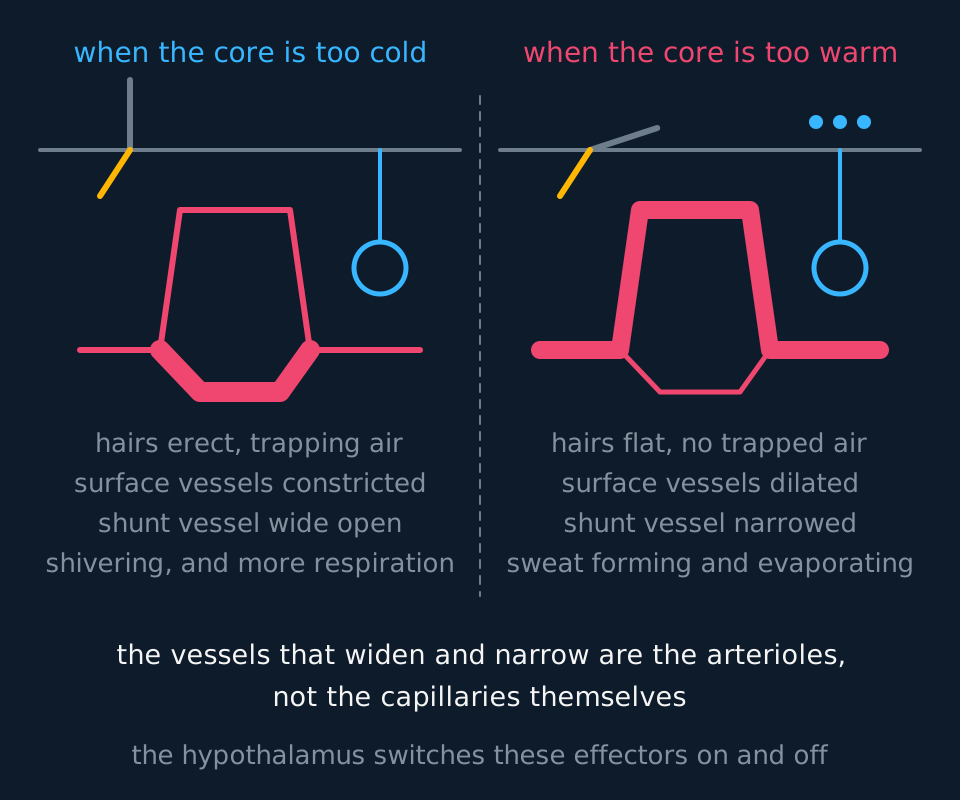
What actually changes is the width of the arterioles that supply the capillary networks near the surface, and the width of the shunt vessels that run beneath them, connecting the arterioles directly to the venules and bypassing the surface network altogether. In the cold, the muscle in the walls of the surface arterioles contracts and they narrow, which is vasoconstriction, while the shunt vessels dilate: little blood reaches the surface, so little heat is lost by radiation and convection, and the skin goes pale. When the body is too warm, the arterioles dilate and the shunt vessels constrict, so far more blood flows through the capillaries close to the surface and heat is lost from it, which is why an overheated person flushes.
Sweating is the effector that removes heat fastest. Sweat glands in the dermis secrete a dilute salt solution onto the skin, and evaporating it takes the latent heat of vaporisation from the surface it leaves. The dependence on evaporation is what makes humid heat so dangerous: in saturated air the sweat runs off instead of evaporating, and sweat that drips cools nothing while still costing water and ions.
Two effectors work on heat production rather than heat loss. Shivering is rapid involuntary contraction of skeletal muscle, doing no useful work, so nearly all of the energy released by the extra respiration appears as heat, and it can raise heat production several times over. Non-shivering thermogenesis is the slower route: adrenaline and thyroxine raise the metabolic rate of the liver and other tissues, and in a human infant brown adipose tissue respires to release heat rather than to make ATP. The liver is included because it is metabolically among the most active organs and one of the warmest.
The hair erector muscles require a qualification. Contracting them pulls each hair upright, trapping a thicker layer of still air next to the skin, and air is a poor conductor, so an animal with a dense coat gains a great deal of insulation this way. In humans the effect is negligible, because body hair is too sparse to trap a significant layer of air. State the trapped air as the insulating mechanism.
| Effector | When the core is too cold | When the core is too warm |
|---|---|---|
| Arterioles supplying surface capillaries | Constrict | Dilate |
| Shunt vessels | Dilate, so blood bypasses the surface | Constrict, so blood is diverted to the surface |
| Sweat glands | Secrete little or nothing | Secrete sweat |
| Hair erector muscles | Contract, so hairs stand up | Relax, so hairs lie flat |
| Skeletal muscle | Shivers | Stays still |
| Liver and metabolic rate | Raised by adrenaline and thyroxine | Lowered |
| Behaviour | Curl up, put on clothing, seek shelter | Spread out, seek shade, drink |
Why a swimmer cools faster than a walker
A person in water at 15 °C loses heat far faster than a person in air at 15 °C, and their core temperature falls even though vasoconstriction and shivering are both happening. Explain this, and explain why shivering eventually stops as the core temperature continues to fall.
Show the working
Heat loss depends on the temperature gradient between the body and its surroundings and on how quickly the surroundings can carry heat away. Water conducts heat far better than air and moves past the body carrying heat with it, so the layer of warmed water next to the skin is constantly replaced. The trapped-air insulation that clothing and hair provide does not exist in water.
The effectors are working, and they are simply outmatched. Vasoconstriction reduces the blood reaching the surface and shivering raises heat production several times over, but the rate of loss is greater than the rate of gain, so the core temperature falls anyway. Negative feedback slows a change; it does not guarantee to reverse one.
Shivering stops because the reactions producing the heat are themselves temperature dependent. As the core cools, metabolic rate falls, so less heat is produced, so the temperature falls further and the muscles eventually cannot sustain the contractions. What began as negative feedback has been overwhelmed and replaced by a positive feedback spiral, which is why hypothermia becomes rapidly more dangerous once it is established.
Behavioural regulation in an ectotherm
A lizard has enzymes with similar optima, but it lacks a metabolic rate high enough to heat itself: a reptile at rest produces a small fraction of the heat a mammal of the same mass produces, and loses it as fast as it is made. Its body temperature therefore depends largely on its surroundings.
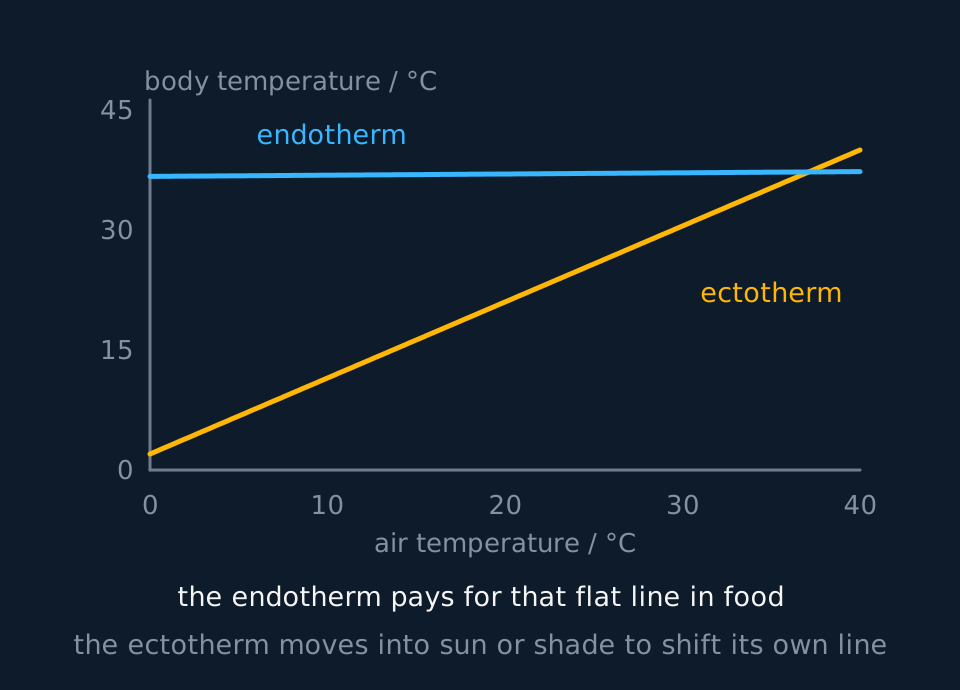
Depending on the surroundings does not mean being unable to regulate. An ectotherm regulates its temperature actively, by behaviour. It basks in the sun when it is cold, and moves into shade or down a burrow when it is hot. It presses its underside against a rock the sun has warmed, gaining heat by conduction, or lifts itself clear of ground that has become too hot on straightened legs. It shifts its activity to the time of day that suits it, which is why desert lizards are active in the morning and evening and desert mammals are more often nocturnal.
Posture is a control of its own. A lizard warming up turns its flank towards the sun and flattens its body against the ground, presenting the largest possible area to the radiation; an overheating one turns to face the sun so that only its head is exposed, and stands tall to catch the breeze. Many species darken when cold, since a darker surface absorbs more radiation, and pale as they warm. A lizard gaping in the heat is evaporating water from its mouth for the same reason a dog pants.
The result is the graph in the figure. Body temperature follows air temperature, and over a day an active lizard's temperature is held in a band much narrower than the air's, because it spends the morning in the sun and the middle of the day in the shade. What it cannot do is hold that band on a cold, overcast day, and on such a day it is slow, cannot digest a meal properly and cannot escape a predator that is warm.
The two strategies compared:
| Endotherm | Ectotherm | |
|---|---|---|
| Main source of heat | Its own metabolism | The surroundings |
| How it is controlled | Physiologically, by the hypothalamus and its effectors | Chiefly by behaviour and posture |
| Food needed | Large: much of it is spent on heat | Small: perhaps a tenth as much for the same mass |
| Activity in the cold | Full activity at any time of day or year | Slow or dormant until warmed |
| Growth from the food eaten | A smaller proportion | A larger proportion, so growth per unit of food is better |
| Range of habitats | Polar to tropical | Restricted where it is cold, and none in the coldest places |
| Enzyme conditions | Held near the optimum all the time | Near the optimum only for part of the day |
Neither strategy is superior in all conditions. An endotherm maintains constant performance at a high energy cost: a mammal spends most of the energy it assimilates simply staying warm, and must find that food every day or every few days. An ectotherm is cheap to run, and pays in dependence. It can survive months without eating and can colonise habitats where food is too scarce to support a mammal of the same size, and it converts a far greater share of the food it eats into new tissue, which is why ectotherms dominate the animal biomass of many warm ecosystems. Its limitation is availability: on a cold, overcast day, and at night, it cannot sustain full activity.
TRY IT: Explaining a measurement made at dawn
A researcher measures the body temperature of lizards and of small mammals in the same desert at dawn and again at noon. The mammals read 37 °C on both occasions. The lizards read 18 °C at dawn and 36 °C at noon, and the researcher notes that the lizards were lying flat on exposed rock at dawn and were in the shade of boulders at noon. Explain the readings, and suggest one advantage the lizards have over the mammals in this habitat.
Check your answer
The mammals are endotherms. Their heat comes from their own metabolism and their hypothalamus corrects any deviation using the effectors of the skin and muscle, so their core temperature is held near 37 °C whatever the air is doing. A reading that does not change between dawn and noon is the signature of physiological control.
The lizards are ectotherms, so their temperature depends on heat gained from the surroundings, and the desert is cold at dawn and hot at noon. The 18 °C reading is close to the air temperature after a clear night.
The behaviour explains why the readings are not simply the air temperature at each time. Lying flat on exposed rock at dawn presents the largest area to the sun and to the warming rock, so heat is absorbed by radiation and conduction as fast as possible. Moving into shade at noon avoids radiation that would take the body above its optimum, so the noon reading of 36 °C is regulated rather than accidental.
The advantage is energetic. A lizard needs roughly a tenth of the food a mammal of the same mass needs, because it is not paying to produce heat, so it can survive on prey that is scarce and unpredictable and can go for long periods without a meal, which is exactly the condition a desert imposes.
In the exam
- Capillaries do not move nearer to or further from the surface. Arterioles constrict or dilate and shunt vessels do the opposite, which changes how much blood reaches the surface capillaries.
- State the mechanism of sweating: evaporation of water from the skin takes latent heat from the body. That sweat cools the body is the outcome rather than the mechanism.
- Peripheral receptors detect the temperature of the skin and of the surroundings; central receptors in the hypothalamus detect the temperature of the blood. A response beginning before the core temperature changes depends on the peripheral receptors.
- Use the negative feedback vocabulary in temperature answers exactly as you would for glucose or water potential: receptor, coordinator, effector, and a response that reverses the change.
- For hair erector muscles, state that the raised hairs trap a layer of still air, and add that the effect is small in humans.
- For an ectotherm, name the behaviours rather than using the word behaviour alone: basking, orientation to the sun, pressing against warm rock, sheltering in a burrow, shifting activity to a cooler hour.
Check yourself
A person steps out of a warm building into air at 2 °C. Describe the sequence of events that follows, naming the receptors, the coordinator and three effectors, and explain why the response begins before their core temperature has changed at all. Then state what a lizard in the same doorway would do instead.
Answer
Peripheral thermoreceptors in the skin detect the fall in surface temperature, and they are sensitive to the change rather than only to an absolute value, so they fire immediately. Impulses travel to the hypothalamus, which is the coordinator, and its heat gain centre is stimulated. This is why the response starts at once: the skin receptors report a disturbance that has not yet reached the core, so the correction can begin before the variable being regulated has moved.
Impulses then travel along neurones of the autonomic nervous system to the effectors. The arterioles supplying the surface capillaries constrict and the shunt vessels beneath them dilate, so less blood flows near the surface and less heat is lost by radiation and convection. The hair erector muscles contract, pulling the hairs upright to trap a layer of still air, although in a human that layer is thin. Sweat secretion, already low, stops.
If the cold persists, heat production is raised as well. Skeletal muscle begins to shiver, contracting rapidly without doing useful work, so the energy from the extra respiration appears almost entirely as heat, and adrenaline and thyroxine raise the metabolic rate of the liver and other tissues. Each of these responses moves the core temperature in the direction that removes the original deviation, so the control is negative feedback.
A lizard has none of those physiological responses available in useful measure, because its metabolic rate is too low to heat it. It would return indoors, or find a patch of sun and bask in it, flattening its body and turning its flank towards the radiation to absorb heat as fast as possible. Its regulation is behavioural, and if no warm place is available its body temperature falls to that of the air and it becomes slow and eventually torpid.
Questions
Question 15 marks
A biologist claims that ectotherms will cope better than endotherms with a warming climate, because ectotherms do not need to spend energy producing their own heat. Evaluate this claim.
Mark scheme
- B1 in support: as air temperature rises, an ectotherm needs to spend less time and behaviour maintaining a workable body temperature and may reach an active temperature for more of the day
- B1 in support: an ectotherm already converts a much larger share of the food it eats into new tissue than an endotherm does, so a longer active season without the fixed cost of internally generated heat could increase its growth and reproduction
- B1 against: an ectotherm's body temperature depends directly on its surroundings, so if air temperature rises above the optimum for its enzymes it has far less physiological ability to cool itself than an endotherm's hypothalamus and effectors provide
- B1 against: an endotherm holds its core temperature near the optimum for its enzymes largely independently of the surroundings, so it is buffered against a change in air temperature in a way an ectotherm is not, at the continuing cost of needing more food
- B1 judgement: the claim is too simple; whether warming helps or harms a species depends on how far conditions move from that species' own optimum and on whether food supply changes as well, not on being an ectotherm or an endotherm as such
Question 24 marks
Describe the responses of the skin when the body becomes too warm, and describe how each of those responses increases the loss of heat.
Mark scheme
- B1 the arterioles supplying the capillary networks near the surface dilate, which is vasodilation
- B1 the shunt vessels beneath them constrict, so more blood is diverted through the surface capillaries and more heat is lost by radiation and convection
- B1 the sweat glands secrete sweat onto the surface of the skin, and its evaporation takes latent heat from the skin
- A1 the hair erector muscles relax so the hairs lie flat, trapping a thinner layer of still air and so reducing the insulation
Question 34 marks
Describe how a lizard raises and then limits its body temperature during a hot day in a desert, giving named examples of the behaviour involved.
Mark scheme
- B1 in the cool of the morning it basks in the sun, absorbing heat by radiation, and presses its underside against rock the sun has warmed so that heat is also gained by conduction
- B1 it flattens its body and turns its flank towards the sun, presenting the largest possible surface area to the radiation, and may darken in colour so that more is absorbed
- B1 as the day becomes hot it moves into the shade of a rock or into a burrow, turns to face the sun so that less of it is exposed, and raises its body clear of the hot ground
- A1 it may also gape to evaporate water from the mouth, and shift its activity to the cooler hours of the morning and evening
Question 44 marks
Discuss the advantages and disadvantages of being an endotherm rather than an ectotherm of the same body mass.
Mark scheme
- B1 an endotherm holds its core temperature near the optimum for its enzymes whatever the surroundings are doing, so it can be fully active at night, in winter and in cold habitats that an ectotherm cannot occupy
- B1 that independence widens the range of habitats available to it and means it is not immobilised at dawn, so it can hunt or escape at any hour
- B1 against that, much of the energy it assimilates is spent on producing heat, so it needs perhaps ten times as much food as an ectotherm of the same mass and must find it regularly
- A1 an ectotherm converts a far greater share of its food into new tissue and can survive long periods without eating, so where food is scarce and the climate is warm the ectotherm's strategy is the better one
Question 54 marks
Describe the responses of the skin and of skeletal muscle when the body becomes too cold, and describe how each response reduces heat loss or increases heat production.
Mark scheme
- B1 the arterioles supplying the surface capillary networks constrict, vasoconstriction, while the shunt vessels beneath them dilate, so less blood reaches the surface and less heat is lost by radiation and convection
- B1 the hair erector muscles contract, pulling each hair upright and trapping a thicker layer of still air next to the skin, which insulates, although this effect is small in a human
- B1 sweat glands secrete little or no sweat, so little heat is lost by evaporation
- A1 skeletal muscle begins to shiver, contracting rapidly without doing useful work, so nearly all of the extra energy released by the increased respiration appears as heat, raising the rate of heat production
Question 63 marks
Explain why a mammal controls its core temperature within narrow limits, referring to enzymes in your answer.
Mark scheme
- B1 below the optimum, molecules have less kinetic energy, so there are fewer successful collisions between substrate and active site and the rate of every enzyme-controlled reaction falls
- B1 above the optimum, increased vibration breaks the hydrogen bonds and ionic bonds holding the tertiary structure, so enzymes denature and the active site is no longer complementary to the substrate
- A1 denaturation is not reversed by cooling, so a core temperature much above 37 °C is far more dangerous than one the same distance below it
Question 73 marks
Compare the peripheral thermoreceptors of the skin with the central thermoreceptors of the hypothalamus.
Mark scheme
- B1 peripheral thermoreceptors are nerve endings in the skin and detect the temperature of the surface and so of the surroundings, whereas central thermoreceptors lie in the hypothalamus and detect the temperature of the blood
- B1 the blood temperature the central receptors detect is the core temperature, which is the variable actually being regulated, whereas the skin temperature is not
- A1 the peripheral receptors respond to a change and so allow correction to begin before the core has altered at all, which the central receptors cannot do
Question 83 marks
A student writes that capillaries move closer to the surface of the skin when a person is hot. Explain why this is wrong, and explain what actually changes.
Mark scheme
- B1 capillaries are vessels one cell thick held in position by the tissue around them, and there is no mechanism that could move them through the dermis
- B1 what changes is the diameter of the arterioles supplying the surface capillary networks, which dilate when the body is warm and constrict when it is cold
- A1 the shunt vessels running beneath the surface network do the opposite, so the volume of blood flowing near the surface changes while the vessels themselves stay where they are
Question 93 marks
A person working in still air at 35 °C and high humidity overheats far more quickly than a person working at the same temperature in dry air. Suggest why.
Mark scheme
- B1 at an air temperature close to body temperature there is little gradient for heat loss by radiation and convection, so evaporation of sweat is doing nearly all of the cooling
- B1 in humid air the water vapour concentration outside is already high, so sweat evaporates only slowly and instead runs off the skin, taking little latent heat with it
- A1 heat production from respiration continues while heat loss has effectively stopped, so the core temperature rises, and the sweat lost still costs the person water and ions
Question 103 marks
Explain how non-shivering thermogenesis raises heat production in a person exposed to cold for several weeks, without any muscle contraction being involved.
Mark scheme
- B1 adrenaline and thyroxine raise the metabolic rate of the liver and other tissues, so more heat is released as a by-product of increased respiration
- B1 in an infant, brown adipose tissue respires in a way that releases the energy directly as heat rather than using it to make ATP
- A1 because this route relies on thyroxine, released over days and weeks rather than a nerve impulse, its effect builds up slowly and accounts for acclimatisation after prolonged cold exposure, rather than an instant response to a single cold moment
Question 113 marks
An ectotherm and an endotherm of the same body mass are kept in the same conditions. Over a week the endotherm eats 2100 g of food and the ectotherm eats 190 g, figures constructed for this question rather than measured. Calculate the ectotherm's food intake as a percentage of the endotherm's, and calculate how many times greater the endotherm's intake is.
Mark scheme
- M1 percentage = ectotherm's intake ÷ endotherm's intake × 100 = 190 ÷ 2100 × 100
- A1 9.0 per cent
- A1 the endotherm eats 2100 ÷ 190 = about 11 times as much food as the ectotherm over the same week, consistent with the roughly tenfold difference typical of the two strategies
Question 123 marks
A well-furred mammal gains far more insulation from erecting its hairs in the cold than a human does. Explain why.
Mark scheme
- B1 erecting hairs traps a layer of still air next to the skin, and still air is a poor conductor of heat, so trapping more of it increases insulation
- B1 a furred mammal has hair dense enough that erecting it traps a substantial, continuous layer of still air over the whole body surface
- A1 human body hair is too sparse to trap a significant layer of air even when the hair erector muscles contract fully, which is why the response, although still present, achieves very little extra insulation in a person compared with a well-furred animal
Question 133 marks
A small mammal such as a hedgehog lowers its own body temperature and metabolic rate for weeks at a time during winter, a state called torpor, rather than maintaining a normal core temperature throughout. Suggest the advantage of doing this, given what this lesson states about the energy cost of being an endotherm.
Mark scheme
- B1 maintaining a normal core temperature is energetically expensive, since much of the energy an endotherm assimilates is spent simply producing heat
- B1 in winter, food such as insects and other invertebrates is scarce, so a small mammal may not be able to eat enough to sustain its normal high metabolic rate
- A1 by lowering its body temperature and metabolic rate it greatly reduces its energy expenditure during the period when food cannot be found, surviving on stored fat until conditions improve, at the cost of being unable to respond quickly to danger while torpid
Question 143 marks
Compare the nervous and hormonal components of the response to cold, referring to their speed and how long each takes to have its full effect.
Mark scheme
- B1 the nervous component, impulses from the hypothalamus along the autonomic nervous system to effectors such as the arterioles and skeletal muscle, acts within seconds of a temperature change
- B1 the hormonal component, thyroxine with adrenaline raising the metabolic rate of tissues such as the liver, is released more slowly and its effect builds up over days to weeks of continued cold exposure
- A1 the nervous route therefore handles an immediate cold snap, such as stepping outside, while the hormonal route underlies acclimatisation to a cold season, and the two operate on different timescales rather than one replacing the other
Question 152 marks
State the difference between core temperature and skin temperature, and state which one the body actually regulates.
Mark scheme
- B1 core temperature is the temperature of the blood and the deep organs, whereas skin temperature is the temperature of the body surface and extremities
- B1 it is core temperature that is regulated within narrow limits; skin temperature is allowed to vary considerably, since reducing blood flow to the surface is itself one of the mechanisms that conserves core heat
Worth remembering
- Core temperature is regulated; skin temperature is allowed to vary, and reducing blood flow to the surface conserves core heat.
- Skin receptors detect the surroundings and predict a change; hypothalamic receptors detect the temperature of the blood itself.
- Vasoconstriction and vasodilation are changes in the arterioles, with the shunt vessels doing the opposite. Capillaries never move.
- Sweat cools by evaporation, taking latent heat from the skin, so it is much less effective in humid air.
- Shivering and raised metabolic rate in the liver make heat; hairs standing up trap air, which insulates.
- An ectotherm regulates by behaviour and posture, needs roughly a tenth of the food, and pays for it with periods when it cannot be active.
CHECK YOUR PROGRESS
Rate how confident you are with each objective for this lesson. Ratings are saved in this browser, on this device, unless you sign in.
- Explain why a mammal controls its core temperature, in terms of what temperature does to enzymes.
- Distinguish peripheral from central thermoreceptors by what each of them detects.
- Describe the responses of the skin, muscle and liver to cold and to heat, in the vocabulary of negative feedback.
- Explain vasoconstriction and vasodilation correctly, naming the arterioles and the shunt vessels.
- Describe how an ectotherm regulates its temperature by behaviour and posture.
- Compare the costs and benefits of the two strategies, arguing the case both ways.
Open the full revision checklist to see every objective in the curriculum in one place.
Practise this lesson
WORKBOOK
The same questions as the player, on paper with room to work, and a separate book of mark schemes. Free to use; please do not redistribute or sell.