Biology › Cell cycles, reproduction and development › Cloning in plants and animals
Cloning in plants and animals
Clones are genetically identical at the nuclear-DNA level but may differ because of mitochondrial DNA, development and environment. Plant cloning includes natural vegetative propagation, cuttings and micropropagation. Animal cloning includes embryo splitting and somatic cell nuclear transfer, used for reproductive or therapeutic purposes.
Before this Stem cells · The cell cycle and mitosis · Gametes and fertilisation
COMMON MISCONCEPTION
A clone is an exact copy, so a cloned animal is identical in every respect to the animal it was made from.
Identical nuclear DNA is not identical everything. A cloned animal carries the mitochondria of the egg it was made in, not of its nuclear donor, and its coat markings, size and temperament also answer to the womb it grew in and the life it has led since.
What you should be able to do
- Define a clone, and explain why every cell produced by mitosis from one parent belongs to one.
- Describe natural vegetative propagation, with named structures and named plants.
- Describe how a cutting is taken and how micropropagation is carried out, step by step.
- Argue the case for and against micropropagation as a commercial method.
- Describe embryo splitting and somatic cell nuclear transfer, and say what each product inherits and from whom.
- Evaluate reproductive cloning against therapeutic cloning, using what potency means.
Clones without a laboratory
A clone is a group of genetically identical organisms, or a genetically identical cell produced from another cell. Nothing in that definition requires a laboratory, and the last three lessons have already explained why: mitosis produces daughter cells genetically identical to the parent, so any organism that reproduces by mitosis alone produces clones of itself. Bacteria do it by binary fission, and a great many plants do it as a matter of routine.
Cloning in plants is called vegetative propagation: a new plant grows from a vegetative part of the parent, a stem, a root or a leaf, rather than from a seed. Seeds come from fertilisation and carry two parents' alleles shuffled by meiosis, so a seedling is not a clone of anything. A plant grown from a runner is.
| Structure | What it is | A plant that uses it |
|---|---|---|
| Runner, or stolon | A horizontal stem growing above ground, rooting where it touches down | Strawberry, spider plant |
| Rhizome | A horizontal stem growing underground, sending shoots up along its length | Couch grass, mint, ginger |
| Stem tuber | A swollen underground stem storing food, with buds on it | Potato |
| Bulb | A short stem with fleshy leaf bases, which divides to give daughter bulbs | Onion, daffodil |
| Leaf plantlet | Small complete plants formed along the leaf margin and dropped | Kalanchoe |
All of these depend on the same property. Plant tissues retain populations of unspecialised cells in their meristems throughout life, and a mature plant cell can often be induced to divide and differentiate again, a degree of potency an adult animal cell does not have. Prerequisite: stem cells and cell potency.
The advantages and disadvantages are those of asexual reproduction generally, stated here for the plant rather than for a grower. In favour: no pollinator and no second plant are needed, so a single arrival can colonise a site; the offspring inherit a genotype that has already proved itself where the parent is growing; and each new plant is supplied by the parent while it establishes, so it grows away faster than a seedling can. Against: the offspring carry no new combinations of alleles, so a population of them meets a new disease or a changed climate with no variation for selection to work on; they are crowded around the parent and compete with it for light, water and minerals; and they are not dispersed, which seeds are.
- Clone
- A group of genetically identical organisms, or a cell genetically identical to the cell it was produced from.
- Vegetative propagation
- Asexual reproduction in plants, in which a new plant develops from a stem, root or leaf of the parent and is genetically identical to it.
- Meristem
- A region of a plant in which the cells remain unspecialised and continue to divide by mitosis.
Cuttings and micropropagation
Growers have used vegetative propagation for centuries. A cutting is a piece of stem cut from a parent plant just below a node, with the lower leaves removed, the cut end dipped in a rooting powder containing auxin, and the whole thing pushed into moist compost and kept humid so that water loss does not exceed what the cutting can take up before roots form. Cells near the cut divide, roots develop, and the result is a new plant genetically identical to the parent. The method is cheap and requires no equipment, but the scale is limited: one parent plant yields a few dozen cuttings a season at most.
Micropropagation, also called tissue culture, applies the same principle in a laboratory at a much larger scale.
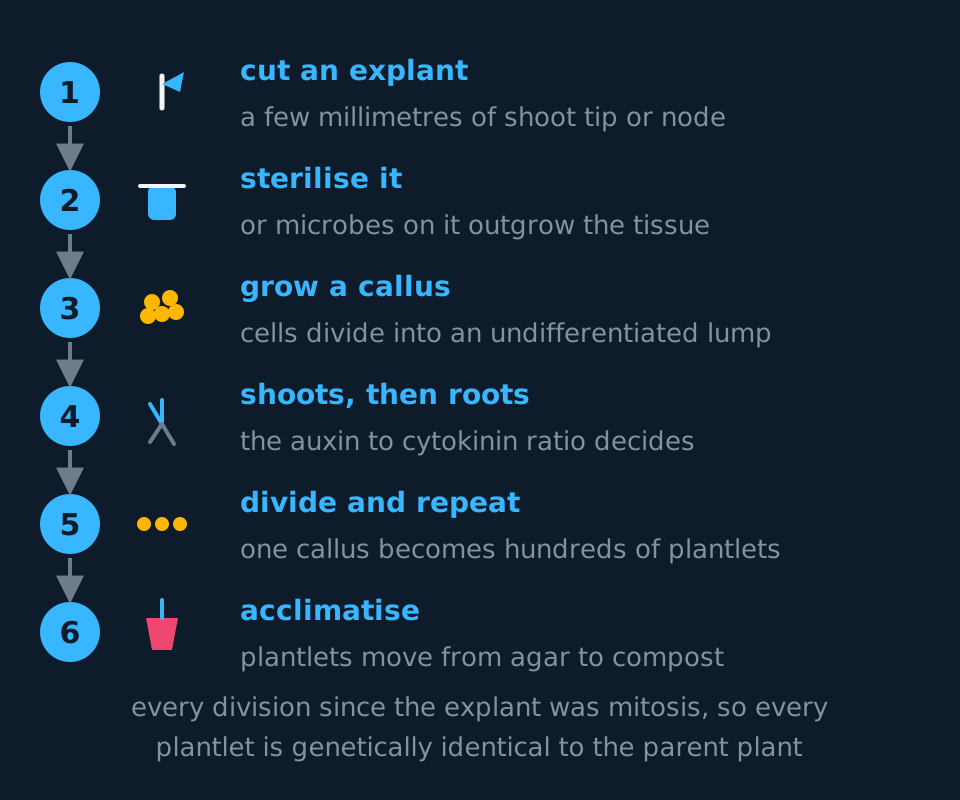
The sequence runs like this. A small piece of tissue, a few millimetres of shoot tip or a node, is cut from the chosen parent plant; this piece is the explant. Its surface is sterilised, usually in dilute bleach or ethanol, because any bacterium or fungal spore left on it will outgrow the plant tissue on the medium provided. The explant is then placed on sterile nutrient agar containing sugar, mineral ions, vitamins and plant hormones, in a sealed vessel, and its cells divide into an undifferentiated lump called a callus.
The auxin-to-cytokinin ratio in the medium influences whether the callus forms roots or shoots. A medium with a high ratio of cytokinin to auxin induces shoot formation; transferring those shoots to a medium with a higher proportion of auxin induces root formation. These are the same growth regulators examined under plant responses. The callus can also be divided repeatedly before this stage, so one explant becomes many calluses and one parent plant becomes thousands of plantlets.
Finally the plantlets are moved out of their sterile vessels into compost and acclimatised, gradually, under high humidity that is reduced over days or weeks. Plants grown on agar have thin cuticles and stomata that do not close properly, so a plantlet moved straight to a greenhouse bench wilts and dies.
- Explant
- The small piece of tissue cut from a parent plant to start a tissue culture, usually a shoot tip or a node.
- Callus
- The mass of undifferentiated dividing cells produced from an explant on a nutrient medium, from which whole plantlets are regenerated.
- Micropropagation
- The production of very large numbers of genetically identical plants from a small piece of tissue, grown on sterile nutrient medium containing plant hormones.
Why a shoot tip and not a leaf
Growers who want virus-free stock of a potato variety start their cultures from the extreme tip of a shoot, a fraction of a millimetre across, even though a larger explant would grow away faster. Suggest why.
Show the working
Viruses spread through a plant in its vascular tissue, and the cells right at the apical meristem have no vascular tissue supplying them yet. Those cells are therefore often free of the virus that has infected the rest of the plant.
An explant taken from the tip alone can then give a whole population of plants carrying none of the virus, from a parent plant that is infected. That is worth the slower start, because it is not a thing a cutting or a tuber can do: both carry the vascular tissue and the virus with them.
Micropropagation therefore serves two purposes: producing large numbers of plants, and producing disease-free stock from an infected parent.
The case for and against cloning plants
Micropropagation is expensive, so its use has to be justified commercially. Four arguments are usually given. It produces very large numbers from one parent, quickly, and at any time of year rather than at the season a plant flowers. It produces plants that are uniform, which matters when a supermarket wants a crop that matures together and packs to a standard size. It can be started from meristem tissue and so clear a valuable variety of a virus it carries. And it works for plants that are difficult or slow to grow from seed, including many orchids, and for rare or endangered species and for genetically modified lines whose seed would not breed true.
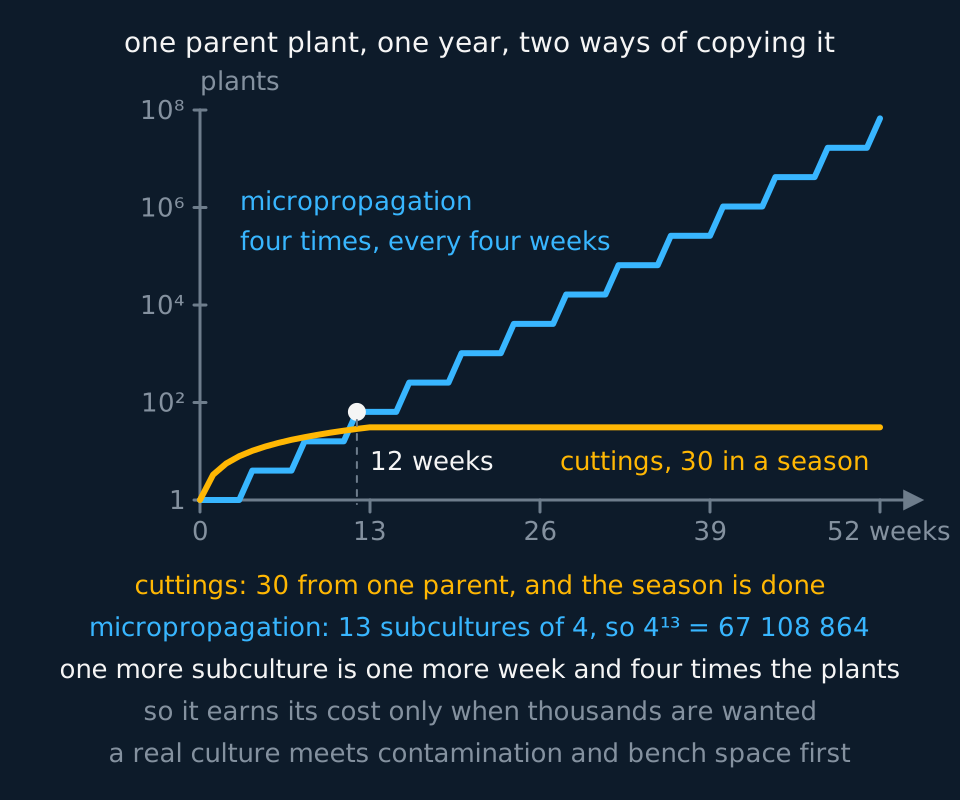
The arguments against are as follows. The equipment, the sterile conditions and the skilled labour make it far more costly per plant than seed or cuttings. A contamination found late in the process costs the whole batch. Not every species will form a callus and regenerate from one, so the method is not universal. And the uniformity that is an advantage in a supermarket is a hazard in a field: a crop of genetically identical plants has no variation in its resistance, so a pest or a pathogen that can infect one plant can infect every plant, and a whole planting can be lost to a single new strain. There is a longer-term version of the same point, which is that a breeding programme needs variation to select from, and a population of clones offers none.
| Cuttings | Micropropagation | |
|---|---|---|
| Scale from one parent | Tens per season | Thousands, and repeatable |
| Cost per plant | Very low | High |
| Equipment needed | A knife and rooting powder | Sterile facilities, media, hormones, trained staff |
| Disease | Carries any infection the parent had | Can be started from meristem tissue to give virus-free stock |
| Works for | Most garden shrubs and herbaceous plants | Species that respond to the media, including orchids and modified lines |
When evaluating plant cloning, discuss the technique's scale, cost, disease status, genetic uniformity and effect on variation. Ethical and welfare issues belong to questions about animal cloning unless the question explicitly asks for a comparison.
Cloning animals: twinning, splitting and nuclear transfer
None of the plant methods applies to animals. An adult animal cell has a much narrower potency than a mature plant cell, so an animal cannot be grown from a cutting. Natural cloning in mammals occurs only very early in development, before the cells of an embryo have committed to particular fates.
That moment is what produces identical twins. An early embryo splits in two, each half develops into a whole individual, and the two are genetically identical to each other because both came from one zygote by mitosis. They are not identical to either parent: the zygote they came from was produced by fertilisation, so its combination of alleles is new.
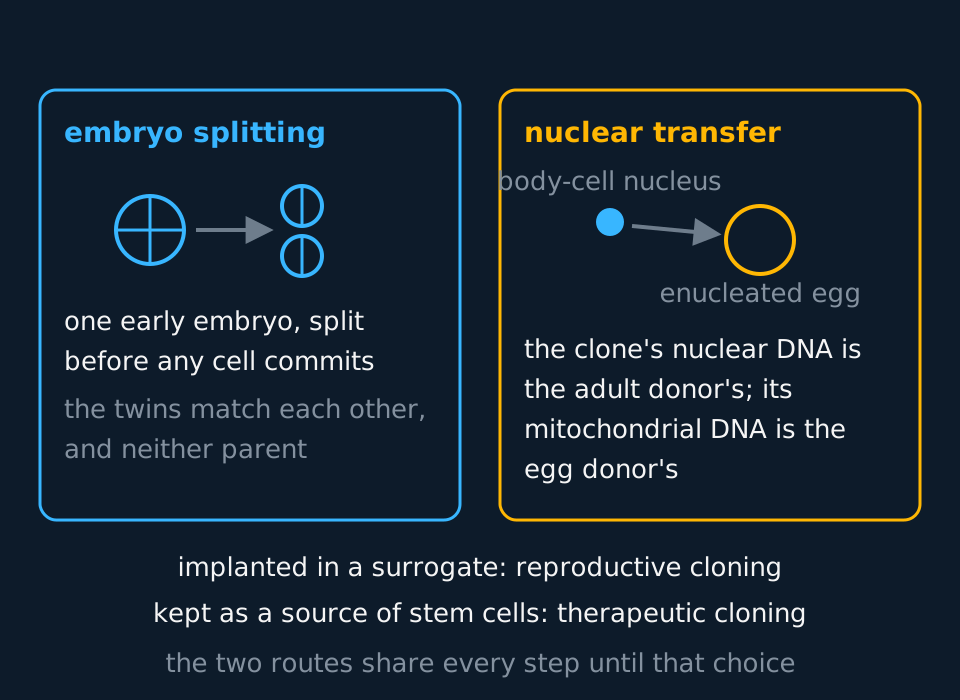
Artificial embryo splitting is that natural process carried out deliberately. An egg is fertilised, in the animal or in the laboratory, and the embryo is grown to a few cells and then divided, each part being implanted into a surrogate mother. It is used in cattle, where a mating between two valuable animals can be turned into several calves instead of one. Its limitation is the one above: the parents' qualities are known, but the calves' are not, because their genotype is new.
Somatic cell nuclear transfer answers that limitation, because it copies an animal whose phenotype is already known. A somatic cell is any body cell that is not a gamete. The steps are these. An egg cell is taken from a donor female and enucleated, its own nucleus removed with a fine pipette, leaving the cytoplasm intact. A somatic cell is taken from the animal to be cloned, often a skin or mammary gland cell, and is held in a resting state. The somatic cell, or its nucleus, is placed beside the enucleated egg and the two are fused with a pulse of electricity, which also stimulates the cell to begin dividing. Factors in the egg cytoplasm then reprogramme the transferred nucleus, restoring the pattern of gene expression of an embryo. Prerequisite: differentiation changes gene expression rather than gene content. The embryo is cultured to the blastocyst stage, after which the two purposes diverge.
If the blastocyst is implanted into a surrogate mother and allowed to develop into a whole animal, that is reproductive cloning. The first mammal cloned this way from an adult cell was a sheep, born in 1996, and the numbers are part of the topic: hundreds of reconstructed eggs gave a handful of pregnancies and one surviving lamb. Success rates in the decades since have improved but remain low. Pregnancies that fail late, and offspring born oversized or unhealthy, are the basis of the welfare argument against the technique.
A clone is genetically identical at the nuclear-DNA level but is not a duplicate of the donor. Its nuclear DNA is the donor's, but its mitochondrial DNA came with the egg cytoplasm and so belongs to the egg donor. It develops in a different uterus, is born at a different time, and grows up in different surroundings, and the pattern of gene expression a cell carries is not reset perfectly by the egg. A cloned cat with a coat pattern unlike its donor's is the standard illustration, since the pattern depends on which X chromosome is inactivated in which patch of skin, and that is settled at random in each embryo.
- Somatic cell
- Any body cell of a multicellular organism other than a gamete or the cells that produce gametes.
- Enucleation
- The removal of the nucleus from a cell, usually an egg cell, leaving its cytoplasm intact.
- Somatic cell nuclear transfer
- The transfer of a nucleus from a body cell into an enucleated egg cell, which is then stimulated to divide as an embryo genetically identical to the nucleus donor.
- Reproductive cloning
- Cloning in which the embryo produced is implanted into a surrogate and develops into a whole new individual.
- Therapeutic cloning
- Cloning in which the embryo produced is used as a source of stem cells and is never implanted.
Reproductive against therapeutic cloning
The two purposes share every step up to the blastocyst and diverge there, so evaluate them separately.
Reproductive cloning is defended on the ground that it copies an animal of proven value: a bull whose daughters yield well, a genetically modified sheep whose milk carries a human protein, a working animal of exceptional ability. It has also been proposed for conservation, to produce individuals of a species too rare to breed in the ordinary way. Against it stand the success rates and what they cost in animal welfare, the health of the offspring that are born, the loss of genetic variation in a herd bred from few genotypes, and, when the subject is raised, the argument that no case has been made for cloning a human being at all, which is why it is prohibited by law in the United Kingdom and in many other countries.
Therapeutic cloning is a different proposition, because no animal is born. The embryo is a source of stem cells, and the reason for making it by nuclear transfer rather than any other way is that the cells carry the patient's own nuclear DNA and so the patient's own antigens, which removes the rejection problem that limits every transplant. The cells obtained are pluripotent, so the range of tissues they could be directed into is much wider than that available from an adult source. Prerequisite: the four levels of potency.
There are two objections, of different kinds. The first is the ethical objection set out under stem cells: a human embryo is created and then destroyed, and the positions people hold on that do not change because the embryo was made by nuclear transfer rather than by fertilisation. The second is practical, and it applies to the eggs: human egg cells are needed in quantity, and collecting them requires hormone treatment and a procedure that carries risk for the women who donate.
A further argument is that the technique has been superseded. Induced pluripotent cells give a patient-matched pluripotent cell from a skin sample, with no egg and no embryo, and most laboratories that previously pursued therapeutic cloning now use them. State that development in an evaluation, since it changes the conclusion available.
TRY IT: Deciding what a farmer should do
A dairy farmer owns a cow whose milk yield is far above the herd average. He is offered two services: splitting embryos produced by mating her with a bull of proven quality, or producing calves by somatic cell nuclear transfer using cells from the cow herself. Evaluate the two offers. (6 marks)
Check your answer
Embryo splitting: the calves are genetically identical to each other but new, because the embryo came from fertilisation, so half their alleles are the bull's. Their yield cannot be predicted from the cow's, only estimated from both parents. The technique is established and its success rate is high.
Nuclear transfer: every calf carries the cow's nuclear DNA, so the genotype behind the yield is copied exactly, which is what the farmer is paying for. The success rate is low, many pregnancies fail, and some calves that are born are oversized or unhealthy, so the cost per surviving calf is high and there is a welfare cost as well.
Both share a longer-term drawback: a herd built from a few genotypes has little genetic variation, so it is vulnerable to a new disease and offers nothing to select from in future breeding. Yield also depends on feeding and management, so no clone is guaranteed to match the cow's performance.
Give a judgement that follows from the points above. An evaluation requires a comparison of the two offers, including the cost and welfare points, and a stated conclusion.
In the exam
- Name the structure as well as the process. Runner, rhizome, stem tuber and bulb are the examinable terms; give a named plant alongside each.
- Give the micropropagation sequence in order: explant, sterilise, callus on medium with hormones, shoots then roots, subdivide, acclimatise. Include the sterilisation step.
- State why the plantlets are identical. Every division from the explant onwards is mitosis, so no new combinations of alleles arise.
- Identical twins are clones of each other and of neither parent, because the zygote they came from was produced by fertilisation.
- In nuclear transfer, name what the egg supplies as well as what the somatic cell supplies: the cytoplasm, the mitochondrial DNA, and the factors that reprogramme the nucleus.
- Reproductive and therapeutic cloning differ at one step, which is implantation. Answer about the one the question names.
- An evaluation requires both sides and a judgement that follows from them. Cost, success rate, welfare and loss of variation are the four points to cover.
Check yourself
A cloned calf is produced by somatic cell nuclear transfer using a skin cell from a prize cow and an egg cell from an unrelated cow. Describe the main steps in the procedure, and explain why the calf is not genetically identical to the prize cow in every respect.
Answer
The egg cell is enucleated, its nucleus removed with a fine pipette so that the cytoplasm is left intact. The skin cell from the prize cow, or its nucleus, is placed beside it and the two are fused using a pulse of electricity, which also stimulates the reconstructed cell to start dividing.
Factors in the egg cytoplasm reprogramme the transferred nucleus, switching its genes back to the pattern of an early embryo. The cell divides by mitosis, the embryo is cultured to the blastocyst stage and is then implanted into a surrogate cow, which carries the pregnancy.
The calf is not identical in every respect because its mitochondrial DNA came from the egg cell and so belongs to the unrelated donor, not to the prize cow. Only the nuclear DNA is copied.
Two further differences are worth a sentence. The reprogramming of the nucleus is not perfect, so the pattern of gene expression the calf's cells carry is not exactly the cow's, and the calf develops in a different uterus and grows up under different conditions, so its phenotype will differ whatever its genotype says.
Questions
Question 16 marks
Evaluate the use of therapeutic cloning, rather than reproductive cloning, as a way of obtaining stem cells to treat a patient.
Mark scheme
- B1 for: the two share every step until the blastocyst stage, and in therapeutic cloning the embryo is never implanted, so no animal or person is born and the welfare problems of reproductive cloning do not arise
- B1 for: the stem cells carry the patient's own nuclear DNA and so the patient's own antigens, so they are not rejected by the patient's immune system
- B1 for: the cells obtained are pluripotent, so a far wider range of tissues can be produced from them than from adult stem cells taken from the patient
- B1 against: a human embryo is created and then destroyed, which some hold to be the ending of a human life whatever the benefit to the patient
- B1 against: human egg cells are needed in quantity, and collecting them requires hormone treatment and a procedure that carries a risk to the donor; success rates are also low
- A1 a judgement is stated and supported by the points made, for example that induced pluripotent cells now offer patient-matched pluripotent cells with no egg and no embryo; credit either conclusion where the reasoning leads to it
Question 25 marks
Describe how a large number of genetically identical plants can be produced from one parent plant by micropropagation.
Mark scheme
- B1 an explant, a small piece of tissue such as a shoot tip or a node, is cut from the chosen parent plant
- B1 the surface of the explant is sterilised, because any bacteria or fungal spores on it would outgrow the plant tissue on the medium
- B1 the explant is placed on sterile nutrient medium containing sugar, mineral ions and plant hormones, and its cells divide to form a callus of undifferentiated cells
- B1 the callus is divided repeatedly, and the ratio of cytokinin to auxin in the medium is used to make the pieces grow shoots and then roots
- B1 the plantlets are acclimatised, being moved gradually from the sterile medium to compost at high humidity; every division has been mitosis, so all the plants are genetically identical to the parent
Question 35 marks
Discuss the commercial advantages and disadvantages of using micropropagation to produce a crop, compared with growing the same crop from seed.
Mark scheme
- B1 advantage: micropropagation produces very large numbers of genetically identical plants quickly, at any time of year, from a single valuable parent
- B1 advantage: it produces uniform plants that mature together, which suits a commercial grower supplying a market that wants a standard size and timing
- B1 disadvantage: the sterile facilities, culture media and skilled labour needed make it far more costly per plant than growing from seed
- B1 disadvantage: not every species forms a callus and regenerates successfully, so the technique does not work for every crop, and a contamination discovered late costs the whole batch
- A1 on balance, micropropagation is justified commercially where uniformity, speed or freedom from disease outweigh its higher cost, for example in high-value ornamentals or virus-free seed stock, but not for a low-value crop that grows easily from seed
Question 44 marks
Describe how a cloned mammal is produced from an adult body cell by somatic cell nuclear transfer.
Mark scheme
- B1 an egg cell is taken from a donor female and enucleated, its nucleus being removed and its cytoplasm left intact
- B1 a somatic cell, such as a skin or mammary gland cell, is taken from the animal to be cloned, and it or its nucleus is placed next to the enucleated egg
- B1 the two are fused using a pulse of electricity, which also stimulates the reconstructed cell to begin dividing, and factors in the egg cytoplasm reprogramme the transferred nucleus
- B1 the cell divides by mitosis, the embryo is cultured to the blastocyst stage and is implanted into a surrogate mother that carries the pregnancy
Question 53 marks
One callus is divided into 8 pieces every 4 weeks, and each piece grows into a callus of the same size before the next division. Calculate the number of calluses present after 12 weeks.
Mark scheme
- M1 12 weeks allows three rounds of division, one every 4 weeks
- M1 1 multiplied by 8 three times, which is 83
- A1 512 calluses are present after 12 weeks
Question 63 marks
A field planted entirely with micropropagated potato plants is more likely to be lost to a new strain of a fungal pathogen than a field grown from seed. Explain why.
Mark scheme
- B1 the micropropagated plants are clones, produced by mitosis from one parent, so they are genetically identical to one another
- B1 there is therefore no variation between them in resistance to the pathogen, whereas plants grown from seed carry new combinations of alleles produced by meiosis and fertilisation
- A1 a strain able to infect one plant can infect every plant in the field, so the whole crop can be lost, and no resistant individuals survive to be selected or bred from
Question 73 marks
A calf produced by nuclear transfer is not identical in every respect to the animal that donated the nucleus. Explain why.
Mark scheme
- B1 only the nuclear DNA comes from the donor animal, because only the nucleus was transferred
- B1 the mitochondria, and so the mitochondrial DNA, came with the cytoplasm of the egg cell and belong to the egg donor
- B1 the reprogramming of the transferred nucleus is not perfect, so the pattern of gene expression differs, and the calf develops in a different uterus and grows up in different conditions, which affect the phenotype
Question 83 marks
Describe how a cutting is used to produce a new plant that is a clone of its parent.
Mark scheme
- B1 a piece of stem is cut from the parent plant just below a node, and the lower leaves are removed
- B1 the cut end is dipped in rooting powder containing auxin, and the cutting is pushed into moist compost and kept humid
- A1 cells near the cut divide and roots develop, producing a new plant genetically identical to the parent because every division has been mitosis
Question 93 marks
Compare cuttings with micropropagation as methods of cloning a plant, referring to the scale each can achieve and the cost of each.
Mark scheme
- B1 a cutting needs only a knife and rooting powder, and is cheap, whereas micropropagation needs sterile facilities, culture media and trained staff, and is far more costly per plant
- B1 one parent plant yields at most a few dozen cuttings in a season, whereas micropropagation can produce thousands of genetically identical plantlets, repeatedly, from one parent
- A1 micropropagation can also be started from meristem tissue to give stock free of a virus the parent carries, which taking cuttings cannot do because a cutting carries the parent's vascular tissue and any virus in it
Question 103 marks
Growers who want disease-free stock of a valuable potato variety start their tissue cultures from the extreme tip of a shoot, even though a larger explant would grow away faster. Suggest why the shoot tip is used.
Mark scheme
- B1 viruses spread through a plant in its vascular tissue, and the cells at the very tip of the shoot meristem have no vascular tissue supplying them yet
- B1 those cells are therefore often free of a virus that has infected the rest of the plant, even though the rest of the plant is infected
- A1 an explant taken from just the tip can give rise to a whole population of virus-free plants, which is worth the slower start because no other propagation method can clear the virus
Question 113 marks
Identical twins arise when an early embryo splits naturally into two. Explain why the resulting twins are clones of each other but not clones of either parent.
Mark scheme
- B1 the twins are genetically identical to each other because both arose from the same zygote by mitosis, which produces genetically identical daughter cells
- B1 they are not clones of either parent because the zygote they came from was produced by fertilisation, combining alleles from both parents in a new combination
- A1 that combination of alleles is not identical to either parent's genotype, so neither twin is a clone of the mother or of the father
Question 123 marks
Compare artificial embryo splitting with somatic cell nuclear transfer as ways of cloning cattle, referring to whose phenotype is copied and what limitation this creates.
Mark scheme
- B1 embryo splitting copies an embryo produced by fertilising two chosen parents, so it copies a new genotype whose phenotype is not yet known, whereas nuclear transfer copies an adult animal whose phenotype has already proved itself
- B1 in embryo splitting the resulting calves' qualities can only be estimated from both parents, whereas in nuclear transfer every calf carries the same nuclear DNA as the donor animal, so the genotype behind its known qualities is copied exactly
- A1 embryo splitting is the more established technique with a higher success rate, whereas nuclear transfer has a lower success rate and a greater welfare cost, since many reconstructed pregnancies fail or produce unhealthy offspring
Question 133 marks
A cat cloned by somatic cell nuclear transfer is found to have a coat pattern unlike the donor cat's, even though its nuclear DNA is identical to the donor's. Suggest why the two cats' coat patterns differ.
Mark scheme
- B1 coat colour pattern in a calico or tortoiseshell cat depends on which of the two X chromosomes is inactivated in each patch of skin
- B1 X-inactivation is settled at random early in the development of each individual embryo, independently of the sequence of the DNA itself
- A1 the donor cat and the clone therefore have different patterns of X-inactivation, even though their nuclear DNA sequence is identical, so their coat patterns differ
Question 142 marks
State two structures by which a plant reproduces asexually in nature, and name a plant that uses each one.
Mark scheme
- B1 any one of runner or stolon, rhizome, stem tuber, bulb or leaf plantlet, with a correct plant such as strawberry, couch grass, potato, onion or Kalanchoe
- B1 a second correct structure from that list, with a correct plant named for it
Question 152 marks
State the species of the first mammal cloned from an adult cell using somatic cell nuclear transfer, and state the general trend in success rates for reproductive cloning since then.
Mark scheme
- B1 the first mammal cloned from an adult cell was a sheep, born in 1996
- B1 success rates have improved in the decades since but remain low
Worth remembering
- A clone is genetically identical at the nuclear-DNA level to the organism or cell it came from, because it is produced by mitosis.
- Vegetative propagation uses runners, rhizomes, stem tubers, bulbs and leaf plantlets, and every offspring is a clone of the parent.
- Micropropagation runs explant, sterilise, callus, shoots then roots, subdivide, acclimatise, with the auxin-to-cytokinin ratio influencing whether roots or shoots form.
- Clones are uniform and show no genetic variation: an advantage for commercial uniformity, and a disadvantage for disease resistance in a crop.
- Identical twins and split embryos are clones of each other and of neither parent.
- In nuclear transfer the nuclear DNA is the body-cell donor's and the mitochondrial DNA is the egg donor's.
- Reproductive cloning implants the embryo; therapeutic cloning takes stem cells from it and never implants it.
CHECK YOUR PROGRESS
Rate how confident you are with each objective for this lesson. Ratings are saved in this browser, on this device, unless you sign in.
- Define a clone, and explain why every cell produced by mitosis from one parent belongs to one.
- Describe natural vegetative propagation, with named structures and named plants.
- Describe how a cutting is taken and how micropropagation is carried out, step by step.
- Argue the case for and against micropropagation as a commercial method.
- Describe embryo splitting and somatic cell nuclear transfer, and say what each product inherits and from whom.
- Evaluate reproductive cloning against therapeutic cloning, using what potency means.
Open the full revision checklist to see every objective in the curriculum in one place.
Practise this lesson
WORKBOOK
The same questions as the player, on paper with room to work, and a separate book of mark schemes. Free to use; please do not redistribute or sell.