Biology › Pathogens, disease and immunity › Infectious disease: transmission and control
Infectious disease: transmission and control
An infectious disease persists only if its pathogen passes between hosts. Cholera travels in water, malaria in a mosquito, tuberculosis on shared air and HIV in body fluids. For each, the pathogen, the route between hosts and the biological, social and economic measures that interrupt that route are set out here.
Before this The four groups of pathogen and their named diseases · The cholera toxin, osmosis and oral rehydration · Vaccination, herd immunity and antigenic variation
COMMON MISCONCEPTION
Controlling an infectious disease means finding the drug that cures it.
A cure is one measure among several, and rarely the one that ends an epidemic. Cholera fell to clean water, malaria to nets and drained breeding sites, tuberculosis to housing and contact tracing as much as to antibiotics. Control works on transmission, not only on the infected.
What you should be able to do
- Name the pathogen behind cholera, malaria, tuberculosis and HIV, down to the four Plasmodium species and the two mycobacteria.
- State the route each of the four takes between hosts, and classify transmission routes in general.
- Match a control measure to the step of transmission it interrupts.
- Sort the controls for a named disease onto biological, social and economic axes, with an example of each.
- Explain why tuberculosis has a vaccine and HIV, so far, does not.
Transmission and the points at which it can be interrupted
An infectious disease persists only if its pathogen passes between hosts. Control therefore targets one or more parts of the transmission chain: the source of infection, the route between hosts, or host susceptibility. The most effective combination depends on the pathogen and its route of transmission.
The examples below are cholera (faecal-oral transmission), malaria (a mosquito vector), tuberculosis (airborne transmission) and HIV (infected body fluids). For each disease, distinguish prevention of transmission from treatment of an infected person.
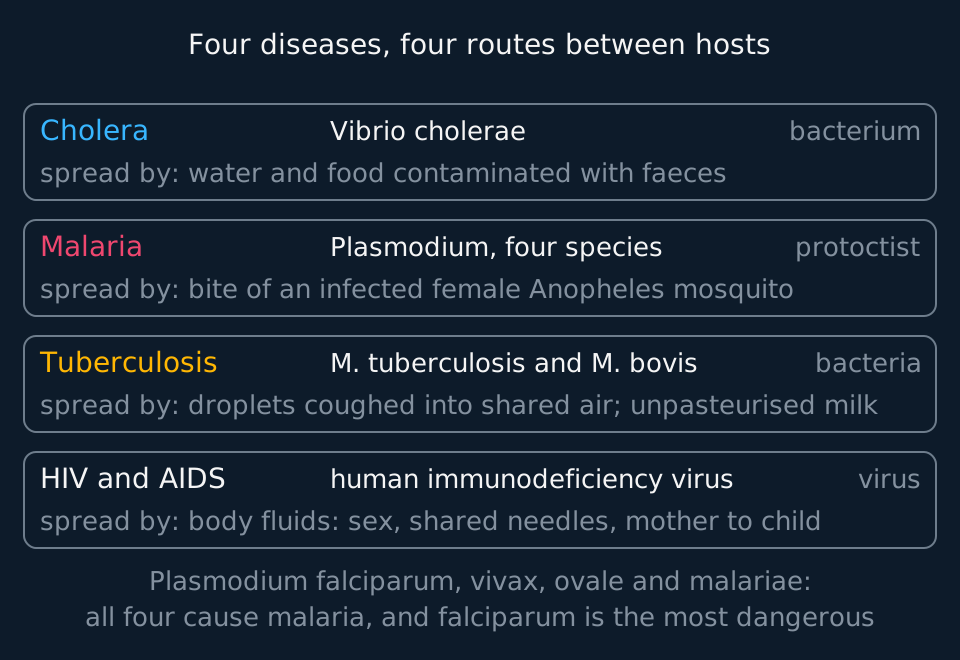
The routes fall into a short list. Direct contact and body fluids: HIV passes only when infected fluid meets a mucous membrane or broken skin. Droplets: coughs and sneezes launch aerosols that another person inhales, which is how tuberculosis and influenza move through a shared room. Water and food: the faecal-oral route, where sewage reaches something that will be drunk or eaten, carries cholera. Vectors: an organism, usually biting, ferries the pathogen from blood to blood. Some pathogens add durable spores that wait in soil or dust for years, which is how tetanus enters a cut and how fungal diseases cross a field.
- Transmission
- The passage of a pathogen from an infected host to an uninfected one, directly or through an intermediate such as water, food or a vector.
- Vector
- An organism that carries a pathogen between hosts without suffering the disease itself; the female Anopheles mosquito is the vector of malaria.
- Carrier
- An infected person with no symptoms who still sheds the pathogen and can pass it on.
- Endemic
- Describes a disease permanently established in a region or population, as malaria is across much of the tropics.
Living conditions multiply every route at once. Overcrowding shortens the distance a droplet has to travel; missing sanitation connects sewage to drinking water; malnutrition weakens the immune response that would otherwise end an infection early. These diseases therefore concentrate in the poorest places, which is why control measures are classified on an economic axis as well as a biological and a social one.
Cholera: faecal-oral transmission
Vibrio cholerae leaves one host in faeces and enters the next by mouth. Where sewage and drinking water are kept apart, cholera is close to impossible; where a flood, an earthquake or a war camp mixes them, one infected arrival can seed an epidemic within days, because a single water source serves thousands of mouths.
Two features increase transmission. Many infected people are carriers, shedding the bacterium with mild symptoms or none, so the number of sources exceeds the number of visible cases. And the watery diarrhoea produced by the toxin, several litres a day, contains large numbers of V. cholerae, which reaches the water supply where sanitation is absent.
The classic demonstration that control does not need a cure is John Snow's, in London in 1854, thirty years before the bacterium was identified. He mapped the cholera deaths of Soho, found them clustered around one public water pump in Broad Street, and had the pump handle removed. The outbreak collapsed. Snow knew nothing about the organism; he had found the route.
Modern control is the same insight with better tools. The engineering that separates sewage from drinking water is expensive once and effective for a century. Oral vaccines exist and work, though protection fades within a few years, so they are used to blunt outbreaks and protect travellers rather than as a permanent shield. And for whoever is infected anyway, oral rehydration solution turns a disease that can be fatal within a day into one that is usually survived, at very low cost. Prerequisite: the cholera toxin, osmosis and oral rehydration.
Malaria: transmission by a mosquito vector
Malaria is caused by four species of the protoctist Plasmodium: P. falciparum, P. vivax, P. ovale and P. malariae. Falciparum is the dangerous one, responsible for most deaths; vivax and ovale can hide dormant in the liver and relapse months or years later; malariae runs the mildest, longest course. Name the four species and identify P. falciparum as the one causing most severe disease.
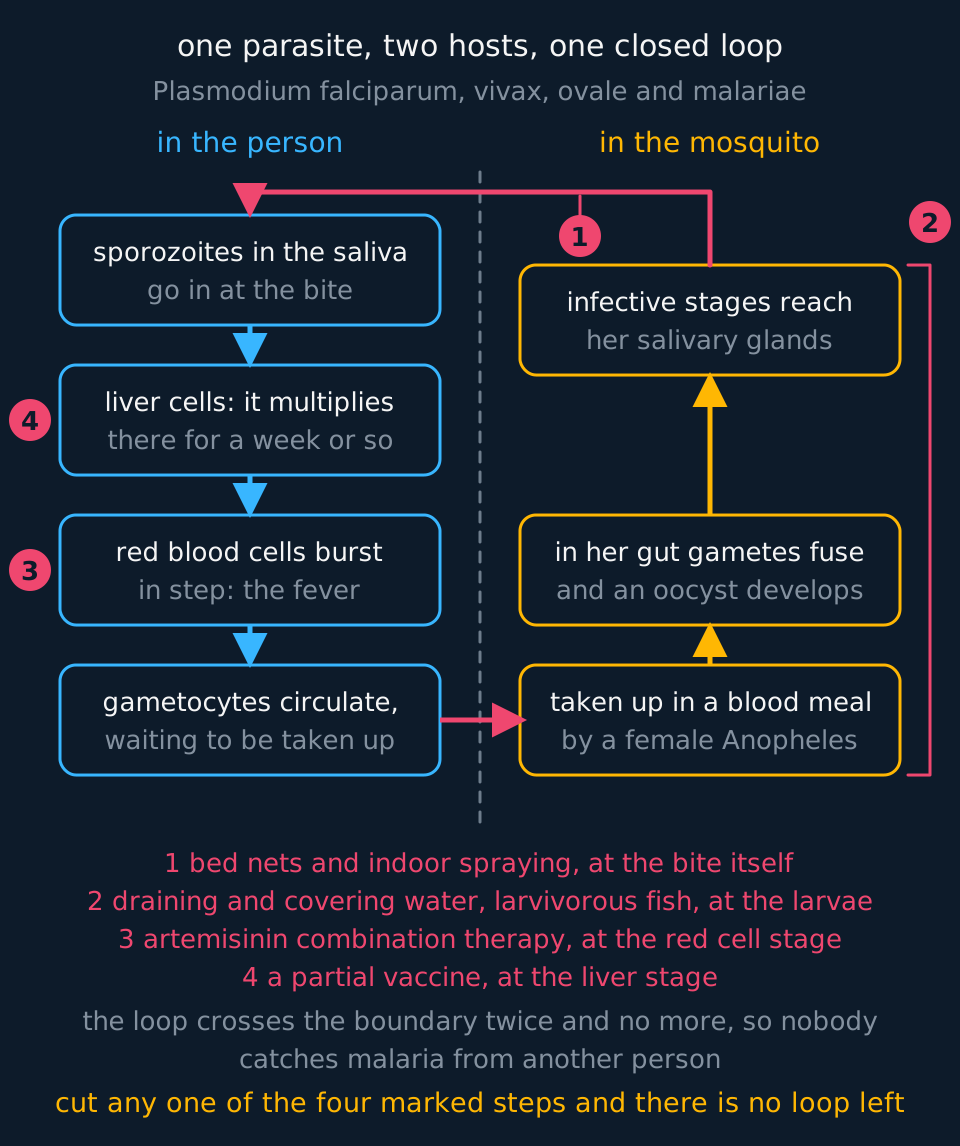
The parasite cannot pass from person to person. It needs two hosts, and the second is the female Anopheles mosquito, female because only females take blood meals. Biting an infected person, she takes up the parasite's sexual stages with the blood. They complete their development in her gut, and when she next feeds, one to two weeks later, the infective stages travel in with her saliva. In the person they multiply first in the liver, then in red blood cells, whose synchronised bursting gives the periodic waves of fever.
A two-host cycle gives control two targets, and the vector is the easier one. Insecticide-treated bed nets exploit the fact that Anopheles feeds mostly at night: the net blocks the bite, and the insecticide kills the mosquito that lands on it. Indoor spraying does the same for the walls she rests on after feeding. Draining or covering standing water removes the still pools her larvae need, and stocking ponds with larvae-eating fish is biological control in the strict sense, one organism deployed against another.
Resistance has developed to each antimalarial drug in turn. Artemisinin, isolated from sweet wormwood, is given as a combination with a second drug on purpose: a parasite carrying a mutation against one drug is still met by the other, so resistant lines are far slower to establish. Vaccines reached the clinic only in the 2020s and protect partially, because Plasmodium moves through liver, blood and mosquito stages that each present different antigens. The antigens therefore change with life stage as well as by mutation, which is a more difficult case than influenza's antigenic variation.
Tuberculosis: two species, two routes
Tuberculosis is caused by Mycobacterium tuberculosis, and also by Mycobacterium bovis, whose usual hosts are cattle. The two organisms give the disease two routes, and each route has its own control.
M. tuberculosis travels in droplets. An untreated person with active TB coughs the bacterium into shared air, and infection is a matter of dose and time: hours in the same poorly ventilated room, night after night, is the classic setting, which is why the disease tracks overcrowded housing, prisons and shelters. Most people infected never become ill; the bacterium survives inside macrophages, walled into granulomas, and waits. Malnutrition, age or an untreated HIV infection can release it decades later, which is one of the ways the two pandemics feed each other.
M. bovis travels in unpasteurised milk and close contact with cattle. The control is agricultural rather than medical: herds are tested and infected animals slaughtered, and pasteurisation heats milk enough to denature the bacterium's proteins. In countries that do both, M. bovis disease in people has almost disappeared, an entire transmission route closed without a single patient treated.
Treatment exists and is long: a combination of antibiotics taken for six months or more, because the bacterium grows slowly and shelters inside cells. The length of the course creates a risk of resistance. A patient who stops at two months, when symptoms have gone, leaves the least susceptible bacteria in the infection, which arose by chance mutation, and the infection that relapses is resistant to those drugs. Multi-drug-resistant TB is the accumulated result, and it is why control programmes fund supervised courses, with a health worker watching each dose swallowed, rather than handing over a bottle of tablets. The BCG vaccine gives partial protection, strongest against severe childhood forms, so it contributes to a control programme without preventing all infection.
HIV: transmission in body fluids
The human immunodeficiency virus passes only in body fluids: unprotected sex, transfused blood and shared needles, and from mother to child in pregnancy, birth or breast milk. It does not survive drying, is not carried by insects and does not cross intact skin, so shaking hands, sharing cups and sharing air do not transmit it. Much of the stigma attached to the disease has followed from inaccurate beliefs about these boundaries.
Each route has a corresponding control. Condoms place a barrier between fluids. Donated blood is screened, subject to the testing-window limitation noted with ELISA. Needle exchanges supply sterile equipment to people who inject drugs, and substantially reduce transmission. Antiretroviral drugs given in pregnancy cut mother-to-child transmission from roughly one in four to under one in a hundred.
Antiretroviral drugs do not clear the infection, because the virus integrates its genome into the T-helper cells that would coordinate a response against it; replication resumes if the drugs are stopped. They hold replication low enough that the immune system remains intact and AIDS does not develop, and a person with a sustained undetectable viral load does not transmit the virus sexually, so treatment also functions as prevention.
There is at present no vaccine. The virus mutates its surface antigens rapidly within a single infected person, and it infects the T-helper cells on which a vaccine response would depend. Prerequisite: antigenic variation and the specific immune response. With no cure and no vaccine, control acts on transmission, and global estimates of new infections have fallen since a peak in the 1990s.
Biological, social and economic control measures
Every measure described above is biological, social or economic, and control programmes that rely on one category alone are less effective.
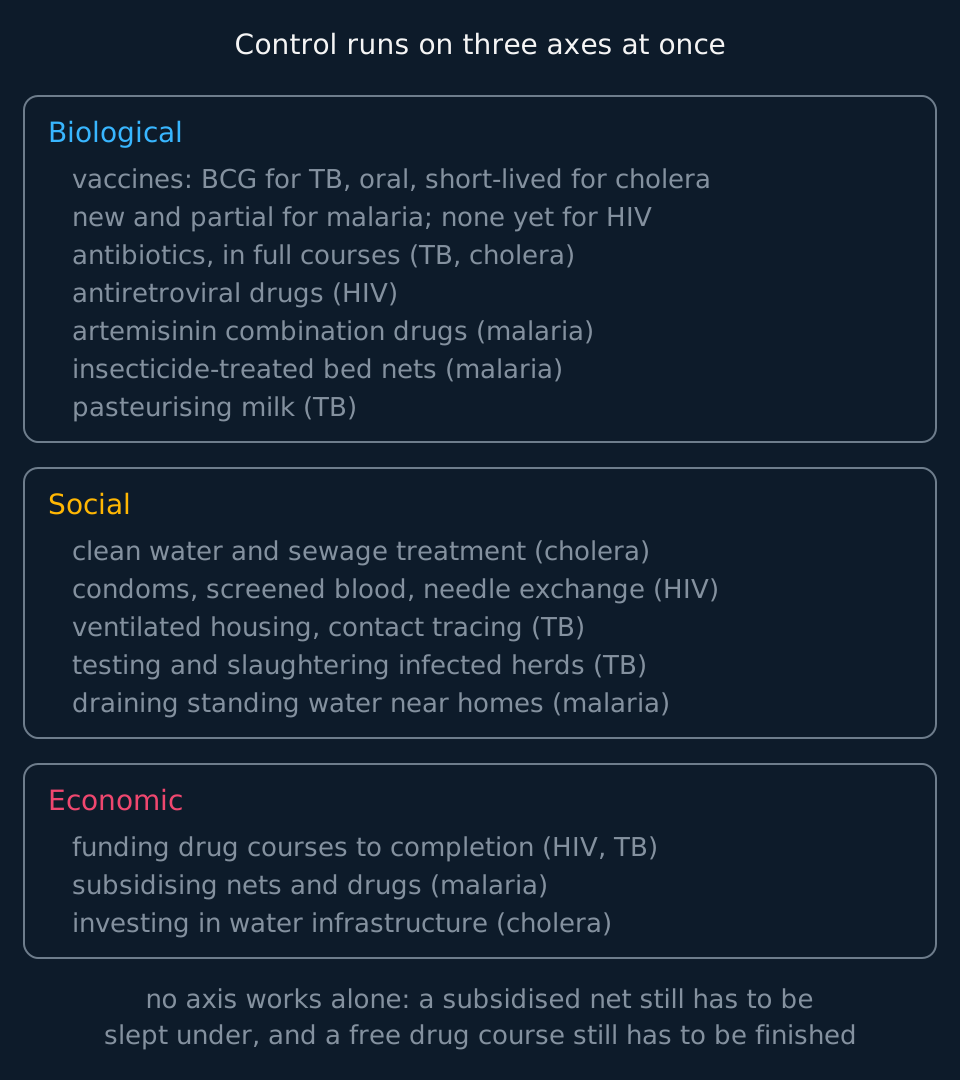
Biological measures act on the pathogen or its vector: vaccines, drugs, insecticides, fish that eat larvae, pasteurisation. Social measures change what people do and where they live: sanitation, ventilation, condom use, contact tracing, testing and slaughtering infected herds, education. Economic measures decide whether the first two happen at all: a net costs a few pounds and a sewage system costs millions, and the populations that need them most can afford them least.
The axes interlock rather than add. A bed net is a biological object; whether a family sleeps under it every night is social; whether they own one is economic. A six-month antibiotic course is biological; finishing it is social; being able to miss work for clinic visits is economic. Disease and poverty act on each other in both directions: illness reduces work and schooling, so expenditure on control has an economic return as well as a health benefit.
TRY IT: Choosing controls by route
A health ministry has to advise two districts. In district A, malaria is endemic. In district B, tuberculosis is spreading through overcrowded housing. For each district, suggest one biological and one social control measure, and explain how each interrupts transmission.
Check your answer
District A, biological: insecticide-treated bed nets. The female Anopheles mosquito feeds mainly at night, so the net physically blocks the bite that transfers Plasmodium, and the insecticide reduces the mosquito population with each landing.
District A, social: organising the drainage or covering of standing water near houses. Anopheles larvae develop in still water; removing it breaks the vector's life cycle before any bite happens.
District B, biological: antibiotic treatment of active cases, supervised to completion. A treated patient stops coughing viable bacteria within weeks, so each completed course removes a source of droplets, and supervision prevents the half-finished courses that select resistant strains.
District B, social: better ventilation and reduced crowding, plus contact tracing of households. Droplet dose depends on shared air and time; more air and fewer hours of exposure cut the probability of infection, and tracing finds the undiagnosed cases still seeding the chain.
The shape of the answer matters as much as the content: name the measure, then name the step of the route it interrupts.
In the exam
- Name the organism and its group: Vibrio cholerae and the mycobacteria are bacteria, Plasmodium is a protoctist, HIV is a virus. Antibiotics act on bacterial structures, so they treat none of the other three.
- The mosquito is the vector, not the pathogen: the female Anopheles mosquito transmits Plasmodium, which causes malaria.
- In a transmission answer, name the route; in a control answer, name the step interrupted, as in 'the net blocks the night-time bite by which the vector transfers the parasite'.
- Resistance wording: mutations arise by chance and are present before the drug is used; the drug removes the susceptible and leaves the resistant to reproduce. Bacteria do not learn, choose or become immune.
- To discuss the control of a named disease, give at least one biological, one social and one economic measure, each linked to the step of transmission it interrupts.
Check yourself
After an earthquake, a crowded low-income city reports its first cholera cases. A relief agency can fund exactly one of two programmes this year: mass vaccination with the oral cholera vaccine, or emergency repair of the water and sewage system. Using your knowledge of how cholera is transmitted, evaluate the two options.
Answer
Start from the route. Cholera is faecal-oral: Vibrio cholerae leaves infected people in faeces and reaches new hosts in contaminated drinking water and food. The earthquake matters because it has broken the separation between sewage and water, and the crowding matters because one contaminated source now serves very many people.
The repair attacks that route directly. If sewage and drinking water are separated again, the pathogen shed by existing cases, including the symptomless carriers no vaccination campaign can find, has no path to anyone's mouth, and transmission stops regardless of how many people are already infected. The protection is also permanent: it works against next year's cholera, and against every other faecal-oral disease at the same time.
Vaccination protects the vaccinated quickly, which matters in the weeks a repair would take, and an oral vaccine can be given fast by workers with little training. But its protection is partial and fades within a few years, it does nothing about the contaminated water itself, and coverage has to be high before transmission falls rather than individual risk.
On the biology, the repair is the better single investment: it removes the route rather than hardening some hosts, and its effect outlasts the epidemic. The strongest answer adds the caveat that the choice is artificial. Real programmes vaccinate to blunt the outbreak while the engineering is done, and give oral rehydration solution to those infected meanwhile, which is a judgement about sequencing rather than either-or.
Questions
Question 15 marks
Tuberculosis is spreading in a low-income country, and cases that have stopped responding to the usual antibiotics are appearing. Discuss the biological, social and economic measures a control programme should use.
Mark scheme
- B1 biological: the BCG vaccine gives partial protection, strongest against the severe childhood forms, and is worth using even though it is imperfect
- B1 biological: active cases are treated with a combination of antibiotics for six months or more, because the bacterium grows slowly and shelters inside macrophages, and a treated patient stops coughing viable bacteria within weeks; pasteurising milk is biological too, heating it enough to denature the proteins of M. bovis and close that route
- B1 the resistant cases arise because a patient who feels well at two months and stops has spared the least susceptible bacteria, mutants present by chance from the start, which then reproduce; supervised courses, with a health worker watching each dose swallowed, are the answer
- B1 social: better ventilation and less crowded housing cut the droplet dose, contact tracing finds the undiagnosed cases still seeding the chain, and testing herds and slaughtering infected animals closes the M. bovis route at its source
- B1 economic: supervision, drugs, housing and pasteurisation all cost money, and the populations that need them most can afford them least, so a judgement is needed on where limited funds do most good, with the argument that money spent returns as the productivity of adults who can work and children who can learn
Question 24 marks
Describe how malaria is transmitted from an infected person to an uninfected person.
Mark scheme
- B1 the parasite cannot pass directly from person to person: it needs a vector, the female Anopheles mosquito, female because only females take blood meals
- B1 biting an infected person, she takes up the parasite's sexual stages with the blood
- B1 these complete their development in her gut, and one to two weeks later the infective stages pass into the next person in her saliva as she feeds again
- B1 in that person the parasite multiplies first in the liver and then in the red blood cells, whose synchronised bursting gives the waves of fever
Question 34 marks
Explain why antiretroviral drugs control an HIV infection without curing it, and explain why there is still no vaccine against HIV.
Mark scheme
- B1 the drugs hold replication so low that the immune system stays intact and AIDS never develops, and a person with an undetectable viral load does not transmit the virus sexually
- B1 the virus archives its genome inside the T-helper cells themselves, so it is never cleared and returns if the drugs are stopped
- B1 its surface antigens mutate faster within a single patient than those of influenza do worldwide, so antibodies and memory cells raised against one version do not recognise the next
- B1 it also infects the T-helper cells that any vaccinated response would have to depend on, so the response a vaccine provokes is attacking the cells that coordinate it
Question 44 marks
A camp built after a flood has one water source, no latrines and has just reported its first cases of cholera. Suggest why cholera spreads so quickly under these conditions, and suggest one measure that would break the chain of transmission.
Mark scheme
- B1 cholera takes the faecal-oral route: Vibrio cholerae leaves an infected person in faeces and enters the next by mouth, so with no latrines sewage reaches the one water source that serves thousands of people
- B1 the disease accelerates its own spread, because the watery diarrhoea produced by the toxin, litres of it a day, is loaded with the bacterium
- B1 many infected people are carriers with mild symptoms or none who still shed the bacterium, so the visible cases are only a fraction of the sources
- B1 separating sewage from drinking water, by providing latrines and a treated supply, removes the route itself and so stops transmission regardless of how many people are already infected; oral vaccine can blunt the outbreak meanwhile
Question 54 marks
Compare why a measles vaccine can give lifelong protection with why a malaria vaccine, developed decades later, still gives only partial protection.
Mark scheme
- B1 measles virus has stable surface antigens, so a single set of antibodies and memory cells remains effective for life, whereas Plasmodium moves through liver, blood and mosquito stages that each present different antigens
- B1 a measles vaccine only has to match one stable set of antigens, whereas a malaria vaccine effective against one Plasmodium stage's antigens does not protect against the antigens of a different stage
- B1 measles vaccination has decades of use behind it against a virus that has not changed its antigens in that time, whereas a malaria vaccine is recent and must contend with a parasite whose antigens differ at every life stage
- A1 this variation between stages, on top of ordinary mutation, is why protection from a malaria vaccine is only partial rather than complete, unlike the measles vaccine
Question 64 marks
Compare the transmission of Mycobacterium tuberculosis with the transmission of Mycobacterium bovis, and compare the control measure that targets each route.
Mark scheme
- B1 M. tuberculosis travels in droplets coughed out by a person with active disease, whereas M. bovis travels in unpasteurised milk and through close contact with infected cattle
- B1 M. tuberculosis is controlled by measures such as ventilation, reduced crowding and supervised antibiotic treatment, which act on person-to-person spread
- B1 M. bovis is controlled by testing herds and slaughtering infected animals and by pasteurising milk, which act on the animal-to-person route instead
- A1 so tuberculosis needs two different sets of control measures, medical and social for one route and agricultural for the other, matched to the two separate routes by which the disease reaches people
Question 74 marks
A country wants to reduce the number of new HIV infections. Suggest three different measures it could introduce, each acting on a different route or stage of transmission.
Mark scheme
- B1 screening donated blood for HIV antibodies (and, in fourth-generation tests, for the p24 protein) prevents transmission through transfusion
- B1 needle exchange programmes supply sterile equipment to people who inject drugs, preventing transmission through shared needles
- B1 giving antiretroviral drugs to pregnant women who are HIV positive cuts mother-to-child transmission from roughly one in four to under one in a hundred
- A1 widespread antiretroviral treatment also reduces onward sexual transmission, because a person with a sustained undetectable viral load does not transmit the virus, so treatment functions as prevention as well as therapy
Question 83 marks
Name the pathogen that causes cholera, name the four species of Plasmodium that cause malaria, and name the two species of Mycobacterium that cause tuberculosis.
Mark scheme
- B1 cholera is caused by the bacterium Vibrio cholerae
- B1 malaria is caused by Plasmodium falciparum, P. vivax, P. ovale and P. malariae
- B1 tuberculosis is caused by Mycobacterium tuberculosis and by Mycobacterium bovis, whose usual hosts are cattle
Question 93 marks
Explain why tuberculosis spreads readily through overcrowded, poorly ventilated housing.
Mark scheme
- B1 a person with untreated active TB coughs M. tuberculosis into shared air in droplets, which other people inhale
- B1 infection is a matter of dose and time, so hours spent in the same unventilated room night after night deliver enough bacteria to establish an infection
- B1 crowding shortens the distance a droplet has to travel and puts more people in that air, and the malnutrition that accompanies poor housing weakens the immune response that would otherwise end the infection early
Question 103 marks
In one district there are 4000 pregnancies a year in women infected with HIV. Untreated, 25 per cent of these result in transmission to the child; with antiretroviral treatment in pregnancy the figure falls to 0.8 per cent. Calculate the number of infections prevented each year if every pregnancy is treated, and calculate that as a percentage reduction.
Mark scheme
- M1 untreated infections are 25 per cent of 4000 = 1000, and treated infections are 0.8 per cent of 4000 = 32
- A1 1000 − 32 = 968 infections prevented each year
- A1 968 ÷ 1000 × 100 = 96.8 per cent reduction
Question 113 marks
In 1854, John Snow mapped cholera deaths in Soho and found them clustered around the Broad Street pump; when its handle was removed, the outbreak collapsed, although the bacterium responsible was not identified for another thirty years. Explain what this shows about controlling an infectious disease.
Mark scheme
- B1 Snow had found the transmission route, water from the contaminated pump, even without knowing what pathogen it carried or how it caused disease
- B1 removing that one water source broke the route between the source of infection and new hosts, and the outbreak ended
- A1 this shows that a disease can be controlled effectively by interrupting its transmission route, without needing to identify the pathogen or have a cure for it
Question 123 marks
Artemisinin is given to treat malaria in combination with a second antimalarial drug, rather than on its own. Explain why.
Mark scheme
- B1 resistance mutations to any one drug arise by chance and are already present in a small number of parasites before the drug is used
- B1 a parasite resistant to artemisinin is still likely to be susceptible to the second drug, and vice versa, since the two act differently
- A1 using both together means a parasite has to carry resistance mutations to both drugs at once to survive treatment, which is far less likely, so resistant lines are much slower to establish than with either drug alone
Question 133 marks
A course of antibiotics for tuberculosis is biological, finishing the course is social, and being able to afford time off work for clinic visits is economic. Suggest why a control programme needs measures from all three categories rather than the biological measure alone.
Mark scheme
- B1 a biological measure such as a drug or a vaccine only works if people can access it and are able to use it as intended
- B1 a patient who cannot afford to miss work for clinic visits may stop an antibiotic course early even though the drug itself is effective, which is an economic barrier to a biological measure succeeding
- A1 the three categories interlock rather than add: a drug or a vaccine is a biological object, but whether people use it correctly is social, and whether they can obtain or afford it at all is economic, so a programme relying on only one axis is incomplete
Question 143 marks
Untreated tuberculosis can remain dormant inside macrophages for decades before causing illness. Explain how a later untreated HIV infection can cause this dormant tuberculosis to become active disease.
Mark scheme
- B1 in most people infected with M. tuberculosis, the bacterium survives inside macrophages, walled into granulomas by the immune response, without causing active disease
- B1 keeping the bacterium contained in this dormant state depends on continued immune surveillance, including T-helper cells co-ordinating the response
- A1 an untreated HIV infection destroys T-helper cells over years, so the immune system can no longer keep the dormant tuberculosis contained, and it can become active disease
Question 152 marks
State the general category of transmission route by which HIV passes between people, and state the general category by which tuberculosis passes between people.
Mark scheme
- B1 HIV is transmitted through direct contact with infected body fluids
- B1 tuberculosis is transmitted by droplets, breathed out in a cough or sneeze and inhaled by another person
Worth remembering
- Four cases, four routes: cholera in water and food, malaria in a vector, tuberculosis on shared air and in unpasteurised milk, HIV in body fluids.
- Control acts on the route. Break the journey between hosts and the epidemic ends without a cure.
- Malaria is the only one of the four with a vector: the female Anopheles carries it, and four Plasmodium species cause it.
- Tuberculosis is two organisms: M. tuberculosis in people, M. bovis from cattle, which is why pasteurisation is a TB control.
- Control has three axes, biological, social and economic, and a programme standing on one of them falls over.
CHECK YOUR PROGRESS
Rate how confident you are with each objective for this lesson. Ratings are saved in this browser, on this device, unless you sign in.
- Name the pathogen behind cholera, malaria, tuberculosis and HIV, down to the four Plasmodium species and the two mycobacteria.
- State the route each of the four takes between hosts, and classify transmission routes in general.
- Match a control measure to the step of transmission it interrupts.
- Sort the controls for a named disease onto biological, social and economic axes, with an example of each.
- Explain why tuberculosis has a vaccine and HIV, so far, does not.
Open the full revision checklist to see every objective in the curriculum in one place.
Practise this lesson
WORKBOOK
The same questions as the player, on paper with room to work, and a separate book of mark schemes. Free to use; please do not redistribute or sell.