Biology › Pathogens, disease and immunity › Antibodies, vaccination and the four kinds of immunity
Antibodies, vaccination and the four kinds of immunity
An antibody is four polypeptide chains folded so that its two binding sites are complementary to one antigen. That specificity underlies agglutination, neutralisation, vaccination, pregnancy testing and monoclonal antibody drugs, and antigenic variation explains why the influenza vaccine is reformulated annually.
Before this Protein structure and function: tertiary and quaternary structure · Disulfide bridges between cysteine side chains · The specific immune response
COMMON MISCONCEPTION
Antibodies kill pathogens.
Antibodies bind specifically to antigens. Binding can neutralise a pathogen or toxin, agglutinate particles and promote phagocytosis; some antibodies also activate complement. Antibodies do not digest pathogens enzymatically.
What you should be able to do
- Describe the structure of an antibody and relate each feature to what it does.
- Explain agglutination, neutralisation and opsonisation without claiming that antibodies destroy pathogens.
- Classify an example of immunity as active or passive and natural or artificial, and justify the classification.
- Explain how vaccination protects an unvaccinated person, and why a threshold coverage exists.
- Explain why the influenza vaccine changes annually and the measles vaccine does not.
- Describe how a monoclonal antibody is produced, from immunising a mouse to harvesting the antibody, and say what each of the two fused cells contributes.
- Set out both sides of an ethical question about vaccine trials without asserting a conclusion.
- Compare William Withering's testing of digitalis with a modern protocol of placebo-controlled, double-blind trials in three phases.
- Evaluate the ethics of using an untested drug during an epidemic, with the 2014 Ebola outbreak as the case.
What an antibody is made of
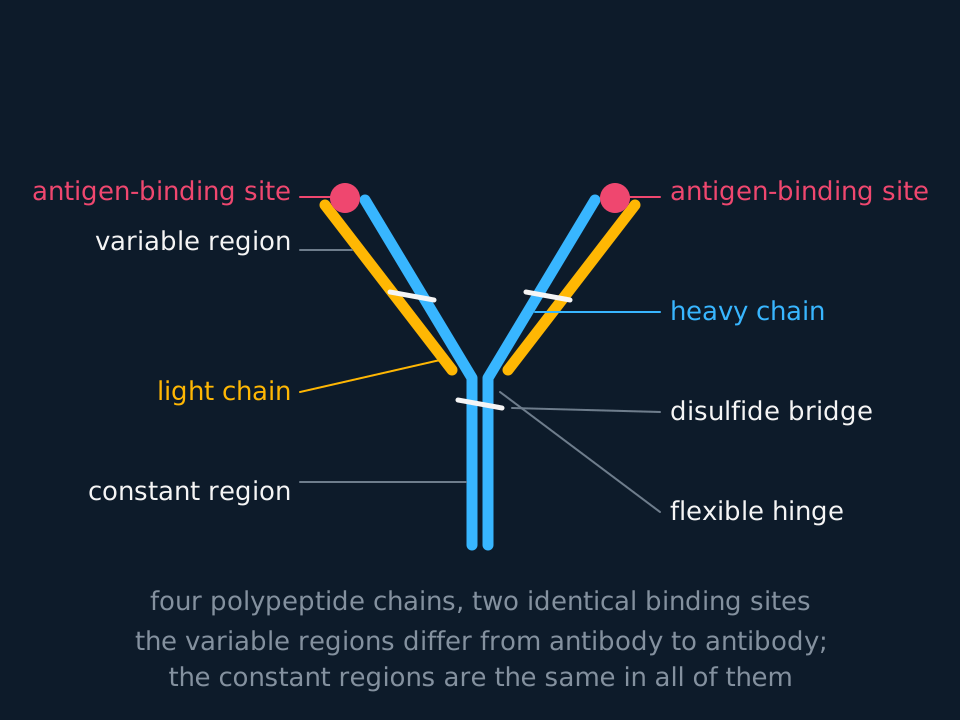
An antibody is a protein, an immunoglobulin, with a quaternary structure of four polypeptide chains: two identical long heavy chains and two identical short light chains, held together by disulfide bridges into a Y.
Describe the drawing
A Y-shaped antibody drawn with two long heavy chains running from the arm tips down through the stem and two short light chains lying along the outside of each arm. Labelled features include the two identical antigen-binding sites at the tips of the arms, the variable regions at the top of each arm, the constant regions below, three disulfide bridges, and the flexible hinge where the arms meet the stem.
The tips of the two arms are the variable regions. Their amino acid sequence differs between one antibody and the next, so the tertiary structure there differs, so the shape of the binding site differs. Each arm carries one antigen-binding site, formed where a heavy chain and a light chain meet, and the two sites on any one antibody are identical to each other. Two sites, one shape.
Everything else is the constant region, and its sequence is the same, or nearly the same, in every antibody of a given class. That is what makes it useful. Phagocytes have receptors for the constant region, so they can bind any antibody regardless of what it is attached to, which is how one receptor deals with millions of different pathogens.
- Antibody
- A protein with a quaternary structure of four polypeptide chains, produced by plasma cells, with variable regions forming two binding sites complementary to one antigen.
- Variable region
- The part of an antibody whose amino acid sequence differs between antibodies, forming the antigen-binding site.
- Constant region
- The part of an antibody that is the same in all antibodies of a class, and that binds to receptors on phagocytes.
- Antigen-antibody complex
- The structure formed when an antigen binds to the complementary binding site of an antibody.
The hinge between the arms and the stem is flexible, so the arms can move to reach antigens at different spacings on a pathogen's surface. In a structure-and-function answer, name the feature and then state what it allows the molecule to do.
What an antibody does, and what it does not
An antibody binds an antigen, forming an antigen-antibody complex. Everything else follows from that, and there are three consequences worth naming.
Agglutination. Because each antibody has two binding sites, one antibody can bind two pathogens at once. Repeat that across thousands of antibodies and the bacteria are clumped into a mass. The clump cannot move about the body, and a single phagocyte can engulf many cells at once rather than one at a time. Agglutination requires at least two binding sites, which is the functional reason for the two arms. Antibodies acting in this way are called agglutinins.
Neutralisation. Antibodies bound over a bacterial toxin cover the part of it that would otherwise fit a host receptor, so it cannot act; antibodies that neutralise toxins are called anti-toxins. The same works on viruses: an antibody covering the attachment proteins of an influenza virus stops it binding to and entering a host cell, and a virus that cannot get into a cell can do nothing at all.
Marking for phagocytosis. With antibody bound, the constant regions stick outwards from the pathogen's surface, and phagocytes have receptors that bind them. The pathogen is far more readily engulfed than it would be otherwise. Antibodies acting as these markers are opsonins.
In none of those does the antibody destroy the pathogen. Hydrolysis occurs inside a phagocyte's phagosome. State that the antibody binds, agglutinates, neutralises or marks for phagocytosis, not that it destroys.
A structure-to-function question, answered fully
Explain how the structure of an antibody allows it to cause agglutination of bacteria and to be engulfed together with them by a phagocyte. (4 marks)
Show the working
Each antibody has two identical antigen-binding sites, formed by the variable regions at the tips of the two arms. Both are complementary to the same antigen.
One antibody can therefore bind an antigen on one bacterium with one site and an identical antigen on a second bacterium with the other, so many antibodies cross-link many bacteria into a clump. The flexible hinge lets the arms move to reach antigens that are not conveniently spaced.
The constant regions are identical in all antibodies of that class and project outwards from the clump. Receptors on the phagocyte's cell-surface membrane are complementary to them, so the phagocyte attaches to the clump and engulfs the whole thing by endocytosis.
The phagocyte does not recognise the bacterium at all: it binds the constant region of the antibody, which is why one type of receptor on one type of cell can act against any pathogen an antibody has bound.
Four ways to end up immune
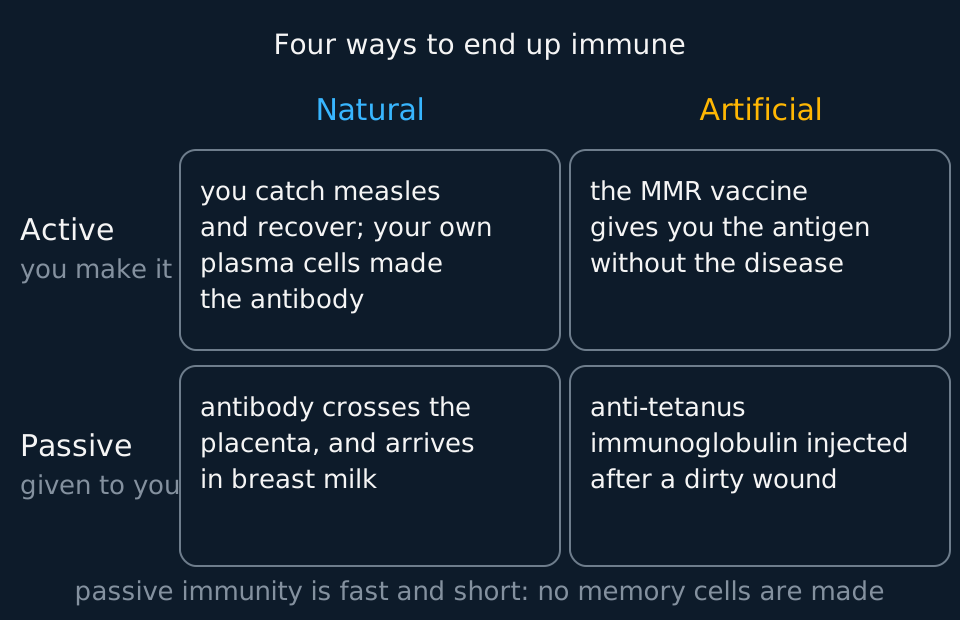
Immunity is classified on two independent criteria: whether the individual's own lymphocytes produced the response, and whether the antigen was encountered naturally or administered. The two criteria give four combinations.
Describe the drawing
A two-by-two grid. The columns are natural and artificial, the rows active and passive. Active natural is catching measles and recovering. Active artificial is the MMR vaccine. Passive natural is antibody crossing the placenta and arriving in breast milk. Passive artificial is anti-tetanus immunoglobulin injected after a dirty wound. A note underneath says passive immunity is fast and short-lived because no memory cells are made.
Active immunity means your own lymphocytes met the antigen, underwent clonal selection and expansion, and left memory cells behind. It takes days or weeks to establish and then lasts for years. Passive immunity means ready-made antibody was introduced from outside. It works immediately, because the antibody is already there, and it fades within weeks to a few months, because antibodies are proteins that get broken down and nothing was made to replace them.
| Natural | Artificial | |
|---|---|---|
| Active | Catching measles and recovering; your plasma cells made the antibody | The MMR vaccine: antigen without the disease |
| Passive | Antibody crossing the placenta before birth, and in breast milk | Anti-tetanus or anti-rabies immunoglobulin, injected after exposure |
Both passive examples rely on the same property: ready-made antibody acts at once. A newborn cannot mount a full specific response for some months, so maternal antibodies supply protection, which fades over roughly six months. Someone bitten by a possibly rabid animal cannot wait the eight days a primary response takes, so they are given antibodies directly and vaccinated at the same time: passive protection now, active protection later.
Vaccination and herd immunity
A vaccine puts antigen into the body in a form that provokes a primary response without causing the disease. Depending on the vaccine, that antigen may be a weakened (attenuated) strain, an inactivated pathogen, a purified surface protein, a harmless toxin derivative, or the mRNA instructions for making one viral protein. What all of them have in common is antigen; what none of them contains is a full dose of virulent pathogen.
A vaccine is sometimes described as producing a mild form of the disease. For most vaccines that is not what happens. A sore arm and a day of malaise after vaccination are effects of the primary immune response, meaning inflammation, cytokines and a slight fever, rather than the disease. A tetanus vaccine contains no live tetanus bacteria and cannot cause tetanus.
The response to a first dose is a primary response: slow, small, and leaving memory cells. A booster is deliberately arranged to be a secondary response, producing much more antibody and many more memory cells, which is why schedules involve several doses rather than one.
Describe the drawing
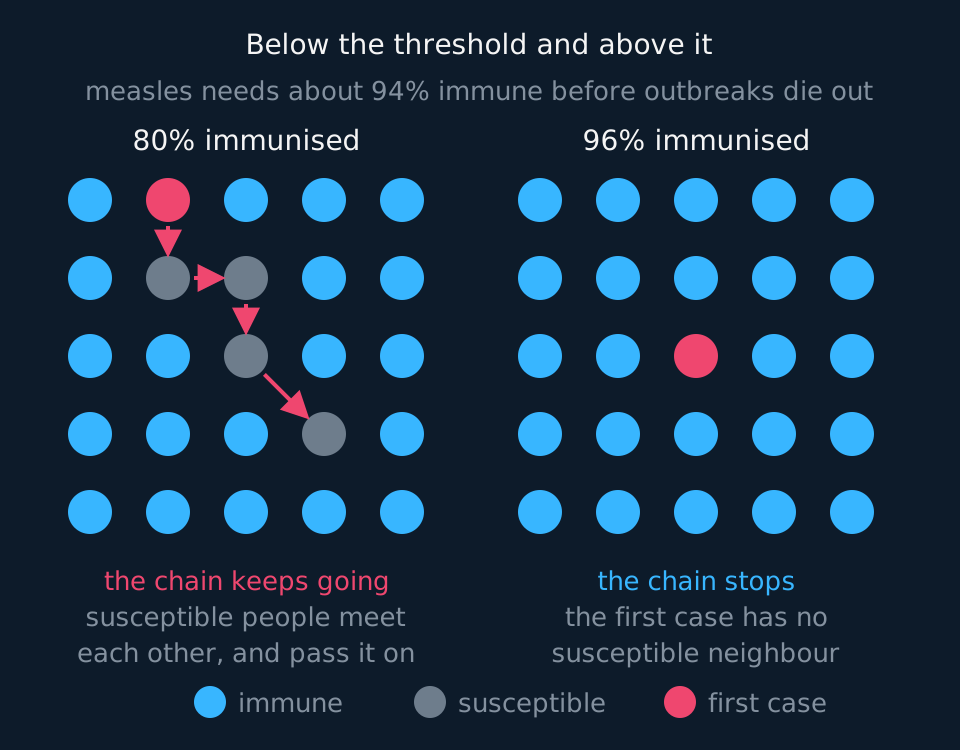
Two five-by-five grids of twenty-five people. In the left grid eighty per cent are immune, and arrows trace an infection running from the first case through four susceptible people who happen to be next to one another. In the right grid ninety-six per cent are immune, the single susceptible person is the first case, and no arrows leave them because every neighbour is already immune.
Herd immunity is the protection unvaccinated people get from being surrounded by vaccinated ones. An infected person can only pass the pathogen to someone susceptible, and if nearly everyone they meet is immune, the chain of transmission breaks before an outbreak can build. This matters because some people cannot be vaccinated: babies below the recommended age, people receiving chemotherapy or immunosuppressants, and anyone with a genuine allergy to a component.
There is a threshold because transmission is a multiplication. If each infected person would on average infect R₀ others in a fully susceptible population, then a proportion of them being immune reduces that number proportionally; once the average falls below one, each case leads to fewer than one new case and the outbreak shrinks. That happens when the immune proportion exceeds 1 − 1/R₀. Measles is extremely transmissible, with R₀ around 15 to 18. Put the two ends in and do the arithmetic: 1 − 1/15 is 93.3%, and 1 − 1/18 is 94.4%, so the threshold is 93 to 94%. Coverage of 90% sounds high and is not high enough, which is why measles returns in communities where uptake slips by a few per cent.
The figure quoted in public health is 95%, and it is a different number, not a rounding of the same one. The threshold is the bare point at which transmission stops on average, in a population where everyone mixes with everyone and every immunised person is genuinely immune. Real populations are not like that: the unvaccinated cluster in particular schools and neighbourhoods, a small fraction of those vaccinated never respond properly, and R₀ is higher in a crowded city than on a farm. The 95% coverage target is what the bare threshold becomes once those idealisations are corrected: an operational figure allowing for imperfect vaccine effectiveness, waning immunity and uneven mixing. If a question gives you R₀ and asks for the threshold, calculate it and quote 93 to 94%; if it asks what health services aim for, that is the 95%.
- Vaccine
- A preparation containing antigens from a pathogen, given to produce a primary immune response and memory cells without causing the disease.
- Herd immunity
- The protection of unvaccinated individuals that results when a large enough proportion of a population is immune for transmission not to be sustained.
- Antigenic variation
- Change in the antigens on a pathogen's surface, so that memory cells and antibodies produced against the previous form are no longer complementary to it.
Why the flu vaccine changes and the measles one does not
Immunity is immunity to a shape. Memory cells specific to one antigen recognise that antigen and nothing else, so a pathogen that changes its surface antigens is effectively a new pathogen to an immune system that has met the old one.
Influenza does this constantly. Its surface proteins, haemagglutinin and neuraminidase, accumulate mutations, and occasionally two strains infecting the same animal exchange whole segments of genome. Your memory cells from last year carry receptors complementary to last year's haemagglutinin. Against this year's they bind poorly or not at all, so the response to infection is essentially primary again. That is why the vaccine is reformulated annually against the strains predicted to circulate, and why the prediction is sometimes wrong.
Measles virus has stable surface antigens, so antibodies and memory cells raised against it in 1985 still fit the virus circulating today. Two doses in childhood give protection that generally lasts for life. The difference between the two vaccines is nothing to do with vaccine quality; it is a property of the viruses.
HIV goes further still, mutating rapidly within a single infected person, so antibodies effective at one stage of the infection are useless months later. That, and the fact that it infects the very cells that would co-ordinate the response, is why an HIV vaccine has proved so much harder to make than a measles one.
Monoclonal antibodies
A monoclonal antibody is a population of identical antibody molecules produced by a clone of identical cells, and therefore specific to one antigen. A molecule that binds one shape and ignores everything else in a sample of blood is a very precise tool.
An immunised mouse produces B lymphocytes specific to the injected antigen. B lymphocytes isolated from the spleen are fused with myeloma cells. Selective medium removes unfused cells, and screening identifies the hybridoma that secretes the required antibody. That clone is cultured to produce genetically identical monoclonal antibodies. The steps are set out below.
Start with the antigen the antibody is required against and inject it into a mouse. The mouse mounts an ordinary specific immune response: B cells with complementary receptors are selected, they divide by clonal expansion, and some differentiate into plasma cells secreting antibody against that antigen. Its spleen is then removed and the antibody-producing B lymphocytes are isolated from it. Those cells make the required antibody but cannot be cultured on their own, because a B lymphocyte removed from the body divides only a few times in culture and then dies.
The second ingredient supplies what is missing. A myeloma cell is a cancer cell of the bone marrow, and like other cancer cells it divides indefinitely in culture. Cell lines are chosen that make no antibody of their own, so the product is not contaminated.
The two cell types are then fused. The B lymphocytes and the myeloma cells are mixed and treated with polyethylene glycol, or given an electric pulse, which makes the membranes of cells in contact merge. A cell formed from one of each is a hybridoma, and it has inherited both properties: it secretes the B lymphocyte's antibody and it divides indefinitely like the myeloma cell.
Two separate sorting steps follow, and both should be named. The fusion mixture contains unfused B lymphocytes, unfused myeloma cells and hybridomas, so it is grown on a selective medium on which only fused cells can survive: the unfused B lymphocytes die of their own accord, and the medium is chosen so that the unfused myeloma cells cannot grow on it either. That is selection, and it leaves hybridomas. Then comes screening, which is a different question. The mouse made B lymphocytes against everything it had ever met, not only the injected antigen, so the surviving hybridomas are a mixture of clones making a mixture of antibodies. Each is grown separately in its own well and its antibody tested against the antigen, and the wells that come up positive are kept.
One hybridoma is then chosen and cultured, either in large vessels of medium or in a fermenter, and because every cell in that culture descends from a single cell, every antibody molecule it secretes is identical. That is what monoclonal means. The antibody is harvested from the medium and purified, and the cell line is frozen so the same antibody can be made again years later.
- Monoclonal antibody
- A population of identical antibody molecules secreted by a clone of identical cells, and therefore all specific to the same antigen.
- Hybridoma
- A cell made by fusing an antibody-producing B lymphocyte from the spleen of an immunised mouse with a myeloma cell, so that it both makes the wanted antibody and divides indefinitely in culture.
- Myeloma cell
- A cancer cell of the bone marrow that divides indefinitely in culture; the lines used for fusion make no antibody of their own.
Two engineered forms of monoclonal antibody are named on drug labels. An antibody made in a mouse is a mouse protein, so a human immune system treats it as non-self and mounts a response against it, which both clears the drug and can make the patient ill. A chimeric antibody combines mouse variable regions with human constant regions. A humanised antibody retains only the mouse sequences needed to form the antigen-binding site, while most of the remaining sequence is human. This reduces the likelihood of an immune response against the treatment. Both designs are possible because the constant region is the same in every antibody of a class, so it can be replaced without altering the binding site.
Targeted cancer treatment. Roughly one breast cancer in five over-produces a receptor protein called HER2 on its cell surfaces. Trastuzumab is a monoclonal antibody with binding sites complementary to HER2: it blocks the growth signal those receptors carry and marks the cells for destruction. Healthy cells carry far less HER2, so the drug affects them much less than a conventional cytotoxic agent would, and the side effects are correspondingly narrower, though not absent. A monoclonal antibody can also carry a drug to its target. A cytotoxic drug attached to an antibody against a cancer-cell antigen is delivered to the cells that display that antigen, so the drug acts mainly on them and much less of it reaches healthy cells. Trastuzumab emtansine is trastuzumab joined to such a drug.
Pregnancy testing. The placenta produces the hormone hCG, which appears in urine. A test strip carries mobile anti-hCG antibodies attached to coloured beads, and a second set fixed in a line further up. Urine carrying hCG picks up the mobile antibodies and carries them to the fixed line, where they are trapped and the colour concentrates. No hCG, no trapping, no line. A control line further up carries antibodies that bind the mobile antibody itself, so it colours whether or not hCG is present and shows that the test has worked.
ELISA (enzyme-linked immunosorbent assay) uses the same logic in a laboratory. In a test for HIV infection, HIV antigen is fixed to the bottom of a well and the patient's plasma is added, so any antibody against HIV binds to it. The well is washed to remove unbound antibody. A second antibody, which binds to human antibody and has an enzyme attached, is added, and the well is washed again, so any enzyme left behind is held there by the patient's antibody. Finally a substrate is added, and a colour change shows a positive result. Without the washes, unbound enzyme would colour a negative sample. A control well given everything except the patient's plasma should stay colourless, which shows that the second antibody does not stick to the well by itself. Note what is detected: antibodies against HIV, which is why a test taken very soon after exposure can be negative in an infected person. Modern fourth-generation tests shorten that window by also detecting p24, a protein from the virus itself, which appears in the blood before the antibodies do.
From foxglove to the double-blind trial
A new drug reaches patients only after testing that asks two questions separately: is it safe, and does it work. The history of that protocol usually starts with William Withering, a physician in Birmingham. In 1775 he was asked his opinion of a family recipe for dropsy, the swelling of the legs and body with fluid that is often the result of heart failure. The recipe was a herbal brew, often called digitalis soup, made from twenty or more plants. Withering reasoned that only one of them was active, identified it as the foxglove, Digitalis purpurea, and spent about ten years giving it to his patients. In 1785 he published An Account of the Foxglove, describing 163 cases, including the ones in which the drug failed.
He changed from a boiled brew to dried, powdered leaf, because the strength of a brew varied. He found the dose by trial, starting low and increasing it until either the swelling went down or side effects appeared: nausea, vomiting, a slowed pulse and disturbed vision. The working dose is close to the poisonous one. Digoxin, a compound from a closely related foxglove, is still prescribed for some heart conditions, now as measured tablets.
His method lacked what a modern trial is built around. There was no control group, so he could not say how many patients would have improved without treatment. The patients knew they were being treated and Withering knew whom he had treated, so expectation could affect what patients reported and how he judged them. He chose his patients rather than allocating them by chance. Safety and effectiveness were tested at the same time, in people who were already ill.
- Placebo
- An inactive substance made to look and be taken exactly like the drug being tested, given to the control group of a trial.
- Double-blind trial
- A trial in which neither the patients nor the doctors and researchers assessing them know who is receiving the drug and who the placebo or comparison treatment.
- Phase I trial
- The first test of a drug in humans, on a small number of healthy volunteers, to find whether it is safe, what dose is tolerated and how the body handles it.
- Phase II trial
- A test of a drug on a few hundred patients with the condition, to find whether it works, at what dose, and its side effects.
- Phase III trial
- A large randomised, usually double-blind trial on thousands of patients, comparing the drug with a placebo or the best existing treatment.
Patients often improve because they believe they are being treated, the placebo effect, so a new drug has to do better than a placebo, not merely better than nothing. In a double-blind trial neither the patients nor the doctors assessing them know who received the drug until the results are analysed. Blinding the patients controls for the placebo effect; blinding the researchers stops their expectations influencing how they treat, examine or record a patient. Patients are allocated to the groups at random, so that differences in age or severity of illness are spread evenly between them. Where an effective treatment already exists, the control group is given that instead of a placebo, because withholding it would harm them.
The three phases test safety in small numbers before effectiveness in large ones, after preclinical tests on cells, tissues and animals.
| Stage | Who is tested | How many | Main question |
|---|---|---|---|
| Preclinical | Cell and tissue cultures, then animals | No humans | Is it toxic, and how is it absorbed and broken down? |
| Phase I | Healthy volunteers | Tens, often 20 to 100 | Is it safe in humans, what dose is tolerated, and what are the side effects? |
| Phase II | Patients with the condition | A few hundred | Does it work, at what dose, and with what side effects? |
| Phase III | Patients, randomised and usually double-blind | Thousands, often in many hospitals | Is it better than a placebo or the existing treatment, and are there rarer side effects? |
| After licensing | Everyone prescribed it | Very large | Are there rare or long-term effects missed by the trials? |
Withering's method and a modern protocol compare point by point.
| Withering, 1775 to 1785 | A modern protocol | |
|---|---|---|
| What was given | Dried foxglove leaf of variable strength | A pure compound at a measured dose |
| Finding the dose | By trial on each patient | In phase I and II, before the main trial |
| Safety and effectiveness | Judged together, in sick patients | Safety first in small numbers, then effectiveness |
| Comparison | None | Placebo or the best existing treatment |
| Allocation | Chosen by the physician | Random |
| Blinding | None | Double-blind |
| Numbers | 163 cases over about ten years | Thousands in phase III |
Untested drugs during an epidemic
Taking a drug through three phases takes years. During an epidemic of a disease with no effective treatment, that timetable sets the people who are ill now against the evidence that would protect people later. The usual case is the Ebola outbreak in West Africa from 2014 to 2016, in which more than 11,000 people died.
No drug or vaccine for Ebola had been licensed. ZMapp, a mixture of three monoclonal antibodies against the virus, had protected monkeys in laboratory tests but had never been given to a human. In mid-2014 it was given to a few patients, two American aid workers among the first, and the small supply soon ran out. In August 2014 a panel convened by the World Health Organization concluded that, in the particular circumstances of that outbreak, it was ethical to offer unproven treatments whose effectiveness and side effects were not yet known, provided that patients gave informed consent and were free to refuse, and that the results were collected and shared.
The case for offering such a drug starts with the patient. Ebola killed a large proportion of the people it infected, so a small chance of benefit can outweigh an unknown risk, and an adult who understands that a drug is unproven can choose to take that risk. Trials run at the normal pace finish too late for anyone ill during the epidemic.
The case against has several parts. Without a phase I trial the drug's toxicity is unknown, and harm it does to a very sick person can look like the disease. Consent from a frightened, very ill person with no alternative is weaker than the consent a trial normally requires. Supply is small, so someone decides who receives it: the first doses of ZMapp going to foreign aid workers rather than to West Africans, who made up almost all the cases, were criticised on that ground. If a drug is handed out without a comparison group, the epidemic can end with no one knowing whether it worked. An unproven drug can also draw money and attention from measures known to work: isolation, rehydration, safe burial and contact tracing.
The answer that emerged was to run trials inside the epidemic. The vaccine rVSV-ZEBOV was tested in Guinea in 2015 by ring vaccination: the contacts of each new case were vaccinated either at once or three weeks later, decided at random. Nobody received a placebo, and the comparison showed that the vaccine was highly effective. In the outbreak in the Democratic Republic of the Congo that began in 2018, a randomised trial compared four experimental treatments, and two monoclonal antibody treatments, mAb114 and REGN-EB3, gave better survival than ZMapp.
The ethics, stated evenly
An ethical discussion sets out the considerations on both sides and distinguishes factual claims from value judgements. The reasoning matters more than the conclusion.
Testing. A new vaccine is tested on animals before humans, raising the question of whether harm to the animals is justified by benefit to people, and on humans before licensing, raising questions about consent and about who bears the risk. Trials often run in the countries where the disease is common, which are frequently poorer countries: an argument that the trial goes where the disease is, and an argument that consent means less where the alternative is no medical care at all.
Control groups. A trial needs a comparison group, and giving that group a placebo means deliberately leaving people without protection during an epidemic. Using the existing vaccine as the comparison avoids that but makes the trial larger, slower and more expensive, which delays the new vaccine for everyone.
Individual and population. Vaccination carries a small risk of side effects to the individual and a large benefit to the population through herd immunity. Someone who declines is protected by others' uptake without accepting the risk themselves. Some countries make certain vaccinations a condition of school entry; others do not, and the disagreement is about how far a state may compel a medical procedure for a collective benefit rather than about the immunology.
Monoclonal antibodies. Producing them uses animals: mice are immunised and then killed for their spleen cells, which raises the same question as animal testing of vaccines, weighed against the diseases the antibodies diagnose and treat. Testing a new antibody in people carries its own risk: in 2006 six healthy volunteers in a London trial of TGN1412, an antibody acting on T cells, became critically ill within hours of receiving it. The drugs are also expensive, so a health service has to decide who receives them.
Set these out as claims and counter-claims. An argument made wholly on one side, and a list of facts with no weighing of them, are both incomplete discussions. The biology does not settle any of these questions, and saying so belongs in the answer.
TRY IT: A coverage figure that is not good enough
In a region, 88% of children are vaccinated against measles. Public health officials describe this as insufficient and campaign to raise it to 95%. Using your knowledge of transmission, explain why 88% is insufficient, and suggest two reasons why a small group of unvaccinated children still matters.
Check your answer
Measles is highly transmissible: one infected person would infect something like 15 to 18 others in a fully susceptible population. The proportion immune has to exceed 1 − 1/R₀ before the average number of new cases per case falls below one. That is 1 − 1/15 = 93.3% at one end and 1 − 1/18 = 94.4% at the other, so the threshold is 93 to 94%.
The 95% the officials are campaigning for is not that threshold but a target set above it. The threshold assumes everyone mixes evenly and every vaccinated child becomes and stays fully immune, and none of that holds exactly, so the operational target absorbs the difference.
At 88%, roughly one child in eight is still susceptible, and each case therefore still produces more than one further case on average. Transmission is sustained and an outbreak can grow rather than fade.
The unvaccinated children matter first because they are clustered in particular schools or communities, so the local proportion susceptible is far higher than the regional average and transmission runs freely inside the cluster.
They matter second because they include children who could not be vaccinated rather than were not: infants below the recommended age, and children immunosuppressed by treatment for leukaemia or after a transplant. Measles is most dangerous to exactly those individuals, and the only protection available to them is everyone else's.
In the exam
- Antibodies bind: they agglutinate, neutralise and mark pathogens for phagocytosis. They do not kill, lyse or destroy.
- In a structure-and-function answer, give the feature and its consequence together: two binding sites, so pathogens are clumped together; a constant region, so phagocytes can bind it.
- Classify immunity on both criteria, as in 'passive natural, because ready-made antibody crossed the placenta'.
- For herd immunity, give the mechanism: transmission is not sustained when an infected person is unlikely to meet a susceptible one.
- State that a vaccine contains antigens; calling it a weak version of the disease is usually inaccurate.
- In an ethics answer, give at least one point on each side and identify which statements are value judgements.
- For monoclonal production, state what each cell contributes. The B lymphocyte from the immunised mouse's spleen makes the required antibody but does not continue dividing; the myeloma cell divides indefinitely but makes no useful antibody. Give the reason for the fusion as well as the fusion itself.
- Selection and screening are separate steps. Selection removes the cells that did not fuse; screening identifies which hybridoma makes the required antibody.
- Give each trial phase its purpose: phase I safety and dose in a few healthy volunteers, phase II effectiveness in a few hundred patients, phase III comparison in thousands.
- Double-blind means neither the patients nor the researchers know who had the drug. Say what each half of the blinding prevents.
- On untested drugs, weigh the patient's poor outlook against unknown harm, pressured consent, unfair allocation and the loss of evidence if there is no comparison group.
Check yourself
A person recovering from a severe bacterial infection is given an injection of antibodies taken from a donor who has recovered from the same infection. They improve within a day. Six months later they are infected again and become seriously ill. Explain both outcomes, and state what should have been done differently if long-term protection was the aim.
Answer
The injection gave artificial passive immunity. Ready-made antibodies with binding sites complementary to the bacterium's antigens were already present in the blood, so agglutination, neutralisation of toxins and marking for phagocytosis began at once, with no lag for clonal selection or expansion. That is why the improvement was so fast.
No memory cells were produced. The patient's own B cells were not selected and did not undergo clonal expansion, because the donor's antibodies bound the antigens and cleared them before the patient's response had developed. The injected antibodies are proteins and were broken down over the following weeks, leaving nothing behind.
Six months later there were therefore no memory cells specific to that antigen. The second infection provoked a primary response, taking around eight days to detectable antibody and at a low concentration, so the bacteria reproduced freely in the meantime and the patient became seriously ill.
For long-term protection they should have been vaccinated as well as given the antibodies: passive immunity for immediate control, and antigen to provoke an active response and leave memory cells. That is exactly the combined treatment used after a possible rabies exposure.
Questions
Question 16 marks
During the 2014 Ebola outbreak in West Africa, an experimental drug that had protected monkeys, but had not been tested in humans, was given to a small number of patients. Evaluate the use of untested drugs during an epidemic.
Mark scheme
- B1 for: the disease kills a large proportion of those infected and there is no effective treatment, so a possible benefit may outweigh an unknown risk
- B1 for: a patient who understands the drug is unproven can consent to take the risk, and completing normal trials would take until after the epidemic
- B1 against: the drug has not passed phase I, so its safe dose and side effects are unknown and it could harm or kill patients
- B1 against: consent from a very ill, frightened patient with no alternative may not be freely given, and with a small supply someone has to decide fairly who receives it
- B1 against: without a comparison group no one learns whether the drug works, and resources may be drawn from proven measures such as isolation and rehydration
- B1 a judgement supported by the points, for example that use is acceptable with informed consent and with outcomes recorded, ideally within a randomised trial run during the epidemic
Question 25 marks
Describe how a monoclonal antibody against a chosen antigen is produced, from the immunisation of a mouse to the harvesting of the antibody.
Mark scheme
- B1 the antigen is injected into a mouse, which mounts a specific immune response, and antibody-producing B lymphocytes are isolated from its spleen
- B1 those B lymphocytes are fused with myeloma cells, using polyethylene glycol or an electric pulse, and each cell formed from one of each is a hybridoma
- B1 the mixture is grown on a selective medium on which only the fused cells survive, so the unfused B lymphocytes and unfused myeloma cells are removed
- B1 the surviving hybridomas are grown separately and screened by testing their antibody against the antigen, because the mouse made B lymphocytes against many antigens and only some of the clones make the one wanted
- A1 a single positive hybridoma is cultured on a large scale, so every cell is a clone of one cell and every antibody molecule secreted is identical, and the antibody is harvested from the medium and purified
Question 34 marks
An antibody has no enzymic activity of any kind. Explain how antibodies nevertheless help to clear a bacterial infection.
Mark scheme
- B1 an antibody has two binding sites and cannot lyse a cell, digest a wall or poison anything; all it does is bind an antigen to form an antigen-antibody complex
- B1 agglutination: because each antibody has two identical binding sites it can bind two bacteria at once, clumping them so they cannot spread and so one phagocyte can engulf many at a time
- B1 neutralisation: antibody bound over a toxin, or over the attachment proteins of a pathogen, covers the part that would otherwise fit a host receptor, so it cannot act or enter a cell
- B1 marking for phagocytosis: the constant regions project outwards and phagocytes carry receptors complementary to them, so the pathogen is engulfed and hydrolysed inside the phagocyte
Question 44 marks
Compare active immunity with passive immunity, referring to how each arises, how quickly it acts and how long it lasts.
Mark scheme
- B1 in active immunity the person's own lymphocytes meet the antigen and respond, whereas in passive immunity ready-made antibody is introduced from outside
- B1 active immunity takes days or weeks to become established, whereas passive immunity works immediately because the antibody is already present
- B1 active immunity leaves memory cells behind, whereas passive immunity produces none
- B1 active immunity therefore lasts for years, whereas passive immunity fades within weeks to a few months as the introduced antibodies are broken down and nothing replaces them
Question 54 marks
An ELISA test for HIV detects antibodies against the virus rather than the virus itself. Suggest why a person infected two weeks ago may still test negative, and suggest what follows for the screening of donated blood.
Mark scheme
- B1 after infection the specific response takes time: antigen must be presented, a B cell selected, and clonal expansion must run before plasma cells exist
- B1 antibody against HIV usually takes several weeks to reach a detectable concentration, a gap called the window period, so at two weeks it may still be below what the test can detect
- B1 the person is infected, and infectious, despite the negative result, which is a false negative
- B1 donated blood could therefore transmit HIV despite passing the screen, so an antibody test alone is not sufficient and a further test or a repeat test after an interval is needed
Question 64 marks
A new vaccine is trialled during an epidemic, with one group given the vaccine and a control group given a placebo. Evaluate the use of a placebo control group in a trial of this kind.
Mark scheme
- B1 in favour: a placebo group provides a valid comparison, so any difference in infection rate between the groups can be attributed to the vaccine rather than to other factors
- B1 against: the control group is deliberately left without protection during an epidemic, so people who could have been protected may catch the disease
- B1 the alternative of comparing against an existing vaccine avoids that, but makes the trial larger, slower and more expensive, which delays the new vaccine for everyone
- B1 a judgement supported by the points made, for example that a placebo group is defensible only where no effective vaccine already exists and consent is genuinely informed
Question 74 marks
Compare the response to the second injection with the response to the first, using values from the graph, and explain what the difference tells you about the cells involved.
Mark scheme
- B1 the second response peaks at 60 units against 12 units for the first, so it is five times higher
- B1 the second response reaches its peak about 7 days after the injection against about 14 days for the first, so it is faster
- B1 antibody from the second response is still well above the first response's peak when the graph ends, so it lasts longer
- A1 memory B cells made during the first response are already present and specific to the antigen, so they divide and differentiate into plasma cells at once rather than after clonal selection of a rare naive cell
Question 84 marks
Describe the quaternary structure of an antibody molecule, and explain what its flexible hinge region allows it to do.
Mark scheme
- B1 an antibody has a quaternary structure of four polypeptide chains, two identical long heavy chains and two identical short light chains, held together by disulfide bridges into a Y shape
- B1 each arm carries one antigen-binding site, formed where a heavy chain and a light chain meet, and the two sites on one antibody are identical to each other
- B1 the hinge between the arms and the stem is flexible
- A1 this flexibility lets the two arms move to reach antigens that are not evenly spaced on a pathogen's surface, which helps the antibody bind two antigens at once
Question 94 marks
Compare the way William Withering tested digitalis from foxglove with the way a new drug is tested today.
Mark scheme
- B1 Withering used dried leaf of variable strength, whereas a modern trial uses a pure compound at a measured dose
- B1 Withering tested safety and effectiveness together in sick patients, whereas a modern protocol tests safety in a few healthy volunteers first, in phase I, then effectiveness in phases II and III
- B1 Withering had no control group, whereas a modern trial compares the drug with a placebo or the existing treatment
- B1 Withering chose his patients and both he and they knew who was treated, whereas modern patients are allocated at random and the trial is double-blind
Question 103 marks
A virus has a basic reproduction number R₀ of 12 in a fully susceptible population. Calculate the percentage of that population which must be immune before transmission is no longer sustained.
Mark scheme
- M1 uses the threshold proportion 1 − 1/R₀
- M1 substitutes correctly: 1 − 1/12 = 1 − 0.0833
- A1 0.917, that is 91.7 per cent (accept 92 per cent), of the population must be immune
Question 113 marks
Explain why the influenza vaccine has to be reformulated every year while the measles vaccine does not.
Mark scheme
- B1 immunity is immunity to a shape: memory cells and antibodies are complementary to one antigen and to no other
- B1 the surface proteins of influenza, haemagglutinin and neuraminidase, accumulate mutations and whole genome segments can be exchanged, so its antigens change from year to year, which is antigenic variation
- B1 memory cells raised against last year's antigens bind this year's poorly or not at all, whereas measles has stable surface antigens, so the same memory cells still fit and childhood doses last for life
Question 123 marks
Neither an antibody-producing B lymphocyte on its own nor a myeloma cell on its own can be used to manufacture a monoclonal antibody. Explain why each is unsuitable alone, and explain what fusing them achieves.
Mark scheme
- B1 a B lymphocyte from the immunised mouse's spleen makes the antibody that is wanted, but taken out of the body it divides only a few times in culture and then dies, so no useful quantity can be made from it
- B1 a myeloma cell divides indefinitely in culture, but it makes the wrong antibody or, in the lines chosen for fusion, none at all
- A1 the hybridoma formed by fusing them inherits both properties, so it secretes the wanted antibody and goes on dividing indefinitely, which is what allows a clone of identical cells to be grown from it
Question 133 marks
Describe what a vaccine may contain, and describe what all vaccine types have in common.
Mark scheme
- B1 a vaccine may contain a weakened (attenuated) strain of the pathogen, an inactivated pathogen, a purified surface protein, a harmless toxin derivative, or the mRNA instructions for making one viral protein
- B1 what all of them have in common is that they supply antigen, or with mRNA the instructions for the body's own cells to make it
- A1 none of them contains a full dose of virulent pathogen, so a vaccine does not give a person a mild form of the actual disease
Question 143 marks
A monoclonal antibody produced entirely in a mouse provokes an immune response against itself when given to a human patient. Explain how making the antibody chimeric or humanised reduces this problem.
Mark scheme
- B1 an antibody made entirely in a mouse is a mouse protein, so a human immune system recognises it as non-self and mounts a response against it
- B1 a chimeric antibody replaces the mouse constant region with a human constant region, keeping only the mouse variable regions that form the binding site
- A1 a humanised antibody goes further, keeping only the small part of the mouse sequence needed to form the binding site itself, with the rest human, so less of the molecule is recognised as foreign and the immune response against it is reduced
Question 153 marks
Roughly one breast cancer in five over-produces a receptor protein called HER2 on the cell surface. Explain why a monoclonal antibody against HER2 affects cancer cells more than it affects healthy cells.
Mark scheme
- B1 the monoclonal antibody has binding sites complementary to HER2, so it binds specifically to cells carrying that receptor
- B1 cancer cells that over-produce HER2 carry far more of it on their surface than healthy cells do
- A1 so the antibody binds mostly to the cancer cells, blocking the growth signal HER2 carries and marking those cells for destruction, while healthy cells with little HER2 are largely unaffected
Question 163 marks
The calculated herd immunity threshold for measles is 93 to 94%, yet public health services aim for 95% vaccine coverage. Explain why the coverage target is set higher than the calculated threshold.
Mark scheme
- B1 the calculated threshold assumes a population where everyone mixes evenly with everyone else and every vaccinated person becomes and stays fully immune
- B1 real populations are not like that: unvaccinated people cluster in particular schools or communities, and a small fraction of those vaccinated never respond properly to the vaccine
- A1 the 95% coverage target allows for these departures from the idealised assumptions, as well as for immunity that wanes over time
Question 173 marks
Describe the three phases of clinical testing of a new drug.
Mark scheme
- B1 phase I: a small number of healthy volunteers, to test safety, the dose tolerated and side effects
- B1 phase II: a few hundred patients with the condition, to test whether the drug works and at what dose
- B1 phase III: thousands of patients in a randomised, usually double-blind trial, comparing the drug with a placebo or the existing treatment
Question 182 marks
A baby receives antibodies in its mother's breast milk. A child of five is given the MMR vaccine. Identify the type of immunity produced in each case, naming both axes of the classification.
Mark scheme
- B1 the breast milk gives natural passive immunity
- B1 the MMR vaccine gives artificial active immunity
Question 192 marks
In a phase III trial, neither the patients nor the doctors assessing them know who received the drug and who received the placebo. Explain why the trial is designed in this way.
Mark scheme
- B1 patients who believe they are being treated may improve anyway, the placebo effect, so patients not knowing means this is the same in both groups
- B1 doctors not knowing prevents their expectations affecting how they treat, examine or record patients, so bias in the results is avoided
Worth remembering
- An antibody is four chains, two identical binding sites, variable regions at the tips and a constant region below.
- Antibodies agglutinate, neutralise and mark for phagocytosis. Phagocytes do the destroying.
- Active immunity makes memory cells and lasts; passive immunity supplies antibody and fades.
- A vaccine supplies antigen, provokes a primary response, and leaves memory cells so that the real infection meets a secondary one.
- Herd immunity has a threshold of 1 − 1/R₀, which for measles is 93 to 94% under the formula's idealised assumptions. The 95% coverage target is the operational figure that allows for real vaccines and real mixing, not the same figure.
- A monoclonal antibody comes from a hybridoma: an antibody-producing B lymphocyte from the spleen of an immunised mouse, which makes the right antibody, fused with a myeloma cell, which divides indefinitely.
- Immunise, isolate spleen B lymphocytes, fuse, select the fused cells, screen for the clone making the antibody wanted, culture it, harvest.
- Withering found digitalis by trial with no control or blinding; a modern drug passes phases I, II and III, with a placebo and double-blinding.
- An untested drug in an epidemic sets one patient's hope against unknown harm and lost evidence; trials run inside the epidemic.
CHECK YOUR PROGRESS
Rate how confident you are with each objective for this lesson. Ratings are saved in this browser, on this device, unless you sign in.
- Describe the structure of an antibody and relate each feature to what it does.
- Explain agglutination, neutralisation and opsonisation without claiming that antibodies destroy pathogens.
- Classify an example of immunity as active or passive and natural or artificial, and justify the classification.
- Explain how vaccination protects an unvaccinated person, and why a threshold coverage exists.
- Explain why the influenza vaccine changes annually and the measles vaccine does not.
- Describe how a monoclonal antibody is produced, from immunising a mouse to harvesting the antibody, and say what each of the two fused cells contributes.
- Set out both sides of an ethical question about vaccine trials without asserting a conclusion.
- Compare William Withering's testing of digitalis with a modern protocol of placebo-controlled, double-blind trials in three phases.
- Evaluate the ethics of using an untested drug during an epidemic, with the 2014 Ebola outbreak as the case.
Open the full revision checklist to see every objective in the curriculum in one place.
Practise this lesson
WORKBOOK
The written questions from this topic, on paper with room to work, and a separate book of mark schemes. The question that is set on a diagram stays on this page, where the diagram can be drawn. Free to use; please do not redistribute or sell.