Biology › Ecology, populations and environmental change › The carbon cycle and climate change
The carbon cycle and climate change
Carbon moves between the atmosphere, oceans, living organisms, soils, rocks and fossil-fuel stores. Before industrialisation, large natural fluxes were close to long-term dynamic balance, although the stores varied. Fossil-fuel combustion, cement production and land-use change now create a net transfer to the atmosphere; land and ocean sinks absorb part of this addition and the remainder raises atmospheric carbon dioxide.
Before this Nutrient cycles and human effects · The Calvin cycle · ATP, glycolysis and the link reaction
COMMON MISCONCEPTION
The carbon dioxide people add to the air is a large amount compared with the carbon dioxide living things move around.
Natural carbon fluxes are large but were close to long-term balance before industrialisation. Fossil-fuel use and land-use change add a smaller one-way net flux; land and ocean sinks absorb part of it and the remainder accumulates in the atmosphere. Attach a year and source to the figures used.
What you should be able to do
- Assemble the carbon cycle from the processes that move carbon between the air, living organisms, the soil and the sea.
- Explain how fossil fuels were formed, and why burning them transfers geological carbon to the atmosphere far faster than natural processes do.
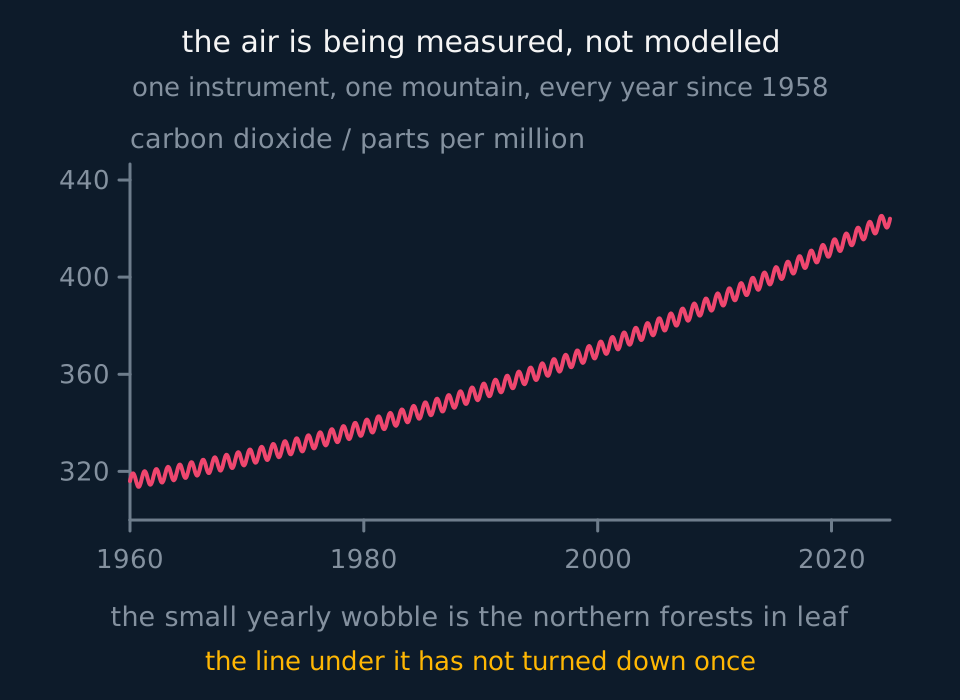
- Describe the evidence that atmospheric carbon dioxide is rising, and explain the shape of the record.
- Explain how deforestation, consumption per person and land-use choices contribute to the rise, alongside population size.
- Describe the effects of a changing climate on the distribution and abundance of species, and hence on biodiversity.
Stores, transfers, and a cycle in approximate balance
Before industrialisation, the global carbon cycle was in approximate long-term dynamic balance, although stores and atmospheric carbon dioxide varied.
Carbon is the element every organic molecule is built on, and there is a fixed amount of it. It is not made or destroyed by anything biology does; it is moved between places where it is held. Those places are called stores, or reservoirs, and the processes that move carbon between them are transfers, or fluxes. Keep the two terms distinct: a store is a place where carbon is held, and a transfer is a process that moves it.
The stores are the atmosphere, where carbon is carbon dioxide gas; living organisms, where it is carbohydrate, lipid and protein; dead organic matter in soil; the oceans, where it is dissolved carbon dioxide, hydrogencarbonate ions and the tissues of marine organisms; sedimentary rock, chiefly limestone, which is much the largest store of all; and fossil fuels. The transfers are the processes you already know, viewed from the outside.
Photosynthesis takes carbon dioxide out of the air and fixes it into organic molecules, which is the only sizeable route from the atmosphere into living things. Feeding moves that carbon along a food chain, which is a transfer between organisms rather than into or out of the air. Respiration returns carbon dioxide to the air from every living thing, producers and consumers alike. Decomposition is respiration too, carried out by bacteria and fungi on dead organisms and on faeces, and it is the route by which carbon locked into a body gets back into circulation instead of accumulating. The sea both dissolves carbon dioxide from the air and releases it back, and the two happen at rates that depend on temperature: cold water holds more dissolved gas than warm water.
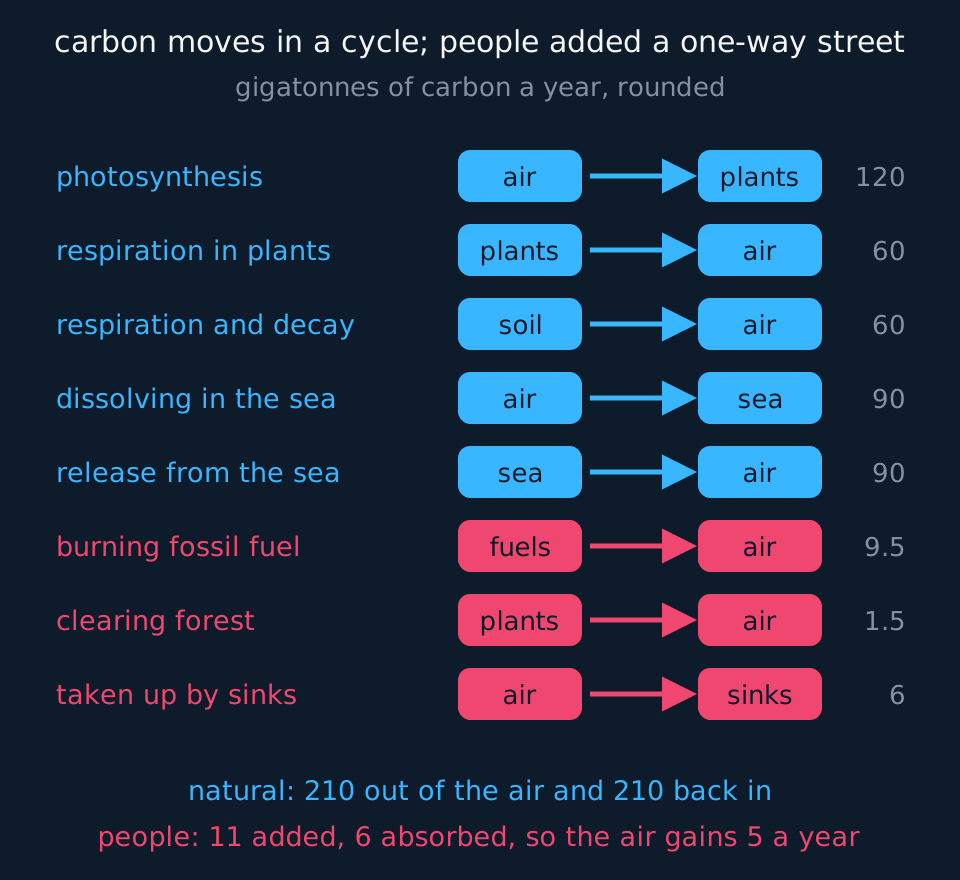
Two of the transfers are slow enough to be worth separating out. Marine organisms build shells and skeletons of calcium carbonate, and when they die those settle, compact and become limestone, which takes carbon out of circulation for many millions of years; weathering of that rock and volcanic activity slowly return it. And where dead organic matter fell into conditions with little or no oxygen, decomposition was slowed and altered rather than stopped, so organic matter accumulated faster than it was broken down and was buried, compressed and heated into fossil fuels. Coal formed mostly from the trees of swamp forests some three hundred million years ago; oil and natural gas formed mostly from marine plankton. Every one of them is carbon that photosynthesis removed from the air and that was buried before decomposition returned it.
- Carbon store
- A place where carbon is held, such as the atmosphere, living organisms, soil, the oceans, sedimentary rock or fossil fuels.
- Carbon transfer
- A process that moves carbon from one store to another, such as photosynthesis, respiration, decomposition or combustion.
- Fossil fuel
- Coal, oil or natural gas, formed over millions of years from the remains of organisms that were buried before decomposers could break them down.
The net transfer added by human activity
The natural transfers above continue. In addition, human activity has greatly accelerated the transfer of geological carbon to the atmosphere. Combustion of fossil fuels returns to the atmosphere, in a couple of centuries, carbon that took hundreds of millions of years to be buried, and the rate at which it is being returned is about ten thousand million tonnes of carbon a year. Deforestation adds to it twice over: burning or rotting the felled trees releases the carbon they held, and the forest that would have gone on fixing carbon is no longer there to do it. Cement manufacture, which drives carbon dioxide out of limestone, adds a further few per cent.
The relative sizes matter. Photosynthesis and respiration move of the order of a hundred and twenty gigatonnes of carbon a year in each direction, and the human addition is of the order of eleven, so the addition is under a tenth of the natural gross flux. Those are recent published estimates and should be quoted with a year and a source, since both are revised. The natural fluxes approximately cancel over the long term; the human addition does not, so the difference accumulates year on year. Land plants and the oceans absorb roughly half of the addition, so about half remains in the atmosphere each year and the concentration rises.
Population size is one of several contributing factors. The human population was about one thousand million in 1800, two thousand million by 1930, and passed eight thousand million in 2022, and energy use per person rose over the same period as well. Population growth has slowed, since the global growth rate peaked in the 1960s and family sizes have fallen almost everywhere, but the population is still rising and the total demand for energy, food and land rises with it. Population is not the whole account, though. Environmental pressure depends on population, consumption per person, technology and land-use choices. All four bear on the pressures treated in this unit and in the biodiversity lesson: land cleared for farming, forests felled for timber, fisheries taken past what they can replace, and now the composition of the atmosphere.
The figures below are approximate annual averages for the 2010s. Published global carbon-budget estimates are revised every year, so quote the year and the source with any flux you use.
| Transfer | Direction | Roughly, in gigatonnes a year |
|---|---|---|
| Photosynthesis | Air into living organisms | 120 |
| Respiration by producers | Living organisms into air | 60 |
| Respiration and decay by consumers and decomposers | Living organisms and soil into air | 60 |
| Exchange with the oceans | Both ways, and roughly equal | 90 |
| Burning fossil fuels | Fossil fuels into air | About 10 |
| Deforestation and land clearance | Living organisms into air | About 1.5 |
| Taken up by oceans and land plants | Air into stores | About 6 |
What a changing atmosphere does to living things
Carbon dioxide is a greenhouse gas: it is transparent to the short-wavelength radiation arriving from the Sun and absorbs some of the long-wavelength radiation the warmed Earth emits, so raising its concentration raises the mean surface temperature. Methane, released by cattle, rice paddies, landfill and thawing permafrost, does the same job far more strongly per molecule while being much less abundant. The ecological question is not whether the temperature changes but what a change does to organisms whose tolerances evolved under the old one.
Distribution. Every species has a range of conditions it can survive in, so a change in climate moves the places where those conditions are found. In practice ranges have been moving polewards and uphill. British butterflies and dragonflies have extended their northern limits by tens of kilometres over a few decades, tree lines on mountains have crept upwards, and fish stocks in the North Sea have shifted north. Species already at the top of a mountain or the edge of a continent have nowhere to move to, which is why arctic and alpine species are the ones most often listed as at risk.
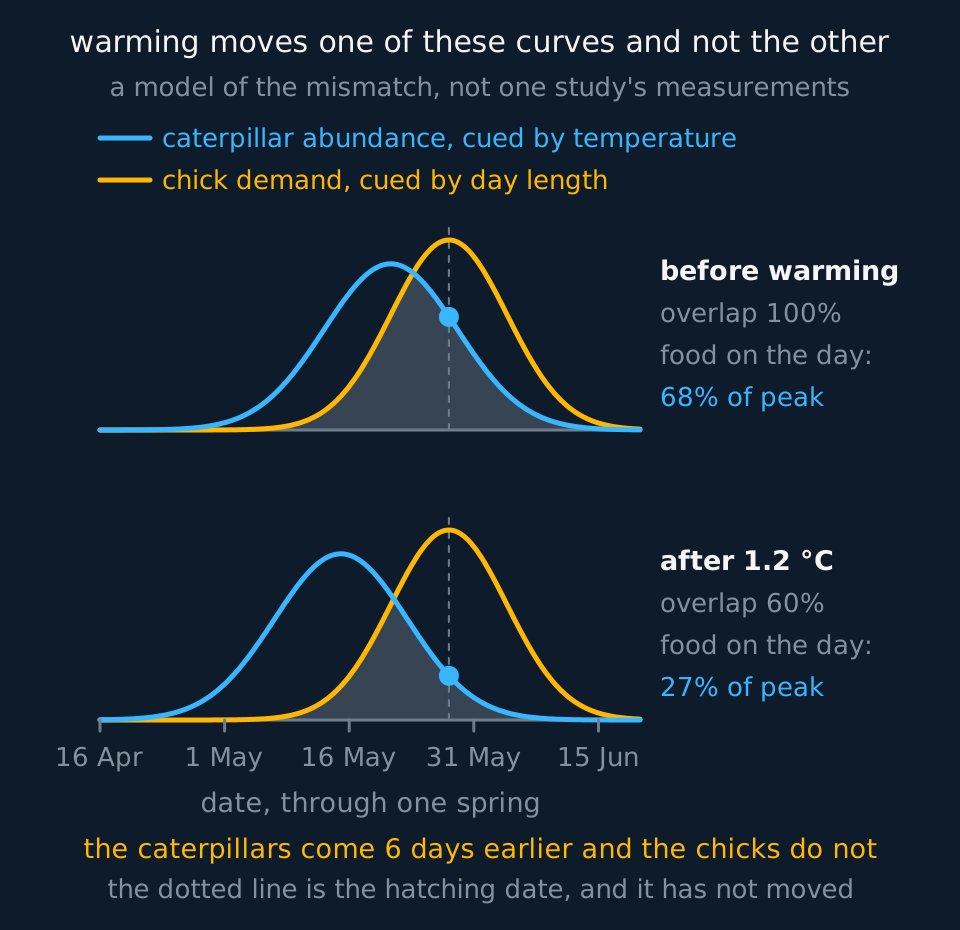
Timing. Many life cycles are triggered by temperature, and warming brings events forward. Trees come into leaf earlier, insects emerge earlier and birds lay earlier. The problem is that not everything shifts by the same amount, because different species take their cue from different things: a bird that times laying by day length, which has not changed, can find its chicks hatching after the peak of the caterpillars they were meant to eat. That mismatch is one of the clearest measured effects on abundance.
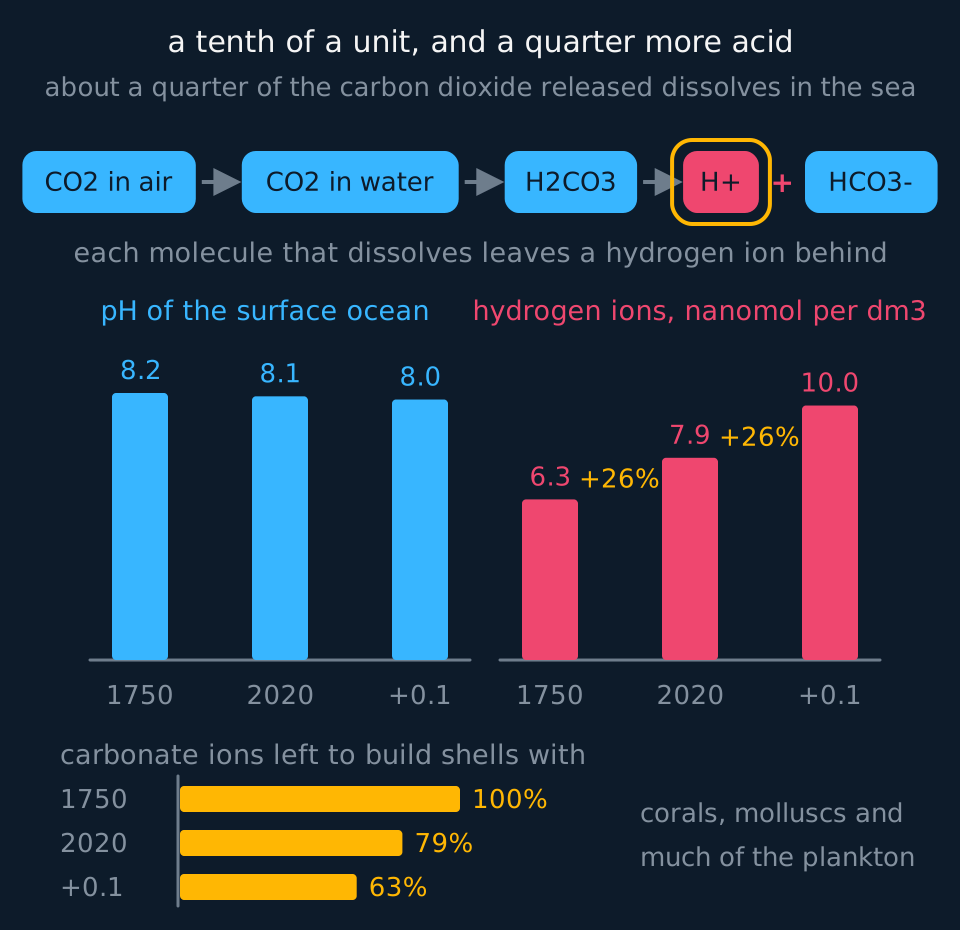
The oceans. About a quarter of the carbon dioxide released dissolves in seawater, where it forms carbonic acid and lowers the pH, a change usually called ocean acidification. It makes building calcium carbonate shells and skeletons harder, which affects corals, molluscs and much of the plankton at the base of marine food chains. Warming does more immediate damage to reefs: above a threshold temperature corals expel the photosynthetic protoctists living in their tissues and bleach, and repeated bleaching kills them. A reef is a habitat for a very large number of other species, so losing it is a loss of species diversity as well as of habitat diversity.
Biodiversity overall. The three effects work together. Species with narrow tolerances, small ranges or poor powers of dispersal lose out; generalists with wide tolerances spread; and communities that took a long time to assemble come apart at different rates. The result is not simply fewer species everywhere but a redistribution, with local diversity rising in some places and falling in others while the number of species on the planet falls. Habitat fragmentation increases the effect, since a species whose range must shift may be unable to cross a city or a motorway, which is one argument for wildlife corridors.
TRY IT: Reading a distribution shift
The northern limit of a British butterfly species was recorded in 1970 and again in 2020. Over that period the mean summer temperature in Britain rose by about 1.2 °C, and the northern limit moved 220 km north. The species overwinters as an egg on a single food plant, which has not moved north.
Explain the shift in the northern limit, and suggest why the species may still decline overall.
Check your answer
The butterfly can survive only within a range of temperatures. Warming has moved the places where those temperatures occur northwards, so conditions at the old northern limit are now suitable further north, and adults dispersing into that area can now survive and breed there.
The shift is therefore not the species changing but the map changing underneath it. This is a change in distribution, and it has happened over about fifty generations, which is far too fast for adaptation to a new temperature range to explain it.
It may still decline because the food plant has not moved. The butterfly can only complete its life cycle where its food plant grows, so the area it can actually occupy is the overlap of the two ranges, and that overlap can shrink even while the butterfly's own climatic range moves.
The southern limit is likely to be retreating at the same time, as conditions there become too warm, so the range moves rather than expands. Habitat fragmentation may also prevent the species from reaching newly suitable areas at all, since it has to cross farmland and towns to get there.
Distinguish the mechanism, a change in where the tolerable conditions occur, from the outcome, which depends on what else must shift with the species.
In the exam
- Name the process rather than the organism: photosynthesis, respiration, decomposition or combustion, with the store it moves carbon from and the store it moves it to.
- State that decomposition is respiration by decomposers, and that they release carbon dioxide by respiring, rather than that they break things down.
- Include the low-oxygen condition in an account of fossil fuel formation: decomposition was slowed and altered, not stopped, so organic matter accumulated faster than decomposers returned it.
- State both the size and the direction of the human transfer: it is small beside the natural gross fluxes, and it is a net one-way addition that accumulates.
- Answer a distribution question through tolerance: the species survives within a range of conditions, and warming moves where those conditions occur.
Check yourself
A student writes: 'Burning fossil fuels is a problem because it creates carbon dioxide, and the amount of carbon on Earth is therefore increasing.' Explain what is wrong with this statement, and give a correct account of why burning fossil fuels raises the concentration of carbon dioxide in the atmosphere.
Answer
Combustion does not create carbon. The carbon in a fossil fuel was already on Earth, and burning it transfers that carbon from one store, the fuel, to another store, the atmosphere. The total amount of carbon is unchanged.
The carbon in fossil fuels was originally removed from the atmosphere by photosynthesis, hundreds of millions of years ago. The organisms that fixed it were buried in conditions without oxygen, so decomposers could not respire their remains, and the carbon was locked away instead of being returned to the air.
Before industrialisation the cycle was in approximate long-term dynamic balance. Photosynthesis removes roughly a hundred and twenty gigatonnes of carbon a year from the atmosphere and respiration and decomposition return about the same, while the oceans dissolve and release roughly equal amounts. Those fluxes approximately cancel.
Burning fossil fuels adds a transfer into the atmosphere with no matching transfer out. About ten gigatonnes of carbon a year are released, with a further one to two from deforestation, which also removes the trees that would have fixed carbon.
Oceans and land plants absorb roughly half of that addition, so about five gigatonnes a year remain in the atmosphere. The annual addition is small compared with the natural flows, but because it is a net addition it accumulates, and the concentration has risen from about 280 parts per million before industrialisation to over 420 parts per million in the 2020s. Quote current concentrations and fluxes with their year and source.
The demand behind it depends on population, consumption per person, technology and land-use choices. The human population has risen from about one thousand million in 1800 to over eight thousand million, and energy use per person has risen as well.
Questions
Question 15 marks
The table gives the concentration of carbon dioxide in the air and two measurements made on surface seawater over the same period, constructed for this question rather than measured. Describe what happens to the seawater as the concentration of carbon dioxide in the air rises, and describe the effect of that change on organisms that build shells and skeletons of calcium carbonate.
| Year | Carbon dioxide in the air / parts per million | pH of surface seawater | Carbonate ions / µmol kg⁻¹ |
|---|---|---|---|
| 1990 | 354 | 8.11 | 240 |
| 2000 | 369 | 8.09 | 232 |
| 2010 | 389 | 8.07 | 224 |
| 2020 | 414 | 8.05 | 216 |
Mark scheme
- B1 as the carbon dioxide in the air rises from 354 to 414 parts per million, the pH of the surface seawater falls from 8.11 to 8.05 and the concentration of carbonate ions falls with it, from 240 to 216 µmol kg⁻¹
- B1 about a quarter of the carbon dioxide released dissolves in the sea, where it reacts with water to form carbonic acid
- B1 the carbonic acid releases hydrogen ions, which is what lowers the pH; the change is called ocean acidification, although the water stays alkaline throughout the period in the table
- B1 those hydrogen ions react with carbonate ions and take them out of solution, which is the fall in the third column, so there is less carbonate available for building calcium carbonate
- B1 corals, molluscs and much of the plankton at the base of marine food chains therefore deposit their shells and skeletons more slowly and existing structures dissolve more readily, so the food chains built on those plankton are affected as well
Question 24 marks
The northern limits of several British insect species have moved north over the past fifty years. Suggest why, and suggest why this may still lead to a fall in biodiversity overall.
Mark scheme
- B1 each species survives only within a range of temperatures, and rising mean temperature has moved the area in which those conditions occur northwards
- B1 individuals dispersing into the newly suitable area can now survive and reproduce there, so the recorded limit moves, while the southern limit retreats as conditions there become too warm
- B1 species already at the northern edge of a land mass, or at the top of a mountain, have nowhere suitable to move to and are lost
- B1 the species a population depends on, such as a larval food plant or the insects a bird feeds its chicks, may not shift by the same amount or at the same time, so ranges and timings no longer overlap
Question 34 marks
Compare carbon dioxide with methane as greenhouse gases, referring to how each warms the surface, to how much of each is in the air, and to where the added gas comes from.
Mark scheme
- B1 both are transparent to the short-wavelength radiation arriving from the Sun and both absorb part of the long-wavelength radiation the warmed Earth emits, so both raise the mean surface temperature
- B1 methane absorbs far more strongly per molecule than carbon dioxide, but there is far less of it in the air, so carbon dioxide accounts for more of the warming overall
- B1 the carbon dioxide added comes chiefly from burning fossil fuels, from deforestation and from cement manufacture, whereas the methane added comes chiefly from cattle, rice paddies, landfill and thawing permafrost
- B1 the methane from thawing permafrost is released by the warming itself, so that transfer grows as the temperature rises, whereas the size of the carbon dioxide transfer depends on how much fuel people burn
Question 44 marks
A student says that because the carbon people add to the air each year is less than a tenth of the carbon photosynthesis removes, the human contribution cannot matter. Discuss this claim.
Mark scheme
- B1 the arithmetic is right: photosynthesis removes about 120 gigatonnes of carbon a year, while combustion and deforestation together add about 11.5, which is under a tenth of it
- B1 against the claim: the natural transfers are a balanced pair, because respiration and decomposition return each year about as much as photosynthesis takes, so the natural cycle leaves the amount held in the air unchanged
- B1 against the claim: the human transfer has no matching return, and although the oceans and land plants take up roughly half of it, about 5.5 gigatonnes stays in the air every year and the surplus accumulates year on year
- B1 a judgement: comparing one transfer with another is the wrong test, and the right one is whether a transfer is balanced; the accumulation is what has taken the concentration from about 280 parts per million before industrialisation to over 420 today
Question 54 marks
A woodland bird times its egg-laying by day length, but its chicks hatch just after the peak abundance of the caterpillars it feeds them. Suggest why this mismatch has developed as the climate has warmed, and suggest one consequence for the bird population.
Mark scheme
- B1 caterpillar emergence is triggered by temperature, so warming has brought the caterpillar peak forward in the year
- B1 the bird's laying date is cued by day length, which does not change as the climate warms, so when its chicks hatch, and need most food, has not shifted by the same amount
- B1 the two events, once closely matched, have drifted apart, so chicks now hatch after rather than at the peak of the food supply
- B1 chicks receive less food during their critical growth period, so fewer survive to fledge, which can reduce the size of the bird population over time
Question 64 marks
Climate change requires many species to shift the area they occupy, but habitat fragmentation can prevent a population from reaching a newly suitable area. Suggest how connecting fragments of habitat with a wildlife corridor could reduce the resulting loss of biodiversity, and suggest one situation in which a corridor would not solve the problem.
Mark scheme
- B1 a corridor of suitable habitat linking fragments gives individuals a route by which they can disperse from an area becoming unsuitable into one that has newly become suitable, rather than being blocked by farmland, a city or a motorway
- B1 a species able to reach the newly suitable area can survive and breed there, so its population, and the local biodiversity, is maintained rather than lost as its old range becomes unsuitable
- B1 a corridor does not help a species already at the top of a mountain or the edge of a landmass, since there is no further suitable area beyond it for a corridor to lead to
- B1 nor does it help a species that must shift faster than it can disperse even along a clear route, since a corridor removes the barrier to movement without increasing the rate at which the species itself can move
Question 74 marks
Explain why the rise in atmospheric carbon dioxide cannot be explained by population growth on its own, referring to what else the environmental pressure a population creates depends on.
Mark scheme
- B1 population size is one factor behind the demand for energy, food and land, but it is not the whole account of that demand
- B1 consumption per person also matters, since energy use per person has risen over the same period that population has risen, so total demand has grown faster than population alone would predict
- B1 the technology used changes how much carbon dioxide a given amount of consumption releases, for example whether energy is generated by burning fossil fuels or by a low-carbon method
- B1 land-use choices, such as clearing forest for farming, add a further transfer of carbon to the atmosphere that is independent of how many people there are or how much each one consumes
Question 83 marks
Name the process that transfers carbon from the atmosphere into living organisms, the process that returns it from living organisms to the atmosphere, and the process that returns carbon locked in dead organisms to the atmosphere.
Mark scheme
- B1 photosynthesis, carried out by producers
- B1 respiration, carried out by all living organisms
- B1 decomposition, which is respiration carried out by saprobiotic bacteria and fungi on dead material and faeces
Question 93 marks
Explain how coal was formed, and explain why the carbon in it had not been returned to the atmosphere before people began to mine it.
Mark scheme
- B1 it formed from the remains of plants, chiefly the trees of swamp forests, that were buried under sediment
- B1 the conditions were anaerobic, so decomposers could not respire the remains and the organic material was not broken down
- B1 over millions of years heat and pressure converted it to coal, so the carbon that photosynthesis had removed from the air stayed out of the cycle
Question 103 marks
Photosynthesis removes about 120 gigatonnes of carbon from the atmosphere each year and respiration and decomposition return about 120 gigatonnes. Burning fossil fuels adds 10 gigatonnes and deforestation adds 1.5 gigatonnes, while oceans and land plants absorb 6.0 gigatonnes of the addition. Calculate the mass of carbon added to the atmosphere each year, and calculate this as a percentage of the carbon removed by photosynthesis.
Mark scheme
- M1 total human addition = 10 + 1.5 = 11.5 gigatonnes
- A1 net gain = 11.5 − 6.0 = 5.5 gigatonnes of carbon a year
- A1 5.5 ÷ 120 × 100 = 4.6 per cent, to two significant figures
Question 113 marks
The concentration of carbon dioxide in the atmosphere falls slightly during the northern hemisphere summer and rises again during the northern winter. Explain this pattern.
Mark scheme
- B1 most of the world's land, and therefore most of its vegetation, lies in the northern hemisphere
- B1 in the northern summer the rate of photosynthesis across that vegetation exceeds the rate of respiration and decomposition, so more carbon dioxide is removed from the air than is returned to it
- B1 in the northern winter many plants have lost their leaves or are dormant, so photosynthesis falls below respiration and decomposition and the concentration rises again
Question 123 marks
Explain why the ocean both takes up carbon dioxide from the air and releases it back, and explain why a warmer ocean is expected to hold less dissolved carbon dioxide.
Mark scheme
- B1 carbon dioxide dissolves into the ocean from the air and comes back out of the ocean into the air, so the ocean is both a carbon store and the site of a two-way transfer with the atmosphere
- B1 the rate of each direction depends on temperature, and cold water is able to hold more dissolved gas than warm water
- B1 as the ocean warms, its capacity to hold dissolved carbon dioxide falls, so it is expected to absorb a smaller proportion of what is emitted over time
Question 133 marks
Explain what happens to a coral reef when sea temperature rises above a threshold, and explain why the loss of a reef reduces biodiversity beyond the corals themselves.
Mark scheme
- B1 above a threshold temperature, corals expel the photosynthetic protoctists living in their tissues, which is called bleaching, and repeated bleaching kills the coral
- B1 a coral reef is the habitat for a very large number of other species, so losing the reef removes their habitat as well as removing the coral that built it
- B1 the loss of the species that depended on the reef habitat is therefore a loss of both habitat diversity and species diversity, beyond the direct effect on the corals
Question 142 marks
State the difference between a carbon store and a carbon transfer, giving an example of each.
Mark scheme
- B1 a store is a place where carbon is held, such as the atmosphere, living organisms, soil, the ocean, sedimentary rock or fossil fuels
- B1 a transfer is a process that moves carbon from one store to another, such as photosynthesis, respiration, decomposition or combustion
Question 152 marks
The following are all part of the carbon cycle: the atmosphere, photosynthesis, sedimentary rock, respiration, fossil fuels, decomposition. Identify which three of these are stores and which three are transfers.
Mark scheme
- B1 the atmosphere, sedimentary rock and fossil fuels are stores, each a place where carbon is held
- B1 photosynthesis, respiration and decomposition are transfers, each a process that moves carbon from one store to another
Worth remembering
- Stores hold carbon; transfers move it. Photosynthesis, respiration, decomposition and combustion are transfers.
- Decomposition is respiration carried out by bacteria and fungi on dead material, and it is what stops carbon accumulating in dead bodies.
- Fossil fuels formed where dead organisms were buried in low-oxygen conditions that slowed decomposition, so most of their carbon was not returned to the air.
- Before industrialisation the cycle was in approximate long-term dynamic balance. Combustion and deforestation greatly accelerated the transfer of geological carbon to the air, and about half of what is added stays there.
- A changing climate moves the places where a species can survive, so ranges shift polewards and uphill, and species with nowhere to go are the ones at risk.
CHECK YOUR PROGRESS
Rate how confident you are with each objective for this lesson. Ratings are saved in this browser, on this device, unless you sign in.
- Assemble the carbon cycle from the processes that move carbon between the air, living organisms, the soil and the sea.
- Explain how fossil fuels were formed, and why burning them transfers geological carbon to the atmosphere far faster than natural processes do.
- Describe the evidence that atmospheric carbon dioxide is rising, and explain the shape of the record.
- Explain how deforestation, consumption per person and land-use choices contribute to the rise, alongside population size.
- Describe the effects of a changing climate on the distribution and abundance of species, and hence on biodiversity.
Open the full revision checklist to see every objective in the curriculum in one place.
Practise this lesson
WORKBOOK
The written questions from this topic, on paper with room to work, and a separate book of mark schemes. The question that is set on a diagram stays on this page, where the diagram can be drawn. Free to use; please do not redistribute or sell.