Biology › Plant transport and mineral nutrition › Phloem translocation and the mass-flow hypothesis
Phloem translocation and the mass-flow hypothesis
Phloem moves sucrose up, down and laterally, changes direction with the season, and does so far faster than diffusion could. The mass flow hypothesis is the best available explanation rather than a settled fact, and the evidence for and against it is set out here.
Before this Active transport and co-transport at membranes · Water potential and osmosis in plant cells
COMMON MISCONCEPTION
Sugars are actively transported along the phloem from the leaves to the roots.
Loading at the source is active and generates the pressure gradient. Movement along the sieve tube is mass flow down that gradient and not active transport. Unloading at the sink may be passive or active, depending on the tissue and the concentration gradient.
What you should be able to do
- Describe a sieve tube element and a companion cell, and relate each feature to the job it does.
- Explain how sucrose is loaded into a sieve tube at a source, naming the pump and the co-transporter.
- Explain how loading and unloading create the pressure gradient that mass flow depends on.
- Identify sources and sinks, including an organ that is both at different times of year.
- Describe ringing, aphid stylet and tracer experiments and say what each one does and does not establish.
- Evaluate the mass flow hypothesis, giving evidence on both sides.
Sieve tube elements and companion cells
Phloem is a tissue containing several cell types, two of which carry out transport. Learn them together, since each depends on the other.
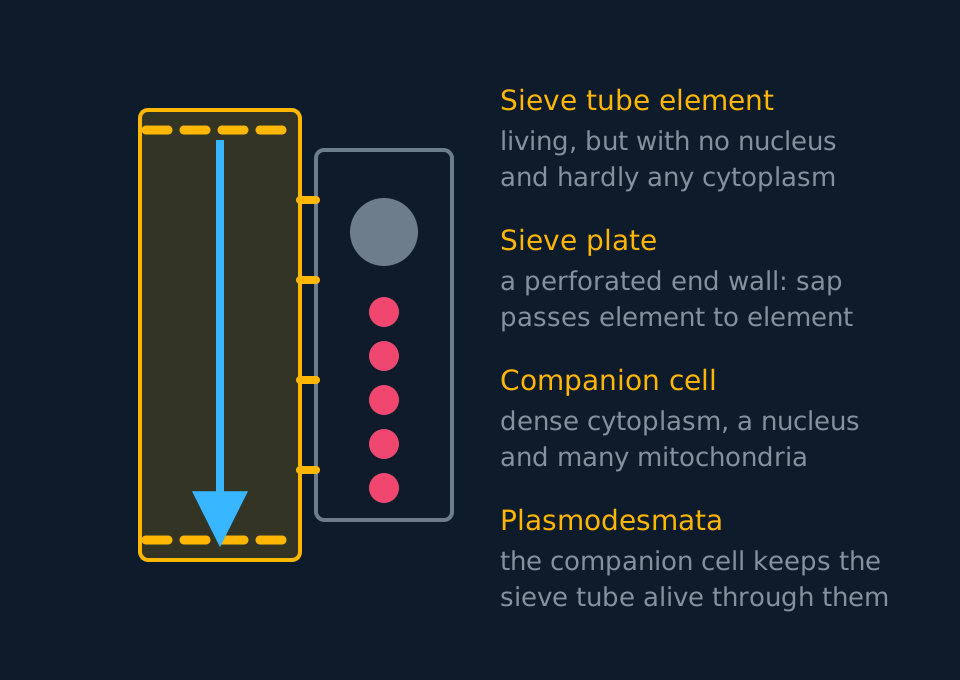
Describe the drawing
A vertical sieve tube in longitudinal section, drawn in amber and crossed near each end by a row of short bars, the perforated sieve plates at the two ends of one element, with a cyan arrow running down the lumen for the sap. Beside it a companion cell containing one large nucleus and five smaller organelles for mitochondria, joined to the sieve tube by four thick plasmodesmata. Four labelled notes to the right name each structure.
- Sieve tube element
- A living cell of the phloem, joined end to end with others into a tube; at maturity it has no nucleus, few organelles and only a thin layer of cytoplasm around the edge.
- Sieve plate
- The perforated end wall between two sieve tube elements, through which the sap passes.
- Companion cell
- A cell alongside each sieve tube element with dense cytoplasm, a nucleus and many mitochondria, connected to it by numerous plasmodesmata and responsible for loading it and keeping it alive.
- Translocation
- The transport of assimilates, mainly sucrose, through the phloem from a source to a sink.
The sieve tube element is a cell that has thrown away most of what a cell normally needs. The nucleus goes, the tonoplast goes, most organelles go, and the end walls become sieve plates with pores wide enough for the contents to move through. What is left is a channel with as little in the way as a living cell can manage. Companion cells supply everything it can no longer make, through plasmodesmata so numerous that the two are sometimes treated as one functional unit.
The sugar carried is sucrose, not glucose. Sucrose is a non-reducing sugar and is not an intermediate in respiration, so it can travel at high concentration without being drawn into the metabolism of every cell it passes and without reacting on the way. It is also soluble, whereas starch, the form in which carbohydrate is stored rather than moved, is not. Amino acids travel in phloem too, along with potassium, phosphate and the other mobile ions, which is why nitrogen and magnesium shortages show up on a plant's oldest leaves first.
Loading at the source and the pressure gradient
The mass flow hypothesis explains long-distance movement as bulk flow driven by a difference in hydrostatic pressure between the two ends of the tube. That pressure difference is generated osmotically, following active loading of sucrose.
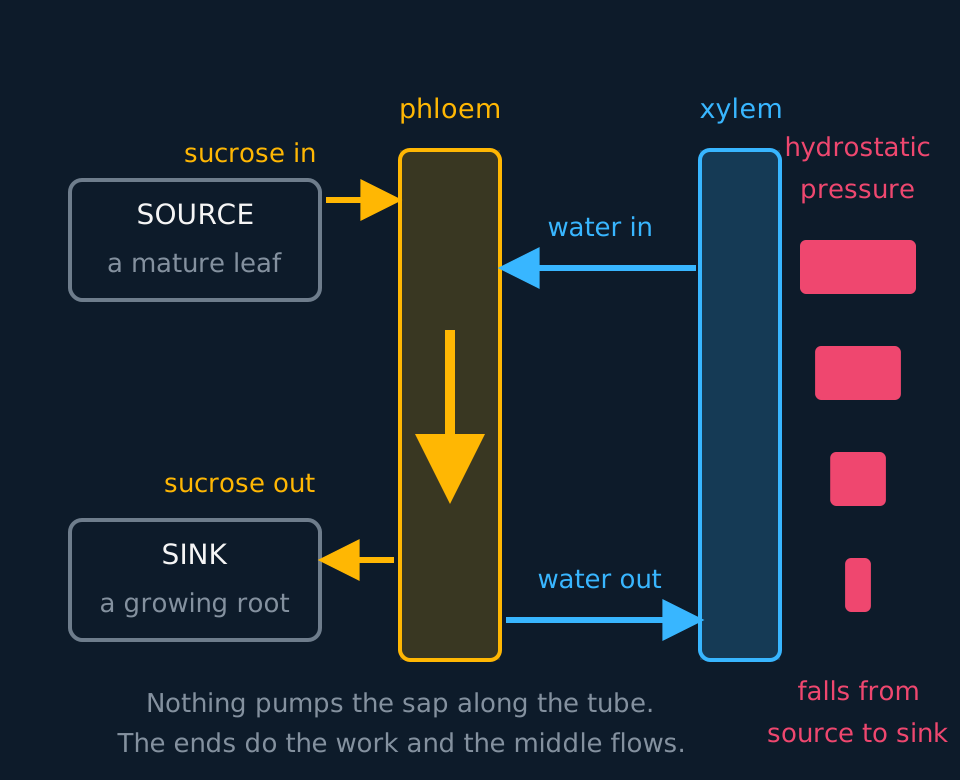
Describe the drawing
A tall amber phloem tube beside a cyan xylem tube, with a source box labelled as a mature leaf at the top left and a sink box labelled as a growing root at the bottom left. Arrows carry sucrose into the phloem at the source and water across from the xylem just below it; a thick arrow runs down the phloem; at the bottom sucrose leaves for the sink and water returns to the xylem. A column of coral bars at the right narrows from top to bottom for the falling hydrostatic pressure.
At a source, in the loading route A-level teaches (a common one, though some species load through plasmodesmata instead), the companion cell uses ATP to pump hydrogen ions out across its plasma membrane into the cell wall. That builds a concentration gradient of hydrogen ions, and they leak back in through a co-transporter protein that will only carry a hydrogen ion inwards if it carries a sucrose molecule with it. Sucrose is dragged into the companion cell against its own concentration gradient on the back of the hydrogen ion gradient, and passes on into the sieve tube element through the plasmodesmata. The pump spends the ATP; the co-transporter spends none, which is why this is called secondary active transport.
The next two steps are osmosis and a rise in hydrostatic pressure. Sucrose in the sieve tube reaches concentrations of roughly 0.3 to 0.9 mol dm⁻³, or ten to thirty per cent sugar by mass, so the water potential of the sap falls sharply. Water enters from the xylem alongside, and because the sieve tube has stiff walls and is already full, the hydrostatic pressure inside it rises. Measurements at a source put it in the region of 800 to 2000 kPa.
The reverse occurs at a sink, because the sucrose delivered is continuously used. Sucrose is unloaded into the surrounding cells and immediately converted into something else, whether respired, stored as starch or built into cellulose, so its concentration in the sink cells stays low and the unloading gradient never runs out. With less solute, the water potential of the sap rises, water leaves back into the xylem, and the hydrostatic pressure falls. Sap flows from the high-pressure end to the low-pressure end, carrying everything dissolved in it.
The rate of movement is why a mechanism other than diffusion is required. Phloem sap moves at roughly 0.15 to 1.5 metres an hour, whereas sucrose diffusing through water would take decades to travel a metre.
Sources and sinks
A source is any region where sucrose enters the phloem; a sink is any region where it leaves. Neither is a fixed part of the plant, and questions often use organs that change role with the season.
| Organ | When it is a source | When it is a sink |
|---|---|---|
| A mature leaf | Whenever it is photosynthesising in surplus | Never, once it is fully expanded |
| A young leaf | Not until it is about a third grown | While it is expanding and importing sugar to build itself |
| A potato tuber | In spring, feeding the new shoot from its stored starch | In late summer, filling with starch from the leaves |
| A root | Rarely, and only from stored reserves | Almost always: it never photosynthesises and always respires |
| A seed or fruit | Never while it is developing | Strongly, and it outcompetes other sinks for the supply |
Two consequences follow. Phloem carries material in both directions, up the stem in spring from a tuber and down it in summer from the leaves, so an answer stating that phloem transports sugar downwards is incomplete. And the direction of flow in any one sieve tube depends on which end currently has the higher hydrostatic pressure, which is what a pressure-driven mechanism predicts.
Phloem mobility also accounts for the pattern of mineral deficiency symptoms. Because phloem runs from source to sink, a plant short of nitrogen can break down protein in an old leaf and export the amino acids to a young one. Calcium has almost no phloem mobility, so nearly all of it goes where the transpiration stream takes it and stays there.
Evidence for and against mass flow
Mass flow is a hypothesis, and the specifications describe it as one. Evaluation questions require evidence to be named and interpreted, not a conclusion stated on its own.
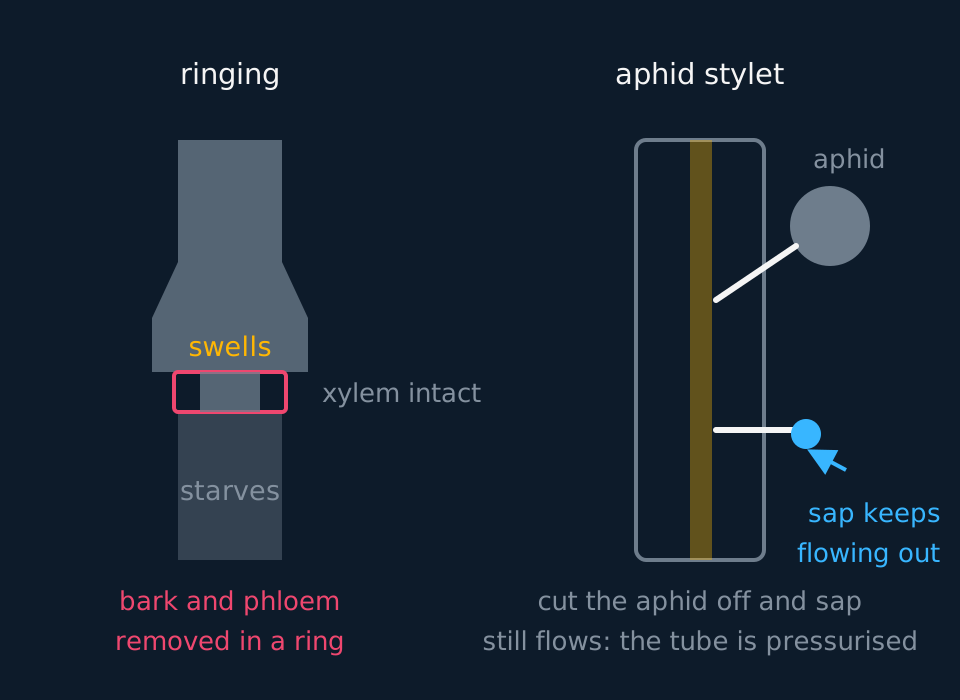
Describe the drawing
Two experiments drawn side by side. On the left a stem with a band of bark and phloem removed, drawn as a coral ring with the wood, labelled xylem intact, running on through it: the trunk above the ring is visibly wider and marked as swelling, the trunk below it is drawn faint and marked as starving. On the right a stem with an amber phloem strip, an aphid resting on it with its stylet pushed in, and below that the same stylet alone with the aphid's body gone and a droplet of sap still forming at the cut end.
Ringing. Cut a complete ring of bark, and with it the phloem, from a woody stem, leaving the xylem intact. Within weeks the stem swells above the cut and the tissue there is rich in sugars, while below the cut the sugar concentration falls and the roots eventually die. That establishes that organic solutes travel in the phloem and that the flow at that point is downwards. It does not establish how.
Aphid stylets. An aphid pushes a fine mouthpart into a single sieve tube and feeds. Anaesthetise it with carbon dioxide and cut the body away, and sap goes on flowing out of the abandoned stylet for hours. Two things follow at once: the contents of a sieve tube really are under positive hydrostatic pressure, and no suction by the aphid is needed to keep the sap moving out. Sap sampled this way is what most measurements of phloem sucrose concentration come from.
Radioactive tracers. Supply a leaf with carbon dioxide made with the carbon-14 isotope. The labelled carbon appears in sugars within minutes, and an autoradiograph of a stem section afterwards shows the radioactivity in the phloem and not in the xylem. Repeated over hours, the label is found in whichever organ is acting as the sink.
Interpreting aphid stylet data
Aphid stylets were used to sample sap from a single tree at two heights. Near the leaves, the sap contained 0.71 mol dm⁻³ sucrose and exuded at 2.3 mm³ h⁻¹. Twelve metres lower down the trunk, sap from stylets in the same vascular bundle contained 0.42 mol dm⁻³ sucrose and exuded at 1.1 mm³ h⁻¹. Explain how these results support the mass flow hypothesis.
Show the working
Take the concentrations first. Sucrose is more concentrated near the source and less concentrated further from it, which is what continuous unloading along the route and at the sink would produce.
Now the exudation rates. Sap leaves a stylet at a rate set by the pressure behind it and by the resistance of the stylet itself, so the comparison is only fair because the stylets are alike and in the same bundle. Granting that, a rate twice as high near the leaves points to a higher hydrostatic pressure there.
Mass flow requires exactly that: a pressure gradient falling from source to sink, generated by sucrose being loaded at one end and removed at the other. Both measurements change in the direction the hypothesis predicts, and the two gradients run the same way. State that explicitly.
State the limit of the conclusion. The data show a gradient consistent with mass flow; they do not exclude another mechanism that would also produce one. Use the word 'support', as the question does, rather than 'prove'.
The objections to the hypothesis follow.
| Objection | The reply mass flow offers |
|---|---|
| Sieve plates obstruct the flow. Why would a bulk-flow system evolve sieves in the pipe? | They may hold the tubes open under pressure, and callose and protein can plug them within seconds if the tube is cut, which stops the plant bleeding out |
| Not all solutes move at the same speed, and mass flow says everything in the sap travels together | Sucrose and amino acids may be loaded and unloaded at different points along the route, which changes their apparent speed without changing the flow |
| Solutes have been seen moving in opposite directions at the same time | Never convincingly within one sieve tube; adjacent tubes in the same bundle can carry sap in opposite directions |
| Metabolic poisons stop translocation even in the middle of the route, far from any loading | Sieve tube elements need ATP from their companion cells simply to stay alive and keep their membranes intact, which is not the same as pumping the sap |
| Measured flow rates in some species are faster than the measured pressure gradient seems able to drive | The measurements are hard: puncturing a sieve tube changes the pressure you are trying to measure |
In summary, mass flow accounts for the rate of movement, the direction changes, the pressure measured at a stylet and the effect of ringing, while several observations remain difficult to reconcile with it. State both when evaluating the hypothesis.
TRY IT: Discussing evidence on both sides
'The sieve plate is the strongest argument against mass flow.' Discuss this statement, using what you know about the structure of a sieve tube. (5 marks)
Check your answer
The objection is straightforward. Mass flow describes sap being pushed along a tube by a pressure difference, and a perforated wall every few hundred micrometres adds resistance. A system designed for bulk flow would seem better off without such walls, and the pressure gradient measured between source and sink is not obviously large enough to overcome that resistance in every species.
Against that, the pores in a sieve plate are wide and, in an undamaged tube, largely clear; the protein filaments seen in electron micrographs may be an artefact of the cut made in preparing the specimen, when callose and phloem protein rush to seal the plate.
The plates also have a job that has nothing to do with flow. A tube under 800 kPa or more that is bitten through would empty itself, and the plant would lose sap and gain an infection route. A plate that seals in seconds limits the damage to a short length of tube.
So the plates are a genuine difficulty for the simplest version of the hypothesis rather than a refutation of it, and the aphid stylet evidence shows sap flowing under pressure through plates that are working normally.
Structure the answer accordingly: state the objection, give the counter-argument, and finish with a judgement that follows from both.
In the exam
- State where the active transport occurs. Loading at the source is active; movement along the tube is not; and unloading at the sink may be passive or active, depending on the tissue and the concentration gradient.
- Name the two proteins separately: the hydrogen ion pump and the sucrose-hydrogen co-transporter.
- Give all four steps of the loading chain and its consequences: solutes in, water potential down, water in from the xylem, hydrostatic pressure up.
- Phloem transports in both directions and xylem only upwards. Use that when asked for a difference between the tissues.
- For 'evidence for and against', give both sides. Supporting evidence alone does not answer the question.
- Use the command word as given. Data that 'support' a hypothesis do not prove it.
Check yourself
A plant is supplied with carbon dioxide containing the carbon-14 isotope for one hour in bright light. Sections cut from the stem four hours later are placed against photographic film. The film darkens over the phloem of the vascular bundles and not over the xylem. In a second plant treated identically, a ring of bark had been removed from the stem an hour before the carbon dioxide was supplied; in that plant the film darkens above the ring but not below it. Explain both results.
Answer
The labelled carbon dioxide was fixed in photosynthesis, so the carbon-14 ended up in sugars made in the leaves. Those leaves are sources, and the sugar is loaded into the sieve tubes as sucrose.
The film darkens where the radioactive isotope is, so darkening over the phloem and not the xylem shows that the labelled sucrose travelled in the phloem. This is what separates the two tissues experimentally rather than by assertion.
In the ringed plant, removing the bark removed the phloem while leaving the xylem intact. Sucrose loaded above the ring cannot pass the gap, so it accumulates in the phloem above it and the film darkens there.
Below the ring there is no continuous sieve tube from the leaves, so no labelled sucrose arrives and the film stays clear. The xylem below the ring is undamaged and still carrying water upwards, which is why the plant does not wilt immediately even though its roots are being starved.
State the limit of the conclusion in an evaluation. The experiment shows the route sucrose takes and shows that intact phloem is required. It gives no evidence about the mechanism driving the movement, because mass flow and any alternative would produce the same autoradiograph.
Questions
Question 15 marks
Explain how the loading of sucrose at a source and its removal at a sink together produce the pressure difference that mass flow depends on.
Mark scheme
- B1 ATP drives a pump that moves hydrogen ions out of the companion cell into the cell wall, building up a hydrogen ion gradient
- B1 the hydrogen ions leak back in through a co-transporter that will only carry them with a sucrose molecule, so sucrose is brought in against its own concentration gradient
- B1 sucrose passes on into the sieve tube element through the plasmodesmata, so the water potential of the sap falls sharply
- B1 water enters from the xylem alongside by osmosis, and because the sieve tube has stiff walls and is already full, the hydrostatic pressure inside it rises
- A1 at the sink sucrose is unloaded and converted to something else, so water leaves and the pressure falls there, and sap flows from the high-pressure end to the low-pressure end carrying everything dissolved in it
Question 25 marks
Discuss the sieve plate as evidence against the mass flow hypothesis, using what you know of the structure of a sieve tube.
Mark scheme
- B1 a perforated wall every few hundred micrometres would add resistance to a pressure-driven flow, and the measured pressure gradient is not obviously large enough to overcome that resistance in every species, which is a genuine objection
- B1 against this, in an undamaged tube the pores are wide and largely clear, and the protein filaments often seen blocking sieve plates in micrographs may be an artefact produced by the cutting and fixing needed to prepare the specimen
- B1 the sieve plate also has a function unconnected with driving the flow: a punctured tube under high hydrostatic pressure would otherwise empty rapidly, and callose and phloem protein sealing the plate within seconds limits damage to a short length of tube
- B1 the aphid stylet evidence shows sap flowing under pressure through plates that are working normally, which supports the plates being compatible with mass flow rather than ruling it out
- A1 taken together the sieve plate is a genuine difficulty for the simplest version of the hypothesis rather than a decisive refutation of it, since it also serves a separate protective function and pressure-driven flow through it has been observed directly
Question 34 marks
Ringing a woody stem makes the tissue above the cut swell and grow rich in sugars, and sap flows for hours from the stylet of an aphid whose body has been cut away. Evaluate these two results as support for the mass flow hypothesis.
Mark scheme
- B1 ringing removes the phloem and leaves the xylem intact, so sugar accumulating above the cut and roots starving below it show that organic solutes travel in the phloem
- B1 ringing establishes the route and the direction of flow at that point, but it says nothing about the mechanism moving the sap
- B1 sap continuing to flow from an abandoned stylet shows that the contents of a sieve tube are under positive hydrostatic pressure, which pushes the sap out without any suction by the aphid
- A1 judgement: the stylet result supports the pressure gradient that mass flow requires, but neither experiment excludes another mechanism producing the same observations, so the evidence supports the hypothesis rather than proving it
Question 44 marks
Describe the structure of a mature sieve tube element, and describe how a companion cell compensates for what the sieve tube element has lost.
Mark scheme
- B1 at maturity a sieve tube element has no nucleus, very few organelles and only a thin layer of cytoplasm around the edge of the cell
- B1 its end walls become perforated sieve plates, through which the sap passes from one element to the next
- B1 the companion cell alongside it has a nucleus, dense cytoplasm and many mitochondria
- B1 it is connected to the sieve tube element by numerous plasmodesmata, through which it supplies the proteins and the ATP the sieve tube element can no longer make for itself
Question 54 marks
Aphid stylets sample sap from the same vascular bundle of one plant at two points: near the leaves the sap contains 0.60 mol dm⁻³ sucrose, and 8 metres further down the stem it contains 0.36 mol dm⁻³ sucrose. Calculate the percentage decrease in sucrose concentration over this distance, and calculate the mean fall in concentration per metre.
Mark scheme
- M1 decrease = 0.60 − 0.36 = 0.24 mol dm⁻³
- M1 percentage decrease = 0.24 ÷ 0.60 × 100
- A1 = 40% decrease
- A1 fall per metre = 0.24 ÷ 8 = 0.03 mol dm⁻³ per metre
Question 63 marks
Describe how a potato tuber changes from a sink in late summer into a source in the following spring.
Mark scheme
- B1 in late summer sucrose made in the leaves is unloaded into the tuber and stored as starch, so the tuber is a sink
- B1 in spring the stored starch is broken down and sucrose is loaded into the phloem, so the tuber becomes a source
- A1 the new shoot is then the sink, so sap travels up the stem rather than down it; the direction is set by which end of the sieve tube currently holds the higher pressure
Question 73 marks
A metabolic poison applied to the middle of a stem, far from any loading or unloading, stops translocation. Suggest why this result does not by itself disprove the mass flow hypothesis.
Mark scheme
- B1 mass flow claims that the movement along the tube is driven by a pressure difference generated at the ends, not by anything pumping in the middle
- B1 a sieve tube element is still a living cell and depends on ATP from its companion cell simply to stay alive and keep its plasma membrane intact
- A1 poisoning the middle of the route kills those cells and the tube stops working, which is not the same as showing that ATP was being spent to push the sap along
Question 83 marks
Sucrose, rather than starch, is the form of carbohydrate transported in the phloem. Explain why sucrose, and not starch, is suited to being moved rather than stored.
Mark scheme
- B1 sucrose is soluble, so it can dissolve in the sap and be carried in solution along the sieve tube, which an insoluble molecule could not do
- B1 sucrose is a non-reducing sugar and is not an intermediate in respiration, so it can pass through many cells at high concentration without being drawn into their metabolism or reacting on the way
- B1 starch is insoluble, so it stays where it is laid down, which suits it to storage rather than movement
Question 93 marks
A young, still-expanding leaf, a fully expanded mature leaf, and a root are compared in early summer. Identify which of the three is a source and which are sinks at this time, giving a reason for each.
Mark scheme
- B1 the mature leaf is a source, because it is photosynthesising in surplus of its own needs; once fully expanded it is never a sink
- B1 the young leaf is a sink, because it is still expanding and importing sugar to build its own tissues
- B1 the root is a sink, because it never photosynthesises and always respires, so it almost always imports sucrose rather than exporting it
Question 103 marks
A leaf is supplied with carbon dioxide containing the radioactive isotope carbon-14 for thirty minutes. An hour later, autoradiographs of stem sections taken above and below the leaf both show radioactivity in the phloem, but sections of the root taken at the same time show almost none. Suggest what this pattern shows about the direction sucrose was travelling, and suggest why the root showed so little radioactivity.
Mark scheme
- B1 radioactivity above and below the supplied leaf shows sucrose made in that leaf travelled in both directions in the phloem, up the stem and down it, not just in one direction
- B1 the leaf is a source with sinks both above it, such as the shoot tip and young leaves, and below it, such as the roots, so sucrose moves from the source towards whichever sinks are drawing on it
- B1 little activity in the root by this point could mean the root was not yet a strong sink for this leaf's sugar, or that not enough time had passed for the label to travel that far along the route
Question 113 marks
Nitrogen deficiency symptoms appear first in a plant's oldest leaves, while calcium deficiency symptoms appear first in the youngest growing tissues. Explain this difference in terms of phloem mobility.
Mark scheme
- B1 nitrogen-containing compounds such as amino acids are mobile in the phloem, so when nitrogen is short the plant can break down protein in an old leaf and export the amino acids released to younger, growing tissue, which is why the old leaf shows the deficiency
- B1 calcium has almost no phloem mobility, so once it has been delivered somewhere by the transpiration stream it cannot be redistributed to newer tissue when supply runs short
- B1 growing points and the youngest leaves therefore run short of calcium first, because they depend on continuing xylem delivery rather than on being resupplied from elsewhere in the plant
Question 123 marks
A gardener removes all the flowers from a tomato plant before any fruit can set, and notices that the leaves near the top of the plant grow unusually large. Suggest, in terms of sources and sinks, why removing the flowers might have this effect.
Mark scheme
- B1 a developing fruit is normally a very strong sink, competing hard for the sugar produced by the leaves
- B1 with no fruit developing, that large sink is removed, so more sucrose remains available for other sinks, such as the still-growing leaves near the top of the plant
- B1 with an increased supply of sugar reaching them, those leaves can grow larger than they would while competing with a fruit for the same limited supply
Question 132 marks
Name the two membrane proteins in a companion cell that together load sucrose into a sieve tube element.
Mark scheme
- A1 a hydrogen ion pump, which spends ATP
- A1 a sucrose and hydrogen ion co-transporter protein
Question 142 marks
Explain why a mechanism such as mass flow, rather than diffusion of sucrose through water, is needed to account for the speed of translocation.
Mark scheme
- B1 phloem sap has been measured moving at roughly 0.15 to 1.5 metres an hour, which is far faster than sucrose could travel by diffusion alone
- B1 sucrose diffusing through water over the same distance would take decades, so diffusion alone cannot explain the observed speed and a bulk-flow mechanism is required
Question 151 mark
Give one reason why sucrose rather than glucose is the sugar transported in the phloem.
Mark scheme
- B1 sucrose is not an intermediate in respiration, so it is not drawn into the metabolism of every cell it passes; accept that it is a non-reducing sugar and so does not react on the way
Worth remembering
- Sieve tube elements lose their nucleus and most organelles; companion cells keep both and do the work.
- Sucrose travels because it is soluble, non-reducing and not a respiratory intermediate.
- Loading is a hydrogen ion pump plus a co-transporter; the flow along the tube is not pumped.
- Solute in, water potential down, water in, pressure up: that chain at the source and its reverse at the sink is the whole of mass flow.
- Source and sink are roles, and an organ can swap between them with the season.
- Ringing shows the route, aphid stylets show the pressure, tracers show the tissue; none of them proves the mechanism.
CHECK YOUR PROGRESS
Rate how confident you are with each objective for this lesson. Ratings are saved in this browser, on this device, unless you sign in.
- Describe a sieve tube element and a companion cell, and relate each feature to the job it does.
- Explain how sucrose is loaded into a sieve tube at a source, naming the pump and the co-transporter.
- Explain how loading and unloading create the pressure gradient that mass flow depends on.
- Identify sources and sinks, including an organ that is both at different times of year.
- Describe ringing, aphid stylet and tracer experiments and say what each one does and does not establish.
- Evaluate the mass flow hypothesis, giving evidence on both sides.
Open the full revision checklist to see every objective in the curriculum in one place.
Practise this lesson
WORKBOOK
The questions from this topic, on paper with room to work, and a separate book of mark schemes. Free to use; please do not redistribute or sell.
Used later in Plant disease and plant defences