Biology › Plant transport and mineral nutrition › Transpiration and stomatal control
Transpiration and stomatal control
Transpiration is the loss of water vapour from the aerial parts of a plant, mainly through stomata. Water evaporates from mesophyll cell walls into the leaf air spaces and then diffuses out down a water-potential gradient. The rate depends on temperature, humidity, air movement and stomatal aperture.
Before this Diffusion and the factors that affect its rate · Diffusion and osmosis: water potential and turgor · Gas exchange in insects, fish and plants
COMMON MISCONCEPTION
Transpiration exists in order to transport water and minerals to the leaves.
Transpiration is an unavoidable consequence of opening stomata for carbon-dioxide uptake. It also contributes to water and mineral transport, turgor and leaf cooling.
What you should be able to do
- Define transpiration and explain why a photosynthesising plant cannot avoid it.
- Predict and explain the effect of light, temperature, humidity and air movement on the rate, saying whether each acts through the water potential gradient or through stomatal aperture.
- Describe how a guard cell opens a stoma, from the proton pump to the turgor.
- Explain why the daily cycle of stomatal opening is called a rhythm rather than a response, using the result of keeping a plant in constant conditions.
- Describe how abscisic acid closes a stoma, naming calcium ions as the second messenger that opens the anion channels.
- Explain why the shape and wall thickness of a guard cell turn turgor into an open pore rather than a fatter cell.
- Account for xerophyte and hydrophyte adaptations by saying what each does to the water potential gradient.
- Process potometer data: calculate rates, compare conditions and state what was controlled.
Transpiration as a consequence of gas exchange
Open stomata allow carbon dioxide to diffuse into the leaf for photosynthesis, but they also allow water vapour to leave. The transpiration stream supplies water and mineral ions, maintains turgor and can cool the leaf, but excessive water loss causes stomatal closure and reduces carbon-dioxide uptake.
The features that suit a leaf to gas exchange also suit it to evaporation. Carbon dioxide is 0.04 per cent of the atmosphere, so the leaf has a large internal surface, an air space system reaching every cell, and thin wet walls in which the gas dissolves. Those same features form an evaporating surface, and the stomata open into air spaces saturated with water vapour.
- Transpiration
- The loss of water vapour from the aerial parts of a plant, mainly through the stomata, by evaporation from the mesophyll cell walls followed by diffusion out of the leaf.
- Transpiration stream
- The continuous movement of water from the soil, through the root and up the xylem, to replace the water lost from the leaves.
- Stoma
- A pore in the epidermis, bounded by two guard cells, through which gases and water vapour pass.
The quantities involved are large. A single maize plant moves a couple of litres of water in a summer day, and a mature oak in leaf can move several hundred litres. Nearly all of it evaporates. The associated benefits are the delivery of mineral ions to the leaves, the turgor pressure that supports a non-woody stem, and evaporative cooling on a hot day, which is measurable but small relative to the volume of water lost.
The two-step description matters for exam wording. Water first evaporates from the wet cellulose walls of the mesophyll cells into the leaf air spaces, which is where the energy is spent. It then diffuses out through the open stomata down a water potential gradient. Anything that changes either step changes the rate, and every factor below acts on one or the other.
Between 95 and 99 per cent of the water a plant absorbs is lost to the air, and drought limits crop yields more than any other single factor. Transpiration is an unavoidable consequence of opening stomata for carbon-dioxide uptake rather than a process selected for its own sake. Transport of water and mineral ions is a useful consequence, and when water is short the stomata close, reducing both water loss and the rate of photosynthesis.
Four factors affecting the rate
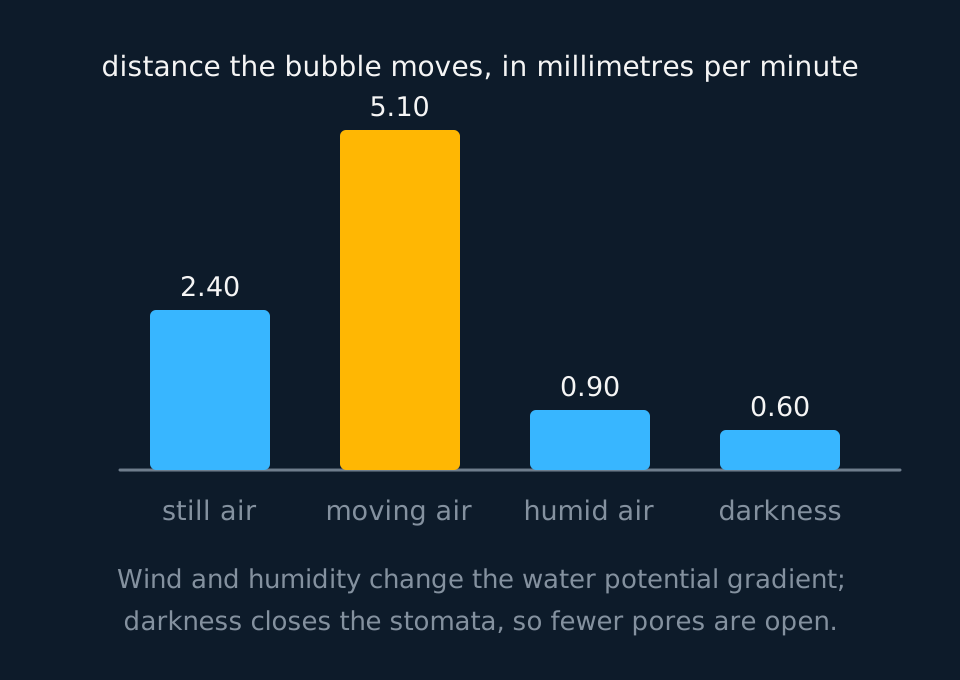
The practical is a potometer with one condition changed at a time. The readings below are idealised so that the arithmetic is readable. Real class results differ: shoots have different leaf areas, bubbles stick, and repeats from one bench vary by ten or twenty per cent, which is why repeats are taken and means compared rather than single readings.
Describe the drawing
A bar chart of four potometer results with the rate printed above each bar: still air at two point four, moving air at five point one drawn in amber as the tallest, humid air at zero point nine and darkness at zero point six, all in millimetres of bubble travel per minute. A note beneath explains that wind and humidity act on the water potential gradient while darkness closes the stomata.
| Factor | Effect on rate | Because |
|---|---|---|
| Light intensity up | Faster | Stomata open in the light for photosynthesis, so more pores are available for diffusion; the rate levels off once they are all open |
| Temperature up | Faster | Molecules have more kinetic energy, so evaporation from the walls is faster and diffusion is faster; warmer air can also hold more vapour, so if the moisture in the air stays the same the relative humidity falls and the gradient steepens |
| Humidity up | Slower | The air outside is closer in water potential to the saturated air inside the leaf, so the gradient across the stoma is shallower |
| Air movement up | Faster | Wind sweeps away the humid boundary layer clinging to the leaf surface, so the steep part of the gradient is restored |
Humidity is the factor most often explained badly, and a number fixes it. Air at 20 °C and 50 per cent relative humidity has a water potential of about −94 000 kPa. At 95 per cent relative humidity it is about −7000 kPa. Leaf mesophyll might be at −1500 kPa. Even very humid air is drier than the inside of a leaf, so transpiration does not stop in a greenhouse. It slows, because the gradient has gone from enormous to merely large.
The boundary layer deserves the same treatment. Still air next to a leaf becomes saturated with the vapour coming out of it, and that saturated layer, not the room, is what the leaf's interior is actually exchanging with. Hairs on a leaf surface hold that layer in place; a fan strips it away. This is why wind has such a large effect and why xerophytes are hairy.
Comparing two conditions properly
Using the readings in the figure: the bubble moved 24 mm in 10 minutes in still air and 51 mm in 10 minutes with a fan running. The capillary tube has an internal diameter of 1.0 mm. Calculate the rate of water uptake in each condition in mm³ min⁻¹, and the percentage increase caused by the fan.
Show the working
Rates first: 24 ÷ 10 = 2.4 mm min⁻¹ and 51 ÷ 10 = 5.1 mm min⁻¹ of bubble travel.
Cross-sectional area = πr² = π × 0.50² = 0.785 mm². So still air gives 0.785 × 2.4 = 1.9 mm³ min⁻¹ and moving air gives 0.785 × 5.1 = 4.0 mm³ min⁻¹.
Percentage increase = (5.1 − 2.4) ÷ 2.4 × 100 = 112.5%, or 110% to two significant figures: the rate slightly more than doubled.
Note what the percentage is calculated from. It is the change divided by the original, not by the new value, and the original here is the control condition. Working in bubble distance rather than volume gives the same percentage, because the conversion factor cancels, which is a useful check and a legitimate shortcut if the question only wants the comparison.
How guard cells open a stoma
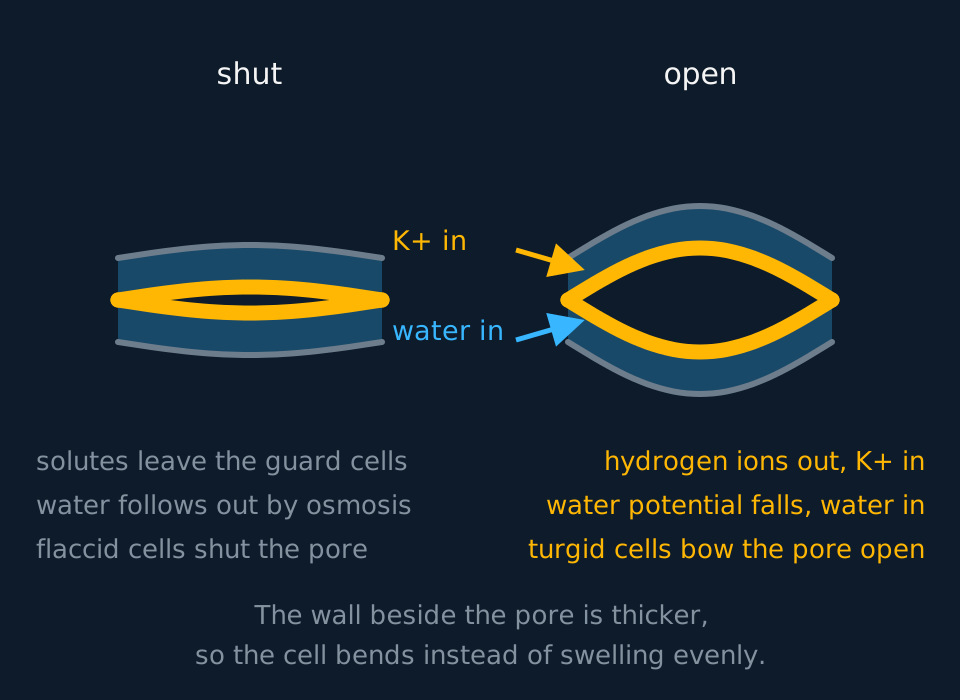
A stoma is a gap between two guard cells, and it opens because the cells change shape. The sequence below is a chain of causes; give the whole chain rather than only its outcome.
Describe the drawing
Two pairs of guard cells side by side. On the left the pair is almost straight and the slit between them is nearly shut. On the right the two cells bow away from each other, leaving a wide open pore, with arrows showing potassium ions and water entering. In both pairs the wall facing the pore is drawn much thicker than the outer wall. Notes beneath list the events on each side.
In the light, and when carbon dioxide in the air spaces runs low, ATP from the guard cell's own chloroplasts and mitochondria drives proton pumps in its plasma membrane. Hydrogen ions are pumped out. That leaves the inside of the cell electrically negative relative to the outside, and potassium ions move in through channel proteins down the electrical gradient. Chloride ions follow, and stored starch is converted to malate, adding more solute still.
The consequences are osmotic and mechanical in turn. More solute means a lower solute potential, so a lower water potential; water enters from the neighbouring epidermal cells by osmosis; the guard cells become turgid. Now the wall does the rest. The wall on the side facing the pore is thicker and less elastic than the outer wall, and the cellulose microfibrils are wound in hoops around the cell, so it can lengthen but cannot fatten. A turgid guard cell therefore bows away from its partner, and the pore opens.
Recorded over a whole day, stomatal aperture follows a pattern. In most plants the stomata begin to open before dawn, reach their widest during the morning, narrow somewhat through the hottest part of the afternoon and close towards dusk. Aperture is not simply tracking light intensity: the pores are already opening in the dark, an hour or so before the sun comes up.
The experiment that distinguishes an internal rhythm from a response to light is the standard test for any biological rhythm. Take a plant that has been kept in a normal day and night cycle and move it into constant conditions: dim, unchanging light, a constant temperature and a constant humidity, with nothing left to tell it what time it is. The stomata go on opening and closing anyway, on a cycle of about twenty-four hours, for several days before the swing gradually damps out.
That result rules out the simple explanation. If opening were only a response to light, removing the light changes would stop the cycle at once, and it does not. The timing is generated inside the plant, by an internal clock, and the daily light and dark cycle acts as a cue that keeps that clock set to local time rather than as the cause of each opening. A rhythm that persists in constant conditions with a period near a day is a circadian rhythm, and stomatal movement is one of the oldest known examples.
The selective advantage can be stated. A pore that opened only in response to light would open some minutes after photosynthesis could have begun, and those are the minutes when the air is coolest and most humid, so water loss per unit of carbon dioxide admitted is lowest. Opening in advance of dawn gives full aperture at first light, and closing in advance of the afternoon reduces water loss under the most evaporative conditions. The internal clock sets the background aperture, which light, carbon dioxide concentration and abscisic acid then modify.
- Circadian rhythm
- A biological rhythm with a period of about twenty-four hours that continues in constant conditions, showing that it is generated by an internal clock rather than by the daily change in the environment.
Closing runs the same chain backwards, and the plant can force it. Under water stress the roots and leaves produce abscisic acid, which is carried to the guard cells and binds specific receptors there. Mark schemes credit this as binding to receptors on the guard-cell membrane. The main receptors are in fact in the cytoplasm, so the hormone does get into the cell, but it does not act on the ion channels itself. Something has to carry the message on, and one of the messengers is calcium.
Binding the receptor causes the concentration of calcium ions in the cytoplasm to rise, within seconds and by a large factor. Some of the calcium enters through channels in the plasma membrane, from the wall space outside, and some is released from stores inside the cell, chiefly the vacuole. That raised cytosolic calcium concentration is the signal that opens the anion channels. Calcium ions are therefore acting as a second messenger, in exactly the sense the hormone lessons use the term. The hormone is the first message; a small ion whose concentration can be changed quickly is the second, and it is the one that reaches the channels.
The remaining steps are the opening sequence in reverse. The anion channels open and chloride and malate leave the cell. Losing negative charge makes the inside of the cell less negative, which opens potassium channels, and potassium leaves too. With the solutes gone the water potential of the guard cell rises, water leaves by osmosis, the cells go flaccid and the stoma shuts, often within minutes and regardless of how bright the light is. Guard cells have no plasmodesmata joining them to their neighbours, which is what lets them be controlled osmotically as an isolated pair.
- Abscisic acid
- A plant hormone produced under water stress that binds a receptor on the guard cell membrane and brings about stomatal closure.
- Second messenger
- A substance inside a cell whose concentration changes when a hormone binds a receptor on the outside, carrying the signal onwards; calcium ions do this job in the guard cell.
Where this is examined varies. CAIE 9700 asks for the guard-cell mechanism, the daily rhythm and abscisic acid, with calcium as the second messenger, in 14.2 (homeostasis in plants), not in its transport topic; OCR A examines abscisic acid under plant responses. It is the same chain of events either way, so learn it once.
Xerophyte and hydrophyte adaptations
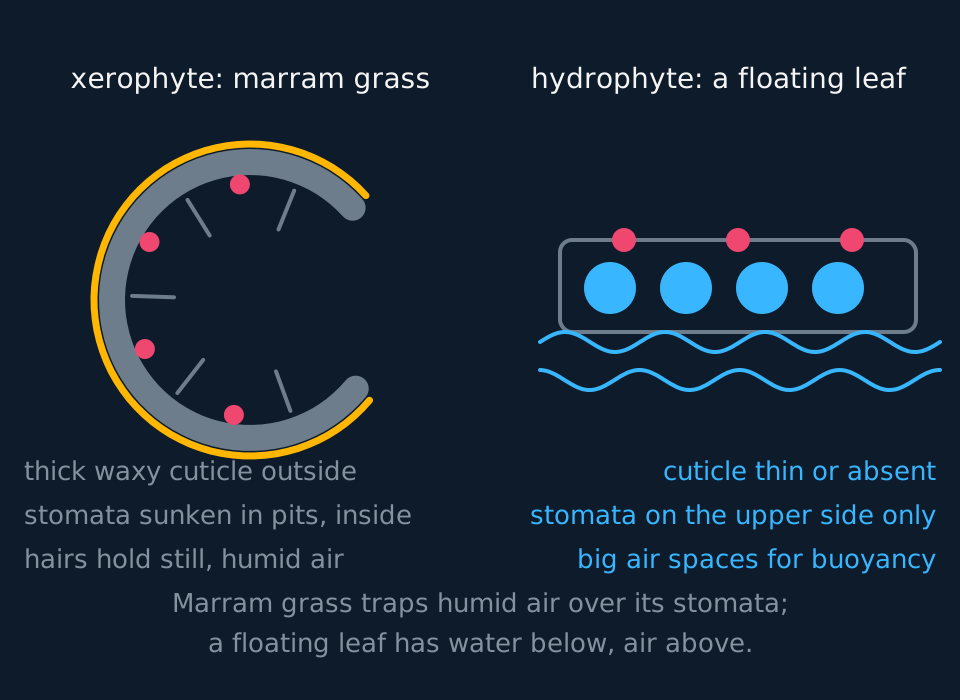
Each xerophyte adaptation reduces the water-potential gradient out of the leaf, lengthens the diffusion path, or reduces the number of stomata through which water vapour can leave.
Describe the drawing
Two leaves in cross section. On the left a marram grass leaf rolled into an almost closed cylinder, its outer surface carrying a thick cuticle drawn in amber, with stomata marked as coral dots on the inner face and hairs projecting into the enclosed space. On the right a floating leaf lying on a wavy water surface, with stomata marked only along its upper edge and large circular air spaces inside. Notes beneath list the adaptations of each.
| Adaptation | How it slows water loss |
|---|---|
| Thick waxy cuticle | Cuticle is very nearly impermeable, so little evaporates through the epidermis itself |
| Stomata sunken in pits | The pit traps humid air outside the pore, so the gradient across the stoma is shallower |
| Hairs on the epidermis | They hold a still, humid boundary layer against the surface even when the wind blows |
| Rolled leaf, as in marram grass | The stomata end up enclosed inside the roll, in air that quickly becomes saturated |
| Leaves reduced to spines or needles | Less surface area from which to lose water |
| Stomata open only at night | Carbon dioxide is fixed into malate in the dark and released to the Calvin cycle by day, so the pores are shut when evaporation is fastest |
A hydrophyte such as the water lily has the opposite problem: water is never short, so it does without these defences. A floating leaf has water under it and air above, so its stomata sit on the upper surface, the reverse of an ordinary leaf, and a favourite one-mark question. The cuticle is thin or missing, there is little lignified tissue because the water provides support, and large air spaces called aerenchyma give buoyancy and carry oxygen down to roots sitting in anaerobic mud. OCR A names hydrophytes alongside xerophytes; AQA and CAIE concentrate on the xerophyte side.
TRY IT: Explaining an adaptation, not listing it
Marram grass grows on sand dunes, where water drains away within minutes of rain and the wind rarely stops. Its leaves roll into a tube with the stomata on the inside, and the inner surface carries dense hairs. Explain how these two features reduce water loss. (4 marks)
Check your answer
Rolling encloses the stomata in a small volume of trapped air. Water vapour diffusing out of the stomata quickly saturates that air, so its water potential rises towards the water potential inside the leaf.
The water potential gradient between the leaf air spaces and the air just outside the pore is therefore shallower, so the rate of diffusion out of the stomata falls.
The hairs hold that humid air still. Without them, air moving over the surface would sweep the saturated layer away and restore the steep gradient, which is exactly what wind does to an unprotected leaf.
The rolled tube also keeps the stomata out of the moving air altogether, so the boundary layer survives even in the near-constant wind on a dune.
Do not stop at 'traps water vapour'. State the effect on the gradient: trapped vapour raises the water potential outside the stoma, and a shallower gradient gives slower diffusion.
In the exam
- For humidity, air movement and temperature, state what happens to the water potential gradient between the leaf air spaces and the air outside, then state the effect on the rate of diffusion. For light, state what happens to stomatal aperture instead.
- Evaporation and diffusion are two different steps. Temperature speeds up both; humidity and wind act only on the second.
- For guard cells, give the chain in order: protons out, potassium in, water potential falls, water in by osmosis, cell becomes turgid, thicker inner wall makes the cell curve outwards. Include the intermediate steps rather than only the turgor and the outcome.
- State which surface. Stomata are usually on the lower epidermis; a floating hydrophyte leaf has them on the upper surface.
- Name the plant: 'marram grass rolls its leaves' is more precise than 'some plants roll their leaves', and the named examples in the specification are the ones to learn.
- Quote the constant-conditions experiment as the evidence that stomatal opening is a rhythm. The cycle continues for several days with light, temperature and humidity held steady, which a simple response to light could not do.
- For abscisic acid, include the intermediate steps: the hormone binds a receptor of the guard cell (on its membrane, in mark-scheme terms), cytosolic calcium concentration rises, and the raised calcium opens the anion channels.
- In an evaluation, state what was controlled. Temperature, humidity, light and air movement all affect the rate, so a potometer investigation of one of them is valid only if the other three were held constant.
Check yourself
A student measures water uptake by a leafy shoot in a potometer. She records 2.4 mm min⁻¹ of bubble travel in still air at 20 °C, and 0.9 mm min⁻¹ after sealing a clear plastic bag loosely around the shoot. She concludes that the bag 'stopped the plant transpiring'. Evaluate her conclusion and explain the result.
Answer
The conclusion is wrong on two counts. The rate fell to 0.9 mm min⁻¹, which is a reduction of 62.5%, not a stop. The shoot went on taking up water throughout.
And the potometer was measuring uptake, not transpiration, so no reading it produces can be described directly as a transpiration rate.
The explanation is the gradient. Water vapour leaving the leaves accumulated inside the bag, so the humidity of the air around the shoot rose and its water potential rose with it, towards the water potential of the saturated air inside the leaf. A shallower gradient across the stomata means slower diffusion out, so less water is lost and less is drawn in to replace it.
It does not fall to zero because the air in the bag never quite reaches saturation, and even air at 95% relative humidity sits far below the leaf in water potential.
A fair criticism of the method: the bag also cut the light reaching the leaves slightly and raised the temperature inside it, so humidity was not the only variable that changed. A better design would humidify the air around an unbagged shoot instead.
Questions
Question 15 marks
In a potometer investigation the bubble travelled 18 mm in 10 minutes in still air and 47 mm in 10 minutes with a fan running. The capillary tube has an internal diameter of 1.0 mm. Calculate the rate of water uptake in moving air in mm³ min⁻¹, and calculate the percentage increase in the rate of bubble travel caused by the fan.
Mark scheme
- M1 cross-sectional area = πr² = π × 0.50² = 0.785 mm²
- M1 rate of bubble travel in moving air = 47 ÷ 10 = 4.7 mm min⁻¹
- A1 rate of water uptake = 0.785 × 4.7 = 3.7 mm³ min⁻¹
- M1 percentage increase = (47 − 18) ÷ 18 × 100, dividing the change by the original still-air value
- A1 160 per cent to two significant figures, accepting 161
Question 25 marks
Explain how a guard cell opens a stoma in bright light, beginning with the proton pump in its plasma membrane.
Mark scheme
- B1 ATP drives proton pumps that move hydrogen ions out of the guard cell across its plasma membrane
- B1 the inside of the cell becomes electrically negative relative to the outside, so potassium ions enter through channel proteins down the electrical gradient
- B1 chloride ions follow and stored starch is converted to malate, adding further solute to the guard cell
- B1 the extra solute lowers the water potential of the guard cell, so water enters from the neighbouring epidermal cells by osmosis and the cell becomes turgid
- A1 the wall facing the pore is thicker and less elastic and the cellulose microfibrils are wound in hoops, so the turgid cell lengthens by bowing away from its partner and the pore opens
Question 34 marks
Explain why moving air over a leaf raises the rate of transpiration while raising the humidity of the air lowers it.
Mark scheme
- B1 water vapour leaving the stomata saturates a boundary layer of still air held against the leaf surface
- B1 moving air sweeps that saturated layer away, so the air just outside the pore has a much lower water potential and the steep part of the gradient is restored
- B1 raising the humidity raises the water potential of the air outside the leaf, towards that of the saturated air in the leaf air spaces
- A1 the water potential gradient across the stoma is therefore shallower, so water vapour diffuses out more slowly
Question 44 marks
A plant kept in a normal cycle of day and night is moved into constant dim light at a constant temperature and humidity. Its stomata continue to open and close on a cycle of about twenty-four hours for several days. Explain what this result shows about the control of stomatal opening, and explain why opening before dawn is useful to the plant.
Mark scheme
- B1 the environmental cues have been held constant, so nothing outside the plant is changing to drive the cycle, yet the cycle continues
- B1 the timing must therefore be generated inside the plant, by an internal clock, so this is a circadian rhythm rather than a simple response to light
- B1 the daily change in light normally acts as a cue that keeps that clock set to local time, which is why the rhythm eventually damps out once the cue is removed
- A1 opening in anticipation means the pores are already wide when light arrives, so carbon dioxide is available for photosynthesis from first light rather than some minutes later, and at a time of day when the air is cool and humid so relatively little water is lost
Question 54 marks
Abscisic acid is produced when a plant is short of water. Describe how it brings about the closure of a stoma, naming the second messenger involved.
Mark scheme
- B1 abscisic acid binds to specific receptors of the guard cell; accept receptors on the guard-cell plasma membrane
- B1 the concentration of calcium ions in the cytoplasm rises, some entering through channels in the plasma membrane and some released from the vacuole, so calcium ions are acting as the second messenger
- B1 the raised calcium concentration opens anion channels, so chloride and malate leave the cell, which makes the inside less negative and opens potassium channels so potassium leaves too
- A1 with the solutes gone the water potential of the guard cells rises, water leaves by osmosis, the cells become flaccid and the pore closes
Question 63 marks
Compare the effect of a rise in temperature on the rate of transpiration with the effect of a rise in humidity.
Mark scheme
- B1 a rise in temperature raises the rate whereas a rise in humidity lowers it
- B1 temperature acts on both steps, since molecules gain kinetic energy so evaporation from the mesophyll walls and diffusion out of the stomata are both faster, whereas humidity acts only on the diffusion step
- A1 warmer air also holds more vapour, so the air outside is further from saturation and the gradient steepens, while raising the humidity brings the water potential outside closer to that inside the leaf and makes the gradient shallower
Question 73 marks
A water lily has leaves that float on the surface of a pond, with their stomata on the upper surface rather than the lower. Suggest why the stomata are on that surface, and suggest one other feature you would expect such a leaf to show.
Mark scheme
- B1 the lower surface of a floating leaf is in contact with water, so gases could not diffuse in or out through stomata placed there
- B1 stomata on the upper surface are in contact with the air, so carbon dioxide can diffuse in and oxygen and water vapour can diffuse out
- B1 any one further feature with a reason: a thin or absent cuticle since water loss is not a threat, little lignified tissue since the water supports the leaf, or large air spaces called aerenchyma giving buoyancy and carrying oxygen down to roots in anaerobic mud
Question 83 marks
The capillary tube of the potometer has a cross-sectional area of 1.0 mm². Calculate the rate of water uptake at a wind speed of 2.0 m s⁻¹, in mm³ min⁻¹.
| Wind speed / m s⁻¹ | Distance moved by the meniscus in 10 min / mm |
|---|---|
| 0.0 | 24 |
| 1.0 | 36 |
| 2.0 | 48 |
| 3.0 | 54 |
Mark scheme
- M1 volume taken up = distance moved × cross-sectional area = 48 × 1.0
- M1 rate = volume ÷ time = 48 ÷ 10
- A1 4.8 mm³ min⁻¹, with the unit
Question 93 marks
The distance moved rises with wind speed but by less at the highest speed. Explain why moving air increases the rate, and explain why the increase gets smaller.
| Wind speed / m s⁻¹ | Distance moved by the meniscus in 10 min / mm | Increase on the row above / mm |
|---|---|---|
| 0.0 | 24 | no earlier row |
| 1.0 | 36 | 12 |
| 2.0 | 48 | 12 |
| 3.0 | 54 | 6 |
Mark scheme
- B1 moving air removes the layer of humid air held at the leaf surface, so the water potential gradient between the air spaces and the outside air is steeper
- B1 water vapour therefore diffuses out through the open stomata faster, and more water is drawn up the xylem to replace it
- B1 once the humid layer has been largely stripped away, more wind thins it only a little further, so the gradient steepens less and diffusion through the stomatal pores becomes what limits the rate; accept that the stomata begin to close as the shoot loses water faster than the cut stem can replace it
Question 103 marks
Explain why an increase in light intensity increases the rate of transpiration, up to a point beyond which further increases in light intensity have little additional effect.
Mark scheme
- B1 stomata open wider in the light, because photosynthesis needs a supply of carbon dioxide, and a greater aperture gives a larger area available for the diffusion of water vapour out of the leaf
- B1 once the stomata are fully open, no further increase in light intensity can open them any wider, so the rate of transpiration levels off
- B1 the effect of light on transpiration is therefore indirect, acting through stomatal aperture rather than directly on evaporation or diffusion
Question 113 marks
A xerophyte has its stomata sunk into pits in the leaf surface, each pit lined with hairs. Explain how each of these two features reduces the rate of water loss.
Mark scheme
- B1 a sunken pit traps a pocket of humid air immediately outside the pore, raising the water potential of the air the stoma is exchanging with and making the gradient across the stoma shallower
- B1 hairs lining the pit hold that trapped humid air in place, stopping wind from sweeping it away and restoring a steep gradient
- B1 together the two features keep the boundary layer both humid and still, which a stoma on a flat, exposed leaf surface could not do
Question 123 marks
Explain why transpiration is an unavoidable consequence of gas exchange in a photosynthesising leaf, rather than a process that benefits the plant in its own right.
Mark scheme
- B1 a leaf must keep its stomata open to let carbon dioxide diffuse in for photosynthesis
- B1 the same open stomata, leading to air spaces saturated with water vapour, inevitably also let water vapour diffuse out, since both movements use the same pores
- B1 water loss is therefore a side effect of the stomata being open for carbon dioxide, not something the plant does deliberately, which is why the stomata close, and reduce photosynthesis, when water is in short supply
Question 133 marks
A succulent desert plant opens its stomata only at night and fixes carbon dioxide into malate in the dark, releasing it to the Calvin cycle during the day. Suggest why opening the stomata at night, rather than during the day, reduces the plant's water loss.
Mark scheme
- B1 night air is cooler and more humid than daytime air, so the water potential gradient between the leaf air spaces and the outside air is shallower at night
- B1 a shallower gradient means a slower rate of diffusion of water vapour out of the stomata for a given aperture
- B1 the plant can therefore take in the carbon dioxide it needs for the day's photosynthesis while losing much less water than it would opening its stomata under the hotter, drier conditions of the day
Question 142 marks
State the two steps by which water is lost from a leaf during transpiration, in the order in which they occur.
Mark scheme
- B1 water evaporates from the wet cellulose walls of the mesophyll cells into the air spaces of the leaf
- B1 water vapour then diffuses out through the open stomata down a water potential gradient
Question 152 marks
State the approximate percentage of the water a plant absorbs that is lost again by transpiration, and state what happens to the stomata, and to photosynthesis, when water is short.
Mark scheme
- B1 between 95 and 99 per cent of the water absorbed is lost through transpiration
- B1 the stomata close, which reduces water loss but also reduces carbon dioxide uptake and so the rate of photosynthesis
Worth remembering
- Transpiration is an unavoidable consequence of opening stomata for carbon-dioxide uptake. It also contributes to water and mineral transport, turgor and leaf cooling.
- Evaporation from the mesophyll walls, then diffusion out of the stomata: two steps, and factors act on one or the other.
- Light and temperature raise the rate; humidity lowers it; wind raises it by removing the boundary layer.
- Protons out, potassium in, water in, turgid, thicker inner wall bows the cell and the pore opens.
- Stomatal opening is a circadian rhythm: it keeps its roughly daily cycle in constant conditions, so an internal clock sets it; light resets the clock and also opens stomata directly.
- Abscisic acid closes stomata under water stress, independently of light intensity.
- Abscisic acid binds a receptor, cytosolic calcium rises, and the calcium is the second messenger that opens the anion channels.
- Xerophyte adaptations reduce the gradient or the number of stomata; a floating hydrophyte leaf has stomata on its upper surface.
CHECK YOUR PROGRESS
Rate how confident you are with each objective for this lesson. Ratings are saved in this browser, on this device, unless you sign in.
- Define transpiration and explain why a photosynthesising plant cannot avoid it.
- Predict and explain the effect of light, temperature, humidity and air movement on the rate, saying whether each acts through the water potential gradient or through stomatal aperture.
- Describe how a guard cell opens a stoma, from the proton pump to the turgor.
- Explain why the daily cycle of stomatal opening is called a rhythm rather than a response, using the result of keeping a plant in constant conditions.
- Describe how abscisic acid closes a stoma, naming calcium ions as the second messenger that opens the anion channels.
- Explain why the shape and wall thickness of a guard cell turn turgor into an open pore rather than a fatter cell.
- Account for xerophyte and hydrophyte adaptations by saying what each does to the water potential gradient.
- Process potometer data: calculate rates, compare conditions and state what was controlled.
Open the full revision checklist to see every objective in the curriculum in one place.
Practise this lesson
WORKBOOK
The written questions from this topic, on paper with room to work, and a separate book of mark schemes. The 2 questions that are set on a diagram stay on this page, where the diagram can be drawn. Free to use; please do not redistribute or sell.