Biology › Membranes and transport across cells › Diffusion and osmosis
Diffusion and osmosis
Simple diffusion, facilitated diffusion and osmosis are passive processes. Net movement occurs down a concentration or electrochemical gradient; osmosis is the net movement of water from higher to lower water potential through a partially permeable membrane.
Before this The fluid mosaic model and the hydrophobic core · Surface area to volume ratio
COMMON MISCONCEPTION
Osmosis is the movement of water from a region of high concentration to a region of low concentration.
Osmosis is the net movement of water from higher water potential to lower water potential through a partially permeable membrane. A concentration statement alone is insufficient because pressure also contributes to water potential.
What you should be able to do
- Define simple and facilitated diffusion and say what distinguishes them.
- State how rate of diffusion depends on surface area, concentration difference and thickness, and apply that to a named exchange surface.
- Define osmosis using water potential, and use the relationship between water potential, solute potential and pressure potential.
- Explain what happens to a plant cell and to an animal cell placed in a solution of lower water potential than their contents.
- Describe how a dilution series of sucrose is used to find the water potential of potato tissue.
- Describe how Visking tubing and agar model diffusion and osmosis, and how agar blocks of different sizes show what surface area to volume ratio does to exchange.
Diffusion and the three factors affecting its rate
Molecules and ions in a liquid or gas are in constant random motion. Movement of any individual particle is undirected, but where the concentration is higher on one side than the other, more particles cross from the higher-concentration side than in the reverse direction. The net result is movement down the concentration gradient until the gradient is abolished. That is diffusion, and it requires no energy from the cell: the kinetic energy of the particles themselves drives it.
- Diffusion
- The net movement of particles from a region of higher concentration to a region of lower concentration, down a concentration gradient, as a result of their random motion.
- Simple diffusion
- Diffusion directly through the phospholipid bilayer, available to small non-polar molecules such as oxygen and carbon dioxide.
- Passive
- Requiring no energy from ATP; driven by the kinetic energy of the particles themselves.
Three quantities set the rate, combined in a single relationship that should be quoted and applied.
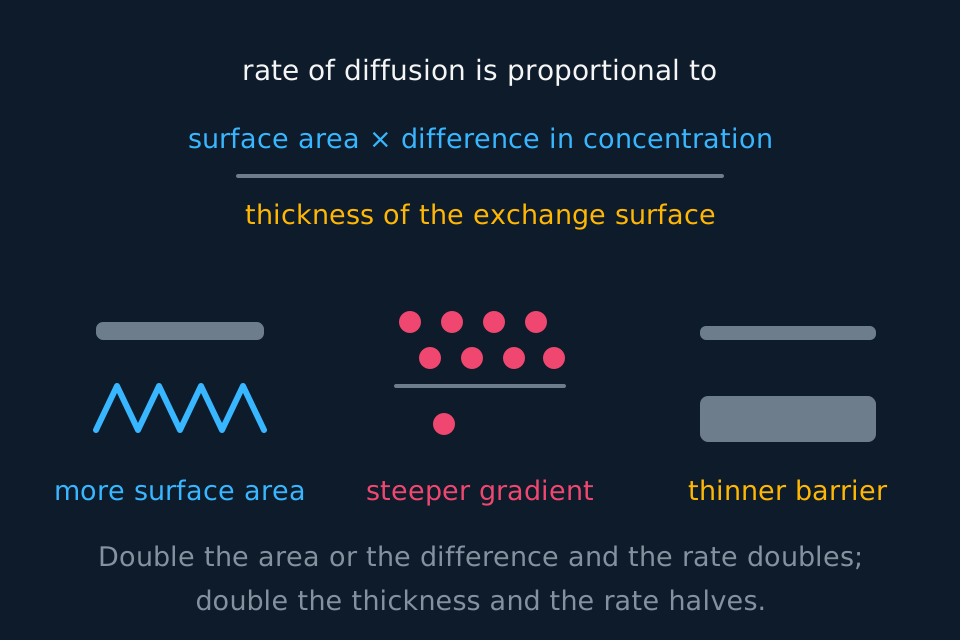
rate of diffusion ∝ (surface area × difference in concentration) ÷ thickness of the exchange surfaceOften called Fick's law. The first two multiply the rate; the third divides it.
Describe the drawing
The relationship written as a fraction across the top, with surface area multiplied by difference in concentration above the line and thickness of the exchange surface below it. Three sketches sit underneath. On the left a flat bar is compared with a folded zigzag of the same width, giving more surface. In the middle eight particles are packed above a barrier and one sits below it. On the right a thin bar is compared with a bar several times thicker.
Gas exchange surfaces are adapted for each of the three terms. Human lungs hold roughly 70 m² of alveolar surface, which addresses the first term. The barrier between alveolar air and blood is around 0.3 µm thick, being one flattened epithelial cell and one capillary endothelial cell, which addresses the third. Ventilation and continuous blood flow replace the air and the blood on either side, which maintains the second, since a gradient allowed to equalise no longer drives net movement.
Applying the whole relationship
A section of gut has a surface area of 4 arbitrary units and an epithelium 2 units thick. In a second species the same section has 12 units of surface area and an epithelium 3 units thick. Assuming the same concentration difference, how do the rates compare?
Show the working
Take the rate as proportional to area divided by thickness. For the first species that is 4 ÷ 2 = 2. For the second, 12 ÷ 3 = 4.
The second species absorbs at twice the rate, even though its epithelium is thicker. Three times the surface area more than compensates for one and a half times the thickness.
Use all three terms of the expression. Considering the thicker epithelium alone gives the wrong direction, because the change in surface area is the larger effect.
Facilitated diffusion is still diffusion
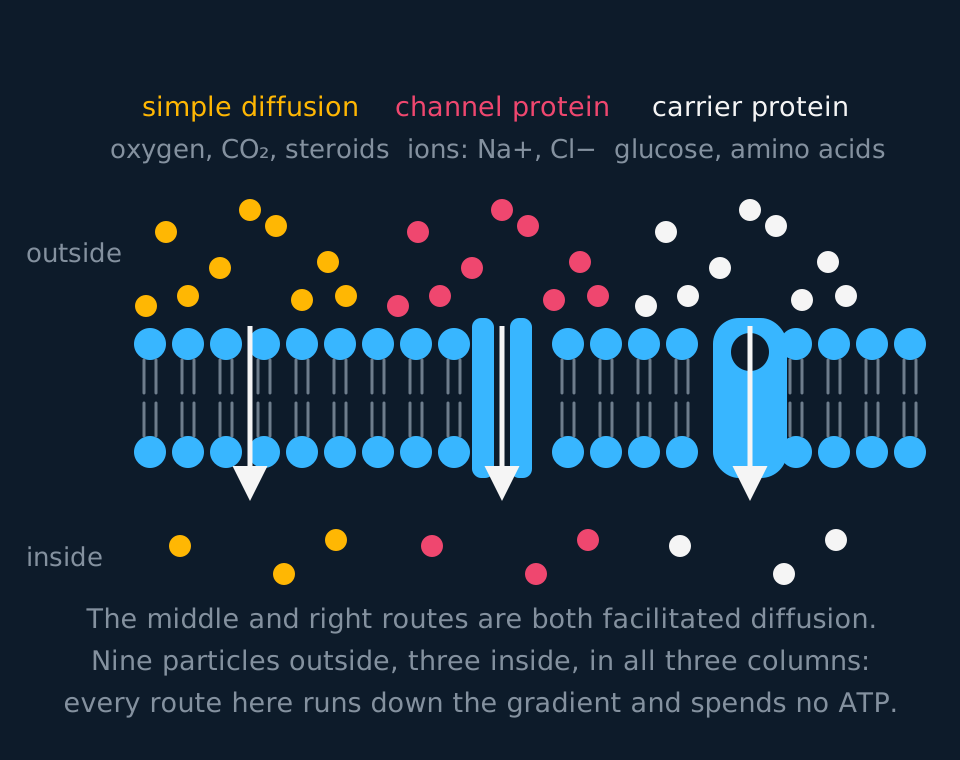
Ions and larger polar molecules cannot cross the hydrophobic core on their own. They cross through proteins instead: through a channel protein, which is a hydrophilic pore, or on a carrier protein, which binds the molecule, changes shape and releases it on the other side. In both cases the substance moves down its gradient and the cell expends no ATP. For an uncharged molecule that gradient is the concentration gradient; for an ion, charge counts as well, and the ion moves down the combined electrochemical gradient, concentration and electrical attraction taken together.
Describe the drawing
One membrane drawn across the width of the figure with three routes through it side by side. In each column nine particles are scattered above the membrane and only three below, and a long arrow points from the crowded side to the empty one. The left route passes straight between the phospholipids, the middle route passes through the gap in a two-walled channel protein, and the right route passes through a carrier protein with a binding site cut into it.
Because the protein routes are finite in number, facilitated diffusion differs from simple diffusion at high concentration gradients. Raising the concentration gradient increases the rate of simple diffusion roughly in proportion. Facilitated diffusion also increases, but to a maximum. Carrier proteins show this clearly: each binding and conformational change takes time, so the rate levels off once all carriers are occupied, however steep the gradient becomes. Channels pass ions rapidly enough that over the ranges most experiments cover they behave almost like simple diffusion, although they too have a maximum throughput. A plateau in such a graph indicates that a protein, usually a carrier, is involved.
| Simple diffusion | Facilitated diffusion | |
|---|---|---|
| Route | Between the phospholipids | Through a channel or on a carrier protein |
| Substances | Small, non-polar: O₂, CO₂, steroids | Charged or large polar: Na⁺, K⁺, glucose, amino acids |
| Direction | Down the gradient | Down the gradient |
| ATP | None | None |
| At high gradient | Rate keeps rising | Rate plateaus as the proteins reach capacity, most sharply for carriers |
The presence of a channel or carrier protein does not make transport active. Facilitated diffusion uses a membrane protein but does not require ATP because the substance moves down its electrochemical gradient.
Osmosis and water potential
Water crosses membranes constantly, some of it through the bilayer and much of it through channel proteins called aquaporins. The direction it moves is set by water potential, given the symbol ψ (the Greek letter psi) and measured in kilopascals.
- Water potential (ψ)
- The tendency of water molecules to move out of a solution, measured in kPa. Pure water at atmospheric pressure has a water potential of 0 kPa; adding solute makes the solute potential negative.
- Osmosis
- The net movement of water molecules from a solution of higher water potential to a solution of lower water potential, through a partially permeable membrane.
Two consequences follow. Pure water at atmospheric pressure is the zero point, so a solution at atmospheric pressure has a negative water potential, because adding solute makes the solute potential negative. The condition 'at atmospheric pressure' is required, because positive pressure potential raises the total water potential: a solution under sufficient pressure can have a water potential above zero.
The word 'higher' means less negative. Water moves from −400 kPa to −1200 kPa, because −400 is the higher of the two. Handle the negative signs carefully when comparing values.
Adding solute lowers water potential because water molecules associate with the dissolved particles and are less free to leave. A 1.0 mol dm⁻³ sucrose solution has a water potential of about −3500 kPa; 0.2 mol dm⁻³ is around −540 kPa. Human blood plasma is roughly −800 kPa, and red blood cells remain intact at that value.
In a cell, two separate things affect water potential and they are added together.
ψ = ψs + ψpWater potential = solute potential + pressure potential. Pearson Edexcel Biology B writes it as ψ = P + π, turgor pressure plus osmotic potential. Solute potential is always negative; pressure potential in a living plant cell is zero or positive.
Solute potential (ψs, sometimes called osmotic potential) is the contribution from dissolved solutes, and it is negative in any real cell. Pressure potential (ψp) is the contribution from physical pressure. In a plant cell, water entering pushes the contents against the cellulose wall, the wall pushes back, and that push is a positive pressure potential that raises the cell's water potential back towards zero. An animal cell has no wall and therefore develops no significant pressure potential, which is why plant and animal cells respond differently to the same solution.
Plant cells and animal cells in solution
Describe the drawing
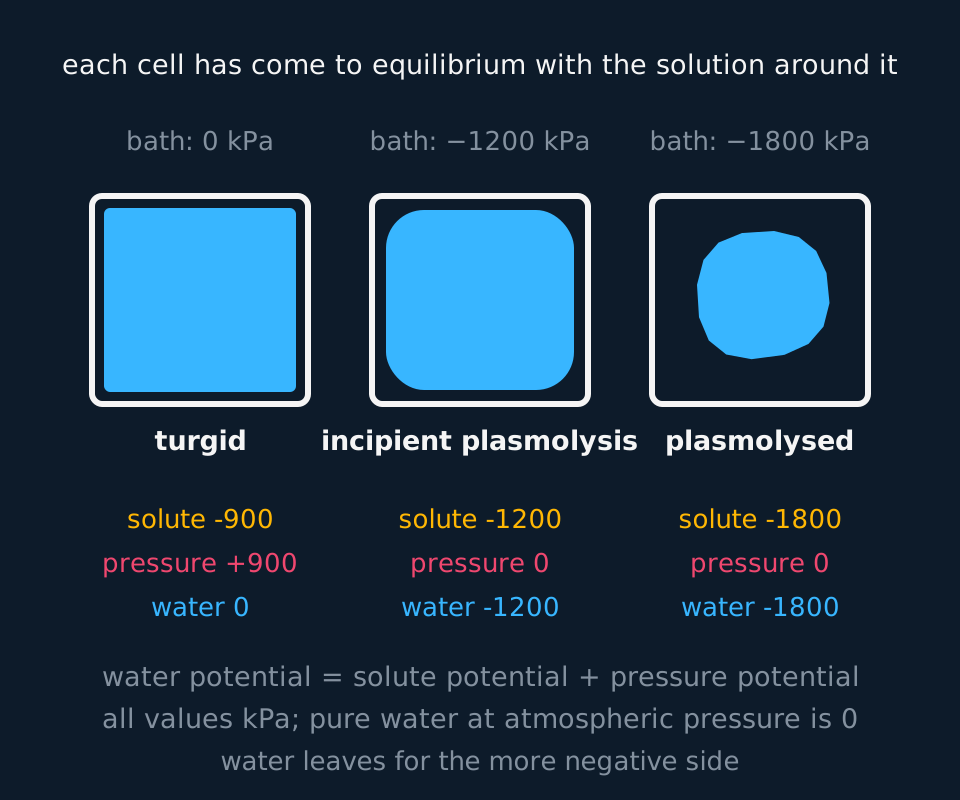
Three plant cells drawn side by side, each as a rigid rectangular wall with the living contents shaded inside it. The left cell is pressed hard against its wall and labelled turgid, the middle cell just fills the wall with no push left, and the right cell has shrunk into a rounded blob well clear of its wall. Under each cell three numbers in kilopascals give the solute potential, the pressure potential and their sum, which matches the bathing solution above.
Put a plant cell in pure water and water enters by osmosis. The contents swell against the wall, pressure potential climbs, and water keeps entering until the cell's water potential has risen to equal the water outside. The cell is now turgid. The wall is strong enough to prevent bursting, and the pressure generated is what supports a non-woody plant. Wilting occurs when cells lose that pressure potential.
Move that cell into a concentrated sucrose solution and the flow reverses. Water leaves, the contents shrink, and pressure potential falls. At the moment it reaches exactly zero the contents are just touching the wall but exerting no pressure on it. This is incipient plasmolysis, and at that point ψp = 0, so ψ = ψs. With further water loss the membrane pulls away from the wall altogether, leaving a gap the external solution fills. The cell is plasmolysed.
An animal cell has no wall, so neither outcome occurs. In a solution of higher water potential than its contents, distilled water for example, water enters, the membrane cannot resist the pressure, and the cell bursts. In a red blood cell this is haemolysis. In a solution of lower water potential, water leaves and the cell shrinks and puckers into a spiky shape: crenation. Blood plasma is maintained close to −800 kPa so that neither haemolysis nor crenation occurs in circulating red blood cells.
Plasmolysis, haemolysis and crenation can all be watched under a light microscope. Strips of red onion epidermis mounted in a series of sucrose solutions show plasmolysis, and the solution in which half the cells are plasmolysed is taken as the point of incipient plasmolysis, so its water potential estimates the solute potential of the cells. Animal blood from a supplier, diluted in a series of salt solutions, shows crenated cells in the strong solutions and fewer intact cells in the dilute ones as they burst.
| Solution | Plant cell | Animal cell |
|---|---|---|
| Higher ψ than the cell (e.g. pure water) | Water enters, cell becomes turgid, wall prevents bursting | Water enters, cell swells and bursts (haemolysis) |
| Same ψ as the cell | No net movement; turgor unchanged | No net movement; normal shape |
| Lower ψ than the cell (e.g. 1.0 mol dm⁻³ sucrose) | Water leaves, membrane pulls from wall (plasmolysis) | Water leaves, cell shrinks and crenates |
- Turgid
- A plant cell whose contents press against the wall, giving a positive pressure potential.
- Incipient plasmolysis
- The point at which the pressure potential of a plant cell has just fallen to zero, so its water potential equals its solute potential.
- Plasmolysis
- The pulling away of the cell surface membrane from the cell wall as water leaves a plant cell.
- Haemolysis
- The bursting of a red blood cell when water enters it by osmosis.
- Crenation
- The shrinking and puckering of an animal cell when water leaves it by osmosis.
Finding the water potential of potato tissue
A cell's water potential cannot be measured directly. The investigation uses a dilution series to identify the external solution that produces no net movement of water, since that solution has the same water potential as the cells.
Make sucrose solutions from a 1.0 mol dm⁻³ stock. A standard set is 0.8, 0.6, 0.4, 0.2 and 0.0 mol dm⁻³, each made by mixing a measured volume of stock with a measured volume of distilled water. Cut cylinders of potato with a cork borer, trim them to the same length, blot them dry and record the mass of each. Leave one cylinder in each solution for a fixed time, then blot and reweigh.
Work in percentage change in mass, not raw change. The cylinders start at slightly different masses, and a percentage removes that difference: percentage change = (change in mass ÷ initial mass) × 100. Plot it against sucrose concentration and draw a line of best fit. Where the line crosses zero, the cylinder neither gained nor lost water, so that solution's water potential equals the potato's. Read the concentration off, then convert it to a water potential: 0.1 mol dm⁻³ sucrose is about −260 kPa, 0.2 is −540, 0.3 is −820, 0.4 is −1120, 0.5 is −1450, 0.6 is −1800, 0.7 is −2180, 0.8 is −2580, 0.9 is −3000 and 1.0 is −3500 kPa.
TRY IT: Two cylinders, two directions
A potato cylinder in 0.2 mol dm⁻³ sucrose gains 6% of its mass. An identical cylinder in 0.8 mol dm⁻³ sucrose loses 11%. Using water potential, explain both results, and state what you can conclude about the water potential of the potato cells.
Check your answer
The 0.2 mol dm⁻³ solution has a water potential of about −540 kPa, which is higher, meaning less negative, than the water potential of the potato cells. Water therefore moved by osmosis from the solution into the cells, through their partially permeable membranes, and the cylinder gained mass.
The 0.8 mol dm⁻³ solution is about −2580 kPa, which is lower than the water potential of the cells. Water moved out of the cells into the solution, the vacuoles and cytoplasm lost volume, and the cylinder lost mass. The larger percentage change suggests a steeper water potential difference in this direction.
The water potential of the potato cells therefore lies between −540 kPa and −2580 kPa. A closer value requires the concentration at which the percentage change is zero, obtained by plotting all the points and reading the x-intercept.
Neither answer refers to the concentration of water. Both compare two water potentials, and the sign of the difference gives the direction of net movement.
Non-living models: Visking tubing and agar
A membrane is 7 nm thick and a cell a few micrometres across, so neither can be observed directly on a bench. Two non-living models make the processes visible at flask scale. Because neither model is alive, any movement observed is diffusion or osmosis alone: no carrier proteins, no active transport and no metabolism contribute to the result.
Visking tubing, also sold as dialysis tubing, is a cellulose membrane with pores that let water and small solutes through and hold back large molecules. It makes a workable model gut: fill a length with a mixture of starch and glucose solutions, seal it, rinse the outside, and suspend it in a boiling tube of water. Test that outer water at intervals and Benedict's solution turns positive while iodine stays orange-brown: glucose has crossed the membrane and starch has not, which is the reason digestion has to hydrolyse polymers before anything can be absorbed. The same tubing models osmosis: fill it with concentrated sucrose solution, fit a capillary tube through the bung, and stand it in water. Water enters by osmosis, down the water potential gradient and through the partially permeable membrane, and the level climbs the capillary; the steeper the gradient, the faster the climb.
Agar makes diffusion itself visible. Set the jelly with dilute sodium hydroxide and a few drops of phenolphthalein and it sets pink; drop a cube of it into dilute hydrochloric acid and the pink fades from the outside inwards as the acid diffuses in and neutralises the alkali. Timing how long the last of the colour takes to vanish measures how long diffusion needs to reach the centre.
Cutting cubes of different sizes extends the experiment. A 5 mm cube loses its colour in a couple of minutes; a 20 mm cube retains a pink core for much longer. The acid and the jelly are unchanged, so the difference is geometric: the small cube has the larger surface area to volume ratio, and no point inside it is far from a face. A 5 mm cube has 6 × 25 = 150 mm² of surface serving 125 mm³ of volume, a ratio of 1.2 mm⁻¹, while a 20 mm cube has 2,400 mm² serving 8,000 mm³, a ratio of 0.3 mm⁻¹. Diffusion alone supplies a small object and cannot supply a large one, which is why large organisms require exchange surfaces and transport systems.
State the model's limits when a question asks for them. Visking tubing has pores but no proteins, so it models simple diffusion and osmosis and nothing else: no facilitated diffusion, no active transport, no selectivity beyond size. That limits it as a model of a membrane, but it also means that anything crossing it did so by diffusion or osmosis alone.
- Visking tubing
- A partially permeable cellulose membrane, with pores that pass water and small solutes but not large molecules, used as a non-living model of a membrane.
In the exam
- Water moves from higher to lower water potential, and higher means less negative: −400 kPa is higher than −1200 kPa.
- Define osmosis with water potential and a partially permeable membrane. 'From high to low concentration of water' is not accepted where water potential is examined. Pearson Edexcel Biology A (Salters-Nuffield) does not require water potential; for that board, osmosis is the net movement of free water molecules from a higher to a lower concentration of free water molecules, through a partially permeable membrane.
- Pure water at atmospheric pressure has a water potential of 0 kPa. Adding solute makes the solute potential negative. A solution at atmospheric pressure therefore has a negative water potential, but positive pressure potential can raise the total water potential.
- Where two of ψ, ψs and ψp are given, calculate the third from ψ = ψs + ψp. Carry the negative signs through the arithmetic.
- State that facilitated diffusion requires no ATP, because the substance moves down its electrochemical gradient through a membrane protein.
- For the potato practical, use percentage change in mass and state the reason: the cylinders do not start at identical masses.
- When a rate-against-concentration graph plateaus, name the reason: all the carrier or channel proteins are occupied.
Check yourself
A plant cell has a solute potential of −1400 kPa and a pressure potential of +500 kPa. It is placed in a sucrose solution of water potential −1100 kPa. Calculate the cell's water potential, state the direction of net water movement, and explain what will happen to the cell's pressure potential as a result.
Answer
Water potential is solute potential plus pressure potential: ψ = −1400 + 500 = −900 kPa.
The cell is at −900 kPa and the solution is at −1100 kPa. The cell has the higher (less negative) water potential, so water moves by osmosis out of the cell into the solution, through the partially permeable cell surface membrane.
As water leaves, the volume of the cell contents falls, so they press less hard against the cellulose wall and the pressure potential drops below +500 kPa. The solute potential becomes slightly more negative too, since the same solutes are now dissolved in less water, but the fall in pressure potential is the larger effect.
Water continues to leave until the cell's water potential has fallen to −1100 kPa and matches the solution. If the pressure potential reaches zero before that happens, the cell is at incipient plasmolysis, and any further loss of water pulls the membrane away from the wall.
Questions
Question 14 marks
A potato cylinder of initial mass 4.20 g is left in a sucrose solution for thirty minutes, blotted dry and reweighed at 3.78 g. Calculate the percentage change in mass and state the direction of net water movement.
Mark scheme
- M1 change in mass = 3.78 − 4.20 = −0.42 g
- M1 percentage change = change in mass divided by initial mass, multiplied by one hundred: (−0.42 ÷ 4.20) × 100
- A1 −10.0 per cent, that is a loss of a tenth of the initial mass
- B1 water moved out of the cylinder into the solution, so the solution had the lower, more negative, water potential
Question 24 marks
Explain what happens to a red blood cell placed in distilled water, and what happens to an identical red blood cell placed in a concentrated sodium chloride solution.
Mark scheme
- B1 distilled water has a water potential of 0 kPa, which is higher, that is less negative, than the roughly −800 kPa of the cell contents; for Pearson Edexcel Biology A, accept a higher concentration of free water molecules in the distilled water than in the cell contents
- B1 water therefore enters by osmosis through the partially permeable cell surface membrane, and with no cell wall to resist the pressure the cell bursts, which is haemolysis
- B1 the concentrated sodium chloride solution has a lower, more negative, water potential than the cell contents, so water leaves the cell by osmosis; for Pearson Edexcel Biology A, accept a lower concentration of free water molecules in the solution than in the cell contents
- B1 the cell shrinks and puckers into a spiky shape, which is crenation
Question 34 marks
The uptake of glucose by red blood cells rises as the external glucose concentration rises and then levels off, while the uptake of oxygen by the same cells continues to rise across the whole range tested. Suggest an explanation for both results.
Mark scheme
- B1 glucose is a large polar molecule and cannot cross the hydrophobic core unaided, so it enters by facilitated diffusion through carrier proteins
- B1 the rate levels off once every carrier protein is occupied, so a steeper concentration gradient cannot raise it any further
- B1 oxygen is small and non-polar, so it dissolves in the bilayer and crosses by simple diffusion between the phospholipids
- B1 simple diffusion uses no proteins, so there is nothing to become saturated and the rate keeps rising with the concentration difference
Question 44 marks
A mammal's lungs have a gas-exchange surface area of 60 m² and a diffusion barrier 0.3 µm thick. A fish's gills have a surface area of 3 m² and a barrier 15 µm thick. Assuming the same concentration difference for both, calculate the value of area ÷ thickness for each, and calculate how many times greater the mammal's rate of diffusion would be than the fish's.
Mark scheme
- M1 for the mammal, area ÷ thickness = 60 ÷ 0.3 = 200
- A1 for the fish, area ÷ thickness = 3 ÷ 15 = 0.2
- M1 divide the mammal's value by the fish's: 200 ÷ 0.2
- A1 1000 times greater
Question 54 marks
Compare simple diffusion with facilitated diffusion, referring to the route taken, the substances each carries, and what happens to the rate at a very high concentration gradient.
Mark scheme
- B1 simple diffusion occurs directly between the phospholipids of the bilayer, whereas facilitated diffusion occurs through a channel or on a carrier protein
- B1 simple diffusion carries small non-polar molecules such as oxygen and carbon dioxide, whereas facilitated diffusion carries substances that cannot cross the bilayer unaided, such as ions and glucose
- B1 at a very high concentration gradient the rate of simple diffusion keeps rising roughly in proportion, whereas facilitated diffusion levels off once the available channels or carriers are saturated
- B1 neither process requires ATP, since both move a substance down its own gradient
Question 64 marks
A plant cell has a water potential of −300 kPa and a solute potential of −900 kPa. Calculate its pressure potential, and calculate its new pressure potential if, after further water uptake, its water potential rises to −50 kPa while its solute potential remains −900 kPa.
Mark scheme
- M1 rearrange ψ = ψs + ψp to give ψp = ψ − ψs, and substitute the first pair of values: −300 − (−900)
- A1 600 kPa, the pressure potential
- M1 substitute the second pair of values: −50 − (−900)
- A1 850 kPa, the new pressure potential
Question 74 marks
Two agar cubes set with the same alkali-phenolphthalein mixture are cut to different sizes, a 5 mm cube and a 20 mm cube, and both are placed in the same dilute acid at the same time. Suggest which cube loses its colour first, and suggest the reason in terms of surface area to volume ratio.
Mark scheme
- B1 the smaller, 5 mm cube loses its colour first
- B1 the smaller cube has a larger surface area to volume ratio than the larger cube, so relatively more of its volume is close to a face through which acid can diffuse in
- B1 no point inside the small cube is far from a surface, so acid reaches the centre sooner, whereas in the large cube the centre is much further from any face
- B1 the acid and the jelly are the same in both cases, so the only thing that differs between the two cubes is this geometric ratio
Question 84 marks
A nurse mistakenly infuses a patient with distilled water directly into a vein instead of isotonic (0.9%) saline. Suggest the effect this would have on the patient's red blood cells, and suggest why isotonic saline is used instead in normal practice.
Mark scheme
- B1 distilled water has a water potential of 0 kPa, which is much higher, less negative, than the roughly −800 kPa of the red blood cells' contents; for Pearson Edexcel Biology A, accept a higher concentration of free water molecules in distilled water than in the cells
- B1 water would enter the red blood cells by osmosis, down this water potential gradient, through their partially permeable cell surface membranes
- B1 with no cell wall to resist the rising pressure, the cells would swell and burst, which is haemolysis
- B1 isotonic saline is formulated to have almost the same water potential as blood plasma, so there is no net osmotic movement of water into or out of the red blood cells, keeping them at their normal volume
Question 93 marks
A plant cell has a water potential of −1150 kPa and a pressure potential of +450 kPa. Calculate the solute potential of the cell, giving your answer in kPa.
Mark scheme
- M1 rearranges the relationship to give solute potential = water potential − pressure potential
- M1 substitutes correctly: −1150 − (+450)
- A1 −1600 kPa, negative as a solute potential must always be
Question 103 marks
Explain how the alveoli of the lungs and the blood flowing past them maintain a high rate of diffusion of oxygen into the blood.
Mark scheme
- B1 the alveoli give an enormous total surface area, about 70 m² in human lungs, and rate is proportional to surface area
- B1 the barrier is only about 0.3 µm thick, one flattened epithelial cell and one capillary endothelial cell, and rate is inversely proportional to thickness
- B1 ventilation and continuous blood flow keep replacing the air and the blood, which maintains a steep concentration difference that would otherwise even out
Question 113 marks
Explain what is meant by incipient plasmolysis, and explain why a plant cell at incipient plasmolysis has a water potential equal to its solute potential.
Mark scheme
- B1 incipient plasmolysis is the point at which a plant cell's pressure potential has just fallen to zero, so its contents are just touching the cell wall but exerting no pressure on it
- B1 water potential is the sum of solute potential and pressure potential, ψ = ψs + ψp
- B1 at incipient plasmolysis ψp = 0, so this relationship reduces to ψ = ψs, meaning the two are equal at that specific point only
Question 123 marks
Describe how Visking tubing can be used to show that starch cannot cross a partially permeable membrane while glucose can.
Mark scheme
- B1 a length of Visking tubing is filled with a mixture of starch and glucose solutions, sealed, rinsed on the outside, and suspended in a boiling tube of water
- B1 samples of the water outside the tubing are tested at intervals with iodine and with Benedict's solution
- B1 the iodine stays orange-brown, showing no starch has crossed, while Benedict's solution turns from blue to a positive colour, showing glucose has crossed the tubing's pores
Question 133 marks
Explain why percentage change in mass, rather than the raw change in mass, is used to compare potato cylinders in the water potential investigation.
Mark scheme
- B1 the cylinders are not all cut to exactly the same starting mass, even when cut with the same cork borer and trimmed to the same length
- B1 a raw change in mass in grams would be affected both by the water potential of the solution and by how large the cylinder happened to be to start with, mixing the two together
- B1 dividing the change in mass by the initial mass and multiplying by 100 removes the effect of the cylinder's starting size, so cylinders of different starting mass can be fairly compared
Question 142 marks
State the water potential of pure water at atmospheric pressure, and state what this tells you about the sign of the water potential of a solution at atmospheric pressure.
Mark scheme
- B1 pure water at atmospheric pressure has a water potential of 0 kPa
- B1 a solution at atmospheric pressure therefore has a negative water potential, because adding solute lowers the solute potential and no pressure is raising it
Question 152 marks
State the term for the shrinking and puckering of an animal cell as water leaves it by osmosis, and state the term for a plant cell whose contents are pressing against its wall.
Mark scheme
- B1 crenation, the shrinking and puckering
- B1 turgid, pressing against the wall
Worth remembering
- Rate of diffusion rises with surface area and concentration difference, and falls as the exchange surface gets thicker.
- Facilitated diffusion uses proteins but no ATP, and its rate plateaus when they are all occupied.
- Pure water at atmospheric pressure is 0 kPa; a solution at atmospheric pressure is negative; water moves from the less negative to the more negative.
- ψ = ψs + ψp, with ψs always negative and ψp zero or positive in a living plant cell.
- At incipient plasmolysis ψp = 0, so ψ = ψs.
CHECK YOUR PROGRESS
Rate how confident you are with each objective for this lesson. Ratings are saved in this browser, on this device, unless you sign in.
- Define simple and facilitated diffusion and say what distinguishes them.
- State how rate of diffusion depends on surface area, concentration difference and thickness, and apply that to a named exchange surface.
- Define osmosis using water potential, and use the relationship between water potential, solute potential and pressure potential.
- Explain what happens to a plant cell and to an animal cell placed in a solution of lower water potential than their contents.
- Describe how a dilution series of sucrose is used to find the water potential of potato tissue.
- Describe how Visking tubing and agar model diffusion and osmosis, and how agar blocks of different sizes show what surface area to volume ratio does to exchange.
Open the full revision checklist to see every objective in the curriculum in one place.
Practise this lesson
Practise diffusion and osmosis with 15 original questions and point-by-point mark schemes
WORKBOOK
The questions from this topic, on paper with room to work, and a separate book of mark schemes. Free to use; please do not redistribute or sell.
Used later in Gas exchange in insects, fish and plants · Transpiration and stomatal control · Blood vessels, tissue fluid and lymph · Osmoregulation and kidney function