Biology › Exchange surfaces and gas exchange › Gas exchange in insects, fish and plants
Gas exchange in insects, fish and plants
Insects, fish and plants meet the same gas exchange problem in three different ways. An insect delivers air directly to its tissues through tracheae, a fish passes water over its gills counter-current to the blood and extracts about 80 per cent of the oxygen, and a leaf exchanges gases through open stomata at the cost of losing water.
Before this Surface area to volume ratio and Fick's law · Diffusion and osmosis: water potential
COMMON MISCONCEPTION
A fish's gills work well because water flows over a huge surface area, so plenty of oxygen has the chance to diffuse across.
Area alone would not save the fish. Run water and blood the same way and they equalise part-way along the lamella, after which the remaining surface does nothing. Counter-current flow keeps the water richer in oxygen than the blood beside it the whole way.
What you should be able to do
- Trace the path of oxygen from a spiracle to an insect's muscle cell and say why its blood plays little or no part.
- Explain how tracheal fluid moves during activity and why that speeds up gas exchange.
- Describe the structure of a bony fish gill from arch to lamella, and the buccal pump that drives water over it.
- Explain why counter-current flow extracts far more oxygen than parallel flow would, using the gradient along the lamella.
- Describe how a leaf exchanges gases and explain the trade-off that forces xerophyte adaptations.
- Dissect an insect's tracheal system and a fish gill safely, and record each in a labelled biological drawing with a scale.
Insects: air to the cell, not to the blood
An insect has a waterproof exoskeleton, which solves the problem of drying out and creates the problem of getting oxygen through it. The solution is a system of tubes that pipes air directly to the tissues, so that in most insects the blood plays little or no part in carrying oxygen. Some aquatic larvae are the exception: the midge larvae sold as 'bloodworms' carry haemoglobin in their body fluid for life in low-oxygen mud.
Air enters through spiracles, pores along the thorax and abdomen, each guarded by valves and often fringed with hairs. From each spiracle a trachea runs inwards, held open by rings of chitin in its wall in the same way the trachea of a mammal is held open by cartilage. The tracheae branch repeatedly into tracheoles, which are under a micrometre across, have no chitin lining, and run between and even into the cells. Oxygen diffuses out through the tracheole wall straight into the cytoplasm, and carbon dioxide diffuses back the same way.
- Spiracle
- A pore in the body wall of an insect, guarded by valves, through which air enters and leaves the tracheal system.
- Tracheole
- One of the finest branches of an insect's tracheal system, under a micrometre across, running between and into the cells and delivering oxygen to them directly.
Describe the drawing
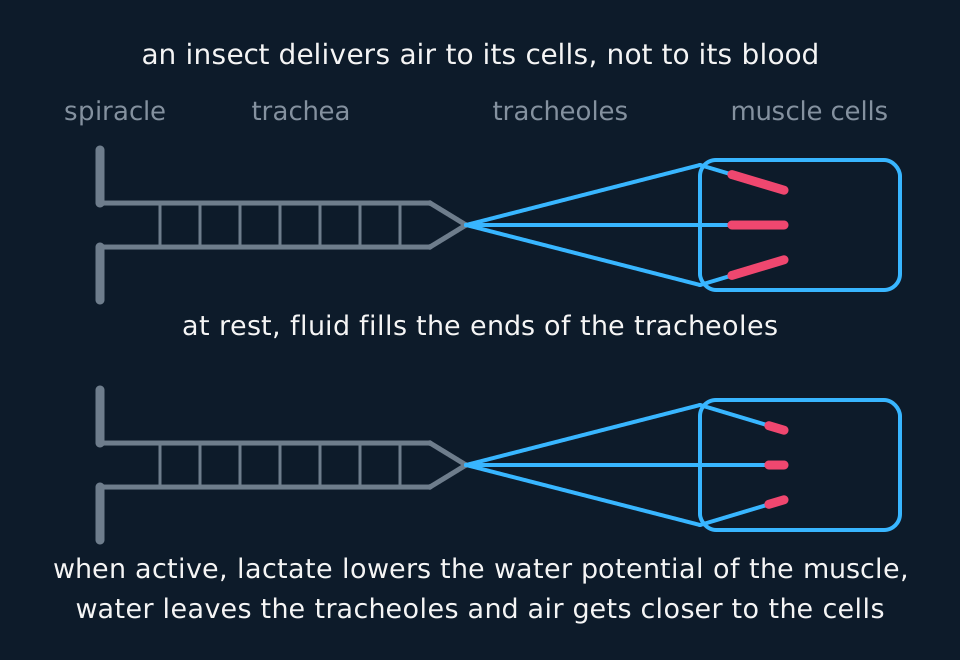
Two rows showing the same tracheal system. In each, a pore in the body wall leads into a wide ringed tube that branches into three fine tracheoles ending inside a block of muscle. In the upper row a thick coloured length of fluid fills most of each tracheole tip; in the lower row that fluid has shrunk to a short stub near the very end.
At rest the ends of the tracheoles are filled with tracheal fluid. The movement of that fluid depends on water potential. During sustained activity a muscle cell respires anaerobically in part, and lactate accumulates in the cytoplasm. That lowers the water potential of the cell, so water moves out of the tracheole into the cell by osmosis. Air is drawn further along the tracheole to fill the space, the final stretch of the diffusion pathway is now gas rather than liquid, and oxygen reaches the cell far faster. The response follows directly from the change in water potential, without a separate control mechanism.
Diffusion is the main mechanism, but larger and more active insects supplement it. Rhythmic movements of the abdomen and thorax change the volume of the body, squeezing the tracheae and moving air along them in bulk, which is mass transport rather than diffusion. Some insects also close alternate spiracles in a co-ordinated pattern so that air is driven through the system in one direction.
Every open spiracle is also a hole through which water vapour leaves, and an insect is small enough to have a high surface area to volume ratio, so the loss matters. The spiracles are therefore kept shut when the insect is inactive and opened only as demand requires, the cuticle is waterproofed with wax, and the hairs around each spiracle hold a layer of humid air that shallows the gradient for water loss. Trapping humid air in this way is the same mechanism used by the xerophyte adaptations described below.
The design has a limit. Diffusion down a tracheal tube is slow over long distances, so the tracheal system sets a ceiling on insect body size. Insects were much larger in the Carboniferous, when the atmosphere held a substantially higher proportion of oxygen than it does now, though the oxygen is one plausible contributor to their size rather than a settled single cause.
Fish gills and counter-current flow
Water is a difficult medium from which to extract oxygen. A cubic decimetre of air holds around 210 cm³ of oxygen; the same volume of fresh water at 15 °C holds about 7 cm³, roughly thirty times less. Water is also about eight hundred times denser than air and far more viscous, so ventilating a gill has a substantial energy cost. The gill must therefore extract a high proportion of the oxygen available.
A bony fish has four gill arches on each side of its head, covered by a bony flap called the operculum. Each arch carries two rows of gill filaments, and each filament carries stacks of thin plates, the lamellae, set at right angles to it. The lamellae are where exchange happens: each is covered by a single layer of cells, contains a capillary network, and the stacking gives an enormous area in a small space.
Water is kept moving in one direction by a two-stage pump. The fish lowers the floor of its buccal cavity with the mouth open, which increases the volume, drops the pressure and draws water in. It then closes its mouth and raises the floor, raising the pressure and forcing water over the gills and out past the operculum, which opens as a valve on the way out. While the buccal cavity is filling, the operculum is shut and the opercular cavity behind the gills expands, lowering its pressure and drawing water across the gills, so water flows over them almost continuously and in one direction, rather than moving back and forth over water already depleted of oxygen.
Describe the drawing
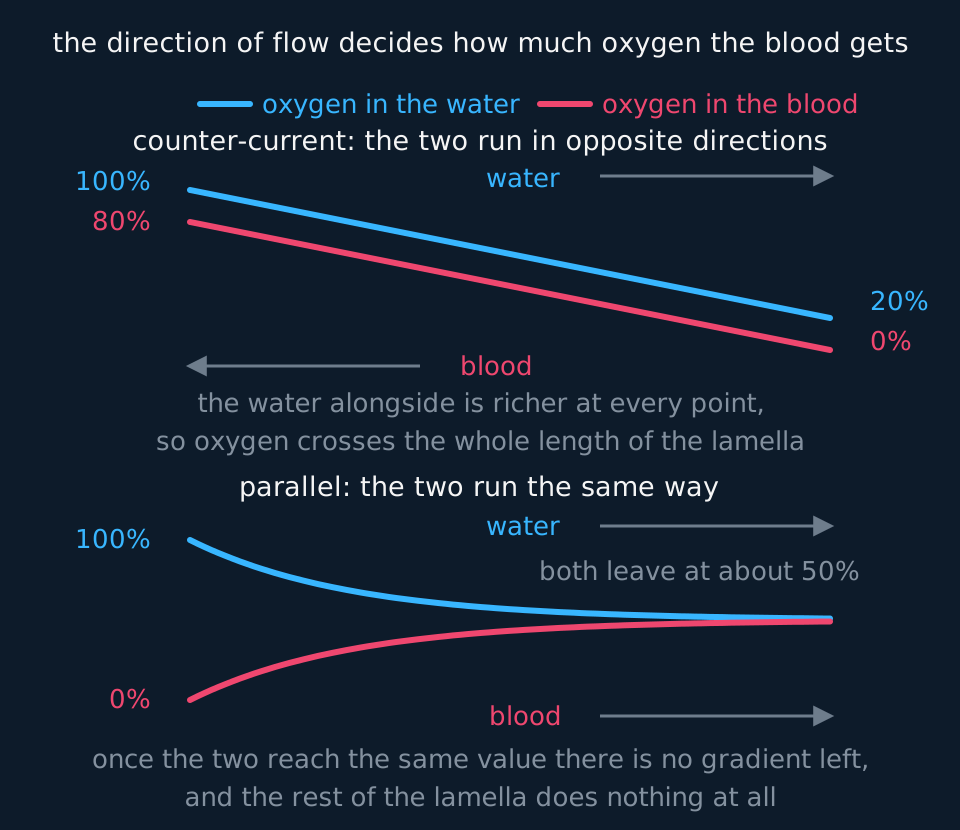
Two plots of oxygen saturation against distance along a gill lamella. In the upper plot water falls from one hundred per cent to twenty while blood rises from zero to eighty in the opposite direction, the two lines staying a constant distance apart. In the lower plot both flow the same way, the water falling and the blood rising until they meet near fifty per cent part-way along and run flat together after that.
State the comparison precisely. Counter-current flow maintains a concentration gradient along the whole length of the lamella, so that oxygen diffuses from water to blood across the entire surface rather than only the first part of it. The number usually quoted is that a bony fish removes about 80% of the dissolved oxygen from the water passing over its gills, against a ceiling of about 50% for parallel flow. The 50% assumes matched flow rates and carrying capacities on the two sides, which is how the comparison is always drawn.
Counter-current flow also allows blood to leave the lamella with a higher oxygen content than the water leaving the lamella, because at its exit end that blood was in contact with fully oxygenated water. In parallel flow the two fluids converge on the same value, so this cannot occur.
- Gill filament
- One of the many thin projections from a gill arch, sometimes called a primary lamella.
- Lamella
- One of the thin plates set at right angles along a gill filament, covered by an epithelium one cell thick with blood flowing just beneath it; the actual exchange surface.
- Counter-current flow
- An arrangement in which two fluids move past each other in opposite directions, so a concentration gradient is maintained along the whole length of the exchange surface.
- Operculum
- The bony flap covering the gills of a bony fish, acting as a valve and part of the pump that maintains the flow of water.
A gill out of water fails for a structural reason, not a chemical one. Water supports the lamellae and holds them apart; in air they stick together and collapse into a wet mass, so the surface area falls catastrophically. A stranded fish suffocates in an atmosphere containing thirty times more oxygen than the water it came from.
Gas exchange in a leaf
A plant needs carbon dioxide in during the day, and oxygen in at night once photosynthesis has stopped; in daylight the respiring cells use oxygen the chloroplasts are making, and the net movement of oxygen is outward. It has no muscles, no blood and nothing that could be called ventilation. It manages with pure diffusion, which works because a leaf is thin and full of holes.
Gas enters through stomata, pores in the epidermis, mostly on the lower surface of a typical broad leaf. Inside, the spongy mesophyll is a loose network of cells with large air spaces between them, so gas diffuses freely through the leaf's interior and reaches the moist surface of every mesophyll cell. Those wet cell walls are the exchange surface, and they add up to an area several times the area of the leaf itself. No cell in a leaf is more than a fraction of a millimetre from an air space, so the diffusion distance is short and no transport system for gases is needed at all. Woody stems and roots are covered in bark, which is almost impermeable to gases, so they exchange gases through lenticels, patches of loosely packed cells in the bark whose air spaces let oxygen diffuse to the living cells beneath and carbon dioxide diffuse out.
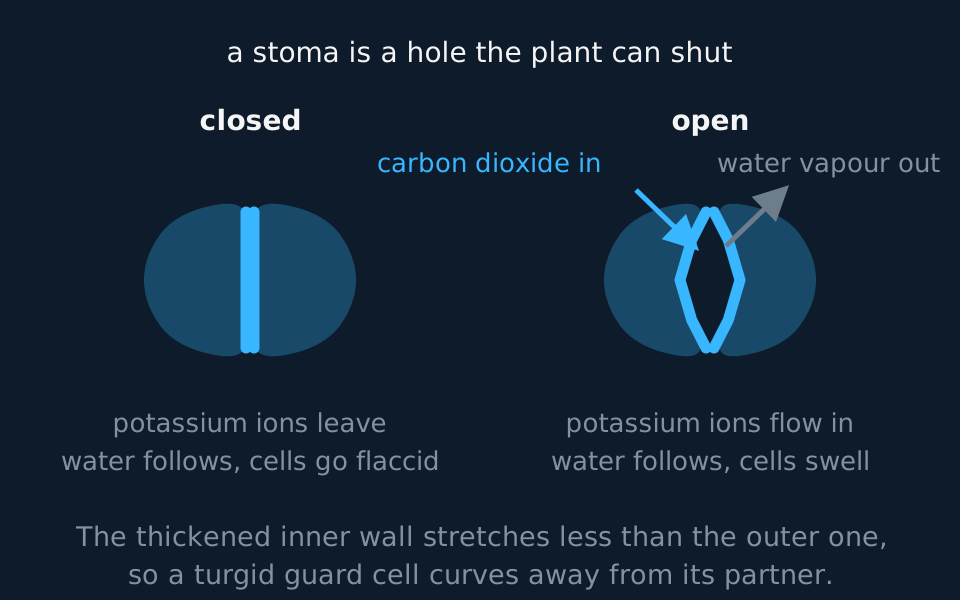
Each stoma is bounded by two guard cells, and, like an insect's spiracle, it can be closed. When water is available, a proton pump uses ATP to move hydrogen ions out of the guard cell, and the resulting electrochemical gradient allows potassium ions to enter through channel proteins. The water potential of the guard cells falls, water follows by osmosis, and the cells become turgid. Because the wall facing the pore is thicker than the outer wall, and the cellulose microfibrils are arranged in hoops around the cell, the cell lengthens by curving rather than by swelling evenly. The two cells bow away from each other and the pore opens.
Describe the drawing
Two pairs of guard cells side by side. On the left the pair meets along its whole length with no gap between them. On the right the same pair has bowed apart into a lens-shaped pore, with a thicker line drawn along the wall facing the pore in both, and arrows showing carbon dioxide entering and water vapour leaving.
Reverse the process and the stoma shuts. Potassium ions leave, water follows, the guard cells go flaccid, and the pore closes. Plants shut their stomata in darkness, when photosynthesis has stopped and carbon dioxide is not wanted, and in drought, when the hormone abscisic acid triggers closure. The hormone comes from roots in dry soil and also from the leaf's own tissues as they lose water, so the signal has a local arm as well as a long-distance one.
Water loss is a consequence of opening stomata for gas exchange. The leaf interior is saturated with water vapour while the air outside rarely is, so a pore open enough to admit carbon dioxide also allows water vapour to leave. That loss is transpiration.
- Guard cell
- One of the pair of cells around a stoma. The pair bow apart and open the pore when they become turgid, and close it when they become flaccid.
Xerophytes: making the gradient shallow
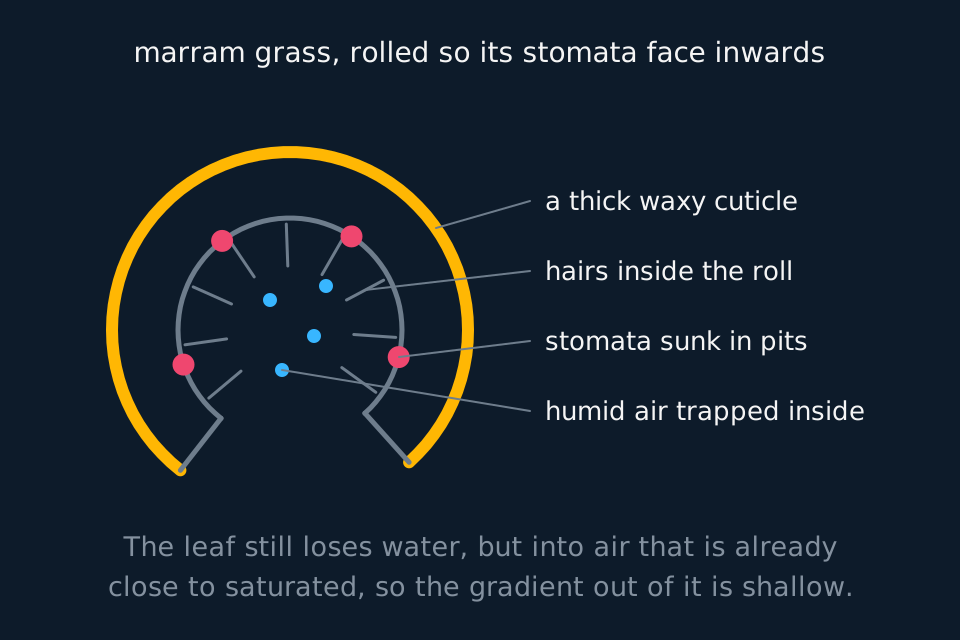
A plant living where water is scarce cannot stop exchanging gases, so it attacks the other terms of Fick's law instead. Every classic xerophyte adaptation is doing one of three things: cutting the area available for loss, lengthening the diffusion pathway, or flattening the gradient by trapping humid air next to the pore.
| Adaptation | How it reduces water loss | Example |
|---|---|---|
| Thick waxy cuticle | Waterproofs the epidermis so vapour can only leave through stomata | Holly, cacti, marram grass |
| Stomata sunk in pits | Traps humid air in the pit, lowering the gradient and lengthening the pathway | Marram grass, pine needles |
| Hairs on the epidermis | Hold a layer of still, humid air against the surface, lowering the gradient | Marram grass, many silver-leaved shrubs |
| Rolled leaves | Encloses the stomata in a humid chamber and cuts the exposed surface area | Marram grass |
| Reduced leaves or spines | Cuts the surface area available for evaporation | Cacti, gorse |
| Stomata open at night only | Restricts loss to the coolest, most humid part of the day | Cacti and other succulents |
The mechanism behind the middle rows is one idea repeated. Water vapour leaving a stoma has to diffuse away from it, and if it cannot get away it accumulates and the air immediately outside the pore approaches saturation. The difference in water potential between the leaf interior and the air just outside then becomes small, and the rate of loss falls with it. Pits, hairs and rolled leaves are all ways of preventing the humid air near a stoma from being carried off by wind.
These adaptations have a cost. Anything that slows water leaving also slows carbon dioxide entering, so a xerophyte's rate of photosynthesis is typically lower than that of a plant with unrestricted stomata. Succulents that open their stomata only at night, storing carbon dioxide as an organic acid until daylight, pay in a different way: the storage step costs energy and the daily supply is capped by how much acid the plant can hold.
- Xerophyte
- A plant whose leaves and stems have features that reduce water loss by transpiration, found where water is scarce.
Exam-board note. AQA 7402 examines insects, fish, leaves and xerophytes together in its gas exchange topic. OCR A H420 examines insects and fish under exchange surfaces but places stomata and xerophytes with transport in plants. Cambridge 9700 does not examine the insect tracheal system or the fish gill at all, and covers xerophyte adaptations within transport in plants. Check the current specification for the qualification being taken.
TRY IT: Comparing two exchange systems
Explain why an insect can supply its flight muscles with oxygen without any oxygen-carrying pigment in its blood, while a fish of similar mass cannot manage without haemoglobin.
Check your answer
The insect's tracheal system delivers air directly to the tissues. Tracheoles run between and into the cells, so the diffusion distance from air to cytoplasm is only a fraction of a micrometre and no carrier is needed to bridge a gap.
Gases also diffuse far faster in air than in liquid, so a gas-filled tube is a much better delivery route than a liquid-filled one over the same distance. During activity the tracheal fluid withdraws and even more of the pathway becomes gas.
A fish takes oxygen up at a gill, which may be many centimetres from a working muscle. Diffusion time rises with the square of the distance, so diffusion alone would take far too long, and the oxygen has to be carried in a mass transport system instead. Blood plasma dissolves very little oxygen, so haemoglobin is needed to raise the amount each volume of blood can carry.
The two systems address the same constraint differently: the insect shortens the diffusion distance by delivering air to the tissues, while the fish uses mass transport and an oxygen-carrying pigment to cover the distance.
Dissecting an insect and a fish gill
optional
AQA sets this as required practical 5: Dissection of animal or plant gas exchange or mass transport system or of organ within such a system. Pearson Edexcel Biology B (9BI0) sets Core Practical 7: Dissect an insect to show the structure of the gas exchange system, taking into account the safe and ethical use of organisms, beside statement 4.3 i. In OCR A (H420), practical activity group PAG2 is Dissection.
The instruments: a dissecting board or a wax-lined dish, a scalpel, fine scissors, blunt and fine forceps, a seeker, dissecting pins, a hand lens or stereo microscope, a light microscope with slides and coverslips, and a ruler.
| Step | What to do | Why |
|---|---|---|
| 1 | Take a locust or cockroach from a biological supplier, killed by the method your school approves. Cut off the wings and legs, lay it dorsal side up in the wax dish and pin it through the thorax, the pins angled outwards | Angled pins hold the body and leave room to work |
| 2 | With fine scissors, cut along the dorsal midline from the tip of the abdomen to the head, the lower blade just under the exoskeleton and its point kept up | A shallow cut leaves the tracheae beneath intact |
| 3 | Pin the exoskeleton back on each side and cover the specimen with water | Water supports the tracheae and stops them drying |
| 4 | With a hand lens, find the silvery tubes running in from the side walls and trace one to a spiracle, moving the gut aside with the seeker | The tracheae are silvery because they are full of air |
| 5 | Cut a short length of trachea free, mount it in water under a coverslip and examine it with the light microscope | Shows the chitin in its wall |
The spiracles are a row of small pores along each side of the abdomen, with more on the thorax. On the slide the trachea shows a spiral thickening of chitin, the taenidia, which is what the rings described above look like close up. It holds the tube open so that air can move along it, while letting it bend as the body moves.
The fish gill. Use a fish head from a fishmonger. Lift the operculum with forceps and cut it away at its base to expose the four gill arches. Cut one arch free at both ends and put it in a dish of water. Under a hand lens or stereo microscope the filaments spread out in two rows, with the lamellae as fine plates across each filament. Lifted into air, the filaments stick together: water no longer holds them apart, and the film of water between them draws them together. This is the loss of surface area that suffocates a stranded fish. In life, water passes between the lamellae from the mouth side of the arch to the opercular side while blood in the lamellae flows the other way, the counter-current arrangement taught above. The dissection shows the surface but not the flow.
AQA also accepts a mass transport system or an organ in either system. A lamb's heart from a butcher shows the valves and the thicker left ventricle wall, and lungs show the cartilage of the trachea and bronchi. A celery stalk stood in dilute dye and cut across shows the xylem as stained dots.
Recording. Make a biological drawing: a sharp pencil, single unbroken lines, no shading or colour, and labels on ruled lines that do not cross and carry no arrowheads. Keep the parts in proportion. Measure a real structure, such as one filament, and add a scale bar or the magnification, which is drawn length divided by real length. Draw the branches you found, not the textbook pattern.
Ethics. Insects come from a supplier, are killed humanely and are used only in the numbers the work needs. A fish head is left over from fish sold as food. A student who objects can watch a dissection, work from photographs or video, or draw a prepared slide of trachea; tell your teacher beforehand.
| Limitation | Effect |
|---|---|
| Tracheoles are under a micrometre across and end among the muscle fibres | Only the larger tracheae can be traced |
| The specimen is dead | No ventilation or tracheal fluid can be observed |
| Tracheae tear, and gills are damaged in gutting | The drawing undercounts branches and lamellae |
Risk assessment. Cut on the board, away from your body, your other hand and other people. Pass instruments handle-first, fit and remove blades only by your school's method, and put used blades in the sharps container. Handle animal material as the risk assessment directs, keep it away from your face and food, and dispose of it as the school says. Anyone allergic to locusts or fish should say so before the practical. Disinfect the bench and instruments and wash your hands afterwards. Check the CLEAPSS guidance and your school's risk assessment before starting; where they differ from this page, follow them.
- Dorsal
- The back or upper surface of an animal, opposite the ventral surface.
In the exam
- For counter-current flow, state that the gradient is maintained along the whole length of the lamella, not simply that a concentration gradient is maintained.
- For tracheal fluid, give the full sequence: lactate accumulates, the water potential of the muscle cell falls, water leaves the tracheole by osmosis, air moves further in, and the diffusion pathway through liquid is shortened.
- In most insects the blood does not transport oxygen; oxygen reaches the cells through the tracheal system.
- For guard cells, name the ion and the pump. A proton pump uses ATP to move hydrogen ions out of the guard cell; the resulting electrochemical gradient allows potassium ions to enter through channel proteins; the water potential falls, water enters by osmosis, the cells become turgid and bow apart because of the thickened inner wall.
- State the mechanism of each xerophyte adaptation, not only its effect: hairs trap humid air, so the water-potential gradient between the leaf and the air outside is reduced.
- Exam-board note. Cambridge 9700 does not examine insect or fish gas exchange, and OCR A puts stomata and xerophytes with transport in plants rather than with exchange surfaces.
Check yourself
Water arrives at a gill lamella carrying 100 arbitrary units of oxygen per minute and leaves carrying 20. Blood arrives carrying 10 and leaves carrying 90. Show that these figures are consistent, state what would happen if the blood flow were reversed, and explain the difference in terms of the concentration gradient.
Answer
Check the balance first. The water loses 100 − 20 = 80 units and the blood gains 90 − 10 = 80 units. Whatever leaves one fluid enters the other, so the figures are consistent.
The blood leaves carrying 90 while the water leaves carrying 20, which looks impossible until you notice which end each fluid leaves from. Blood at 90 is leaving at the end where water arrives at 100, so it is beside water richer than itself right up to the moment it goes.
Reverse the blood flow and the two now travel the same way. They start far apart, 100 against 10, and converge as oxygen crosses. Once they reach the same value there is no gradient left and diffusion stops, so both leave at about 55 units and the rest of the lamella does nothing.
The reason is the gradient. In counter-current flow the water alongside any point of the lamella is always richer in oxygen than the blood at that point, so oxygen diffuses across the full length of the surface. In parallel flow the gradient exists only over the first part of the lamella and the remaining surface is wasted, which is why the counter-current arrangement extracts around 80% of the oxygen and the parallel one could not exceed half.
Questions
Question 14 marks
A bony fish removes about 80 per cent of the dissolved oxygen from the water passing over its gills, while parallel flow could not exceed 50 per cent. Explain this difference.
Mark scheme
- B1 in counter-current flow the water and the blood travel in opposite directions along the lamella
- B1 the water alongside any point on the lamella therefore always holds more oxygen than the blood beneath it
- B1 a concentration gradient is maintained along the whole length of the lamella, so oxygen diffuses into the blood across the entire exchange surface
- A1 in parallel flow the two fluids converge part-way along, and once they reach the same concentration diffusion stops and the rest of the surface is wasted, so at best both leave at about half the starting value
Question 24 marks
Describe what happens to the fluid at the ends of an insect's tracheoles during a period of sustained activity, and describe the effect this has on the delivery of oxygen.
Mark scheme
- B1 the muscle cells respire anaerobically in part, so lactate accumulates in their cytoplasm
- B1 the water potential of the muscle cells falls below that of the tracheal fluid
- B1 water therefore moves out of the end of the tracheole into the muscle cell by osmosis, and air is drawn further along the tracheole to fill the space
- A1 more of the final stretch of the pathway is now gas rather than liquid, and gases diffuse far faster through air than through water, so oxygen reaches the cell sooner
Question 34 marks
A leaf has no ventilation and no transport system for gases, yet it supplies every mesophyll cell with carbon dioxide. Explain how it manages this, and explain why the same arrangement costs the plant water.
Mark scheme
- B1 gas enters through the stomata into the large air spaces of the spongy mesophyll, so it diffuses freely through the interior of the leaf
- B1 no cell is more than a fraction of a millimetre from an air space, so the diffusion distance is short enough for diffusion alone to be fast enough
- B1 the moist walls of the mesophyll cells act as the exchange surface, and together they come to several times the area of the leaf itself
- A1 the leaf interior is saturated with water vapour while the air outside rarely is, so a pore open enough to admit carbon dioxide also lets water vapour diffuse out
Question 44 marks
Explain how changes in the volume of the buccal cavity and the opercular cavity keep water flowing over a bony fish's gills in one direction and almost without a break.
Mark scheme
- B1 the fish first lowers the floor of its buccal cavity with its mouth open, increasing the volume of the cavity, which drops the pressure inside it and draws water in through the mouth
- B1 the fish then closes its mouth and raises the floor of the buccal cavity, decreasing the volume and raising the pressure, which forces water backwards over the gills
- B1 the operculum acts as a valve, opening to let water leave as the pressure rises and closing to prevent it being drawn back in during the first stage
- B1 while the buccal cavity fills, the opercular cavity expands with the operculum shut and draws water across the gills, so flow over them continues through both stages and stays in one direction, rather than the same, partly deoxygenated water being moved back and forth across the exchange surface
Question 54 marks
Explain, in terms of ATP, hydrogen ions and potassium ions, how a guard cell opens a stoma.
Mark scheme
- B1 a proton pump in the guard cell membrane uses ATP to actively move hydrogen ions out of the cell
- B1 the resulting electrochemical gradient allows potassium ions to enter the guard cell through channel proteins
- B1 the water potential of the guard cell falls as potassium ion concentration rises inside it, so water enters the cell by osmosis and the cell becomes turgid
- B1 because the guard cell wall facing the pore is thicker than the outer wall, the cell lengthens by curving rather than swelling evenly, and the two guard cells bow apart, opening the pore
Question 64 marks
Compare the tracheal system of an insect with the stomata and air spaces of a leaf as routes for gas exchange, referring to what drives movement through each system and to what limits the size each system can serve.
Mark scheme
- B1 gas moves through most of an insect's tracheal system by diffusion, supplemented by mass transport when abdominal pumping squeezes the tracheae in larger, more active insects, whereas gas moves through a leaf's internal air spaces by diffusion alone, since a leaf has no equivalent muscular pumping mechanism
- B1 both systems deliver gas directly to or from individual cells rather than relying on a circulatory fluid, the tracheoles ending at or in insect cells and the air spaces reaching the moist walls of every mesophyll cell
- B1 the insect's tracheal system limits the size an insect can reach, because diffusion down a long tracheal tube becomes too slow over a large body, whereas a leaf's flat, thin shape keeps every mesophyll cell close to an air space regardless of how large the whole leaf's surface area becomes
- B1 both are therefore diffusion-based systems whose reach is set by distance rather than by a lack of surface area, but the tracheal system is constrained by overall body size while the leaf's internal geometry avoids that constraint by staying thin
Question 73 marks
A fish stranded on a riverbank dies of oxygen shortage in air containing about thirty times more oxygen than the water it came from. Suggest why.
Mark scheme
- B1 in water the lamellae are supported and held apart, but in air they stick together and collapse into a wet mass
- B1 the surface area available for gas exchange therefore falls sharply
- A1 rate of diffusion is proportional to surface area, so too little oxygen crosses into the blood however much is present in the air around the fish
Question 83 marks
Compare the way an insect delivers oxygen to its flight muscles with the way a bony fish delivers oxygen to its swimming muscles.
Mark scheme
- B1 the insect pipes oxygen as a gas along tracheae and tracheoles directly to the cells, whereas the fish takes oxygen up at the gill and carries it in the blood
- B1 the insect's blood plays little or no part in oxygen transport, whereas the fish depends on haemoglobin to raise the amount of oxygen each volume of blood can carry
- A1 the insect's diffusion distance from air to cytoplasm is under a micrometre, whereas the fish's gill may be many centimetres from a working muscle, so a mass transport system is unavoidable
Question 93 marks
Explain why a plant closes its stomata in darkness, and explain why it also closes them in drought even though carbon dioxide is still needed for photosynthesis in daylight.
Mark scheme
- B1 in darkness photosynthesis has stopped, so carbon dioxide is not needed and closing the stomata avoids the unnecessary loss of water vapour that keeping them open would cost
- B1 in drought, the hormone abscisic acid, produced by roots in dry soil and by the leaf's own tissue as it loses water, triggers closure of the stomata
- B1 closing the stomata in drought reduces water loss and protects the plant from dehydration, even at the cost of reducing photosynthesis by restricting the carbon dioxide supply
Question 103 marks
Describe how rolling its leaves and growing hairs on its epidermis each reduce water loss in a plant such as marram grass, referring in each case to humid air.
Mark scheme
- B1 rolling the leaf encloses the stomata, which are on the inner, rolled-in surface, within a humid chamber, cutting the leaf surface actually exposed to moving air
- B1 hairs on the epidermis hold a layer of still, humid air against the surface, so the water potential gradient between the leaf interior and the air immediately outside the stomata is reduced
- B1 in both cases the mechanism is the same: trapping humid air near the stomata lowers the difference in water potential that drives water loss, rather than physically blocking the stomata themselves
Question 113 marks
A succulent plant opens its stomata only at night, storing carbon dioxide as an organic acid until it is needed for photosynthesis the following day. Suggest the advantage of this pattern in a hot, dry habitat, and suggest two disadvantages of storing carbon dioxide this way rather than taking it in directly during the day.
Mark scheme
- B1 the advantage is that opening the stomata at night, when the air is cooler and more humid, restricts most water loss to the part of the day when the water potential gradient between the leaf and the air is smallest
- B1 a disadvantage is that storing carbon dioxide as an organic acid costs the plant energy, beyond the energy cost of ordinary photosynthesis
- B1 a second disadvantage is that the amount of carbon dioxide available for photosynthesis the next day is limited by how much acid the plant can store overnight, capping the daily supply regardless of demand
Question 123 marks
Fossil dragonflies from the Carboniferous period had wingspans far larger than any insect flying today, at a time when the atmosphere contained a notably higher percentage of oxygen than it does now. Suggest how a higher atmospheric oxygen concentration could have allowed insects of that size to be sustained by a tracheal system.
Mark scheme
- B1 gas exchange through a tracheal system relies on diffusion down tracheae and tracheoles, and the rate of diffusion depends on the concentration difference driving it
- B1 a higher atmospheric oxygen concentration would increase the difference in oxygen concentration between the air in the tracheal system and the tissue at the end of it, increasing the rate of diffusion for a tube of any given length
- B1 a faster rate of diffusion would let oxygen reach cells at the end of longer tracheae fast enough to meet their demand, allowing a larger tracheal system, and so a larger insect, than today's lower atmospheric oxygen concentration can sustain
Question 133 marks
A student dissects a locust under water and sees silvery tubes running inwards from small pores along the sides of the abdomen. A short length of one tube, mounted on a slide, shows a spiral thickening in its wall. Explain these observations.
Mark scheme
- B1 the tubes are tracheae, and they look silvery because they are filled with air, which reflects light at its boundary with the water
- B1 the pores are spiracles, and each trachea runs inwards from a spiracle
- B1 the spiral thickening is chitin, which holds the trachea open so that air can move along it
Question 143 marks
A gill arch cut from a fish head is examined in a dish of water, then lifted out into the air. Explain why the filaments spread apart in water but stick together in air, and why this means a fish cannot survive in air even though air contains more oxygen than water.
Mark scheme
- B1 in water the filaments and lamellae are supported by the water and held apart
- B1 in air nothing supports them, and the film of water between them draws them together so they collapse into a mass
- B1 the surface area available for gas exchange falls greatly, so too little oxygen diffuses into the blood to meet the fish's demand
Question 152 marks
State two features of a gill lamella, other than the direction in which water flows over it, that increase the rate at which oxygen enters the blood.
Mark scheme
- B1 each lamella is covered by a single layer of cells, so the diffusion pathway is very short
- B1 the lamellae are stacked in large numbers along each filament, giving a very large surface area; accept a capillary network inside each lamella that carries oxygen away and maintains the gradient
Question 162 marks
Name the pores through which air enters an insect's tracheal system, and name the tubes into which they lead.
Mark scheme
- A1 the pores are spiracles
- A1 tracheae, which lead inward from each spiracle and are held open by rings of chitin
Question 172 marks
Describe two ways in which an insect's spiracles reduce water loss when the insect is not actively gas exchanging.
Mark scheme
- B1 each spiracle is guarded by a valve, which is closed when the insect is inactive and opened only as demand for gas exchange requires
- B1 spiracles are often fringed with hairs, which hold a layer of humid air close to the opening, reducing the concentration gradient down which water vapour is lost
Question 182 marks
After dissecting a locust, a student concludes that the tracheal system delivers oxygen directly to the muscle cells. Suggest two reasons why the dissection itself could not show this.
Mark scheme
- B1 the tracheoles that reach the cells are under a micrometre across and end among the muscle fibres, too fine to trace with a hand lens, so only the larger tracheae are seen
- B1 the locust is dead, so no movement of air, tracheal fluid or oxygen into the cells can be observed
Worth remembering
- Insects pipe air to their cells through spiracles, tracheae and tracheoles; their blood plays little or no part in carrying oxygen.
- Tracheal fluid withdraws during activity because lactate lowers the water potential of the muscle cells, shortening the liquid part of the pathway.
- A fish gill is arch, filament, lamella; each lamella is covered by an epithelium one cell thick, with blood flowing just beneath it.
- Counter-current flow keeps water richer than blood along the whole lamella; parallel flow equalises part-way along and stops.
- A leaf exchanges gases through stomata into air spaces, using the wet walls of mesophyll cells as the surface, and pays in water vapour.
- Every xerophyte adaptation cuts the area, lengthens the pathway, or traps humid air to flatten the gradient.
CHECK YOUR PROGRESS
Rate how confident you are with each objective for this lesson. Ratings are saved in this browser, on this device, unless you sign in.
- Trace the path of oxygen from a spiracle to an insect's muscle cell and say why its blood plays little or no part.
- Explain how tracheal fluid moves during activity and why that speeds up gas exchange.
- Describe the structure of a bony fish gill from arch to lamella, and the buccal pump that drives water over it.
- Explain why counter-current flow extracts far more oxygen than parallel flow would, using the gradient along the lamella.
- Describe how a leaf exchanges gases and explain the trade-off that forces xerophyte adaptations.
- Dissect an insect's tracheal system and a fish gill safely, and record each in a labelled biological drawing with a scale.
Open the full revision checklist to see every objective in the curriculum in one place.
Practise this lesson
WORKBOOK
The questions from this topic, on paper with room to work, and a separate book of mark schemes. Free to use; please do not redistribute or sell.
Used later in Transpiration and stomatal control