Biology › Respiration and cellular energy › The Krebs cycle and oxidative phosphorylation
The Krebs cycle and oxidative phosphorylation
The Krebs cycle oxidises acetyl groups in the mitochondrial matrix, releasing carbon dioxide and reducing NAD and FAD. At the inner mitochondrial membrane, electron transfer from those reduced coenzymes to oxygen pumps protons into the intermembrane space, and their return through ATP synthase drives the phosphorylation of ADP.
Before this Glycolysis and the link reaction · Membrane structure and carrier proteins · Active transport and electrochemical gradients
COMMON MISCONCEPTION
Oxygen burns the glucose in respiration, in the same way it burns petrol in an engine.
Oxygen is the final electron acceptor in aerobic respiration. At the end of the electron-transport chain it accepts electrons and combines with protons to form water, allowing oxidised NAD and FAD to be regenerated and oxidative phosphorylation to continue.
What you should be able to do
- Describe one turn of the Krebs cycle and account for all of the carbon that enters it.
- State the products of the cycle per turn and per molecule of glucose.
- Explain how electron transfer along the chain produces a proton gradient across the inner membrane.
- Explain how the gradient is used to make ATP, naming the enzyme and the direction of proton movement.
- State the role of oxygen precisely, and say what happens to the chain without it.
- Explain why a measured ATP yield falls short of the theoretical 38.
The cycle that finishes the carbon
Two acetyl groups arrive in the matrix per glucose, each carried by coenzyme A, each holding two carbons. The Krebs cycle takes them apart one at a time, and because it is a cycle it has to hand back whatever it started with.
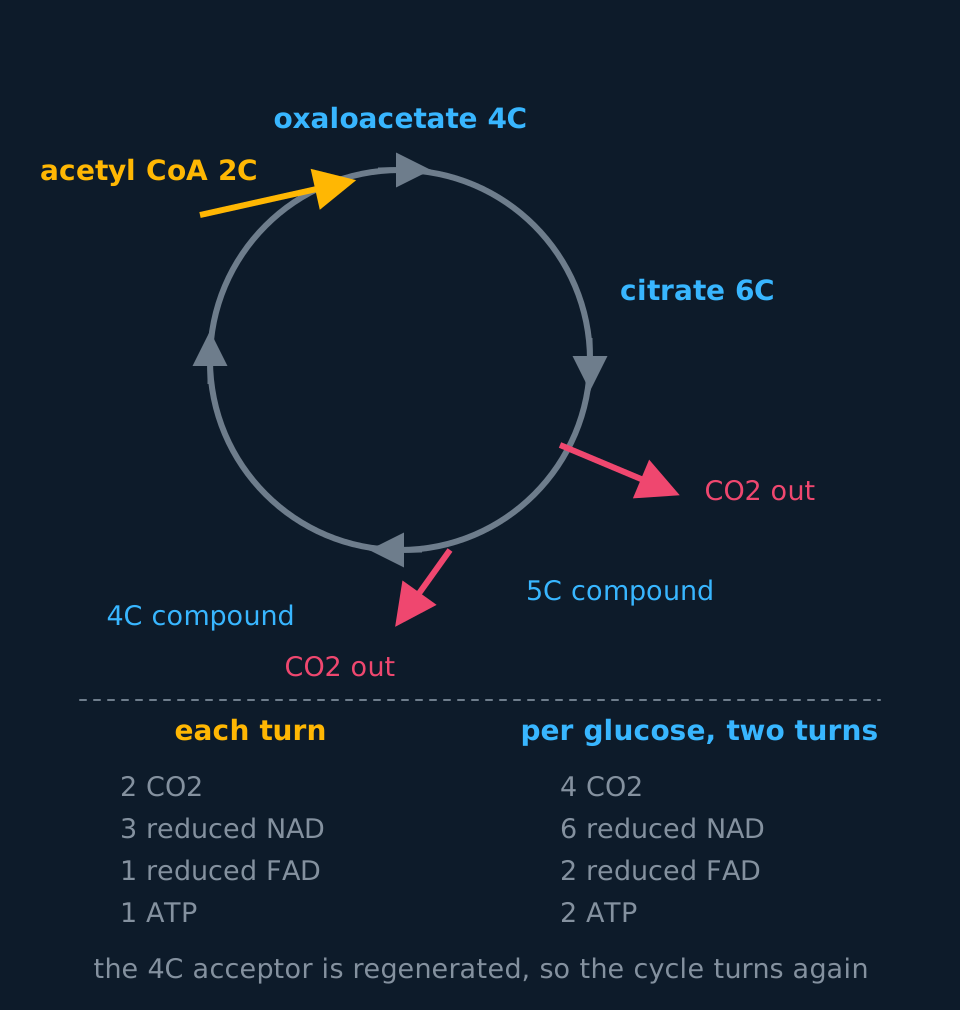
The acetyl group is transferred from coenzyme A onto a four-carbon acceptor, oxaloacetate, giving the six-carbon citrate. Coenzyme A leaves at once and goes back for another acetyl group. Citrate is then decarboxylated and dehydrogenated to a five-carbon compound, and again to a four-carbon compound; a series of further changes regenerates oxaloacetate, and the cycle turns again. Six carbons in, two out as carbon dioxide, four handed back, as many as it borrowed.
Describe the drawing
A large ring with small arrows on it showing the direction of travel. Oxaloacetate with four carbons is marked at the top, citrate with six carbons at the right, a five-carbon compound at the lower right and a four-carbon compound at the lower left. An arrow from the left brings in acetyl coenzyme A carrying two carbons, and two arrows leave the ring pointing outwards, each labelled carbon dioxide out. Below a dashed line, two columns list what each turn yields and what two turns yield: two and four carbon dioxide, three and six reduced NAD, one and two reduced FAD, one and two ATP.
Per turn, the cycle yields 2 CO₂, 3 reduced NAD, 1 reduced FAD and 1 ATP. That single ATP is made by substrate-level phosphorylation, the same mechanism as in glycolysis, and it is the only ATP the cycle makes directly. Because one glucose gives two pyruvate and therefore two acetyl groups, the cycle turns twice per glucose, and every one of those figures doubles.
- Krebs cycle
- A closed series of reactions in the mitochondrial matrix in which an acetyl group is combined with a four-carbon acceptor and completely oxidised, releasing carbon dioxide and reducing coenzymes, and regenerating the acceptor.
- Dehydrogenase
- An enzyme that catalyses the removal of hydrogen from a substrate, passing it to a coenzyme such as NAD or FAD.
- Decarboxylase
- An enzyme that catalyses the removal of a carbon atom from a substrate, released as carbon dioxide.
- FAD
- A hydrogen-carrying coenzyme like NAD, but one that hands its electrons to the transport chain further along, so it yields less ATP per molecule.
Counting a whole glucose through the cycle
One molecule of glucose is respired aerobically. Calculate the total number of molecules of carbon dioxide and of reduced NAD produced by the link reaction and the Krebs cycle together, and show that the carbon balances.
Show the working
The link reaction runs twice: 2 CO₂ and 2 reduced NAD. The cycle turns twice, each turn giving 2 CO₂ and 3 reduced NAD, so 4 CO₂ and 6 reduced NAD.
Totals: 6 CO₂ and 8 reduced NAD from those two stages. Add the two reduced NAD from glycolysis and the cell has ten in all.
The carbon balances neatly. Glucose brought in six carbons; two left in the link reaction and four in the cycle, giving six carbon dioxide molecules, which is why the overall equation has a 6 in front of the CO₂ and why none of the carbon ends up in the water.
What the first three stages produce
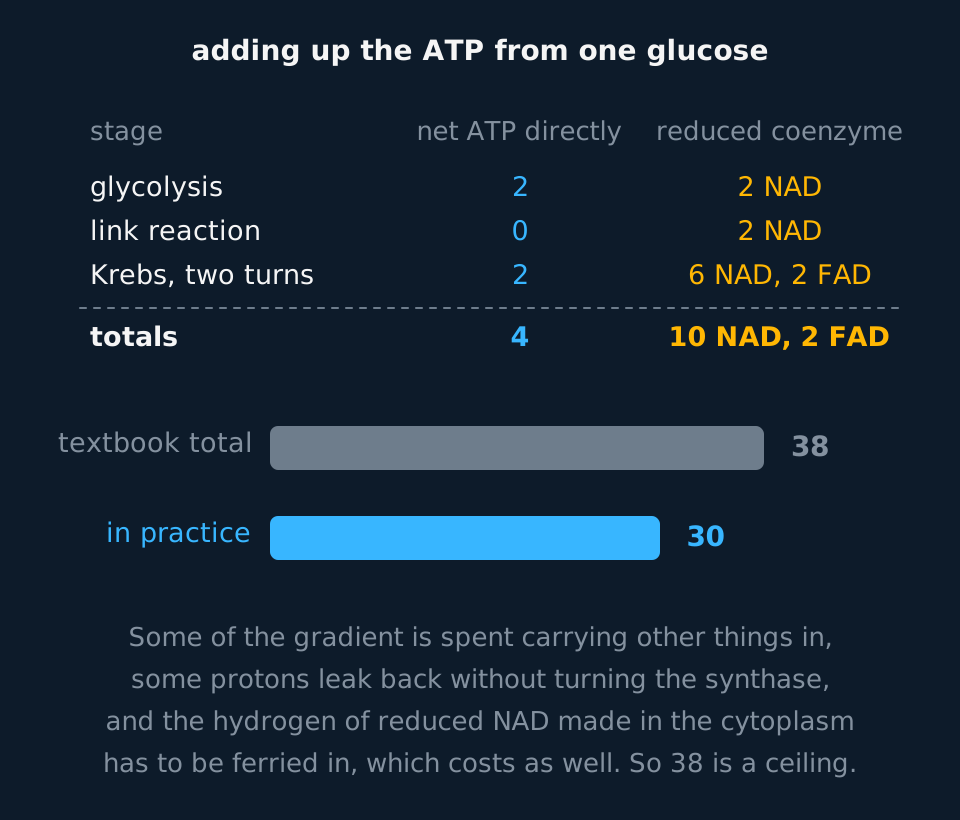
The net ATP made directly by the first three stages totals four per glucose: a net two from glycolysis (four made, two spent), none from the link reaction and two from the cycle. Over the same three stages the glucose has also produced ten reduced NAD and two reduced FAD.
Those reduced coenzymes carry most of the available energy. Each carries a pair of hydrogen atoms taken from a substrate, and each hydrogen atom is a proton and an electron. At the inner membrane the two are separated: the electrons pass to a chain of carriers and the protons are released into solution. The energy released as electrons pass along the chain establishes the proton gradient used in the fourth stage.
The electron transport chain and chemiosmosis
The inner mitochondrial membrane carries a series of electron carriers, arranged so that each one holds electrons a little less tightly than the next. Reduced NAD is oxidised at the first carrier, handing over its electrons and releasing its protons into the matrix. The electrons then pass from carrier to carrier, releasing energy at each transfer.
That energy is not used to make ATP directly. At three of the carriers, the ones biochemists number complexes I, III and IV, it is used to move protons out of the matrix, across the inner membrane, into the intermembrane space. The membrane is impermeable to protons, so they build up there: the space becomes more concentrated in protons and more positively charged than the matrix. The result is an electrochemical gradient, which stores potential energy across the membrane.
The only easy way back into the matrix is through ATP synthase, a large protein spanning the membrane with a channel through it. Protons flow back down their gradient through that channel, the flow turns part of the enzyme, and the movement drives the joining of ADP and inorganic phosphate into ATP. Making ATP this way, from a gradient rather than from a substrate, is chemiosmosis, and the whole stage is oxidative phosphorylation.

Describe the drawing
Chemiosmosis animated across the inner mitochondrial membrane, which is drawn as a band with three carrier proteins set into it and an ATP synthase further along, the intermembrane space above and the matrix below. First, reduced NAD arrives from the matrix and hands two electrons to the first carrier. Second, the electrons move along from carrier to carrier and three arrows carry protons up out of the matrix into the intermembrane space. Third, the space above is crowded with protons while the matrix below is nearly empty of them. Fourth, a thick arrow brings protons back down through the ATP synthase into the matrix, where ADP and phosphate join to make ATP. Fifth, the electrons leave the last carrier for a molecule of oxygen in the matrix, which takes them up with protons and forms water.
Electrons must be removed from the last carrier, or transfer along the chain stops. Oxygen is the final electron acceptor. At the end of the chain each oxygen atom takes up two electrons and, with two protons from the matrix, forms water. Oxygen does not react with glucose or with carbon in respiration.
Removing oxygen has consequences along the whole pathway. With no oxygen, the last carrier stays reduced, so the carrier before it cannot pass its electrons on, and so on back up the chain. Within seconds nothing can hand its electrons anywhere, no protons are pumped, the gradient collapses and ATP synthase stops. Reduced NAD is no longer oxidised by the chain, so oxidised NAD is not regenerated, and the link reaction, the Krebs cycle and eventually glycolysis all run out of the coenzyme they depend on.
- Electron transport chain
- A series of carrier proteins in the inner mitochondrial membrane that pass electrons from one to the next, releasing energy used to pump protons into the intermembrane space.
- Chemiosmosis
- The synthesis of ATP driven by the movement of protons down an electrochemical gradient through ATP synthase.
- Oxidative phosphorylation
- The formation of ATP from ADP and inorganic phosphate using energy from the electron transport chain, with oxygen as the final electron acceptor.
- Final electron acceptor
- The molecule that takes electrons from the end of the chain. In aerobic respiration it is oxygen, which combines with protons to form water.
Adding it up, with the caveats stated
The textbook total is 38 ATP per glucose. It comes from a straightforward sum: a net 4 ATP made directly, plus 10 reduced NAD counted as 3 ATP each, plus 2 reduced FAD counted as 2 each. 4 + 30 + 4 = 38.
Those two ratios are round numbers chosen for convenience rather than measured values. Careful work puts a reduced NAD nearer 2.5 ATP and a reduced FAD nearer 1.5, because the number of protons pumped per pair of electrons does not divide neatly by the number needed to turn the synthase once. Redo the sum with those and you get 32, not 38.
Describe the drawing
A small table above two horizontal bars. The table lists glycolysis, the link reaction and two turns of the Krebs cycle against the net ATP each makes directly and the reduced coenzymes each makes, totalling four ATP, ten reduced NAD and two reduced FAD. Below it, a long grey bar labelled textbook total reaches the value thirty-eight and a shorter cyan bar labelled in practice reaches thirty, with four lines of explanation underneath.
Three further costs reduce the measured figure, and an answer explaining why the actual yield falls below the theoretical one should name at least two. Reduced NAD formed in glycolysis is in the cytoplasm and cannot cross the inner mitochondrial membrane, so shuttle systems transfer its reducing equivalents into the mitochondrion; this uses part of the gradient, and in some tissues the shuttle delivers to FAD rather than NAD, which yields less ATP again. Some protons return across the membrane without passing through the synthase. The gradient also drives the transport of pyruvate, phosphate and calcium ions into the matrix, and in brown adipose tissue it is short-circuited through an uncoupling protein to release heat. A realistic figure for a working cell is around 30.
TRY IT: Explaining a poison
Cyanide binds tightly to the final carrier of the electron transport chain and prevents it passing electrons to oxygen. Explain why a cell treated with cyanide stops making ATP by oxidative phosphorylation within seconds, and why the pH of the intermembrane space rises.
Check your answer
Electrons can no longer leave the chain, so the final carrier stays reduced. The carrier before it has nowhere to pass its electrons, and the block extends back along the chain until no transfers occur at any carrier.
No electron transfer means no energy released to pump protons. The existing gradient is used up as protons flow back through ATP synthase, and once it has gone the synthase stops turning and oxidative phosphorylation ends.
A higher pH means fewer protons, and that is the point: pumping has stopped while leakage and flow through the synthase continue, so the intermembrane space loses the protons it had accumulated.
Glycolysis carries on, with lactate formation regenerating oxidised NAD, but 2 ATP per glucose cannot meet the cell's demand. That is why cyanide is fast and why tissues with high ATP demand fail first.
In the exam
- State that oxygen is the final electron acceptor and forms water. Oxygen does not burn or react with glucose; that describes combustion rather than respiration.
- For chemiosmosis, give both directions: protons are pumped from the matrix into the intermembrane space, and return through ATP synthase into the matrix.
- The cycle turns twice per molecule of glucose, so figures such as 3 reduced NAD are per turn and must be doubled for a whole glucose.
- Say where the energy for pumping comes from: the transfer of electrons between carriers, not from ATP and not from oxygen.
- For the difference between actual and theoretical yield, give named causes: proton leakage, the gradient used for transporting other substances, and the cost of shuttling reducing equivalents from cytoplasmic reduced NAD into the mitochondrion.
- Reduced FAD yields less ATP than reduced NAD because it delivers its electrons further along the chain, so fewer protons are pumped. Give that reason as well as the numbers.
Check yourself
A drug makes the inner mitochondrial membrane freely permeable to protons. Explain what happens to the rate of electron transport, to ATP production and to the temperature of the tissue. Then explain why a person taking such a drug loses mass rapidly but is in serious danger.
Answer
Protons can now return to the matrix anywhere, so no gradient can be maintained. ATP synthase has nothing driving protons through it and ATP production by oxidative phosphorylation falls to almost nothing.
Electron transport does not slow. It speeds up. Pumping protons into a space that no longer resists them is easy, so the carriers pass electrons faster than before, and oxygen is consumed faster than usual while producing no ATP.
The energy released at each transfer is no longer captured in a gradient, so it appears as heat, and the tissue warms. This is not hypothetical: brown adipose tissue does exactly this on purpose, using a channel protein to warm a newborn.
Mass is lost because respiratory substrates are being oxidised at a high rate to no useful end, so stored lipid and then protein are consumed quickly. The danger is that cells still need ATP and are now getting almost none of it from the mitochondrion, while body temperature climbs beyond what enzymes tolerate. Drugs of this kind were sold as slimming aids in the 1930s and killed people.
Questions
Question 15 marks
Explain how the reduced NAD produced by the earlier stages of respiration leads to the synthesis of ATP on the inner mitochondrial membrane.
Mark scheme
- B1 reduced NAD is oxidised at the first carrier of the chain, handing over its electrons and releasing its protons into solution
- B1 the electrons pass from carrier to carrier along the inner membrane, releasing energy at each transfer because each carrier holds them a little more tightly than the one before
- B1 that energy is used to pump protons out of the matrix into the intermembrane space, and since the membrane is impermeable to protons an electrochemical gradient builds across it
- B1 protons return to the matrix down that gradient through the channel in ATP synthase, and the flow drives the enzyme to join ADP and inorganic phosphate into ATP, which is chemiosmosis
- B1 oxygen acts as the final electron acceptor at the end of the chain, taking up electrons and combining with protons to form water, so electrons do not pile up and the chain keeps running
Question 24 marks
Describe one turn of the Krebs cycle, and account for every carbon atom that enters it.
Mark scheme
- B1 the two-carbon acetyl group is transferred from coenzyme A onto the four-carbon acceptor oxaloacetate, giving the six-carbon compound citrate, and coenzyme A leaves at once to collect another acetyl group
- B1 citrate is decarboxylated and dehydrogenated to a five-carbon compound, and again to a four-carbon compound, so two molecules of carbon dioxide are released per turn
- B1 a series of further changes regenerates oxaloacetate, so the acceptor ends the turn exactly as it began it and the cycle can turn again
- B1 six carbons are present at the start of the turn, two leave as carbon dioxide, and four are handed back, as many as the cycle borrowed, so the carbon count balances: two in on the acetyl group, two out as carbon dioxide
Question 34 marks
One molecule of glucose respired aerobically yields 10 reduced NAD, 2 reduced FAD and a net 4 ATP made directly. Calculate the theoretical ATP yield per glucose using the textbook ratios of 3 ATP per reduced NAD and 2 ATP per reduced FAD, and calculate it again using the better ratios of 2.5 and 1.5.
Mark scheme
- M1 multiply each coenzyme by its ratio and add the ATP made directly by substrate-level phosphorylation
- M1 10 × 3 = 30 from reduced NAD and 2 × 2 = 4 from reduced FAD, plus the 4 made directly
- A1 a theoretical total of 30 + 4 + 4 = 38 ATP per molecule of glucose
- A1 with the better ratios, 10 × 2.5 = 25 and 2 × 1.5 = 3, giving 25 + 3 + 4 = 32 ATP per molecule of glucose
Question 44 marks
Taking 2.5 ATP for each reduced NAD and 1.5 for each reduced FAD, the yield from one glucose molecule is 32 ATP. This counts the 2 reduced NAD made in glycolysis at 2.5 ATP each. They are made in the cytoplasm and cannot cross the inner mitochondrial membrane, and in some cells a shuttle system passes their electrons into the mitochondrion by way of FAD instead, so each then yields 1.5 ATP. Calculate the yield per glucose in such a cell, and suggest two reasons why the yield in a working cell may be lower still.
Mark scheme
- M1 each of the two reduced NAD from glycolysis yields 1.5 instead of 2.5 ATP, so the total falls by 2 × 1 = 2
- A1 32 − 2 = 30 ATP per glucose
- B1 the inner membrane leaks protons, so some return to the matrix without passing through ATP synthase and their energy is released as heat
- B1 the proton gradient also drives the transport of other substances, such as pyruvate, into the matrix, so not all of it is used to make ATP
Question 54 marks
A drug blocks the proton channel through ATP synthase in the inner mitochondrial membrane but does not affect the electron carriers themselves. Suggest what happens to the proton gradient, to ATP production, to the rate of electron transport and to the rate at which the tissue consumes oxygen.
Mark scheme
- B1 protons can no longer return to the matrix through ATP synthase, so they accumulate in the intermembrane space and the gradient across the membrane becomes steeper
- B1 ATP production by oxidative phosphorylation stops, because there is no flow of protons through the enzyme to drive it
- B1 pumping further protons against an ever steeper gradient needs more energy than the transfers can supply, so electron transport slows and then stops
- B1 with few electrons reaching the end of the chain, little oxygen is needed as the final electron acceptor, so oxygen consumption falls even though the carriers themselves are untouched
Question 64 marks
One molecule of glucose is respired aerobically. For glycolysis, the link reaction and the Krebs cycle combined, before oxidative phosphorylation, calculate the net gain in ATP made by substrate-level phosphorylation and the total numbers of molecules of reduced NAD and of reduced FAD produced.
Mark scheme
- M1 glycolysis gives a net 2 ATP and 2 reduced NAD; the link reaction gives 0 ATP and 2 reduced NAD, since it runs twice per glucose; the Krebs cycle gives 2 ATP, 6 reduced NAD and 2 reduced FAD, since one turn gives 1 ATP, 3 reduced NAD and 1 reduced FAD and it turns twice
- A1 net gain in ATP made directly = 2 + 0 + 2 = 4
- M1 sum the reduced NAD from all three stages: 2 + 2 + 6
- A1 total reduced NAD = 10, and total reduced FAD = 0 + 0 + 2 = 2
Question 74 marks
In brown adipose tissue, an uncoupling protein in the inner mitochondrial membrane allows protons to leak back into the matrix without passing through ATP synthase. Suggest the effect this has on the rate of electron transport, on the amount of ATP made, and on the temperature of the tissue.
Mark scheme
- B1 protons leaking back through the uncoupling protein continually reduce the proton gradient, so the rate of electron transport speeds up rather than slowing, because pumping into a gradient that keeps leaking away meets less resistance
- B1 ATP production falls, because much of the proton gradient is dissipated through the uncoupling protein rather than driving ATP synthase
- B1 the energy that would otherwise have been captured as ATP is instead released as heat, since the proton gradient represents stored energy that has to go somewhere when it is not used to make ATP
- B1 the tissue's temperature rises as a result, which is the physiological function of brown adipose tissue: generating heat rather than ATP, useful in newborn mammals and in hibernators
Question 84 marks
A cell has a supply of acetyl coenzyme A that has not come from glucose. Calculate the number of molecules of carbon dioxide and of reduced NAD produced when 5 molecules of acetyl coenzyme A pass through the Krebs cycle, one turn per molecule.
Mark scheme
- M1 one turn of the cycle, driven by one acetyl group, gives 2 CO₂ and 3 reduced NAD (as well as 1 reduced FAD and 1 ATP)
- M1 multiply each figure by 5, since each of the 5 acetyl CoA molecules drives one turn of the cycle
- A1 CO₂ = 5 × 2 = 10 molecules
- A1 reduced NAD = 5 × 3 = 15 molecules
Question 94 marks
A mutation in mitochondrial DNA produces a faulty version of one of the electron carrier proteins partway along the chain, so it can still accept electrons from the carrier before it but cannot pass them on to the next carrier. Suggest the effect this would have on ATP production in cells carrying this mutation, and suggest why muscle and nerve cells are often especially badly affected by mitochondrial DNA mutations of this kind.
Mark scheme
- B1 electron transport would stop at the faulty carrier: it stays reduced, so the carriers before it cannot pass their electrons on either and the carriers after it receive none, so proton pumping along the chain stops and the proton gradient falls
- B1 with a smaller proton gradient, less ATP could be made by ATP synthase, so oxidative phosphorylation in affected mitochondria would be greatly reduced
- B1 the cell would be limited mostly to the small ATP yield of glycolysis, far short of normal aerobic respiration's output
- B1 muscle and nerve cells have very high, continuous ATP demands, for contraction and for maintaining electrical excitability respectively, and contain large numbers of mitochondria to meet that demand, so they are especially reliant on oxidative phosphorylation working normally
Question 104 marks
A revision guide states: 'the Krebs cycle is the stage that makes most of a cell's ATP.' Evaluate this statement.
Mark scheme
- B1 for the statement: the Krebs cycle is essential to the great majority of ATP eventually made during aerobic respiration, because it produces most of the reduced NAD and reduced FAD, 6 reduced NAD and 2 reduced FAD per glucose, that oxidative phosphorylation later uses to make most of the cell's ATP
- B1 against the statement: the Krebs cycle itself makes only a small amount of ATP directly, 1 per turn by substrate-level phosphorylation, 2 per glucose, similar to the net 2 ATP made directly by glycolysis and far less than the roughly 30 ATP eventually made at the inner membrane
- B1 the stage that actually makes most of the ATP directly is oxidative phosphorylation at the inner mitochondrial membrane, not the Krebs cycle itself
- B1 a judgement: the statement is misleading as worded, since it credits the Krebs cycle with ATP that is actually made at a later, separate stage; a more accurate statement is that the Krebs cycle is essential for the ATP later made by oxidative phosphorylation, rather than that it makes that ATP itself
Question 113 marks
Explain why a cell deprived of oxygen cannot make ATP by oxidative phosphorylation within a very short time, even though the mitochondria and all the electron carriers are still present and undamaged.
Mark scheme
- B1 without oxygen there is no final electron acceptor at the end of the chain, so the last carrier cannot pass on its electrons and stays reduced
- B1 with the last carrier unable to accept further electrons, the carrier before it cannot pass its own electrons on either, and this blockage extends back along the whole chain within seconds, so no carrier can pass on electrons and no protons are pumped
- B1 with pumping stopped, protons continue to leak back and the existing gradient collapses, so ATP synthase has no gradient left to drive it and oxidative phosphorylation stops
Question 123 marks
Explain why it is essential that oxaloacetate is regenerated at the end of each turn of the Krebs cycle.
Mark scheme
- B1 oxaloacetate is the four-carbon molecule that accepts each new acetyl group arriving from the link reaction, so without regenerating it there would be nothing for the next acetyl group to combine with
- B1 the cell's total supply of Krebs cycle intermediates is small, so oxaloacetate has to be reused rather than a fresh molecule being available for every turn
- B1 if oxaloacetate were not regenerated, the cycle would stop after a single turn once its starting supply ran out, and most acetyl groups arriving from the link reaction, and therefore most of the useful energy in the original glucose, would not be able to enter the cycle for further oxidation at all
Question 133 marks
Compare substrate-level phosphorylation with oxidative phosphorylation as ways of making ATP during aerobic respiration.
Mark scheme
- B1 substrate-level phosphorylation is the direct transfer of a phosphate group from a substrate molecule onto ADP, and happens in glycolysis and in the Krebs cycle, whereas oxidative phosphorylation makes ATP using energy from a proton gradient built by the electron transport chain, at the inner mitochondrial membrane
- B1 substrate-level phosphorylation does not require oxygen and makes only a small amount of ATP directly, 4 from glycolysis and 2 from the Krebs cycle per glucose, whereas oxidative phosphorylation requires oxygen and makes the great majority of the ATP produced during aerobic respiration
- B1 substrate-level phosphorylation happens in a single enzyme-catalysed step each time, whereas oxidative phosphorylation depends on a whole series of electron carriers building a gradient before ATP synthase can use it, a much more indirect route to the same product
Question 142 marks
State the products of one complete turn of the Krebs cycle, and state how many turns take place per molecule of glucose.
Mark scheme
- B1 one turn gives two molecules of carbon dioxide and one molecule of ATP
- B1 one turn also gives three reduced NAD and one reduced FAD, and the cycle turns twice per molecule of glucose
Question 152 marks
State one similarity and one difference between FAD and NAD as coenzymes in respiration.
Mark scheme
- B1 similarity: both are coenzymes that accept hydrogen, and therefore electrons, removed from a substrate during respiration, becoming reduced
- B1 difference: reduced FAD hands its electrons to the transport chain at a later point than reduced NAD does, so it yields less ATP per molecule
Worth remembering
- One turn of the Krebs cycle: 2 CO₂, 3 reduced NAD, 1 reduced FAD, 1 ATP. Two turns per glucose.
- The acceptor is four carbons, citrate is six, and the acceptor is regenerated, since otherwise the cycle could not turn again.
- Electrons pass down the carriers; the energy pumps protons out of the matrix; the protons return through ATP synthase and ATP is made.
- Oxygen's only role is as the final electron acceptor, combining with electrons and protons to form water.
- 38 ATP is a theoretical ceiling. Around 30 is realistic, and the shortfall has named causes.
CHECK YOUR PROGRESS
Rate how confident you are with each objective for this lesson. Ratings are saved in this browser, on this device, unless you sign in.
- Describe one turn of the Krebs cycle and account for all of the carbon that enters it.
- State the products of the cycle per turn and per molecule of glucose.
- Explain how electron transfer along the chain produces a proton gradient across the inner membrane.
- Explain how the gradient is used to make ATP, naming the enzyme and the direction of proton movement.
- State the role of oxygen precisely, and say what happens to the chain without it.
- Explain why a measured ATP yield falls short of the theoretical 38.
Open the full revision checklist to see every objective in the curriculum in one place.
Practise this lesson
WORKBOOK
The questions from this topic, on paper with room to work, and a separate book of mark schemes. Free to use; please do not redistribute or sell.