Biology › Respiration and cellular energy › Anaerobic respiration and the respiratory quotient
Anaerobic respiration and the respiratory quotient
Anaerobic respiration keeps glycolysis running when oxygen is absent, but only if the cell regenerates the oxidised NAD it is using up. The two fermentation routes, the contribution of lipids and proteins as respiratory substrates, and the respiratory quotient that identifies which substrate is being respired are set out here.
Before this Glycolysis and the link reaction · The electron transport chain and chemiosmosis · Lipids: triglycerides, phospholipids and ester bonds
COMMON MISCONCEPTION
Anaerobic respiration is what happens when your muscles run out of energy.
When oxygen is short, the electron-transport chain cannot reoxidise reduced NAD fast enough. Lactate formation in animals, or ethanol fermentation in yeast and plants, regenerates oxidised NAD so glycolysis can continue to make a net two ATP per glucose.
What you should be able to do
- Explain why glycolysis can continue without oxygen and what must be regenerated for it to do so.
- Describe lactate fermentation and explain what happens to the lactate afterwards.
- Describe ethanol fermentation in yeast and compare it with the animal route.
- Compare anaerobic and aerobic yields per molecule of glucose.
- Explain how lipids and proteins enter respiration and why lipid yields more energy per gram.
- Calculate a respiratory quotient and interpret values of 0.7, 1.0 and above 1.0.
- Describe how a respirometer is used, including its controls.
- Describe the yeast and methylene blue investigation, saying what is mixed, what is varied and what is timed, and explain why boiled yeast is the control it needs.
- Describe how to compare the rate of respiration of yeast in aerobic and anaerobic conditions, and explain why a gas syringe alone shows little change for the aerobic flask.
What actually runs out
A cell holds a tiny pool of NAD, and every molecule of it cycles between oxidised and reduced forms hundreds of times a minute. In aerobic conditions the chain oxidises reduced NAD at the inner membrane and returns it to the matrix and the cytoplasm ready to collect more hydrogen. Remove the oxygen and that return stops.
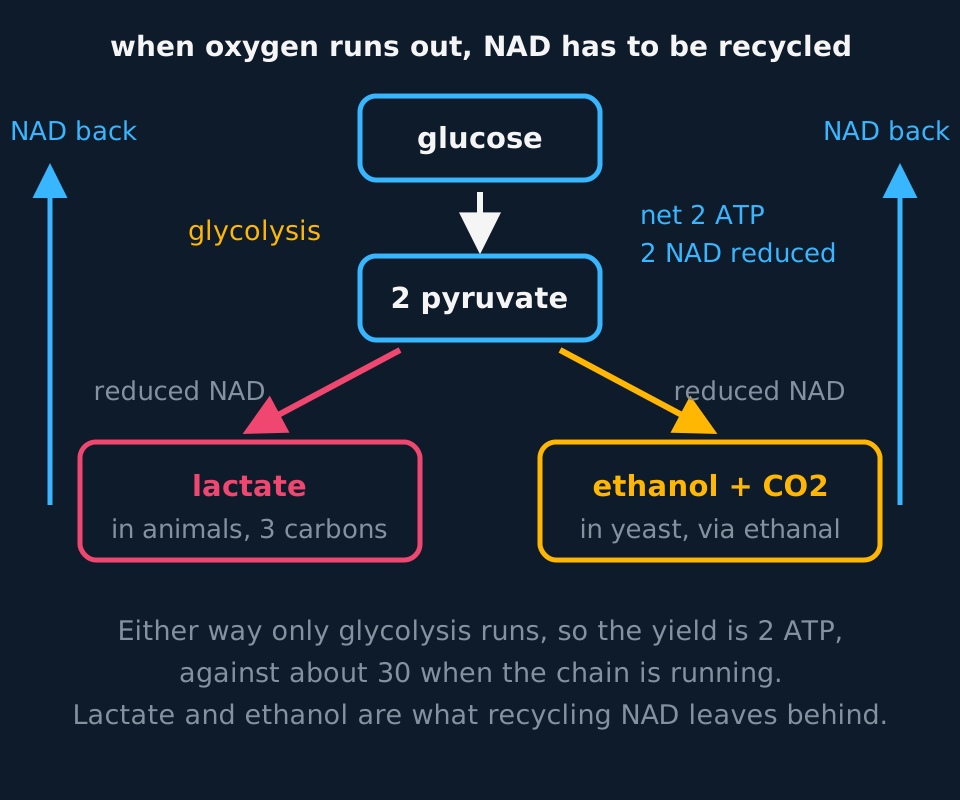
Glycolysis does not use oxygen directly, but it requires oxidised NAD to accept hydrogen when triose phosphate is oxidised. When oxygen is unavailable, the electron-transport chain cannot reoxidise reduced NAD. Cells therefore transfer hydrogen from reduced NAD to another acceptor: pyruvate is reduced to lactate in animals, while ethanal is reduced to ethanol in yeast and many plant tissues. This regenerates NAD so glycolysis can continue, with a net yield of two ATP per glucose.
Describe the drawing
A flow diagram. A box of glucose at the top leads down to a box of two pyruvate, with the step labelled glycolysis on one side and net two ATP and two NAD reduced on the other. From pyruvate two arrows branch outwards, each labelled reduced NAD: the left one reaches a box reading lactate, for animals, three carbons and no gas, and the right one a box reading ethanol plus carbon dioxide, for yeast, made by way of ethanal. From each of those boxes a tall arrow runs back up the outside of the diagram labelled NAD back, returning the coenzyme to glycolysis.
- Anaerobic respiration
- The release of energy from an organic molecule without oxygen, in which glycolysis continues because reduced NAD is oxidised by a reaction other than the electron transport chain.
- Fermentation
- The anaerobic conversion of pyruvate to lactate or to ethanol and carbon dioxide, regenerating oxidised NAD.
Lactate fermentation in animals and the Cori cycle
In an animal cell, pyruvate itself accepts the hydrogen. Reduced NAD is oxidised and pyruvate is reduced to lactate, catalysed by lactate dehydrogenase. Three carbons in, three carbons out; nothing is released as gas, and no ATP is made in the step itself.
Two features of this reaction matter. It is reversible, because the carbon is all still there. Given oxygen again, lactate can be converted back to pyruvate and fed into the link reaction as normal. And it is fast, which is why a sprinter can keep going for thirty seconds at a rate their oxygen supply cannot possibly sustain.
The pH of hard-working muscle falls as lactate accumulates, and the acidity interferes with the enzymes and the contractile proteins and contributes to fatigue. At A level the fall in pH is attributed to lactate accumulation; strictly, the protons come mainly from the high rate of ATP turnover that accompanies anaerobic work, with lactate as its most visible marker, and fatigue has other contributors besides acidity. Most of the lactate diffuses into the blood and is carried to the liver. In the Cori cycle, liver cells convert lactate back to pyruvate and then, using ATP, resynthesise glucose from it, which is released into the blood or stored as glycogen. That conversion needs energy and oxygen, and it is a large part of why breathing and heart rate stay elevated after hard exercise has finished. The older name for the raised oxygen consumption afterwards is the oxygen debt.
Lactate is not simply a waste product. Cardiac muscle and slow-twitch fibres take it up from the blood and oxidise it as a fuel, and the muscle soreness felt a day or two after unfamiliar exercise is caused by microscopic damage, not by lactate, which has long since gone.
Ethanol in yeast, and how the two routes differ
Yeast and plant tissues take a different route, and it takes two steps rather than one. Pyruvate is first decarboxylated: a carbon is removed as carbon dioxide, leaving the two-carbon ethanal. Ethanal then accepts hydrogen from reduced NAD and becomes ethanol, regenerating oxidised NAD.
Losing that carbon as gas makes the pathway irreversible in the way the lactate route is not, because the carbon has left. It also makes yeast commercially useful twice over: the ethanol is what a brewer wants and the carbon dioxide is what a baker wants, and both come from the same reaction. Yeast eventually poisons itself, since ethanol denatures its own enzymes; most strains stop at around 15% by volume, which is why spirits have to be distilled rather than simply fermented harder.
The same pathway allows rice to grow in flooded soil. A paddy field holds standing water, and water contains little dissolved oxygen and delivers it slowly, so the roots and the submerged base of the stem are close to anaerobic. Rice tolerates this through three adaptations. Its root and stem tissues develop aerenchyma, loosely packed cells with large interconnected air spaces, which form a continuous low-resistance channel down which oxygen diffuses from the shoot above the water to the cells below it. Where that supply still falls short, the root cells switch to ethanol fermentation: the same decarboxylation and reduction as in yeast, regenerating the oxidised NAD that keeps glycolysis and its 2 ATP per glucose running, and rice roots tolerate concentrations of ethanol that would injure most other crops. And when the water rises, the stems of deepwater varieties respond with faster elongation, growing quickly enough to keep the upper leaves above the surface so that photosynthesis, and the oxygen supply feeding the aerenchyma, continues. A complete account names all three adaptations and links the fermentation to the regeneration of oxidised NAD rather than stating only that the plant respires anaerobically.
| In animals | In yeast and plants | |
|---|---|---|
| Product | Lactate | Ethanol and carbon dioxide |
| Carbons in the product | 3, all of them kept | 2 in ethanol, 1 lost as CO₂ |
| Steps | One: pyruvate reduced | Two: decarboxylation, then reduction |
| Gas released | None | Carbon dioxide |
| Reversible? | Yes: lactate can become pyruvate again | No: the carbon has gone |
| ATP per glucose | 2 (net, from glycolysis) | 2 (net, from glycolysis) |
The difference in yield is large. Anaerobically, a molecule of glucose gives a net 2 ATP, because glycolysis is the only stage running and neither fermentation step makes any ATP at all. Aerobically the same molecule gives around 30. Anaerobic respiration therefore recovers something like seven per cent of what is available, which is why anaerobic organisms consume substrate at a high rate, and why a muscle working anaerobically empties its glycogen so quickly.
Comparing two flasks of yeast
Two flasks of yeast are given identical amounts of glucose. Flask A is aerated; flask B is sealed. After several hours, flask B has used far more glucose than flask A but has produced less carbon dioxide in total. Explain both observations.
Show the working
Flask B is respiring anaerobically, gaining 2 ATP per glucose against roughly 30 in flask A. To supply ATP at a comparable rate it must respire glucose roughly fifteen times as fast, so it races through its fixed supply while flask A draws its own down slowly.
The carbon dioxide result follows from where the gas comes from. Aerobically, all six carbons of each glucose leave as carbon dioxide, two in the link reaction and four in the Krebs cycle: 6 CO₂ per glucose. Anaerobically in yeast, only the decarboxylation of pyruvate releases gas, so 2 CO₂ per glucose.
So flask A releases three times as much carbon dioxide per glucose respired, and its total is the larger whenever it has respired more than a third as much glucose as B. Once B's glucose has run out, its total stops at 2 CO₂ for each glucose supplied, and A, with the same supply, passes that figure once it has respired a third of its own.
Respiring something other than glucose
Glucose is the standard substrate in every diagram, but it is not the only one, and in a person who has not eaten for a few hours it is not even the main one. Lipids and proteins both enter the same pathways, each at its own point.
Lipids are hydrolysed to glycerol and fatty acids. The glycerol is phosphorylated and converted to triose phosphate, joining glycolysis part-way down. The fatty acids are the substantial part: their long hydrocarbon chains are broken down two carbons at a time, and each two-carbon fragment becomes an acetyl group carried by coenzyme A straight into the Krebs cycle. A single 16-carbon fatty acid yields eight acetyl groups and therefore eight turns of the cycle, plus a large haul of reduced coenzyme from the breakdown itself.
Proteins are hydrolysed to amino acids, which are deaminated in the liver, where the amino group is removed and converted to urea. What is left of each amino acid enters wherever its carbon skeleton fits: some as pyruvate, some as acetyl CoA, some directly as an intermediate of the Krebs cycle. Protein is respired in quantity only when carbohydrate and lipid are short, because the amino acids used are drawn from functional body proteins rather than from a dedicated store.
Lipid yields more energy per gram: about 39 kJ from a gram of lipid against roughly 16 from carbohydrate and 17 from protein. The reason is its degree of reduction. A fatty acid chain is almost all carbon and hydrogen, with very little oxygen already attached, so it is highly reduced and carries a great many hydrogen atoms per carbon. Carbohydrate is already part-oxidised, since glucose carries an oxygen for every carbon. More hydrogen per gram means more reduced coenzyme, more electrons through the chain, more protons pumped and more ATP. It also means more oxygen is needed to respire it, which is what the respiratory quotient measures. A note on the numbers: these are the values A-level data sets use. For lipid and carbohydrate they are close to what a bomb calorimeter measures. For protein the calorimeter gives about 23 kJ per gram, because the body excretes nitrogen as urea with energy still in the molecule rather than oxidising it completely. Quote whichever figure your board's data uses and stay consistent within an answer.
| Substrate | Enters at | Energy per gram | RQ |
|---|---|---|---|
| Carbohydrate | Glycolysis, as glucose | ≈ 16 kJ | 1.0 |
| Lipid | Glycerol at triose phosphate; fatty acids as acetyl CoA | ≈ 39 kJ | ≈ 0.7 |
| Protein | As pyruvate, acetyl CoA or a Krebs intermediate | ≈ 17 kJ | ≈ 0.9 |
The respiratory quotient
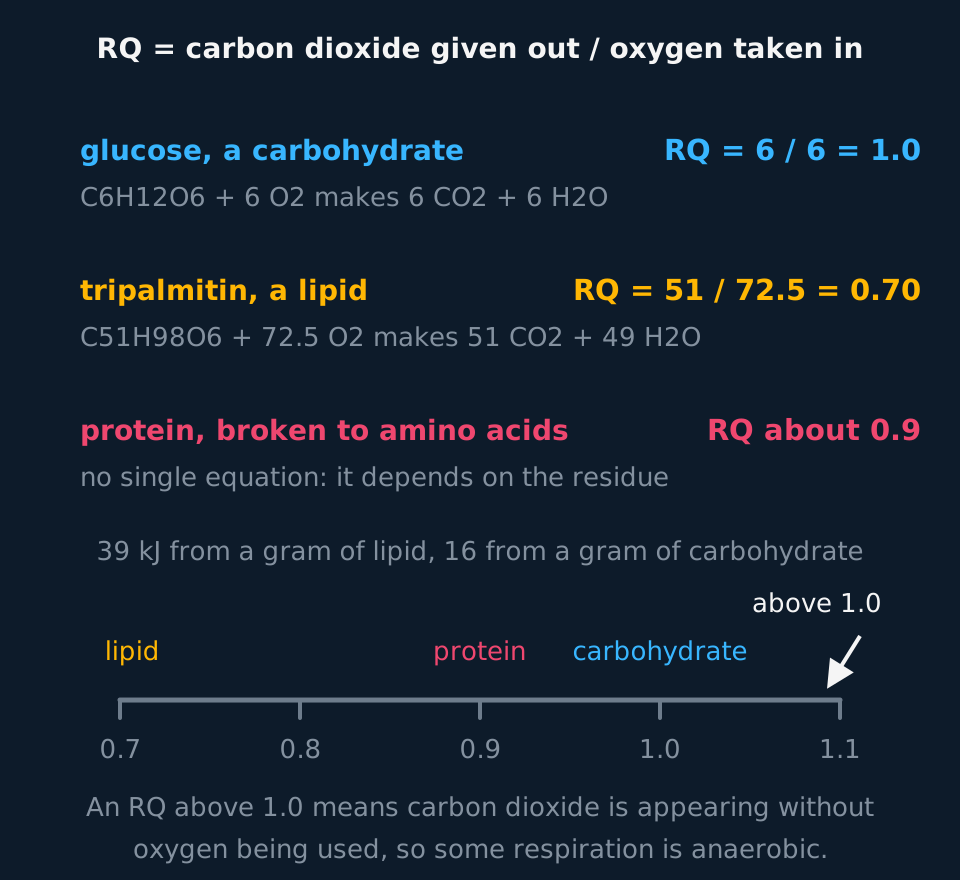
The oxygen required per carbon dioxide released differs between substrates, and the ratio is used to identify them. The respiratory quotient is the volume of carbon dioxide given out divided by the volume of oxygen taken in over the same period.
RQ = volume of CO2 produced ÷ volume of O2 consumedvolumes measured over the same time, at the same temperature and pressure
Work it out from a balanced equation and the arithmetic is short. For glucose, C₆H₁₂O₆ + 6O₂ gives 6CO₂ + 6H₂O, so RQ = 6 ÷ 6 = 1.0. For a typical lipid such as tripalmitin, C₅₁H₉₈O₆ + 72.5O₂ gives 51CO₂ + 49H₂O, so RQ = 51 ÷ 72.5 = 0.70. The lipid needs far more oxygen because it arrived carrying almost none of its own.
Describe the drawing
Three rows, each naming a respiratory substrate on the left with its balanced equation underneath and its respiratory quotient on the right: glucose respired to six carbon dioxide with six oxygen for an RQ of one, tripalmitin needing seventy-two and a half oxygen for fifty-one carbon dioxide for an RQ of nought point seven, and protein with no single equation at about nought point nine. Below them a horizontal scale runs from nought point seven to one point one with the three substrates marked on it in order and an arrow pointing to the region above one.
Reading an RQ from data
Germinating seeds in a respirometer take up 21.5 cm³ of oxygen and release 15.1 cm³ of carbon dioxide in the same period. Calculate the RQ and state, with a reason, which substrate the seeds are mainly respiring.
Show the working
RQ = 15.1 ÷ 21.5 = 0.70. Give it to two decimal places, and give no unit: the quotient is a ratio of two volumes.
A value of 0.70 indicates lipid. These are oil-storing seeds, and a lipid substrate demands much more oxygen per carbon dioxide released because it is highly reduced and carries little oxygen of its own.
A sensible extra sentence: as the seedling's oil reserve runs down and it begins to photosynthesise, the RQ would be expected to rise towards 1.0.
Values above 1.0 need explaining rather than reporting. Carbon dioxide is appearing that no oxygen uptake accounts for, so some of it is coming from a reaction that does not use oxygen, which is anaerobic respiration alongside the aerobic. Yeast in a sealed flask can show an RQ well above 1.0, and in a completely anaerobic culture, with oxygen uptake at zero, the quotient is undefined rather than merely large. A value slightly above 1.0 in a well-fed animal can also mean carbohydrate is being converted into lipid for storage, which releases carbon dioxide.
Measuring it: the respirometer
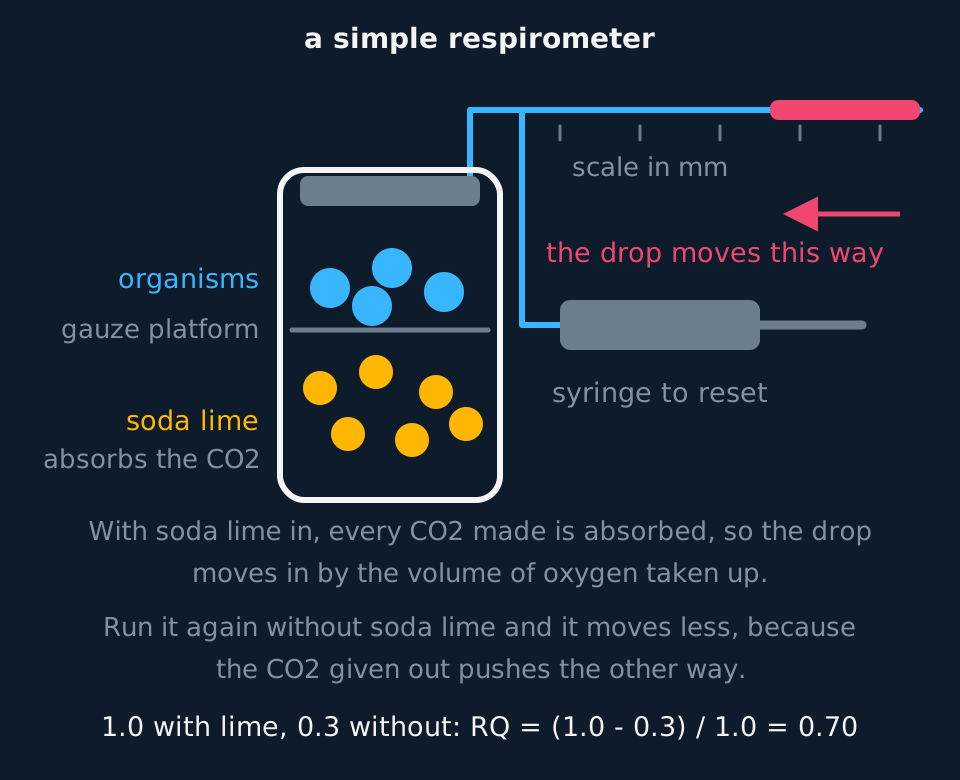
The apparatus measures the volume of oxygen consumed by living material. Living material such as germinating seeds, woodlice or blowfly larvae sits on a gauze platform in a sealed tube. Beneath the gauze is soda lime or concentrated potassium hydroxide, which absorbs carbon dioxide as fast as it is produced. A capillary tube containing a drop of coloured fluid runs from the tube to the outside air.
With the carbon dioxide absorbed, the only gas change left is the oxygen being used up. The pressure inside falls, and the fluid moves towards the respiring organisms by a volume equal to the oxygen consumed. Multiply the distance moved by the cross-sectional area of the capillary and you have that volume in cubic millimetres.
Describe the drawing
A boiling tube standing upright with a bung in its neck, drawn in section. Inside, four round organisms rest on a gauze platform part-way down and granules of soda lime fill the space beneath it. A capillary tube leaves the bung, turns and runs off to the right with a short scale marked along it and a block of coloured fluid sitting in it, and an arrow shows that block travelling back towards the tube. A syringe beside it is joined to the capillary by a side tube. Labels name the organisms, the gauze, the soda lime that absorbs carbon dioxide and the syringe, and lines of text below give the two readings that yield a respiratory quotient of nought point seven.
The controls determine whether the readings can be interpreted. An identical tube containing glass beads of the same mass, with the same soda lime, corrects for changes in room temperature and atmospheric pressure, which would otherwise move the drop as much as respiration does. The whole apparatus sits in a water bath so temperature is controlled, and it is left to equilibrate before the first reading, because gas warming up to bath temperature expands and swamps the effect being measured. A syringe lets the drop be returned to the start between readings. And the rate must be expressed per gram of organism per minute, or two results cannot be compared.
TRY IT: Getting an RQ out of two runs
A student runs a respirometer containing woodlice twice at 20 °C. With soda lime present, the fluid moves 40 mm towards the woodlice in ten minutes. With the soda lime removed and the apparatus otherwise unchanged, it moves 12 mm towards the woodlice in ten minutes. The capillary has a cross-sectional area of 1.0 mm². Calculate the RQ and comment on the substrate.
Check your answer
With soda lime, all the carbon dioxide is absorbed, so the movement measures oxygen uptake alone: 40 × 1.0 = 40 mm³ of oxygen in ten minutes.
Without soda lime, carbon dioxide is released back into the tube and partly offsets the oxygen used, so the movement measures the difference between them: 12 mm³. The carbon dioxide produced is therefore 40 − 12 = 28 mm³.
RQ = 28 ÷ 40 = 0.70, which indicates lipid as the main substrate.
The second step is the one to set out explicitly. The reading without soda lime is not the carbon dioxide; it is oxygen used minus carbon dioxide released, so it must be subtracted from the first reading.
Measuring it the other way: yeast and methylene blue
A respirometer measures a gas. A second standard method measures the removal of hydrogen from a substrate instead. The enzymes catalysing that removal are the dehydrogenases, and their hydrogen normally goes to NAD. A redox indicator will take it instead. Methylene blue is blue when oxidised and colourless when reduced, so a suspension of respiring yeast with methylene blue in it goes from blue to cream, and the time that takes is the measurement.
The method, tube by tube. Make up a yeast suspension by stirring dried yeast into warm water with glucose in it and leaving it for fifteen or twenty minutes, so the cells are active before the experiment starts rather than during it. Into a test tube put a measured volume of that suspension, say 10 cm³, and a measured volume of glucose solution of known concentration as the substrate, say 2 cm³. Stand the tube in a water bath and leave it long enough to reach the bath's temperature. Then add a small measured volume of dilute methylene blue (1 cm³ of a 0.05 per cent solution is typical), stopper the tube, invert it once to mix, and start the clock. Stop the clock when the blue colour has gone from the body of the liquid.
Two details of the set-up affect the result. Stopper the tube, or run a thin layer of oil on top of the liquid, because the reduced form of methylene blue is re-oxidised by oxygen from the air and turns blue again: leave the tube open and the colour comes back at the surface while the rest of the tube is already cream. For the same reason, do not shake the tube once timing has begun. And read the endpoint the same way every time, against a white background and ideally against a reference tube of already decolourised suspension, because a colour judgement made by eye is the least reproducible part of the whole procedure. A colorimeter with a red filter removes that judgement altogether, and turns the run into a series of absorbance readings rather than a single time.
Then change one thing. The usual choice is temperature: identical tubes in water baths at 20, 30, 40, 50 and 60 °C, everything else held constant, and the decolourising time recorded for each. The curve that comes out is the enzyme curve from the enzymes unit, rising to an optimum near 40 °C and falling steeply above it as the dehydrogenases denature. A second choice is substrate concentration: glucose at, say, 0, 1, 2, 5 and 10 per cent, giving a rate that rises and then levels off as the enzymes approach saturation. DCPIP, also blue when oxidised and colourless when reduced, can replace methylene blue in any of these runs, and Cambridge lists both. A third choice is the substrate itself: the same yeast given glucose, sucrose, maltose, lactose or starch at the same concentration. Yeast decolourises fastest on glucose, which needs no hydrolysis first, manages sucrose and maltose, and does almost nothing with lactose or starch, because it has no enzyme to hydrolyse them and cannot take the intact molecule in. That last result is the interesting one, since it tests the yeast's enzymes rather than its energy supply.
Rate is the reciprocal of the time. A tube that decolourises in 60 s is respiring twice as fast as one that takes 120 s, so plotting time against temperature gives a curve with a minimum where the biology has a maximum. Plot 1 ÷ time, in units of s⁻¹, and the graph has the shape the explanation needs.
| Variable | How it is handled |
|---|---|
| Temperature of the tube | Independent variable if it is the one being changed; otherwise fixed by a water bath |
| Volume and concentration of yeast suspension | Controlled: same volume from the same batch in every tube |
| Volume and concentration of methylene blue | Controlled: too much takes longer to reduce and is toxic to the cells |
| Substrate and its concentration | Independent variable if either is what is being compared; otherwise controlled |
| pH | Controlled with a buffer, since fermentation acidifies the suspension as it runs |
| Time to lose the blue colour | Dependent variable, converted to a rate as 1 ÷ time |
The control is a tube of yeast that was boiled and then cooled back to the temperature of the run, given the same substrate, the same volume of methylene blue and the same treatment as every other tube. It stays blue. Boiling denatures the dehydrogenases, so no hydrogen is removed from the substrate and nothing reduces the indicator, and that is precisely why it is the right control rather than a tube of water. A tube of water would differ from the experimental tubes in several ways at once: no cells, so a clear liquid instead of a cloudy one, which changes how the colour looks and how the endpoint is judged, and nothing present that could reduce the dye by ordinary chemistry rather than by respiration. Boiled yeast keeps every one of those features and removes exactly one thing, the enzyme activity. If the boiled tube decolourises too, the result did not come from respiration, and the experiment has told you so before you draw the graph.
- Dehydrogenase
- An enzyme that catalyses the removal of hydrogen from a substrate, passing it to a carrier such as NAD.
- Redox indicator
- A dye that changes colour when it is reduced or oxidised, such as methylene blue, which is blue when oxidised and colourless when reduced.
Reading a set of decolourising times
Tubes of yeast with glucose and methylene blue are held at five temperatures. The times to decolourise are 610 s at 20 °C, 300 s at 30 °C, 190 s at 40 °C, 340 s at 50 °C and no decolourisation within 900 s at 60 °C. A boiled-yeast tube at 40 °C stayed blue throughout. Explain the pattern.
Show the working
Convert to rates first: 0.0016, 0.0033, 0.0053 and 0.0029 s⁻¹ for the first four, and effectively zero at 60 °C. Now the shape is the familiar one, a rise to a peak near 40 °C and a collapse above it.
The rise from 20 to 40 °C is the usual kinetic argument: more kinetic energy, more frequent successful collisions between the dehydrogenases and their substrates, so hydrogen is removed faster and the indicator is reduced faster.
The fall above 40 °C is denaturation. Hydrogen bonds holding the tertiary structure break, the active sites change shape, and by 60 °C enough of the dehydrogenases have been destroyed that no measurable reduction happens in fifteen minutes.
The boiled tube is what licenses that conclusion. It shows the dye is not being reduced by anything in the medium or by the heat itself, so the colour change in the other tubes was the yeast's enzymes and nothing else.
Yeast with and without oxygen
OCR asks for the rate of respiration of yeast to be compared in aerobic and anaerobic conditions. Yeast is a facultative anaerobe: it respires aerobically when oxygen is available and switches to ethanol fermentation when it is not, so two portions of the same suspension can be run side by side with oxygen as the only planned difference.
Set up the two conditions with everything else matched: the same volume of the same yeast suspension, the same volume and concentration of glucose solution, the same water bath and the same time to reach its temperature. For the anaerobic flask, boil the glucose solution first and let it cool, which drives out the dissolved oxygen, then add the yeast and pour a layer of liquid paraffin over the surface so oxygen from the air cannot dissolve back in. For the aerobic flask, use glucose solution that has not been boiled, leave a large volume of air above the suspension, and swirl it at regular intervals so oxygen keeps dissolving. Use a fairly dilute glucose solution: given a lot of glucose, baker's yeast ferments part of it to ethanol even with oxygen present, and the aerobic flask then stops being purely aerobic.
The obvious apparatus is a flask joined to a gas syringe, read every few minutes. For the anaerobic flask it works. Fermentation releases carbon dioxide and takes in no oxygen, so the volume of gas rises and the plunger moves out by about the volume of carbon dioxide released. For the aerobic flask a gas syringe alone shows little net change, however fast the yeast is respiring. Aerobic respiration of glucose takes in one molecule of oxygen for every molecule of carbon dioxide it releases (an RQ of 1.0), and equal numbers of gas molecules take up equal volumes at the same temperature and pressure. Every cubic centimetre of oxygen removed from the air space is replaced by a cubic centimetre of carbon dioxide, and the total stays almost the same. If anything the plunger creeps in, because carbon dioxide is far more soluble in water than oxygen and some of it stays dissolved in the suspension. A result of 'no gas produced' for the aerobic flask is a balance between two gases, not a slow rate.
Three ways round it measure what the gas syringe cannot. The first, and the one that gives both gases, is a respirometer run with and without soda lime, exactly as in the section above. With soda lime (or potassium hydroxide on a filter-paper wick) held in a small container above the liquid, all the carbon dioxide is absorbed and the movement measures oxygen uptake. Without it, the movement is carbon dioxide released minus oxygen taken in, and the difference between the two runs gives the carbon dioxide. The aerobic flask contracts with soda lime and barely moves without it; the anaerobic flask does not move with soda lime, because it takes in no oxygen, and expands without it. The second is to measure carbon dioxide directly in both flasks, with a carbon dioxide sensor and data logger in the air space or by bubbling the gas through hydrogencarbonate indicator. The third is to follow the glucose itself, measuring how much remains after a set time.
Methylene blue, used in the section above, is not one of the three. Oxygen re-oxidises the reduced dye, so an aerated tube stays blue however fast its dehydrogenases are working, and the comparison would measure the oxygen supply rather than the respiration. It is the right method for comparing anaerobic tubes with each other, and the wrong one for this question.
Each condition needs its own control flask of boiled and cooled yeast, and the results should be expressed as a volume per minute so they can be compared. Soda lime and potassium hydroxide are corrosive: wear eye protection, keep them out of contact with skin and with the yeast, and check the CLEAPSS Hazcards and your school's risk assessment before starting.
- Facultative anaerobe
- An organism that respires aerobically when oxygen is available and anaerobically when it is not, as yeast does.
TRY IT: Comparing the two flasks
Two respirometers each hold 10 cm³ of the same yeast suspension in glucose solution at 30 °C, one aerobic and one under paraffin. Each is run for 20 minutes with soda lime and again without it. These readings are constructed for practice. Aerobic: contracts 1.20 cm³ with soda lime and 0.04 cm³ without. Anaerobic: no movement with soda lime, expands 2.40 cm³ without. Calculate the rate of carbon dioxide release in each flask and compare the rates at which they use glucose.
Check your answer
Aerobic flask. With soda lime the contraction is the oxygen taken in: 1.20 cm³. Without soda lime the contraction is oxygen in minus carbon dioxide out, so the carbon dioxide is 1.20 − 0.04 = 1.16 cm³ in 20 minutes, a rate of 0.058 cm³ min⁻¹. The RQ is 1.16 ÷ 1.20 = 0.97, close to the 1.0 of glucose.
Anaerobic flask. No movement with soda lime means no oxygen is taken in, so the 2.40 cm³ expansion without it is all carbon dioxide: a rate of 0.12 cm³ min⁻¹, about twice the aerobic rate.
Glucose. Aerobically each glucose gives 6 CO₂; anaerobically, 2. The anaerobic flask is therefore using glucose at about (0.12 ÷ 2) ÷ (0.058 ÷ 6) = 6.2 times the aerobic rate. Fermentation gives 2 ATP per glucose against roughly 30 aerobically, so the anaerobic yeast must get through glucose much faster for a similar supply of ATP.
A gas syringe on the aerobic flask would have recorded the 0.04 cm³ alone, and that reading on its own would have suggested the aerobic yeast was barely respiring.
In the exam
- State the function of anaerobic respiration: it regenerates oxidised NAD so that glycolysis can continue. Naming the product alone does not explain it.
- The anaerobic yield is 2 ATP per glucose and all of it comes from glycolysis. Neither fermentation step produces ATP.
- Give the yeast route in two steps: pyruvate is decarboxylated to ethanal, then ethanal is reduced to ethanol. Going straight from pyruvate to ethanol omits the carbon dioxide.
- Explain the higher energy per gram of lipid by its chemistry: more hydrogen atoms per gram, so more reduced coenzyme, more protons pumped and more ATP.
- RQ has no unit and is quoted to two decimal places. State the substrate it indicates. A value above 1.0 indicates that some respiration is anaerobic, or that carbohydrate is being converted to lipid.
- For a respirometer, include the control tube of glass beads and the water bath in the method as well as the treatment of the organisms.
- For the methylene blue investigation, state what the dye does: it accepts hydrogen from the dehydrogenases in place of NAD, so a shorter time to decolourise means a faster rate of respiration.
- The control is boiled yeast rather than water, because it matches the experimental tube in everything except enzyme activity. State also that the tube is stoppered, since oxygen re-oxidises the dye.
- Comparing aerobic and anaerobic yeast: say how oxygen is removed (boiled glucose solution under paraffin) and how the gases are separated (runs with and without soda lime). Aerobic respiration takes in as much oxygen as it gives out carbon dioxide, so a gas syringe alone records almost nothing.
Check yourself
A 100 m sprinter and a marathon runner are both working hard. Explain why the sprinter's muscles produce lactate while the marathon runner's largely do not, and explain why the marathon runner's main respiratory substrate changes during the race.
Answer
The sprinter's muscles demand ATP far faster than the heart and lungs can supply oxygen to them, so the electron transport chain cannot oxidise reduced NAD quickly enough. Without oxidised NAD being returned, glycolysis would stop, so pyruvate is reduced to lactate instead, which hands the hydrogen over and lets glycolysis continue. The yield is only 2 ATP per glucose, but it arrives quickly and without waiting for oxygen.
The marathon runner works at an intensity oxygen delivery can keep up with. Reduced NAD is oxidised at the inner membrane as fast as it is made, oxidised NAD is returned to the cytoplasm and the matrix, and pyruvate goes into the link reaction rather than being reduced. Little lactate accumulates, and what does is taken up and respired by cardiac and slow-twitch muscle.
The substrate changes because the stores run out at different rates. Muscle and liver glycogen last roughly an hour and a half of hard running; as carbohydrate is depleted, an increasing proportion of the ATP comes from fatty acids, hydrolysed from stored triglyceride and fed in as acetyl CoA. Lipid gives about 39 kJ per gram against 16 for carbohydrate, so the reserve is large, but it needs more oxygen per carbon dioxide released, which is why the runner's RQ falls from near 1.0 towards 0.8 or below as the race goes on, and why the pace that can be held drops with it.
Questions
Question 15 marks
Describe how you would compare the rate of respiration of yeast in aerobic and anaerobic conditions, using respirometers.
Mark scheme
- B1 use the same volume of the same yeast suspension and the same volume and concentration of glucose solution in each, in a water bath at the same temperature, left to equilibrate before readings start
- B1 anaerobic: boil and cool the glucose solution to remove dissolved oxygen, then cover the suspension with a layer of liquid paraffin or oil
- B1 aerobic: unboiled solution with a large air space, swirled at intervals so oxygen keeps dissolving
- B1 run each with soda lime or potassium hydroxide to absorb carbon dioxide, so the movement gives oxygen uptake, and again without it; the difference between the two runs gives the carbon dioxide released
- B1 measure the distance the fluid moves in a set time, convert to a volume using the capillary's cross-sectional area, express as a rate per minute, and use boiled yeast as a control for each condition
Question 24 marks
Explain why glycolysis can continue in a muscle cell that has run short of oxygen, and explain what the reduction of pyruvate to lactate achieves.
Mark scheme
- B1 no step of glycolysis uses oxygen; what it needs is oxidised NAD, to accept the hydrogen removed when triose phosphate is oxidised
- B1 without oxygen the electron transport chain cannot oxidise reduced NAD, so oxidised NAD is no longer returned to the cytoplasm and glycolysis would stall within seconds
- B1 pyruvate accepts the hydrogen from reduced NAD instead, catalysed by lactate dehydrogenase, so pyruvate is reduced to lactate and oxidised NAD is regenerated
- B1 glycolysis can therefore keep running and keep supplying 2 ATP per glucose, quickly and without waiting for oxygen, so the lactate is a by-product of solving the coenzyme problem rather than the purpose of the pathway
Question 34 marks
Compare the anaerobic pathway followed in an animal muscle cell with the anaerobic pathway followed in yeast.
Mark scheme
- B1 in an animal, pyruvate is reduced to lactate in a single step, whereas in yeast pyruvate is first decarboxylated to ethanal and the ethanal is then reduced to ethanol, which is two steps
- B1 the animal route keeps all three carbons in the lactate, whereas the yeast route loses one as carbon dioxide, so only the yeast route releases a gas
- B1 the animal route is reversible, so lactate can be converted back to pyruvate and respired once oxygen returns, whereas the yeast route is irreversible because the carbon has left as gas
- B1 both routes exist to regenerate oxidised NAD for glycolysis, and both give the same net yield of 2 ATP per molecule of glucose
Question 44 marks
Germinating seeds are placed in a respirometer at 20 °C. With soda lime present the fluid drop moves 50 mm towards the seeds in ten minutes; with the soda lime removed and everything else unchanged it moves 5 mm towards the seeds in ten minutes. The capillary has a cross-sectional area of 1.0 mm². Calculate the respiratory quotient and state which substrate it indicates.
Mark scheme
- M1 with soda lime the carbon dioxide is absorbed as fast as it is made, so the movement measures oxygen uptake alone: 50 × 1.0 = 50 mm³
- M1 without soda lime the movement measures oxygen consumed minus carbon dioxide released: 5 × 1.0 = 5 mm³, so the carbon dioxide produced is 50 − 5 = 45 mm³
- M1 RQ = volume of carbon dioxide produced ÷ volume of oxygen consumed = 45 ÷ 50
- A1 RQ = 0.90, quoted with no units, which indicates protein as the main substrate, or a mixture of substrates
Question 54 marks
A student wants to find the effect of temperature on the rate of respiration in yeast, using methylene blue. Describe how the investigation should be carried out.
Mark scheme
- B1 mix a measured volume of yeast suspension with a measured volume of a substrate such as glucose solution, and leave the tube in a water bath until it has reached the bath temperature
- B1 add a small measured volume of dilute methylene blue, stopper the tube or layer oil on top, invert once to mix and start timing
- B1 record the time taken for the blue colour to disappear, judged against the same reference each time, and repeat the whole procedure at a series of temperatures such as 20, 30, 40, 50 and 60 °C
- B1 keep the volume and concentration of yeast, substrate and methylene blue the same in every tube, and calculate the rate as 1 divided by the time
Question 64 marks
Calculate the respiratory quotient of each of the three organisms in the table, and use the values to identify the respiratory substrate each is mainly using.
| Organism | Oxygen used / cm³ h⁻¹ | Carbon dioxide produced / cm³ h⁻¹ |
|---|---|---|
| germinating wheat grains | 24.0 | 24.0 |
| germinating castor oil seeds | 30.0 | 21.0 |
| blowfly larvae | 20.0 | 18.0 |
Mark scheme
- M1 respiratory quotient = carbon dioxide produced ÷ oxygen used, over the same time
- A1 wheat 24.0 ÷ 24.0 = 1.00, castor 21.0 ÷ 30.0 = 0.70, larvae 18.0 ÷ 20.0 = 0.90
- B1 a quotient of 1.00 means carbohydrate, because glucose respired aerobically gives one carbon dioxide for every oxygen used
- B1 0.70 means lipid, which is more reduced and so needs more oxygen per carbon dioxide released; 0.90 is between the two and indicates protein, or a mixture
Question 74 marks
Describe what happens to lactate produced by hard-working muscle once it diffuses into the blood, up to and including the point at which glucose is released back into the blood.
Mark scheme
- B1 lactate diffuses from the muscle into the blood and is carried to the liver
- B1 in the liver, lactate is converted back to pyruvate, the reverse of the reaction that produced it in the muscle
- B1 the liver then uses ATP to resynthesise glucose from that pyruvate, which needs energy and oxygen
- B1 the newly made glucose is released into the blood, or stored as glycogen, and can be taken up by the muscle again; this whole route is the Cori cycle, and the extra oxygen the liver uses to carry it out is a large part of why breathing and heart rate stay raised after hard exercise has stopped
Question 84 marks
Rice grows successfully in flooded paddy fields, where the roots and the submerged base of the stem receive little dissolved oxygen. Explain three adaptations that allow rice to survive these conditions.
Mark scheme
- B1 rice develops aerenchyma in its root and stem tissue, loosely packed cells with large interconnected air spaces that form a continuous low-resistance channel down which oxygen can diffuse from the shoot above the water to the submerged cells below
- B1 where the oxygen supply through aerenchyma still falls short, the affected root cells switch to ethanol fermentation, the same reaction as in yeast, which regenerates the oxidised NAD that keeps glycolysis running without oxygen
- B1 rice root cells can tolerate concentrations of ethanol produced this way that would injure most other crop plants
- B1 in deepwater varieties, rising floodwater triggers faster stem elongation, growing quickly enough to keep the upper leaves above the surface so photosynthesis, and the oxygen supply feeding the aerenchyma, can continue
Question 94 marks
Explain how the products of lipid digestion enter the respiratory pathways, and explain why a fatty acid molecule yields far more reduced coenzyme than the glycerol from the same lipid molecule.
Mark scheme
- B1 a triglyceride is hydrolysed to glycerol and fatty acids; the glycerol is phosphorylated and converted to triose phosphate, entering glycolysis part-way down rather than at the start
- B1 the fatty acids are broken down into two-carbon fragments, and each fragment becomes an acetyl group carried by coenzyme A straight into the Krebs cycle, bypassing glycolysis and the link reaction entirely
- B1 a single molecule of glycerol is only a three-carbon molecule contributing at one point in glycolysis, whereas a typical fatty acid chain is much longer, such as 16 carbons, giving several acetyl groups, each driving a full turn of the Krebs cycle with its own reduced NAD and reduced FAD
- B1 so the fatty acid component, being both longer and entering directly into repeated turns of the Krebs cycle, contributes far more reduced coenzyme, and eventually far more ATP, than the single glycerol molecule from the same triglyceride
Question 104 marks
Yeast was kept in two respirometers for 10 minutes, one aerobic and one anaerobic, each run with and without soda lime. The readings in the table were constructed for this question rather than measured. Calculate the rate of carbon dioxide release in each, in cm³ min⁻¹, and the respiratory quotient of the aerobic yeast.
| Condition | With soda lime | Without soda lime |
|---|---|---|
| Aerobic | contracts 0.50 cm³ | contracts 0.02 cm³ |
| Anaerobic | no movement | expands 0.90 cm³ |
Mark scheme
- M1 aerobic carbon dioxide = oxygen taken in minus the net contraction = 0.50 − 0.02 = 0.48 cm³ in 10 minutes
- A1 aerobic rate = 0.048 cm³ min⁻¹ and RQ = 0.48 ÷ 0.50 = 0.96
- M1 anaerobic: no movement with soda lime means no oxygen is taken in, so the whole expansion without soda lime is carbon dioxide, 0.90 cm³
- A1 anaerobic rate = 0.090 cm³ min⁻¹
Question 113 marks
Explain why a gram of lipid releases roughly 39 kJ when it is respired while a gram of carbohydrate releases only about 16 kJ.
Mark scheme
- B1 a fatty acid chain is almost entirely carbon and hydrogen, with very little oxygen already attached, so it is highly reduced and carries many more hydrogen atoms per gram than glucose, which holds an oxygen for every carbon
- B1 more hydrogen per gram means more reduced NAD and reduced FAD are produced, so more electrons pass along the chain and more protons are pumped into the intermembrane space
- B1 more protons returning through ATP synthase means more ATP is made per gram; it also means more oxygen is needed, which is why lipid gives a respiratory quotient near 0.70
Question 123 marks
Explain why a respirometer investigation includes a second tube holding glass beads of the same mass, and why the whole apparatus is left to equilibrate in a water bath before the first reading is taken.
Mark scheme
- B1 the tube of glass beads contains nothing that respires, so any movement of fluid in it is caused by changes in room temperature or atmospheric pressure rather than by oxygen uptake
- B1 its reading is used to correct the reading from the experimental tube, so that a warm afternoon is not recorded as a burst of respiration
- B1 gas warming up to the temperature of the water bath expands, and that expansion would swamp the small volume change caused by the organisms, so the apparatus is equilibrated before readings begin
Question 133 marks
A sealed flask of yeast, fed on glucose, is found to have a respiratory quotient of 1.6. Suggest what this value shows about the respiration taking place in the flask.
Mark scheme
- B1 carbon dioxide is being released that the oxygen uptake cannot account for, so some of it must come from a reaction that does not consume oxygen
- B1 the yeast must therefore be respiring anaerobically alongside any aerobic respiration, releasing carbon dioxide when pyruvate is decarboxylated to ethanal
- B1 aerobic respiration of glucose alone would give a quotient of 1.0, so a value as high as 1.6 suggests the oxygen sealed into the flask is running short
Question 143 marks
In the yeast and methylene blue investigation, a tube of boiled and cooled yeast is set up alongside the others. Explain why methylene blue loses its colour in the untreated tubes, and explain why boiled yeast is the appropriate control.
Mark scheme
- B1 dehydrogenases in the respiring yeast remove hydrogen from the substrate, and the methylene blue accepts it in place of NAD, so the dye is reduced and its blue colour is lost
- B1 boiling denatures those enzymes, so no hydrogen is transferred and the boiled tube stays blue
- B1 the boiled tube matches the others in everything else, the same cloudy suspension, substrate, dye volume and temperature, so it differs only in enzyme activity and shows that the colour change was caused by respiration rather than by the medium
Question 153 marks
Compare carbohydrate with protein as a respiratory substrate, referring to where each enters the respiratory pathways and to the respiratory quotient each gives.
Mark scheme
- B1 carbohydrate (glucose) enters at the very start of glycolysis, whereas protein is first hydrolysed to amino acids, which are deaminated in the liver, and what remains of each amino acid enters at various different points, some as pyruvate, some as acetyl CoA, some directly as a Krebs cycle intermediate
- B1 carbohydrate gives a respiratory quotient of about 1.0, whereas protein gives an intermediate value of about 0.9, reflecting protein's intermediate degree of reduction between carbohydrate and lipid
- B1 carbohydrate is respired in quantity routinely, whereas protein is respired in quantity mainly when carbohydrate and lipid are in short supply, because the amino acids used are drawn from functional body proteins rather than from a substance stored for the purpose
Question 163 marks
A student connects a flask of yeast in glucose solution to a gas syringe. The flask is aerated and the yeast is respiring aerobically, yet the plunger barely moves in 20 minutes. Explain why.
Mark scheme
- B1 aerobic respiration of glucose takes in one molecule of oxygen for every molecule of carbon dioxide released, an RQ of 1.0
- B1 equal numbers of gas molecules occupy equal volumes at the same temperature and pressure, so the oxygen removed is replaced by an equal volume of carbon dioxide
- B1 so the total volume of gas, which is all a gas syringe measures, stays almost constant; any small fall is because carbon dioxide is more soluble in water than oxygen
Question 172 marks
State the products formed when yeast respires glucose anaerobically, and state the net number of ATP molecules gained per molecule of glucose.
Mark scheme
- B1 ethanol and carbon dioxide are the products of the fermentation itself
- B1 the net gain is 2 ATP per molecule of glucose, all of it from glycolysis, since neither fermentation step makes any ATP
Question 182 marks
State the approximate energy value of a gram of protein used in A-level data, and state what happens to the amino group of an amino acid before the rest of the molecule can be respired.
Mark scheme
- B1 about 17 kJ per gram
- B1 it is removed by deamination in the liver and converted to urea, and what is left enters respiration as pyruvate, acetyl CoA or a Krebs cycle intermediate, wherever its carbon skeleton fits
Worth remembering
- Glycolysis needs oxidised NAD, not oxygen. Anaerobic routes exist to hand that NAD back.
- Animals: pyruvate to lactate, three carbons kept, reversible. Yeast: pyruvate to ethanal plus CO₂, then ethanal to ethanol, irreversible.
- Anaerobic yield is 2 ATP per glucose against about 30 aerobically.
- Lipid gives roughly 39 kJ per gram because it is highly reduced: more hydrogen per gram means more reduced coenzyme.
- RQ = CO₂ out ÷ O₂ in. About 1.0 for carbohydrate, 0.9 for protein, 0.7 for lipid; above 1.0 usually indicates some anaerobic respiration (or carbohydrate being converted to lipid).
- Yeast plus substrate plus methylene blue in a stoppered tube: time the loss of blue, take the rate as 1 ÷ time, and vary temperature, substrate concentration or the substrate itself.
- Boiled yeast is the control, because it differs from the experimental tube only in having no working dehydrogenases, and it should stay blue.
- Aerobic yeast swaps oxygen for carbon dioxide volume for volume, so compare the two conditions with a respirometer run with and without soda lime, not with a gas syringe alone.
CHECK YOUR PROGRESS
Rate how confident you are with each objective for this lesson. Ratings are saved in this browser, on this device, unless you sign in.
- Explain why glycolysis can continue without oxygen and what must be regenerated for it to do so.
- Describe lactate fermentation and explain what happens to the lactate afterwards.
- Describe ethanol fermentation in yeast and compare it with the animal route.
- Compare anaerobic and aerobic yields per molecule of glucose.
- Explain how lipids and proteins enter respiration and why lipid yields more energy per gram.
- Calculate a respiratory quotient and interpret values of 0.7, 1.0 and above 1.0.
- Describe how a respirometer is used, including its controls.
- Describe the yeast and methylene blue investigation, saying what is mixed, what is varied and what is timed, and explain why boiled yeast is the control it needs.
- Describe how to compare the rate of respiration of yeast in aerobic and anaerobic conditions, and explain why a gas syringe alone shows little change for the aerobic flask.
Open the full revision checklist to see every objective in the curriculum in one place.
Practise this lesson
WORKBOOK
The written questions from this topic, on paper with room to work, and a separate book of mark schemes. The 2 questions that are set on a diagram stay on this page, where the diagram can be drawn. Free to use; please do not redistribute or sell.
Used later in Muscles and movement: the sliding-filament model · The liver: detoxification, deamination and the making of urea