Biology › Respiration and cellular energy › Glycolysis, ATP and the link reaction
Glycolysis, ATP and the link reaction
ATP transfers usable free energy between cellular reactions. Its hydrolysis to ADP and inorganic phosphate, and the phosphorylation reactions that use it, come first; glucose is then followed through glycolysis in the cytoplasm and pyruvate through the link reaction in the mitochondrial matrix, with ATP, reduced NAD and carbon dioxide counted per molecule of glucose.
Before this Mitochondrial structure and the fluid mosaic membrane · Enzymes, coenzymes and activation energy · Oxidation and reduction as loss and gain of hydrogen
COMMON MISCONCEPTION
ATP is the cell's energy store, so cells build up a supply and draw on it when they need it.
Cells store energy as glycogen and triglyceride, not as ATP. An adult holds about 50 g of ATP at any moment and turns over close to their own body mass of it in a day, so the whole pool would be gone in about ninety seconds without resynthesis.
What you should be able to do
- Describe the structure of ATP and explain what its hydrolysis releases, with a figure.
- Give three reasons ATP suits a cell better than releasing a glucose molecule's energy in one go.
- State where each of the four stages of respiration happens, and why glycolysis needs no oxygen.
- Describe glycolysis as phosphorylation, lysis and oxidation, with the net yield per glucose.
- Describe the link reaction, naming the decarboxylation and the dehydrogenation.
- Keep a running tally of ATP, reduced NAD and carbon dioxide per molecule of glucose.
Respiration is not breathing, and ATP is not a store
Breathing, or ventilation, moves air in and out of the lungs. Respiration is a set of enzyme-controlled reactions inside cells that releases energy from organic molecules and uses it to make ATP. A yeast cell in a sealed flask respires and has no lungs at all, so respiration should be located in cells rather than in the lungs.
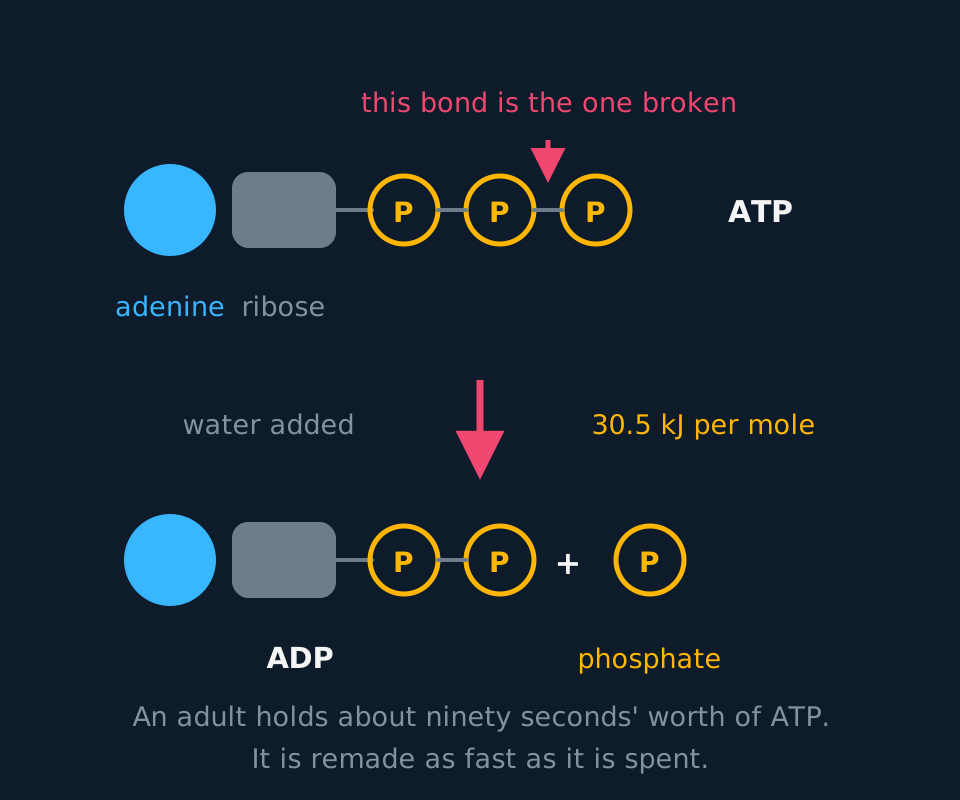
Adenosine triphosphate is a nucleotide: the base adenine, the five-carbon sugar ribose, and a chain of three phosphate groups. The three phosphates carry negative charges packed close together, which makes the chain strained, and it is the last phosphate in that chain, the terminal one, that matters.
Describe the drawing
Two rows showing the same molecule before and after hydrolysis. The upper row is ATP: a round adenine group, a block of ribose beside it, and three ringed phosphate groups joined in a line, with an arrow pointing down at the bond holding the last one. A thick arrow leads to the lower row, labelled water added on one side and thirty point five kilojoules per mole on the other. The lower row shows adenine, ribose and only two phosphates, labelled ADP, with the third phosphate drawn separately alongside.
Hydrolysis of that terminal bond, catalysed by an ATP hydrolase, gives ADP and an inorganic phosphate ion and releases about 30.5 kJ per mole. Be precise about where the energy comes from: it is the overall reaction, products more stable than reactants, not the snapping of one bond. ATP hydrolysis to ADP and inorganic phosphate releases usable free energy overall, and cells couple this exergonic reaction to energy-requiring processes, often by transferring the phosphate group to another molecule. The 30.5 is the standard-conditions figure, with the real value in a cell varying with concentrations. Complete oxidation of one mole of glucose releases roughly 2880 kJ, nearly a hundred times as much, and released in one reaction most of it would be lost as heat. Respiration oxidises glucose in small steps so that the energy is released in quantities a cell can couple to its reactions.
- ATP
- Adenosine triphosphate: a phosphorylated nucleotide made of adenine, ribose and three phosphate groups, used as the immediate source of energy in every cell.
- Hydrolysis of ATP
- The breaking of the bond to the terminal phosphate by addition of water, catalysed by ATP hydrolase, giving ADP and inorganic phosphate and releasing about 30.5 kJ per mole.
- Phosphorylation
- The addition of a phosphate group to a molecule. The phosphate released from ATP is often added to another molecule, making it more reactive.
Three properties make ATP a suitable immediate energy source, and a complete answer gives all three. It releases energy in a single step, so there is no delay while intermediates form. The quantity released is small enough to be useful, so little is wasted as heat. And the reaction is easily reversed: ATP synthase joins ADP and phosphate straight back together, so the same molecules cycle round and round. A fourth point is worth knowing: ATP cannot cross the cell surface membrane, so it is made in the cell that will use it and never shipped between cells the way glucose is.
The energy released is used in muscle contraction, active transport, DNA replication and protein synthesis. In many of these the phosphate group is transferred to the substrate rather than released alone. Phosphorylating a substrate lowers the activation energy of the next reaction, and the first steps of glycolysis are an example.
The scale is worth a number. An adult holds roughly 50 g of ATP at any instant and turns over something close to their own body mass of it in a day. Stop remaking it and the whole pool is gone in about ninety seconds. Cells do store energy, as glycogen in the liver and muscle and as triglyceride in adipose tissue, but they never stockpile ATP.
Four stages, two compartments
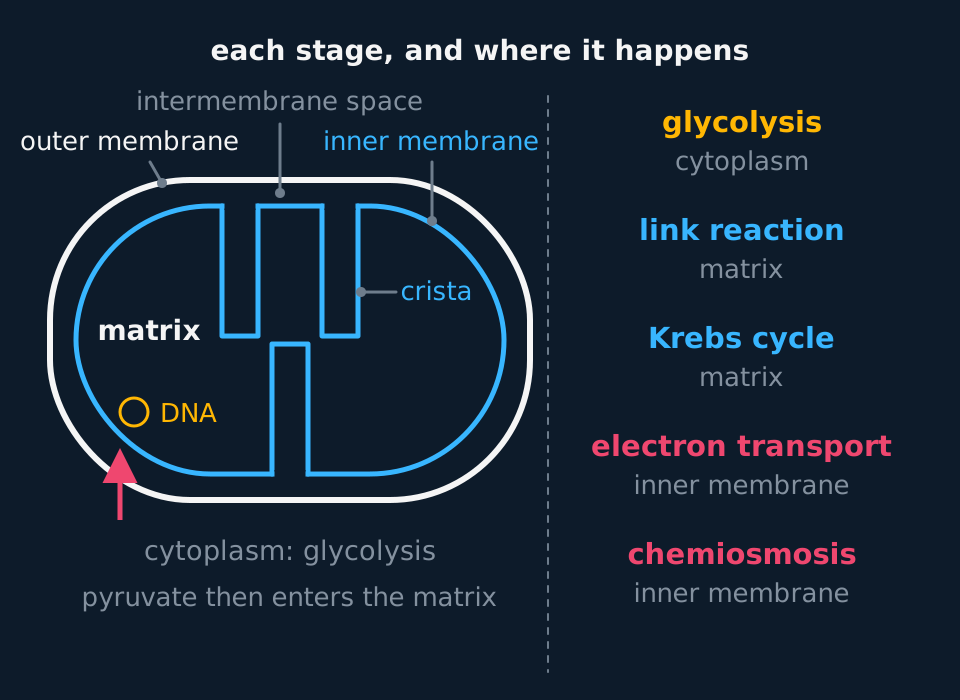
Aerobic respiration is conventionally split into four stages, each with its own location. Fixing the locations first makes the reactions easier to place.
Describe the drawing
On the left a mitochondrion drawn in section, labelled: an outer membrane, a narrow intermembrane space, and an inner membrane folded inwards in three places as cristae, with a small loop of DNA in the matrix. An arrow points in from the surrounding cytoplasm, which is labelled as the place glycolysis happens and the source of the pyruvate entering. On the right, separated by a dashed line, five stages are listed in order with their locations: glycolysis in the cytoplasm, the link reaction and the Krebs cycle in the matrix, and electron transport and chemiosmosis on the inner membrane.
| Stage | Where | Takes in | Gives out |
|---|---|---|---|
| Glycolysis | Cytoplasm | Glucose, 2 ATP, 2 NAD | 2 pyruvate, 4 ATP, 2 reduced NAD |
| Link reaction | Mitochondrial matrix | Pyruvate, coenzyme A, NAD | Acetyl CoA, CO₂, reduced NAD |
| Krebs cycle | Mitochondrial matrix | Acetyl CoA, NAD, FAD, ADP | CO₂, reduced NAD, reduced FAD, ATP |
| Oxidative phosphorylation | Inner mitochondrial membrane | Reduced NAD and FAD, oxygen, ADP | ATP, water, NAD, FAD |
Two things follow from that table. First, glycolysis happens in the cytoplasm and needs no oxygen and no mitochondrion, which is why a red blood cell, having neither a nucleus nor mitochondria, still respires, and why bacteria and yeast can run it perfectly well. Nearly every organism studied does glycolysis, in almost exactly the same ten enzyme-catalysed steps, which suggests it appeared early.
Second, the mitochondrion's shape follows its chemistry. The matrix is a fluid compartment holding the enzymes of the link reaction and the Krebs cycle, along with ribosomes and a small circular DNA. The inner membrane is folded into cristae, and the folding gives the enormous area needed for the electron carriers and the ATP synthase molecules that stud it. Cells that work hard, such as cardiac muscle, the epithelium of the ileum and the proximal tubule of a nephron, are packed with mitochondria carrying densely folded cristae, which is what an electron micrograph of such tissue shows.
Glycolysis, one step at a time
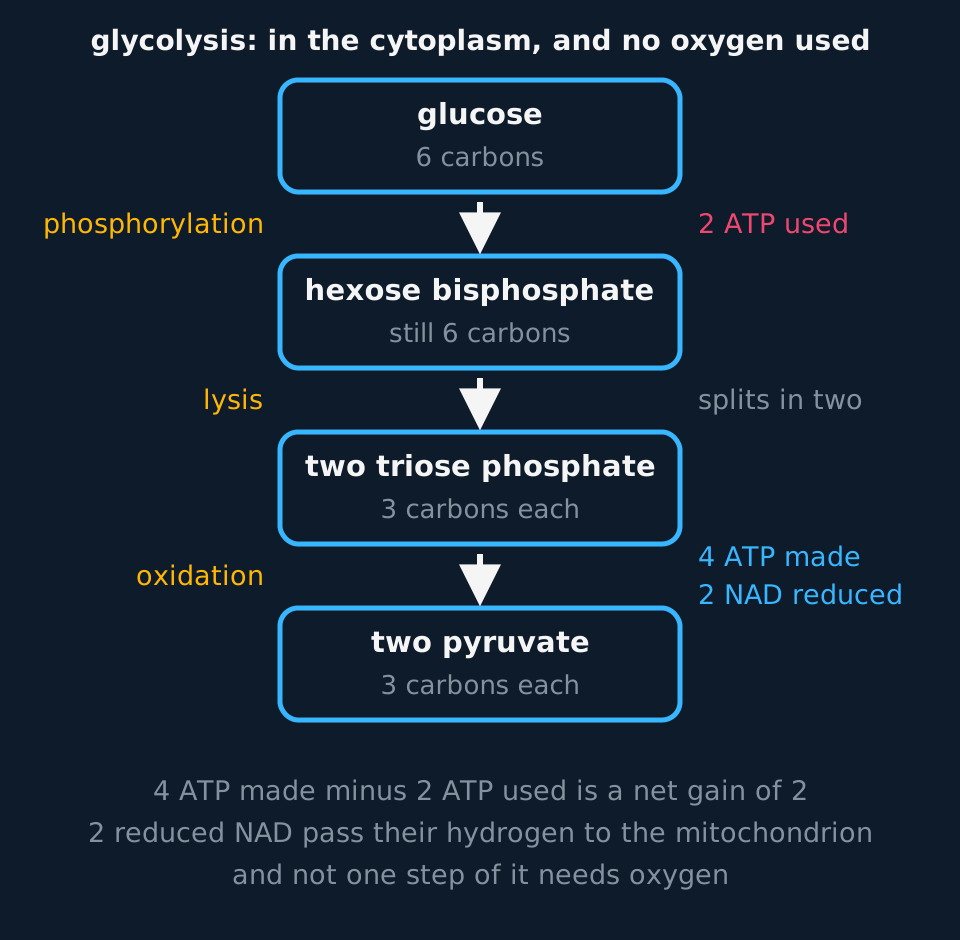
At A level, glycolysis is treated as three steps: phosphorylation, lysis and oxidation, in that order.
Phosphorylation. Glucose is a stable molecule and must be made more reactive before it can be broken down. Two molecules of ATP are hydrolysed and their phosphates are added to the glucose, one at each end, giving hexose bisphosphate. Boards that want the molecule's full name call it fructose 1,6-bisphosphate: the glucose is rearranged into its isomer fructose on the way, and the 1 and the 6 name the two carbons now carrying phosphate groups. The molecule is now less stable and more reactive; it also carries charges that prevent it leaving the cell. The two ATP spent here are recovered twice over later in the pathway.
Lysis. The six-carbon hexose bisphosphate splits into two three-carbon molecules of triose phosphate. Everything from here on happens twice per molecule of glucose, so every subsequent quantity is doubled.
Oxidation. Each triose phosphate is oxidised, meaning hydrogen is removed from it, and the hydrogen is picked up by the coenzyme NAD, giving reduced NAD. In the same sequence, phosphate groups are transferred from the intermediates directly onto ADP, making two ATP per triose phosphate, and on the way each triose phosphate becomes glycerate 3-phosphate (GP). What is left is pyruvate, with three carbons.
Describe the drawing
A vertical flow of four boxes joined by downward arrows. The top box holds glucose with six carbons, the second hexose bisphosphate still with six, the third two molecules of triose phosphate with three carbons each, and the last two molecules of pyruvate with three carbons each. To the left of each arrow the step is named as phosphorylation, lysis and oxidation; to the right the running cost is given as two ATP used, then the split into two, then four ATP made and two molecules of NAD reduced.
- Glycolysis
- The splitting of glucose into two molecules of pyruvate in the cytoplasm, producing a net gain of two ATP and two reduced NAD, without oxygen.
- Substrate-level phosphorylation
- The direct transfer of a phosphate group from a substrate molecule onto ADP, as opposed to ATP made using a proton gradient.
- Coenzyme
- An organic non-protein molecule that an enzyme needs in order to work. NAD accepts hydrogen from a substrate and carries it elsewhere, so it is a hydrogen carrier.
- Oxidation
- In respiration, most easily read as the loss of hydrogen. A substrate that hands hydrogen to NAD has been oxidised; the NAD has been reduced.
Getting the doubling right
A cell respires 5 molecules of glucose aerobically. State the number of molecules of pyruvate, of reduced NAD and of ATP produced by glycolysis alone, and the number of ATP molecules the cell had to spend to get them.
Show the working
Per glucose, glycolysis gives 2 pyruvate, so 5 glucose gives 10 pyruvate. Each triose phosphate reduces one NAD and there are two per glucose, so 5 × 2 = 10 reduced NAD.
ATP needs both halves of the answer. Four are made per glucose, so 20 made; two are used per glucose, so 10 spent; the net gain is 20 − 10 = 10 ATP.
A question that says 'produced' is asking for 4 per glucose, and a question that says 'net' or 'gain' is asking for 2. Check which term the question uses before giving a figure.
The link reaction: one carbon off, two carbons on
Pyruvate is made in the cytoplasm and used in the matrix, so it has to get there. It passes through pores in the outer membrane and is carried across the inner membrane by a specific carrier protein, using energy, so its entry into the matrix is active transport. Once inside, one short reaction prepares it for the cycle.
Three things happen to each pyruvate. It is decarboxylated: one carbon is removed as carbon dioxide, and this is the first carbon dioxide respiration produces. The carbon dioxide exhaled by a mammal is produced in the link reaction and the Krebs cycle, not in the lungs. It is dehydrogenated: two hydrogens are removed and taken by NAD, giving one reduced NAD. And the two-carbon acetyl group that remains is joined to coenzyme A, forming acetyl coenzyme A, which delivers it into the Krebs cycle.
No ATP is made in the link reaction. It happens twice per glucose, because glycolysis produced two pyruvate, so per glucose the link reaction gives 2 CO₂, 2 reduced NAD and 2 acetyl CoA. Those three products and the location are the whole of the link reaction.
- Link reaction
- The oxidative decarboxylation of pyruvate in the mitochondrial matrix, producing carbon dioxide, reduced NAD and a two-carbon acetyl group carried by coenzyme A.
- Decarboxylation
- Removal of a carbon atom from a molecule, released as carbon dioxide.
- Dehydrogenation
- Removal of hydrogen from a molecule, catalysed by a dehydrogenase, with the hydrogen taken up by a coenzyme.
- Acetyl coenzyme A
- The two-carbon acetyl group attached to coenzyme A, which carries it into the Krebs cycle.
TRY IT: Tracking a labelled carbon
A yeast culture is supplied with glucose in which every carbon atom is the radioactive isotope carbon-14. The yeast respires aerobically. Explain where the labelled carbon atoms will first appear as carbon dioxide, and how many of the six will have been released as carbon dioxide by the end of the link reaction.
Check your answer
Glycolysis releases no carbon dioxide at all. Six carbons enter as glucose and six leave it as two molecules of pyruvate, three each, so all the label is still in the pyruvate.
The first labelled carbon dioxide appears in the link reaction, in the matrix, when each pyruvate is decarboxylated. That happens twice per glucose, so two of the six carbons have gone as carbon dioxide by the end of it, leaving four in the two acetyl groups.
The remaining four leave as carbon dioxide from the Krebs cycle, which releases two per turn. They do not leave in the turn they enter: the carbon dioxide of each turn comes from the oxaloacetate part, and the new acetyl carbons are released in later turns.
The tally so far
The totals after the first two stages are the starting point for the final ATP figure.
| After... | ATP (net) | Reduced NAD | CO₂ | Left over |
|---|---|---|---|---|
| Glycolysis | 2 | 2 | 0 | 2 pyruvate |
| Link reaction | 2 | 4 | 2 | 2 acetyl CoA |
Two molecules of ATP, from a molecule releasing 2880 kJ per mole on complete oxidation, is under three per cent of what is available. The remainder is held in two forms. Most is in the carbon-hydrogen and carbon-carbon bonds of the acetyl groups, which the Krebs cycle oxidises. The rest is held by the four reduced NAD, which carry hydrogen, and therefore electrons, to the inner membrane, where most of the ATP is made.
The first three stages reduce coenzymes; the fourth stage oxidises them and uses the energy released to phosphorylate ADP. Only that fourth stage uses oxygen.
In the exam
- Name the reaction and give the quantity: ATP is hydrolysed to ADP and inorganic phosphate, releasing about 30.5 kJ per mole.
- Describe ATP as the immediate energy source rather than an energy store. For its suitability, give immediate release in one step, a small usable quantity, and easy re-formation from ADP and phosphate.
- Give the location precisely: glycolysis in the cytoplasm, the link reaction and the Krebs cycle in the matrix, oxidative phosphorylation on the inner mitochondrial membrane. 'In the mitochondrion' does not answer a question asking where in it.
- Distinguish 'produced' from 'net'. Glycolysis produces four ATP and gives a net gain of two.
- Everything after lysis happens twice per molecule of glucose, so double the figures obtained for a single triose phosphate.
- State that glycolysis releases no carbon dioxide and that the first carbon dioxide comes from the link reaction.
Check yourself
A student writes: 'Glycolysis makes 2 ATP, so it is not worth much to the cell, and it needs the mitochondrion to be useful.' Evaluate that statement, using what glycolysis produces and where it happens.
Answer
The 2 ATP figure is right as a net gain, and small: four are made by substrate-level phosphorylation and two were spent phosphorylating the glucose at the start.
But ATP is not the main product worth counting here. Glycolysis also produces two reduced NAD per glucose, and a shuttle passes their hydrogen into the mitochondrion, where it yields roughly 1.5 to 2.5 more ATP per reduced NAD at the inner membrane. The pyruvate that glycolysis leaves behind still holds most of the original energy, and the link reaction and Krebs cycle exist to get at it.
The claim about needing a mitochondrion is wrong twice over. Glycolysis takes place in the cytoplasm and uses no oxygen and no organelle, which is why a mature red blood cell, having neither nucleus nor mitochondria, is entirely dependent on it, and why yeast in a sealed fermenter goes on respiring.
So the statement is half right: the net ATP yield is small, but glycolysis needs no mitochondrion and no oxygen, and its reduced NAD and pyruvate carry most of the energy on to the later stages.
Questions
Question 14 marks
Describe what happens during glycolysis, using the terms phosphorylation, lysis and oxidation, and give the net yield per molecule of glucose.
Mark scheme
- B1 phosphorylation: two molecules of ATP are hydrolysed and their phosphate groups added to glucose, giving hexose bisphosphate, which is less stable and more reactive
- B1 lysis: the six-carbon hexose bisphosphate splits into two three-carbon molecules of triose phosphate, so everything after this point happens twice per glucose
- B1 oxidation: hydrogen is removed from each triose phosphate and taken up by NAD, giving two reduced NAD per glucose, and pyruvate is what remains
- B1 phosphate groups are transferred directly from the intermediates onto ADP by substrate-level phosphorylation, making four ATP per glucose, so the net yield is 2 ATP, 2 reduced NAD and 2 pyruvate
Question 24 marks
Eight molecules of glucose pass through glycolysis in a cell. Calculate the number of molecules of ATP produced, the number used, the net gain in ATP, and the number of molecules of reduced NAD formed.
Mark scheme
- M1 per molecule of glucose, glycolysis produces 4 ATP, uses 2 ATP and forms 2 reduced NAD
- A1 4 × 8 = 32 molecules of ATP produced
- A1 2 × 8 = 16 molecules of ATP used, so the net gain is 32 − 16 = 16 ATP
- A1 2 × 8 = 16 molecules of reduced NAD
Question 34 marks
Describe what happens to a molecule of pyruvate during the link reaction, and give the products of the link reaction per molecule of glucose.
Mark scheme
- B1 pyruvate is decarboxylated: one carbon is removed and released as carbon dioxide, which is the first carbon dioxide respiration produces
- B1 it is dehydrogenated: hydrogen is removed and taken up by NAD, giving one reduced NAD
- B1 the two-carbon acetyl group left behind joins coenzyme A to form acetyl coenzyme A
- B1 the reaction runs twice per glucose, so the products are 2 CO₂, 2 reduced NAD and 2 acetyl CoA, with no ATP made
Question 44 marks
A cell respires 6 molecules of glucose fully through glycolysis and the link reaction. Calculate the total number of molecules of reduced NAD produced by these two stages together, and calculate the total number of carbon dioxide molecules released.
Mark scheme
- M1 glycolysis produces 2 reduced NAD per glucose and the link reaction produces 2 more, one per pyruvate with two pyruvate per glucose, so 4 reduced NAD are produced per glucose by the two stages together
- A1 for 6 glucose: 4 × 6 = 24 reduced NAD
- M1 glycolysis releases no carbon dioxide, and the link reaction releases 2 CO₂ per glucose, one per pyruvate decarboxylated
- A1 for 6 glucose: 2 × 6 = 12 CO₂ molecules
Question 53 marks
Explain why ATP is a suitable immediate source of energy for a cell, when the complete oxidation of glucose releases roughly 2880 kJ per mole.
Mark scheme
- B1 hydrolysis of the terminal phosphate of ATP, catalysed by ATP hydrolase, releases about 30.5 kJ per mole in a single step, so the energy is available at once with no chain of intermediates to wait for
- B1 that quantity is small enough to be useful for a single reaction, so little is wasted as heat, whereas releasing the 2880 kJ per mole held in glucose in one go would damage the cell
- B1 the reaction is easily reversed, because ATP synthase joins ADP and inorganic phosphate back together, so the same molecules are recycled about a thousand times a day rather than being stockpiled
Question 63 marks
A mature red blood cell has neither a nucleus nor any mitochondria. Suggest how such a cell still makes ATP, and suggest what limits the amount of ATP it can obtain from each molecule of glucose.
Mark scheme
- B1 glycolysis takes place in the cytoplasm and needs neither oxygen nor a mitochondrion, so the cell can still carry it out and make ATP by substrate-level phosphorylation
- B1 the cell cannot carry out the link reaction, the Krebs cycle or oxidative phosphorylation, because those need the matrix and the inner membrane
- B1 so it gains only the net 2 ATP from glycolysis, under three per cent of the energy held in a molecule of glucose, and it must respire a great deal of glucose to meet its demand
Question 73 marks
An adult holds roughly 50 g of ATP at any instant but turns over close to their own body mass of ATP in a day. Explain how these two facts can both be true, and explain what would happen to a cell if it stopped remaking ATP.
Mark scheme
- B1 the small standing pool of ATP is continuously hydrolysed to ADP and phosphate as energy is used, and continuously resynthesised from ADP and phosphate using energy released by respiration, so the same roughly 50 g of molecules cycles round many times a day rather than being a single-use supply
- B1 ATP is not stored in bulk the way glycogen or triglyceride is, so a cell has no large reserve to fall back on
- B1 if a cell stopped remaking ATP its entire pool would be used up within about ninety seconds, after which the energy-requiring processes ATP powers, such as active transport and muscle contraction, could not continue
Question 83 marks
Compare glycolysis with the link reaction, referring to where each takes place in the cell and whether each needs oxygen.
Mark scheme
- B1 glycolysis takes place in the cytoplasm, whereas the link reaction takes place in the mitochondrial matrix, so pyruvate has to be transported across both mitochondrial membranes between the two stages
- B1 neither glycolysis nor the link reaction uses oxygen directly, since oxygen is used only at the fourth stage, oxidative phosphorylation
- B1 glycolysis produces a net gain of ATP by substrate-level phosphorylation, whereas the link reaction produces no ATP at all, only reduced NAD and carbon dioxide
Question 93 marks
Before glucose can be broken down in glycolysis, it is first phosphorylated using two molecules of ATP. Explain why this step is necessary, given that it appears to use energy rather than release it.
Mark scheme
- B1 glucose is a relatively stable molecule, and adding phosphate groups to it, making hexose bisphosphate, makes it less stable and more reactive so it can be broken down in the reactions that follow
- B1 the phosphate groups added also carry a negative charge, which prevents the molecule leaving the cell through the surface membrane, trapping it inside the cell where it can be used
- B1 although this step spends 2 ATP, that spending is more than repaid later in the pathway, since 4 ATP are made by substrate-level phosphorylation from the two triose phosphate molecules, for a net gain of 2 ATP overall
Question 103 marks
The four stages of aerobic respiration are glycolysis, the link reaction, the Krebs cycle and oxidative phosphorylation. Identify the two stages that take place in the mitochondrial matrix, and identify the one stage that takes place on the inner mitochondrial membrane rather than in the matrix, and explain why it takes place there.
Mark scheme
- B1 the link reaction and the Krebs cycle both take place in the mitochondrial matrix
- B1 oxidative phosphorylation takes place on the inner mitochondrial membrane rather than in the matrix
- B1 because it is the folded inner membrane, not the matrix, that carries the electron carriers and ATP synthase molecules this stage needs
Question 113 marks
A muscle cell respiring glucose as its only substrate is treated with a drug that specifically and completely blocks the carrier protein that moves pyruvate across the inner mitochondrial membrane, but has no other effect. Suggest what would happen to the rate of glycolysis in this cell, suggest what would happen to the rate of the link reaction, and suggest what would happen to the cell's release of carbon dioxide.
Mark scheme
- B1 glycolysis would be largely unaffected at first, since it does not require pyruvate to enter the mitochondrion and needs no oxygen or mitochondrial involvement itself, so it could continue producing ATP and reduced NAD in the cytoplasm
- B1 the link reaction would stop, or fall to almost nothing, because pyruvate could no longer reach the mitochondrial matrix where its enzymes are located
- B1 carbon dioxide release would fall to almost nothing, because glycolysis releases none: the carbon dioxide made from pyruvate, beginning with the one molecule removed from each pyruvate by decarboxylation in the link reaction, is all made in the matrix, which pyruvate can no longer reach
Question 123 marks
Explain, using the oxidation step of glycolysis as your example, what is meant by describing a reaction as an oxidation in the context of respiration.
Mark scheme
- B1 in the context of respiration, oxidation is most easily understood as the loss of hydrogen from a molecule, rather than as a reaction with oxygen
- B1 in the oxidation step of glycolysis, each triose phosphate loses hydrogen and is oxidised, and that hydrogen is taken up by NAD
- B1 the substrate, triose phosphate, that loses the hydrogen has been oxidised, while the NAD that gains it has been reduced to reduced NAD, since the two always happen together as a redox reaction
Question 133 marks
Compare releasing energy by hydrolysing ATP with releasing energy by completely oxidising a molecule of glucose in one reaction, referring to the quantity of energy released and how useful this is to a cell.
Mark scheme
- B1 hydrolysis of the terminal phosphate of ATP releases a small quantity of energy, about 30.5 kJ per mole, in a single, easily controlled step
- B1 complete oxidation of a mole of glucose releases roughly 2880 kJ, nearly a hundred times as much, and releasing this all at once in a single reaction would be far more than a cell's reactions could couple to, so most of it would be lost as heat and could damage the cell
- B1 respiration therefore oxidises glucose in many small steps, capturing the energy in a series of manageable packages, mostly as ATP, each similar in size to the energy a single ATP hydrolysis releases, rather than releasing the whole 2880 kJ in one uncontrolled step
Question 142 marks
State where in a cell glycolysis takes place, and state where the link reaction takes place.
Mark scheme
- B1 glycolysis takes place in the cytoplasm of the cell
- B1 the link reaction takes place in the matrix of the mitochondrion
Question 152 marks
State the three components of an ATP molecule, and state which bond is broken when ATP is hydrolysed to release usable energy.
Mark scheme
- B1 adenine, a base; ribose, a five-carbon sugar; and a chain of three phosphate groups
- B1 the bond to the terminal, outermost phosphate group is broken (hydrolysed), giving ADP and inorganic phosphate
Worth remembering
- ATP is hydrolysed to ADP and phosphate, releasing about 30.5 kJ per mole in one step, and a cell holds only seconds' worth of it.
- Glycolysis: cytoplasm, no oxygen, net 2 ATP, 2 reduced NAD, 2 pyruvate.
- Phosphorylation, lysis, oxidation: 2 ATP in, 4 ATP out.
- The link reaction takes place in the matrix: decarboxylation, dehydrogenation, acetyl CoA. Twice per glucose.
- After glycolysis and the link reaction: 2 ATP, 4 reduced NAD, 2 CO₂ per glucose.
CHECK YOUR PROGRESS
Rate how confident you are with each objective for this lesson. Ratings are saved in this browser, on this device, unless you sign in.
- Describe the structure of ATP and explain what its hydrolysis releases, with a figure.
- Give three reasons ATP suits a cell better than releasing a glucose molecule's energy in one go.
- State where each of the four stages of respiration happens, and why glycolysis needs no oxygen.
- Describe glycolysis as phosphorylation, lysis and oxidation, with the net yield per glucose.
- Describe the link reaction, naming the decarboxylation and the dehydrogenation.
- Keep a running tally of ATP, reduced NAD and carbon dioxide per molecule of glucose.
Open the full revision checklist to see every objective in the curriculum in one place.
Practise this lesson
WORKBOOK
The questions from this topic, on paper with room to work, and a separate book of mark schemes. Free to use; please do not redistribute or sell.
Used later in Anaerobic respiration and the respiratory quotient · The carbon cycle and climate change