Biology › Scientific method and quantitative biology › Variables and controls: what an experiment can show
Variables and controls: what an experiment can show
An experiment is designed to rule out the explanations it is not testing. The independent variable and its levels, the variables held constant, and the control that contains everything except the thing under test each close off one way the result could have been produced by something else.
Before this Measuring with a ruler, balance, thermometer and timer · Reading a line graph
COMMON MISCONCEPTION
A control is the tube you leave the interesting thing out of, and every experiment has one.
A control variable is a condition kept constant because it could affect the dependent variable. A control experiment is an additional run used to test an alternative explanation, such as a solvent-only negative control or a known positive control. An investigation may require one, both or neither type.
What you should be able to do
- Name the independent, dependent and controlled variables in an investigation you have not seen before, and justify the levels chosen.
- Distinguish a control variable from a control experiment, and say which of the two a question is asking about.
- Explain what a negative control rules out and what a positive control rules out, and why those are different jobs.
- Identify a confounding variable and explain why repeating the measurement does not deal with it.
- Set out the evidence that would raise a correlation to a causal claim.
- Use validity, accuracy, precision, repeatability and reproducibility to mean five different things.
- Plan an investigation on a living animal, such as the effect of caffeine on Daphnia heart rate, with its controls and a risk assessment.
- Discuss the ethical issues in using invertebrates in research, using the 3Rs and what is known about sentience, and reach a judgement.
Independent, dependent and control variables
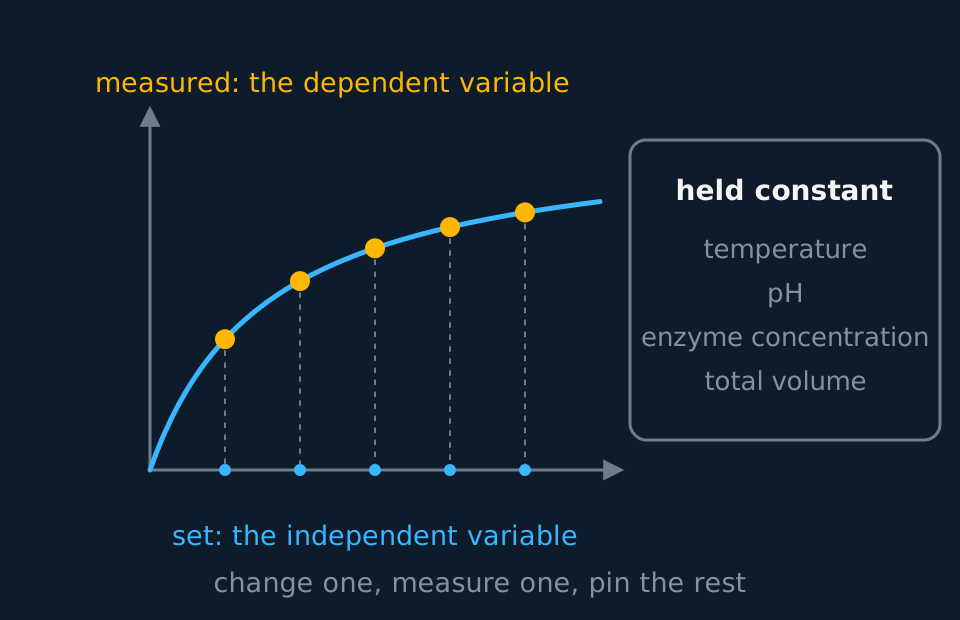
An investigation identifies an independent variable, a dependent variable and the relevant control variables. The independent variable is changed or selected; the dependent variable is measured; control variables are kept constant where they could affect the result. State units for measured quantities where applicable.
- Independent variable
- The quantity you change on purpose, and the only one that should differ between your treatments. It goes on the horizontal axis.
- Dependent variable
- The quantity you measure, whose value depends on the independent variable. It goes on the vertical axis.
- Control variable
- A quantity held the same across every treatment, so that it cannot be the reason the dependent variable changed.
- Control experiment
- An extra run of the method, differing in one deliberate way, done to rule out an explanation the main runs cannot rule out on their own.
Describe the drawing
An investigation drawn as the graph it produces. Five chosen levels of one variable are marked along the horizontal axis, dashed lines rise from each to a point on a curve that climbs steeply at first and then flattens, and the vertical axis carries the quantity being measured. A panel on the right lists four quantities held constant: temperature, pH, enzyme concentration and total volume.
Choose enough values of the independent variable to reveal the expected relationship, spread across an appropriate range. Five values are often suitable for drawing a trend, but the method and specification take priority. Four points can be joined by a straight line that a fifth would rule out, and the range must cover the region of interest: an enzyme investigation running only from 20 °C to 30 °C gives a rising line and misses an optimum near 40 °C.
Use a bar chart for categorical groups and a scatter graph or line graph for continuous data, as appropriate to the design. Species of plant and brand of antiseptic are categorical; temperature, concentration and time are continuous. A bar chart of a continuous variable does not show the shape of the relationship.
Select control variables that could plausibly affect the dependent variable and state how each is controlled. For example: 'Keep each tube in a 35 °C water bath for five minutes before starting the reaction.' This is reproducible because it gives both the set value and the method.
A control variable is not a control experiment
Controlling variables does not answer a further question: would the result have appeared without the factor being tested? That is the function of a control experiment. The two standard kinds have opposite functions.
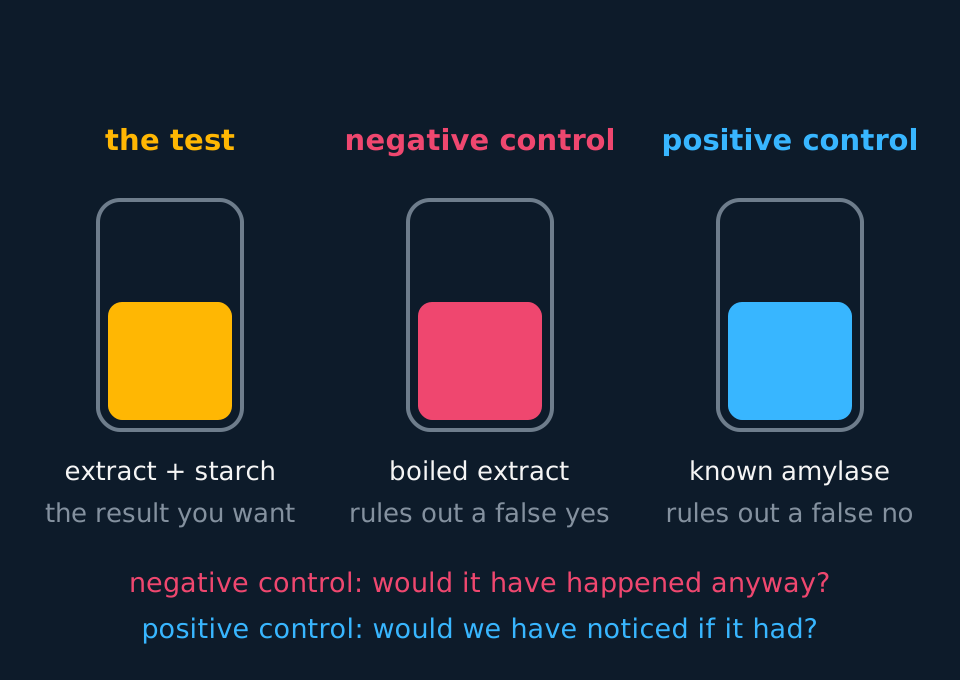
A negative control is the run in which the factor you are testing has been removed or destroyed, with everything else left exactly as it was. Boiled enzyme, distilled water in place of the extract, an agar disc soaked in nothing but the solvent. If the effect shows up in the negative control, the effect was never yours: the apparatus, the solvent or the handling produced it. A negative control guards against a false positive.
A positive control uses something already known to produce the effect: a disc of an antibiotic the organism is sensitive to, a glucose solution in a set of Benedict's tests. If it shows nothing, the method failed and the flat readings from your real samples mean nothing at all. A positive control guards against a false negative.
Neither control substitutes for the other. If six plant extracts are tested for antibacterial activity and no zones appear, a blank solvent disc showing nothing is the expected result. But a lawn that never grew, discs that never dried and a cold incubator would produce the same appearance. Only a disc of a known antibiotic distinguishes the two cases.
Choosing the right control
A student investigates whether an extract of garlic inhibits the growth of a bacterium on an agar plate. Suggest one negative control and one positive control, and state what each one shows.
Show the working
The negative control is a disc soaked in the solvent the garlic was extracted into, ethanol say, and nothing else. If it produces a clear zone, the ethanol was killing the bacteria and the garlic result cannot be attributed to the garlic.
The positive control is a disc of an antibiotic the bacterium is known to be sensitive to. A clear zone around it shows that the bacteria were alive, the plate was seeded properly and a zone would have been visible if there had been one to see.
Interpret the two together. Garlic zone present, solvent zone absent and antibiotic zone present is the only combination supporting the claim. Garlic absent and antibiotic absent supports no conclusion about garlic: it indicates that the investigation did not work.
Confounding: when one change is really two
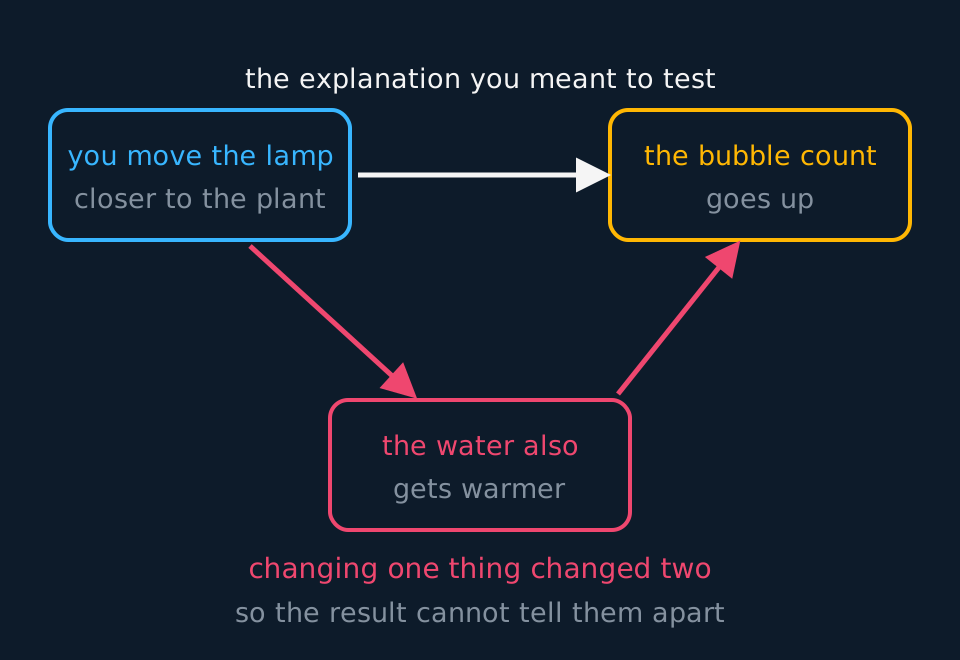
A confounding variable is one that changes along with your independent variable and could produce the same effect on its own. It is a serious fault in a design, because it does not appear as scatter or as an anomalous result: it produces a consistent graph of a relationship that may not exist.
Describe the drawing
Three boxes joined by arrows. A box for moving a lamp closer sits top left, a box for the bubble count rising sits top right, and a straight arrow runs between them. A third box below records that the water also warms, with arrows running into it from the lamp and out of it to the bubble count, so two separate routes connect the same cause to the same effect.
The pondweed and the lamp is the standard case. Move the lamp closer and the light intensity rises, and so does the temperature of the water, because a filament lamp is mostly a heater. Oxygen production rises. You cannot tell from the readings whether it rose because of the light or because of the warmth, and no number of repeats will separate them, because every repeat changes both things together in exactly the same way. The fix is in the design: put a heat shield of water between the lamp and the beaker, or use an LED source, and then measure the temperature to show it stayed put.
It is also what makes some biological questions genuinely hard. Ask whether people who eat oily fish have fewer heart attacks and you are also asking about people who can afford oily fish, who cook at home, who were told by a doctor to change their diet. Ruling those out means measuring them and comparing people who match on them, which is why an epidemiological paper spends most of its length on adjustment and a paragraph on the result.
- Confounding variable
- A variable that changes with the independent variable and could itself explain the change in the dependent variable, so the two effects cannot be separated by the data collected.
- Randomisation
- Assigning subjects or sample positions by chance rather than by choice, so that variables not identified in advance tend to balance out between the groups on average.
Randomisation addresses confounding variables that were not identified in advance. Assign which leaf disc goes into which concentration by drawing lots rather than by picking, and the discs that happen to be thicker, older or nearer the midrib tend to be spread across every treatment instead of piling into one. Note the word 'tend': randomisation balances confounders in expectation, across many runs; it does not guarantee an even spread in any single experiment, which is one reason sample size still matters.
Correlation and causation, argued rather than asserted
A correlation does not by itself show that one variable caused the other. A common cause, reverse causation or chance may explain the association. A causal conclusion becomes stronger when several independent forms of evidence agree, including a plausible mechanism, the correct time order, a dose-response relationship, adjustment for confounding variables, replication in other populations and reversal when the exposure is removed. Where random allocation would be unethical or impossible, causal inference may depend on this combination of evidence rather than on a single experiment. The link between smoking and lung cancer is the standard example: no randomised trial assigned people to smoke, and the causal claim rests on that combination.
- Correlation
- A relationship in which two variables tend to change together. It may be positive or negative, strong or weak, and it makes no claim about which variable moved first.
- Causation
- A relationship in which changing one variable changes the other. It cannot be read off a scatter graph.
Three things produce correlations with no causal link between the variables plotted. A common cause may sit behind both, as the summer sits behind ice cream sales and drowning deaths. The arrow may run the other way, which is reverse causation, as when a nutrient is low in people with a disease because the disease stopped them absorbing it. And with enough variables plotted against enough others, some pairs correlate by coincidence, which is why a relationship found by trawling data has to be tested on a fresh set.
Several separate lines of evidence, none decisive alone, strengthen a causal claim:
| What to look for | The smoking case |
|---|---|
| A mechanism | Tobacco smoke causes mutations in cultured cells and tumours in animals |
| The right order in time | Healthy people were recruited first, then followed for decades |
| A dose response | Risk climbs with cigarettes per day and with years smoked |
| Survival of adjustment | The association remains after age, sex and occupation are accounted for |
| Repetition elsewhere | Case-control and cohort studies in several countries agree |
| Reversibility | Risk in people who stop smoking falls year by year |
An A-level answer does not need all six. It needs the specific alternative explanation named, whether common cause, reverse causation or coincidence, together with the evidence that would test it.
TRY IT: Reading a correlation carefully
A study of 40 rivers finds a strong positive correlation between the concentration of nitrate in the water and the mass of algae per cubic metre. A newspaper reports that nitrate fertiliser is causing algal blooms. Evaluate this conclusion.
Check your answer
The correlation is consistent with the conclusion and does not establish it. The study is observational: nobody set the nitrate concentration, so the rivers differ in many ways at once.
A mechanism is available, which helps. Nitrate is a limiting mineral ion for algal growth, so more nitrate allowing more growth is what would be expected.
A common cause is the obvious alternative. Rivers running through farmland receive nitrate, and also phosphate, warmer run-off and less shade from trees, any of which could raise algal mass alone.
Reverse causation can be dismissed in a sentence: a large mass of algae would take nitrate up and lower its concentration, so the association runs against that explanation rather than for it.
What would settle it is tanks seeded identically and given set nitrate concentrations with everything else matched, plus a dose response in the field data rather than a bare correlation.
Validity, accuracy, precision and the two kinds of repeat
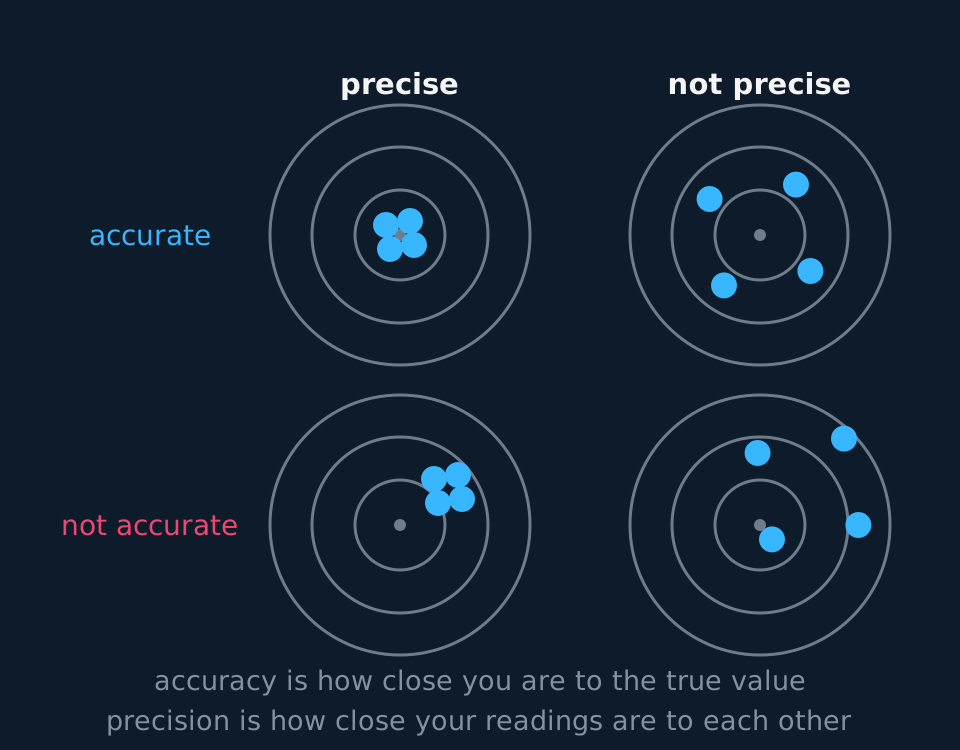
Validity, accuracy, precision, repeatability and reproducibility are five distinct properties. They fail in different ways, so identifying which one an investigation lacks identifies what to change.
Describe the drawing
A two by two grid of target boards, each with three rings and four shots marked on it. The left column has shots clustered tightly together and the right column has them widely scattered; the top row has shots centred on the bullseye and the bottom row has them displaced to one side. All four combinations of the two properties appear.
- Valid
- A measurement is valid if it measures what it claims to measure; an investigation is valid if its design allows its conclusion to follow. A confounding variable destroys validity however careful the measuring was.
- Accurate
- Close to the true value.
- Precise
- Repeat readings close to one another. Precision says nothing at all about being right.
- Repeatable
- The same person, using the same method and the same apparatus, gets the same results again.
- Reproducible
- Somebody else, or the same person using different apparatus or a different method, gets the same results.
- Resolution (of an instrument)
- The smallest change an instrument can register: 0.01 g on a two-decimal-place balance, 1 mm on a metre rule.
The two kinds of error map onto two of those words. A random error scatters readings above and below the true value, as in judging a meniscus, starting a stopclock late, or tissue that was not quite identical. It damages precision, and a mean of several repeats reduces its effect because the scatter partly cancels. A systematic error shifts every reading the same way: a balance that was not zeroed, a thermometer reading 2 °C high, a bubble in a burette tip. It damages accuracy, and repeating the measurement a hundred times gives a hundred readings wrong by the same amount. That is the lower-left case, and it is why precision is not evidence of accuracy.
Reliability is used loosely to mean that repeats agree, and is accepted, but repeatable and reproducible are more precise terms. An anomaly is a reading that does not fit the pattern of the others: identify it, state that it is anomalous, and exclude it from the mean only with a stated reason, such as a bubble in the tube or a sample that was dropped. Excluding a point solely because it does not fit the line is not justified.
What the experiment can actually show
A complete write-up states the limits of the result. A conclusion that extends beyond the data is unsupported however carefully the data were collected.
Your result holds over the range you tested and for the material you used. If your temperatures ran from 20 °C to 50 °C, the data say nothing about 60 °C. Reading a value off an extended line is extrapolation and is not supported by the measurements; reading between two measured points is interpolation and is. Catalase from potato is not catalase from liver, and cultured cells are not tissue, so name the organism and the tissue.
It describes what happened, not why. An investigation showing that rate falls above 45 °C shows that rate falls above 45 °C; denaturation is an explanation brought to it from elsewhere, and the careful sentence says 'this is consistent with the enzyme denaturing' rather than 'this shows the enzyme denatured'.
And it holds for the sample you took. Five leaf discs from one leaf describe that leaf. Extending the claim to the plant or the species needs a sample drawn to represent them, which is a decision made before any measuring starts and cannot be repaired afterwards.
Measuring a living animal: caffeine and the heart rate of Daphnia
Daphnia, the water flea, is a freshwater crustacean a few millimetres long with a transparent body. Its heart can be watched beating through a light microscope with no dissection, which is why Pearson Edexcel Biology A sets the effect of caffeine on heart rate in Daphnia as Core Practical 1. The design follows the earlier sections of this lesson. A living animal adds three problems of its own.
| Part of the design | In the Daphnia investigation |
|---|---|
| Independent variable | Concentration of caffeine, at five or more values made by diluting a stock solution with pond water |
| Dependent variable | Heart rate in beats per minute, counted under the microscope |
| Control variables | Temperature of the water; size of the animal, as a rough guide to its age; volume of liquid on the slide; time in each solution before counting starts |
| Control experiment | An animal in pond water with no caffeine, handled and timed in exactly the same way, so that any change caused by the handling or the lamp shows up there too |
The first problem is heat. The microscope lamp warms a small drop of water quickly, and Daphnia is an ectotherm whose heart rate rises with temperature, so time under the lamp becomes a confounding variable. Keep each count short, switch the lamp off between counts or use a cool LED source, and measure the temperature of the water at the start and end.
The second is that the heart beats several times a second, too fast to count steadily for a full minute. Count for 15 or 20 seconds and scale up, or tap a pencil on paper once per beat and count the dots afterwards. Scaling up multiplies any miscount too, so repeat each count and take the mean.
The third is that two animals in the same solution do not beat at the same rate. Record each animal's rate in pond water first, then in caffeine solution, and report the change from its own baseline. Use a fresh animal for each concentration so that no caffeine is carried over from a previous solution. A few strands of cotton wool in the drop on a cavity slide hold the animal still without crushing it.
Turning a count into a rate and a change
A Daphnia in pond water gives 58 beats in 15 seconds. After five minutes in a caffeine solution the same animal gives 69 beats in 15 seconds. Calculate both heart rates and the percentage change, and state the effect on the rate of missing one beat in a count. The counts are idealised.
Show the working
Each 15-second count is a quarter of a minute, so multiply by 4. Baseline: 58 × 4 = 232 beats min⁻¹. In caffeine: 69 × 4 = 276 beats min⁻¹.
Percentage change = (276 − 232) ÷ 232 × 100 = 44 ÷ 232 × 100 = +19.0%, an increase.
One missed beat in 15 seconds is 4 beats min⁻¹ after scaling, about 1.7% of the baseline. A difference between two concentrations smaller than that is within the counting error of a single count.
Every practical also needs a risk assessment, which separates the hazard from the risk and names a control measure for each. Here the hazards are modest: broken slides and coverslips, mains electricity close to water, pond water carrying microorganisms, and caffeine itself, which is harmful if swallowed as a solid. Wash hands after handling pond water, keep liquids away from the microscope's plug, and check the CLEAPSS Hazcard and your school's risk assessment for the caffeine stock.
- Hazard
- Anything with the potential to cause harm, such as a chemical, a sharp edge or a pathogen.
- Risk
- How likely it is that a hazard causes harm, and how serious the harm would be, under the conditions in which the work is done. Control measures reduce the risk; the hazard stays the same.
The ethics of using invertebrates in research
Pearson Edexcel Biology A pairs Core Practical 1 with statement 1.17: discuss the potential ethical issues regarding the use of invertebrates in research. A discussion needs arguments on both sides, each tied to a fact about the animal or the work, and a judgement.
- Sentience
- The capacity to have experiences that feel good or bad to the animal itself, such as pain, distress or comfort.
- The 3Rs
- Replacement, Reduction and Refinement: replace animals with other methods where possible, reduce the number used, and refine procedures so that the animals used suffer as little as possible. Set out by Russell and Burch in 1959.
The central question is whether the animal can suffer, and for most invertebrates the answer is not known. The evidence used to judge sentience includes receptors that detect damaging stimuli, a centralised nervous system that integrates information, and behaviour that goes beyond a reflex, such as guarding an injured part or accepting a cost to avoid a harmful stimulus. A Daphnia has a small brain and responds to light and touch, but that evidence has not been gathered for it in the detail it has for crabs, lobsters and octopuses.
The law in the UK draws its line by animal group. The Animals (Scientific Procedures) Act 1986 regulates procedures on living vertebrates and, since 2013, on cephalopods such as octopus and squid. The Animal Welfare (Sentience) Act 2022 treats all vertebrates, cephalopod molluscs and decapod crustaceans, such as crabs and lobsters, as sentient for the purposes of UK government policy. Daphnia is a crustacean but not a decapod, so neither Act covers it: using it in a school laboratory needs no licence. That it is legal does not settle whether it is right.
| Arguments for using invertebrates | Arguments against, or for limits |
|---|---|
| Simpler nervous systems, so the capacity to suffer is probably lower than in a vertebrate | How much lower is not known; if sentience cannot be ruled out, the precautionary choice is to treat the animal as if it can suffer |
| Using an invertebrate in place of a vertebrate is a form of replacement under the 3Rs | Some people hold that every living organism has value of its own, whatever its nervous system, so harm needs a reason |
| Daphnia is transparent, so the heart is observed without surgery, which is refinement | Restraint, heating under the lamp, drying out and exposure to a drug may all cause stress, and some animals die |
| Daphnia breeds fast, by parthenogenesis when conditions are good, so using some does not deplete a wild population | The result applies to Daphnia; carrying it to a human heart is extrapolation across a large evolutionary distance, which lowers the benefit the harm is weighed against |
| No licence or ethical review is legally required | Lack of legal protection means the care taken depends entirely on the person doing the work |
Two ethical frameworks approach the question differently. A utilitarian argument weighs the benefit, here learning a method or testing a drug cheaply, against the total harm, and accepts the work if the benefit is larger. A rights-based argument asks whether the animal has a right not to be harmed that no benefit can override, and that turns again on whether it can suffer.
Whichever view is taken, the 3Rs give the practical steps. Use the fewest animals that give a reliable result. Keep each one in pond water, out of the lamp's heat and for as short a time as possible. Do not use concentrations far beyond the range the question needs, and return each animal to a separate culture tank to recover rather than to the stock it came from.
TRY IT: A discussion with a judgement
A school proposes that every student in a class of 24 uses five Daphnia each to investigate the effect of caffeine on heart rate. Discuss the ethical issues, and suggest one change to the plan that answers the strongest objection.
Check your answer
For: Daphnia has a far simpler nervous system than a vertebrate, the heart can be seen without surgery, the animals breed quickly in culture, and no law requires a licence. Using an invertebrate in place of a vertebrate is itself replacement under the 3Rs.
Against: whether Daphnia can suffer is unknown, and restraint, heat from the lamp and the drug may all cause stress. The result is already well known, so the benefit is educational rather than new knowledge, and 120 animals is a large number for that.
Judgement: the practical can be justified because the harm to each animal is probably small and the skills are worth learning, but the numbers are hard to defend. The strongest objection is to the number used.
Change: reduce. Students work in groups and pool their results, so each concentration is tested on a few animals across the class rather than by every student, and each animal is returned to a recovery tank after one short exposure.
In the exam
- Name each measured variable with its unit, as in 'temperature in degrees Celsius' and 'volume of oxygen in cm³'.
- Where a question asks how a variable was controlled, describe the method: a water bath at a stated temperature, a buffer at a stated pH, tissue cut with the same cork borer. Give the technique, not the intention.
- Read 'control' carefully. Control variable wants a quantity held constant; control experiment wants a run of the method with something deliberately removed or deliberately known to work.
- 'Suggest why this conclusion may not be valid' almost always points at a confounding variable or at a sample too narrow to support the claim. Say which, and name it.
- Repeating an investigation improves precision and does not correct a systematic error or a confounding variable, so it does not by itself answer an evaluation question.
- Precision and accuracy are separate properties. Describing readings that agree closely addresses precision only.
Check yourself
A student investigates the effect of light intensity on the rate of photosynthesis by counting bubbles from pondweed, moving a bench lamp to five distances from the beaker. The bubble count rises steadily as the lamp is moved closer. Identify the independent, dependent and two control variables, identify one confounding variable, and state what the student may and may not conclude.
Answer
Independent variable: the distance of the lamp from the beaker in centimetres, standing in for light intensity. Dependent variable: bubbles released per minute. Control variables include the mass of pondweed, the concentration of hydrogencarbonate solution supplying carbon dioxide, and the equilibration time before counting starts.
The confounding variable is temperature. A filament lamp warms the water, and warms it more as it comes closer, so light intensity and temperature rise together and these readings cannot separate them.
The student may conclude that bubble production increased as the lamp was brought closer, over the range of distances used, for this piece of pondweed. That is all the data supports.
The student may not conclude that light intensity caused the increase, because temperature changed with it; nor that the rate of photosynthesis rose, because bubble count assumes every bubble is the same size; nor anything about distances outside those tested.
The repair is a design change rather than more repeats: a water-filled flask between lamp and beaker as a heat filter, temperature reported at each distance, and a light meter so intensity is measured rather than inferred.
Questions
Question 15 marks
Describe how you would investigate the effect of caffeine concentration on the heart rate of Daphnia, observed through a light microscope.
Mark scheme
- B1 make at least five caffeine concentrations by diluting a stock solution with pond water, with pond water alone as the control
- B1 place one Daphnia in a small drop on a cavity slide, with a few cotton wool strands to restrict its movement, and leave it for a fixed time in each solution before counting
- B1 count heartbeats for a fixed time such as 15 seconds, scale up to beats per minute, and repeat the count to give a mean
- B1 control temperature, because the lamp warms the drop and heart rate rises with temperature: keep counts short, turn the lamp off between counts, and measure the water temperature
- B1 control the size of the animals, record each one's rate in pond water first and report the change from that baseline, and use a fresh animal for each concentration
Question 25 marks
Discuss the ethical issues raised by using invertebrates such as Daphnia in research.
Mark scheme
- B1 for: invertebrates such as Daphnia have much simpler nervous systems than vertebrates, so their capacity to suffer is probably lower
- B1 for: using an invertebrate in place of a vertebrate is replacement under the 3Rs, and observing the heart through a transparent body without surgery is refinement
- B1 against: whether invertebrates are sentient is not known, so a precautionary view treats them as able to suffer; restraint, heat from the lamp and the drug may cause stress and some animals die
- B1 against: Daphnia is not protected by the Animals (Scientific Procedures) Act, which covers vertebrates and cephalopods, so the care taken depends on the person doing the work; or: some hold that all living organisms have value whatever their nervous system
- B1 a judgement linked to the arguments, such as that the use is justified if the benefit outweighs a probably small harm and the 3Rs are followed, with the fewest animals used and each returned to recover
Question 34 marks
A student measures oxygen production by pondweed at five distances from a filament lamp, and the rate rises as the lamp is brought closer. Explain why repeating the whole investigation ten times would not make the conclusion valid.
Mark scheme
- B1 temperature is a confounding variable here: a filament lamp is mostly a heater, so bringing it closer raises the temperature of the water as well as the light intensity
- B1 either the light or the warmth could have raised oxygen production, and the readings collected cannot separate the two effects
- B1 every repeat changes both quantities together in exactly the same way, so more repeats trace the same two routes again rather than telling them apart
- B1 repeats improve precision, not validity; the fix is a change of design, such as a water-filled flask acting as a heat filter or an LED source, with the temperature measured at each distance to show it stayed put
Question 44 marks
Compare accuracy with precision, and compare repeatability with reproducibility, as descriptions of a set of measurements.
Mark scheme
- B1 accuracy is closeness to the true value, whereas precision is how closely repeat readings agree with one another
- B1 a random error such as misjudging a meniscus scatters readings either side of the true value and damages precision, whereas a systematic error such as an unzeroed balance shifts every reading the same way and damages accuracy
- B1 readings can therefore be precise and inaccurate at the same time, which is why agreement between repeats is no evidence at all of being right
- B1 repeatability is the same person getting the same results with the same method and apparatus, whereas reproducibility is somebody else, or different apparatus or a different method, getting them
Question 54 marks
A student tests six extracts of seaweed for antibacterial activity by soaking paper discs in each and placing them on a lawn of bacteria. No clear zone appears around any of the six discs. Suggest two control experiments the student should have set up, and suggest what each would have shown.
Mark scheme
- B1 a negative control: a disc soaked in the solvent the extracts were made up in, and nothing else
- B1 if that disc produces a zone, the solvent was killing the bacteria and any zone around an extract could not be credited to the seaweed
- B1 a positive control: a disc carrying an antibiotic the bacterium is known to be sensitive to
- B1 a zone around it shows the bacteria were alive, the plate was seeded properly and a zone would have been visible had there been one to see; with no zone anywhere the honest conclusion is that the investigation failed, not that the extracts have no effect
Question 64 marks
A survey of 5000 adults finds that those with a higher intake of oily fish have fewer heart attacks over the following ten years. A newspaper reports that eating oily fish prevents heart attacks. Evaluate that conclusion.
Mark scheme
- B1 the study is observational rather than experimental: nobody set how much fish each person ate, so the groups differ in many ways at once and the correlation is consistent with the conclusion without establishing it
- B1 a common cause is the obvious alternative, since people who can afford oily fish and cook at home also tend to differ in income, exercise and smoking, any of which could lower heart attack rate on its own
- B1 reverse causation deserves a sentence: people already diagnosed with heart disease may have been told to change their diet, which would put the arrow the other way round
- B1 the argument the paper needs is a stack of separate points: a mechanism, a dose response, survival of adjustment for the known confounders and repetition elsewhere. On this evidence alone the causal claim is not yet supported
Question 73 marks
A student assigns leaf discs to five sucrose concentrations by drawing lots rather than by picking each disc up and choosing a tube for it. Explain what this randomisation achieves, and explain why it does not guarantee an even spread of disc types in this one experiment.
Mark scheme
- B1 discs differ in ways nobody measured, such as thickness, age or distance from the midrib, and choosing by hand could pile one kind into one treatment
- B1 assigning by chance means those unmeasured variables tend to balance out between the treatments on average, so a confounder nobody thought of is less likely to line up with the independent variable
- B1 randomisation balances confounders in expectation, across many runs, not in any single one, so an uneven spread can still happen by chance, which is one reason sample size still matters
Question 83 marks
State what is meant by interpolation and what is meant by extrapolation, and state which of the two a valid conclusion may rest on.
Mark scheme
- B1 interpolation is reading a value off the line between two measured points
- B1 extrapolation is reading a value off the line extended beyond the range that was measured
- B1 only interpolation is safe: a conclusion holds over the range tested, and a value read from an extended line is guesswork because nothing was measured there
Question 93 marks
A student plans to investigate the effect of temperature on the rate of an enzyme-catalysed reaction using only four temperatures: 30 °C, 33 °C, 36 °C and 39 °C. Suggest why this choice of temperatures is a poor design for finding the enzyme's optimum temperature.
Mark scheme
- B1 the four temperatures are bunched together in a narrow, comparatively low range, so the investigation may not reach the temperature at which the enzyme's rate is greatest
- B1 with the optimum possibly lying above the highest temperature tested, the results could show only a rising trend and never capture the point where the rate turns over and falls, which denaturation would be expected to produce
- B1 a higher temperature would be needed to be confident the curve had been followed past its peak, since too few points spread over too narrow a range can be joined by a line a wider range would rule out
Question 103 marks
Explain what is meant by the validity of an investigation, and explain why a confounding variable destroys validity however carefully every measurement was made.
Mark scheme
- B1 an investigation is valid if its design allows its conclusion to actually follow from the results, that is, if it tests what it claims to test
- B1 a confounding variable changes alongside the independent variable and could itself explain the change in the dependent variable, so the data cannot show which of the two produced the effect
- B1 no amount of care in measuring removes this problem, because the fault lies in the design of the investigation rather than in how precisely the readings were taken
Question 113 marks
An investigation finds that the rate of an enzyme-catalysed reaction falls above 45 °C. Explain why the conclusion 'this shows the enzyme denatured' claims more than the data support, and explain the more careful sentence a scientist should write instead.
Mark scheme
- B1 the investigation measured rate against temperature, so directly it shows only that rate falls above 45 °C, not any change to the enzyme's structure
- B1 denaturation is an explanation for the pattern, brought in from what is known about protein structure elsewhere, rather than something the readings themselves establish
- B1 the careful sentence states what happened and offers denaturation only as an interpretation: 'this is consistent with the enzyme denaturing above 45 °C', rather than asserting it as shown
Question 123 marks
A student takes five leaf discs from a single ivy leaf and concludes from the results that 'ivy leaves lose water fastest through the lower surface.' Suggest why this conclusion claims more than the investigation can support, and suggest what would be needed to support the wider claim.
Mark scheme
- B1 the five discs all came from one leaf, so strictly the result describes that leaf and not necessarily the species as a whole
- B1 leaves from different plants, or different parts of the same plant, could vary in ways not sampled here, such as age, exposure to sun or thickness of cuticle
- B1 supporting the wider claim needs a sample deliberately drawn to represent the species, such as leaves taken from several different ivy plants in different conditions, decided before the investigation was carried out
Question 133 marks
A student investigating the effect of substrate concentration on the initial rate of an enzyme reaction keeps the pH, temperature and enzyme concentration the same in every tube, and also runs one extra tube with the enzyme replaced by boiled, inactivated enzyme. Identify three control variables in this investigation, and identify the one control experiment, saying what it is for.
Mark scheme
- B1 the three control variables are pH, temperature and enzyme concentration, each held constant across every tube
- B1 the control experiment is the tube with boiled, inactivated enzyme
- B1 it is a negative control, testing whether any change seen is really due to the active enzyme rather than to the apparatus, the substrate itself or the handling
Question 143 marks
A Daphnia gives 52 heartbeats in 15 seconds in pond water and 61 heartbeats in 15 seconds after five minutes in a caffeine solution. Calculate the percentage change in heart rate. Give your answer to three significant figures.
Mark scheme
- M1 heart rates are 52 × 4 = 208 beats min⁻¹ and 61 × 4 = 244 beats min⁻¹, or the counts are compared directly since both cover the same time
- M1 percentage change = (244 − 208) ÷ 208 × 100, or (61 − 52) ÷ 52 × 100
- A1 +17.3 per cent, an increase
Question 153 marks
A student writes in a risk assessment for the Daphnia heart-rate practical: 'Caffeine is a hazard, so the risk is high.' Suggest why this sentence confuses hazard with risk, and suggest one control measure for a hazard in this practical.
Mark scheme
- B1 a hazard is anything that could cause harm; caffeine is one, as a solid that is harmful if swallowed
- B1 risk is the likelihood and severity of harm under the conditions of use, and dilute solutions in small volumes, handled with care, carry a low risk, so a hazard does not by itself make the risk high
- B1 any one control measure matched to its hazard, such as washing hands after handling pond water that may carry microorganisms, keeping liquids away from the microscope's mains plug, or handling slides and coverslips carefully to avoid cuts
Question 163 marks
Explain how each of the 3Rs could be applied to a class practical measuring the heart rate of Daphnia.
Mark scheme
- B1 replacement: an invertebrate is used in place of a vertebrate, or a video of a beating heart replaces live animals for practising the counting method
- B1 reduction: students work in groups and pool results, so the fewest animals that give a reliable mean are used
- B1 refinement: each animal is kept in pond water, out of the lamp's heat, for as short a time as possible, then returned to a recovery tank
Question 172 marks
State what a negative control is designed to rule out, and state what a positive control is designed to rule out.
Mark scheme
- B1 a negative control, in which the factor being tested has been removed or destroyed, rules out a false positive: an effect produced by the apparatus, the solvent or the handling rather than by the factor
- B1 a positive control, using something already known to produce the effect, rules out a false negative: a method that failed, so that flat readings mean nothing
Question 182 marks
A student measures the volume of oxygen released in five minutes by catalase-soaked potato discs in hydrogen peroxide solutions of five different concentrations, all held at 25 °C. Identify the independent variable and the dependent variable, giving the unit of each.
Mark scheme
- B1 the independent variable is the concentration of the hydrogen peroxide solution, in mol dm⁻³ or per cent, because it is the quantity changed on purpose
- B1 the dependent variable is the volume of oxygen released in five minutes, in cm³, because it is the quantity measured to see what happened
Question 192 marks
A student investigates the rate of photosynthesis in five species of pondweed, each at the same light intensity. Suggest whether a bar chart or a line graph should be used to present the results, and justify your choice.
Mark scheme
- B1 a bar chart, because species is a categorical variable rather than a continuous one
- B1 a line graph would wrongly imply that the species form a continuous, ordered scale with intermediate values between them
Question 202 marks
State how a control variable such as temperature should be described in a method, so that the description is reproducible.
Mark scheme
- B1 give the set value of the variable, such as a stated temperature of 35 °C
- B1 give the method used to hold it there, such as a water bath, for a stated time before starting
Worth remembering
- One variable changes, one is measured, everything else is pinned and you say how.
- A control variable is a quantity held constant; a control experiment is a whole extra run.
- A negative control rules out a false positive; a positive control rules out a false negative.
- A confounding variable changes with your independent variable, and more repeats will never separate them.
- Precision is agreement between readings; accuracy is agreement with the truth; you can have either without the other.
- A conclusion holds for the range tested, the material used and the sample taken, and no further.
CHECK YOUR PROGRESS
Rate how confident you are with each objective for this lesson. Ratings are saved in this browser, on this device, unless you sign in.
- Name the independent, dependent and controlled variables in an investigation you have not seen before, and justify the levels chosen.
- Distinguish a control variable from a control experiment, and say which of the two a question is asking about.
- Explain what a negative control rules out and what a positive control rules out, and why those are different jobs.
- Identify a confounding variable and explain why repeating the measurement does not deal with it.
- Set out the evidence that would raise a correlation to a causal claim.
- Use validity, accuracy, precision, repeatability and reproducibility to mean five different things.
- Plan an investigation on a living animal, such as the effect of caffeine on Daphnia heart rate, with its controls and a risk assessment.
- Discuss the ethical issues in using invertebrates in research, using the 3Rs and what is known about sentience, and reach a judgement.
Open the full revision checklist to see every objective in the curriculum in one place.
Practise this lesson
WORKBOOK
The questions from this topic, on paper with room to work, and a separate book of mark schemes. Free to use; please do not redistribute or sell.
Used later in Cholesterol, atheroma and what a risk factor means · Exercise, sports medicine and performance-enhancing drugs · Succession and environmental change