Biology › Respiration and cellular energy › Exercise, sports medicine and performance-enhancing drugs
Exercise, sports medicine and performance-enhancing drugs
Too little exercise raises the risk of obesity, cardiovascular disease and type 2 diabetes; too much can wear joints and may be followed by a spell of weaker immune defence. This lesson sets out both, how to tell a correlation from a cause in the data, how keyhole surgery and prostheses let injured and disabled people take part in sport, and the ethical arguments over performance-enhancing drugs.
Before this Anaerobic respiration and the respiratory quotient · Cholesterol and cardiovascular disease · Designing an investigation: correlation, causation and confounding variables
COMMON MISCONCEPTION
Exercise is good for you, so the more of it you do, the healthier you will be.
The benefit levels off and then reverses. Regular moderate exercise lowers the risk of obesity, cardiovascular disease and type 2 diabetes, but very heavy training without enough recovery can wear joint cartilage and may be followed by a period of raised infection risk.
What you should be able to do
- Explain how exercising too little increases the risk of obesity, cardiovascular disease and type 2 diabetes.
- Describe the possible disadvantages of exercising too much, including wear and tear on joints and suppression of the immune system.
- Interpret data on exercise and health, and say whether they show a correlation or a causal relationship.
- Explain how keyhole surgery and prostheses enable people with injuries and disabilities to take part in sport.
- Explain how anabolic steroids and EPO improve performance, and state the health risks of each.
- Discuss the different ethical positions on whether athletes should be allowed to use performance-enhancing substances.
Too little: what inactivity does
The lessons before this one followed the ATP a working muscle needs. This one asks what happens to the whole body when that work is missing, and when there is far too much of it. The specification puts both sides in one statement and asks for the evidence to be read critically, so each claim below comes with the reason it is believed.
Obesity is the most direct consequence. Energy taken in as food and not used is stored, most of it as triglyceride in adipose tissue. An inactive person spends less energy each day, so the same diet leaves a larger surplus, and a small daily surplus held for years becomes a large mass of fat. Exercise also builds and keeps muscle, which uses more energy at rest than adipose tissue does.
Cardiovascular disease (CVD) follows partly through obesity and partly by its own routes. Regular aerobic exercise lowers resting blood pressure, lowers the concentration of triglycerides in the blood and raises HDL relative to LDL. High blood pressure damages the endothelium lining the arteries, and damaged endothelium is where atheroma begins, so a sedentary person loses each of these protective effects at once. The heart muscle of a trained person is also stronger, pumping a larger stroke volume at a lower heart rate.
Type 2 diabetes comes from cells that respond poorly to insulin. Contracting muscle takes glucose out of the blood by moving glucose transporter proteins into its cell surface membrane, and it can do this without insulin. Regular exercise also makes muscle and liver cells more sensitive to insulin for many hours afterwards. Take the exercise away and add the extra fat that usually comes with inactivity, and the cells become resistant: the pancreas must secrete more and more insulin to hold blood glucose down, and when its β cells can no longer keep pace the concentration stays high.
Too much: joints, immunity and overtraining
The costs at the other end are of a different kind. They come from the body being asked to repair itself faster than it can.
Wear and tear on joints. In a synovial joint such as the knee, the ends of the bones are covered with smooth articular cartilage, which reduces friction and absorbs some of the shock of each impact. Synovial fluid lubricates the surfaces, ligaments hold the bones together, and two crescents of cartilage, the menisci, spread the load across the knee. Years of repeated high-impact loading, as in long-distance running on hard surfaces or repeated jumping and landing, can wear the articular cartilage thin. Cartilage has no blood supply, so it repairs slowly and poorly. Once it is worn, bone surfaces begin to rub, and the result is pain, swelling and stiffness: osteoarthritis. Heavy training also tears ligaments and menisci, and inflames tendons and the fluid-filled bursae that cushion them.
The evidence here is less one-sided than the phrase suggests. Most studies of recreational runners have not found more knee osteoarthritis than in people who do not run. The raised rates appear in former elite athletes from high-impact sports, and in anyone who has had a serious joint injury. Injury is a large part of the link, and an exam answer that says running wears out knees in everyone has gone further than the data.
Suppression of the immune system. People who exercise moderately and regularly report fewer upper respiratory tract infections, colds and sore throats, than people who do not exercise at all. After a prolonged, intense effort such as a marathon, more of these infections are reported in the following week or two. Put together, the two observations suggest that infection risk plotted against the amount of exercise has the shape of a letter J. This J-shaped curve is a hypothesis, and the evidence for its rising arm is mixed, as the paragraphs below show.
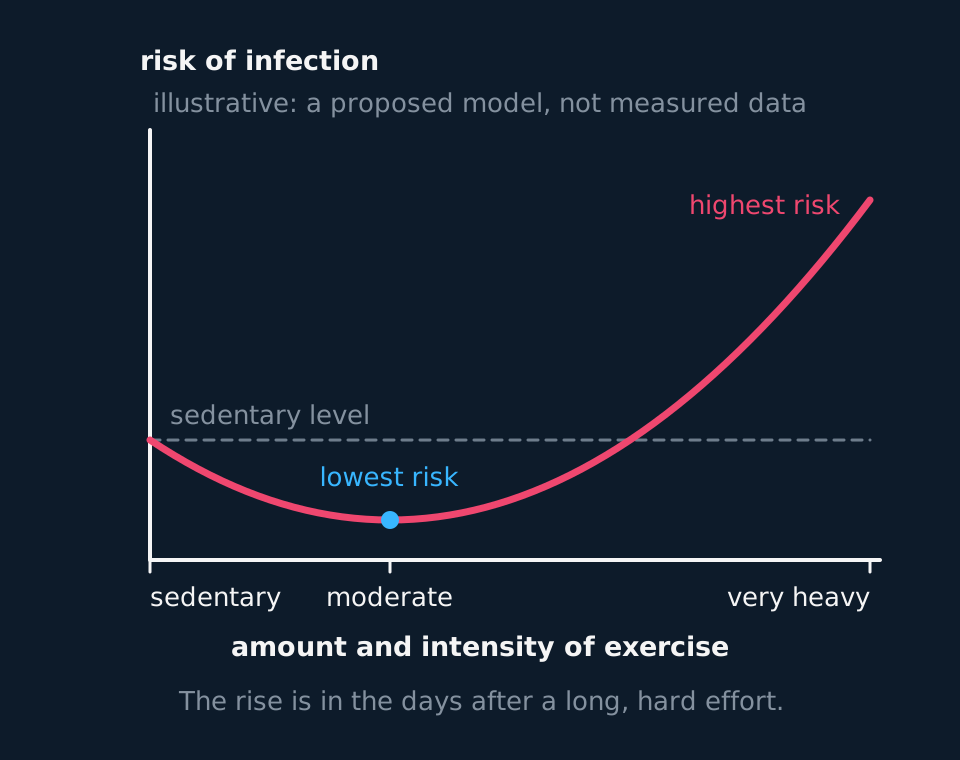
Describe the drawing
A line graph with no numbers on its axes. The vertical axis is the risk of an upper respiratory tract infection and the horizontal axis is the amount and intensity of exercise, running from sedentary through moderate to very heavy. A dashed horizontal line marks the risk for a sedentary person. The curve starts on that line, dips below it to its lowest point at moderate exercise, then climbs steeply and ends well above the dashed line at very heavy training, giving the shape of a letter J. A note says it is an illustrative, proposed model rather than measured data.
The changes measured in the blood after heavy exercise are the ones the explanation rests on. For some hours, the number and activity of lymphocytes in the blood, natural killer cells among them, fall, phagocytes are less active, and the concentration of the antibody IgA in saliva falls, so the mucosal surfaces of the nose and throat are less well defended. Cortisol and adrenaline, released in large amounts during hard exercise, both suppress parts of the immune response. This period of a few hours to a few days is sometimes called the open window.
Here too the evidence is argued over. Some immunologists point out that lymphocytes leaving the blood after exercise are moving into tissues such as the lungs and gut rather than being lost, and that many studies counted symptoms reported by the athletes rather than infections confirmed in a laboratory. Athletes at a big race have also travelled, slept badly and stood in crowds, all of which raise the chance of catching something.
Overtraining is what happens when heavy training continues without enough recovery. Performance falls and does not come back after a few days' rest, and the athlete has persistent fatigue, poor sleep, low mood and frequent minor infections. Overuse injuries to joints and tendons are common in the same athletes.
- Osteoarthritis
- A joint disease in which the articular cartilage is worn away, so that bone surfaces rub, causing pain, swelling and stiffness.
- Overtraining
- A fall in performance, with persistent fatigue and frequent infections, caused by heavy training without enough recovery.
Reading the evidence: correlation or cause
Almost all of this evidence is observational. Researchers follow large groups of people for years, record how active they are, and count who develops a disease. What such a study can show is a correlation: the more active group has less disease. A causal relationship, that the activity is what lowers the risk, needs more than that, because three other explanations have to be ruled out.
The first is a confounding variable. Active people, on average, smoke less, eat differently and have higher incomes, and each of those lowers the risk of CVD and diabetes by itself. The second is reverse causation: people who are already unwell, or whose joints hurt, exercise less because of it, so the illness causes the inactivity rather than the other way round. The third is chance, which a large sample makes less likely.
Several things strengthen the case for a cause: a large sample; confounding variables measured and allowed for in the analysis; a dose-response relationship, in which the risk falls steadily as activity rises; the same result in studies of different populations; and a plausible mechanism, such as the glucose uptake and blood pressure effects above. Randomised controlled trials, in which people are allocated to exercise or not, show that exercise lowers blood pressure and improves insulin sensitivity. A trial lasting the decades a disease takes to develop is rarely possible, so the case for exercise rests on trials of these risk factors together with long observational studies of the disease itself.
| Weekly moderate activity | Adults followed | Developed type 2 diabetes | Percentage |
|---|---|---|---|
| None | 4000 | 360 | 9.0 |
| Under 2.5 hours | 6000 | 390 | 6.5 |
| 2.5 to 5 hours | 6000 | 300 | 5.0 |
| Over 5 hours | 4000 | 184 | 4.6 |
Does this show that exercise prevents diabetes?
The table above is constructed for practice rather than taken from a real study. It records adults followed for ten years. Describe the pattern, and say whether the data show that exercise prevents type 2 diabetes.
Show the working
The pattern first. The percentage developing type 2 diabetes falls as weekly activity rises, from 9.0 per cent with none to 4.6 per cent with over 5 hours, so the risk is roughly halved. The fall is steepest between none and under 2.5 hours and small between the top two groups.
That is a negative correlation with a dose-response shape, which supports a causal link but does not prove one. The groups were not allocated at random, so they may differ in diet, body mass, smoking or income, and any of these could account for some of the difference. People with early, undiagnosed disease may also have been less active to begin with.
The conclusion is that the data are consistent with exercise lowering the risk, and become strong evidence only if confounding variables were allowed for and the result agrees with other studies and with a known mechanism.
- Causal relationship
- A relationship in which a change in one variable brings about the change in the other, rather than both simply varying together.
Keyhole surgery
Medical technology now returns many injured athletes to sport who would once have stopped. The specification names two examples, and the first is keyhole surgery, which on a joint is called arthroscopy.
The surgeon makes two or three small incisions, each about a centimetre long. Through one goes the arthroscope, a narrow tube carrying optical fibres that light the inside of the joint and a camera that shows it on a screen. The joint is filled with sterile saline, which swells it open so there is room to see and work. Fine instruments pass through the other ports to trim or stitch a torn meniscus, smooth damaged cartilage, remove loose fragments, or reconstruct a ligament.
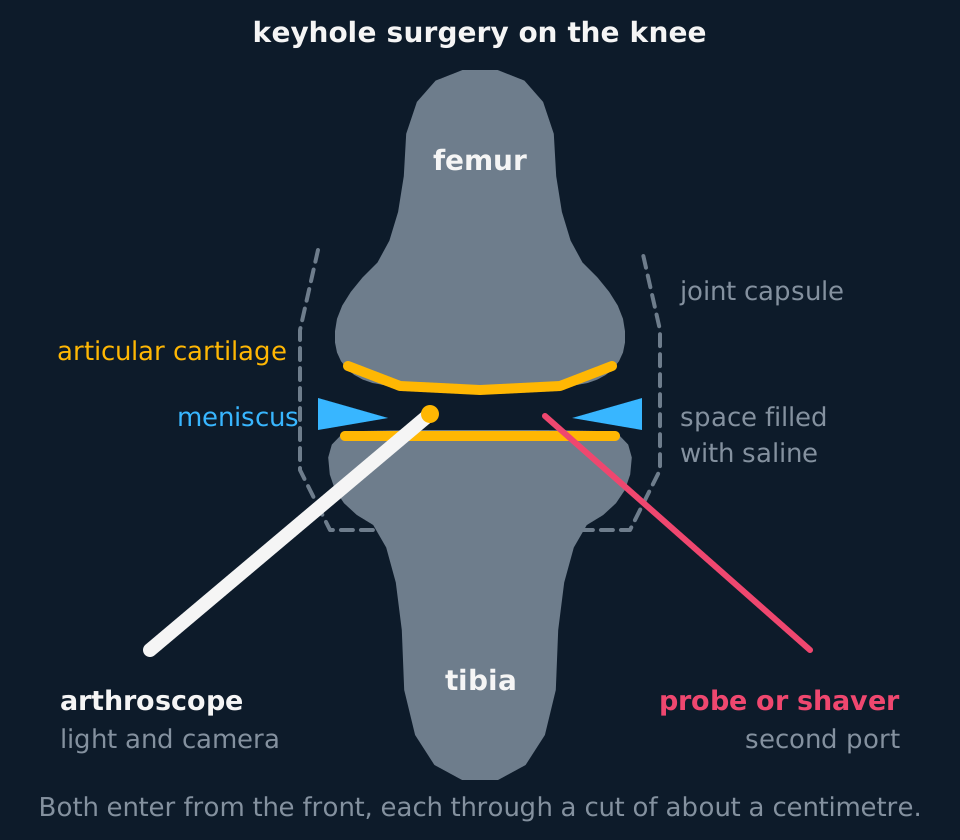
Describe the drawing
A knee joint drawn from the front in simplified form. The femur comes down from the top and ends in two rounded condyles capped with a band of articular cartilage. The tibia rises from the bottom with its own cartilage on its flat upper surface, and a wedge of meniscus sits at each side of the narrow joint space between them. A dashed joint capsule encloses the joint, and the space is labelled as filled with saline. Two straight instruments enter from below on either side: a thick arthroscope carrying light and a camera from the left, and a thinner probe or shaver through a second port from the right, both with their tips in the joint space. A note says both enter from the front of the knee, each through a cut of about a centimetre.
The commonest major repair is of the anterior cruciate ligament, the ACL, which is often torn by a twisting landing. A torn ACL heals poorly because it has a poor blood supply, so it is replaced with a graft taken from the patient's own tendon, usually part of a hamstring tendon or the patellar tendon, threaded through tunnels drilled in the femur and tibia. Because it is the patient's own tissue, there is no rejection. Return to full sport commonly takes nine months or more, because the graft has to remodel into ligament before it can take the loads of competition.
| Open surgery | Keyhole surgery | |
|---|---|---|
| Incision | One long cut through skin and muscle | Two or three cuts of about a centimetre |
| Damage to surrounding tissue | Extensive | Little |
| Blood loss and infection risk | Higher | Lower |
| Pain and scarring | More | Less |
| Hospital stay | Days | Often home the same day |
| Rehabilitation | Slower to start | Can start sooner, so less muscle wastes |
Each advantage in the table follows from the size of the incisions. Less tissue is cut, so less has to heal, less blood is lost, there is less open wound for bacteria to enter, and the patient can start moving the joint sooner, which limits the muscle wasting that inactivity causes. The limits are that the surgeon sees only what the camera shows and works with long, fine instruments, so some repairs still need open surgery.
- Keyhole surgery
- Surgery carried out through small incisions using a camera on a narrow tube and fine instruments; on a joint it is called arthroscopy.
Prostheses
A prosthesis is an artificial device that replaces a missing or damaged part of the body. Two kinds matter for sport.
A joint replacement is used when osteoarthritis has destroyed the cartilage of a hip or knee. The worn surfaces are removed and replaced with metal alloy components, commonly titanium or cobalt-chromium, bearing on a surface of hard-wearing polyethylene or ceramic. The new joint moves without the pain of bone on bone, so many people return to swimming, cycling, golf and walking. Surgeons usually advise against high-impact running afterwards, because impact speeds up the wear and loosening of the implant.
A limb prosthesis replaces part of a leg or arm. It is attached through a socket moulded to the residual limb, and the fit matters, because a poor socket concentrates the load on small areas of skin and damages it. For running, the lower leg is replaced by a curved blade of carbon fibre. The blade bends as the runner's weight comes onto it, storing elastic strain energy, and springs back as the foot leaves the ground, returning much of that energy to the stride. Knees controlled by a microprocessor adjust their resistance to bending many times a second, so the leg stays stable when walking on slopes and stairs. Running blades let athletes with a leg amputation compete in Paralympic sprints and long jump.
They also bring a question to sports' governing bodies: whether a blade gives its user an advantage over a biological leg. The question has been argued in sport's courts, and it is the same question of fairness that runs through the debate on drugs.
- Prosthesis
- An artificial device that replaces a missing or damaged part of the body, such as a joint replacement or an artificial limb.
Performance-enhancing substances
A performance-enhancing substance is one taken to improve performance beyond what training and diet achieve. The World Anti-Doping Agency (WADA) publishes a Prohibited List each year. A substance is considered for the list when it meets any two of three criteria: it can enhance performance, it carries a risk to the athlete's health, and its use is against the spirit of sport. Two examples come up repeatedly in exam questions, and both work through biology covered elsewhere in the course.
Anabolic steroids are testosterone and synthetic drugs related to it, such as nandrolone. Like other steroid hormones they are lipid-soluble, so they diffuse through the phospholipid bilayer of the muscle cell. Inside, each binds a receptor protein, and the hormone-receptor complex enters the nucleus and acts as a transcription factor: it binds DNA and switches on the genes for muscle proteins. More mRNA is transcribed, more protein is synthesised, and the muscle fibres grow larger and stronger. Recovery between sessions is also faster, so the athlete can train harder.
EPO, erythropoietin, is a glycoprotein hormone made by the kidneys when the oxygen concentration of the blood is low. It stimulates the bone marrow to produce more red blood cells. Made by genetically modified cells, it is a medicine for the anaemia of kidney failure. In an endurance athlete, injected EPO raises the proportion of the blood that is red cells, so each litre carries more haemoglobin and more oxygen, aerobic respiration in the muscles can continue at a higher rate, and less of the work depends on anaerobic respiration and its lactate.
| Substance | Effect on performance | Health risks |
|---|---|---|
| Anabolic steroids | More muscle mass and strength; faster recovery | Liver damage; raised LDL and lowered HDL; raised blood pressure; reduced sperm production in men; masculinisation in women; mood changes and aggression |
| EPO | More red cells, more oxygen to muscle; greater endurance | Thicker, more viscous blood; clots; stroke and heart attack, worse when the athlete is dehydrated |
Not everything that improves performance is banned. Caffeine is permitted, creatine is sold legally as a supplement, and some asthma inhalers are allowed up to a set dose. An athlete with a diagnosed condition can apply for a therapeutic use exemption to take a prohibited medicine, provided it does no more than return them to normal health.
- Anabolic steroid
- A drug related to testosterone that enters muscle cells, binds a receptor and switches on genes for muscle protein, increasing muscle mass and strength.
- EPO
- Erythropoietin, a hormone made by the kidneys that stimulates the bone marrow to produce red blood cells.
Should doping be allowed? The ethical positions
The specification asks for the different ethical positions, not for a verdict. An absolutist position holds that an action is right or wrong whatever the circumstances: doping is cheating and always wrong. A relativist position judges each case by its circumstances and consequences, which is the reasoning behind the therapeutic use exemption. Four ethical frameworks are commonly used to organise the arguments.
| Framework | The question it asks | How it applies to doping |
|---|---|---|
| Rights and duties | What rules and obligations apply? | Athletes agree to the rules of their sport and have a duty to keep them; doping breaks that agreement |
| Utilitarianism | Which choice gives the greatest good for the greatest number? | Weighs harm to athletes' health and to clean competitors against any benefit to the user or to spectators |
| Autonomy | Should people make their own informed choices? | An informed adult may choose to take a risk with their own body, as boxers and climbers do |
| Virtue ethics | What would a good person do? | Fair play, effort and keeping to the rules are the virtues sport is meant to show; doping fails them |
The arguments against allowing doping. It is cheating: an athlete gains an advantage by breaking rules every competitor agreed to. It harms health, sometimes years later, and athletes often take doses far above medical ones. It removes other people's choice, because once some competitors dope, clean athletes must either take the same risks or accept losing, which is coercion. Young athletes copy their heroes. And it replaces talent and effort, the things spectators come to see, with pharmacology.
The arguments for allowing it. Adults should be free to take informed risks with their own bodies. The line between permitted and banned is hard to draw: sleeping in an altitude tent raises red cell numbers legally, as EPO does illegally, and expensive equipment, coaching and diet already make competition unequal, as do genes. Testing never catches everyone, so undetected users win anyway, and if use were permitted it could be supervised by doctors, which might be safer than covert doping with drugs of unknown quality.
Planning a six-mark discussion
Discuss whether athletes should be allowed to use performance-enhancing substances.
Show the working
A mark scheme for a question like this credits arguments on both sides, each tied to an ethical position, and a reasoned conclusion. Plan three points a side and name the position each comes from.
Against: rights and duties, because doping breaks rules every competitor agreed to; utilitarian, because the harm to athletes' health and to clean competitors outweighs the benefit to the few who gain; virtue ethics, because it replaces effort and fair play with a drug.
For: autonomy, because an informed adult may accept a risk to their own body; relativist, because the line between a legal altitude tent and illegal EPO is arbitrary; utilitarian, because supervised use might cause less harm than covert use that testing fails to stop.
Then a judgement, with its reason: for example, that the coercion argument is the strongest, because legal doping would force every athlete to take the risk, which removes the autonomy the main argument for it relies on.
- Therapeutic use exemption
- Permission for an athlete with a diagnosed condition to take a prohibited medicine, provided it only restores normal health.
- Utilitarianism
- The ethical position that the right action is the one producing the greatest good for the greatest number of people.
In the exam
- Questions on 7.13 are usually data questions. Describe the trend with figures quoted from the data, then say whether it shows a correlation or a cause, naming a likely confounding variable.
- For wear and tear, name the tissue: articular cartilage. State that it has no blood supply, which is why it repairs poorly.
- For immune suppression, give a measured change, such as fewer natural killer cells or less IgA in saliva, rather than saying the immune system is weaker.
- Each advantage of keyhole surgery should be traced back to the small incisions: less tissue damage, less blood loss, lower infection risk, faster recovery.
- For anabolic steroids, write the mechanism as a transcription factor switching on genes, which links this topic to 7.16.
- An ethics answer needs both sides, each linked to a named position such as autonomy or rights and duties, and a conclusion with a reason.
Check yourself
One endurance runner sleeps in an altitude tent, which lowers the oxygen concentration of the air she breathes at night. Another injects EPO. Explain why both may improve endurance, and suggest why the first is permitted and the second is not.
Answer
Breathing air with less oxygen lowers the oxygen concentration of the blood, and the kidneys respond by secreting more of the runner's own EPO. Injected EPO acts on the same target. Either way, the bone marrow produces more red blood cells, each litre of blood carries more haemoglobin, and more oxygen reaches the muscles during a race. Aerobic respiration can supply ATP at a higher rate, so the runner can hold a faster pace before relying on anaerobic respiration and building up lactate.
One reason given for permitting the tent is that the response is the body's own and is limited by it: the kidneys stop secreting extra EPO once the oxygen concentration recovers, so the red cell count stays within a natural range. Injected EPO has no such limit and can push the blood's viscosity high enough to cause clots and strokes. Injected EPO meets all three WADA criteria: it enhances performance, it risks health, and it is against the spirit of sport.
A relativist would point out that the two have the same effect on the blood, so the difference is one of degree and of risk rather than of kind, which is the strongest argument that the line between them is arbitrary.
Questions
Question 16 marks
Discuss whether athletes should be allowed to use performance-enhancing substances. Refer to different ethical positions in your answer.
Mark scheme
- B1 against, rights and duties: athletes have agreed to the rules of their sport and doping breaks them, so it is cheating
- B1 against, harm: the substances carry health risks, such as liver damage and heart disease from steroids or clots from EPO, and doses exceed medical ones
- B1 against, coercion or virtue ethics: clean athletes are pressured to dope to compete, and doping replaces fair play and effort, setting a poor example to young athletes
- B1 for, autonomy: informed adults should be free to take risks with their own bodies
- B1 for, relativist or utilitarian: the line is arbitrary, since altitude training has a similar effect to EPO legally, and supervised legal use might cause less harm than covert use that testing misses
- B1 a reasoned conclusion that weighs the two sides, for example that coercion removes the autonomy the main argument for doping relies on
Question 25 marks
Using the same table, evaluate the claim that exercise prevents type 2 diabetes.
| Weekly moderate activity | Adults followed | Developed type 2 diabetes |
|---|---|---|
| None | 4000 | 360 |
| Under 2.5 hours | 6000 | 390 |
| 2.5 to 5 hours | 6000 | 300 |
| Over 5 hours | 4000 | 184 |
Mark scheme
- B1 the proportion developing diabetes falls as activity rises, from 9.0 to 6.5 to 5.0 to 4.6 per cent, a negative correlation
- B1 the steady fall is a dose-response relationship and the sample is large, both of which support a causal link
- B1 but the study is observational and the groups were not allocated at random, so confounding variables such as diet, body mass, smoking or income may explain some of the difference
- B1 reverse causation is possible: people with early or undiagnosed illness may have been less active
- B1 the data show a correlation consistent with the claim but do not prove that exercise prevents diabetes; 'prevents' is too strong, since some active people still developed it, and 'reduces the risk' is what the data could support
Question 34 marks
Explain how a lack of exercise increases a person's risk of developing type 2 diabetes.
Mark scheme
- B1 less energy is used each day, so with the same diet more is stored as fat and the person is more likely to become obese
- B1 contracting muscle takes up glucose from the blood, moving glucose transporters into its membrane without needing insulin, so less glucose is removed when muscles are inactive
- B1 without regular exercise, and with obesity, muscle and liver cells become less sensitive to insulin (insulin resistance)
- B1 the pancreas must secrete more insulin to control blood glucose, and when its β cells cannot keep up the blood glucose concentration stays high
Question 44 marks
Explain why many years of high-impact training can lead to osteoarthritis of the knee, and why the damage is slow to repair.
Mark scheme
- B1 the ends of the femur and tibia are covered with articular cartilage, which reduces friction and absorbs shock
- B1 repeated impact loading wears the cartilage thin, and the menisci that spread the load can be torn
- B1 once the cartilage is worn the bone surfaces rub, causing pain, swelling and stiffness, which is osteoarthritis
- B1 cartilage has no blood supply, so few nutrients and cells reach it and it repairs slowly and poorly
Question 54 marks
A footballer has a torn meniscus repaired by keyhole surgery rather than open surgery. Explain why she is likely to return to training sooner.
Mark scheme
- B1 the arthroscope and instruments go in through two or three small incisions rather than one long cut
- B1 less skin, muscle and other tissue is cut, so there is less to heal, less pain and less blood loss
- B1 the smaller wound gives a lower risk of infection
- B1 she can go home sooner and start moving the joint and rehabilitation earlier, so less muscle wastes
Question 64 marks
Anabolic steroids are lipid-soluble drugs related to testosterone. Explain how they increase muscle mass.
Mark scheme
- B1 being lipid-soluble, they diffuse through the phospholipid bilayer of the muscle cell membrane
- B1 they bind a receptor protein inside the cell, and the hormone-receptor complex enters the nucleus
- B1 the complex acts as a transcription factor, binding DNA and switching on the genes for muscle proteins
- B1 more mRNA is transcribed and translated, so more muscle protein is made and the fibres grow larger and stronger
Question 74 marks
Explain how injecting EPO can improve the performance of an endurance cyclist, and why it is dangerous.
Mark scheme
- B1 EPO stimulates the bone marrow to produce more red blood cells
- B1 so the blood carries more haemoglobin and more oxygen per litre to the muscles
- B1 aerobic respiration can supply ATP at a higher rate, so the cyclist relies less on anaerobic respiration and builds up less lactate, delaying fatigue
- B1 the blood becomes thicker and more viscous, raising the risk of clots, stroke and heart attack, especially when dehydrated
Question 83 marks
Describe the J-shaped curve proposed to relate the risk of upper respiratory tract infection to the amount of exercise, and give one change in the immune system after intense exercise that could explain it.
Mark scheme
- B1 moderate exercise lowers the risk below that of a sedentary person, the lowest point of the curve
- B1 very heavy or prolonged intense exercise raises the risk above that of a sedentary person
- B1 after intense exercise there are fewer, or less active, lymphocytes such as natural killer cells in the blood, or less phagocyte activity, or less IgA in saliva, or raised cortisol suppressing the immune response
Question 93 marks
The table shows the results of a ten-year study of 20 000 adults. The data were constructed for this question rather than measured. Calculate the percentage of each of the two extreme groups that developed type 2 diabetes, and the percentage reduction in risk from the least active group to the most active.
| Weekly moderate activity | Adults followed | Developed type 2 diabetes |
|---|---|---|
| None | 4000 | 360 |
| Under 2.5 hours | 6000 | 390 |
| 2.5 to 5 hours | 6000 | 300 |
| Over 5 hours | 4000 | 184 |
Mark scheme
- M1 none: 360 ÷ 4000 × 100 = 9.0 per cent; over 5 hours: 184 ÷ 4000 × 100 = 4.6 per cent
- M1 percentage reduction = (9.0 − 4.6) ÷ 9.0 × 100
- A1 = 49 per cent (48.9)
Question 103 marks
Using the marathon study in the previous question, suggest three reasons, other than suppression of the immune system by exercise, why the finishers reported more colds.
Mark scheme
- B1 the finishers spent the race and its build-up in crowds, and travelled, so were more exposed to pathogens
- B1 symptoms were self-reported rather than confirmed in a laboratory, and runners who expect to fall ill may report minor symptoms more often
- B1 the two groups were not allocated at random and differ in other ways, such as sleep, diet or training load before the race, which are confounding variables
Question 113 marks
Explain how a carbon-fibre running blade allows an athlete with a lower-leg amputation to sprint.
Mark scheme
- B1 it is attached to the residual limb by a socket moulded to fit, which spreads the load and transmits force to the blade
- B1 the curved blade bends when the athlete's weight comes onto it, storing elastic strain energy
- B1 it springs back as the foot leaves the ground, returning much of that energy to propel the athlete forward
Question 123 marks
Sleeping in an altitude tent and injecting EPO both raise an athlete's red blood cell count. Suggest why the first is permitted and the second is prohibited.
Mark scheme
- B1 the tent works through the body's own response: low blood oxygen makes the kidneys secrete more of the athlete's own EPO
- B1 that response stops once blood oxygen recovers, so the red cell count stays within a natural range and the health risk is small
- B1 injected EPO has no such limit and can make the blood dangerously viscous, so it meets the criteria of enhancing performance, risking health and being against the spirit of sport
Question 132 marks
State two possible disadvantages to health of exercising too much.
Mark scheme
- B1 wear and tear on joints, such as wearing away of the articular cartilage, leading to osteoarthritis, or damage to ligaments, menisci or tendons
- B1 suppression of the immune system after prolonged intense exercise, giving a higher risk of infections such as upper respiratory tract infections
Question 142 marks
In a study constructed for this question, 225 of 1500 runners who finished a marathon reported symptoms of a cold in the following week, compared with 20 of 500 people who entered but did not run. Calculate how many times more likely the finishers were to report symptoms.
Mark scheme
- M1 finishers 225 ÷ 1500 = 15 per cent; non-runners 20 ÷ 500 = 4 per cent
- A1 15 ÷ 4 = 3.75 times (accept 3.8)
Worth remembering
- Too little exercise: more risk of obesity, CVD and type 2 diabetes. Too much: worn joints and a spell of weaker immune defence.
- Articular cartilage has no blood supply, so once worn it repairs poorly, and osteoarthritis follows.
- The J-shaped curve hypothesis: infection risk is lowest with moderate exercise and rises after very heavy exercise.
- Observational data show correlation. A dose-response, controlled confounders, repeated results and a mechanism build the case for a cause.
- Keyhole surgery: small incisions, so less tissue damage, less blood loss, lower infection risk and faster rehabilitation.
- Anabolic steroids act as transcription factors for muscle protein genes; EPO makes the marrow produce more red blood cells.
- Doping debates set duty, harm and fair play against autonomy and the arbitrariness of where the line is drawn.
CHECK YOUR PROGRESS
Rate how confident you are with each objective for this lesson. Ratings are saved in this browser, on this device, unless you sign in.
- Explain how exercising too little increases the risk of obesity, cardiovascular disease and type 2 diabetes.
- Describe the possible disadvantages of exercising too much, including wear and tear on joints and suppression of the immune system.
- Interpret data on exercise and health, and say whether they show a correlation or a causal relationship.
- Explain how keyhole surgery and prostheses enable people with injuries and disabilities to take part in sport.
- Explain how anabolic steroids and EPO improve performance, and state the health risks of each.
- Discuss the different ethical positions on whether athletes should be allowed to use performance-enhancing substances.
Open the full revision checklist to see every objective in the curriculum in one place.
Practise this lesson
WORKBOOK
The written questions from this topic, on paper with room to work, and a separate book of mark schemes. The 2 questions that are set on a diagram stay on this page, where the diagram can be drawn. Free to use; please do not redistribute or sell.