Chemistry › Periodicity and Period 3 › The Period 3 elements: reactions with oxygen and water
The Period 3 elements: reactions with oxygen and water
Sodium dropped into water skates across the surface, fizzing, while magnesium in the same trough gives a few bubbles over a few days. Heated in oxygen, the elements from sodium to sulfur burn to white solids or a colourless gas, and the formula of each oxide follows from the number of electrons in the outer shell.
Key terms Every definition in periodicity and Period 3, lesson by lesson
Before this Periodicity: trends across Period 3 and the blocks of the table – the structure of each element and its first ionisation energy · Oxidation states and the rules for assigning them – oxygen as −2 in an oxide · Formulae, equations and state symbols – balancing an equation and choosing (s), (l), (g) or (aq)
COMMON MISCONCEPTION
Magnesium doesn't react with water at all; it just sits at the bottom of the beaker.
Magnesium reacts with cold water, very slowly: over several days a clean ribbon gives a few bubbles of hydrogen and a faintly alkaline solution of magnesium hydroxide. With steam it burns brightly in seconds: Mg(s) + H₂O(g) → MgO(s) + H₂(g). Sodium does in seconds with cold water what magnesium takes days to do.
What you should be able to do
- Describe the reactions of sodium and magnesium with water, with equations and the pH of the resulting solution.
- Explain why magnesium reacts so much faster with steam than with cold water, and why the product is different.
- Write equations for the reactions of sodium, magnesium, aluminium, silicon, phosphorus and sulfur with oxygen, and describe what is seen.
- Deduce the oxidation state of the Period 3 element in each oxide, and relate the highest oxidation state to the number of outer electrons.
- Calculate gas volumes and reacting masses for these reactions, and deduce an oxide's formula from combustion data.
- Describe the reactions of sodium to phosphorus with chlorine, and relate the oxidation state in each chloride to the number of outer electrons.CAIE
Sodium and magnesium with water
Sodium reacts vigorously with cold water to give hydrogen and sodium hydroxide solution. A piece the size of a lentil, in a trough of water with a few drops of universal indicator, floats, melts into a silvery ball and moves rapidly across the surface, fizzing, until it has gone. The fizzing is hydrogen. The sodium melts because the reaction is strongly exothermic and sodium melts at 98 °C. The indicator turns purple: the solution left is sodium hydroxide.
2Na(s) + 2H₂O(l) → 2NaOH(aq) + H₂(g)Vigorous. Sodium hydroxide is soluble, so the resulting solution is strongly alkaline, pH 13 to 14.
An observation is what could be seen without knowing the chemistry: 'fizzing' or 'effervescence', 'melts into a ball', 'moves across the surface', 'the indicator turns purple'. 'Hydrogen is produced' names a product, and a description built from product names earns none of the observation marks.
Magnesium ribbon in cold water seems to do nothing. Leave it for a few days and a few bubbles of hydrogen collect on the ribbon, and the water around it becomes weakly alkaline, about pH 10. The product, magnesium hydroxide, is only sparingly soluble. Most of it stays on the ribbon as a white solid, which slows the reaction further, and only a little dissolves to release hydroxide ions.
Mg(s) + 2H₂O(l) → Mg(OH)₂(s) + H₂(g)Very slow with cold water. Mg(OH)₂ is sparingly soluble, so the solution is only weakly alkaline, about pH 10.
Both reactions are redox. Each metal atom loses electrons, sodium to Na⁺ and magnesium to Mg²⁺, and hydrogen in water is reduced from +1 to 0. Sodium reacts far more readily because it has to lose only one electron, with a first ionisation energy of 496 kJ mol⁻¹. Magnesium has to lose two, which takes 738 + 1451 = 2189 kJ mol⁻¹.
The rest of the period does not continue the pattern in water. Aluminium would react on the same reasoning, but its surface layer of aluminium oxide is insoluble and keeps the water off the metal, so an aluminium saucepan can be boiled dry without reacting. Silicon, phosphorus and sulfur do not react with water at all; white phosphorus is stored under it. Chlorine dissolves in water and reacts with it, giving a mixture of hydrochloric and chloric(I) acids, a reaction of the halogens rather than of the period.
The volume of hydrogen from a piece of sodium
A 0.115 g piece of sodium reacts completely with water. Calculate the volume of hydrogen formed at room temperature and pressure, and the concentration of sodium hydroxide if the solution is made up to 250 cm³. Molar gas volume is 24.0 dm³ mol⁻¹.
Show the working
Amount of sodium = 0.115 ÷ 23.0 = 0.00500 mol.
From the equation, 2 mol Na gives 1 mol H₂, so amount of H₂ = 0.00500 ÷ 2 = 0.00250 mol.
Volume of H₂ = 0.00250 × 24.0 = 0.0600 dm³ = 60.0 cm³.
2 mol Na gives 2 mol NaOH, so amount of NaOH = 0.00500 mol, and its concentration = 0.00500 ÷ 0.250 = 0.0200 mol dm⁻³.
- Alkali
- A base that dissolves in water to release hydroxide ions, OH⁻(aq).
- Oxidation
- The loss of electrons by a species, or an increase in its oxidation state.
- Reduction
- The gain of electrons by a species, or a decrease in its oxidation state.
Magnesium and steam
Hot magnesium reacts rapidly with steam, and the product is the oxide, not the hydroxide. In the usual apparatus, mineral wool soaked in water sits at the closed end of a hard-glass boiling tube, with a coil of magnesium ribbon in the middle. The ribbon is heated strongly, and the flame is flicked back to the wool now and then to drive steam over it. The magnesium glows with a bright white light, a white solid is left in the tube, and the hydrogen can be lit at a jet.
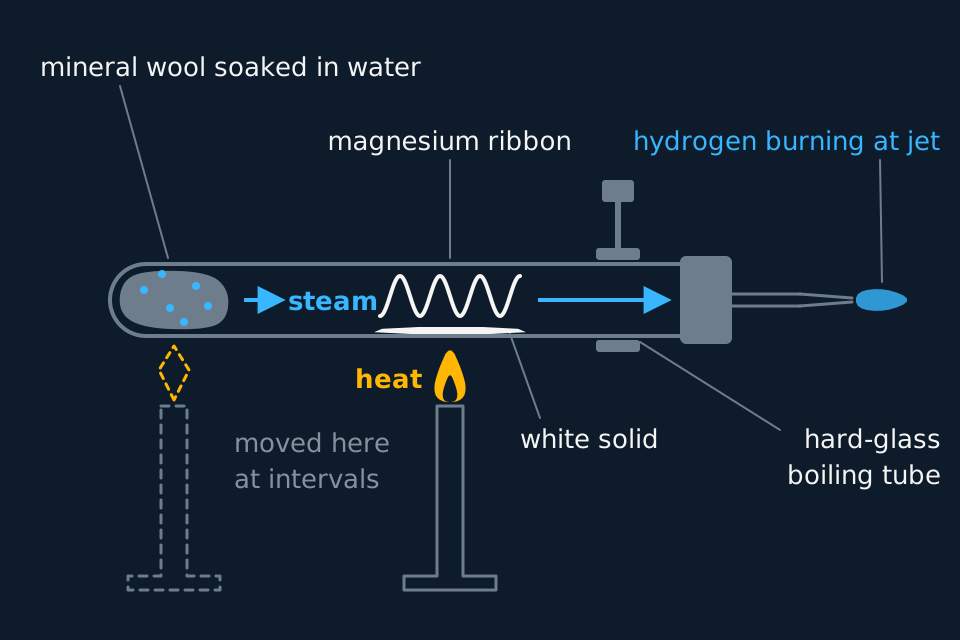
Describe the drawing
A hard-glass boiling tube lies horizontally. At its closed left end is a plug of mineral wool soaked in water; in the middle is a loose coil of magnesium ribbon with a white solid beneath it. Arrows show steam passing from the wool over the magnesium towards the right-hand end, which is closed by a bung carrying a glass tube drawn out to a jet, where a small flame of hydrogen burns. A Bunsen burner heats the magnesium, and a dashed burner under the wool shows it is moved there at intervals.
Mg(s) + H₂O(g) → MgO(s) + H₂(g)With steam the product is magnesium oxide, a white solid, not the hydroxide.
Two things differ from the cold-water reaction. The rate is far higher: the magnesium and the steam are several hundred degrees hotter, so a much larger proportion of collisions have energy greater than the activation energy. And the product is the oxide, because magnesium hydroxide is not stable at that temperature; it decomposes to magnesium oxide and water.
The apparatus has one hazard particular to it. If the gas is collected over water and the heating stops while the delivery tube is still under the water, the gas in the tube cools and contracts, and cold water is drawn back into the hot glass, which can crack it. Taking the delivery tube out of the water before removing the flame prevents this suck-back. With a jet instead, the hydrogen is lit only once the air has been swept out of the tube.
Sodium is never heated in steam in a school laboratory. Its reaction with cold water already needs a small piece and a safety screen.
Burning the elements in oxygen
Each element from sodium to sulfur burns when heated in oxygen, and each product is the oxide. Five of the six oxides are white solids; sulfur's is a colourless gas. What changes along the period is how readily the element catches fire and what the flame looks like.
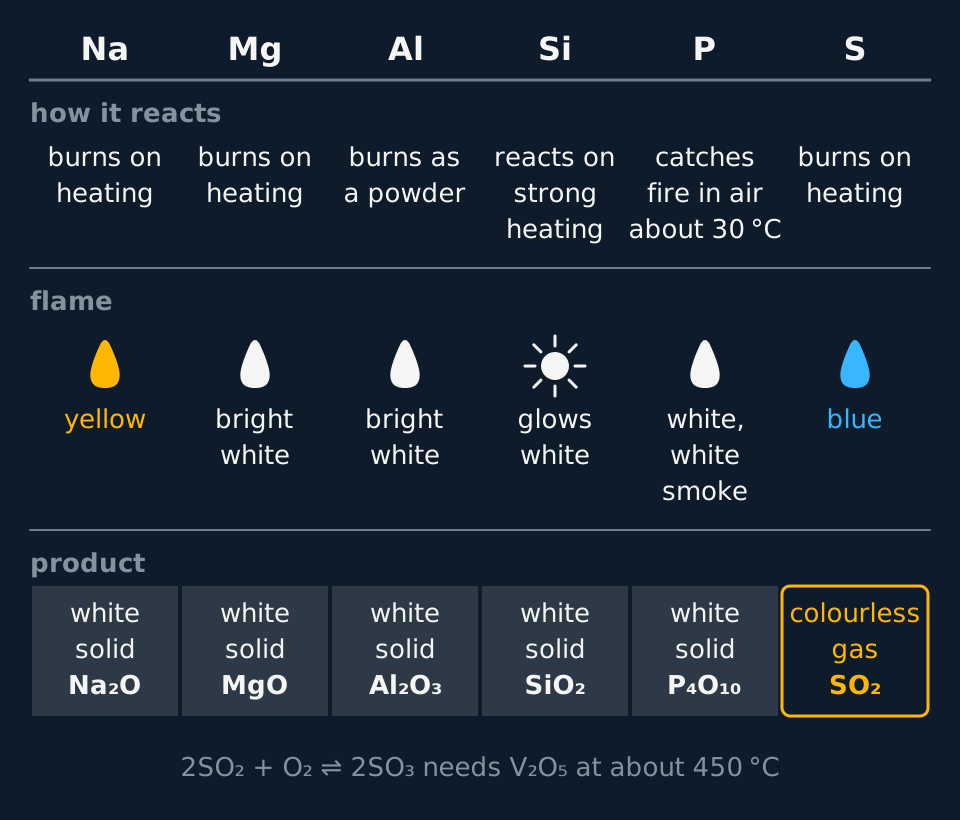
Describe the drawing
A table drawn as a figure with columns for sodium, magnesium, aluminium, silicon, phosphorus and sulfur and rows for how each reacts, its flame and its product. Sodium gives a yellow flame, magnesium and aluminium powder a bright white one, silicon glows white on strong heating, phosphorus catches fire in air at about 30 degrees with a white flame and white smoke, and sulfur burns with a blue flame. The first five products are white solids in shaded cells; sulfur's product, sulfur dioxide, is a colourless gas in an outlined amber cell. A line below notes that sulfur dioxide only goes on to sulfur trioxide with a vanadium(V) oxide catalyst at about 450 degrees Celsius.
Sodium, heated on a combustion spoon until it melts and lowered into a gas jar of oxygen, burns with a yellow flame and leaves a white solid, sodium oxide. Magnesium burns with a bright white flame, too bright to look at directly, and leaves a white powder of magnesium oxide.
4Na(s) + O₂(g) → 2Na₂O(s)Yellow flame, white solid. In excess oxygen some sodium peroxide, Na₂O₂, forms as well; the equation asked for is the one to Na₂O.
2Mg(s) + O₂(g) → 2MgO(s)Bright white flame, white solid.
Aluminium is covered by a thin, unreactive layer of aluminium oxide, which keeps oxygen away from the metal underneath, so a sheet of aluminium does not burn in a Bunsen flame. As a powder sprinkled into a flame it burns with a bright white flame, giving a white solid. Silicon reacts only when heated strongly in oxygen, and then slowly, glowing white, to give silicon dioxide, another white solid.
4Al(s) + 3O₂(g) → 2Al₂O₃(s)Powder: bright white flame, white solid.
Si(s) + O₂(g) → SiO₂(s)Needs strong heating. White solid.
White phosphorus catches fire in air at about 30 °C, so it is stored under water. It burns with a white flame and gives dense white smoke, which is solid phosphorus(V) oxide. In a limited supply of air P₄O₆ forms instead. Sulfur, a yellow solid, melts when heated and burns with a blue flame, giving sulfur dioxide, a colourless gas with a choking smell.
P₄(s) + 5O₂(g) → P₄O₁₀(s)White flame, white smoke. P₄O₁₀ is often called phosphorus pentoxide, after its empirical formula P₂O₅.
S(s) + O₂(g) → SO₂(g)Blue flame, colourless gas with a choking smell.
Burning sulfur does not give sulfur trioxide, however much oxygen is present. Sulfur dioxide is oxidised further only with a catalyst, vanadium(V) oxide, at about 450 °C, which is the key step of the Contact process for making sulfuric acid. The reaction is reversible.
2SO₂(g) + O₂(g) ⇌ 2SO₃(g)V₂O₅ catalyst, about 450 °C.
Chlorine and argon are left out. Chlorine does form oxides, such as Cl₂O₇, but not by reacting directly with oxygen, and argon forms none.
White phosphorus catches fire so readily because of the shape of its molecule. The four atoms of P₄ sit at the corners of a tetrahedron, so each P–P–P bond angle is 60°, far smaller than the angle the bonding pairs would adopt if they could. The bonds are strained and weak, and little energy is needed to start breaking them. Red phosphorus, in which the tetrahedra are opened out and joined into chains, is stable in air and is the form on the side of a matchbox.
Sodium tarnishes in air at room temperature and white phosphorus catches fire at about 30 °C; magnesium and sulfur need a flame to start them; aluminium and silicon need the strongest heating. The order is not a trend in the atoms. It reflects the barriers to starting the reaction: an oxide layer on aluminium, a giant covalent lattice to break into in silicon, strained bonds in white phosphorus. Once burning, every one of these reactions is strongly exothermic.
- Oxide
- A compound containing oxygen and one other element only.
Oxidation states and the formulae of the oxides
Oxygen is −2 in every one of these oxides, so the oxidation state of the other element follows from the formula. In Na₂O, two sodium atoms balance one oxygen at −2, so sodium is +1. In P₄O₁₀, ten oxygens contribute −20, which four phosphorus atoms balance, so each phosphorus is +5.
| Oxide | Oxidation state of the Period 3 element | Outer electrons of the element |
|---|---|---|
| Na₂O | +1 | 1 |
| MgO | +2 | 2 |
| Al₂O₃ | +3 | 3 |
| SiO₂ | +4 | 4 |
| P₄O₁₀ | +5 | 5 |
| SO₂ | +4 | 6 |
| SO₃ | +6 | 6 |
In six of the seven oxides the oxidation state equals the number of outer electrons. Sodium to phosphorus use all their outer electrons in bonding to oxygen, and so does sulfur in SO₃: that is the highest oxidation state each element can reach. Sulfur dioxide is the exception. Only four of sulfur's six outer electrons are used, and +4 is not sulfur's highest state, which is why SO₂ can be oxidised further to SO₃.
The rule predicts a formula without memorising it. An element in group 3 that uses all three outer electrons is +3, and two atoms at +3 balance three oxygens at −2, so the oxide is E₂O₃, as Al₂O₃ is. For group 5 the same arithmetic gives E₂O₅. That is the empirical formula of phosphorus(V) oxide; the molecule is twice that, P₄O₁₀, because phosphorus starts as P₄ and the oxide keeps the four phosphorus atoms together in one cage.
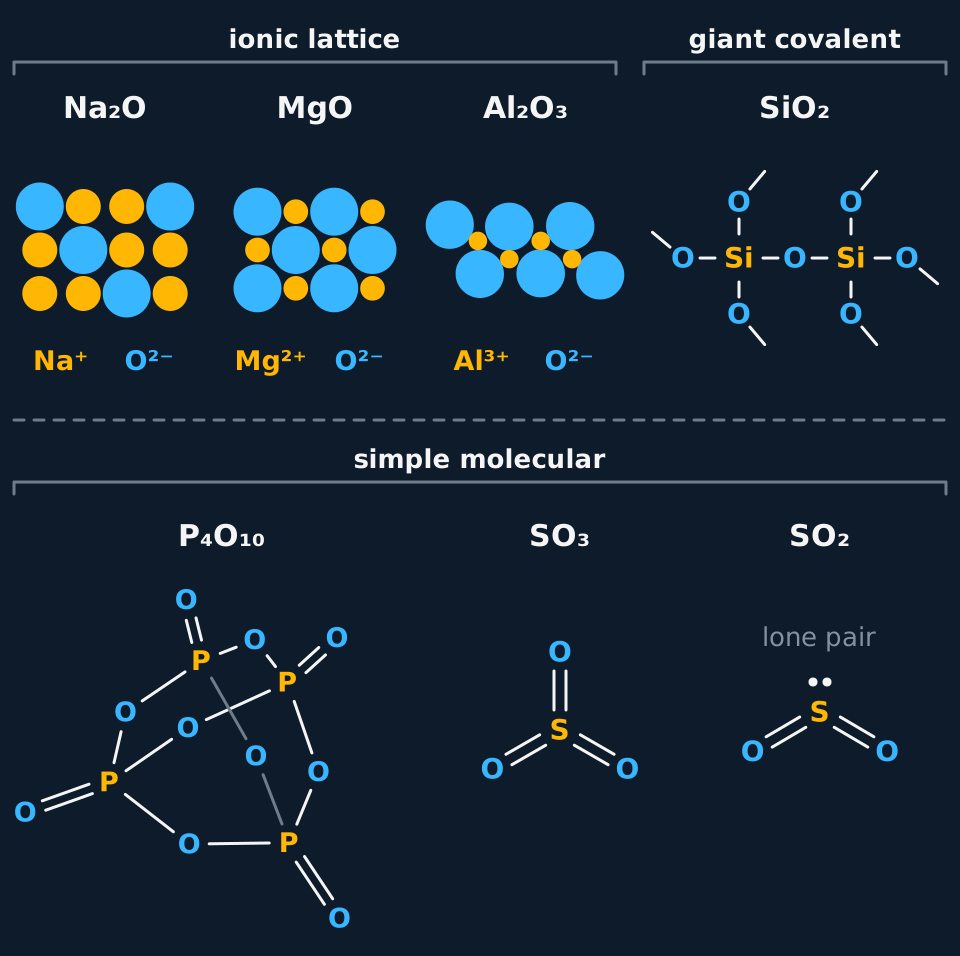
Describe the drawing
Seven Period 3 oxides drawn as structures in two rows, separated by a dashed line. Above it the giant structures: sodium oxide, magnesium oxide and aluminium oxide as fragments of ionic lattice, small amber cations among larger cyan oxide ions drawn to relative size, with the oxide ions in aluminium oxide pulled out of round towards the small aluminium ions; and silicon dioxide as a displayed network in which each silicon bonds to four oxygens and each oxygen to two silicons. Below it the simple molecules: the P4O10 cage of four phosphorus atoms, six bridging oxygens and four terminal P=O, trigonal planar sulfur trioxide with three S=O, and bent sulfur dioxide with two S=O and a lone pair on sulfur.
The change from giant lattice to small molecule along the strip determines each oxide's melting point and what it does with water: the ionic oxides at the left are basic, the molecular oxides at the right acidic.
The formula of phosphorus's oxide from combustion data
0.620 g of white phosphorus burns in excess oxygen to give 1.420 g of oxide. The relative formula mass of the oxide is 284. Find its empirical and molecular formulae, and the oxidation state of phosphorus in it.
Show the working
Mass of oxygen combined = 1.420 − 0.620 = 0.800 g.
Amount of P = 0.620 ÷ 31.0 = 0.0200 mol. Amount of O = 0.800 ÷ 16.0 = 0.0500 mol.
Ratio P : O = 0.0200 : 0.0500 = 2 : 5, so the empirical formula is P₂O₅, with an empirical formula mass of 2(31.0) + 5(16.0) = 142.0.
284 ÷ 142.0 = 2, so the molecular formula is P₄O₁₀. Ten oxygens at −2 give −20, shared among four phosphorus atoms, so phosphorus is +5.
TRY IT: Burning a strip of magnesium
A 0.243 g strip of magnesium is burned completely in a crucible. Calculate the mass of magnesium oxide formed. Then suggest one reason the mass weighed at the end might be lower than this.
Check your answer
Amount of Mg = 0.243 ÷ 24.3 = 0.0100 mol. From 2Mg + O₂ → 2MgO, 1 mol Mg gives 1 mol MgO, so 0.0100 mol MgO forms.
Mr of MgO = 24.3 + 16.0 = 40.3, so the mass of MgO = 0.0100 × 40.3 = 0.403 g.
A lower mass results if some white magnesium oxide smoke escapes when the lid is lifted, or if some magnesium is left unreacted. Burning in air also forms some magnesium nitride, Mg₃N₂, which adds less mass per magnesium atom than the oxide does.
- Oxidation state
- The charge an atom would have if all its bonds were ionic; the oxidation states in a neutral compound add up to zero.
- Empirical formula
- The simplest whole-number ratio of atoms of each element in a compound.
- Molecular formula
- The actual number of atoms of each element in one molecule of a compound.
Other boards: the elements with chlorine
Cambridge examines the reactions of sodium to phosphorus with chlorine as well as with oxygen and water; AQA's statements stop at oxygen and water. Chlorine takes the place of oxygen as the oxidising agent, and the pattern holds: each element combines directly when heated, and the formula of the chloride follows from the number of outer electrons.
Sodium, heated on a combustion spoon and lowered into a gas jar of chlorine, burns with a bright yellow flame and leaves a white solid, sodium chloride. Magnesium burns with a bright white flame and gives white magnesium chloride. Both chlorides are ionic.
2Na(s) + Cl₂(g) → 2NaCl(s)Yellow flame, white solid.
Mg(s) + Cl₂(g) → MgCl₂(s)Bright white flame, white solid.
Aluminium is heated in a tube while dry chlorine is passed over it. The aluminium chloride formed sublimes at about 178 °C, so it leaves the hot metal as a vapour and collects as a white or pale yellow solid in the cooler part of the apparatus. The chlorine must be dry, because aluminium chloride reacts with water. In the vapour two AlCl₃ molecules join as Al₂Cl₆, a lone pair on a chlorine of each forming a dative bond to the aluminium of the other, which has only six electrons in its outer shell in AlCl₃.
2Al(s) + 3Cl₂(g) → 2AlCl₃(s)Dry chlorine over heated aluminium. The vapour is Al₂Cl₆.
Silicon heated in chlorine gives silicon tetrachloride, a colourless liquid that boils at 58 °C and is collected in a cooled receiver. Phosphorus reacts with chlorine with little heating. With chlorine in excess the product is phosphorus(V) chloride, an off-white solid; with phosphorus in excess it is phosphorus(III) chloride, PCl₃, a colourless liquid. Sulfur gives S₂Cl₂, an orange liquid, which is not asked for.
Si(s) + 2Cl₂(g) → SiCl₄(l)Colourless liquid.
P₄(s) + 10Cl₂(g) → 4PCl₅(s)Excess chlorine. Off-white solid.
| Chloride | Oxidation state | Outer electrons | At room temperature | Bonding |
|---|---|---|---|---|
| NaCl | +1 | 1 | White solid | Ionic |
| MgCl₂ | +2 | 2 | White solid | Ionic |
| AlCl₃ | +3 | 3 | White solid, sublimes at 178 °C | Covalent, Al₂Cl₆ in the vapour |
| SiCl₄ | +4 | 4 | Colourless liquid | Covalent |
| PCl₅ | +5 | 5 | Off-white solid | Covalent |
Chlorine is −1 in every one of these, so one chlorine atom balances each unit of positive oxidation state, and once more the oxidation state equals the number of outer electrons. PCl₃ plays the part SO₂ played among the oxides: phosphorus uses three of its five outer electrons and is +3, not its highest state, and PCl₃ reacts with more chlorine to give PCl₅.
The bonding changes from ionic to covalent one element sooner than in the oxides. Aluminium oxide is ionic with some covalent character, but aluminium chloride is covalent. Chlorine, at 3.0 on the Pauling scale, is less electronegative than oxygen, at 3.5, so the difference between aluminium and chlorine is too small for ionic bonding. What the chlorides do with water follows from that change: the ionic chlorides dissolve, and the covalent ones are hydrolysed to acidic solutions.
- Sublimation
- The change of state of a substance directly from solid to gas, without melting.
- Dimer
- A molecule formed when two identical molecules join, as two AlCl₃ molecules join to form Al₂Cl₆.
- Dative covalent bond
- A covalent bond in which both electrons of the shared pair come from the same atom.
In the exam
- Observation marks go to what is seen: the scheme accepts 'fizzing', 'bubbles' or 'effervescence' and 'white solid', and ignores 'hydrogen is produced' or 'magnesium oxide forms', which name products.
- Where the question asks for state symbols, one missing or wrong loses the equation mark. MgO(s) with steam and Mg(OH)₂(s) with cold water are not interchangeable, and H₂O(g) marks the steam.
- A pH answer needs a value or a narrow range: 13 to 14 for sodium, about 10 for magnesium. 'Alkaline' alone is not credited as a pH.
- An oxidation state is deduced by setting oxygen at −2 and balancing. P₄O₁₀ gives +5 for phosphorus, and SO₂ gives +4 for sulfur, which is not its highest state of +6.
- Cambridge questions on the chlorides want NaCl, MgCl₂, AlCl₃, SiCl₄ and PCl₅ with chlorine at −1, and aluminium chloride made with dry chlorine, covalent and Al₂Cl₆ in the vapour.
Check yourself
Sulfur is in group 6, so its highest oxidation state is +6. Yet burning sulfur in pure oxygen gives SO₂, in which sulfur is +4. Explain how the oxidation states show this, and how SO₃ is made.
Answer
In SO₂, two oxygens at −2 give −4, so sulfur is +4: only four of its six outer electrons are used in bonding. In SO₃, three oxygens give −6 and sulfur is +6, its highest state, with all six outer electrons used.
Burning sulfur stops at SO₂ however much oxygen is present, because the further oxidation of SO₂ to SO₃ is too slow without a catalyst.
SO₃ is made by passing SO₂ and oxygen over a vanadium(V) oxide catalyst at about 450 °C: 2SO₂(g) + O₂(g) ⇌ 2SO₃(g). The reaction is reversible, which is why the Contact process recycles the unreacted gases.
Questions
Question 16 marksAQA · CAIE
Describe the reactions of sodium, magnesium, aluminium, silicon, phosphorus and sulfur with oxygen. Explain why they differ in how readily they start, and how the formula of each oxide follows from the element's outer electrons.
Mark scheme
Indicative content
- sodium and magnesium burn when heated, sodium with a yellow flame and magnesium with a bright white flame, each giving a white solid oxide
- aluminium sheet does not burn because its oxide layer keeps oxygen off the metal, but aluminium powder burns with a bright white flame to give white Al₂O₃
- silicon reacts only on strong heating, and slowly, because its giant covalent lattice must be broken into, giving white solid SiO₂
- white phosphorus catches fire in air at about 30 °C because the 60° bond angles in P₄ leave its bonds strained, and it gives white smoke of P₄O₁₀
- sulfur burns with a blue flame to give sulfur dioxide, a colourless gas with a choking smell, and gives no SO₃ without a catalyst
- the oxidation state in Na₂O, MgO, Al₂O₃, SiO₂ and P₄O₁₀ rises from +1 to +5, equal to the number of outer electrons, because all of them are used in bonding
Levels
- Level 3 (5–6 marks) all six elements are covered with their observations and products, the differences in how readily they start are explained, aluminium through its oxide layer, silicon through its lattice and phosphorus through bond strain, and the oxidation states of the oxides are linked to the number of outer electrons
- Level 2 (3–4 marks) four or five elements are described with correct observations and products and the oxidation-state pattern stated; one reason for reactivity, or the link to outer electrons, is not given
- Level 1 (1–2 marks) two or three reactions are described; burning sulfur is often said to give SO₃, and the formulae are not tied to the outer electrons
Question 25 marksAQA · CAIE
Describe what is seen when a small piece of sodium is added to water containing universal indicator. Give an equation with state symbols for the reaction, and the pH of the solution left.
Mark scheme
- B1 the sodium floats, melts into a ball and moves around on the surface
- B1 there is fizzing, or effervescence; ignore 'hydrogen is given off', which is not an observation
- B1 the sodium gets smaller and disappears
- B1 the indicator turns purple, and the solution has a pH of 13 to 14; reject 'alkaline' with no value
- B1 2Na(s) + 2H₂O(l) → 2NaOH(aq) + H₂(g), with every state symbol correct
Question 34 marksAQA · CAIE
Describe what is seen when sulfur is burned in oxygen and when white phosphorus is exposed to air at about 30 °C, naming the product each time.
Mark scheme
- B1 sulfur melts and burns with a blue flame
- B1 a colourless gas with a choking smell forms, which is sulfur dioxide, SO₂
- B1 white phosphorus catches fire without being lit and burns with a white flame
- B1 dense white smoke forms, which is phosphorus(V) oxide, P₄O₁₀; allow P₂O₅
All 19 questions with mark schemes, the other 16 set out in full on the question page.
Worth remembering
- Describe what is seen, never the product's name: fizzing, a white solid, a blue flame.
- Steam gives MgO, cold water gives Mg(OH)₂; swapping them loses the equation.
- SO₃ written as the product of burning sulfur is wrong in any amount of oxygen: combustion stops at SO₂, and SO₃ needs V₂O₅ at about 450 °C.
- Give P₄O₁₀ when the molecular formula is asked for; P₂O₅ is only the empirical formula.
- The pH of a solution is a number or a narrow range, never just 'alkaline'.
CHECK YOUR PROGRESS
Rate how confident you are with each objective for this lesson. Ratings are saved in this browser, on this device, unless you sign in.
- Describe the reactions of sodium and magnesium with water, with equations and the pH of the resulting solution.
- Explain why magnesium reacts so much faster with steam than with cold water, and why the product is different.
- Write equations for the reactions of sodium, magnesium, aluminium, silicon, phosphorus and sulfur with oxygen, and describe what is seen.
- Deduce the oxidation state of the Period 3 element in each oxide, and relate the highest oxidation state to the number of outer electrons.
- Calculate gas volumes and reacting masses for these reactions, and deduce an oxide's formula from combustion data.
- Describe the reactions of sodium to phosphorus with chlorine, and relate the oxidation state in each chloride to the number of outer electrons.CAIE
Open the full revision checklist to see every objective in the curriculum in one place.
Practise this lesson
WORKBOOK
The questions from this topic, on paper with room to work, and a separate book of mark schemes. Free to use; please do not redistribute or sell.