Chemistry › Periodicity and Period 3 › The Period 3 oxides: structure, bonding and acid–base character
The Period 3 oxides: structure, bonding and acid–base character
Sodium oxide dissolves to make one of the strongest alkalis on the shelf; phosphorus(V) oxide hisses in water and makes an acid; aluminium oxide, between them, reacts with acids and with alkalis. The change across the period follows the bonding, from ionic lattice to giant covalent network to small molecules, and the same change explains the melting points.
Key terms Every definition in periodicity and Period 3, lesson by lesson
Before this The Period 3 elements: reactions with oxygen and water – the formula and oxidation state of each oxide · Ionic bonding and ionic lattices – the attraction between oppositely charged ions · Brønsted–Lowry acids and bases, pH and strong acids – an acid as a proton donor and a base as a proton acceptor
COMMON MISCONCEPTION
Every oxide reacts with acids, because an oxide is a base.
Only metal oxides are bases. Across Period 3 the oxides run from basic Na₂O and MgO, through amphoteric Al₂O₃, which reacts with acids and with alkalis, to acidic SiO₂, P₄O₁₀ and SO₂, which react with alkalis and not with acids. The bonding changes from ionic to covalent, and the acid–base character changes with it.
What you should be able to do
- Explain the melting points of the Period 3 oxides in terms of their structure and bonding.
- Write equations for the reactions of Na₂O, MgO, P₄O₁₀, SO₂ and SO₃ with water, and give the pH of each resulting solution.
- Explain why the ionic oxides are basic and the covalent oxides acidic, and why Al₂O₃ and SiO₂ do not react with water.
- Describe the structures of the acids and anions formed when P₄O₁₀, SO₂ and SO₃ react with water.
- Write equations for the reactions of the oxides with acids and bases, including both reactions of amphoteric aluminium oxide.
- Describe and explain the reactions of the Period 3 chlorides with water, with the pH of each solution, from their bonding.CAIE
Melting points: from ionic lattice to small molecule
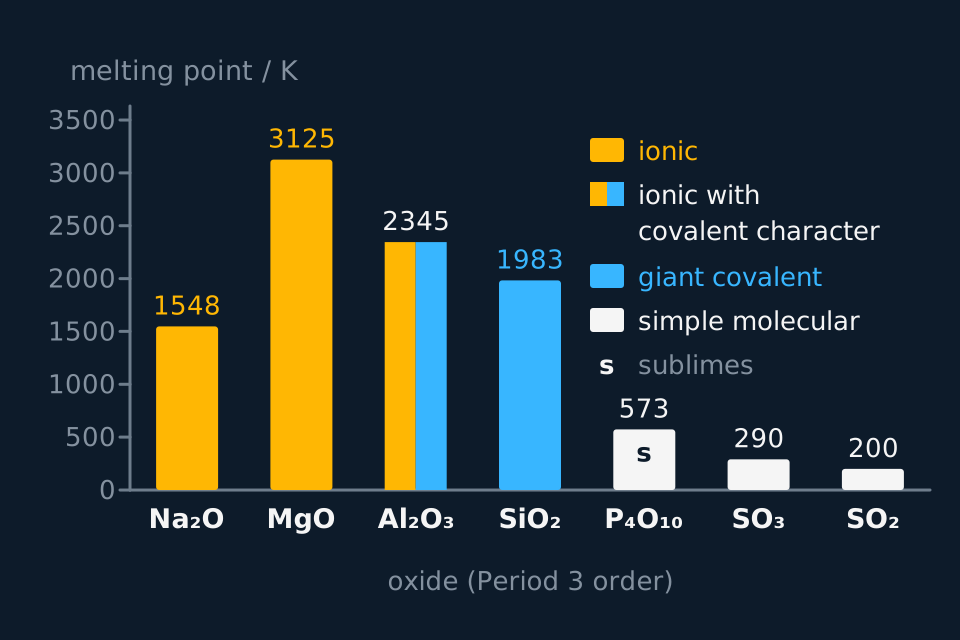
Magnesium oxide is used to line furnaces because it does not melt until 3125 K. Sulfur dioxide, at the other end of the period, is a gas at room temperature and does not freeze until 200 K. Between those extremes the seven oxides fall into three groups by structure, and their melting points follow the groups.
Describe the drawing
A bar chart of melting point in kelvin for the seven Period 3 oxides in order, coloured by bonding. The amber ionic bars are sodium oxide at 1548 and magnesium oxide, the tallest, at 3125; aluminium oxide, half amber and half cyan for ionic with covalent character, is 2345; the cyan giant covalent silicon dioxide is 1983. The three white simple molecular bars are far lower: P4O10 at 573, marked s because it sublimes, sulfur trioxide at 290 and sulfur dioxide at 200.
Sodium oxide and magnesium oxide are ionic: giant lattices of metal ions and oxide ions, O²⁻, held by strong electrostatic attraction in every direction. Melting means overcoming that attraction through the whole lattice. Magnesium oxide melts at 3125 K, far above sodium oxide's 1548 K, because Mg²⁺ has twice the charge of Na⁺ and is smaller, so its attraction to the oxide ions is much stronger.
Aluminium oxide, at 2345 K, breaks the rising pattern. It is ionic, but the Al³⁺ ion is so small and so highly charged that it pulls the electron cloud of each neighbouring oxide ion towards itself, distorting it. The bonding is ionic with some covalent character, the attraction between the ions is weaker than for a purely ionic lattice, and the melting point is lower than magnesium oxide's.
Silicon dioxide is giant covalent. Each silicon atom is bonded to four oxygen atoms and each oxygen to two silicons, in a network through the whole crystal: quartz, and most of the sand on a beach. Melting it breaks many strong covalent bonds, and it melts at 1983 K.
Phosphorus(V) oxide, sulfur trioxide and sulfur dioxide are simple molecular. The covalent bonds within each molecule are strong, but melting overcomes only the forces between molecules, van der Waals forces and, for polar SO₂, dipole–dipole forces as well, and these are weak. P₄O₁₀, the largest molecule, with 140 electrons, holds together longest, subliming at about 573 K; SO₃, with 40 electrons, melts at 290 K; SO₂, with 32, at 200 K.
SO₂ is polar and SO₃ is not, because SO₂ is bent and SO₃ is trigonal planar with its three dipoles cancelling. The permanent dipoles add dipole–dipole forces between SO₂ molecules, yet SO₂ still melts lower. The comparison the specification asks for is on size: SO₃ has more electrons, so stronger van der Waals forces. There is a further reason beyond it. Solid SO₃ is not made of single molecules but of S₃O₉ rings, three SO₃ units joined by covalent bonds, and larger units raise the melting point again.
The dividing line falls where it fell for the elements. Sodium to aluminium form giant lattices of ions, silicon forms a giant covalent structure, and from phosphorus onwards both the elements and their oxides are molecular. The oxide melts far higher than its element at the metal end, where an ionic lattice replaces metallic bonding. At the non-metal end oxide and element are both molecular and melt within about 250 K of each other: P₄O₁₀ above phosphorus, but SO₂ and SO₃ below sulfur.
| Oxide | Structure | Bonding | Melting point / K |
|---|---|---|---|
| Na₂O | Giant lattice | Ionic | 1548 |
| MgO | Giant lattice | Ionic | 3125 |
| Al₂O₃ | Giant lattice | Ionic with covalent character | 2345 |
| SiO₂ | Giant covalent | Covalent | 1983 |
| P₄O₁₀ | Simple molecular | Covalent | about 573 (sublimes) |
| SO₃ | Simple molecular | Covalent | 290 |
| SO₂ | Simple molecular | Covalent | 200 |
- Ionic bonding
- The electrostatic attraction between oppositely charged ions in a lattice.
- Covalent character
- Partial sharing of electrons in an ionic compound, caused by a small, highly charged cation distorting the electron cloud of the anion.
The oxides with water
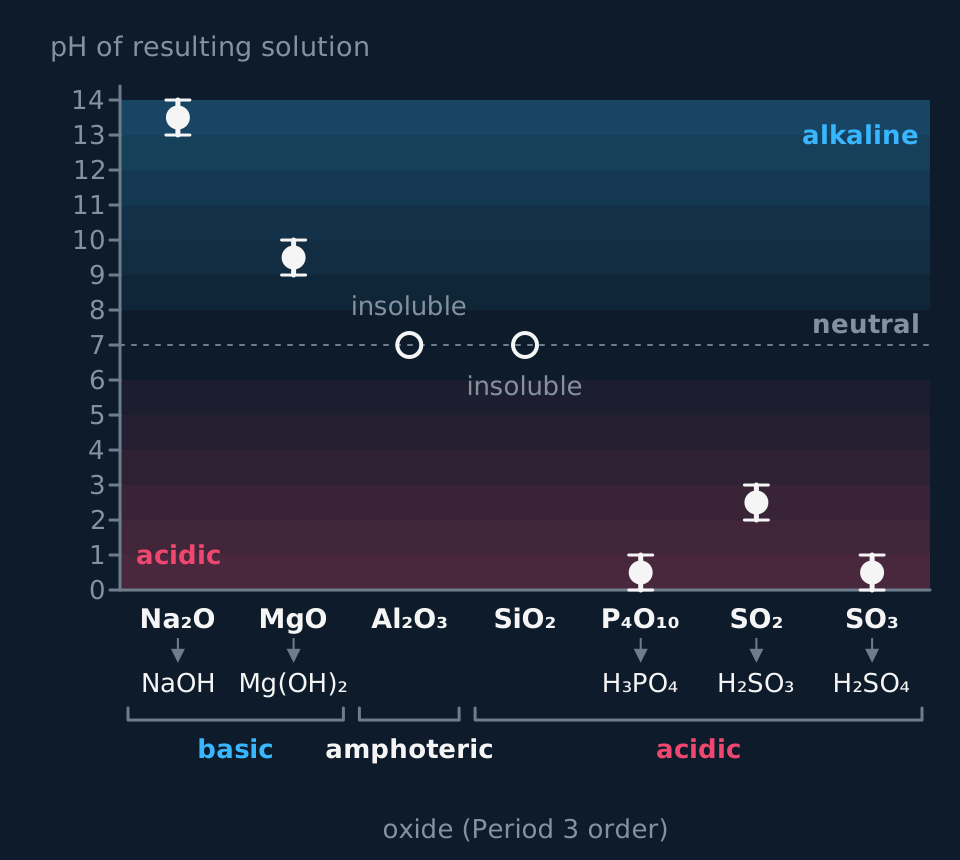
In water the oxides run from strongly basic at sodium to strongly acidic at sulfur. Universal indicator shows the change as a run of colours from purple to red, with two oxides in the middle that leave the water green because they do not dissolve.
Na₂O(s) + H₂O(l) → 2NaOH(aq)pH 13 to 14. Sodium oxide reacts exothermically and dissolves completely.
MgO(s) + H₂O(l) → Mg(OH)₂(s)pH 9 to 10. Mg(OH)₂ is sparingly soluble, so few hydroxide ions reach the solution.
Aluminium oxide and silicon dioxide neither react with water nor dissolve in it, so the water stays at pH 7. The lattice of Al³⁺ and O²⁻ ions is too strong for water to break up, and silicon dioxide is a giant covalent network with no ions to release and no small molecules to dissolve. Neither result means the oxide has no acid–base character, as their reactions with acids and alkalis show.
P₄O₁₀(s) + 6H₂O(l) → 4H₃PO₄(aq)pH 0 to 1. A violent reaction, giving phosphoric(V) acid.
SO₂(g) + H₂O(l) → H₂SO₃(aq)pH 2 to 3. Sulfuric(IV) acid, also called sulfurous acid, is a weak acid.
SO₃(l) + H₂O(l) → H₂SO₄(aq)pH 0 to 1. Sulfuric(VI) acid is a strong acid. SO₃ melts at 290 K and boils at 318 K, so it is a liquid at 298 K.
Describe the drawing
A dot plot of the pH of the solution each Period 3 oxide gives in water, with the background tinted cyan on the alkaline side and coral on the acidic side. Sodium oxide gives sodium hydroxide at pH 13 to 14 and magnesium oxide gives magnesium hydroxide at 9 to 10, each a solid marker on a short range bar. Aluminium oxide and silicon dioxide are hollow markers at pH 7, labelled insoluble. Phosphorus(V) oxide gives phosphoric acid at 0 to 1, sulfur dioxide sulfurous acid at 2 to 3 and sulfur trioxide sulfuric acid at 0 to 1. Brackets beneath group the oxides as basic, amphoteric and acidic.
The switch from alkaline to acidic follows the bonding. An ionic oxide contains O²⁻ ions, and the oxide ion is a strong base: it takes a proton from a water molecule, and two hydroxide ions result. The more soluble the oxide, the more hydroxide ions reach the solution, so sodium oxide gives a higher pH than magnesium oxide. Say 'the oxide ion accepts a proton'; 'the oxide reacts with water' is true but explains nothing about the pH.
O²⁻(s) + H₂O(l) → 2OH⁻(aq)The oxide ion from the lattice accepts a proton from water.
A covalent oxide has no oxide ions. Its molecules react with water to form an oxoacid, in which hydrogen atoms are bonded to oxygen atoms and those oxygens to a central phosphorus or sulfur atom. The O–H bonds break in water, releasing H⁺ ions, so the solution is acidic.
The pH values are for solutions of the usual laboratory strength, and they show a difference between the acids as well as between the oxides. Sulfuric(VI) acid is strong: its first proton is lost completely, so a 0.5 mol dm⁻³ solution has a pH below 1. Sulfuric(IV) acid is weak, and only a small fraction of its molecules ionise, so the solution from sulfur dioxide sits at pH 2 to 3. Sulfur dioxide dissolved in rain is one source of acid rain, and that solution is dilute, at about pH 4.
- Basic oxide
- An oxide that reacts with acids to form a salt and water; in Period 3, an ionic oxide containing O²⁻ ions.
- Acidic oxide
- An oxide that reacts with bases to form a salt and water; in Period 3, a covalent oxide.
- Oxoacid
- An acid in which the acidic hydrogen atoms are bonded to oxygen atoms, as in H₂SO₄ and H₃PO₄.
- Weak acid
- An acid that only partially dissociates into ions in aqueous solution, as H₂SO₃ does.
The acids and their anions
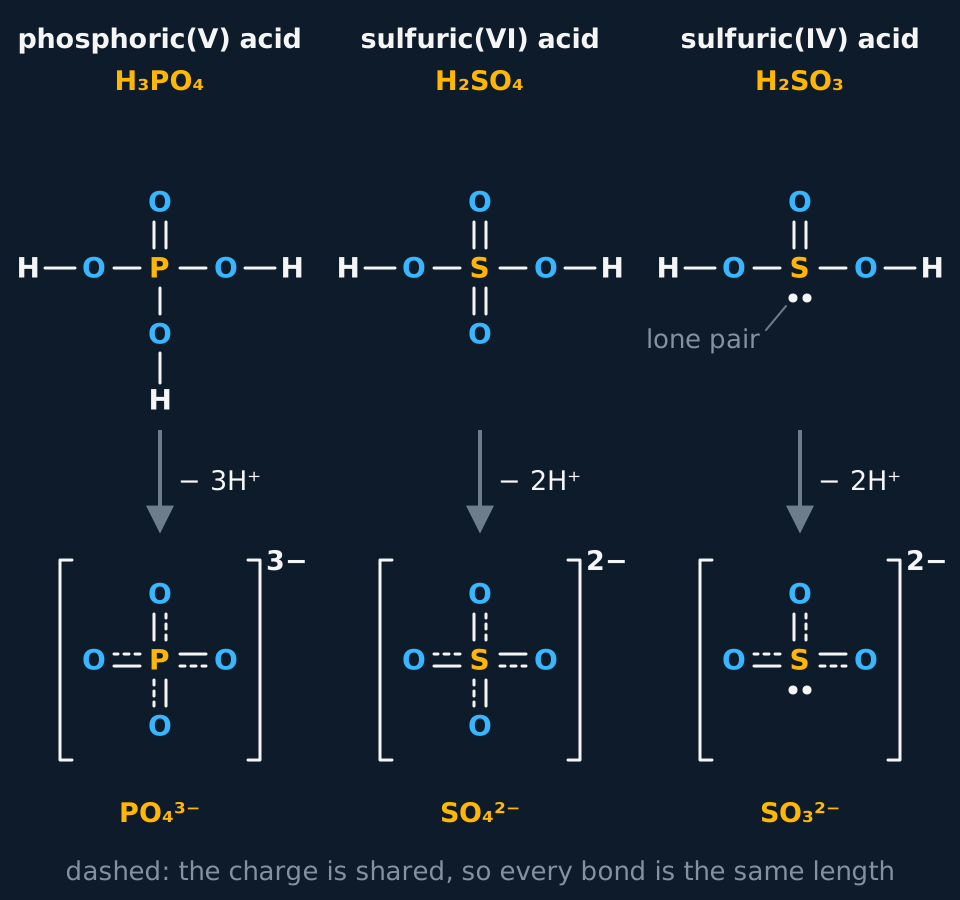
Each of the three acids has a central atom bonded to four or three oxygen atoms, some of which carry a hydrogen. Phosphoric(V) acid, H₃PO₄, has a phosphorus atom with one P=O double bond and three P–O–H groups. Sulfuric(VI) acid, H₂SO₄, has a sulfur atom with two S=O and two S–O–H groups. Sulfuric(IV) acid, H₂SO₃, has a sulfur atom with one S=O, two S–O–H groups and a lone pair.
Describe the drawing
Three columns of displayed formulae. On the left phosphoric(V) acid, H3PO4: phosphorus with one P=O and three P-O-H groups, above an arrow minus 3H+ to the phosphate ion, phosphorus with four identical P-O bonds inside square brackets carrying a 3 minus charge. In the middle sulfuric(VI) acid, H2SO4: sulfur with two S=O and two S-O-H, above the sulfate ion with four identical S-O bonds and a 2 minus charge. On the right sulfuric(IV) acid, H2SO3: sulfur with one S=O, two S-O-H and a lone pair, above the sulfite ion with three identical S-O bonds, the lone pair, and a 2 minus charge.
Losing every hydrogen ion gives the anion: phosphate(V), PO₄³⁻, from phosphoric(V) acid; sulfate(VI), SO₄²⁻, from sulfuric(VI) acid; and sulfate(IV), SO₃²⁻, also called sulfite, from sulfuric(IV) acid. These are the anions in the salts formed when the oxides react with sodium hydroxide. In each ion the negative charge is spread over the oxygen atoms, so all its P–O or S–O bonds are the same length.
H₃PO₄(aq) + 3NaOH(aq) → Na₃PO₄(aq) + 3H₂O(l)All three hydrogens are acidic, so 1 mol of the acid needs 3 mol of sodium hydroxide.
The O–H bonds in these acids break because the central atom is electronegative and is bonded to other oxygen atoms, which draw electron density away from the O–H bond and leave the hydrogen more positive. In sodium hydroxide the bond that breaks in water is the ionic one between Na⁺ and OH⁻, so hydroxide ions are released instead. Which bond breaks depends on how electronegative the element attached to the O–H group is.
Basic, amphoteric and acidic
Reactions with acids and bases give the oxides their classification, including the two that water leaves unchanged.
Sodium oxide and magnesium oxide are basic: they neutralise acids to form a salt and water. Magnesium oxide is the active ingredient of some indigestion remedies for that reason.
Na₂O(s) + 2HCl(aq) → 2NaCl(aq) + H₂O(l)
MgO(s) + 2HCl(aq) → MgCl₂(aq) + H₂O(l)
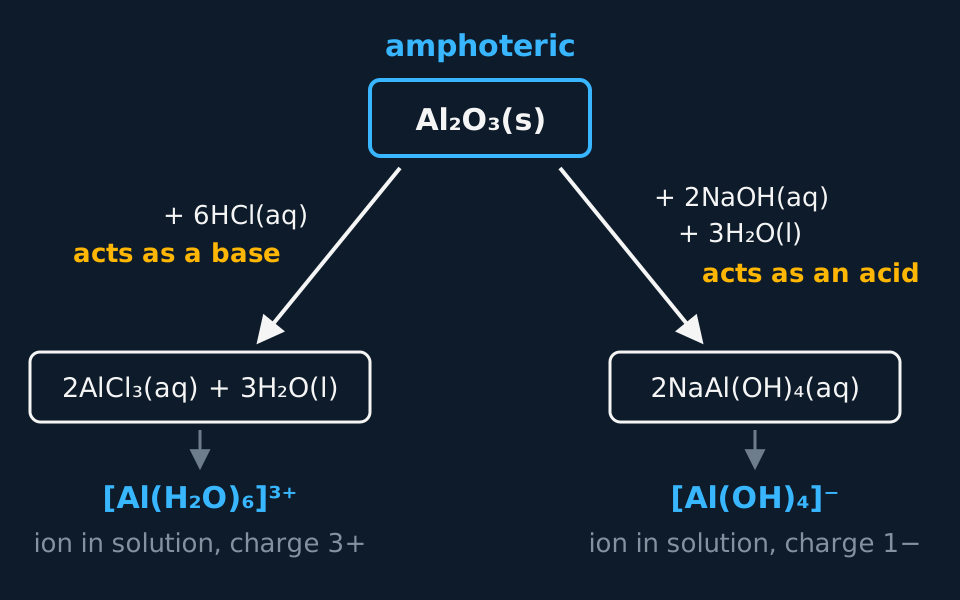
Aluminium oxide is amphoteric. It reacts with acids, behaving as a base, and with bases, behaving as an acid. Its bonding sits between ionic and covalent, and so does its behaviour.
Describe the drawing
Aluminium oxide solid in a central box headed amphoteric. An arrow down to the left, labelled plus six HCl, acts as a base, leads to a box of two aluminium chloride plus three water, with the hexaaquaaluminium ion, charge 3+, beneath it as the ion in solution. An arrow down to the right, labelled plus two sodium hydroxide and three water, acts as an acid, leads to a box of two sodium tetrahydroxoaluminate, with the Al(OH)4 minus ion, charge 1 minus, beneath it.
Aluminium oxide with an acid and with an alkali
Write equations, with state symbols, for aluminium oxide reacting with hydrochloric acid and with sodium hydroxide solution, and the ionic equation for each.
Show the working
With the acid, aluminium oxide acts as a base and forms a salt and water: Al₂O₃(s) + 6HCl(aq) → 2AlCl₃(aq) + 3H₂O(l). Check: 2 Al, 6 H, 6 Cl and 3 O on each side.
Ionic: Al₂O₃(s) + 6H⁺(aq) → 2Al³⁺(aq) + 3H₂O(l). In water the aluminium ion is hydrated, so the same reaction is also written Al₂O₃(s) + 6H⁺(aq) + 9H₂O(l) → 2[Al(H₂O)₆]³⁺(aq).
With the alkali, aluminium oxide acts as an acid, and the product is sodium aluminate: Al₂O₃(s) + 2NaOH(aq) + 3H₂O(l) → 2NaAl(OH)₄(aq). Check: 2 Al, 2 Na, 8 O and 8 H on each side.
Ionic: Al₂O₃(s) + 2OH⁻(aq) + 3H₂O(l) → 2[Al(OH)₄]⁻(aq). Older books write sodium aluminate as NaAlO₂, the same salt without the water.
The hydroxides follow their oxides. Sodium hydroxide and magnesium hydroxide are bases only, and aluminium hydroxide is amphoteric like aluminium oxide: the white precipitate it forms when sodium hydroxide is added to a solution of Al³⁺ ions dissolves again in excess alkali.
Al(OH)₃(s) + 3HCl(aq) → AlCl₃(aq) + 3H₂O(l)Aluminium hydroxide acting as a base.
Al(OH)₃(s) + NaOH(aq) → NaAl(OH)₄(aq)Aluminium hydroxide acting as an acid.
Silicon dioxide is acidic, although water does not show it. It reacts with hot, concentrated sodium hydroxide solution to give sodium silicate, and with basic oxides at high temperature. In a blast furnace, calcium oxide removes the sand in iron ore as molten calcium silicate, the slag.
SiO₂(s) + 2NaOH(aq) → Na₂SiO₃(aq) + H₂O(l)Hot, concentrated sodium hydroxide.
SiO₂(s) + CaO(s) → CaSiO₃(l)In a blast furnace, above the melting point of the slag.
The three molecular oxides are acidic. Each reacts with sodium hydroxide to give the salt of the acid it forms in water.
P₄O₁₀(s) + 12NaOH(aq) → 4Na₃PO₄(aq) + 6H₂O(l)
SO₂(g) + 2NaOH(aq) → Na₂SO₃(aq) + H₂O(l)
SO₃(l) + 2NaOH(aq) → Na₂SO₄(aq) + H₂O(l)
Electronegativity ties the classification together. Oxygen is 3.5 on the Pauling scale. Sodium is 0.9 and magnesium 1.2, so the difference is large, the bonding ionic and the oxide basic. Aluminium, at 1.5, leaves a smaller difference, and its oxide is ionic with covalent character and amphoteric. Silicon, 1.8, phosphorus, 2.1, and sulfur, 2.5, leave smaller differences still: the bonding is covalent and the oxides are acidic. The further an element is from oxygen in electronegativity, the more basic its oxide.
| Oxide | Bonding | With water | pH | Character |
|---|---|---|---|---|
| Na₂O | Ionic | NaOH(aq) | 13 to 14 | Basic |
| MgO | Ionic | Mg(OH)₂, sparingly soluble | 9 to 10 | Basic |
| Al₂O₃ | Ionic, covalent character | Insoluble | 7 | Amphoteric |
| SiO₂ | Giant covalent | Insoluble | 7 | Acidic |
| P₄O₁₀ | Molecular | H₃PO₄(aq) | 0 to 1 | Acidic |
| SO₂ | Molecular | H₂SO₃(aq) | 2 to 3 | Acidic |
| SO₃ | Molecular | H₂SO₄(aq) | 0 to 1 | Acidic |
Neutralising the acid from phosphorus(V) oxide
0.710 g of P₄O₁₀ is added to water and the solution is titrated with 0.500 mol dm⁻³ sodium hydroxide until all the acid is neutralised to Na₃PO₄. Calculate the volume of sodium hydroxide needed.
Show the working
Mr of P₄O₁₀ = 4(31.0) + 10(16.0) = 284.0. Amount = 0.710 ÷ 284.0 = 0.00250 mol.
P₄O₁₀ + 6H₂O → 4H₃PO₄, so amount of H₃PO₄ = 4 × 0.00250 = 0.0100 mol.
H₃PO₄ + 3NaOH → Na₃PO₄ + 3H₂O, so amount of NaOH = 3 × 0.0100 = 0.0300 mol.
Volume = 0.0300 ÷ 0.500 = 0.0600 dm³ = 60.0 cm³. The overall equation, P₄O₁₀ + 12NaOH, gives the same: 12 × 0.00250 = 0.0300 mol.
TRY IT: Choosing an antacid
Magnesium oxide is used in some indigestion remedies to neutralise excess stomach acid, which is hydrochloric acid. Sodium oxide is also a basic oxide. Suggest why it is not used, and write the equation for magnesium oxide neutralising stomach acid.
Check your answer
Sodium oxide reacts exothermically with water to give sodium hydroxide solution of pH 13 to 14, which is corrosive and would burn the mouth and throat.
Magnesium oxide forms only sparingly soluble magnesium hydroxide, so the solution reaches no more than about pH 10, while the solid still neutralises acid as it reacts: MgO(s) + 2HCl(aq) → MgCl₂(aq) + H₂O(l).
- Amphoteric
- Describes a substance that can react both as an acid and as a base.
- Neutralisation
- The reaction of an acid with a base to form a salt and water.
- Electronegativity
- The power of an atom to attract the pair of electrons in a covalent bond.
Other boards: the chlorides with water
Cambridge examines the Period 3 chlorides with water alongside the oxides; AQA does not. The chlorides NaCl, MgCl₂, AlCl₃, SiCl₄ and PCl₅ are made by heating each element in chlorine, and the same change from ionic to covalent runs through them, one element earlier than in the oxides: aluminium chloride is already covalent.
Sodium chloride and magnesium chloride are ionic, and they dissolve without reacting, the ions becoming hydrated. Sodium chloride solution is neutral, pH 7. Magnesium chloride solution is very slightly acidic, about pH 6.5, because the small Mg²⁺ ion polarises the water molecules bonded to it a little, and a few of them release H⁺.
NaCl(s) → Na⁺(aq) + Cl⁻(aq)Dissolves; no reaction with the water. pH 7.
Aluminium chloride reacts. Added to plenty of water it dissolves exothermically to give [Al(H₂O)₆]³⁺ ions. The small, highly charged Al³⁺ polarises the O–H bonds of its water ligands enough for some to release H⁺, and the solution is about pH 3, the acidity of any solution of a 3+ aqua ion. A few drops of water on the solid give steamy fumes of hydrogen chloride instead.
[Al(H₂O)₆]³⁺(aq) ⇌ [Al(H₂O)₅(OH)]²⁺(aq) + H⁺(aq)In plenty of water. pH about 3.
AlCl₃(s) + 3H₂O(l) → Al(OH)₃(s) + 3HCl(g)With a little water: steamy fumes of HCl.
Silicon tetrachloride and phosphorus(V) chloride are covalent, and water hydrolyses them completely and violently, with steamy fumes of hydrogen chloride. The silicon or phosphorus atom carries a partial positive charge from the more electronegative chlorines, a lone pair on the oxygen of a water molecule forms a bond to it, and the element–chlorine bonds break one by one. The hydrogen chloride dissolves in the rest of the water, so the solution is strongly acidic, about pH 1 to 2.
SiCl₄(l) + 2H₂O(l) → SiO₂(s) + 4HCl(aq)Violent. Steamy fumes, and a white solid of hydrated silicon dioxide.
PCl₅(s) + 4H₂O(l) → H₃PO₄(aq) + 5HCl(aq)Violent. Both products are acids.
The pH falls across the chlorides as it falls across the oxides, because the more covalent the compound, the more acid it makes with water. The ionic ends differ, though. An ionic oxide gives an alkali because the oxide ion is a strong base. The chloride ion is far too weak a base to take a proton from water, so an ionic chloride leaves water close to neutral.
| Chloride | Bonding | With water | pH |
|---|---|---|---|
| NaCl | Ionic | Dissolves, no reaction | 7 |
| MgCl₂ | Ionic | Dissolves, very slight reaction | about 6.5 |
| AlCl₃ | Covalent | Reacts to give [Al(H₂O)₆]³⁺; HCl fumes with little water | about 3 |
| SiCl₄ | Covalent | Hydrolysed to SiO₂ and HCl | 1 to 2 |
| PCl₅ | Covalent | Hydrolysed to H₃PO₄ and HCl | 1 to 2 |
The pH of the solution from silicon tetrachloride
0.851 g of SiCl₄ is added to water and the solution is made up to 250 cm³. Calculate the pH of the solution, treating the hydrogen chloride as the only acid.
Show the working
Mr of SiCl₄ = 28.1 + 4(35.5) = 170.1. Amount = 0.851 ÷ 170.1 = 0.00500 mol.
SiCl₄ + 2H₂O → SiO₂ + 4HCl, so amount of HCl = 4 × 0.00500 = 0.0200 mol.
HCl is a strong acid and fully dissociated, so [H⁺] = 0.0200 ÷ 0.250 = 0.0800 mol dm⁻³.
pH = −log(0.0800) = 1.10, inside the 1 to 2 the table gives.
- Hydrolysis
- A reaction in which a bond in a compound is broken by reaction with water.
In the exam
- A pH explanation is tied to the bonding: ionic oxide, O²⁻ ions, OH⁻ in solution; covalent oxide, an oxoacid, H⁺ in solution. A pH value without the reason earns only the pH mark.
- The scheme accepts NaAl(OH)₄ or NaAlO₂ for sodium aluminate when the equation balances, and wants the word amphoteric with its meaning, reacting as both an acid and a base.
- The reaction of SiO₂ with sodium hydroxide needs hot, concentrated solution. 'Insoluble in water' is not the same as unreactive, and an answer that calls SiO₂ neutral loses the classification mark.
- Melting points of the molecular oxides earn marks for the forces between molecules and the size of the molecules. Any covalent bond broken on melting P₄O₁₀ or SO₃ is given no credit for that part.
- For the Cambridge chlorides, say what is seen as well as the pH: steamy fumes of HCl from AlCl₃, SiCl₄ and PCl₅, and a white solid from SiCl₄. NaCl gives pH 7: Cl⁻ is too weak a base to take a proton from water.
Check yourself
A student classifies the Period 3 oxides by the pH of their mixtures with water, and records Al₂O₃ and SiO₂ as neutral oxides. Evaluate that classification.
Answer
The observation is correct: neither oxide reacts with or dissolves in water, so the water stays at pH 7.
The classification is not. pH in water measures only what dissolves. Aluminium oxide reacts with hydrochloric acid to give AlCl₃ and with sodium hydroxide to give NaAl(OH)₄, so it is amphoteric. Silicon dioxide reacts with hot, concentrated sodium hydroxide to give Na₂SiO₃, so it is acidic.
The acid–base character of an oxide is decided by its reactions with acids and bases. pH in water is a useful guide only for the oxides that dissolve, which is why the student's method misclassifies exactly the two insoluble ones.
Questions
Question 16 marksAQA · CAIE
Discuss how the bonding in the oxides of Period 3 changes from Na₂O to SO₃, and how the change accounts for their reactions with water.
Mark scheme
Indicative content
- Na₂O and MgO are ionic, Al₂O₃ is ionic with covalent character, SiO₂ is giant covalent, and P₄O₁₀, SO₂ and SO₃ are simple molecular covalent
- the change follows the fall in electronegativity difference between the element and oxygen across the period
- the ionic oxides contain O²⁻, which accepts protons from water to form OH⁻: Na₂O gives NaOH at pH 13 to 14, MgO gives sparingly soluble Mg(OH)₂ at pH 9 to 10
- Al₂O₃ and SiO₂ do not react with water, the lattice and the covalent network being too strong, so the pH stays at 7
- the molecular oxides react with water to form oxoacids: P₄O₁₀ gives H₃PO₄ and SO₃ gives H₂SO₄, both at pH 0 to 1
- SO₂ gives H₂SO₃, a weak acid at pH 2 to 3; in each oxoacid the O–H bonds break to release H⁺
Levels
- Level 3 (5–6 marks) the change in bonding across the full set of oxides is stated and explained through electronegativity difference, and every reaction with water is matched to the bonding, the ionic oxides giving hydroxide, the two that do not react, and the molecular oxides giving oxoacids, with approximate pH values
- Level 2 (3–4 marks) the change from ionic to covalent is described and most reactions with water are right; the reason for the change in terms of electronegativity, the two oxides that do not react, or the pH values are not there
- Level 1 (1–2 marks) the oxides are said to go from basic to acidic; silicon dioxide is typically said to dissolve to give an acid, and bonding is not linked to pH
Question 25 marksAQA · CAIE
Explain, using the melting points in the table, why magnesium oxide melts at a higher temperature than sodium oxide, and why aluminium oxide melts lower than magnesium oxide although Al³⁺ is more highly charged than Mg²⁺.
| Oxide | Na₂O | MgO | Al₂O₃ |
|---|---|---|---|
| Melting point / K | 1548 | 3125 | 2345 |
Mark scheme
- B1 all three are ionic, giant lattices held by electrostatic attraction between oppositely charged ions in every direction
- B1 Mg²⁺ has a greater charge than Na⁺ and is smaller
- B1 so the attraction between Mg²⁺ and O²⁻ is stronger and more energy is needed to overcome it; reject any reference to molecules or intermolecular forces
- B1 the small, highly charged Al³⁺ ion distorts, or polarises, the electron cloud of the oxide ion
- B1 so the bonding in Al₂O₃ has some covalent character and the ionic attraction is weaker than in a purely ionic lattice
Question 34 marksAQA · CAIE
Give an equation, with state symbols, for the reaction of each of sodium oxide, phosphorus(V) oxide and sulfur dioxide with water, the approximate pH of each solution, and the classification of each oxide as basic or acidic.
Mark scheme
- B1 Na₂O(s) + H₂O(l) → 2NaOH(aq), giving pH 13 to 14; allow pH 12 to 14
- B1 P₄O₁₀(s) + 6H₂O(l) → 4H₃PO₄(aq), giving pH 0 to 1; allow pH 0 to 2
- B1 SO₂(g) + H₂O(l) → H₂SO₃(aq), giving pH 2 to 3
- B1 sodium oxide is a basic oxide; phosphorus(V) oxide and sulfur dioxide are acidic oxides
All 19 questions with mark schemes, the other 16 set out in full on the question page.
Worth remembering
- Classify an oxide by its reactions with acids and bases, not by the pH it leaves in water.
- Putting Al₂O₃ above MgO on melting point because Al³⁺ carries more charge ignores its covalent character: MgO melts highest.
- Written to NaAl(OH)₄, the aluminate equation needs 3H₂O on the left, or it does not balance.
- Giving SO₂ and SO₃ the same pH in water is wrong: H₂SO₃ is a weak acid at pH 2 to 3, H₂SO₄ a strong one at pH 0 to 1.
- Put every acidic hydrogen of H₃PO₄ on an oxygen; none sits on the phosphorus.
CHECK YOUR PROGRESS
Rate how confident you are with each objective for this lesson. Ratings are saved in this browser, on this device, unless you sign in.
- Explain the melting points of the Period 3 oxides in terms of their structure and bonding.
- Write equations for the reactions of Na₂O, MgO, P₄O₁₀, SO₂ and SO₃ with water, and give the pH of each resulting solution.
- Explain why the ionic oxides are basic and the covalent oxides acidic, and why Al₂O₃ and SiO₂ do not react with water.
- Describe the structures of the acids and anions formed when P₄O₁₀, SO₂ and SO₃ react with water.
- Write equations for the reactions of the oxides with acids and bases, including both reactions of amphoteric aluminium oxide.
- Describe and explain the reactions of the Period 3 chlorides with water, with the pH of each solution, from their bonding.CAIE
Open the full revision checklist to see every objective in the curriculum in one place.
Practise this lesson
WORKBOOK
The written questions from this topic, on paper with room to work, and a separate book of mark schemes. The question that is set on a diagram stays on this page, where the diagram can be drawn. Free to use; please do not redistribute or sell.