Chemistry › Working in the laboratory › Formulae, equations and state symbols
Formulae, equations and state symbols
Copper(II) sulfate is CuSO₄ and aluminium sulfate is Al₂(SO₄)₃ for one reason: the charges on the ions have to cancel. Writing formulae from ion charges, balancing an equation without touching a formula, state symbols, ionic equations with the spectator ions taken out, and a first look at half-equations.
Key terms Every definition in working in the laboratory, lesson by lesson
Before this GCSE chemistry: ions form when atoms lose or gain electrons, and the charge follows from the group · GCSE chemistry: word equations and simple balanced symbol equations
COMMON MISCONCEPTION
To balance an equation I can change the small numbers as well as the big ones, as long as the atoms come out equal.
The small numbers are the formula, and the formula is fixed by the compound. Writing H₂O₂ to make the oxygen balance does not balance the equation for water; it writes an equation for hydrogen peroxide instead. The balance comes from the coefficients in front: 2H₂ + O₂ → 2H₂O.
What you should be able to do
- Work out the formula of an ionic compound from the charges on its ions, using brackets for polyatomic ions.
- Give the formulae of the elements that exist as diatomic molecules.
- Balance an equation by inspection, changing only the numbers in front of formulae.
- Add the correct state symbol to every species, and explain what (aq) means.
- Use the solubility rules to identify a precipitate, and write an ionic equation by cancelling spectator ions.
- Explain how electrons balance the charge in a half-equation.
Writing the formula of an ionic compound
Copper(II) sulfate is CuSO₄ and aluminium sulfate is Al₂(SO₄)₃. Both contain the sulfate ion, SO₄²⁻, yet one formula has one sulfate and the other has three. The difference is the metal ion. Copper(II) is Cu²⁺, and one 2+ ion balances one 2− ion. Aluminium is Al³⁺, and the smallest whole numbers that balance 3+ against 2− are two aluminium ions, 6+, and three sulfate ions, 6−.
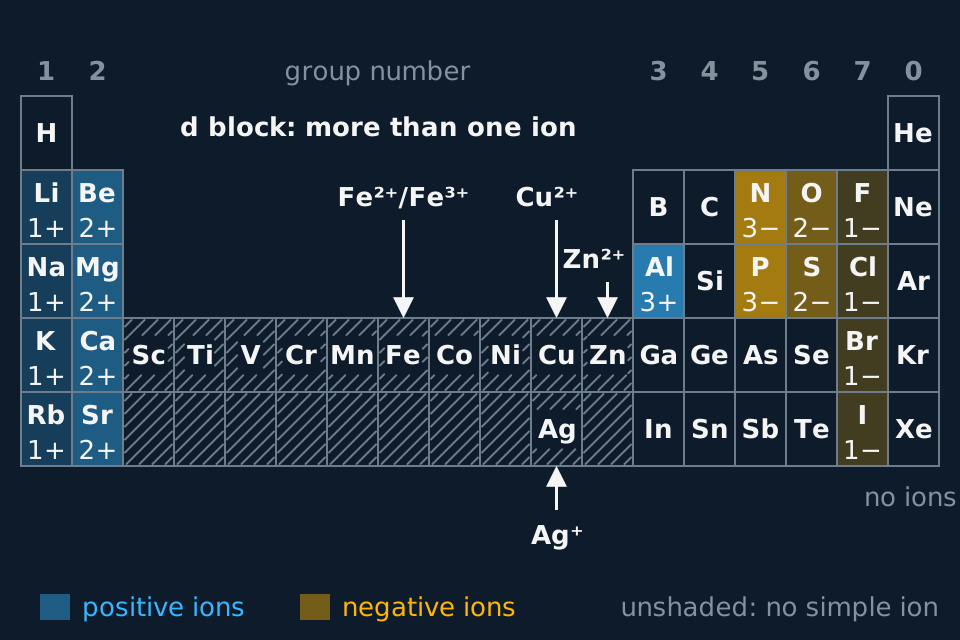
An ionic compound has no overall charge, so its formula is the lowest whole-number ratio of ions in which the positive charges equal the negative. The charges on main-group ions follow from the group: Group 1 metals form 1+ ions, Group 2 metals 2+ and aluminium 3+, while nitrogen forms 3−, oxygen and sulfur 2− and the halogens 1−. Transition metals can form more than one ion, and the Roman numeral in the name gives the charge: iron(II) is Fe²⁺ and iron(III) is Fe³⁺.
Describe the drawing
An outline periodic table of the first five periods. Group 1 is shaded and marked 1+, Group 2 2+ and aluminium 3+, in one colour; nitrogen and phosphorus 3−, oxygen and sulfur 2− and the halogens 1−, in a second colour. Group 0, carbon and silicon are unshaded, Group 0 marked no ions. The d block is hatched, labelled more than one ion, with arrows to Fe²⁺/Fe³⁺, Cu²⁺, Zn²⁺ and Ag⁺.
Many common ions contain more than one atom, held together by covalent bonds, with a charge on the group as a whole. Their formulae and charges cannot be read off the periodic table and are learned as a set.
| Charge | Positive ions | Negative ions |
|---|---|---|
| 1+ or 1− | Li⁺, Na⁺, K⁺, Ag⁺, H⁺, NH₄⁺ (ammonium) | F⁻, Cl⁻, Br⁻, I⁻, OH⁻ (hydroxide), NO₃⁻ (nitrate), HCO₃⁻ (hydrogencarbonate) |
| 2+ or 2− | Mg²⁺, Ca²⁺, Ba²⁺, Zn²⁺, Cu²⁺, Fe²⁺, Pb²⁺ | O²⁻, S²⁻, CO₃²⁻ (carbonate), SO₄²⁻ (sulfate) |
| 3+ or 3− | Al³⁺, Fe³⁺ | N³⁻, PO₄³⁻ (phosphate) |
Where a formula needs more than one polyatomic ion, the ion goes in brackets with the number outside. Calcium hydroxide is Ca(OH)₂: one calcium ion and two whole hydroxide ions. Written CaOH₂, it would mean one oxygen atom and two hydrogen atoms, which is not calcium hydroxide. A single polyatomic ion takes no brackets, as in NaOH, CaCO₃ and NH₄Cl. Ammonium sulfate needs two ammonium ions for each sulfate, so it is (NH₄)₂SO₄.
The blue of copper(II) sulfate crystals comes from water held in the lattice. Crystalline copper(II) sulfate is a hydrated salt, CuSO₄·5H₂O, with five molecules of water of crystallisation for each CuSO₄, joined to the formula by a raised dot. Heated, the crystals lose that water as steam and crumble to white anhydrous CuSO₄. The dot is not a multiplication sign, and the 5 multiplies only the water: one CuSO₄·5H₂O holds nine oxygen atoms, four in the sulfate and five in the water. The number of waters in a hydrated salt is found by heating it to constant mass and comparing the moles of water lost with the moles of anhydrous salt left.
CuSO₄·5H₂O(s) → CuSO₄(s) + 5H₂O(g)Blue hydrated crystals become a white anhydrous powder on heating.
- Polyatomic ion
- An ion made of two or more atoms covalently bonded together and carrying an overall charge, such as SO₄²⁻ or NH₄⁺.
- Water of crystallisation
- Water molecules held in a fixed ratio within the crystal lattice of a hydrated salt.
TRY IT: Three formulae from their ions
Give the formulae of magnesium nitrate, sodium phosphate and iron(III) oxide.
Check your answer
Magnesium nitrate: Mg²⁺ needs two NO₃⁻ to balance its charge, and more than one nitrate means brackets: Mg(NO₃)₂.
Sodium phosphate: PO₄³⁻ needs three Na⁺, and the phosphate appears once, so no brackets: Na₃PO₄.
Iron(III) oxide: the numeral says Fe³⁺, and O²⁻ is 2−. The lowest common multiple of 3 and 2 is 6, so two Fe³⁺ (6+) and three O²⁻ (6−): Fe₂O₃.
Elements, balanced equations and state symbols
Seven elements exist as molecules of two atoms at room temperature and are always written that way when they appear as the element: hydrogen H₂, nitrogen N₂, oxygen O₂, and the halogens F₂, Cl₂, Br₂ and I₂. Hydrogen gas in an equation is H₂(g), never H. The noble gases are single atoms, He and Ar.
Metals, and non-metals with giant structures such as carbon and silicon, are written as the symbol alone, Mg(s) or C(s), because there is no small molecule to write. Sulfur and phosphorus form S₈ and P₄ molecules. Equations usually write sulfur as S(s), and phosphorus as P(s), or as P₄(s) when it burns to P₄O₁₀.
- Diatomic molecule
- A molecule made of two atoms, as in the elements hydrogen, nitrogen, oxygen and the halogens.
A balanced equation has the same number of atoms of each element on both sides, because in a chemical reaction atoms are rearranged, never created or lost.
The only numbers that may change while balancing are the large ones in front of each formula, the coefficients. The small subscripts belong to the formula and fix which substance it is. Changing H₂O to H₂O₂ to get more oxygen on the right does balance the oxygen, but it changes the product from water to hydrogen peroxide, which the reaction does not make.
Balancing goes faster in a sensible order. Start with an element that appears in only one formula on each side. Leave until last any element that appears on its own, such as O₂ or H₂, because its coefficient can be changed without upsetting anything else. Fractions are allowed while working. Multiply through at the end to clear them, unless one mole of a particular substance is wanted, as in the definitions of enthalpy change, where ½O₂ is kept.
Balancing the combustion of butane
Write a balanced equation, with state symbols, for the complete combustion of butane, C₄H₁₀, a gas, to carbon dioxide and water.
Show the working
Skeleton: C₄H₁₀(g) + O₂(g) → CO₂(g) + H₂O(l).
Carbon first, since it is in one formula on each side. Four carbons on the left need 4CO₂: C₄H₁₀(g) + O₂(g) → 4CO₂(g) + H₂O(l).
Hydrogen next. Ten hydrogens on the left need 5H₂O: C₄H₁₀(g) + O₂(g) → 4CO₂(g) + 5H₂O(l).
Oxygen last, because O₂ is an element. The right now holds 4 × 2 + 5 × 1 = 13 oxygen atoms, which needs 13 ÷ 2 = 6½ O₂: C₄H₁₀(g) + 6½O₂(g) → 4CO₂(g) + 5H₂O(l).
Double everything to clear the fraction: 2C₄H₁₀(g) + 13O₂(g) → 8CO₂(g) + 10H₂O(l). Check: 8 carbon, 20 hydrogen and 26 oxygen atoms on each side.
The water in that equation is (l) because a state symbol describes the substance under the conditions the equation refers to, usually room temperature, as in an enthalpy of combustion. In the flame itself the water leaves as steam, and an equation written for the hot gases uses H₂O(g).
- Balanced equation
- An equation with the same number of atoms of each element, and the same total charge, on each side.
- Coefficient
- The number written in front of a formula in an equation, giving how many units of that substance react or form.
Every species in the equation for a reaction carries a state symbol: (s) solid, (l) liquid, (g) gas, (aq) aqueous. Without them an equation cannot say whether hydrogen chloride is a gas or a solution, and the two behave differently. HCl(g) is a gas of covalent molecules; HCl(aq) is hydrochloric acid, in which the molecules have given up H⁺ ions to the water.
HCl(g) + H₂O(l) → H₃O⁺(aq) + Cl⁻(aq)Hydrogen chloride dissolving in water is itself a reaction, and the state symbols show the change from gas to aqueous ions.
Aqueous means dissolved in water, which is not the same as liquid. Pure ethanol is C₂H₅OH(l); ethanol mixed with water is C₂H₅OH(aq). Water itself is H₂O(l) and is never (aq), because water cannot be dissolved in itself. Molten sodium chloride, as in electrolysis, is NaCl(l); a solution of it in water is NaCl(aq).
A solid that forms when two solutions are mixed is a precipitate, and it is written (s). Deciding which product precipitates needs a short list of solubility rules.
State symbols can often be read straight from a test tube. Fizzing means a gas is forming, (g). A solid appearing in a clear solution is a precipitate, (s). A solid that disappears as it reacts has gone into solution as aqueous ions. A solution changing colour means a coloured ion is forming or being used up, as when the blue of Cu²⁺(aq) fades. Writing the state symbols from what was seen is the reverse of predicting what will be seen, and a question can ask for either.
- State symbol
- A symbol after a formula giving its physical state: (s) solid, (l) liquid, (g) gas or (aq) dissolved in water.
- Aqueous
- Dissolved in water, shown by the state symbol (aq) in an equation.
- Precipitate
- An insoluble solid formed when two solutions are mixed and react.
Ionic equations and spectator ions
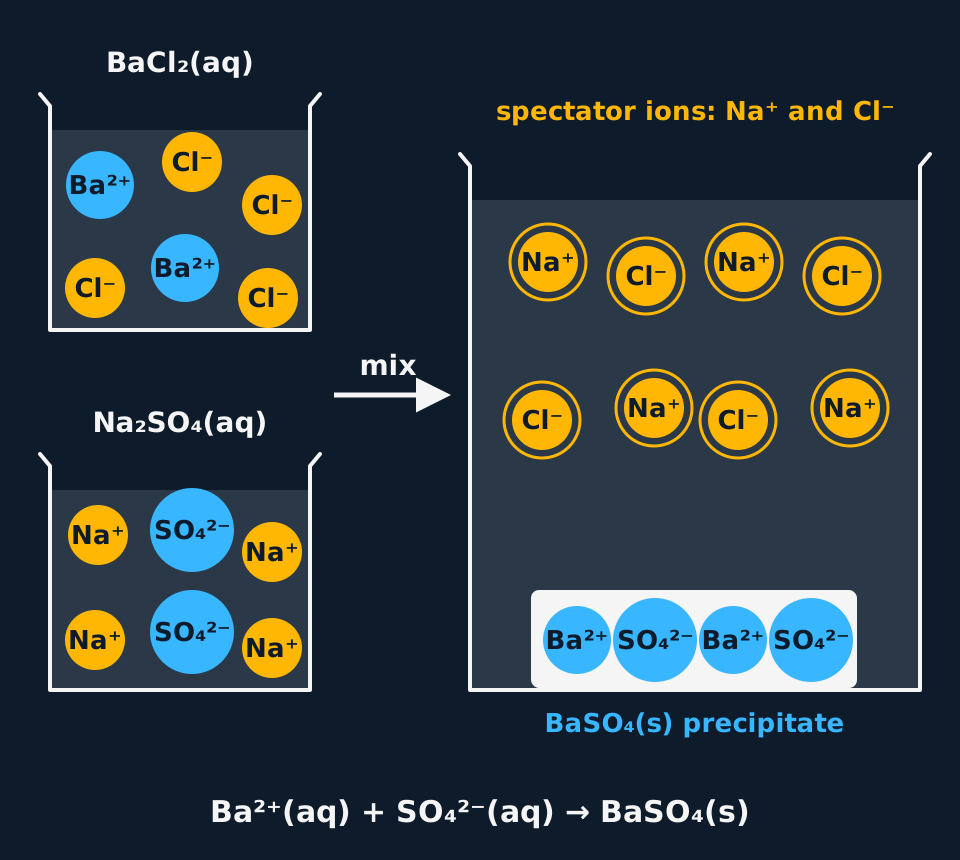
Barium chloride solution and sodium sulfate solution give a thick white precipitate the moment they meet. The full equation is BaCl₂(aq) + Na₂SO₄(aq) → BaSO₄(s) + 2NaCl(aq). But before mixing, the two solutions hold free ions, Ba²⁺, Cl⁻, Na⁺ and SO₄²⁻, moving about in water. Afterwards the sodium and chloride ions are still there, still dissolved, exactly as they were. They are spectator ions: present, but unchanged by the reaction.
Describe the drawing
Before and after mixing. On the left, a beaker of barium chloride solution holding 2 Ba²⁺ and 4 Cl⁻ ions, and a beaker of sodium sulfate solution holding 4 Na⁺ and 2 SO₄²⁻ ions. An arrow labelled mix leads to one beaker where 2 Ba²⁺ and 2 SO₄²⁻ are packed together as a white solid of BaSO₄ at the bottom, while 4 Na⁺ and 4 Cl⁻, each ringed as spectator ions, are still spread through the solution. Underneath: Ba²⁺(aq) + SO₄²⁻(aq) → BaSO₄(s).
An ionic equation leaves the spectators out and shows only what changes. For any soluble barium salt mixed with any soluble sulfate it is the same equation, Ba²⁺(aq) + SO₄²⁻(aq) → BaSO₄(s). Acidified barium chloride solution therefore tests for sulfate ions whatever compound they come from.
| Compounds of | Soluble | Insoluble |
|---|---|---|
| Sodium, potassium, ammonium | All | None |
| Nitrate | All | None |
| Chloride, bromide, iodide | Most | Silver halides, AgCl, AgBr and AgI; lead(II) halides |
| Sulfate | Most | Barium sulfate and lead(II) sulfate; calcium sulfate is only slightly soluble |
| Carbonate | Group 1 and ammonium only | All others, such as CaCO₃ and CuCO₃ |
| Hydroxide | Group 1, and barium | Magnesium hydroxide and transition metal hydroxides such as Cu(OH)₂ and Fe(OH)₃; calcium hydroxide is only slightly soluble |
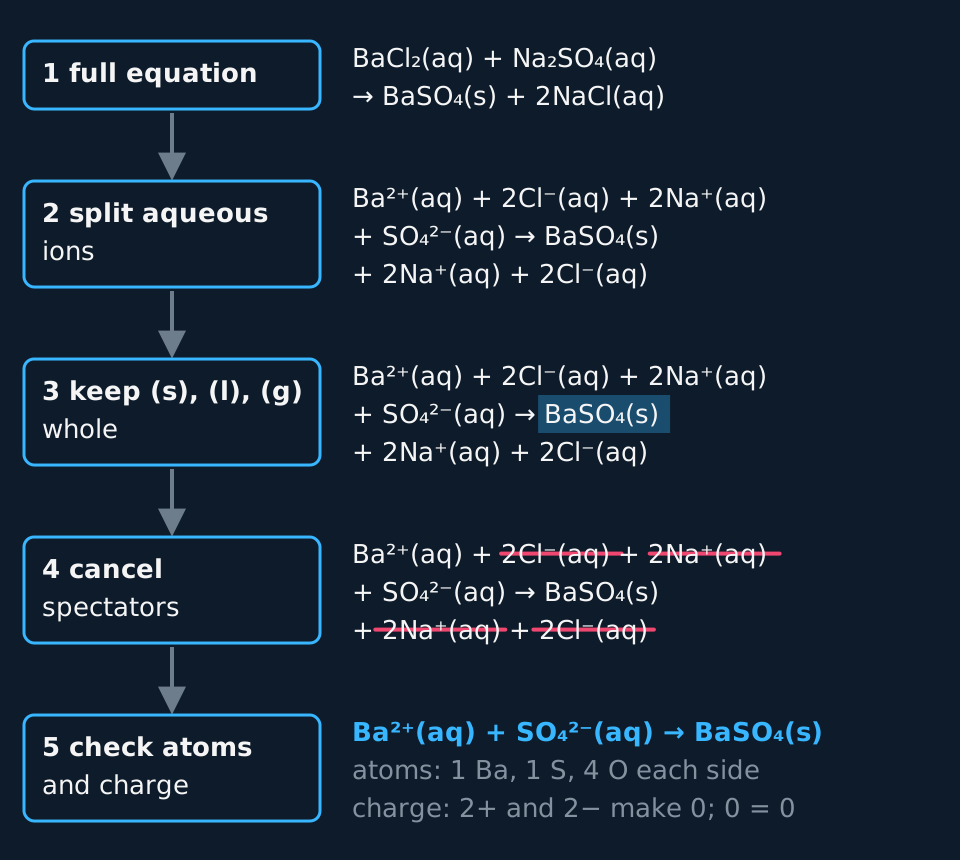
The method is the same every time. Write the balanced full equation with state symbols. Split every aqueous ionic compound, and every strong acid, into its ions, keeping the coefficients. Leave solids, liquids, gases and covalent molecules whole, because they have no free ions in solution. Cross out any ion that appears unchanged on both sides. Check that the atoms and the total charge balance.
Describe the drawing
A vertical flow of five boxes joined by arrows, with the barium sulfate example beside each. One: the full equation BaCl₂(aq) + Na₂SO₄(aq) → BaSO₄(s) + 2NaCl(aq). Two: every aqueous ionic compound split into ions. Three: BaSO₄(s) highlighted and kept whole. Four: 2Na⁺ and 2Cl⁻ struck through on both sides as spectators. Five: Ba²⁺(aq) + SO₄²⁻(aq) → BaSO₄(s), checked for atoms and for charge, 0 = 0.
The ionic equation for barium sulfate
Write the ionic equation, with state symbols, for the reaction of barium chloride solution with sodium sulfate solution.
Show the working
Full equation: BaCl₂(aq) + Na₂SO₄(aq) → BaSO₄(s) + 2NaCl(aq). Barium sulfate is the insoluble product; sodium chloride, like every sodium salt, stays in solution.
Split the aqueous ionic compounds, keeping the numbers: Ba²⁺(aq) + 2Cl⁻(aq) + 2Na⁺(aq) + SO₄²⁻(aq) → BaSO₄(s) + 2Na⁺(aq) + 2Cl⁻(aq). BaSO₄(s) is left whole, because its ions are held in a solid lattice.
Cross out 2Na⁺(aq) and 2Cl⁻(aq), which appear unchanged on both sides.
Ionic equation: Ba²⁺(aq) + SO₄²⁻(aq) → BaSO₄(s). Check: one barium, one sulfur and four oxygens on each side; the charges, 2+ and 2−, total zero on the left, and the right is neutral.
Neutralisation simplifies in the same manner. Hydrochloric acid with sodium hydroxide, nitric acid with potassium hydroxide, any strong acid with any alkali: once the spectators are cancelled, every one is the same reaction.
H⁺(aq) + OH⁻(aq) → H₂O(l)The ionic equation for any strong acid with any alkali. Their enthalpy changes of neutralisation are all close to −57 kJ mol⁻¹ because the reaction is the same.
TRY IT: Magnesium and hydrochloric acid
Magnesium ribbon fizzes in dilute hydrochloric acid, giving magnesium chloride solution and hydrogen. Write the full equation and the ionic equation, both with state symbols.
Check your answer
Full equation: Mg(s) + 2HCl(aq) → MgCl₂(aq) + H₂(g).
Split what is aqueous and ionic: Mg(s) + 2H⁺(aq) + 2Cl⁻(aq) → Mg²⁺(aq) + 2Cl⁻(aq) + H₂(g). Magnesium is a solid metal and hydrogen a gas of molecules, so neither is split.
Cancel 2Cl⁻(aq): Mg(s) + 2H⁺(aq) → Mg²⁺(aq) + H₂(g). The charge is 2+ on each side. Magnesium with dilute sulfuric acid gives the same ionic equation, because sulfate is a spectator too.
- Spectator ion
- An ion present in the reaction mixture that is unchanged by the reaction and appears identically on both sides of the equation.
- Ionic equation
- An equation showing only the ions and other species that take part in a reaction, with spectator ions left out.
Acids, alkalis and their salts
Four acids run through the whole course: hydrochloric acid, HCl, sulfuric acid, H₂SO₄, nitric acid, HNO₃, and ethanoic acid, CH₃COOH. In water each releases H⁺ ions. A salt forms when that hydrogen is replaced by a metal ion or an ammonium ion, so each acid gives its own family of salts. The common alkalis are sodium hydroxide, NaOH, potassium hydroxide, KOH, and aqueous ammonia, NH₃(aq), which takes H⁺ to become NH₄⁺ and so makes ammonium salts: NH₃(aq) + HCl(aq) → NH₄Cl(aq).
| Acid | Formula | Ion in its salts | Sodium salt |
|---|---|---|---|
| Hydrochloric acid | HCl | Cl⁻, chloride | NaCl |
| Sulfuric acid | H₂SO₄ | SO₄²⁻, sulfate | Na₂SO₄ |
| Nitric acid | HNO₃ | NO₃⁻, nitrate | NaNO₃ |
| Ethanoic acid | CH₃COOH | CH₃COO⁻, ethanoate | CH₃COONa |
Acids react with metal oxides to give a salt and water, and with carbonates to give a salt, water and carbon dioxide, which is the fizz. Ionic equations for these follow the same method, with one caution. Ethanoic acid is a weak acid: most of its molecules stay whole in water, so it is written CH₃COOH(aq) and not split. Only the strong acids, hydrochloric, sulfuric and nitric, are split into H⁺(aq) and their negative ions.
CuO(s) + H₂SO₄(aq) → CuSO₄(aq) + H₂O(l)A metal oxide and an acid: black solid dissolves to a blue solution.
An acid with a dissolved carbonate and a solid one
Write the ionic equation, with state symbols, for hydrochloric acid reacting with (a) sodium carbonate solution and (b) marble chips, which are calcium carbonate.
Show the working
(a) Full equation: Na₂CO₃(aq) + 2HCl(aq) → 2NaCl(aq) + H₂O(l) + CO₂(g). Split: 2Na⁺(aq) + CO₃²⁻(aq) + 2H⁺(aq) + 2Cl⁻(aq) → 2Na⁺(aq) + 2Cl⁻(aq) + H₂O(l) + CO₂(g).
Cancel 2Na⁺(aq) and 2Cl⁻(aq): CO₃²⁻(aq) + 2H⁺(aq) → H₂O(l) + CO₂(g). Charge: 2− + 2+ = 0 on the left, 0 on the right.
(b) Full equation: CaCO₃(s) + 2HCl(aq) → CaCl₂(aq) + H₂O(l) + CO₂(g). Calcium carbonate is insoluble, so it stays whole; only the acid and the calcium chloride are split.
Cancel 2Cl⁻(aq): CaCO₃(s) + 2H⁺(aq) → Ca²⁺(aq) + H₂O(l) + CO₂(g). Charge: 2+ on each side.
The carbonate ion appears on its own only when the carbonate was dissolved. A solid carbonate keeps its whole formula, and its metal ion appears among the products.
- Salt
- A compound formed when the hydrogen ions of an acid are replaced by metal ions or ammonium ions.
Half-equations: a first look
Magnesium displaces copper from copper(II) sulfate solution: the metal is coated with brown copper as the blue fades. With sulfate cancelled as a spectator, the ionic equation is Mg(s) + Cu²⁺(aq) → Mg²⁺(aq) + Cu(s). Each magnesium atom has lost two electrons, and each copper(II) ion has gained two.
A half-equation shows one of those changes on its own, with the electrons written in.
Mg(s) → Mg²⁺(aq) + 2e⁻Magnesium loses electrons, which is oxidation.
Cu²⁺(aq) + 2e⁻ → Cu(s)Copper(II) ions gain electrons, which is reduction.
A half-equation balances charge as well as atoms, and the electrons make the two sides equal. In the first, the charge on the left is 0, and on the right it is +2 + 2 × (−1) = 0. In the second, the left is +2 + 2 × (−1) = 0 and the right is 0.
Adding two half-equations with the same number of electrons cancels the electrons and gives the ionic equation back. When the numbers differ, one or both are multiplied first. Aluminium loses three electrons per atom and copper(II) gains two, so 2Al and 3Cu²⁺ transfer six electrons between them: 2Al(s) + 3Cu²⁺(aq) → 2Al³⁺(aq) + 3Cu(s). Half-equations for ions such as manganate(VII) also balance oxygen with water and hydrogen with H⁺ ions, and follow the same rule: atoms first, then electrons to balance the charge.
- Half-equation
- An equation for the oxidation or the reduction half of a redox reaction on its own, with electrons shown to balance the charge.
Other boards: the acids list and equations from observations
OCR A names the four acids and three alkalis of the acids table in its acids statement, 2.1.4: hydrochloric, sulfuric, nitric and ethanoic acids, and sodium hydroxide, potassium hydroxide and aqueous ammonia. The same statement asks for the full and ionic equations of acids with carbonates, metal oxides and alkalis, so an OCR question can name any of those reactions and expect both equations with state symbols.
Edexcel sets writing equations from observations as a statement of its own, 5.15. A question describes a test tube, fizzing, a precipitate, a colour fading, and the state symbols follow from what was seen: fizzing gives (g), a solid appearing gives (s), a solid dissolving gives aqueous ions. Cambridge sets formulae and equations in 2.3 with the same expectations as AQA.
In the exam
- Where a question asks for state symbols, the scheme withholds the equation mark if any one species lacks its symbol or has the wrong one: water at room temperature is (l), a precipitate (s), an ionic compound in solution (aq).
- Multiples of a balanced equation are accepted: 2C₄H₁₀ + 13O₂ and C₄H₁₀ + 6½O₂ both earn the mark, unless one mole of a named substance is required, as in an enthalpy definition.
- An ionic equation must contain only the species that change. An equation that still shows a spectator ion is the full equation split into ions, and is not the ionic equation the question asked for.
- Do not split a solid, a gas, water or any other covalent molecule into ions: BaSO₄(s) stays whole even though it is ionic, and CH₃COOH(aq) stays whole because ethanoic acid is weak.
- A half-equation is marked on its charge: electrons appear as a product for an oxidation and as a reactant for a reduction, and the total charge must be equal on the two sides.
Check yourself
When silver nitrate solution is added to sodium chloride solution, a white precipitate forms. A student writes the ionic equation as Ag⁺(aq) + NaCl(aq) → AgCl(s) + Na⁺(aq). Explain what is wrong with it, and give the correct ionic equation.
Answer
The equation balances in atoms and in charge, so the fault is not in the arithmetic. It is that sodium chloride has not been split. In solution it exists as Na⁺(aq) and Cl⁻(aq), not as NaCl units.
Once it is split, Na⁺(aq) appears on both sides unchanged. It is a spectator, like the nitrate ion the student rightly left out, and is cancelled.
The ionic equation is Ag⁺(aq) + Cl⁻(aq) → AgCl(s). The charge is zero on each side, and the same equation describes any soluble chloride with any soluble silver salt, which is why acidified silver nitrate solution tests for chloride ions.
Questions
Question 16 marks
Explain what is seen when dilute hydrochloric acid is added in turn to solid magnesium oxide, to solid magnesium carbonate and to sodium hydroxide solution, and what the full and ionic equations show about what reacts.
Mark scheme
Indicative content
- magnesium oxide dissolves to give a colourless solution with no gas: MgO(s) + 2HCl(aq) → MgCl₂(aq) + H₂O(l)
- the oxide is an insoluble solid, so it stays whole in the ionic equation, MgO(s) + 2H⁺(aq) → Mg²⁺(aq) + H₂O(l)
- magnesium carbonate fizzes and dissolves: MgCO₃(s) + 2HCl(aq) → MgCl₂(aq) + H₂O(l) + CO₂(g), the gas giving the fizz
- the carbonate is insoluble, so its ionic equation keeps it whole: MgCO₃(s) + 2H⁺(aq) → Mg²⁺(aq) + H₂O(l) + CO₂(g)
- sodium hydroxide shows no visible change, only warming, because both reactants and products are in solution: NaOH(aq) + HCl(aq) → NaCl(aq) + H₂O(l)
- its ionic equation is H⁺(aq) + OH⁻(aq) → H₂O(l); in all three reactions H⁺ is what reacts and chloride is a spectator
Levels
- Level 3 (5–6 marks) all three observations are given and matched to what the full equations show, all three ionic equations are correct with the insoluble solids kept whole, and the answer draws the common conclusion that H⁺ reacts in every case and chloride is a spectator
- Level 2 (3–4 marks) the observations and full equations are right; one ionic equation splits the oxide or carbonate into ions, or the spectator conclusion is not drawn
- Level 1 (1–2 marks) fizzing with the carbonate is noted, with one equation; magnesium oxide is commonly written as separate Mg²⁺ and O²⁻ ions, and chloride is kept in the ionic equations
Question 24 marks
Complete and balance these two equations, adding the state symbols that are missing: the complete combustion of propane, C₃H₈(g) + O₂ → CO₂ + H₂O, and the reduction of iron(III) oxide in a blast furnace, Fe₂O₃(s) + CO(g) → Fe(l) + CO₂(g).
Mark scheme
- B1 C₃H₈ + 5O₂ → 3CO₂ + 4H₂O, with the coefficients 5, 3 and 4; allow multiples
- B1 state symbols (g) for oxygen and carbon dioxide and (l) for water; allow H₂O(g)
- B1 Fe₂O₃(s) + 3CO(g) → 2Fe(l) + 3CO₂(g)
- B1 2 iron atoms, 3 carbon atoms and 6 oxygen atoms on each side of the iron equation
Question 34 marks
Explain why a student who balances the equation for hydrogen burning in oxygen as H₂(g) + O₂(g) → H₂O₂(l) is wrong, and give the correct balanced equation with state symbols.
Mark scheme
- B1 the subscripts are part of a formula and fix which substance it represents
- B1 H₂O₂ is hydrogen peroxide, which the reaction does not produce; the product is water
- B1 the equation is balanced with coefficients only: 2H₂ + O₂ → 2H₂O
- B1 2H₂(g) + O₂(g) → 2H₂O(l), with state symbols; allow H₂O(g)
All 20 questions with mark schemes, the other 17 set out in full on the question page.
Worth remembering
- Bracket a polyatomic ion that appears more than once: calcium hydroxide is Ca(OH)₂, and CaOH₂ is a different formula.
- Writing H₂O₂ to balance the oxygen changes the product; only the coefficients may change.
- Write H₂O(l) even for a reaction in solution: the water is the solvent, and H₂O(aq) would be water dissolved in water.
- An ionic equation with Na⁺ or Cl⁻ still on both sides is unfinished.
- Splitting CaCO₃(s), H₂O(l) or CH₃COOH(aq) into ions is wrong: only aqueous ionic compounds and strong acids split.
CHECK YOUR PROGRESS
Rate how confident you are with each objective for this lesson. Ratings are saved in this browser, on this device, unless you sign in.
- Work out the formula of an ionic compound from the charges on its ions, using brackets for polyatomic ions.
- Give the formulae of the elements that exist as diatomic molecules.
- Balance an equation by inspection, changing only the numbers in front of formulae.
- Add the correct state symbol to every species, and explain what (aq) means.
- Use the solubility rules to identify a precipitate, and write an ionic equation by cancelling spectator ions.
- Explain how electrons balance the charge in a half-equation.
Open the full revision checklist to see every objective in the curriculum in one place.
Practise this lesson
WORKBOOK
The questions from this topic, on paper with room to work, and a separate book of mark schemes. Free to use; please do not redistribute or sell.
Used later in The mole, the Avogadro constant and molar mass · Concentration, volumetric solutions and titration calculations · Ionic bonding and ionic lattices · Enthalpy change, standard conditions and the definitions