Chemistry › Redox › Oxidation states and the rules for assigning them
Oxidation states and the rules for assigning them
Magnesium burns in chlorine as brightly as it burns in air, and no oxygen is involved. Oxidation is the loss of electrons, and an oxidation state is the bookkeeping that tracks where the electrons have gone, worked out from a short list of rules taken in order of priority.
Key terms Every definition in redox, lesson by lesson
Before this Formulae, equations and state symbols – the charges on common ions and writing an ionic formula · Ionic bonding and ionic lattices – metals lose electrons and non-metals gain them
COMMON MISCONCEPTION
Oxidation means adding oxygen, so a reaction with no oxygen in it cannot be a redox reaction.
Oxidation is loss of electrons, shown by a rise in oxidation state, and it needs no oxygen. When sodium burns in chlorine, sodium goes from 0 to +1 and is oxidised; chlorine goes from 0 to −1 and is reduced. Oxygen is one oxidising agent among many, and any reaction in which oxidation states change is redox.
What you should be able to do
- Define oxidation and reduction in terms of electrons and in terms of oxidation state.
- Apply the rules for oxidation states in their order of priority, including the exceptions for peroxides, OF₂ and metal hydrides.
- Calculate the oxidation state of an element in a compound or a polyatomic ion from the sum rule.
- Deduce the oxidation state of a metal in a complex ion, counting each ligand at its own charge.
- Identify the oxidising agent and the reducing agent in a redox reaction, and state what happens to each.
- Use Roman numerals to name compounds and ions such as iron(III) chloride, manganate(VII) and chlorate(I).
Redox without oxygen
Oxidation is not about oxygen. Magnesium burns in chlorine with the same white glare it gives in air, and a white powder settles on the sides of the jar. In air the product is magnesium oxide; in chlorine it is magnesium chloride, and there is no oxygen anywhere in the reaction.
Mg(s) + Cl₂(g) → MgCl₂(s)
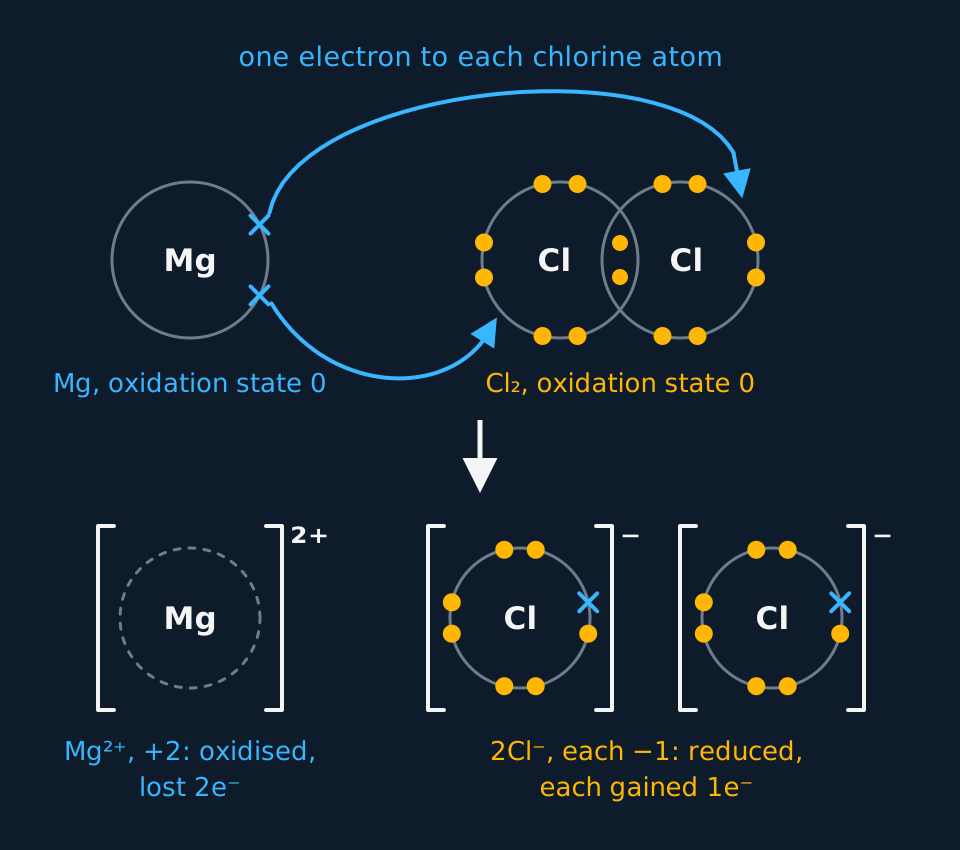
The two reactions look alike because the same thing happens to the magnesium in both. Each atom gives up its two outer electrons and becomes an Mg²⁺ ion. In air the electrons go to oxygen atoms, which become O²⁻; in chlorine they go to chlorine atoms, one to each, which become Cl⁻. What the magnesium does is the same either way, so the name for it should be the same either way.
Describe the drawing
Dot-and-cross diagram of magnesium reacting with chlorine, outer shells only. Above, a magnesium atom with two outer electrons drawn as cyan crosses, and a chlorine molecule of two overlapping atoms with seven dots each, sharing one pair; two curved arrows carry one magnesium electron to each chlorine atom. Below the reaction arrow, Mg²⁺ in square brackets with an empty outer shell, oxidation state +2, and two chloride ions in square brackets, each with seven dots and one cross, oxidation state −1.
A-level chemistry therefore defines oxidation by electrons, not by oxygen. Oxidation is the loss of electrons. Reduction is the gain of electrons. The two always happen together, because an electron lost by one species has to be gained by another, and a reaction in which both happen is a redox reaction. The mnemonic OIL RIG (oxidation is loss, reduction is gain) carries the definitions. Write 'loss of electrons' in full in a definition; 'loses electrons' with no subject, or 'gains oxygen', does not define the term.
The older definitions still work in the cases they were built for. Magnesium gaining oxygen is oxidation, and copper(II) oxide losing oxygen to hydrogen is reduction. They fail where no oxygen is present, and they say nothing about why the reaction happens, so the electron definition replaces them rather than sitting beside them.
- Oxidation
- The loss of electrons by a species, which raises the oxidation state of one of its elements.
- Reduction
- The gain of electrons by a species, which lowers the oxidation state of one of its elements.
- Redox reaction
- A reaction in which one species is oxidised and another is reduced, with electrons transferred from one to the other.
Oxidation states, and the rules in order
Following electrons is easy for magnesium and chlorine, because the product is made of ions. It is harder in a molecule such as SO₂ or an ion such as SO₄²⁻, where electrons are shared. An oxidation state gets round that by pretending. It is the charge an atom would carry if every bond it made were ionic, with the shared electrons given to the more electronegative atom. Nobody claims the sulfur in SO₄²⁻ carries a charge of +6; the number is a record of how many electrons it has lost a share of.
Defined like that, oxidation becomes an increase in oxidation state and reduction a decrease. In the magnesium reaction Mg goes from 0 to +2 and is oxidised; each Cl goes from 0 to −1 and is reduced. The two descriptions, electrons and oxidation states, always agree.
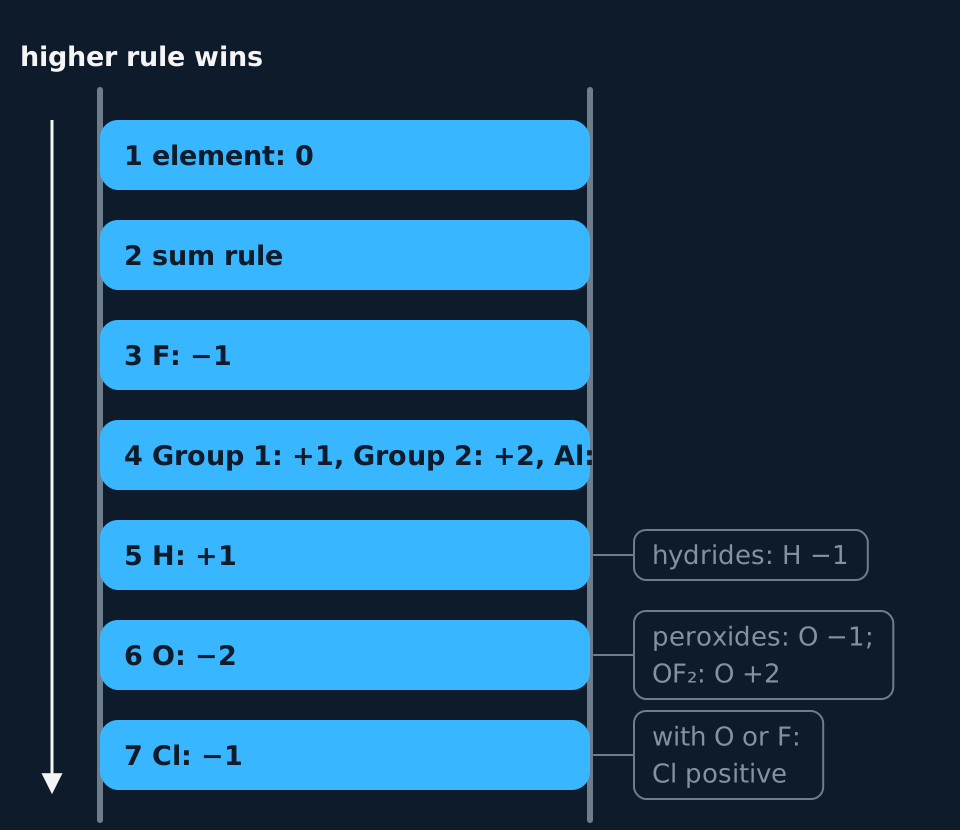
Oxidation states are assigned from rules, and the rules have to be applied in order, because they sometimes conflict and the higher rule wins.
Describe the drawing
A ladder of seven equal cyan rungs, highest priority at the top: an uncombined element is 0; the sum rule; fluorine −1; Group 1 +1, Group 2 +2 and aluminium +3; hydrogen +1; oxygen −2; chlorine −1. Grey tags beside the bottom three rungs give the exceptions: hydrogen −1 in metal hydrides, oxygen −1 in peroxides and +2 in OF₂, and chlorine positive when bonded to oxygen or fluorine. An arrow down the left reads higher rule wins.
| Priority | Rule | Exception or note |
|---|---|---|
| 1 | An uncombined element is 0 | Applies to Na, Cl₂, S₈ and O₃ alike |
| 2 | The oxidation states in a neutral compound add up to 0, and in an ion to the charge on the ion | This rule is never broken |
| 3 | Fluorine is −1 in all its compounds | The most electronegative element |
| 4 | Group 1 metals are +1, Group 2 metals +2, aluminium +3 | Metals in compounds are always positive |
| 5 | Hydrogen is +1 | −1 in metal hydrides such as NaH and CaH₂ |
| 6 | Oxygen is −2 | −1 in peroxides such as H₂O₂; +2 in OF₂ |
| 7 | Chlorine is −1 | Positive when bonded to oxygen or fluorine |
The exceptions follow from rules higher up the table. In OF₂, fluorine must be −1, two of them make −2, and the sum rule then forces oxygen to +2. In sodium hydride, sodium must be +1, so hydrogen has to be −1. In hydrogen peroxide, H₂O₂, each hydrogen is +1, the two oxygens share −2 between them, and each is −1. None of these needs to be learned as a special case if the rules are taken in order.
An oxidation state is written with its sign first: +2, −1, +6. That keeps it distinct from an ionic charge, which is written with the number first, as in Mg²⁺. Writing 2+ for an oxidation state mixes the two notations up.
- Oxidation state
- The charge an atom would have if all its bonds were ionic, with the bonding electrons assigned to the more electronegative atom.
- Oxidation number
- Another name for oxidation state: the same number, found by the same rules.
- Peroxide
- A compound containing an O–O single bond, such as H₂O₂ or Na₂O₂, in which each oxygen has an oxidation state of −1.
- Metal hydride
- A compound of a metal with hydrogen, such as NaH or CaH₂, containing H⁻ ions, in which hydrogen has an oxidation state of −1.
Working out an unknown oxidation state
Most questions give a formula and ask for the oxidation state of the one element no rule covers. Write down everything the rules fix, add it up, and let the sum rule supply the rest.
Every element in K₂Cr₂O₇ and in NH₄NO₃
Deduce the oxidation state of every element in potassium dichromate(VI), K₂Cr₂O₇, and in ammonium nitrate, NH₄NO₃.
Show the working
K₂Cr₂O₇ is neutral, so its oxidation states sum to 0. Potassium is in Group 1, so each K is +1 and the two contribute +2. Each O is −2 and the seven contribute −14. The two chromium atoms must together supply +12, so each Cr is +6, which is the (VI) in the name.
NH₄NO₃ cannot be done in one go. Its formula has two nitrogen atoms, and they are in different ions. Split it into NH₄⁺ and NO₃⁻ first.
In NH₄⁺ the sum is +1. Four H at +1 give +4, so N + 4 = +1 and N is −3. In NO₃⁻ the sum is −1. Three O at −2 give −6, so N − 6 = −1 and N is +5.
Treating NH₄NO₃ as one unit gives 2N + 4 − 6 = 0, so a mean of +1 for nitrogen. No nitrogen atom in the compound is at +1. The split is what makes the answer right: H is +1, O is −2, and N is −3 in the ammonium ion and +5 in the nitrate ion.
Some formulae give a fraction, and that is a clue rather than an error. In Fe₃O₄ four oxygens at −2 make −8, shared among three iron atoms, a mean of +8/3. Iron cannot lose two and two-thirds electrons. Fe₃O₄ is a mixed oxide containing one Fe²⁺ for every two Fe³⁺, and 2 + 3 + 3 = 8. The fraction is the average of two real oxidation states.
Sodium thiosulfate, Na₂S₂O₃, also gives a mean. Two Na give +2 and three O give −6, so the two sulfurs share +4 and the mean is +2. The two sulfur atoms in a thiosulfate ion are not equivalent, since the central one is bonded to three oxygens and the other sulfur, and the outer one only to the central sulfur, but at A level the mean, +2, is the answer to give. In the tetrathionate ion, S₄O₆²⁻, which thiosulfate turns into when it reacts with iodine, the mean is +2.5. That rise is why thiosulfate acts as a reducing agent towards iodine.
Describe the drawing
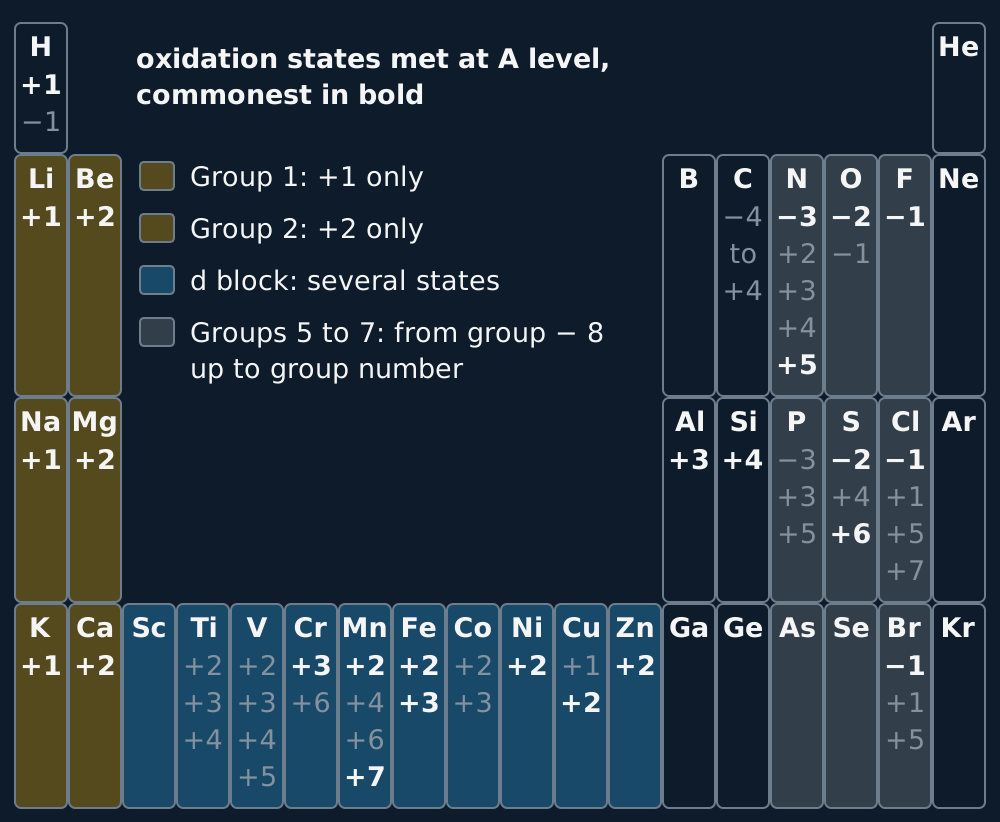
An outline periodic table from hydrogen to krypton with the oxidation states met at A level written in each box, the commonest in bold. Groups 1 and 2 are shaded amber and show one value each, +1 and +2. The d block, shaded cyan, shows several values per metal, manganese from +2 to +7. Groups 5 to 7, shaded grey, run from the group number minus eight up to the group number, such as nitrogen −3 to +5 and chlorine −1 to +7. Noble gases are blank.
Across the periodic table there is a pattern to the values. A Group 1 or Group 2 metal has only one positive oxidation state, equal to its group number. The non-metals reach their most negative value, group number minus eight, when bonded to less electronegative atoms, and their most positive value, the group number itself, when bonded to oxygen. Sulfur runs from −2 in H₂S to +6 in SO₄²⁻; nitrogen from −3 in NH₃ to +5 in NO₃⁻; chlorine from −1 in NaCl to +7 in ClO₄⁻. The transition metals take several values each, and manganese runs from +2 to +7.
Carbon is the widest of all, and the same arithmetic tracks organic oxidation. In methane carbon is −4; in carbon dioxide it is +4. Ethanol, C₂H₅OH, gives a mean of −2 for its two carbons, and ethanoic acid, CH₃COOH, a mean of 0. The rise of two in the mean is why turning an alcohol into a carboxylic acid is called oxidation, though the reaction gains an oxygen and loses two hydrogens rather than visibly losing electrons.
Transition metals in solution are usually in complex ions, with molecules or ions bonded to the metal. The sum rule still applies, with one shortcut: each ligand is counted as a whole, at its own charge. Water and ammonia are neutral and count 0; chloride, hydroxide and cyanide count −1 each.
The metal in a complex ion and in an oxo-ion
Deduce the oxidation state of the metal in [Cu(H₂O)₆]²⁺, [CuCl₄]²⁻, [Fe(CN)₆]³⁻ and VO²⁺.
Show the working
In [Cu(H₂O)₆]²⁺ the six water ligands add nothing, so the whole charge belongs to the copper, which is +2.
In [CuCl₄]²⁻, Cu + 4(−1) = −2, so copper is again +2. The charge on the complex has changed from 2+ to 2− but the copper has not changed oxidation state: swapping water for chloride is ligand substitution, not redox.
In [Fe(CN)₆]³⁻, six cyanide ions give −6, so Fe − 6 = −3 and iron is +3, the hexacyanoferrate(III) ion. There is no need to split CN⁻ into carbon and nitrogen.
In VO²⁺ there is no ligand, just an oxide: V − 2 = +2, so vanadium is +4. The charge on an oxo-ion is always less than the oxidation state of its metal, so VO²⁺ is vanadium(IV), not vanadium(II).
Spotting a redox reaction
Not every reaction is redox. Silver nitrate solution added to sodium chloride gives a white precipitate of silver chloride, and silver stays at +1, chlorine at −1, sodium at +1 and nitrate as nitrate throughout. Neutralisation is the same: in HCl + NaOH → NaCl + H₂O no oxidation state changes. A reaction is redox only if at least one element changes oxidation state, and then at least one must rise and at least one fall.
That gives a test that works on any equation. Assign the oxidation state of every element on both sides, look for the ones that change, and the direction of each change names the process. Concentrated sulfuric acid with solid sodium bromide gives orange-brown fumes of bromine and a choking gas, sulfur dioxide. Bromine goes from −1 to 0 and is oxidised. Sulfur goes from +6 in H₂SO₄ to +4 in SO₂ and is reduced. Sodium, hydrogen and oxygen do not change, so they play no part in the electron transfer.
Metals with dilute acids are the family met most often. Magnesium ribbon in dilute hydrochloric acid fizzes and dissolves. Magnesium rises from 0 to +2 and is oxidised; hydrogen falls from +1 in H⁺ to 0 in H₂ and is reduced. The chloride ions are unchanged, so the ionic equation is the same with sulfuric acid or any other dilute acid. Magnesium oxide or magnesium carbonate dissolves in the same acid to give the same salt, but no oxidation state changes, so those are acid–base reactions and not redox.
Mg(s) + 2H⁺(aq) → Mg²⁺(aq) + H₂(g)Magnesium 0 to +2, oxidised; hydrogen +1 to 0, reduced.
Oxidised and reduced describe a whole species, not an atom inside it. In the sulfuric acid and bromide reaction the bromide ion is oxidised and the sulfuric acid is reduced; it is the sulfur within it whose oxidation state falls, but the acid is the oxidising agent.
Oxidising agents, reducing agents and Roman numerals
In the magnesium reaction, chlorine takes the electrons. It causes the oxidation of magnesium, so chlorine is the oxidising agent, and in doing so it is itself reduced. Magnesium gives the electrons. It causes the reduction of chlorine, so magnesium is the reducing agent, and it is itself oxidised.
Each name says what the agent does to the other species, which is the opposite of what happens to the agent itself. An oxidising agent is an electron acceptor and is reduced. A reducing agent is an electron donor and is oxidised. Concentrated sulfuric acid, acidified manganate(VII), acidified dichromate(VI) and the halogens are oxidising agents met in this course; metals, iodide ions, iron(II) ions and thiosulfate ions are reducing agents.
- Oxidising agent
- An electron acceptor: a species that oxidises another and is itself reduced.
- Reducing agent
- An electron donor: a species that reduces another and is itself oxidised.
| Oxidation | Reduction | |
|---|---|---|
| Electrons | Lost | Gained |
| Oxidation state | Increases | Decreases |
| Older definition | Gain of oxygen or loss of hydrogen | Loss of oxygen or gain of hydrogen |
| The agent that causes it | An oxidising agent, which is reduced | A reducing agent, which is oxidised |
Where an element can take more than one oxidation state, the name of a compound says which one with a Roman numeral. FeCl₂ is iron(II) chloride and FeCl₃ is iron(III) chloride. The numeral goes on the element it describes, straight after its name with no space. In an anion the same rule names the central atom: MnO₄⁻ is manganate(VII), since 4 × (−2) + Mn = −1 gives +7. ClO⁻ is chlorate(I), ClO₃⁻ is chlorate(V), SO₄²⁻ is sulfate(VI) and SO₃²⁻ is sulfate(IV), and NO₂⁻ is nitrate(III).
The numeral is always the oxidation state, never the number of atoms. Copper(I) oxide is Cu₂O: two copper atoms, each at +1. Reading the (I) as one copper atom gives CuO, which is copper(II) oxide, a different compound with a different colour.
TRY IT: Naming from a formula, and back again
Give the systematic name of KClO₃, and write the formula of sodium chlorate(I). Then identify the oxidising agent in the reaction 2Fe²⁺(aq) + Cl₂(aq) → 2Fe³⁺(aq) + 2Cl⁻(aq).
Check your answer
In KClO₃, K is +1 and three O give −6, so Cl + 1 − 6 = 0 and Cl is +5. The anion is chlorate(V), and the compound is potassium chlorate(V).
Chlorate(I) means chlorine at +1. With one oxygen at −2, the ion is ClO⁻, and with Na⁺ the formula is NaClO.
Iron goes from +2 to +3 and is oxidised; chlorine goes from 0 to −1 and is reduced. Chlorine accepts the electrons, so Cl₂ is the oxidising agent and Fe²⁺ is the reducing agent.
Other boards: oxidation numbers and Group 2 with chlorine
OCR and Edexcel call the same number the oxidation number, and Cambridge prints both names side by side. The rules and the values are identical whichever term a paper uses, so an answer in either is the same answer; Roman numerals in names are used in the same way by all four.
Edexcel names the reactions of the Group 2 metals with chlorine. Every Group 2 metal does what magnesium does. Heated calcium, strontium and barium burn in chlorine to give white solid chlorides, CaCl₂, SrCl₂ and BaCl₂, with the metal rising from 0 to +2 and each chlorine falling from 0 to −1. The reaction becomes more vigorous down the group, because the outer electrons are further from the nucleus and more shielded, so less energy is needed to remove them.
Ca(s) + Cl₂(g) → CaCl₂(s)Calcium is oxidised from 0 to +2; chlorine is reduced from 0 to −1.
OCR names the reactions of metals with dilute acids as redox reactions in its specification, and sets them beside the acid–base reactions of the same acids with oxides and carbonates, so an OCR question may ask which of two reactions giving the same salt is redox. The test is the one taught here: only the reaction of the metal changes an oxidation state.
In the exam
- Define oxidation as loss of electrons and reduction as gain of electrons. A definition in terms of oxygen alone is not accepted at A level.
- Deducing an oxidation state, show the sum: each fixed value, the total, and the value left for the unknown. Give the answer with its sign first, +6; the scheme marks an oxidation state, and a bare 6 reads as a charge or a count.
- Where a question asks for the oxidising agent, the mark is for the species, Cl₂ or MnO₄⁻. 'Manganese' for MnO₄⁻ is not credited, because the scheme wants the species that accepts the electrons.
- For a compound with one element in two different ions, such as NH₄NO₃, split the formula and give each value. A mean of +1 for nitrogen earns no mark: no nitrogen atom in the compound is at +1.
- Name a compound with the Roman numeral in brackets straight after the element it describes, iron(III) chloride. The numeral is the oxidation state, so Cu₂O is copper(I) oxide, never copper(II) oxide.
Check yourself
Hydrogen peroxide slowly decomposes to water and oxygen: 2H₂O₂(l) → 2H₂O(l) + O₂(g). A student says this cannot be redox because nothing else is there to accept the electrons. Evaluate that claim using oxidation states.
Answer
In H₂O₂, hydrogen is +1 and each oxygen is −1, because it is a peroxide. In H₂O oxygen is −2, and in O₂ it is 0.
So of the four oxygen atoms on the left, two fall from −1 to −2 and are reduced, and two rise from −1 to 0 and are oxidised. Hydrogen stays at +1 throughout.
The claim is wrong. Electrons pass from one oxygen atom to another, so hydrogen peroxide is both the oxidising agent and the reducing agent. A redox reaction needs an electron donor and an electron acceptor, and here they are atoms of the same element in the same compound. That case has its own name, disproportionation.
Questions
Question 16 marks
Explain, using oxidation states, which species are oxidised and reduced in the reaction 2KMnO₄(s) + 16HCl(aq) → 2KCl(aq) + 2MnCl₂(aq) + 5Cl₂(g) + 8H₂O(l), and why hydrochloric acid acts both as a reducing agent and as an acid in it.
Mark scheme
Indicative content
- manganese falls from +7 in KMnO₄ to +2 in MnCl₂, a gain of five electrons per manganese atom, so the manganate(VII) is reduced
- ten of the sixteen chlorine atoms rise from −1 in HCl to 0 in Cl₂, losing one electron each, so those chloride ions are oxidised
- the electrons balance: two manganese atoms gain ten electrons and ten chlorine atoms lose ten electrons
- the other six chlorine atoms stay at −1 in KCl and MnCl₂, so that part of the HCl supplies H⁺ and chloride ions as an acid would
- potassium stays at +1, hydrogen at +1 and oxygen at −2 throughout, so none of them takes part in the electron transfer
- KMnO₄ is therefore the oxidising agent, accepting electrons, and HCl is the reducing agent, donating them, as well as acting as the acid
Levels
- Level 3 (5–6 marks) all the oxidation states are assigned correctly, the reduction of manganese and the oxidation of chlorine are identified with the electron count balanced, the six chlorine atoms that stay at −1 are used to show the acid role, and the oxidising and reducing agents are named
- Level 2 (3–4 marks) manganese is shown to go from +7 to +2 and chlorine from −1 to 0; the electrons are not balanced, the six chlorines that stay at −1 are not used, or the agents are not named
- Level 1 (1–2 marks) one oxidation state change is right; HCl is often called the oxidising agent, and its role as an acid is not explained
Question 24 marks
Give the oxidation state of sulfur in H₂SO₄, of nitrogen in NO₂, of chlorine in ClO₃⁻ and of manganese in MnO₄²⁻.
Mark scheme
- B1 sulfur in H₂SO₄ is +6, since 2(+1) + S + 4(−2) = 0
- B1 nitrogen in NO₂ is +4, since N + 2(−2) = 0
- B1 chlorine in ClO₃⁻ is +5, since Cl + 3(−2) = −1
- B1 manganese in MnO₄²⁻ is +6, since Mn + 4(−2) = −2
Question 34 marks
Explain, using the definitions of oxidation and reduction in terms of electrons, why the reaction Mg(s) + Cl₂(g) → MgCl₂(s) is a redox reaction even though it involves no oxygen.
Mark scheme
- B1 oxidation is the loss of electrons and reduction is the gain of electrons; reject definitions in terms of oxygen alone
- B1 each magnesium atom loses two electrons to form Mg²⁺, so magnesium is oxidised from 0 to +2
- B1 each chlorine atom gains one electron to form Cl⁻, so chlorine is reduced from 0 to −1
- B1 oxidation and reduction both occur, with electrons passing from magnesium to chlorine, so the reaction is redox
All 19 questions with mark schemes, the other 16 set out in full on the question page.
Worth remembering
- Put the sign before the number in an oxidation state, +2; 2+ is the notation for an ionic charge.
- A mean of +1 for nitrogen in NH₄NO₃ is wrong: split the formula into its two ions and give −3 and +5.
- Hydrogen set at +1 in NaH breaks the sum rule; the metal's rule ranks higher, so hydrogen is −1.
- 'Manganese' as the oxidising agent is not credited; the agent is the species that accepts the electrons, MnO₄⁻.
- Read the Roman numeral as the oxidation state, not a count of atoms: copper(I) oxide is Cu₂O.
CHECK YOUR PROGRESS
Rate how confident you are with each objective for this lesson. Ratings are saved in this browser, on this device, unless you sign in.
- Define oxidation and reduction in terms of electrons and in terms of oxidation state.
- Apply the rules for oxidation states in their order of priority, including the exceptions for peroxides, OF₂ and metal hydrides.
- Calculate the oxidation state of an element in a compound or a polyatomic ion from the sum rule.
- Deduce the oxidation state of a metal in a complex ion, counting each ligand at its own charge.
- Identify the oxidising agent and the reducing agent in a redox reaction, and state what happens to each.
- Use Roman numerals to name compounds and ions such as iron(III) chloride, manganate(VII) and chlorate(I).
Open the full revision checklist to see every objective in the curriculum in one place.
Practise this lesson
WORKBOOK
The questions from this topic, on paper with room to work, and a separate book of mark schemes. Free to use; please do not redistribute or sell.
Used later in Electrode potentials and the standard hydrogen electrode · The Period 3 elements: reactions with oxygen and water · Group 2: trends down the group and reactions with water · Halide ions, the silver nitrate test, concentrated sulfuric acid, and chlorine in water