Chemistry › Practicals › Distilling propanal from propan-1-ol
Required practical 5: distilling propanal (OCR PAG 5, Edexcel CP 5)
Oxidise propan-1-ol with acidified dichromate and distil the propanal off as it forms, before it can be oxidised further.
This is the method section of Oxidation and elimination of alcohols on a page of its own, with its variables, sample results, an evaluation and questions set on it. The chemistry behind it is in that lesson.
The capability this develops
This investigation is one instance of capability P05: Preparing and purifying organic products, which sets out the techniques it belongs to, the calculations it carries and the errors that cost marks in all of them. The notes behind the chemistry are in Alkenes and alcohols.
Where this sits on the specifications
Each qualification is mapped to its own specification one numbered heading at a time, against a document whose sha256 is recorded. These are the headings that list the lesson this method is taught in, on the four qualifications mapped. Each links to the route map the row belongs to.
| Qualification | Heading |
|---|---|
| AQA 7404/7405 | 3.3.5.2 Oxidation of alcohols |
| AQA 7404/7405 | 3.3.5.3 Elimination |
| OCR Chemistry A H032/H432 | 4.2.1 Alcohols |
| OCR Chemistry A H032/H432 | 4.2.3 Organic synthesis |
| OCR Chemistry A H032/H432 | 6.1.2 Carbonyl compounds |
| Pearson Edexcel Chemistry 8CH0/9CH0 | 6.38 reactions of alcohols |
| Pearson Edexcel Chemistry 8CH0/9CH0 | 6.39 preparing and purifying a liquid |
| Pearson Edexcel Chemistry 8CH0/9CH0 | 17.11 preparing carboxylic acids |
| Cambridge International 9701 | 14.2 Alkenes |
| Cambridge International 9701 | 15.1 Halogenoalkanes |
| Cambridge International 9701 | 16.1 Alcohols |
| Cambridge International 9701 | 17.1 Aldehydes and ketones |
| Cambridge International 9701 | 18.1 Carboxylic acids |
Three boards number their practical activities, and those lists were read here from the same specifications as the headings above. This investigation is filed on them as:
- AQA 7404/7405 required practical 5: Distilling a product from a reaction
- OCR Chemistry A H032/H432 PAG 5: Synthesis of an organic liquid
- Pearson Edexcel Chemistry 8CH0/9CH0 core practical 5: Oxidation of ethanol
Use your awarding organisation’s current specification and its practical handbook as the authority on which activities your course requires and how they are assessed.
Apparatus
A 50 cm³ round-bottomed or pear-shaped flask with two necks, or a single neck with a two-way adapter; a tap funnel; a still head with a thermometer; a Liebig condenser and a receiver adapter; a boiling tube standing in a beaker of ice and water as the receiver; an electric heating mantle; anti-bumping granules; measuring cylinders and a balance.
Safety
Potassium dichromate(VI) is toxic, can cause cancer and can sensitise the skin: wear gloves and eye protection and avoid raising dust. Propan-1-ol and propanal are flammable, so use the heating mantle and no naked flame anywhere nearby, and propanal vapour irritates the eyes and lungs. Check the CLEAPSS Hazcard for each substance and the school's risk assessment before starting; where they differ from this method, they take precedence.
Variables
Independent variable
The temperature at the still head, which decides what is collected: the fraction is taken while it reads below 60 °C. Between preparations, the thing changed is the way the mixture is heated, distillation against reflux, which decides whether the product is the aldehyde or the acid.
Dependent variable
The mass of distillate collected, and so the yield, and its purity, shown by the aldehyde tests and the boiling range on redistillation.
Control variables
- The quantities: 2.0 cm³ of propan-1-ol, about 1.5 g of potassium dichromate(VI) and 20 cm³ of 1.0 mol dm⁻³ sulfuric acid, which keep the alcohol in excess over the oxidising agent.
- The rate of addition from the tap funnel, a few drops at a time, so that each portion reacts as it arrives and its propanal distils off before more dichromate reaches it.
- The heating, from a mantle turned down once the acid boils, so that the propanal distils as it forms and the alcohol does not.
- The receiver in ice and the condenser water running in at the bottom, so that what distils is condensed and kept.
Two things decide whether propanal or propanoic acid is made: the alcohol being in excess over the dichromate, and the product leaving the flask the moment it forms. Both are set by the quantities and by the rate of addition, so those are the controls that matter more than any instrument reading.
Method
| Step | What to do | Why |
|---|---|---|
| 1 | Put 20 cm³ of 1.0 mol dm⁻³ sulfuric acid and a few anti-bumping granules in the flask. Fit the tap funnel to one neck and the still head, condenser and receiver to the other | The acid supplies the H⁺ that dichromate needs; the granules give smooth boiling |
| 2 | Dissolve about 1.5 g of potassium dichromate(VI) in 5 cm³ of water, add 2.0 cm³ of propan-1-ol, and pour the mixture into the tap funnel | Mixing first keeps the alcohol in excess over the oxidising agent throughout |
| 3 | Set the thermometer bulb level with the side arm of the still head. Run water into the condenser at the bottom and out at the top. Stand the receiver in ice and water, and leave the end of the receiver adapter open | The thermometer then reads the vapour that is distilling; the cold receiver stops propanal evaporating; an open end stops pressure building up |
| 4 | Heat the acid until it just boils, then turn the heat down | The propanal must boil off the moment it forms |
| 5 | Run the mixture in from the tap funnel a few drops at a time, at a rate that keeps a steady drip of distillate | Propanal leaves the flask before it can be oxidised to propanoic acid |
| 6 | Collect the distillate while the thermometer reads below 60 °C, and stop when it rises above that | Above 60 °C, propan-1-ol and water start to distil over with the product |
| 7 | Stopper the receiver at once, and keep it cold until the distillate is tested | Propanal is volatile and flammable |
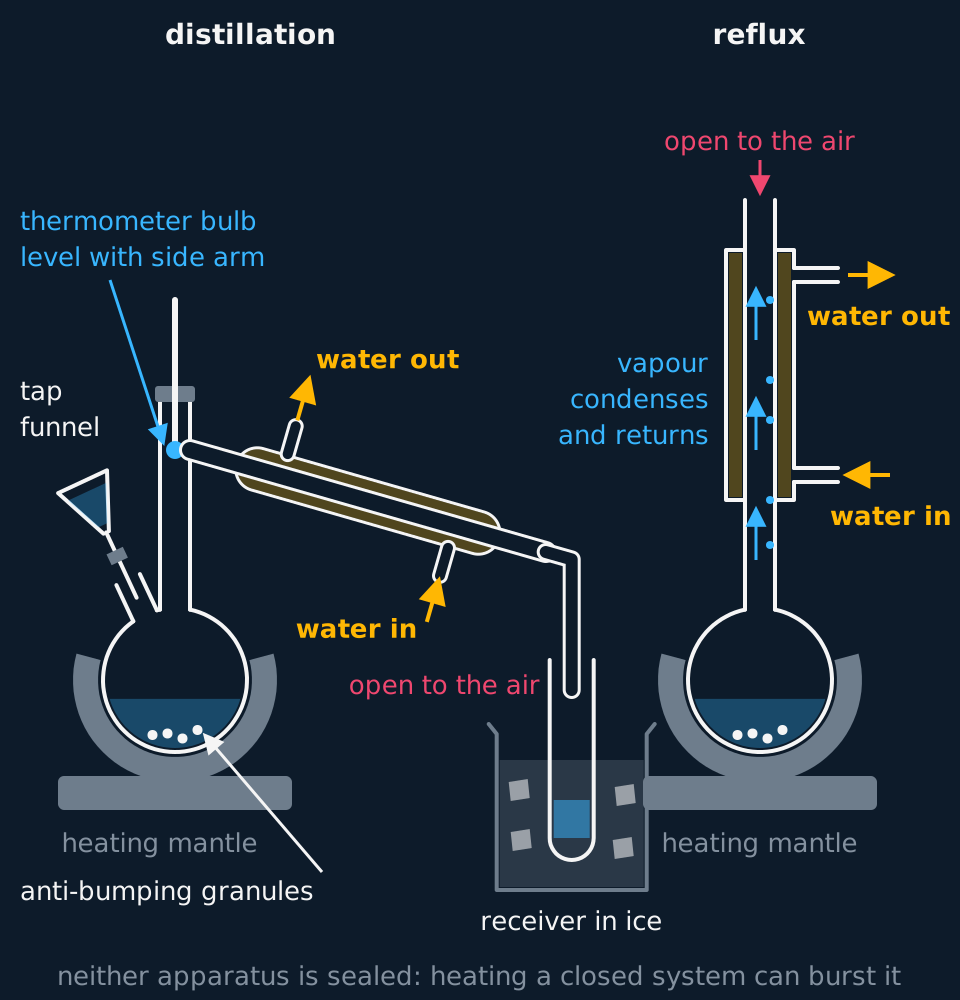
Describe the drawing
Two apparatus drawings side by side. Left, distillation: a round-bottomed flask with anti-bumping granules in an electric heating mantle, with a tap funnel in a second neck and a still head whose thermometer bulb is level with the side arm. A condenser slopes down to the right, water entering at its lower end and leaving at its upper end, and a receiver adapter drops into a boiling tube standing in a beaker of ice and water, with a gap open to the air. Right, reflux: the same flask and mantle with a condenser fitted vertically and open at the top, water in at the bottom and out at the top, and arrows showing vapour rising and liquid dripping back.
What is measured
What is collected is a few cm³ of colourless liquid with a sharp, fruity smell: propanal, with some water and some unreacted propan-1-ol carried over with it. The liquid left in the flask has turned green, the chromium(III) showing that oxidation has taken place. A purer sample comes from distilling the product a second time and keeping only what boils between 46 and 50 °C.
The distillate is tested for an aldehyde. Warmed with Tollens' reagent it gives a silver mirror, and warmed with Fehling's solution it turns from blue to a brick-red precipitate. A ketone, such as the propanone made from propan-2-ol, gives neither. A carboxylic acid is shown by effervescence with sodium hydrogencarbonate solution, the gas turning limewater milky.
Sample results
These readings are idealised: they are the numbers in the lesson's worked yield calculation, not a record of a real run.
| Quantity | Value |
|---|---|
| Mass of potassium dichromate(VI) | 1.47 g, 5.00 × 10⁻³ mol |
| Volume of propan-1-ol | 2.0 cm³, 1.6 g, 0.0267 mol |
| Propan-1-ol the dichromate can oxidise | 0.0150 mol, so the dichromate is limiting |
| Maximum mass of propanal | 0.870 g |
| Mass of propanal collected | 0.522 g |
| Percentage yield | 60.0% |
Evaluation
The limitations of the method, what each does to the result and in which direction, and the improvement a mark scheme credits.
| Limitation | What it does to the result | Improvement |
|---|---|---|
| The mass collected is of an impure distillate | The 60% yield in the sample results is worked from the mass of a liquid that also holds water and propan-1-ol, so the true yield of propanal is lower; a second distillation keeping only 46 to 50 °C gives a purer sample but loses more product in the apparatus | Redistil, weigh the fraction, and check its purity by its boiling range or an infrared spectrum before calculating the yield |
| Tollens' and Fehling's show an aldehyde is present, not that the others are absent | A silver mirror forms from a distillate that also holds propanoic acid or propan-1-ol, so a positive test says nothing about purity | Test a portion with sodium hydrogencarbonate for the acid, and run an infrared spectrum: the alcohol shows a broad O–H absorption at 3230 to 3550 cm⁻¹ and the acid one at 2500 to 3000 cm⁻¹, and a pure aldehyde shows neither |
| Boiling points 48 degrees apart do not separate cleanly in a still head | Propanal boils at 49 °C and propan-1-ol at 97 °C, so some alcohol vapour and water always come over while the flask is hot, and the still-head reading stays below 60 °C while a mixed vapour passes | Fit a short fractionating column between the flask and the still head, and heat slowly enough that the reading stays near 49 °C |
| The scale is small | Under a gram of product is expected, so the drops left in the condenser, adapter and funnel are a large fraction of it | Collect in a weighed receiver and keep the glassware between flask and receiver short; on a larger scale the same losses are a smaller fraction |
Errors in carrying it out
| Error | What it does | How to avoid it |
|---|---|---|
| Apparatus sealed, with no opening to the air | Pressure builds as the flask is heated and the glass can burst | Leave the end of the receiver adapter open |
| Thermometer bulb below the side arm | It reads hotter vapour lower in the still head, so the wrong fraction is collected | Set the bulb level with the side arm |
| Mixture added too fast, or heated too strongly | Propan-1-ol and water distil over before reacting, and the product is impure | Add dropwise; keep the still-head reading below 60 °C |
| Oxidising agent in excess, or propanal left in the flask | Propanal is oxidised to propanoic acid and the yield of aldehyde falls | Keep the alcohol in excess and distil the aldehyde as it forms |
| Receiver not cooled, or left unstoppered | Propanal, boiling at 49 °C, evaporates from the receiver | Stand the receiver in ice and water; stopper it when collection ends |
| Condenser water in at the top | The jacket is only part full and vapour escapes uncondensed | Water in at the bottom, out at the top |
Questions
Question 1 (6 marks)
Describe how a sample of propanal can be prepared from propan-1-ol and collected, including the apparatus and the conditions that keep the yield of propanal high.
Mark scheme
Indicative content
- acidified potassium dichromate(VI) is the oxidising agent, with the propan-1-ol in excess
- the mixture is heated in a flask with anti-bumping granules, using a heating mantle or water bath rather than a flame
- the flask is fitted with a still head, a thermometer with its bulb level with the side arm, and a sloping condenser with water in at the bottom and out at the top
- the alcohol is added slowly so that propanal distils off as soon as it forms, before it can be oxidised further
- the distillate is collected while the thermometer reads below about 60 °C, near propanal's boiling point of 49 °C
- the receiver is cooled in ice and water to reduce evaporation, and the apparatus is left open to the air, not sealed
Levels
- Level 3 (5–6 marks) the oxidising agent, the apparatus for distillation and all the conditions that keep the yield high are given: excess alcohol added slowly, propanal distilled off as it forms, collection below about 60 °C and a cooled receiver
- Level 2 (3–4 marks) acidified dichromate(VI) and distillation are described with the thermometer or condenser placed correctly; one condition for a high yield, such as adding the alcohol slowly or collecting at the right temperature, is not given
- Level 1 (1–2 marks) acidified dichromate(VI) is named, usually with heating under reflux, which turns the propanal into propanoic acid; no condition for keeping the aldehyde is given
Question 2 (3 marks)
Explain why the receiver is cooled in ice and water, and why the thermometer bulb is placed level with the side arm, when propanal is distilled.
Mark scheme
- B1 propanal boils at 49 °C and evaporates readily, so cooling the receiver reduces the loss of product
- B1 the thermometer bulb at the side arm measures the temperature of the vapour that is entering the condenser
- B1 so the reading shows which substance is distilling, and only the right fraction is collected
Question 3 (3 marks)
Suggest why propanal collected in a school preparation is often contaminated with propan-1-ol and water, and suggest how a purer sample could be obtained.
Mark scheme
- B1 propan-1-ol is in excess and volatile, so some vaporises and distils over with the propanal, especially if the flask is heated too strongly
- B1 water from the reaction mixture also distils over
- B1 redistil the product and collect only the fraction boiling close to 49 °C, between about 46 and 50 °C
Question 4 (2 marks)
Suggest a test to show that the distillate from the oxidation of propan-1-ol contains an aldehyde and not a ketone, giving the result.
Mark scheme
- B1 warm the distillate with Tollens' reagent, or with Fehling's solution
- B1 an aldehyde gives a silver mirror, or a brick-red precipitate from the blue Fehling's solution, while a ketone gives no change
Question 5 (3 marks)
Explain why propanal is distilled off as it forms, and state what is made instead if the mixture is heated under reflux with excess dichromate.
Mark scheme
Propanal boils at 49 °C, well below the mixture, so it leaves the flask as vapour before the dichromate can oxidise it further.
An aldehyde is easily oxidised, so left in the flask it would be converted to propanoic acid.
Under reflux the vapour condenses back into the flask and stays with the oxidising agent, so the product is propanoic acid.
Question 6 (2 marks)
Write the equation for the oxidation of propan-1-ol to propanal, using [O] for the oxidising agent, and give the colour change seen in the flask.
Mark scheme
CH₃CH₂CH₂OH + [O] → CH₃CH₂CHO + H₂O.
Orange to green, as dichromate(VI) ions are reduced to chromium(III) ions.
Question 7 (3 marks)
2.5 cm³ of propan-1-ol (density 0.80 g cm⁻³, Mr 60.0), oxidised with acidified dichromate, the alcohol in excess, gives 0.70 g of propanal (Mr 58.0). Calculate the percentage yield based on the propan-1-ol.
Mark scheme
Mass of propan-1-ol = 2.5 × 0.80 = 2.0 g, so n = 2.0 ÷ 60.0 = 0.0333 mol.
The ratio is 1 : 1, so the theoretical mass of propanal = 0.0333 × 58.0 = 1.93 g.
Percentage yield = 0.70 ÷ 1.93 × 100 = 36%.
Question 8 (2 marks)
During collection the still-head thermometer reads 75 °C. State what this shows about the distillate and what the student should do.
Mark scheme
Propan-1-ol and water are distilling over with the propanal, so the distillate is impure.
Turn the heat down or add the mixture more slowly, and collect only while the reading is below 60 °C.
Question 9 (2 marks)
Explain why the propan-1-ol is kept in excess over the potassium dichromate(VI) throughout the preparation.
Mark scheme
With the oxidising agent in excess, propanal still in contact with it is oxidised further to propanoic acid.
With the alcohol in excess, the dichromate is used up oxidising alcohol to aldehyde, which is why the alcohol and dichromate are mixed before they are run into the hot acid.
Question 10 (2 marks)
Suggest how an infrared spectrum of the distillate would show whether propanoic acid was present.
Mark scheme
Propanoic acid shows a very broad O–H absorption at about 2500 to 3000 cm⁻¹, which propanal lacks.
Both show C=O at 1680 to 1750 cm⁻¹, so the C=O peak alone cannot tell them apart.
Coverage maps are available for AQA 7404/7405, OCR Chemistry A H032/H432, Pearson Edexcel Chemistry 8CH0/9CH0 and Cambridge International 9701. Use the relevant route map to check what InkChemistry covers, and your awarding organisation’s current specification as the final authority on examinable content.