Chemistry › Alkenes and alcohols › Oxidation and elimination of alcohols
Oxidation and elimination of alcohols
Warmed with orange acidified potassium dichromate(VI), an alcohol shows its class: primary and secondary alcohols turn it green, tertiary alcohols leave it orange. A primary alcohol gives an aldehyde or a carboxylic acid depending on whether the apparatus lets the aldehyde escape. Hot concentrated acid removes water instead, and the alcohol becomes an alkene.
Key terms Every definition in alkenes and alcohols, lesson by lesson
Before this Alcohols: hydration, fermentation and classification – primary, secondary and tertiary alcohols · Half-equations and building redox equations – the dichromate(VI) half-equation · Alkenes: structure, electrophilic addition and Markovnikov's rule – carbocations and their stability · Structural isomerism and E/Z isomerism – E and Z but-2-ene
COMMON MISCONCEPTION
Heat any alcohol with acidified dichromate for long enough and it will turn the solution green.
A tertiary alcohol leaves the dichromate orange however long it is heated. Oxidation makes a C=O on the carbon carrying the OH, and that needs a hydrogen on that carbon to remove. A tertiary carbon has three alkyl groups and no hydrogen, so no C=O can form without breaking a C–C bond, and dichromate cannot do that.
What you should be able to do
- Write equations, using [O], for the oxidation of primary and secondary alcohols, and explain why tertiary alcohols are not oxidised.
- Explain how distillation gives an aldehyde and heating under reflux gives a carboxylic acid from the same primary alcohol, and describe both sets of apparatus.
- Describe the distillation of an aldehyde from a reaction mixture, and the errors that affect its yield and purity.
- Outline the mechanism of the acid-catalysed elimination of water from an alcohol.
- Deduce the alkenes formed by dehydrating an unsymmetrical alcohol, including E and Z isomers.
- Write equations for the conversion of alcohols into halogenoalkanes by hydrogen halides and phosphorus halides.CAIE · Edexcel · OCR A
What dichromate oxidises, and what it cannot
Acidified potassium dichromate(VI) oxidises primary and secondary alcohols and leaves tertiary alcohols untouched. Warmed in a water bath with a few drops of propan-1-ol or propan-2-ol, the orange solution is green within a minute or two; with 2-methylpropan-2-ol it stays orange however long it is left.
The oxidising agent is the dichromate(VI) ion, Cr₂O₇²⁻, in dilute sulfuric acid. Chromium is in the +6 oxidation state and the ion is orange. As it oxidises the alcohol it is reduced to chromium(III) ions, Cr³⁺, which are green.
Cr₂O₇²⁻(aq) + 14H⁺(aq) + 6e⁻ → 2Cr³⁺(aq) + 7H₂O(l)Orange to green: each chromium goes from +6 to +3.
Writing that half-equation beside every organic equation would be clumsy, so organic equations use [O] for an oxygen atom supplied by the oxidising agent. The equation must still balance.
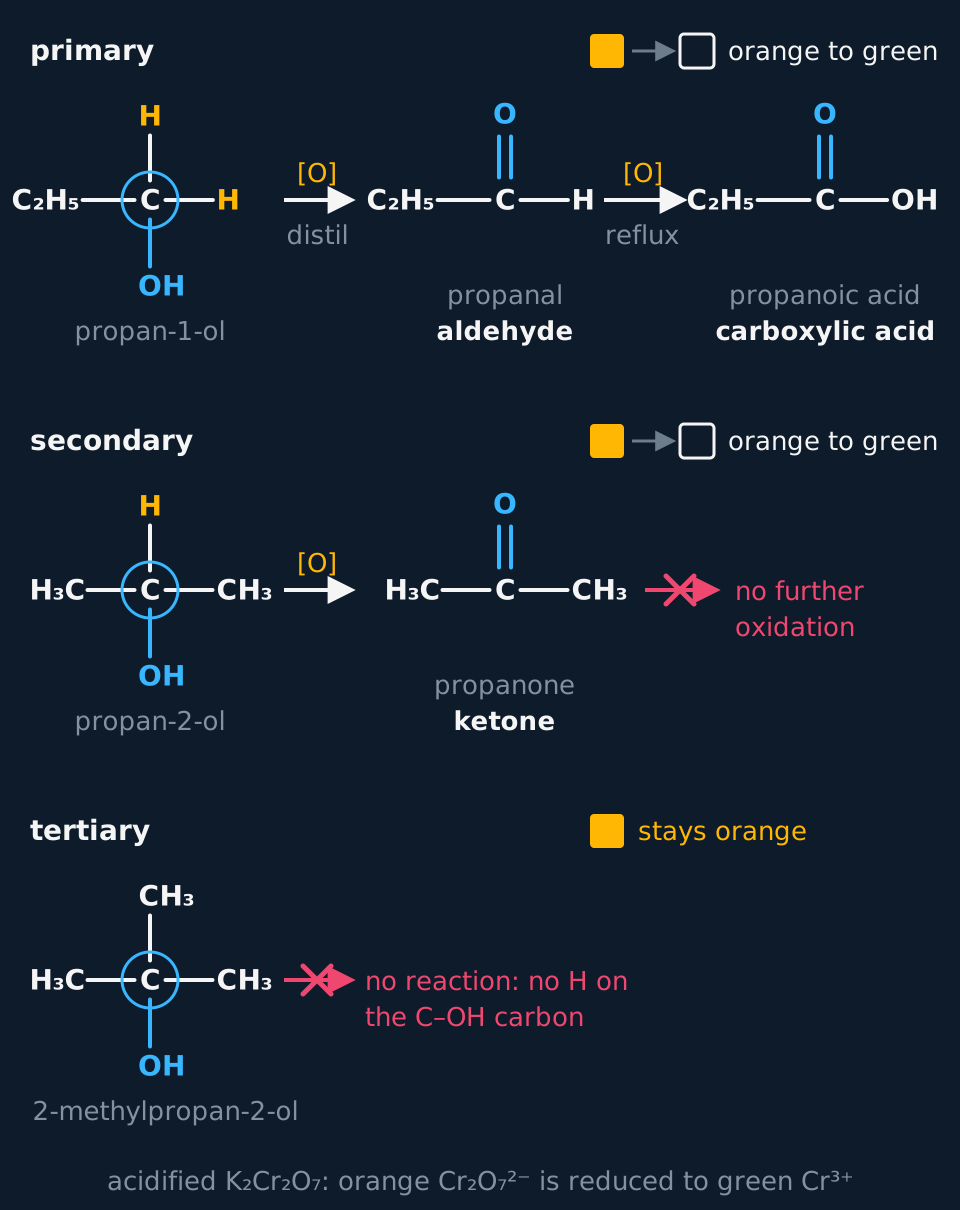
Oxidation of an alcohol removes two hydrogen atoms: the hydrogen of the O–H group, and a hydrogen from the carbon carrying the OH. A C=O double bond forms in their place. A primary alcohol has two hydrogens on that carbon and a secondary alcohol one, so both can lose one. A tertiary alcohol has none. Oxidising it would mean breaking a C–C bond, which acidified dichromate cannot do, so the tertiary alcohol is left unchanged and the solution stays orange.
Describe the drawing
Three rows of alcohol oxidation with acidified potassium dichromate, the hydrogens on the carbon bearing the OH highlighted. Primary: propan-1-ol goes to propanal, an aldehyde, labelled oxidise and distil, then to propanoic acid, labelled oxidise and reflux. Secondary: propan-2-ol goes to propanone, a ketone, and a crossed arrow says no further oxidation. Tertiary: 2-methylpropan-2-ol has a crossed arrow, no reaction because there is no hydrogen on the carbon bearing the OH. Swatches show orange turning green for the first two rows and staying orange for the third.
CH₃CH(OH)CH₃(l) + [O] → CH₃COCH₃(l) + H₂O(l)Propan-2-ol to propanone. Dichromate cannot oxidise a ketone further.
- Oxidising agent
- A species that accepts electrons, oxidising another species and being reduced itself.
- Aldehyde
- A compound containing the CHO group: a C=O at the end of a carbon chain, with a hydrogen on the carbonyl carbon.
- Ketone
- A compound containing a C=O group bonded to two other carbon atoms.
- Carboxylic acid
- A compound containing the carboxyl group, COOH, at the end of a carbon chain.
Primary alcohols: the apparatus decides the product
A primary alcohol is oxidised first to an aldehyde. The aldehyde still has a hydrogen on its carbonyl carbon, so it can be oxidised again, to a carboxylic acid.
CH₃CH₂OH(l) + [O] → CH₃CHO(l) + H₂O(l)Ethanol to ethanal.
CH₃CHO(l) + [O] → CH₃COOH(l)Ethanal to ethanoic acid.
CH₃CH₂OH(l) + 2[O] → CH₃COOH(l) + H₂O(l)Both steps together, under reflux.
Which product is collected depends on boiling points. The aldehyde has the lowest boiling point of the three. Aldehyde molecules have no O–H bond, so they cannot hydrogen bond to each other, while alcohol molecules and acid molecules both can.
| Alcohol | Aldehyde | Carboxylic acid | |
|---|---|---|---|
| Two carbons | Ethanol, 78 °C | Ethanal, 21 °C | Ethanoic acid, 118 °C |
| Three carbons | Propan-1-ol, 97 °C | Propanal, 49 °C | Propanoic acid, 141 °C |
| Hydrogen bonds between molecules | Yes | No | Yes |
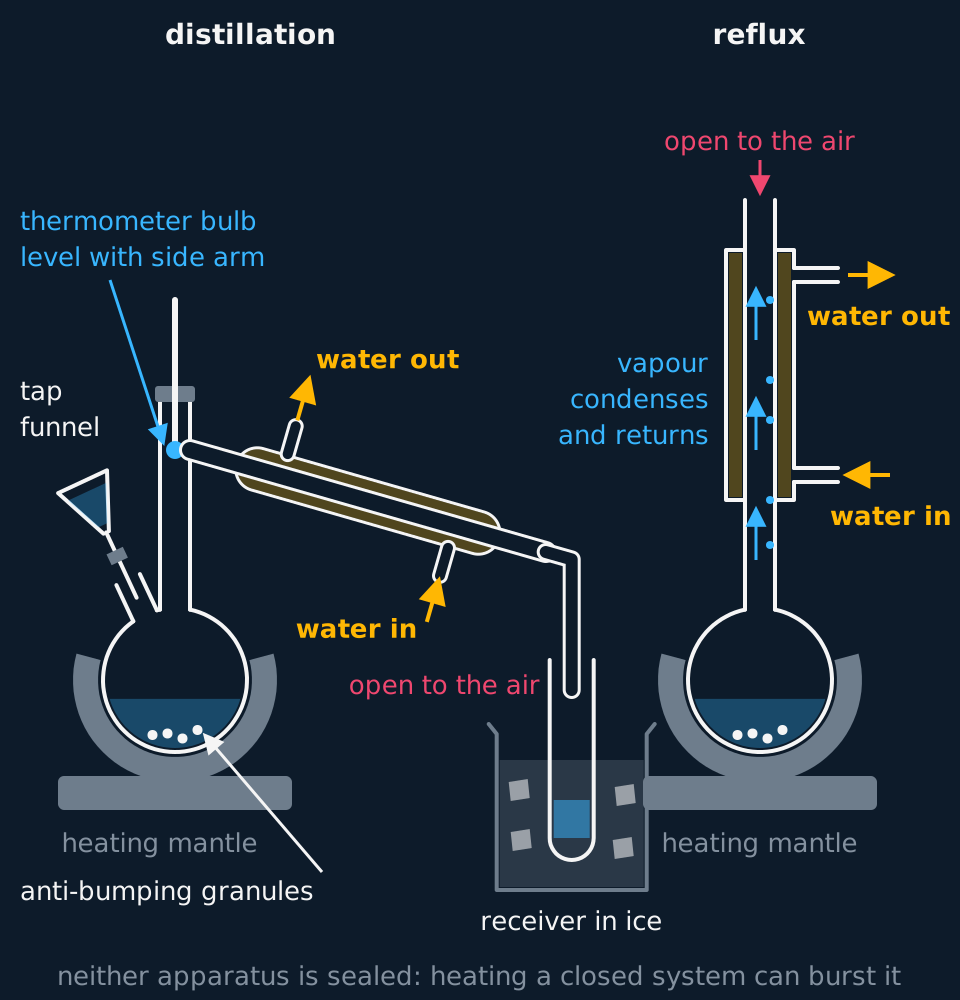
To stop at the aldehyde, heat the alcohol with the oxidising agent in apparatus set up for distillation, with the alcohol in excess. The aldehyde boils off as soon as it forms, passes into the condenser and is collected, so it leaves the flask before it can be oxidised further. Keeping the alcohol in excess means there is too little oxidising agent to take the aldehyde any further.
To go on to the carboxylic acid, heat the alcohol with an excess of the oxidising agent under reflux. The condenser is vertical, so the vapour of anything that boils, the aldehyde included, condenses and runs back into the flask. The mixture can be heated for as long as needed and nothing volatile escapes, so the aldehyde stays with the oxidising agent until it has become the acid. The acid is separated afterwards by distillation.
Describe the drawing
Two apparatus drawings side by side. Left, distillation: a round-bottomed flask with anti-bumping granules in an electric heating mantle, with a tap funnel in a second neck and a still head whose thermometer bulb is level with the side arm. A condenser slopes down to the right, water entering at its lower end and leaving at its upper end, and a receiver adapter drops into a boiling tube standing in a beaker of ice and water, with a gap open to the air. Right, reflux: the same flask and mantle with a condenser fitted vertically and open at the top, water in at the bottom and out at the top, and arrows showing vapour rising and liquid dripping back.
Both sets of apparatus are open to the air at one point, because heating a sealed flask builds up pressure and can burst the glass. Water enters the condenser at the lower end and leaves at the upper, so the jacket stays full and cold. Anti-bumping granules give smooth boiling, and the heat comes from an electric heating mantle or a water bath rather than a flame, because the vapours are flammable.
- Distillation
- Heating a liquid mixture so that the component with the lowest boiling point vaporises, then condensing it and collecting it separately.
- Reflux
- Continuous boiling and condensing of a reaction mixture, a vertical condenser returning the vapour to the flask, so it can be heated for a long time without losing volatile substances.
Products from three butanols
Give the organic product, and an equation using [O], when butan-1-ol, butan-2-ol and 2-methylpropan-2-ol are each heated under reflux with excess acidified potassium dichromate(VI).
Show the working
Butan-1-ol is primary. Under reflux with excess oxidising agent it goes past the aldehyde to the acid: CH₃CH₂CH₂CH₂OH(l) + 2[O] → CH₃CH₂CH₂COOH(l) + H₂O(l). The product is butanoic acid, and the dichromate turns green.
Butan-2-ol is secondary, with one hydrogen on the carbon carrying the OH. It is oxidised to a ketone and no further: CH₃CH₂CH(OH)CH₃(l) + [O] → CH₃CH₂COCH₃(l) + H₂O(l). The product is butanone, and the dichromate turns green.
2-Methylpropan-2-ol is tertiary. The carbon carrying the OH has no hydrogen to lose, so there is no reaction and the dichromate stays orange. Refluxing for longer does not change that.
Required practical 5: distilling propanal from propan-1-ol
AQA sets this as required practical 5, distillation of a product from a reaction. The product here is propanal, boiling point 49 °C, made from propan-1-ol, boiling point 97 °C.
Apparatus: a 50 cm³ round-bottomed or pear-shaped flask with two necks, or a single neck with a two-way adapter; a tap funnel; a still head with a thermometer; a Liebig condenser and a receiver adapter; a boiling tube standing in a beaker of ice and water as the receiver; an electric heating mantle; anti-bumping granules; measuring cylinders and a balance.
| Step | What to do | Why |
|---|---|---|
| 1 | Put 20 cm³ of 1.0 mol dm⁻³ sulfuric acid and a few anti-bumping granules in the flask. Fit the tap funnel to one neck and the still head, condenser and receiver to the other | The acid supplies the H⁺ that dichromate needs; the granules give smooth boiling |
| 2 | Dissolve about 1.5 g of potassium dichromate(VI) in 5 cm³ of water, add 2.0 cm³ of propan-1-ol, and pour the mixture into the tap funnel | Mixing first keeps the alcohol in excess over the oxidising agent throughout |
| 3 | Set the thermometer bulb level with the side arm of the still head. Run water into the condenser at the bottom and out at the top. Stand the receiver in ice and water, and leave the end of the receiver adapter open | The thermometer then reads the vapour that is distilling; the cold receiver stops propanal evaporating; an open end stops pressure building up |
| 4 | Heat the acid until it just boils, then turn the heat down | The propanal must boil off the moment it forms |
| 5 | Run the mixture in from the tap funnel a few drops at a time, at a rate that keeps a steady drip of distillate | Propanal leaves the flask before it can be oxidised to propanoic acid |
| 6 | Collect the distillate while the thermometer reads below 60 °C, and stop when it rises above that | Above 60 °C, propan-1-ol and water start to distil over with the product |
| 7 | Stopper the receiver at once, and keep it cold until the distillate is tested | Propanal is volatile and flammable |
What is collected is a few cm³ of colourless liquid with a sharp, fruity smell: propanal, with some water and some unreacted propan-1-ol carried over with it. The liquid left in the flask has turned green, the chromium(III) showing that oxidation has taken place. A purer sample comes from distilling the product a second time and keeping only what boils between 46 and 50 °C.
The product is checked by its boiling temperature. A pure liquid boils at one fixed temperature, so the boiling temperature of the redistilled liquid is measured and compared with the data-book value for propanal, 49 °C. The sample is distilled slowly, with the thermometer bulb level with the side arm, and the temperature read while drops collect steadily. A liquid that boils over a range of several degrees, or well above 49 °C, still holds propan-1-ol or water.
| Error | What it does | How to avoid it |
|---|---|---|
| Apparatus sealed, with no opening to the air | Pressure builds as the flask is heated and the glass can burst | Leave the end of the receiver adapter open |
| Thermometer bulb below the side arm | It reads hotter vapour lower in the still head, so the wrong fraction is collected | Set the bulb level with the side arm |
| Mixture added too fast, or heated too strongly | Propan-1-ol and water distil over before reacting, and the product is impure | Add dropwise; keep the still-head reading below 60 °C |
| Oxidising agent in excess, or propanal left in the flask | Propanal is oxidised to propanoic acid and the yield of aldehyde falls | Keep the alcohol in excess and distil the aldehyde as it forms |
| Receiver not cooled, or left unstoppered | Propanal, boiling at 49 °C, evaporates from the receiver | Stand the receiver in ice and water; stopper it when collection ends |
| Condenser water in at the top | The jacket is only part full and vapour escapes uncondensed | Water in at the bottom, out at the top |
Limiting reagent and percentage yield of propanal
In one run, 1.47 g of potassium dichromate(VI), K₂Cr₂O₇, and 2.0 cm³ of propan-1-ol (density 0.80 g cm⁻³) gave 0.522 g of propanal. Show which reagent is limiting and calculate the percentage yield. Mr: K₂Cr₂O₇ 294.2, propan-1-ol 60.0, propanal 58.0.
Show the working
Amount of dichromate = 1.47 g ÷ 294.2 g mol⁻¹ = 5.00 × 10⁻³ mol. Amount of propan-1-ol: 2.0 cm³ × 0.80 g cm⁻³ = 1.6 g, and 1.6 g ÷ 60.0 g mol⁻¹ = 0.0267 mol.
Each Cr₂O₇²⁻ accepts six electrons, and each propan-1-ol gives up two on becoming propanal, CH₃CH₂CH₂OH → CH₃CH₂CHO + 2H⁺ + 2e⁻. One dichromate therefore oxidises three alcohol molecules: 5.00 × 10⁻³ mol oxidises 0.0150 mol, less than the 0.0267 mol present. The dichromate is limiting, as the method intends.
Maximum mass of propanal = 0.0150 mol × 58.0 g mol⁻¹ = 0.870 g. Percentage yield = 0.522 ÷ 0.870 × 100 = 60.0%.
Safety. Potassium dichromate(VI) is toxic, can cause cancer and can sensitise the skin: wear gloves and eye protection and avoid raising dust. Propan-1-ol and propanal are flammable, so use the heating mantle and no naked flame anywhere nearby, and propanal vapour irritates the eyes and lungs. Check the CLEAPSS Hazcard for each substance and the school's risk assessment before starting; where they differ from this method, they take precedence.
The distillate is tested for an aldehyde. Warmed with Tollens' reagent it gives a silver mirror, and warmed with Fehling's solution it turns from blue to a brick-red precipitate. A ketone, such as the propanone made from propan-2-ol, gives neither. A carboxylic acid is shown by effervescence with sodium hydrogencarbonate solution, the gas turning limewater milky.
Elimination: from alcohol back to alkene
An alcohol heated with concentrated phosphoric acid or concentrated sulfuric acid loses a molecule of water and becomes an alkene. The reaction is an elimination, and because what is eliminated is water it is also called a dehydration: the OH comes off one carbon and an H off the carbon next to it.
CH₃CH₂OH(g) → CH₂=CH₂(g) + H₂O(g)With concentrated sulfuric or phosphoric acid as the catalyst, heated to about 170 °C.
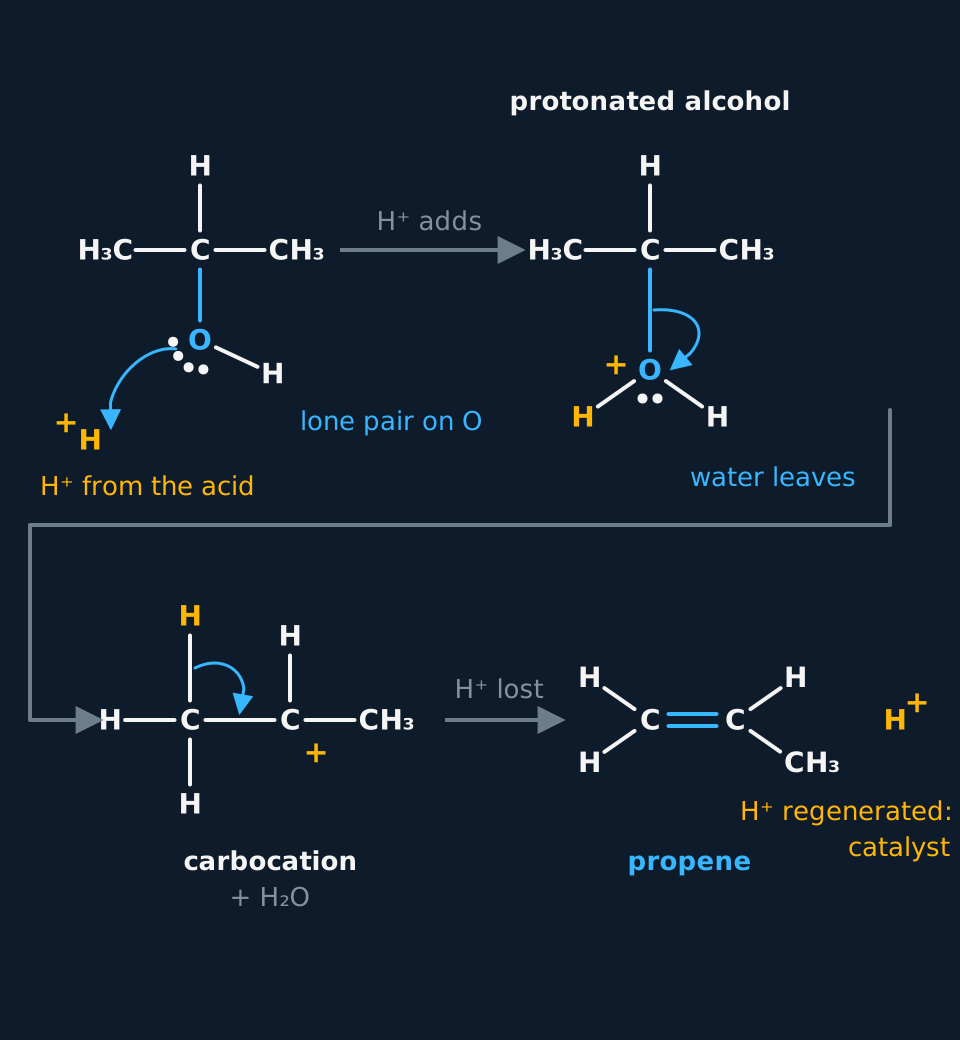
The mechanism has three steps, and the acid is a catalyst, given back at the end. First, a lone pair on the oxygen of the OH group forms a bond to an H⁺ ion from the acid. The alcohol is protonated, and the oxygen now has three bonds and a positive charge. Second, the C–O bond breaks heterolytically, both electrons going to the oxygen, and a water molecule leaves. The carbon it was bonded to is left with a positive charge: a carbocation.
Third, the pair of electrons in a C–H bond on a carbon next to the positive carbon moves to become the second bond of a C=C, and that hydrogen leaves as H⁺. Protonation in the first step is what makes the rest possible. An OH⁻ ion is reluctant to leave, but a water molecule leaves easily, because the positive oxygen pulls the C–O bonding pair towards itself and departs as a stable neutral molecule. Call the reaction an elimination, or a dehydration; 'condensation' names a different reaction, in which two molecules join.
Describe the drawing
Acid-catalysed elimination of water from propan-2-ol in three steps. A lone pair on the alcohol oxygen sends a curly arrow to an H⁺ ion from the acid, giving the protonated alcohol with the positive charge on an oxygen that has three bonds and one lone pair. A second arrow from the C–O bond onto the oxygen lets water leave, giving the secondary carbocation with the positive charge on C2. A third arrow from a C–H bond on C1 to the C1–C2 bond forms the double bond and releases H⁺, giving propene and the regenerated catalyst.
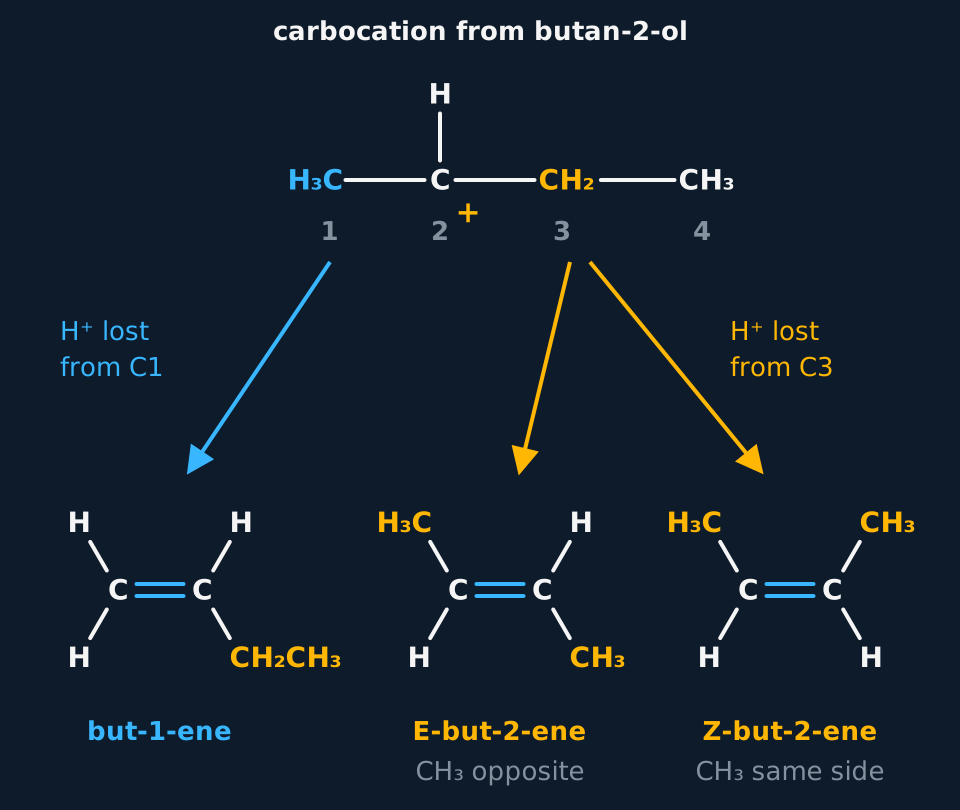
When the alcohol is unsymmetrical, the H⁺ can be lost from more than one neighbouring carbon, and more than one alkene forms. Butan-2-ol gives a carbocation on carbon 2, which has neighbours on both sides. Losing H⁺ from carbon 1 gives but-1-ene. Losing it from carbon 3 gives but-2-ene, and because each carbon of the double bond in but-2-ene carries an H and a CH₃, it forms as both E and Z isomers. Butan-2-ol therefore gives three alkenes.
Describe the drawing
The carbocation from butan-2-ol, CH₃–C⁺H–CH₂–CH₃, drawn at the top with its carbons numbered one to four and the positive charge on carbon two. One arrow, labelled H⁺ lost from C1, leads down to but-1-ene. Two arrows, labelled H⁺ lost from C3, lead to E-but-2-ene, with its methyl groups on opposite sides of the double bond, and Z-but-2-ene, with them on the same side, both drawn with 120 degree angles at the double bond.
The route matters beyond the laboratory. Ethanol made by fermentation can be dehydrated to ethene, and ethene can be polymerised, so poly(ethene) can be made from a crop rather than from crude oil. In the laboratory the alkene is identified by shaking it with bromine water, which turns from orange to colourless.
- Elimination
- A reaction in which a small molecule is removed from a larger one, leaving a double bond.
- Dehydration
- An elimination reaction in which a molecule of water is removed, as when an alcohol forms an alkene.
TRY IT: The alkenes from 2-methylbutan-2-ol
2-Methylbutan-2-ol, (CH₃)₂C(OH)CH₂CH₃, is heated with concentrated phosphoric acid. Identify every alkene formed, and say whether any of them has E and Z isomers. Explain why this alcohol is not oxidised by acidified dichromate.
Check your answer
Protonation and loss of water leave the tertiary carbocation (CH₃)₂C⁺CH₂CH₃. The positive carbon has three neighbours with hydrogens: two equivalent CH₃ groups and one CH₂.
Losing H⁺ from a CH₃ gives 2-methylbut-1-ene, CH₂=C(CH₃)CH₂CH₃. Losing it from the CH₂ gives 2-methylbut-2-ene, (CH₃)₂C=CHCH₃. Neither has E/Z isomers: in each, one carbon of the double bond carries two identical groups, two H atoms in the first and two CH₃ groups in the second. Two alkenes form.
The alcohol is tertiary. The carbon carrying the OH has no hydrogen, so dichromate cannot oxidise it and stays orange, while hot concentrated acid dehydrates it readily.
Other boards: oxidising ethanol, and halogenoalkanes from alcohols
Edexcel's core practical 5 oxidises ethanol both ways, and OCR's practical activity group 5 and the Cambridge practical papers assess the same apparatus and the same reasons for it. Ethanol is added a drop at a time to warm acidified dichromate(VI) in distillation apparatus, with the ethanol in excess, and ethanal, boiling point 21 °C, distils off as it forms into a receiver standing in ice. A second portion is heated under reflux with excess oxidising agent for about twenty minutes, and the ethanoic acid, boiling point 118 °C, is distilled out afterwards. Ethanal gives a silver mirror with Tollens' reagent; the acid fizzes with sodium hydrogencarbonate.
OCR, Edexcel and Cambridge also convert an alcohol into a halogenoalkane, which AQA does not: the OH group is replaced by a halogen atom, a substitution. The acid starts it exactly as it starts a dehydration, H⁺ protonating the OH so that water leaves, but a halide ion then bonds to the carbon instead of H⁺ being lost.
A tertiary alcohol reacts at room temperature because its carbocation is stable: Edexcel's core practical 6 shakes 2-methylpropan-2-ol with concentrated hydrochloric acid in a separating funnel, washes the upper layer with sodium hydrogencarbonate solution, dries it over anhydrous sodium sulfate and distils it at 49 to 53 °C. A primary alcohol needs heating under reflux with potassium bromide and 50% sulfuric acid, which make the hydrogen bromide in the flask; fully concentrated acid would oxidise bromide to bromine.
Phosphorus(V) chloride needs no acid and gives steamy fumes of hydrogen chloride at room temperature, which is a test for an OH group; Edexcel makes iodoalkanes with red phosphorus and iodine, and Cambridge adds PCl₃ and SOCl₂.
(CH₃)₃COH(l) + HCl(aq) → (CH₃)₃CCl(l) + H₂O(l)Shaken at room temperature; the product is the upper layer.
CH₃CH₂OH(l) + PCl₅(s) → CH₃CH₂Cl(g) + POCl₃(l) + HCl(g)Steamy fumes of HCl at room temperature.
In the exam
- Oxidation equations use [O] and must balance: one [O] to an aldehyde or a ketone, two [O] from a primary alcohol to the acid, with H₂O as the other product. Schemes accept displayed, structural or condensed formulae but not a molecular formula such as C₃H₆O, which fits two compounds.
- The colour change earns its mark only in full, orange to green. For a tertiary alcohol the observation is 'stays orange'; 'no reaction' is a conclusion, not an observation.
- For an aldehyde, the method is 'distil it off as it forms, with the alcohol in excess'; for an acid, 'heat under reflux with excess oxidising agent'. The reason is credited separately: distillation removes the aldehyde before it can be oxidised further.
- The dehydration mechanism is marked on its arrows: a lone pair on O to H⁺; the C–O bond to O as water leaves; a C–H bond on the next carbon to the C–C bond. An arrow that starts on the H atom rather than on the C–H bond is not awarded.
- For an unsymmetrical alcohol, check every carbon next to the C–OH carbon that has a hydrogen, then check each alkene for E/Z isomers.
Check yourself
Compound X, C₄H₁₀O, is heated under reflux with acidified potassium dichromate(VI), and the solution stays orange. Heated with concentrated phosphoric acid, X gives a single alkene. Identify X and the alkene, and explain both observations.
Answer
C₄H₁₀O fits CₙH₂ₙ₊₁OH, so X is an alcohol. It is not oxidised, so it is tertiary. The only tertiary alcohol with four carbons is 2-methylpropan-2-ol, (CH₃)₃COH.
Its carbon carrying the OH is joined to three carbons and has no hydrogen, so no C=O can form without breaking a C–C bond, and the dichromate is not reduced.
Dehydration gives the carbocation (CH₃)₃C⁺. All three neighbouring carbons are identical CH₃ groups, so whichever loses H⁺ the product is the same: 2-methylpropene, (CH₃)₂C=CH₂, which has no E/Z isomers because one carbon of its double bond carries two hydrogens.
Questions
Question 16 marks
Describe how a sample of propanal can be prepared from propan-1-ol and collected, including the apparatus and the conditions that keep the yield of propanal high.
Mark scheme
Indicative content
- acidified potassium dichromate(VI) is the oxidising agent, with the propan-1-ol in excess
- the mixture is heated in a flask with anti-bumping granules, using a heating mantle or water bath rather than a flame
- the flask is fitted with a still head, a thermometer with its bulb level with the side arm, and a sloping condenser with water in at the bottom and out at the top
- the alcohol is added slowly so that propanal distils off as soon as it forms, before it can be oxidised further
- the distillate is collected while the thermometer reads below about 60 °C, near propanal's boiling point of 49 °C
- the receiver is cooled in ice and water to reduce evaporation, and the apparatus is left open to the air, not sealed
Levels
- Level 3 (5–6 marks) the oxidising agent, the apparatus for distillation and all the conditions that keep the yield high are given: excess alcohol added slowly, propanal distilled off as it forms, collection below about 60 °C and a cooled receiver
- Level 2 (3–4 marks) acidified dichromate(VI) and distillation are described with the thermometer or condenser placed correctly; one condition for a high yield, such as adding the alcohol slowly or collecting at the right temperature, is not given
- Level 1 (1–2 marks) acidified dichromate(VI) is named, usually with heating under reflux, which turns the propanal into propanoic acid; no condition for keeping the aldehyde is given
Question 26 marksOCR A · Edexcel
Describe how a pure, dry sample of 2-chloro-2-methylpropane is prepared from 2-methylpropan-2-ol and concentrated hydrochloric acid and separated from the reaction mixture.
Mark scheme
Indicative content
- the alcohol is shaken with excess concentrated hydrochloric acid in a stoppered separating funnel, in a fume cupboard, at room temperature
- the funnel is inverted and the tap opened often to release the pressure of hydrogen chloride gas as the mixture is shaken
- the layers are allowed to separate and the lower aqueous layer is run off and discarded, the product being the upper layer
- the product is shaken with sodium hydrogencarbonate solution to neutralise the remaining acid, releasing the pressure of carbon dioxide, then washed with water
- the organic layer is run into a dry flask and swirled with anhydrous sodium sulfate until the cloudy liquid turns clear
- the dried liquid is decanted and distilled, and the fraction boiling between about 49 and 53 °C is collected, near the boiling point of 51 °C
Levels
- Level 3 (5–6 marks) every stage is in order and justified: shaking with the acid while releasing pressure, discarding the aqueous layer, neutralising with hydrogencarbonate and releasing carbon dioxide, drying with an anhydrous salt until clear, and distilling to collect the fraction near 51 °C; the product layer is identified correctly throughout
- Level 2 (3–4 marks) the separating funnel, removing the aqueous layer and drying are described; the hydrogencarbonate wash, venting the pressure, or the final distillation with its collection range does not appear
- Level 1 (1–2 marks) the alcohol and acid are shaken together or a separating funnel is named; the product is often placed in the lower layer, and the purification is largely missing
Question 34 marks
Deduce the class of each alcohol A, B and C, all C₅H₁₂O, from the results in the table, and give the structure of C.
| Alcohol | Warmed with acidified K₂Cr₂O₇ | Distillate warmed with Tollens' reagent |
|---|---|---|
| A | Orange to green | Silver mirror |
| B | Orange to green | No change |
| C | Stays orange | No change |
Mark scheme
- B1 A is a primary alcohol: it is oxidised, and its distillate is an aldehyde, which reduces Tollens' reagent
- B1 B is a secondary alcohol: it is oxidised, but to a ketone, which gives no silver mirror
- B1 C is a tertiary alcohol, with no hydrogen on the carbon bonded to the OH, so it is not oxidised
- B1 the only tertiary alcohol C₅H₁₂O is 2-methylbutan-2-ol, (CH₃)₂C(OH)CH₂CH₃
All 22 questions with mark schemes, the other 19 set out in full on the question page.
Worth remembering
- 'Turns green' without the starting orange is half an observation.
- Distil with the alcohol in excess for an aldehyde; reflux with the oxidising agent in excess for a carboxylic acid.
- A tertiary alcohol is not oxidised because the C–OH carbon has no H, not because it is 'too stable'.
- A sealed apparatus is never right: heated glass under pressure bursts.
- Forgetting the E/Z pair undercounts the alkenes from an unsymmetrical alcohol.
CHECK YOUR PROGRESS
Rate how confident you are with each objective for this lesson. Ratings are saved in this browser, on this device, unless you sign in.
- Write equations, using [O], for the oxidation of primary and secondary alcohols, and explain why tertiary alcohols are not oxidised.
- Explain how distillation gives an aldehyde and heating under reflux gives a carboxylic acid from the same primary alcohol, and describe both sets of apparatus.
- Describe the distillation of an aldehyde from a reaction mixture, and the errors that affect its yield and purity.
- Outline the mechanism of the acid-catalysed elimination of water from an alcohol.
- Deduce the alkenes formed by dehydrating an unsymmetrical alcohol, including E and Z isomers.
- Write equations for the conversion of alcohols into halogenoalkanes by hydrogen halides and phosphorus halides.CAIE · Edexcel · OCR A
Open the full revision checklist to see every objective in the curriculum in one place.
Practise this lesson
WORKBOOK
The written questions from this topic, on paper with room to work, and a separate book of mark schemes. The 3 questions that are set on a diagram stay on this page, where the diagram can be drawn. Free to use; please do not redistribute or sell.
Used later in Aldehydes and ketones: nucleophilic addition and the tests that tell them apart · Planning a synthetic route