Chemistry › Practicals › Measuring the EMF of a cell
Required practical 8: the EMF of a cell (OCR PAG 8, Edexcel CP 10)
Join two metal half-cells with a salt bridge, measure each cell's EMF against copper with a high-resistance voltmeter, and work out each electrode potential.
This is the method section of Electrode potentials and the standard hydrogen electrode on a page of its own, with its variables, sample results, an evaluation and questions set on it. The chemistry behind it is in that lesson.
The capability this develops
This investigation is one instance of capability P07: Measuring the EMF of an electrochemical cell, which sets out the techniques it belongs to, the calculations it carries and the errors that cost marks in all of them. The notes behind the chemistry are in Electrochemistry.
Where this sits on the specifications
Each qualification is mapped to its own specification one numbered heading at a time, against a document whose sha256 is recorded. These are the headings that list the lesson this method is taught in, on the four qualifications mapped. Each links to the route map the row belongs to.
| Qualification | Heading |
|---|---|
| AQA 7404/7405 | 3.1.11.1 Electrode potentials and cells |
| OCR Chemistry A H032/H432 | 5.2.3 Redox and electrode potentials |
| Pearson Edexcel Chemistry 8CH0/9CH0 | 14.3 standard electrode potential |
| Pearson Edexcel Chemistry 8CH0/9CH0 | 14.4 standard conditions for E° |
| Pearson Edexcel Chemistry 8CH0/9CH0 | 14.5 standard hydrogen electrode |
| Pearson Edexcel Chemistry 8CH0/9CH0 | 14.6 measuring E° for metals and ions |
| Pearson Edexcel Chemistry 8CH0/9CH0 | 14.7 E°cell from two electrode potentials |
| Pearson Edexcel Chemistry 8CH0/9CH0 | 14.8 cell diagrams |
| Pearson Edexcel Chemistry 8CH0/9CH0 | 14.9 conditions when measuring E |
| Cambridge International 9701 | 24.2 Standard electrode potentials E°, standard cell potentials E°cell and the Nernst equation |
Three boards number their practical activities, and those lists were read here from the same specifications as the headings above. This investigation is filed on them as:
- AQA 7404/7405 required practical 8: EMF of an electrochemical cell
- OCR Chemistry A H032/H432 PAG 8: Electrochemical cells
- Pearson Edexcel Chemistry 8CH0/9CH0 core practical 10: Electrochemical cells
Use your awarding organisation’s current specification and its practical handbook as the authority on which activities your course requires and how they are assessed.
Apparatus
Two 100 cm³ beakers; strips of copper, zinc and iron, with emery paper to clean them; 1.00 mol dm⁻³ solutions of copper(II) sulfate, zinc sulfate and iron(II) sulfate; strips of filter paper and saturated potassium nitrate solution; a high-resistance digital voltmeter with two leads and crocodile clips; and a thermometer.
Safety
Copper(II) sulfate solution at this concentration is harmful if swallowed and irritates the eyes and skin, zinc sulfate irritates the eyes, and solid potassium nitrate is an oxidiser. Wear eye protection, wash off splashes, and keep solutions away from the voltmeter. Check the CLEAPSS Hazcard for each substance and your school's risk assessment before starting; where they differ from the advice here, follow them.
Variables
Independent variable
The metal half-cell paired with copper: zinc, then iron, each in a solution of its own ions.
Dependent variable
The EMF of the cell, read on the high-resistance voltmeter once it has stopped changing, from which the electrode potential of the other metal follows.
Control variables
- The concentration of every solution, 1.00 mol dm⁻³, because E°cell is defined for standard concentrations and a different concentration gives a different EMF.
- The temperature, recorded and close to 298 K, since every electrode potential shifts with it.
- The copper half-cell, the voltmeter and the leads, the same for every cell, so each reading is a difference from the same reference electrode.
- A fresh salt bridge of the same saturated potassium nitrate for each cell, and each strip cleaned the same way just before use.
E°cell is a difference between two electrodes under standard conditions, so the controls are the conditions. With copper as a fixed reference, a small error in the copper half-cell is the same in every reading and cancels when two cells are compared, which is why the zinc–iron cell can be predicted from the other two.
Method
| Step | What to do | Why |
|---|---|---|
| 1 | Clean each metal strip with emery paper, rinse it with distilled water and dry it | An oxide layer sets up a different equilibrium at the surface and lowers the reading |
| 2 | Pour about 50 cm³ of 1.00 mol dm⁻³ copper(II) sulfate into one beaker and 50 cm³ of 1.00 mol dm⁻³ zinc sulfate into the other, and stand the matching metal in each | Each metal must be in its own ions at standard concentration for the reading to approach E°cell |
| 3 | Soak a strip of filter paper in saturated potassium nitrate solution and lay it between the beakers, one end dipping into each solution | It completes the circuit with ions that react with neither solution |
| 4 | Clip the voltmeter's positive lead to the copper and its negative lead to the zinc | A positive reading then confirms copper as the positive electrode |
| 5 | Read the voltmeter when the reading has stopped changing, and record it with the temperature of the solutions | The first reading drifts while the bridge wets and the surfaces settle |
| 6 | Replace the zinc half-cell with an iron half-cell and a fresh salt bridge and read again; repeat each cell twice more and take the mean | A used bridge carries ions from the last cell; repeats show whether the readings agree |
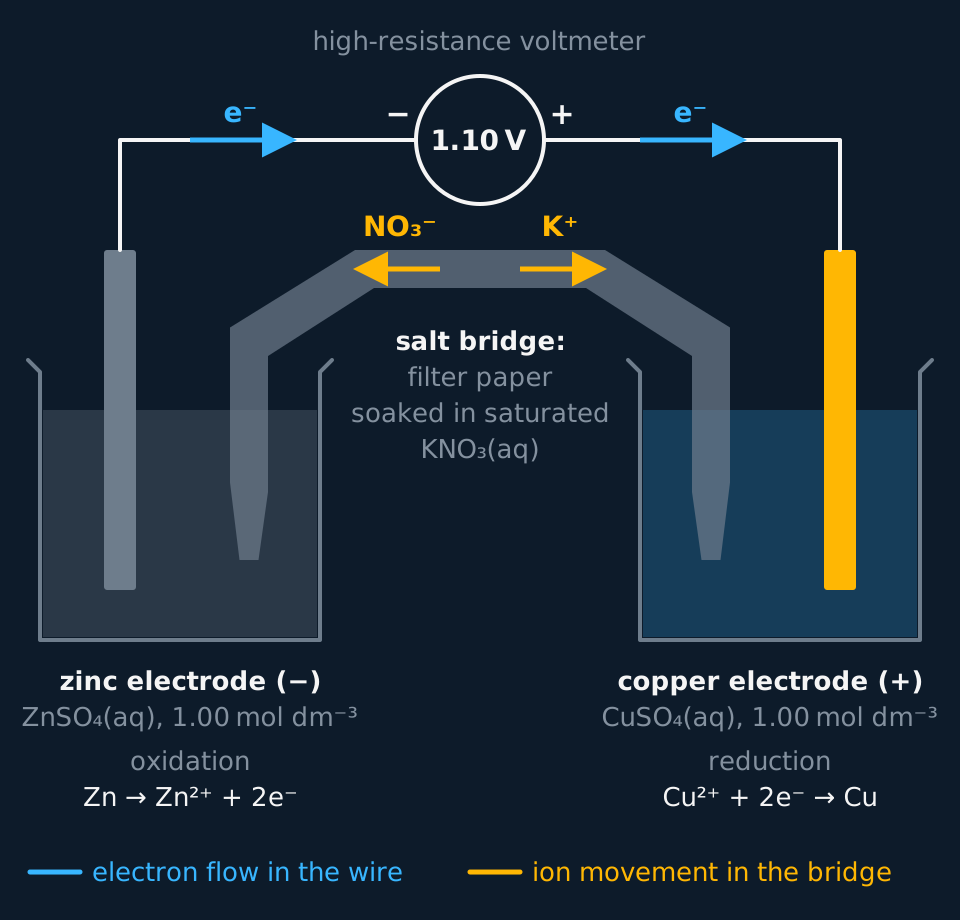
Describe the drawing
Two beakers joined by a wire and a salt bridge. On the left a zinc strip stands in colourless zinc sulfate solution; on the right a copper strip stands in pale blue copper sulfate solution, both 1.00 mol dm⁻³. The wire runs from each strip to a high-resistance voltmeter between them reading 1.10 V, with its positive terminal on the copper side, and arrows on the wire show electrons flowing from zinc to copper. An arched strip of filter paper soaked in potassium nitrate dips into both solutions, with nitrate ions moving towards the zinc and potassium ions towards the copper. The zinc is labelled negative, oxidation, Zn to Zn²⁺ plus two electrons; the copper positive, reduction, Cu²⁺ plus two electrons to Cu.
What is measured
The EMF of each cell. With E°(Cu²⁺/Cu) = +0.34 V known, each metal's electrode potential follows from E°cell = E°right − E°left, copper on the right. A zinc–copper reading of 1.08 V gives E(Zn²⁺/Zn) = 0.34 − 1.08 = −0.74 V. The results also check each other: a zinc–iron cell should read close to the difference between the zinc–copper and iron–copper readings.
The voltmeter gives two decimal places, and the reading is compared with the value from E° data. A difference of a few hundredths of a volt is expected from the sources in the table. A reading a few tenths out, or one that keeps falling, points to a dirty electrode or a dry bridge.
Sample results
These readings are idealised: they are the numbers in the lesson, a zinc–copper reading and an iron–copper reading, each set beside the data-book value.
| Cell, copper on the right | Reading | Electrode potential worked out | Data-book E° |
|---|---|---|---|
| Zinc–copper | 1.08 V | E(Zn²⁺/Zn) = 0.34 − 1.08 = −0.74 V | −0.76 V |
| Iron–copper | 0.75 V | E(Fe²⁺/Fe) = 0.34 − 0.75 = −0.41 V | −0.44 V |
The measured value is 0.03 V less negative than E°, which means the cell reading is 0.03 V lower than the expected 0.78 V. Anything that lowers the reading fits: an oxide layer on the iron strip, a voltmeter that lets a small current flow, or a salt bridge that has begun to dry.
Conditions that are not standard also change the value, such as a temperature away from 298 K or iron(II) sulfate that is not at 1.00 mol dm⁻³. The method gives E under the conditions of the experiment, which is E° only when every condition is standard.
Evaluation
The limitations of the method, what each does to the result and in which direction, and the improvement a mark scheme credits.
| Limitation | What it does to the result | Improvement |
|---|---|---|
| The copper half-cell is taken as +0.34 V | That is the data-book value for a standard half-cell; the one on the bench has its own concentration, temperature and surface, so whatever it is out by is added to every potential worked from it | Measure against a calibrated reference electrode, or check the copper half-cell against a second copper half-cell made the same way, which should read 0.00 V |
| Both sample readings are low in the same direction | −0.74 V against −0.76 V and −0.41 V against −0.44 V: each cell reads 0.02 to 0.03 V below its E°cell, which points to a systematic cause shared by both, the copper half-cell or the voltmeter, rather than random error | Build the zinc–iron cell and compare: it should read 0.33 V, the difference of the two readings, and a different value shows which half-cell is at fault |
| The strips are not pure metals | Laboratory zinc and iron carry impurities that set up small local cells on the surface, and iron rusts in air, so the surface is not the clean equilibrium the half-equation describes | Use high-purity strips or wire, store them dry, and read the cell as soon as it is assembled |
| The voltmeter is not the weakest link | A reading of 1.08 V on a meter showing two decimal places carries ±0.01 V, one in the last digit, under 1% and a third of the 0.03 V the sample results are out by | A meter reading to 0.001 V would change little; controlling concentration, temperature and the metal surface is what moves the reading towards E°cell |
Errors in carrying it out
| Source of error | Effect on the reading | How to reduce it |
|---|---|---|
| Oxide or grease on a metal strip | Lower than expected and unsteady | Clean with emery paper just before use |
| Voltmeter of low resistance | A current flows, so the reading is below the EMF | Use a high-resistance digital voltmeter |
| Solutions not at 1.00 mol dm⁻³, or changing as the cell runs | The EMF differs from E°cell, in the direction Le Chatelier's principle predicts | Use freshly made solutions and read promptly |
| Temperature not 298 K | Every electrode potential shifts slightly | Record the temperature; use a water bath at 25 °C for precise work |
| Salt bridge contaminated or drying out | The reading falls or drifts | Use a fresh, well-soaked strip for each cell |
| Iron(II) oxidised to iron(III) by air | The iron half-cell no longer holds only Fe²⁺ | Make the iron(II) sulfate solution on the day |
Questions
Question 1 (6 marks)
Describe how you would measure the EMF of a cell made from a zinc half-cell and a copper half-cell in a school laboratory.
Mark scheme
Indicative content
- clean the zinc and copper strips with emery paper to remove the oxide layer, then rinse and dry them
- stand the zinc in 1.00 mol dm⁻³ zinc sulfate and the copper in 1.00 mol dm⁻³ copper(II) sulfate, in separate beakers
- join the solutions with a strip of filter paper soaked in saturated potassium nitrate solution as a salt bridge
- connect the two metals to a high-resistance voltmeter, positive terminal to the copper, so that almost no current flows
- read the voltmeter once the reading is steady, and record the temperature, which should be 298 K
- repeat with fresh solutions and a fresh salt bridge, and take the mean of concordant readings
Levels
- Level 3 (5–6 marks) all the elements of a standard measurement are present: cleaned electrodes, 1.00 mol dm⁻³ solutions of each metal's own ions, a salt bridge and what it is made of, a high-resistance voltmeter with the polarity given, a steady reading at 298 K and repeats
- Level 2 (3–4 marks) the two half-cells, the salt bridge and the voltmeter are described correctly; the 1.00 mol dm⁻³ concentrations, the temperature, the high-resistance voltmeter or the cleaned electrodes are not mentioned
- Level 1 (1–2 marks) zinc and copper are dipped in solutions joined to a voltmeter, often in the same beaker or with a wire in place of the salt bridge
Question 2 (3 marks)
Explain the function of the salt bridge in an electrochemical cell, and explain why potassium nitrate is a suitable salt to use in it.
Mark scheme
- B1 the salt bridge allows ions to move between the two half-cells, completing the circuit; reject 'carries electrons'
- B1 the movement of ions keeps each solution electrically neutral without the two solutions mixing
- B1 potassium ions and nitrate ions do not react with the ions in either half-cell and form no precipitate
Question 3 (4 marks)
Explain why the EMF of a cell is measured with a high-resistance voltmeter, and why a metal wire cannot be used in place of the salt bridge.
Mark scheme
- B1 a high-resistance voltmeter allows almost no current to flow through the cell
- B1 no voltage is lost driving a current and the concentrations do not change, so the reading is the EMF; reject 'more accurate' alone
- B1 each end of a wire dipping into a solution would form a new metal–solution half-cell with its own electrode potential
- B1 those extra potentials would add to the reading, so the measured value would not be the EMF of the cell
Question 4 (2 marks)
Suggest two reasons why a student's zinc–copper cell reads 0.92 V when the expected EMF is 1.10 V.
Mark scheme
- B1 an oxide layer or grease on a metal strip, so the equilibrium at its surface is not the one intended
- B1 a voltmeter of too low a resistance, so a current flows and the reading falls below the EMF; or a dry or contaminated salt bridge
Question 5 (2 marks)
Explain why each metal strip is cleaned with emery paper just before it is used.
Mark scheme
It removes the oxide layer and grease from the surface.
An oxide layer sets up a different equilibrium at the surface, so the reading is lower than expected and unsteady.
Question 6 (2 marks)
Explain why a fresh salt bridge is used for each cell.
Mark scheme
A used bridge carries ions from the last cell, which contaminate the solutions of the next.
A bridge that has begun to dry conducts poorly, so the reading falls or drifts.
Question 7 (3 marks)
A zinc–copper cell reads 1.08 V and an iron–copper cell 0.75 V, copper positive in each. Calculate the EMF of a zinc–iron cell, state which electrode is positive, and write the overall equation.
Mark scheme
EMF = 1.08 − 0.75 = 0.33 V.
Iron is the positive electrode, since it is the less reactive metal and its electrode potential is the less negative.
Zn(s) + Fe²⁺(aq) → Zn²⁺(aq) + Fe(s).
Question 8 (3 marks)
An iron half-cell is made with iron(II) sulfate solution prepared the day before. Explain the effect on the measured EMF of the iron–copper cell and how to avoid it.
Mark scheme
Air oxidises some of the iron(II) to iron(III), so the half-cell no longer holds only Fe²⁺ at 1.00 mol dm⁻³.
The half-cell is no longer the Fe²⁺/Fe equilibrium under standard conditions, so the reading differs from E°cell.
Make the iron(II) sulfate solution on the day it is used.
Question 9 (3 marks)
Use Le Chatelier's principle to explain how the EMF of the zinc–copper cell changes if the copper(II) sulfate is diluted to 0.10 mol dm⁻³.
Mark scheme
Cu²⁺(aq) + 2e⁻ ⇌ Cu(s): lowering [Cu²⁺] shifts the equilibrium to the left, so the copper electrode is less positive.
The zinc half-cell is unchanged, so Ecell = Eright − Eleft falls.
The reading is below 1.10 V and is no longer E°cell, because one condition is no longer standard.
Question 10 (2 marks)
Write the conventional cell representation for the zinc–copper cell and give the sign of each electrode.
Mark scheme
Zn(s) | Zn²⁺(aq) || Cu²⁺(aq) | Cu(s).
Zinc is the negative electrode and copper the positive.
Coverage maps are available for AQA 7404/7405, OCR Chemistry A H032/H432, Pearson Edexcel Chemistry 8CH0/9CH0 and Cambridge International 9701. Use the relevant route map to check what InkChemistry covers, and your awarding organisation’s current specification as the final authority on examinable content.