Chemistry › Electrochemistry › Electrode potentials and the standard hydrogen electrode
Electrode potentials and the standard hydrogen electrode
Zinc reduces copper(II) ions: a strip of zinc in copper(II) sulfate solution turns brown with copper as the blue fades. With the zinc and the copper in separate beakers, joined by a wire and a salt bridge, the same electron transfer drives a current through a voltmeter. An electrode potential measures how strongly each half of that reaction holds on to electrons, against the standard hydrogen electrode, and a cell's EMF is the difference between two of them.
Key terms Every definition in electrochemistry, lesson by lesson
Before this Half-equations and building redox equations – balancing the electrons in two half-equations · Oxidation states and the rules for assigning them – oxidation as loss of electrons and reduction as gain
COMMON MISCONCEPTION
The salt bridge is there to carry the electrons from one beaker to the other.
Electrons travel through the wire; the salt bridge carries ions. As one half-cell gains positive charge and the other loses it, ions from the bridge, usually potassium nitrate, drift into each solution to keep both neutral. Without that the charges build up and the current stops within a fraction of a second.
What you should be able to do
- Describe a half-cell, and explain how a potential difference arises between a metal and a solution of its ions.
- Describe the standard hydrogen electrode and state the standard conditions under which E° is measured.
- Explain the function of the salt bridge and of a high-resistance voltmeter in measuring the EMF of a cell.
- Write the conventional representation of a cell, including half-cells that need a platinum electrode.
- Calculate the EMF of a cell from two standard electrode potentials using E°cell = E°right − E°left.
- Describe how to measure the EMF of a cell in the laboratory, and identify the errors that affect the reading.
Zinc, copper and the half-cell
Zinc metal reduces copper(II) ions. A strip of zinc in blue copper(II) sulfate solution is coated within a minute in a brown, spongy layer of copper, a thermometer in the solution climbs a degree or two while the colour fades, and after an hour the blue has gone. Zinc atoms have given electrons to copper(II) ions at the surface of the strip, and the energy released has gone into the solution as heat.
Zn(s) + Cu²⁺(aq) → Zn²⁺(aq) + Cu(s)
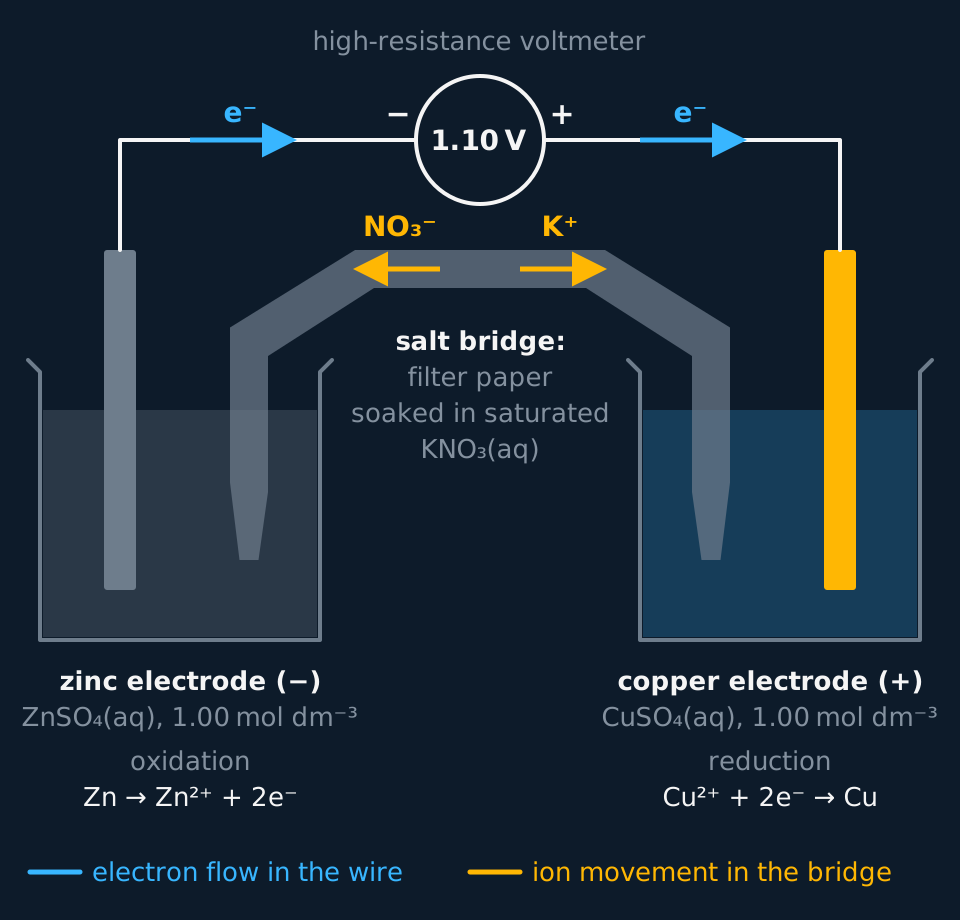
In the beaker the electrons pass straight from atom to ion, and nothing can be done with them. When the two halves of the reaction are separated, the electrons have to travel through a wire to get from one to the other. A zinc strip stands in zinc sulfate solution in one beaker and a copper strip in copper(II) sulfate solution in another. A wire joins the metals, and a strip of filter paper soaked in potassium nitrate solution joins the solutions. Electrons now flow through the wire from the zinc to the copper, and a voltmeter across the two strips reads 1.10 V.
Each beaker is a half-cell: an element in contact with a solution of its ions. At the surface of the zinc an equilibrium is set up. Some zinc atoms leave the metal as Zn²⁺ ions and leave their electrons behind in it, and some Zn²⁺ ions from the solution collect two electrons and return to the metal as atoms.
Zn²⁺(aq) + 2e⁻ ⇌ Zn(s)Electrode equilibria are written as reductions, with the electrons on the left.
Zinc gives up its electrons readily, so the position of that equilibrium lies well to the left and the strip builds up a negative charge relative to the solution around it. Copper holds its electrons more tightly. In the copper half-cell the equilibrium Cu²⁺(aq) + 2e⁻ ⇌ Cu(s) lies further to the right, so the copper strip is much less negative than the zinc. The potential difference between an electrode and its solution is its electrode potential, and the difference between the two strips is what drives electrons from zinc to copper.
No instrument can measure one electrode potential on its own. A voltmeter needs two connections, and dipping its second lead into the zinc sulfate solution would make a new metal–solution boundary with a potential of its own. Only the difference between two half-cells can be measured, and that is what the 1.10 V is. To give each half-cell a number, every one is measured against the same reference half-cell.
- Half-cell
- An element in contact with a solution of its ions, or an inert electrode in a solution of an oxidised and a reduced form, at which a redox equilibrium is set up.
- Electrode potential
- The potential difference between an electrode and the solution it is in; it can be measured only against a second electrode.
The standard hydrogen electrode
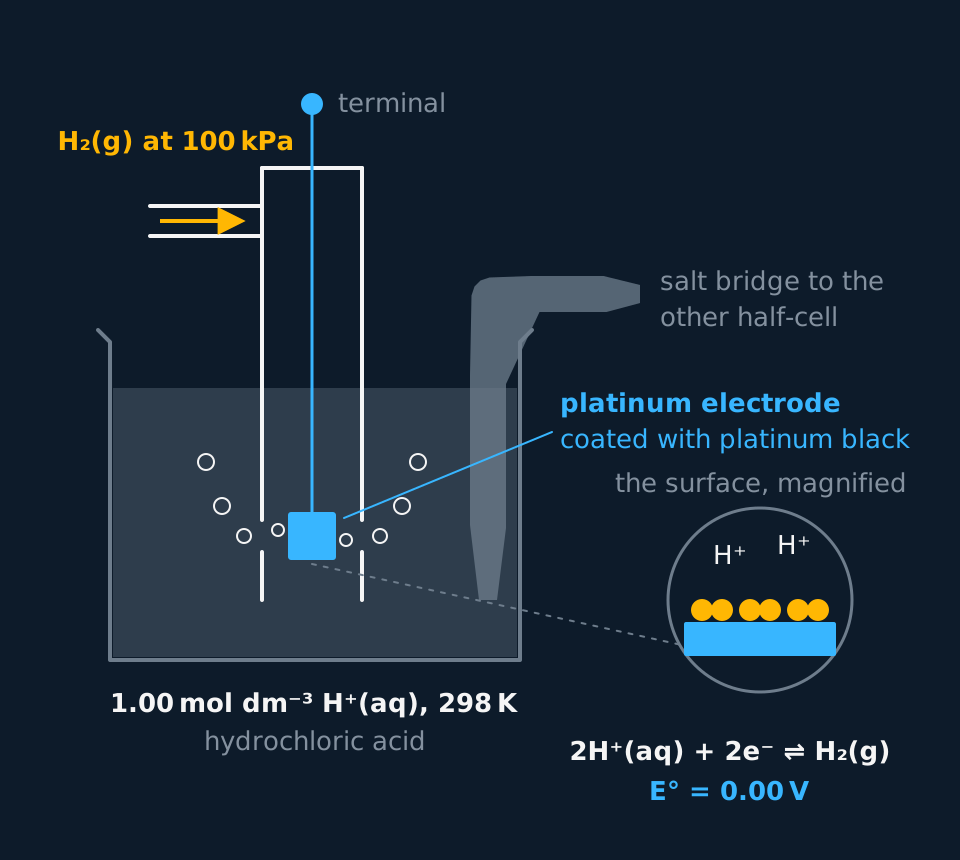
The reference is the standard hydrogen electrode, and its electrode potential is defined as exactly 0.00 V. Hydrogen gas at 100 kPa bubbles over a platinum electrode that dips into a solution of H⁺ ions at 1.00 mol dm⁻³, usually 1.00 mol dm⁻³ hydrochloric acid, at 298 K. The equilibrium at the platinum surface is between hydrogen molecules and hydrogen ions.
2H⁺(aq) + 2e⁻ ⇌ H₂(g)E° = 0.00 V by definition.
Describe the drawing
Cross-section of the standard hydrogen electrode. A glass tube stands in a beaker of 1.00 mol dm⁻³ hydrochloric acid at 298 K. Hydrogen gas at 100 kPa enters through a side arm at the top, passes over a square of platinum foil coated with platinum black near the foot of the tube, and bubbles out through holes level with the foil. A platinum wire runs from the foil up through the top of the tube to a terminal, and a salt bridge leaves the beaker towards the other half-cell. A magnified inset shows hydrogen molecules adsorbed on the platinum surface with hydrogen ions in the acid above, beside the equilibrium 2H⁺ + 2e⁻ ⇌ H₂ and E° = 0.00 V.
Platinum is there because hydrogen cannot be made into a strip. The half-cell needs a solid that conducts, to carry electrons in and out, and that solid must not react with the acid or set up an equilibrium of its own. Platinum is unreactive and a good conductor. It is coated with finely divided platinum, platinum black, which gives a large surface for hydrogen molecules to bind to, or adsorb, so the equilibrium is reached quickly.
Every value in a table of electrode potentials is measured against this electrode, with the other half-cell also under standard conditions: 298 K, 100 kPa for any gas, and 1.00 mol dm⁻³ for every ion in the half-equation. The reading is then the standard electrode potential, E°, of the half-cell. Against the hydrogen electrode a standard zinc half-cell reads 0.76 V with the zinc as the negative terminal, so E°(Zn²⁺/Zn) = −0.76 V. A standard copper half-cell reads 0.34 V with the copper positive, so E°(Cu²⁺/Cu) = +0.34 V.
A definition of E° that earns full credit names three things: the EMF of a cell, the standard hydrogen electrode as the other half-cell, and standard conditions with their values. Use 'EMF' or 'potential difference'. 'The voltage of the electrode' leaves out the reference, and without a reference the number means nothing.
The sign says which way the electrons would flow. A negative E° means the half-cell gives up electrons more readily than hydrogen does, so it is the negative terminal against the hydrogen electrode. A positive E° means the oxidised form, Cu²⁺ here, gains electrons more readily than H⁺ does. The difference between the zinc and copper values, 0.34 − (−0.76) = 1.10 V, is the reading of the zinc–copper cell, so one reference is enough to predict the EMF of every pair.
Not every half-cell has a metal in it. A solution containing both Fe³⁺ and Fe²⁺ ions has a redox equilibrium, Fe³⁺(aq) + e⁻ ⇌ Fe²⁺(aq), but neither form is a solid that could be the electrode. A platinum wire dipped into the solution serves, for the reasons it serves in the hydrogen electrode, and for E° both ions are at 1.00 mol dm⁻³. A halogen half-cell also has a platinum electrode: chlorine at 100 kPa bubbled over platinum in a solution of chloride ions at 1.00 mol dm⁻³.
The hydrogen electrode is awkward to use. It needs a supply of hydrogen at a steady pressure, and its platinum surface is easily contaminated. Working laboratories use a secondary reference, such as a silver/silver chloride electrode, whose potential against hydrogen has been measured once and for all.
- Standard hydrogen electrode
- A half-cell in which hydrogen gas at 100 kPa is bubbled over a platinum electrode in a solution of H⁺ ions at 1.00 mol dm⁻³ at 298 K; its electrode potential is defined as 0.00 V.
- Standard electrode potential
- The EMF of a cell made from the half-cell and the standard hydrogen electrode, measured under standard conditions.
- Standard conditions
- A temperature of 298 K, a pressure of 100 kPa for any gas, and a concentration of 1.00 mol dm⁻³ for every ion in the half-equation.
- Inert electrode
- An electrode, usually platinum, that conducts electrons to and from a redox equilibrium in the solution without reacting or setting up an equilibrium of its own; used when neither species of the couple is a metal.
Salt bridges, cell notation and the EMF
Describe the drawing
Two beakers joined by a wire and a salt bridge. On the left a zinc strip stands in colourless zinc sulfate solution; on the right a copper strip stands in pale blue copper sulfate solution, both 1.00 mol dm⁻³. The wire runs from each strip to a high-resistance voltmeter between them reading 1.10 V, with its positive terminal on the copper side, and arrows on the wire show electrons flowing from zinc to copper. An arched strip of filter paper soaked in potassium nitrate dips into both solutions, with nitrate ions moving towards the zinc and potassium ions towards the copper. The zinc is labelled negative, oxidation, Zn to Zn²⁺ plus two electrons; the copper positive, reduction, Cu²⁺ plus two electrons to Cu.
The salt bridge completes the circuit. As the cell runs, Zn²⁺ ions enter the zinc beaker and Cu²⁺ ions leave the copper beaker. With no way for ions to move between the two, positive charge would build up in one solution and fall in the other, and the current would stop almost at once. Ions in the bridge move to prevent that: NO₃⁻ ions drift into the zinc solution and K⁺ ions into the copper solution. Electrons flow in the wire; ions flow in the bridge and the solutions. Say that the bridge 'allows ions to move between the half-cells'. A bridge that carries electrons, or carries 'the current' with no ions named, is describing the wire.
The bridge is usually a strip of filter paper soaked in saturated potassium nitrate solution. The salt is chosen because neither of its ions reacts with the ions in either half-cell, and all potassium and nitrate salts are soluble, so nothing precipitates. Potassium chloride works for many cells, but not with a silver half-cell, where Ag⁺ and Cl⁻ would precipitate silver chloride and lower [Ag⁺]. A wire cannot replace the bridge, because each end dipped into a solution would form a half-cell of its own and add its own potential to the reading.
The voltmeter must have a very high resistance, so that almost no current flows while it reads. A cell that delivers a current loses part of its voltage driving that current through its own solutions, and its concentrations start to change. The quantity wanted is the potential difference when the current is effectively zero, and that is the EMF of the cell.
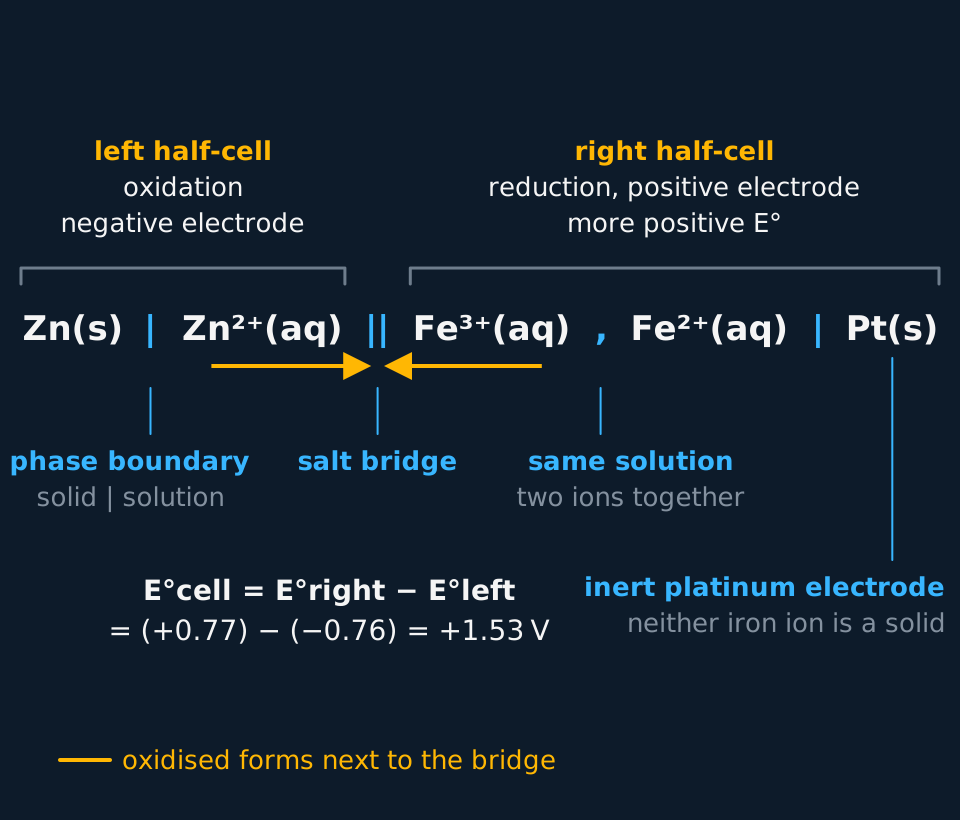
A cell is written in one line, the conventional representation. A single vertical line, |, marks each boundary between phases, and a double vertical line, ||, is the salt bridge. The electrodes go at the two ends, and the oxidised form of each couple sits next to the salt bridge. The half-cell with the more positive E° goes on the right, so the zinc–copper cell is written:
Zn(s) | Zn²⁺(aq) || Cu²⁺(aq) | Cu(s)Read from left to right, the line follows the reaction: zinc is oxidised on the left and copper(II) ions are reduced on the right.
Two species in the same solution are separated by a comma, not a line, because there is no phase boundary between them. A platinum electrode goes at the outer end. The hydrogen electrode on the left of a cell is written Pt(s) | H₂(g) | H⁺(aq) ||, and an Fe³⁺/Fe²⁺ half-cell on the right is written || Fe³⁺(aq), Fe²⁺(aq) | Pt(s).
Describe the drawing
The cell line Zn(s), single line, Zn²⁺(aq), double line, Fe³⁺(aq) comma Fe²⁺(aq), single line, Pt(s), set in large type. Brackets above mark the left half-cell, oxidation at the negative electrode, and the right half-cell, reduction at the positive electrode with the more positive E°. Callouts below say the single line is a phase boundary between solid and solution, the double line is the salt bridge, the comma joins two ions in the same solution, and platinum is an inert electrode because neither iron ion is a solid. Amber arrows show that Zn²⁺ and Fe³⁺, the oxidised forms, sit next to the bridge. Beneath, E°cell equals E°right minus E°left, 0.77 minus minus 0.76, which is plus 1.53 V.
With the more positive half-cell on the right, the EMF is the right-hand E° minus the left-hand one, and it comes out positive. The right-hand electrode is the positive terminal and reduction takes place there; the left-hand electrode is negative and oxidation takes place there. Electrons flow through the external wire from left to right.
E°cell = E°right − E°left
A positive E°cell also says that the cell reaction is feasible: the right-hand couple can take electrons from the left-hand one, in a beaker as well as in a cell. It says nothing about how fast. Aluminium, E°(Al³⁺/Al) = −1.66 V, should reduce water to hydrogen, 2H₂O(l) + 2e⁻ ⇌ H₂(g) + 2OH⁻(aq), E° = −0.83 V, with E°cell = +0.83 V, yet an aluminium pan holds boiling water for years, because a film of aluminium oxide keeps the water off the metal. E° values predict direction; the activation energy and the conditions decide whether anything is seen.
- Conventional representation
- A one-line description of a cell: the electrodes at the ends, single vertical lines for phase boundaries, a double line for the salt bridge, and the oxidised form of each couple next to the salt bridge.
- Standard cell potential
- The EMF of a cell in which both half-cells are under standard conditions, E°cell = E°right − E°left.
- Salt bridge
- A connection between two half-cells, usually filter paper soaked in saturated potassium nitrate solution, that allows ions to move between them to complete the circuit without the solutions mixing.
- EMF
- The potential difference between the two electrodes of a cell when no current flows.
The EMF of the zinc–copper cell
E°(Zn²⁺/Zn) = −0.76 V and E°(Cu²⁺/Cu) = +0.34 V. Write the conventional representation of the cell made from the two standard half-cells, calculate its EMF, and give the equation for the reaction when it delivers a current.
Show the working
+0.34 V is more positive than −0.76 V, so the copper half-cell goes on the right and is the positive electrode.
With the oxidised forms next to the salt bridge: Zn(s) | Zn²⁺(aq) || Cu²⁺(aq) | Cu(s).
E°cell = E°right − E°left = (+0.34) − (−0.76) = +1.10 V.
Reduction on the right, Cu²⁺(aq) + 2e⁻ → Cu(s); oxidation on the left, Zn(s) → Zn²⁺(aq) + 2e⁻. Both half-equations carry two electrons, so they add directly: Zn(s) + Cu²⁺(aq) → Zn²⁺(aq) + Cu(s), the reaction in the beaker at the start.
Iron(III), iron(II) and zinc
A half-cell contains Fe³⁺(aq) and Fe²⁺(aq), each at 1.00 mol dm⁻³, with a platinum electrode. It is connected to a standard zinc half-cell. E°(Fe³⁺/Fe²⁺) = +0.77 V and E°(Zn²⁺/Zn) = −0.76 V. Write the conventional representation, calculate the EMF, and write the equation for the cell reaction.
Show the working
+0.77 V is more positive than −0.76 V, so the iron half-cell goes on the right.
Neither iron ion is a solid, so platinum is the electrode, written at the outer end. Fe³⁺ is the oxidised form and sits next to the salt bridge, separated from Fe²⁺ by a comma because both are in one solution: Zn(s) | Zn²⁺(aq) || Fe³⁺(aq), Fe²⁺(aq) | Pt(s).
E°cell = (+0.77) − (−0.76) = +1.53 V.
On the right Fe³⁺ is reduced, one electron per ion: Fe³⁺(aq) + e⁻ → Fe²⁺(aq). On the left zinc is oxidised, two electrons per atom. Doubling the iron half-equation balances the electrons: Zn(s) + 2Fe³⁺(aq) → Zn²⁺(aq) + 2Fe²⁺(aq).
The E° of the iron couple is not doubled with its half-equation. An electrode potential is a property of the couple at standard concentrations and does not depend on how many electrons are written. Writing the right-hand side as Fe²⁺(aq), Fe³⁺(aq) | Pt(s) would put the reduced form against the bridge, which is the wrong order.
Required practical 8: measuring the EMF of a cell
Required practical 8 is Measuring the EMF of an electrochemical cell; OCR assesses the same technique in PAG 8 and Edexcel in core practical 10. The school version uses metal half-cells, because the hydrogen electrode needs a gas supply, and measures each metal against a copper half-cell, whose E° is known.
The apparatus is two 100 cm³ beakers; strips of copper, zinc and iron, with emery paper to clean them; 1.00 mol dm⁻³ solutions of copper(II) sulfate, zinc sulfate and iron(II) sulfate; strips of filter paper and saturated potassium nitrate solution; a high-resistance digital voltmeter with two leads and crocodile clips; and a thermometer.
| Step | What to do | Why |
|---|---|---|
| 1 | Clean each metal strip with emery paper, rinse it with distilled water and dry it | An oxide layer sets up a different equilibrium at the surface and lowers the reading |
| 2 | Pour about 50 cm³ of 1.00 mol dm⁻³ copper(II) sulfate into one beaker and 50 cm³ of 1.00 mol dm⁻³ zinc sulfate into the other, and stand the matching metal in each | Each metal must be in its own ions at standard concentration for the reading to approach E°cell |
| 3 | Soak a strip of filter paper in saturated potassium nitrate solution and lay it between the beakers, one end dipping into each solution | It completes the circuit with ions that react with neither solution |
| 4 | Clip the voltmeter's positive lead to the copper and its negative lead to the zinc | A positive reading then confirms copper as the positive electrode |
| 5 | Read the voltmeter when the reading has stopped changing, and record it with the temperature of the solutions | The first reading drifts while the bridge wets and the surfaces settle |
| 6 | Replace the zinc half-cell with an iron half-cell and a fresh salt bridge and read again; repeat each cell twice more and take the mean | A used bridge carries ions from the last cell; repeats show whether the readings agree |
What is measured is the EMF of each cell. With E°(Cu²⁺/Cu) = +0.34 V known, each metal's electrode potential follows from E°cell = E°right − E°left, copper on the right. A zinc–copper reading of 1.08 V gives E(Zn²⁺/Zn) = 0.34 − 1.08 = −0.74 V. The results also check each other: a zinc–iron cell should read close to the difference between the zinc–copper and iron–copper readings.
| Source of error | Effect on the reading | How to reduce it |
|---|---|---|
| Oxide or grease on a metal strip | Lower than expected and unsteady | Clean with emery paper just before use |
| Voltmeter of low resistance | A current flows, so the reading is below the EMF | Use a high-resistance digital voltmeter |
| Solutions not at 1.00 mol dm⁻³, or changing as the cell runs | The EMF differs from E°cell, in the direction Le Chatelier's principle predicts | Use freshly made solutions and read promptly |
| Temperature not 298 K | Every electrode potential shifts slightly | Record the temperature; use a water bath at 25 °C for precise work |
| Salt bridge contaminated or drying out | The reading falls or drifts | Use a fresh, well-soaked strip for each cell |
| Iron(II) oxidised to iron(III) by air | The iron half-cell no longer holds only Fe²⁺ | Make the iron(II) sulfate solution on the day |
The voltmeter gives two decimal places, and the reading is compared with the value from E° data. A difference of a few hundredths of a volt is expected from the sources in the table. A reading a few tenths out, or one that keeps falling, points to a dirty electrode or a dry bridge.
Risk assessment. Copper(II) sulfate solution at this concentration is harmful if swallowed and irritates the eyes and skin, zinc sulfate irritates the eyes, and solid potassium nitrate is an oxidiser. Wear eye protection, wash off splashes, and keep solutions away from the voltmeter. Check the CLEAPSS Hazcard for each substance and your school's risk assessment before starting; where they differ from the advice here, follow them.
TRY IT: An iron half-cell against copper
An iron–copper cell made by the method gives a steady reading of 0.75 V, with the copper as the positive electrode. E°(Cu²⁺/Cu) = +0.34 V. Calculate the electrode potential of the iron half-cell, and suggest why it differs from the data-book value, E°(Fe²⁺/Fe) = −0.44 V.
Check your answer
Copper is positive, so it is the right-hand electrode: 0.75 = 0.34 − E(left), so E(Fe²⁺/Fe) = 0.34 − 0.75 = −0.41 V.
The measured value is 0.03 V less negative than E°, which means the cell reading is 0.03 V lower than the expected 0.78 V. Anything that lowers the reading fits: an oxide layer on the iron strip, a voltmeter that lets a small current flow, or a salt bridge that has begun to dry.
Conditions that are not standard also change the value, such as a temperature away from 298 K or iron(II) sulfate that is not at 1.00 mol dm⁻³. The method gives E under the conditions of the experiment, which is E° only when every condition is standard.
Other boards: notation, pressure and the cell potential
OCR and Cambridge write the subtraction as the E° of the positive electrode minus the E° of the negative electrode. With the more positive half-cell on the right that is the same as E°right − E°left, and gives the same number. Cambridge calls the result the standard cell potential, E°cell, and prints the standard sign as a plimsoll (a circle with a bar through it) where the other boards print °; either is accepted and the meaning is the same.
Cambridge's standard conditions use a pressure of 101 kPa, where AQA, OCR and Edexcel use 100 kPa. A Cambridge answer describing the standard hydrogen electrode should give hydrogen at 101 kPa, with [H⁺] = 1.00 mol dm⁻³ and 298 K as before. The difference moves no electrode potential at two decimal places.
Cambridge also asks how the standard electrode potential of a half-cell of two ions is measured. The answer is the Fe³⁺/Fe²⁺ arrangement above: both ions at 1.00 mol dm⁻³ in one solution, a platinum electrode, and a salt bridge and high-resistance voltmeter to a standard hydrogen electrode.
In the exam
- A definition of standard electrode potential must contain three things: the EMF of a cell, a standard hydrogen electrode as the other half-cell, and standard conditions with their values, 298 K, 100 kPa and 1.00 mol dm⁻³.
- For the salt bridge the scheme credits 'allows ions to move between the half-cells' or 'completes the circuit', and rejects any answer in which the bridge carries electrons, whatever else it says.
- In cell notation, put the more positive half-cell on the right, the oxidised forms next to the double line, a comma between ions in one solution, and platinum at the outer end when neither species is a metal.
- Give a calculated EMF with its sign and unit, to the precision of the data: +1.10 V. A negative EMF for a cell written with the more positive half-cell on the right shows the subtraction was reversed and loses the answer mark.
- For required practical 8, name the high-resistance voltmeter and give its reason: almost no current flows, so the reading is the EMF. An 'accurate' or 'sensitive' voltmeter is not credited.
Check yourself
A student connects a standard silver half-cell, E° = +0.80 V, to a standard copper half-cell, E° = +0.34 V, using a strip of filter paper soaked in potassium chloride solution. The reading is well below the expected value and falls over a few minutes. Explain the low reading, and give the cell notation and the EMF the student should have obtained.
Answer
Chloride ions from the bridge meet Ag⁺ ions in the silver half-cell and precipitate silver chloride, Ag⁺(aq) + Cl⁻(aq) → AgCl(s). [Ag⁺] falls below 1.00 mol dm⁻³, so the equilibrium Ag⁺(aq) + e⁻ ⇌ Ag(s) shifts to the left and the silver electrode becomes less positive. The longer the bridge sits in the solution, the more silver chloride forms and the lower the reading.
The bridge should hold potassium nitrate, whose ions react with neither half-cell. Silver is the more positive half-cell, so it goes on the right: Cu(s) | Cu²⁺(aq) || Ag⁺(aq) | Ag(s).
E°cell = E°right − E°left = (+0.80) − (+0.34) = +0.46 V, with the silver electrode positive.
Questions
Question 16 marks
Explain why aluminium foil placed in copper(II) sulfate solution shows almost no change for several minutes, yet becomes coated with copper, and the mixture warms, soon after sodium chloride is dissolved in the solution. E°(Al³⁺/Al) = −1.66 V; E°(Cu²⁺/Cu) = +0.34 V. Your answer should predict whether the reaction is feasible, give its equation, and explain why a feasible reaction may not be seen.
Mark scheme
Indicative content
- copper(II) ions are reduced and aluminium is oxidised, so the copper half-cell goes on the right and E°cell = 0.34 − (−1.66) = +2.00 V
- E°cell is positive, so the reduction of Cu²⁺ by aluminium is feasible under standard conditions and copper is predicted to form
- the equation balances six electrons: 2Al(s) + 3Cu²⁺(aq) → 2Al³⁺(aq) + 3Cu(s), with neither E° value multiplied
- E° values predict whether a reaction can happen, not how fast, because they say nothing about the activation energy of the reaction
- the aluminium is covered by a thin, unreactive layer of aluminium oxide that keeps the copper(II) ions off the metal, so at first the rate is negligible
- chloride ions break down the oxide layer and expose the metal, so the feasible reaction now goes at a visible rate and the energy it releases warms the mixture
Levels
- Level 3 (5–6 marks) E°cell is calculated correctly, the reaction is predicted feasible, the balanced six-electron equation is given, the limit of E° values to feasibility rather than rate is stated, and the oxide layer and its removal by chloride are used to explain both the delay and the later reaction
- Level 2 (3–4 marks) E°cell is calculated, the reaction predicted feasible and the equation is right; the delay is explained only in part, such as the oxide layer with no role for chloride, or E° values are not separated from rate
- Level 1 (1–2 marks) the reaction is called feasible or the oxide layer mentioned; the E° values are typically taken to mean the reaction must start at once, and the equation does not balance the electrons
Question 26 marks
Describe how you would measure the EMF of a cell made from a zinc half-cell and a copper half-cell in a school laboratory.
Mark scheme
Indicative content
- clean the zinc and copper strips with emery paper to remove the oxide layer, then rinse and dry them
- stand the zinc in 1.00 mol dm⁻³ zinc sulfate and the copper in 1.00 mol dm⁻³ copper(II) sulfate, in separate beakers
- join the solutions with a strip of filter paper soaked in saturated potassium nitrate solution as a salt bridge
- connect the two metals to a high-resistance voltmeter, positive terminal to the copper, so that almost no current flows
- read the voltmeter once the reading is steady, and record the temperature, which should be 298 K
- repeat with fresh solutions and a fresh salt bridge, and take the mean of concordant readings
Levels
- Level 3 (5–6 marks) all the elements of a standard measurement are present: cleaned electrodes, 1.00 mol dm⁻³ solutions of each metal's own ions, a salt bridge and what it is made of, a high-resistance voltmeter with the polarity given, a steady reading at 298 K and repeats
- Level 2 (3–4 marks) the two half-cells, the salt bridge and the voltmeter are described correctly; the 1.00 mol dm⁻³ concentrations, the temperature, the high-resistance voltmeter or the cleaned electrodes are not mentioned
- Level 1 (1–2 marks) zinc and copper are dipped in solutions joined to a voltmeter, often in the same beaker or with a wire in place of the salt bridge
Question 35 marks
Calculate the electrode potential of each metal half-cell from a student's readings, given in the table, for three cells measured by the method of required practical 8, each with a copper half-cell as the positive electrode. E°(Cu²⁺/Cu) = +0.34 V. Use your values to predict the EMF of a cell made from the zinc and nickel half-cells, stating which electrode is positive.
| Cell, copper on the right | Reading / V |
|---|---|
| Nickel–copper | 0.57 |
| Lead–copper | 0.46 |
| Zinc–copper | 1.09 |
Mark scheme
- M1 copper is the right-hand electrode, so E(metal) = 0.34 − reading
- A1 E(Ni²⁺/Ni) = −0.23 V, E(Pb²⁺/Pb) = −0.12 V and E(Zn²⁺/Zn) = −0.75 V
- M1 for the zinc–nickel cell, EMF = E(Ni) − E(Zn) = (−0.23) − (−0.75); allow the difference of the two readings, 1.09 − 0.57
- B1 nickel has the less negative potential, so the nickel electrode is positive and goes on the right
- A1 predicted EMF = +0.52 V; allow error carried forward from the electrode potentials
All 19 questions with mark schemes, the other 16 set out in full on the question page.
Worth remembering
- Saying the salt bridge carries electrons is rejected: only ions move through it.
- A definition of E° without the hydrogen electrode, or without the values of the standard conditions, is incomplete.
- Doubling a half-equation to balance electrons never doubles its E°.
- A wire in place of the bridge adds two new electrode potentials to the reading.
- Put the oxidised forms next to the double line, Zn(s) | Zn²⁺(aq) || Cu²⁺(aq) | Cu(s); the reduced forms sit at the outer ends.
CHECK YOUR PROGRESS
Rate how confident you are with each objective for this lesson. Ratings are saved in this browser, on this device, unless you sign in.
- Describe a half-cell, and explain how a potential difference arises between a metal and a solution of its ions.
- Describe the standard hydrogen electrode and state the standard conditions under which E° is measured.
- Explain the function of the salt bridge and of a high-resistance voltmeter in measuring the EMF of a cell.
- Write the conventional representation of a cell, including half-cells that need a platinum electrode.
- Calculate the EMF of a cell from two standard electrode potentials using E°cell = E°right − E°left.
- Describe how to measure the EMF of a cell in the laboratory, and identify the errors that affect the reading.
Open the full revision checklist to see every objective in the curriculum in one place.
Practise this lesson
WORKBOOK
The written questions from this topic, on paper with room to work, and a separate book of mark schemes. The 3 questions that are set on a diagram stay on this page, where the diagram can be drawn. Free to use; please do not redistribute or sell.
Used later in Commercial cells, rechargeable cells and fuel cells