Chemistry › Practicals › An enthalpy change in solution: zinc and copper(II) sulfate
Required practical 2: enthalpy change in solution (OCR PAG 3, Edexcel CP 8)
Measure the temperature change when zinc displaces copper from copper(II) sulfate in a polystyrene cup, and correct it for heat loss by extrapolation.
This is the method section of Measuring an enthalpy change: calorimetry on a page of its own, with its variables, sample results, an evaluation and questions set on it. The chemistry behind it is in that lesson.
The capability this develops
This investigation is one instance of capability P02: Calorimetry: measuring an enthalpy change, which sets out the techniques it belongs to, the calculations it carries and the errors that cost marks in all of them. The notes behind the chemistry are in Energetics.
Where this sits on the specifications
Each qualification is mapped to its own specification one numbered heading at a time, against a document whose sha256 is recorded. These are the headings that list the lesson this method is taught in, on the four qualifications mapped. Each links to the route map the row belongs to.
| Qualification | Heading |
|---|---|
| AQA 7404/7405 | 3.1.4.2 Calorimetry |
| OCR Chemistry A H032/H432 | 1.1 Practical skills assessed in a written examination |
| OCR Chemistry A H032/H432 | 3.2.1 Enthalpy changes |
| OCR Chemistry A H032/H432 | 4.2.1 Alcohols |
| Pearson Edexcel Chemistry 8CH0/9CH0 | 6.38 reactions of alcohols |
| Pearson Edexcel Chemistry 8CH0/9CH0 | 8.5 calorimetry experiments and their errors |
| Pearson Edexcel Chemistry 8CH0/9CH0 | 8.6 enthalpy change in kJ mol-1 |
| Pearson Edexcel Chemistry 8CH0/9CH0 | 12.23 neutralisation enthalpies, strong and weak |
| Cambridge International 9701 | 5.1 Enthalpy change, ΔH |
| Cambridge International 9701 | 16.1 Alcohols |
Three boards number their practical activities, and those lists were read here from the same specifications as the headings above. This investigation is filed on them as:
- AQA 7404/7405 required practical 2: Measuring an enthalpy change
- OCR Chemistry A H032/H432 PAG 3: Enthalpy determination
- Pearson Edexcel Chemistry 8CH0/9CH0 core practical 8: Enthalpy change by Hess's law
Use your awarding organisation’s current specification and its practical handbook as the authority on which activities your course requires and how they are assessed.
Apparatus
An expanded polystyrene cup with a lid, a 250 cm³ beaker to stand it in, a 25.0 cm³ pipette and filler, a thermometer reading to 0.1 °C or a temperature probe, a stopwatch, a balance reading to 0.01 g, a weighing boat, zinc powder and 0.500 mol dm⁻³ copper(II) sulfate solution.
Safety
Copper(II) sulfate solution is harmful if swallowed, irritates the eyes and is toxic to aquatic life, so residues go into the container provided, not down the sink. Zinc powder is flammable. Wear eye protection, and check the CLEAPSS Hazcards and the school's risk assessment before starting.
Variables
Independent variable
Time after mixing, read every 30 s. The measurement is a temperature against time curve, and the one thing changed on purpose is the moment the zinc goes in. Where two reactions or two concentrations of copper(II) sulfate are compared, the reaction or the concentration is the independent variable.
Dependent variable
The temperature of the solution, from which ΔT is found by extrapolating the cooling line back to the time of mixing.
Control variables
- The volume and concentration of the copper(II) sulfate, 25.0 cm³ of 0.500 mol dm⁻³, which fix both the moles reacting and the mass of solution being warmed.
- Zinc in excess, about 3 g, so the copper(II) sulfate is the limiting reagent and the amount of zinc need not be exact.
- The same cup, lid and beaker, so the rate of heat loss is the same in every run and the extrapolation corrects for the same thing.
- Constant stirring, and the same thermometer read at the same intervals, so the thermometer reads the whole solution rather than a warm spot near the zinc.
The quantity that goes into ΔH is ΔT per mole of the limiting reagent, so the controls are the ones that fix which reagent limits and how much heat escapes before the thermometer sees it. A larger cup or a thinner lid changes the cooling line, and the extrapolation only removes the heat lost at the rate the cooling line shows.
Method
Zn(s) + CuSO₄(aq) → ZnSO₄(aq) + Cu(s)
| Step | What to do | Why |
|---|---|---|
| 1 | Weigh about 3 g of zinc powder into a weighing boat | 0.82 g would react with all the copper(II) sulfate, so 3 g is an excess and the zinc is not limiting |
| 2 | Pipette 25.0 cm³ of the copper(II) sulfate solution into the cup, standing in the beaker | A pipette gives the volume, and so the amount, precisely |
| 3 | Start the stopwatch and record the temperature every 30 s for 3 minutes, stirring | Establishes the starting temperature and shows it is steady |
| 4 | At 3.5 minutes add all the zinc at once, stir, and fit the lid; take no reading at 3.5 minutes | The time of mixing is the time the graph is extrapolated to |
| 5 | From 4 minutes, record the temperature every 30 s until 10 minutes, stirring throughout | Captures the peak and enough of the cooling to draw a line through |
| 6 | Plot temperature against time. Draw a line through the first readings and a straight line through the cooling readings, and extend the cooling line back to 3.5 minutes | Corrects for heat lost while the reaction was still releasing it |
| 7 | Read ΔT as the vertical gap at 3.5 minutes between the two lines, then calculate q and ΔH | ΔT is the rise there would have been with no heat loss |
For a neutralisation, the zinc is replaced by 25.0 cm³ of alkali. Measure the temperature of the acid and of the alkali separately before mixing, and use their mean as the starting temperature.
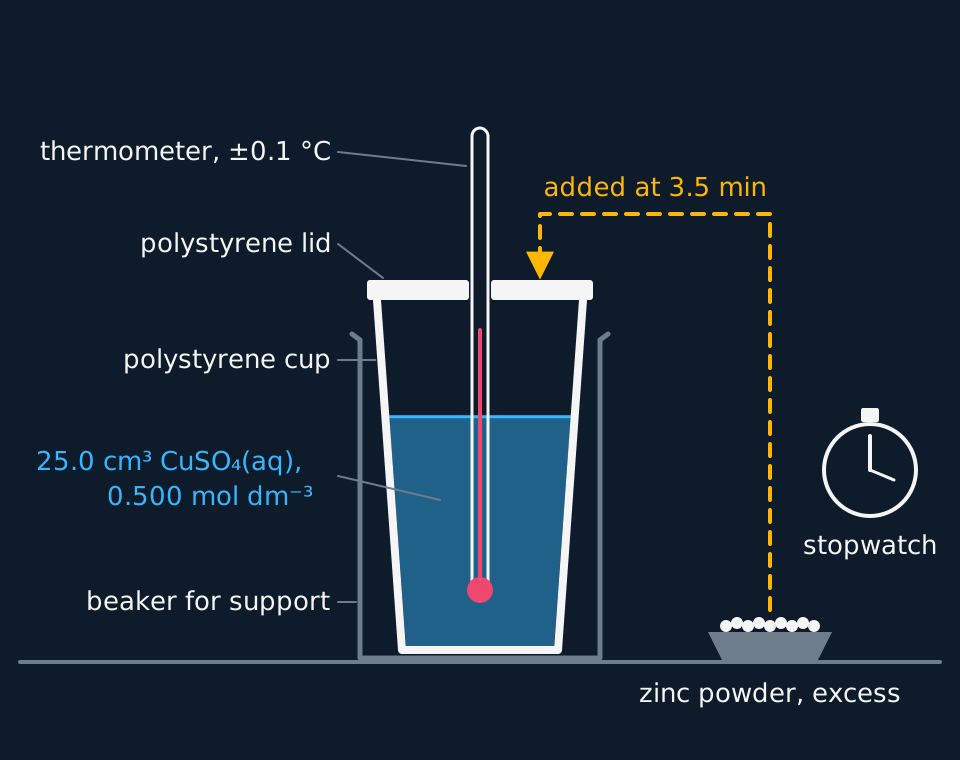
Describe the drawing
Cross-section of a polystyrene cup calorimeter. A tapered polystyrene cup with a lid stands inside a glass beaker for support and is two thirds full of blue copper sulfate solution. A thermometer passes through a hole in the lid with its bulb fully immersed and clear of the bottom. Zinc powder sits in a weighing boat to the right with a dashed arrow into the cup marked added at 3.5 minutes, and a stopwatch stands beside it. There is no heat source.
What is measured
The volume of the solution, which gives its mass; the starting temperature; and the temperature at each time after mixing, which gives ΔT through the extrapolation. The amount of copper(II) sulfate follows from its volume and concentration.
The reaction takes a minute or two to finish, and the cup loses heat the whole time. By the moment the thermometer reaches its highest reading, some heat has already gone. The cooling line shows how fast heat is being lost; extended back to the time of mixing, it gives the temperature the solution would have reached had all the heat been released at once with none lost.
A digital thermometer that reads to 0.1 °C is taken as uncertain by one in its last digit, ±0.1 °C in each reading; a scale marked every 0.1 °C would be read to ±0.05 °C. ΔT is the difference of two readings, so its uncertainty is ±0.2 °C. For the 6.8 °C rise of the polystyrene-cup neutralisation, that is 0.2 ÷ 6.8 × 100 = 2.9%. A 25.0 cm³ pipette, at ±0.06 cm³, contributes only 0.24%. The temperature measurement is the weakest link, so a bigger ΔT, from more concentrated solutions, improves the result more than better glassware does.
Sample results
These readings are idealised: they are the numbers the lesson's own worked attempt uses, and a real run gives different ones.
| Reading | Value |
|---|---|
| Starting temperature | 20.1 °C |
| Highest temperature recorded | 42.8 °C |
| Extrapolated temperature at 3.5 minutes | 43.6 °C |
| ΔT | 23.5 K |
| q = 25.0 × 4.18 × 23.5 | 2.456 kJ |
| n(CuSO₄), the limiting reagent | 0.0125 mol |
| ΔH = −2.456 ÷ 0.0125 | −196 kJ mol⁻¹ |
That is about 90% of −217 kJ mol⁻¹. Heat is still lost through the lid and walls, the cup absorbs some, and the copper coating can stop a little of the zinc reacting. Each of these makes the value less exothermic, none makes it more.
Evaluation
The limitations of the method, what each does to the result and in which direction, and the improvement a mark scheme credits.
| Limitation | What it does to the result | Improvement |
|---|---|---|
| The extrapolation assumes the cooling is a straight line | Cooling is only close to linear while the solution is a few degrees above the room; a line fitted through the first readings after the peak, while the reaction is still finishing, slopes too little and ΔT is underestimated | Keep reading for several minutes after the peak and fit the line through the readings that are clearly cooling; a temperature probe and data logger, reading every second, show where the straight part begins |
| The 10% shortfall in the sample result is systematic | −196 kJ mol⁻¹ against −217 kJ mol⁻¹ is a gap of 21 kJ mol⁻¹, while the ±0.2 °C on ΔT explains only 0.9%; heat absorbed by the cup and thermometer, heat lost through the lid and zinc coated with copper all act in the same direction, so repeating the run would not bring the mean closer | Measure the heat capacity of the cup and thermometer and include it in q, or run a reaction of known enthalpy change, such as the neutralisation of hydrochloric acid by sodium hydroxide at −57.1 kJ mol⁻¹, in the same cup to calibrate it |
| A reading every 30 s can miss the peak | The highest reading is not the highest temperature if the peak falls between readings; the extrapolation does not depend on the peak, but the readings just after it set where the cooling line starts | A temperature probe with a data logger records continuously, to 0.01 °C, and the curve can be plotted from all of it |
| One run, with no repeat | A single ΔT gives no estimate of the random error, so there is no way to tell whether 23.5 °C would be 23.1 or 23.9 next time | Repeat three times and use the mean ΔT; a result that repeats within 0.3 °C and is still 10% low shows the remaining error is systematic |
Errors in carrying it out
| Error | Effect on the result | What reduces it |
|---|---|---|
| Heat lost to the air and the bench | ΔT too small, ΔH less exothermic than it should be | Lid, insulation, and the cooling-curve extrapolation |
| Heat absorbed by the cup and thermometer, which q ignores | ΔH slightly less exothermic | Polystyrene, whose heat capacity is very small |
| Density and c of the solution assumed equal to water's | Small error in q, in either direction | Dilute solutions, which behave nearly as water |
| Thermometer resolution, ±0.1 °C on each reading | ±0.2 °C on ΔT: 0.9% of a 23.5 °C rise | A larger ΔT, from more concentrated solutions |
| Zinc coated with copper and not all reacting | Less heat released than the amount of CuSO₄ implies | Powder rather than granules, and constant stirring |
Heat loss dominates. It always makes the measured value less exothermic than the true value, and for a reaction in solution in a lidded cup the extrapolation removes most of it.
Questions
Question 1 (6 marks)
Describe how to determine the enthalpy change for the reaction of zinc with copper(II) sulfate solution, including how the results are processed.
Mark scheme
Indicative content
- a measured volume of copper(II) sulfate solution, for example 25.0 cm³ by pipette, in a polystyrene cup with a lid, supported in a beaker
- zinc powder weighed out in excess, so that copper(II) sulfate is the limiting reagent
- the temperature recorded at regular intervals, such as every 30 s, for a few minutes before adding the zinc, to establish the starting temperature
- the zinc added at a recorded time, with stirring, and the temperature recorded at regular intervals until it has been falling steadily for several minutes
- a graph of temperature against time, with the cooling line extrapolated back to the time of mixing to find ΔT
- q = mcΔT with m the mass of the solution, divided by the amount of copper(II) sulfate in moles, gives ΔH in kJ mol⁻¹ with a negative sign
Levels
- Level 3 (5–6 marks) the measured volume of solution in an insulated cup, zinc in excess, temperature readings before and after mixing at regular intervals, the extrapolated cooling curve to find ΔT, and the processing through q = mcΔT and the moles of the limiting reagent to a negative ΔH are all present
- Level 2 (3–4 marks) the solution, the excess zinc and the temperature rise are measured and q = mcΔT used with moles of copper(II) sulfate; there is no cooling-curve extrapolation, or no readings before mixing
- Level 1 (1–2 marks) zinc is added and the temperature rise measured; the mass in q = mcΔT is often taken as the mass of zinc, and ΔH is left positive
Question 2 (3 marks)
Explain why the temperature rise in required practical 2 is found by extrapolating the cooling line back to the time of mixing rather than taken from the highest temperature recorded.
Mark scheme
- B1 the reaction takes time to finish, and heat is lost to the surroundings throughout
- B1 so by the time the highest temperature is recorded some heat has already been lost, and that reading is too low
- B1 extending the cooling line back to the time of mixing gives the temperature that would have been reached with no heat lost, so ΔT is larger and more accurate
Question 3 (3 marks)
Explain why a reaction in solution is carried out in a polystyrene cup with a lid rather than in a glass beaker.
Mark scheme
- B1 polystyrene is a poor conductor of heat, so less heat is lost through the walls to the surroundings
- B1 the lid reduces heat lost from the surface of the solution, by convection and evaporation
- B1 polystyrene has a very small heat capacity, so it absorbs little of the heat released, which q = mcΔT ignores
Question 4 (5 marks)
Calculate the enthalpy of neutralisation from the readings in the table. A student put 25.0 cm³ of 2.00 mol dm⁻³ hydrochloric acid in a polystyrene cup and, at 3.0 minutes, added 25.0 cm³ of 2.00 mol dm⁻³ sodium hydroxide solution at the same starting temperature. Use the cooling readings to find ΔT at the time of mixing. c = 4.18 J g⁻¹ K⁻¹.
Mark scheme
- M1 the cooling line runs through the readings from 4.0 minutes, falling (32.5 − 30.9) ÷ (8.0 − 4.0) = 0.40 °C per minute
- A1 extrapolated to 3.0 minutes it reads 32.5 + 0.40 = 32.9 °C, so ΔT = 32.9 − 19.6 = 13.3 °C; accept 13.2 to 13.4 °C read from a graph
- M1 q = 50.0 × 4.18 × 13.3 = 2780 J, using the total mass of 50.0 g
- M1 amount of water formed = 0.0250 dm³ × 2.00 mol dm⁻³ = 0.0500 mol
- A1 ΔH = −2.780 ÷ 0.0500 = −55.6 kJ mol⁻¹ to three significant figures; a ΔT of 12.9 °C, from the highest reading, loses the second mark but allow error carried forward to −53.9 kJ mol⁻¹
Question 5 (3 marks)
Explain why the temperature is recorded for three minutes before the zinc is added, and why no reading is taken at 3.5 minutes.
Mark scheme
The readings before mixing establish the starting temperature and show it is steady, so any rise can be attributed to the reaction.
At 3.5 minutes the zinc is being added and the lid fitted, so the solution is not mixed and a reading would not be the temperature of the whole solution.
The time of mixing is the time both lines are extrapolated to, so it is fixed as a moment rather than measured.
Question 6 (4 marks)
25.0 cm³ of 0.500 mol dm⁻³ copper(II) sulfate reacts with excess zinc and gives an extrapolated temperature rise of 22.0 °C. Calculate the enthalpy change per mole of copper(II) sulfate. Take c = 4.18 J g⁻¹ K⁻¹ and the density of the solution as 1.00 g cm⁻³.
Mark scheme
q = mcΔT = 25.0 × 4.18 × 22.0 = 2299 J (2.30 kJ).
n(CuSO₄) = 0.500 × 25.0 ÷ 1000 = 0.0125 mol.
ΔH = −2299 ÷ 0.0125 = −1.84 × 10⁵ J mol⁻¹.
= −184 kJ mol⁻¹, negative because the temperature rose, so the reaction is exothermic.
Question 7 (2 marks)
Explain why the zinc is used in excess.
Mark scheme
So that all the copper(II) sulfate reacts: its amount is known precisely from the volume and concentration, and it is the limiting reagent.
The enthalpy change per mole is then worked from the moles of copper(II) sulfate, and the mass of zinc need not be weighed precisely.
Question 8 (3 marks)
A measured value of −196 kJ mol⁻¹ is compared with a data-book value of −217 kJ mol⁻¹. Explain why repeating the experiment would not bring the mean closer to −217 kJ mol⁻¹, and suggest one improvement.
Mark scheme
The shortfall is about 10%, far larger than the uncertainty of ±0.2 °C on ΔT (about 1%), so it is not random scatter that averaging would reduce.
Every source, heat lost through the lid and walls, heat absorbed by the cup and thermometer, zinc coated with copper, makes the value less exothermic, so each repeat would be low in the same direction.
Measure the heat capacity of the cup and thermometer and include it in q, or calibrate the cup with a reaction of known enthalpy change; accept better insulation or a tighter lid.
Question 9 (3 marks)
Describe how ΔT is obtained from the graph of temperature against time.
Mark scheme
Draw a straight line through the readings before mixing and extend it to 3.5 minutes.
Draw a straight line of best fit through the cooling readings after the peak and extrapolate it back to 3.5 minutes.
ΔT is the vertical distance between the two lines at 3.5 minutes.
Question 10 (3 marks)
For a neutralisation, 25.0 cm³ of acid is mixed with 25.0 cm³ of alkali and the temperature rises by 6.8 °C. Explain why the temperatures of the two solutions are measured separately and their mean used, and calculate q.
Mark scheme
The two solutions may start at different temperatures, and the mixture of equal volumes starts at their mean, so the mean is the starting temperature.
The mass heated is that of the whole mixture, 50.0 g, not 25.0 g.
q = 50.0 × 4.18 × 6.8 = 1421 J (1.42 kJ).
Coverage maps are available for AQA 7404/7405, OCR Chemistry A H032/H432, Pearson Edexcel Chemistry 8CH0/9CH0 and Cambridge International 9701. Use the relevant route map to check what InkChemistry covers, and your awarding organisation’s current specification as the final authority on examinable content.