Chemistry › Energetics › Measuring an enthalpy change: calorimetry
Measuring an enthalpy change: calorimetry
Heat given out by a reaction in a polystyrene cup warms the water it is dissolved in, and the temperature rise gives the heat through q = mcΔT. Dividing by the moles that reacted, and adding the sign, turns that heat into ΔH. Required practical 2 is set out in full, together with the spirit burner method and the reasons both give values smaller than the data book.
Key terms Every definition in energetics, lesson by lesson
Before this Enthalpy change, standard conditions and the definitions – the sign of ΔH and the standard enthalpies of combustion and neutralisation · Concentration, volumetric solutions and titration calculations – moles from a volume and a concentration · Measurement, uncertainty and significant figures in chemistry – the uncertainty of a difference
COMMON MISCONCEPTION
The mass in q = mcΔT is the mass of the chemical that reacted, because that is what gave out the heat.
m is the mass of whatever was warmed, which is the solution in the cup, and c is its specific heat capacity, taken as water's, 4.18 J g⁻¹ K⁻¹. The reacting chemical gave out the heat; the solution received it, and it is the solution whose temperature rose. The amount that reacted comes in later, when q is divided by moles to give ΔH.
What you should be able to do
- Use q = mcΔT, stating what each symbol is and the unit it takes.
- Calculate ΔH in kJ mol⁻¹ from a temperature change, giving the sign and an appropriate number of significant figures.
- Describe how to measure the enthalpy change of a reaction in solution, including the cooling-curve extrapolation.
- Describe how to measure an enthalpy of combustion with a spirit burner.
- Explain why calorimetry values are smaller than data-book values, and suggest improvements that bring them closer.
- Explain why the enthalpy of neutralisation of a weak acid is less exothermic than that of a strong acid.
From a temperature rise to an amount of heat
A reaction in solution gives its heat to the water the ions are dissolved in, and calorimetry measures that heat from the temperature rise of the water. Sodium hydroxide solution mixed with an equal volume of dilute hydrochloric acid in a polystyrene cup sends a thermometer up several degrees within seconds. The heat came from the reaction, but what got hotter was the water, and the temperature rise of that water is what the thermometer reads.
The heat needed to warm water depends on three things: how much water there is, how far its temperature changes, and a property of water itself, its specific heat capacity. For water c is 4.18 J g⁻¹ K⁻¹: 4.18 J warms one gram by one kelvin.
q = m × c × ΔTq in J; m in g; c = 4.18 J g⁻¹ K⁻¹; ΔT in K, which has the same size as a change in °C.
The m in the equation is the mass of the water or solution that changed temperature. It is not the mass of the solid that reacted, and not the mass of fuel that burned. For dilute solutions the density is taken as 1.00 g cm⁻³, so 50.0 cm³ of solution counts as 50.0 g, and its specific heat capacity is taken to be that of pure water. Mixing 25.0 cm³ of acid with 25.0 cm³ of alkali gives m = 50.0 g, because both solutions warm.
A temperature change is the same number in kelvin as in degrees Celsius, so ΔT needs no conversion. Only an absolute temperature, such as the 298 K of standard conditions, needs 273 added.
- Calorimetry
- The measurement of the heat energy transferred in a reaction from the temperature change of a known mass of water or solution.
- Specific heat capacity, c
- The energy needed to raise the temperature of 1 g of a substance by 1 K.
From q to ΔH
q is the heat for however much reacted in this particular cup. ΔH is per mole. Three steps turn one into the other: convert q from J to kJ, find the amount in moles of the substance the definition names, and divide. Then give the sign from the direction of the temperature change: a rise means heat was released, so ΔH is negative; a fall means ΔH is positive.
The amount to divide by is the amount that reacted, which is the amount of the limiting reagent, or of a product made from it. In a displacement with excess zinc it is the copper(II) sulfate. In a neutralisation it is the water formed.
- Limiting reagent
- The reactant that is completely used up, which fixes the amount of product formed and the heat released.
Neutralisation in a polystyrene cup
50.0 cm³ of 1.00 mol dm⁻³ hydrochloric acid is added to 50.0 cm³ of 1.00 mol dm⁻³ sodium hydroxide solution in a polystyrene cup. The temperature rises by 6.8 °C. Calculate the enthalpy of neutralisation.
Show the working
Mass of solution: 50.0 + 50.0 = 100.0 cm³, taken as 100.0 g.
q = mcΔT = 100.0 × 4.18 × 6.8 = 2842 J = 2.842 kJ.
Amount of water formed: HCl(aq) + NaOH(aq) → NaCl(aq) + H₂O(l), and n(HCl) = 0.0500 dm³ × 1.00 mol dm⁻³ = 0.0500 mol, so 0.0500 mol of water forms.
ΔH = −2.842 ÷ 0.0500 = −56.8 kJ mol⁻¹. The temperature rise is given to two significant figures, so ΔneutH = −57 kJ mol⁻¹, negative because the solution warmed.
The answer is close to the data-book value of −57.1 kJ mol⁻¹, as a neutralisation usually is: the reaction is fast, so little heat escapes before the highest temperature is reached.
The whole calculation can be written as one expression. It holds the same three steps, and its minus sign is the sign rule: a rise in temperature, a positive ΔT, gives a negative ΔH.
ΔH = −mcΔT ÷ nWith mcΔT in J this gives ΔH in J mol⁻¹; divide by 1000 for kJ mol⁻¹.
When the acid and the alkali are not in equal amounts, two things change at once. The mass is still the total volume of solution, because all of it warms. The amount of water formed is set by whichever reactant runs out first, and the other is left over.
Unequal amounts of acid and alkali
25.0 cm³ of 2.00 mol dm⁻³ hydrochloric acid is mixed with 30.0 cm³ of 1.00 mol dm⁻³ sodium hydroxide solution, and the temperature rises by 7.4 °C. Calculate the enthalpy of neutralisation.
Show the working
Mass of solution: 25.0 + 30.0 = 55.0 cm³, taken as 55.0 g. q = 55.0 × 4.18 × 7.4 = 1701 J = 1.701 kJ.
n(HCl) = 0.0250 × 2.00 = 0.0500 mol and n(NaOH) = 0.0300 × 1.00 = 0.0300 mol. They react 1:1, so the sodium hydroxide is limiting and 0.0300 mol of water forms.
ΔH = −1.701 ÷ 0.0300 = −56.7 kJ mol⁻¹, which to two significant figures, matching ΔT, is −57 kJ mol⁻¹.
Dividing by the 0.0500 mol of acid would give −34 kJ mol⁻¹. That answer is wrong because 0.0200 mol of the acid has no hydroxide to react with and releases no heat.
Required practical 2: an enthalpy change in solution
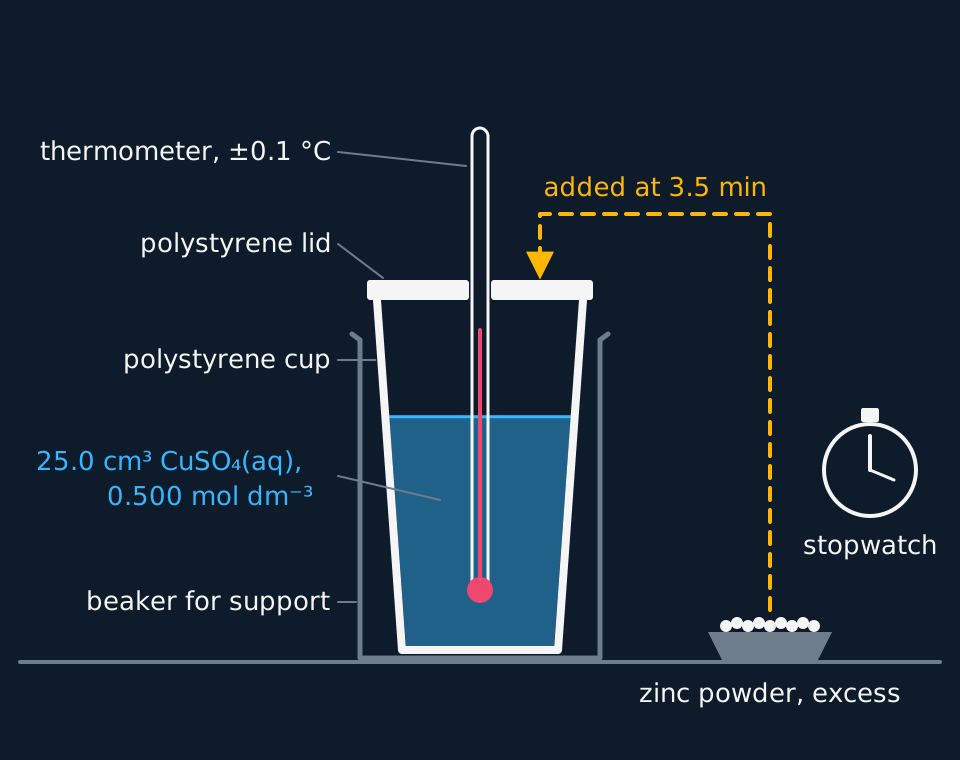
Every board sets the measurement of an enthalpy change in solution: it is required practical 2, PAG 3 for OCR, and part of Edexcel's core practical 8, where two such results feed a Hess cycle. The reaction here is the displacement of copper by zinc, which gives a temperature rise of more than 20 °C.
Zn(s) + CuSO₄(aq) → ZnSO₄(aq) + Cu(s)
Describe the drawing
Cross-section of a polystyrene cup calorimeter. A tapered polystyrene cup with a lid stands inside a glass beaker for support and is two thirds full of blue copper sulfate solution. A thermometer passes through a hole in the lid with its bulb fully immersed and clear of the bottom. Zinc powder sits in a weighing boat to the right with a dashed arrow into the cup marked added at 3.5 minutes, and a stopwatch stands beside it. There is no heat source.
Apparatus. An expanded polystyrene cup with a lid, a 250 cm³ beaker to stand it in, a 25.0 cm³ pipette and filler, a thermometer reading to 0.1 °C or a temperature probe, a stopwatch, a balance reading to 0.01 g, a weighing boat, zinc powder and 0.500 mol dm⁻³ copper(II) sulfate solution.
| Step | What to do | Why |
|---|---|---|
| 1 | Weigh about 3 g of zinc powder into a weighing boat | 0.82 g would react with all the copper(II) sulfate, so 3 g is an excess and the zinc is not limiting |
| 2 | Pipette 25.0 cm³ of the copper(II) sulfate solution into the cup, standing in the beaker | A pipette gives the volume, and so the amount, precisely |
| 3 | Start the stopwatch and record the temperature every 30 s for 3 minutes, stirring | Establishes the starting temperature and shows it is steady |
| 4 | At 3.5 minutes add all the zinc at once, stir, and fit the lid; take no reading at 3.5 minutes | The time of mixing is the time the graph is extrapolated to |
| 5 | From 4 minutes, record the temperature every 30 s until 10 minutes, stirring throughout | Captures the peak and enough of the cooling to draw a line through |
| 6 | Plot temperature against time. Draw a line through the first readings and a straight line through the cooling readings, and extend the cooling line back to 3.5 minutes | Corrects for heat lost while the reaction was still releasing it |
| 7 | Read ΔT as the vertical gap at 3.5 minutes between the two lines, then calculate q and ΔH | ΔT is the rise there would have been with no heat loss |
For a neutralisation, the zinc is replaced by 25.0 cm³ of alkali. Measure the temperature of the acid and of the alkali separately before mixing, and use their mean as the starting temperature.
What is measured. The volume of the solution, which gives its mass; the starting temperature; and the temperature at each time after mixing, which gives ΔT through the extrapolation. The amount of copper(II) sulfate follows from its volume and concentration.
Describe the drawing
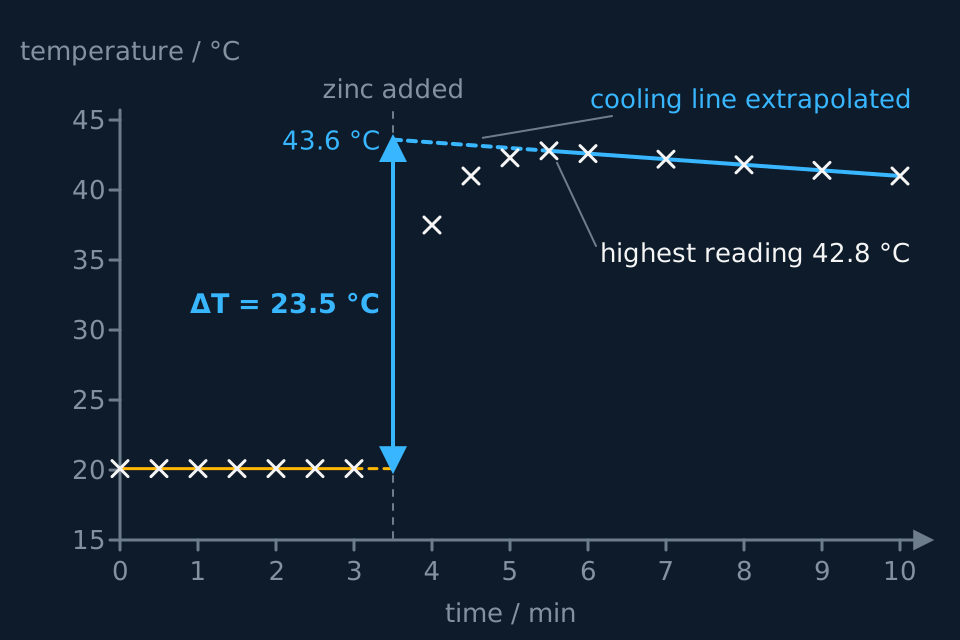
Temperature against time. Readings every half minute sit on a flat line at 20.1 degrees until a dashed vertical line at 3.5 minutes marks the zinc being added. The readings then rise steeply to a highest value of 42.8 degrees at 5.5 minutes and fall slowly. A cyan line through the cooling points is extended back as a dashed line to meet the 3.5 minute line at 43.6 degrees, and a double arrow there from 20.1 to 43.6 degrees marks ΔT = 23.5 degrees.
The reaction takes a minute or two to finish, and the cup loses heat the whole time. By the moment the thermometer reaches its highest reading, some heat has already gone. The cooling line shows how fast heat is being lost; extended back to the time of mixing, it gives the temperature the solution would have reached had all the heat been released at once with none lost.
| Time / min | Temperature / °C | Time / min | Temperature / °C |
|---|---|---|---|
| 0.0 to 3.0 | 20.1 at every reading | 7.0 | 42.2 |
| 3.5 | zinc added; no reading | 7.5 | 42.0 |
| 4.0 | 37.5 | 8.0 | 41.8 |
| 4.5 | 41.0 | 8.5 | 41.6 |
| 5.0 | 42.3 | 9.0 | 41.4 |
| 5.5 | 42.8 | 9.5 | 41.2 |
| 6.0 | 42.6 | 10.0 | 41.0 |
| 6.5 | 42.4 | – | – |
Extrapolating the zinc readings to the time of mixing
The table holds the readings from one run of the zinc experiment, with 25.0 cm³ of 0.500 mol dm⁻³ copper(II) sulfate. Find the temperature at the moment of mixing, 3.5 minutes, that the solution would have reached with no heat lost, and from it ΔT.
Show the working
The line before mixing: the seven readings from 0.0 to 3.0 minutes are all 20.1 °C, so the starting line is flat and still reads 20.1 °C when it is extended to 3.5 minutes.
Which readings make the cooling line: from 5.5 minutes the temperature falls by 0.2 °C every half minute, a straight line. The readings at 4.0, 4.5 and 5.0 minutes are left out, because the zinc was still reacting and they lie below that line.
The gradient of the cooling line: from 42.8 °C at 5.5 minutes to 41.0 °C at 10.0 minutes is a fall of 1.8 °C in 4.5 minutes, 1.8 ÷ 4.5 = 0.40 °C per minute.
Extending it back: 3.5 minutes is 2.0 minutes before 5.5 minutes, so the line stands 0.40 × 2.0 = 0.80 °C higher there, at 42.8 + 0.8 = 43.6 °C.
ΔT = 43.6 − 20.1 = 23.5 °C. The highest reading alone would have given 42.8 − 20.1 = 22.7 °C, a rise 3.4% too small and a value of ΔH less exothermic by the same fraction.
On a graph the same steps are done with a ruler: a line of best fit through the cooling points only, extended back to the vertical line at the time of mixing, and ΔT read as the gap between that point and the starting line. A mark scheme credits the extrapolation only if the line is drawn through the cooling points and taken back to the time of mixing, not to time zero.
An endothermic change gives the same graph upside down. Dissolve ammonium nitrate in the cup and the temperature falls to a minimum, then climbs slowly as heat flows in from the warmer room. The warming line is extended back to the time of mixing in the same way, ΔT is the fall from the starting temperature to that extrapolated value, and ΔH is positive.
- Extrapolated temperature rise
- The temperature change read at the time of mixing from a cooling line extended backwards, which corrects for heat lost to the surroundings during the reaction.
| Error | Effect on the result | What reduces it |
|---|---|---|
| Heat lost to the air and the bench | ΔT too small, ΔH less exothermic than it should be | Lid, insulation, and the cooling-curve extrapolation |
| Heat absorbed by the cup and thermometer, which q ignores | ΔH slightly less exothermic | Polystyrene, whose heat capacity is very small |
| Density and c of the solution assumed equal to water's | Small error in q, in either direction | Dilute solutions, which behave nearly as water |
| Thermometer resolution, ±0.1 °C on each reading | ±0.2 °C on ΔT: 0.9% of a 23.5 °C rise | A larger ΔT, from more concentrated solutions |
| Zinc coated with copper and not all reacting | Less heat released than the amount of CuSO₄ implies | Powder rather than granules, and constant stirring |
Heat loss dominates. It always makes the measured value less exothermic than the true value, and for a reaction in solution in a lidded cup the extrapolation removes most of it.
A digital thermometer that reads to 0.1 °C is taken as uncertain by one in its last digit, ±0.1 °C in each reading; a scale marked every 0.1 °C would be read to ±0.05 °C. ΔT is the difference of two readings, so its uncertainty is ±0.2 °C. For the 6.8 °C rise of the polystyrene-cup neutralisation, that is 0.2 ÷ 6.8 × 100 = 2.9%. A 25.0 cm³ pipette, at ±0.06 cm³, contributes only 0.24%. The temperature measurement is the weakest link, so a bigger ΔT, from more concentrated solutions, improves the result more than better glassware does.
Safety. Copper(II) sulfate solution is harmful if swallowed, irritates the eyes and is toxic to aquatic life, so residues go into the container provided, not down the sink. Zinc powder is flammable. Wear eye protection, and check the CLEAPSS Hazcards and the school's risk assessment before starting.
TRY IT: ΔH for the displacement from the graph
In the zinc experiment, the starting temperature was 20.1 °C and the extrapolated temperature at 3.5 minutes was 43.6 °C. Calculate ΔH for Zn(s) + CuSO₄(aq) → ZnSO₄(aq) + Cu(s), and compare it with the data-book value of −217 kJ mol⁻¹.
Check your answer
ΔT = 43.6 − 20.1 = 23.5 K, and q = 25.0 × 4.18 × 23.5 = 2456 J = 2.456 kJ.
n(CuSO₄) = 0.0250 dm³ × 0.500 mol dm⁻³ = 0.0125 mol, the limiting reagent. ΔH = −2.456 ÷ 0.0125 = −196 kJ mol⁻¹ to three significant figures.
That is about 90% of −217 kJ mol⁻¹. Heat is still lost through the lid and walls, the cup absorbs some, and the copper coating can stop a little of the zinc reacting. Each of these makes the value less exothermic, none makes it more.
Strong and weak acids
Every strong acid with every strong alkali gives close to −57 kJ mol⁻¹, because every one of them is the same reaction. Hydrochloric and nitric acids are fully dissociated in solution, and so are sodium and potassium hydroxides. The chloride, nitrate, sodium and potassium ions are spectators, and the only change is H⁺(aq) + OH⁻(aq) → H₂O(l).
A weak acid is different. Ethanoic acid in solution is mostly undissociated CH₃COOH molecules with a few H⁺ ions among them. As hydroxide ions remove those H⁺ ions, more molecules dissociate to replace them, and the dissociation has an enthalpy change of its own, which takes energy in. The heat released per mole of water is the neutralisation less the energy used in dissociating the acid, so the value is less exothermic than −57 kJ mol⁻¹.
| Acid and alkali | Strong or weak | ΔneutH / kJ mol⁻¹ |
|---|---|---|
| HCl(aq) + NaOH(aq) | Strong acid, strong alkali | −57.1 |
| HNO₃(aq) + KOH(aq) | Strong acid, strong alkali | −57.3 |
| CH₃COOH(aq) + NaOH(aq) | Weak acid, strong alkali | about −56 |
| HCl(aq) + NH₃(aq) | Strong acid, weak alkali | about −53 |
| HCN(aq) + NaOH(aq) | Very weak acid, strong alkali | about −12 |
The size of the gap depends on the acid. For ethanoic acid it is a kilojoule or so, less than the error in a school measurement. Hydrogen cyanide is a far weaker acid, and most of the energy released by neutralisation goes into dissociating it. A weak alkali such as ammonia also gives a smaller value, since it must take H⁺ from water to make its OH⁻ ions, and that step takes energy in too.
An explanation earns its marks with three links: the weak acid is only partially dissociated; its dissociation is endothermic; so less heat is released per mole of water. 'Weak acids release less energy' restates the result without the reason.
- Strong acid
- An acid that is completely dissociated into ions in aqueous solution.
- Weak acid
- An acid that is only partially dissociated into ions in aqueous solution.
Enthalpies of combustion with a spirit burner
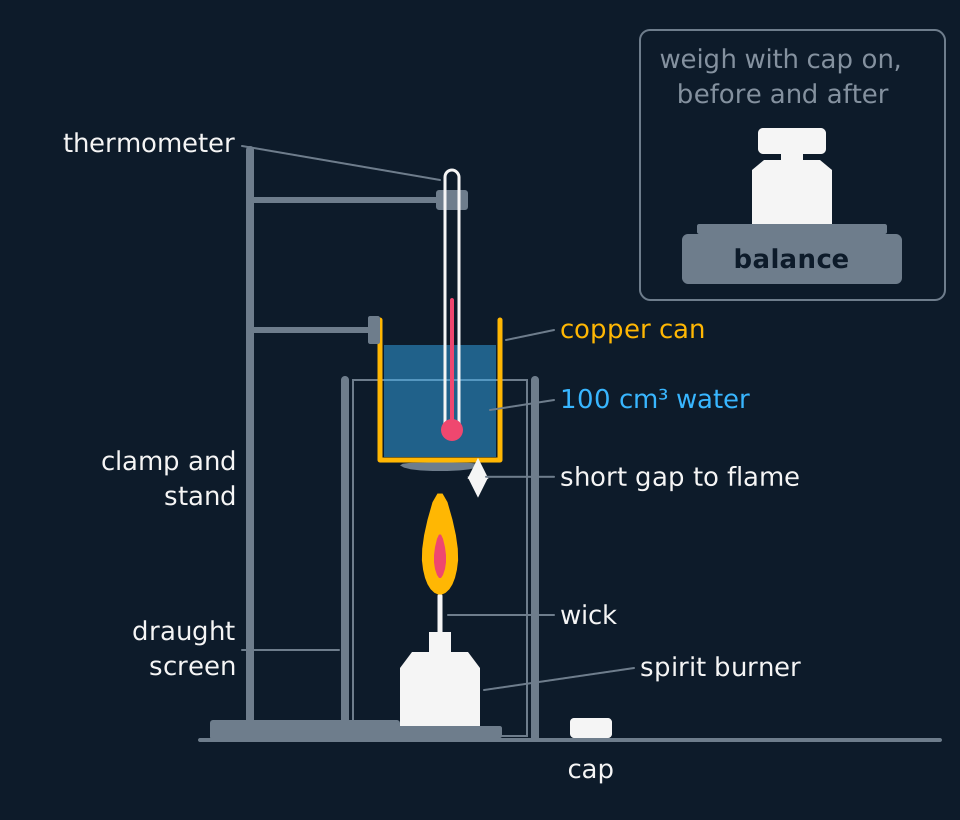
A liquid fuel is burned in a small spirit burner under a metal can of water. Copper is used for the can because it conducts heat to the water quickly. The burner is weighed with its cap on before and after burning, so the mass of fuel burned comes from the difference.
Describe the drawing
A spirit burner with a lit wick on a heatproof mat, beneath a copper can of water held in a clamp on a stand. A thermometer held by a second clamp dips into the water without touching the can, and a short gap between the flame tip and the sooty base of the can is marked. A draught screen surrounds burner and can, the burner's cap lies outside it, and an inset shows the capped burner on a balance, weighed before and after.
Measure 100 cm³ of water into the can and record its temperature. Weigh the capped burner, remove the cap, light the wick and stir the water with the thermometer until it has risen by about 30 °C. Put the cap back on to put out the flame, record the highest temperature, and reweigh the burner straight away.
Each detail answers an error. The cap stops ethanol evaporating from the wick before and after burning, so the mass loss is fuel that burned. The draught screen keeps the flame steady and under the can. A short gap between flame and can means less heat warms the air in between. Stirring spreads the heat through the water so the thermometer reads its average temperature.
The enthalpy of combustion of ethanol
A spirit burner of ethanol weighs 152.364 g before burning and 151.864 g after. The heat warms 100.0 g of water by 32.0 °C. Calculate the enthalpy of combustion of ethanol, and compare it with the data-book value of −1367 kJ mol⁻¹. Mr of C₂H₅OH = 46.0.
Show the working
Mass burned: 152.364 − 151.864 = 0.500 g. Amount: 0.500 ÷ 46.0 = 0.01087 mol.
q = mcΔT = 100.0 × 4.18 × 32.0 = 13 376 J = 13.376 kJ. The mass is the water's, not the ethanol's.
ΔcH = −13.376 ÷ 0.01087 = −1231 kJ mol⁻¹, which to three significant figures is −1.23 × 10³ kJ mol⁻¹.
Compared with the data book: (1367 − 1231) ÷ 1367 × 100 = 10%. The measured value is 10% less exothermic.
Precision cannot explain that gap. A balance reading to 0.001 g, taken as ±0.001 g a reading, gives the 0.500 g burned to within ±0.002 g, which is 0.4%, and ±0.2 °C on a rise of 32.0 °C is 0.6%. Together they come to about 1%, a tenth of the gap. The rest is systematic error, which repeating the experiment would reproduce rather than reduce.
A spirit burner value is always less exothermic than the data book, for four reasons. Heat is lost to the air and to the can, the clamp and the burner, so not all of q reaches the water. Combustion is incomplete: soot on the base of the can is carbon that did not reach CO₂, and incomplete combustion releases less energy. Fuel evaporates from the hot wick without burning, so the mass loss overstates the amount burned. And the water formed escapes as steam, while ΔcH° assumes liquid water, so the heat released as the steam condenses is never collected.
- Incomplete combustion
- Combustion in a limited supply of oxygen, giving carbon monoxide or carbon as well as or instead of carbon dioxide, and releasing less energy.
| Polystyrene cup | Spirit burner | |
|---|---|---|
| Reactions | Neutralisation, displacement, dissolving | Combustion of liquid fuels |
| Where the heat goes | Straight into the solution it is made in | Across an air gap and through the can |
| Typical result | Within about 10% of the data book | Commonly 10 to 40% less exothermic than the data book |
| Main correction | Cooling-curve extrapolation | Draught screen, short flame gap, capped burner |
A bomb calorimeter, a sealed steel vessel of fuel in pure oxygen under water, removes almost all of these errors, which is how data-book values are measured. A school burner is good for comparing fuels with each other under the same conditions, and poor for absolute values.
- Bomb calorimeter
- A sealed steel vessel in which a sample burns completely in pure oxygen, surrounded by a known mass of water, so that almost no heat is lost.
Comparing fuels this way works because the errors are similar for each fuel. Burning methanol, ethanol and propan-1-ol in turn under the same can, with the same gap and the same mass of water, gives values that are all too small, but their order and the roughly constant step between them survive.
Other boards: practical papers and weak acids
Cambridge examines the cup method in its practical papers, Papers 3 and 5, and writes the calculation as the single expression ΔH = −mcΔT ÷ n. Paper 5 is a planning paper, so a question can ask for the method to be planned rather than carried out: which readings to take before mixing, when to mix, and which line to extend.
Edexcel sets the comparison of strong and weak acids in Topic 12 of its A level, with the table of values given here, and expects the answer in terms of the endothermic dissociation of the weak acid.
In the exam
- A calculation earns a method mark for q, one for the amount in moles and one for the division; the answer mark needs the minus sign and kJ mol⁻¹. A positive value for an exothermic change, or an answer in J mol⁻¹ labelled kJ mol⁻¹, loses that final mark.
- Schemes allow error carried forward: a wrong q divided correctly by the right amount still scores the later marks, so every line of working is worth writing down.
- Give significant figures to match the least precise measurement, which is usually ΔT; −56.8 kJ mol⁻¹ from a ΔT of 6.8 °C is given as −57 kJ mol⁻¹.
- In a description of the cooling-curve method the marks go to the readings before mixing, the recorded time of mixing, the readings after, and the cooling line extrapolated back to the time of mixing. 'Use the highest temperature' is rejected.
- For a spirit burner, give evaporation and incomplete combustion as well as heat loss when more than one reason is asked for, and say which way each moves the value: all three make it less exothermic.
Check yourself
Two students repeat the zinc and copper(II) sulfate experiment. One uses 25.0 cm³ of solution in a cup, the other 50.0 cm³ of the same solution in a larger cup with the same mass of zinc. Predict and explain how their temperature rises and their values of ΔH should compare.
Answer
Both use an excess of zinc, so the copper(II) sulfate is limiting. Doubling the volume doubles the amount that reacts, and so doubles the heat released.
Doubling the volume also doubles the mass of solution being warmed. In q = mcΔT, twice the q spread over twice the m gives the same ΔT, so the two rises should match.
ΔH is q divided by the amount reacted, and both have doubled, so ΔH should be the same. In practice the larger volume loses a smaller fraction of its heat, through a surface that is smaller for its volume, so its value may be slightly more exothermic and closer to the data book.
Questions
Question 16 marks
Describe how to determine the enthalpy change for the reaction of zinc with copper(II) sulfate solution, including how the results are processed.
Mark scheme
Indicative content
- a measured volume of copper(II) sulfate solution, for example 25.0 cm³ by pipette, in a polystyrene cup with a lid, supported in a beaker
- zinc powder weighed out in excess, so that copper(II) sulfate is the limiting reagent
- the temperature recorded at regular intervals, such as every 30 s, for a few minutes before adding the zinc, to establish the starting temperature
- the zinc added at a recorded time, with stirring, and the temperature recorded at regular intervals until it has been falling steadily for several minutes
- a graph of temperature against time, with the cooling line extrapolated back to the time of mixing to find ΔT
- q = mcΔT with m the mass of the solution, divided by the amount of copper(II) sulfate in moles, gives ΔH in kJ mol⁻¹ with a negative sign
Levels
- Level 3 (5–6 marks) the measured volume of solution in an insulated cup, zinc in excess, temperature readings before and after mixing at regular intervals, the extrapolated cooling curve to find ΔT, and the processing through q = mcΔT and the moles of the limiting reagent to a negative ΔH are all present
- Level 2 (3–4 marks) the solution, the excess zinc and the temperature rise are measured and q = mcΔT used with moles of copper(II) sulfate; there is no cooling-curve extrapolation, or no readings before mixing
- Level 1 (1–2 marks) zinc is added and the temperature rise measured; the mass in q = mcΔT is often taken as the mass of zinc, and ΔH is left positive
Question 25 marks
Calculate the enthalpy of neutralisation from the readings in the table. A student put 25.0 cm³ of 2.00 mol dm⁻³ hydrochloric acid in a polystyrene cup and, at 3.0 minutes, added 25.0 cm³ of 2.00 mol dm⁻³ sodium hydroxide solution at the same starting temperature. Use the cooling readings to find ΔT at the time of mixing. c = 4.18 J g⁻¹ K⁻¹.
| Time / min | Temperature / °C |
|---|---|
| 0.0 | 19.6 |
| 1.0 | 19.6 |
| 2.0 | 19.6 |
| 3.0 | alkali added; no reading |
| 3.5 | 31.8 |
| 4.0 | 32.5 |
| 5.0 | 32.1 |
| 6.0 | 31.7 |
| 7.0 | 31.3 |
| 8.0 | 30.9 |
Mark scheme
- M1 the cooling line runs through the readings from 4.0 minutes, falling (32.5 − 30.9) ÷ (8.0 − 4.0) = 0.40 °C per minute
- A1 extrapolated to 3.0 minutes it reads 32.5 + 0.40 = 32.9 °C, so ΔT = 32.9 − 19.6 = 13.3 °C; accept 13.2 to 13.4 °C read from a graph
- M1 q = 50.0 × 4.18 × 13.3 = 2780 J, using the total mass of 50.0 g
- M1 amount of water formed = 0.0250 dm³ × 2.00 mol dm⁻³ = 0.0500 mol
- A1 ΔH = −2.780 ÷ 0.0500 = −55.6 kJ mol⁻¹ to three significant figures; a ΔT of 12.9 °C, from the highest reading, loses the second mark but allow error carried forward to −53.9 kJ mol⁻¹
Question 34 marks
State the equation used to calculate the heat energy transferred in a calorimetry experiment, giving the unit of each quantity, and use it to calculate the heat needed to raise the temperature of 75.0 g of water by 8.4 °C. c = 4.18 J g⁻¹ K⁻¹.
Mark scheme
- B1 q = mcΔT: heat energy = mass × specific heat capacity × temperature change
- B1 q in J, m in g, c in J g⁻¹ K⁻¹ and ΔT in K; accept °C for ΔT, since a change is the same size in both
- M1 q = 75.0 × 4.18 × 8.4
- A1 q = 2.6 × 10³ J, or 2.6 kJ, to two significant figures, matching the 8.4 °C
All 19 questions with mark schemes, the other 16 set out in full on the question page.
Worth remembering
- Use the total volume for m when two solutions are mixed: 25 cm³ with 25 cm³ is 50 g, since both solutions warm.
- Divide q by the moles of the limiting reagent, or of the water formed; the reactant in excess gives a value too small.
- A ΔH left in J mol⁻¹ and labelled kJ mol⁻¹, or given positive when the solution warmed, loses the answer mark.
- A cooling line taken back to time zero instead of the time of mixing reads ΔT for a moment before anything was mixed.
- 'Heat loss' alone for a spirit burner leaves two reasons unclaimed: fuel evaporating from the wick and incomplete combustion.
CHECK YOUR PROGRESS
Rate how confident you are with each objective for this lesson. Ratings are saved in this browser, on this device, unless you sign in.
- Use q = mcΔT, stating what each symbol is and the unit it takes.
- Calculate ΔH in kJ mol⁻¹ from a temperature change, giving the sign and an appropriate number of significant figures.
- Describe how to measure the enthalpy change of a reaction in solution, including the cooling-curve extrapolation.
- Describe how to measure an enthalpy of combustion with a spirit burner.
- Explain why calorimetry values are smaller than data-book values, and suggest improvements that bring them closer.
- Explain why the enthalpy of neutralisation of a weak acid is less exothermic than that of a strong acid.
Open the full revision checklist to see every objective in the curriculum in one place.
Practise this lesson
WORKBOOK
The written questions from this topic, on paper with room to work, and a separate book of mark schemes. The 5 questions that are set on a diagram stay on this page, where the diagram can be drawn. Free to use; please do not redistribute or sell.