Chemistry › Practicals › Identifying ions in solution: anions, Group 2 and ammonium
Required practical 4: identifying ions in solution (OCR PAG 4, Edexcel CP 7)
Identify hydroxide, carbonate, sulfate and halide ions, the Group 2 ions and the ammonium ion by test-tube reactions done in a fixed order.
This is the method section of Halide ions, the silver nitrate test, concentrated sulfuric acid, and chlorine in water on a page of its own, with its variables, sample results, an evaluation and questions set on it. The chemistry behind it is in that lesson.
The capability this develops
This investigation is one instance of capability P04: Identifying ions in solution by test-tube reactions, which sets out the techniques it belongs to, the calculations it carries and the errors that cost marks in all of them. The notes behind the chemistry are in Group 2 and Group 7.
Where this sits on the specifications
Each qualification is mapped to its own specification one numbered heading at a time, against a document whose sha256 is recorded. These are the headings that list the lesson this method is taught in, on the four qualifications mapped. Each links to the route map the row belongs to.
| Qualification | Heading |
|---|---|
| AQA 7404/7405 | 3.2.3.1 Trends in properties |
| AQA 7404/7405 | 3.2.3.2 Uses of chlorine and chlorate(I) |
| OCR Chemistry A H032/H432 | 3.1.3 The halogens |
| OCR Chemistry A H032/H432 | 3.1.4 Qualitative analysis |
| OCR Chemistry A H032/H432 | 5.3.2 Qualitative analysis |
| Pearson Edexcel Chemistry 8CH0/9CH0 | 4.12 halogen redox: metals, water, cold and hot alkali |
| Pearson Edexcel Chemistry 8CH0/9CH0 | 4.13 halides with sulfuric acid; silver halides; hydrogen halides |
| Pearson Edexcel Chemistry 8CH0/9CH0 | 4.15 tests for carbonate, sulfate and ammonium |
| Cambridge International 9701 | 11.3 Some reactions of the halide ions |
| Cambridge International 9701 | 11.4 The reactions of chlorine |
Three boards number their practical activities, and those lists were read here from the same specifications as the headings above. This investigation is filed on them as:
- AQA 7404/7405 required practical 4: Test-tube tests for cations and anions
- OCR Chemistry A H032/H432 PAG 4: Qualitative analysis of ions
- Pearson Edexcel Chemistry 8CH0/9CH0 core practical 7: Inorganic and organic unknowns
Use your awarding organisation’s current specification and its practical handbook as the authority on which activities your course requires and how they are assessed.
Apparatus
Test tubes in a rack; a dropping pipette for each reagent; a test-tube holder; a water bath at about 60 °C; red litmus paper; limewater with a delivery tube and bung, or a teat pipette to carry gas; a wash bottle of deionised water. Reagents, all dilute unless stated: nitric acid, hydrochloric acid, sulfuric acid, barium chloride, silver nitrate, sodium hydroxide, and ammonia solution both dilute and concentrated.
Safety
Risks. Concentrated ammonia gives off an irritating vapour and is used in a fume cupboard. Silver nitrate stains skin and is an irritant; barium chloride is harmful if swallowed; sodium hydroxide damages eyes even when dilute. Wear eye protection throughout. Check the CLEAPSS Hazcard for each substance and the school's own risk assessment; where they differ from this method, follow them.
Variables
Independent variable
The reagent added to a fresh portion of the unknown, in the fixed order: litmus, nitric acid, hydrochloric acid then barium chloride, nitric acid then silver nitrate, ammonia, sodium hydroxide, sulfuric acid.
Dependent variable
What is seen: the colour of a precipitate, effervescence, a change in litmus, or no visible change, recorded in those words.
Control variables
- The volume of unknown in each tube, about 1 cm³, and the number of drops of each reagent, so a slight precipitate means the same thing in every tube.
- The concentration of the known solutions, which are run first and at about the same concentration as the unknown, so that a slight white precipitate from calcium is judged against a slight white precipitate from a known calcium solution.
- A fresh portion for every test, deionised water for every rinse, and one dropping pipette per reagent, so nothing is carried from one test into the next.
- The background: each tube viewed against the same dark or white surface, in the same light, beside its matching known.
In an identification, controlled means compared fairly. The known and the unknown are given the same volume, the same drops of the same reagent and the same background, so that the only difference between the two tubes is the ion in them.
Method
The anion tests are done in a fixed order. Carbonate comes first because carbonate ions give white precipitates with both barium and silver ions. Sulfate comes before the halides because silver sulfate can precipitate from a concentrated sulfate solution. Each test uses a fresh 1 cm³ portion of the unknown.
| Step | What to do | What is seen if the ion is present |
|---|---|---|
| 1 | Dip a strip of red litmus paper into 1 cm³ of the unknown | Red litmus turns blue: OH⁻ |
| 2 | Add dilute nitric acid dropwise; pass any gas through limewater | Effervescence, and the gas turns limewater milky: CO₃²⁻ |
| 3 | Add dilute hydrochloric acid until any fizzing stops, then a few drops of barium chloride solution | White precipitate: SO₄²⁻ |
| 4 | Add dilute nitric acid until any fizzing stops, then a few drops of silver nitrate solution | White, cream or yellow precipitate: Cl⁻, Br⁻ or I⁻ |
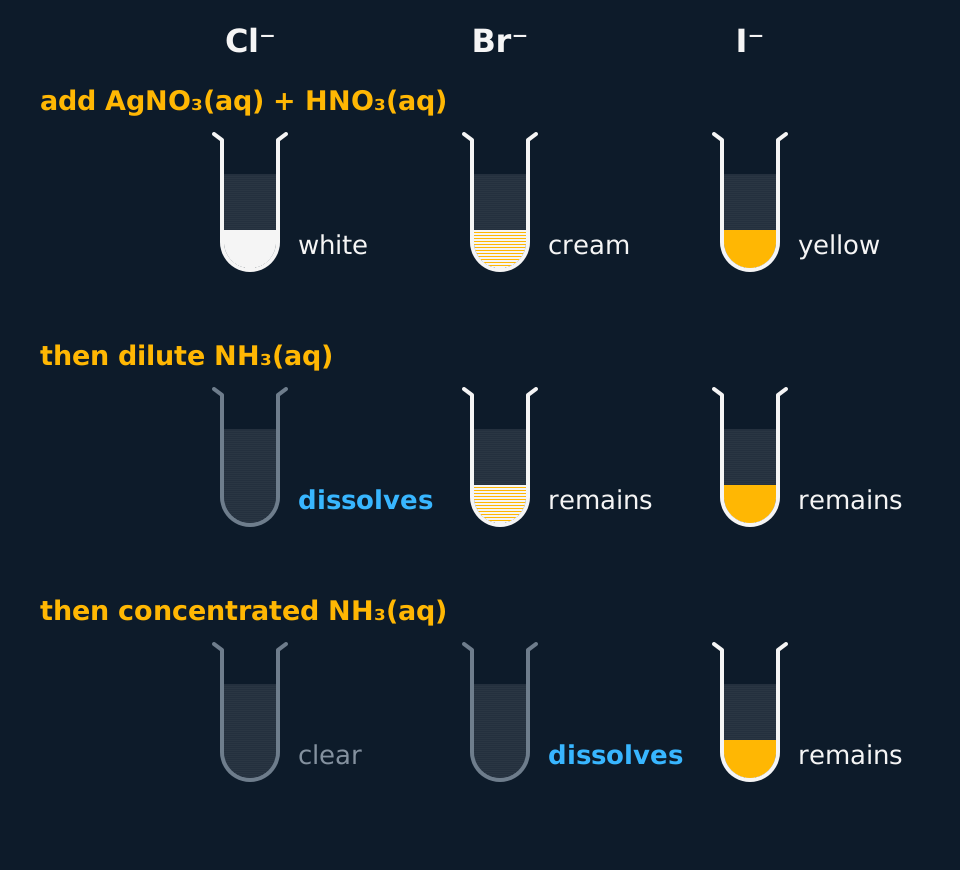
| 5 | Add dilute ammonia solution to the precipitate; if it stays, repeat on a fresh precipitate with concentrated ammonia in a fume cupboard | White precipitate soluble in dilute ammonia: Cl⁻. Cream precipitate soluble in concentrated ammonia: Br⁻. Yellow precipitate insoluble in concentrated ammonia: I⁻ |
| 6 | Add sodium hydroxide solution dropwise to 1 cm³ of the unknown, then in excess | White precipitate: Mg²⁺. Slight white precipitate: Ca²⁺. Very slight or none: Sr²⁺ or Ba²⁺ |
| 7 | Add dilute sulfuric acid dropwise to a fresh 1 cm³ | Dense white precipitate: Ba²⁺. White precipitate: Sr²⁺. Slight white precipitate: Ca²⁺. No change: Mg²⁺ |
| 8 | Add sodium hydroxide solution, warm in the water bath, and hold damp red litmus paper at the mouth of the tube without touching the glass | Damp red litmus turns blue as ammonia is given off: NH₄⁺ |
Describe the drawing
Three columns of test tubes headed chloride, bromide and iodide. After acidified silver nitrate they hold white, cream and yellow precipitates. After dilute ammonia the white silver chloride has dissolved to a clear solution while cream and yellow remain. After concentrated ammonia the cream silver bromide has dissolved too and only the yellow silver iodide remains.
What is measured
Record what is seen in the mark-scheme words: 'white precipitate', 'effervescence', 'no visible change'. 'Goes cloudy' and 'reacts' do not identify anything. When an unknown gives no result in a test, write that down too: a negative result is evidence, and it is often what decides between two ions. Where a result is doubtful, repeat it beside a known solution of the ion, run at the same concentration.
NH₄⁺(aq) + OH⁻(aq) → NH₃(g) + H₂O(l)The ammonium test: ammonia is the only common alkaline gas.
Ca(OH)₂(aq) + CO₂(g) → CaCO₃(s) + H₂O(l)Limewater turns milky as a white precipitate of calcium carbonate forms.
Sample results
These are the idealised results: what each test gives with a solution of the known ion. A real unknown at a low concentration gives a slighter precipitate, which is why a doubtful result is repeated beside a known solution.
| Ion | What is seen |
|---|---|
| OH⁻ | Red litmus turns blue |
| CO₃²⁻ | Effervescence, and the gas turns limewater milky |
| SO₄²⁻ | White precipitate |
| Cl⁻ | White precipitate soluble in dilute ammonia |
| Br⁻ | Cream precipitate soluble in concentrated ammonia |
| I⁻ | Yellow precipitate insoluble in concentrated ammonia |
| Mg²⁺ | With sodium hydroxide: white precipitate. With dilute sulfuric acid: no change |
| Ca²⁺ | With sodium hydroxide: slight white precipitate. With dilute sulfuric acid: slight white precipitate |
| Sr²⁺ | With sodium hydroxide: very slight or none. With dilute sulfuric acid: white precipitate |
| Ba²⁺ | With sodium hydroxide: very slight or none. With dilute sulfuric acid: dense white precipitate |
| NH₄⁺ | Damp red litmus turns blue as ammonia is given off |
Evaluation
The limitations of the method, what each does to the result and in which direction, and the improvement a mark scheme credits.
| Limitation | What it does to the result | Improvement |
|---|---|---|
| Red litmus turning blue does not prove hydroxide ions | A carbonate solution is alkaline too, at about pH 11, and turns red litmus blue; the first test on its own cannot tell a hydroxide from a carbonate | Read the litmus result with the carbonate test that follows it, and use pH paper or a meter: 0.1 mol dm⁻³ sodium hydroxide gives pH 13 where a carbonate gives about 11 |
| The Group 2 tests rest on amounts of precipitate | "Slight" and "dense" only mean something at the concentration the knowns were made at; a concentrated calcium solution gives a dense sulfate precipitate, and a dilute barium solution a slight one | Run the knowns at the same concentration as the unknown, dilute an unknown that gives a dense precipitate in every tube, and confirm with a flame test: calcium brick red, strontium crimson, barium apple green, magnesium none |
| The method assumes one anion | A mixture of two halides gives a precipitate of intermediate colour that partly dissolves in dilute ammonia, and the result fits none of the three rows | Add dilute ammonia, filter off what remains, and test the filtrate and the residue separately; a chloride dissolves and a bromide or iodide stays |
| Every result is a judgement of colour | White against cream is close, a precipitate looks paler in a dilute solution, and silver halides darken in daylight within minutes | Record each observation at once, beside the known, and treat the ammonia test rather than the colour as the result that decides between the halides |
Errors in carrying it out
| Error | What goes wrong | How to avoid it |
|---|---|---|
| Acidifying with hydrochloric acid before silver nitrate | Chloride is added, so a white precipitate forms every time | Use dilute nitric acid |
| Acidifying with sulfuric acid before barium chloride | Sulfate is added, so a white precipitate forms every time | Use dilute hydrochloric or nitric acid |
| Not acidifying at all | Carbonate gives white BaCO₃ or a silver carbonate precipitate | Add acid until fizzing stops before the test reagent |
| Adding the reagent quickly, all at once | A slight precipitate is missed or misjudged | Add dropwise, view against a dark background, and compare with a tube of deionised water |
| Tap water or a shared pipette | Tap water contains Cl⁻ and Ca²⁺; a dirty pipette carries ions between tubes | Rinse with deionised water; one pipette per reagent |
| Dry litmus, or litmus touching the tube | Ammonia shows as alkaline only when it dissolves; sodium hydroxide on the glass turns the paper blue without ammonia | Dampen the paper and hold it in the mouth of the tube |
| Judging white against cream by eye | The colours are close, and silver halides darken in light | Confirm with ammonia, and look at the precipitate at once |
Questions
Question 1 (6 marks)
Describe how test-tube reactions could be used to find out whether an unknown solution contains carbonate, sulfate or chloride ions. Give the order of the tests, the reagents and the observations, and explain the order.
Mark scheme
Indicative content
- test for carbonate first by adding dilute nitric acid: effervescence, and the gas turns limewater milky
- test a fresh portion for sulfate by adding dilute hydrochloric acid, then barium chloride solution: a white precipitate
- test a fresh portion for chloride by adding dilute nitric acid, then silver nitrate solution: a white precipitate
- the chloride is confirmed when the white precipitate dissolves in dilute ammonia, which neither bromide nor iodide precipitates do
- carbonate is tested first because carbonate ions give white precipitates with both barium and silver ions
- sulfate is tested before chloride because silver sulfate can precipitate, and the acids are chosen so as not to add the ion being tested for
Levels
- Level 3 (5–6 marks) all three tests are given in the right order with the reagents, the acids and the observations, the ammonia confirmation for chloride is included, and both reasons for the order are explained, carbonate interfering with both later tests and silver sulfate interfering with the chloride test; the answer explains why each acid is chosen
- Level 2 (3–4 marks) the three tests have the right reagents and observations; the order is only partly justified, the ammonia confirmation is left out, or an acid is chosen that adds the ion under test
- Level 1 (1–2 marks) one or two tests are described; the usual slip is to acidify the barium chloride test with sulfuric acid or the silver nitrate test with hydrochloric acid
Question 2 (3 marks)
Explain why dilute nitric acid is added before silver nitrate in the test for halide ions, and why hydrochloric acid cannot be used instead.
Mark scheme
- B1 the acid removes carbonate (and hydroxide) ions
- B1 these would otherwise react with silver ions to form precipitates and give a false positive
- B1 hydrochloric acid adds chloride ions, which would give a white precipitate of silver chloride whatever the sample contained
Question 3 (4 marks)
Explain how warming a solution with sodium hydroxide solution and testing with red litmus paper identifies ammonium ions, and why the litmus paper must be damp and must not touch the test tube.
Mark scheme
- B1 ammonium ions react with hydroxide ions to give ammonia gas: NH₄⁺(aq) + OH⁻(aq) → NH₃(g) + H₂O(l)
- B1 ammonia is an alkaline gas and turns damp red litmus paper blue; it is the only common alkaline gas
- B1 ammonia must dissolve in water on the paper to form hydroxide ions before the litmus can change colour
- B1 sodium hydroxide on the glass is itself alkaline, so touching it would turn the paper blue even without ammonia
Question 4 (3 marks)
Suggest how a student could show that a solution containing iodide ions also contains chloride ions, using acidified silver nitrate and ammonia solution.
Mark scheme
- B1 add dilute nitric acid and silver nitrate: a pale yellow mixture of silver chloride and silver iodide precipitates
- B1 add dilute ammonia: silver chloride dissolves while silver iodide remains, and filter
- B1 acidify the filtrate with dilute nitric acid; a white precipitate of silver chloride reappears, showing chloride
Question 5 (2 marks)
Explain why the carbonate test is done before the sulfate and halide tests.
Mark scheme
Carbonate ions give a white precipitate with both barium ions and silver ions, so a carbonate would give a false positive in either later test.
Once the acid has shown carbonate absent, or removed it as carbon dioxide, a white precipitate with barium chloride can only be sulfate.
Question 6 (2 marks)
Explain why the sample is acidified with dilute hydrochloric acid before barium chloride is added, and why dilute sulfuric acid cannot be used instead.
Mark scheme
The acid removes carbonate ions as carbon dioxide, which would otherwise give a white precipitate of barium carbonate.
Sulfuric acid adds sulfate ions, so a white precipitate of barium sulfate would form whatever the unknown contained.
Question 7 (3 marks)
Write ionic equations, with state symbols, for the formation of the barium sulfate precipitate and for the reaction of silver chloride with dilute ammonia.
Mark scheme
Ba²⁺(aq) + SO₄²⁻(aq) → BaSO₄(s).
AgCl(s) + 2NH₃(aq) → [Ag(NH₃)₂]⁺(aq) + Cl⁻(aq).
State symbols correct in both equations.
Question 8 (3 marks)
Explain why dilute ammonia distinguishes chloride from bromide, and why bromide and iodide need concentrated ammonia.
Mark scheme
The solubility of the silver halides falls from chloride to iodide, and a precipitate dissolves only if enough of the complex [Ag(NH₃)₂]⁺ forms to take the silver ions into solution.
Silver chloride is soluble enough for dilute ammonia to do that; silver bromide is not.
Silver bromide dissolves in concentrated ammonia, where the ammonia concentration is far higher, and silver iodide is too insoluble to dissolve even then.
Question 9 (2 marks)
An unknown gives no precipitate with sodium hydroxide and a dense white precipitate with dilute sulfuric acid. Identify the cation and explain how the two results together rule out calcium.
Mark scheme
Ba²⁺.
Calcium would give a slight white precipitate with both reagents; barium hydroxide is soluble, so no precipitate forms, and barium sulfate is the least soluble Group 2 sulfate, so the precipitate is dense.
Question 10 (2 marks)
Explain why tap water is not used to rinse the tubes or make up the solutions in these tests.
Mark scheme
Tap water contains chloride ions, which give a white precipitate with silver nitrate and a false positive for chloride.
It also contains calcium ions, which give a slight white precipitate with sulfuric acid or sodium hydroxide and confuse the Group 2 tests.
Coverage maps are available for AQA 7404/7405, OCR Chemistry A H032/H432, Pearson Edexcel Chemistry 8CH0/9CH0 and Cambridge International 9701. Use the relevant route map to check what InkChemistry covers, and your awarding organisation’s current specification as the final authority on examinable content.