Chemistry › Group 2 and Group 7 › Halide ions, the silver nitrate test, concentrated sulfuric acid, and chlorine in water
Halide ions, the silver nitrate test, concentrated sulfuric acid, and chlorine in water
A halide ion can give back the electron its halogen gained, and the larger the ion the more easily it does. That trend explains why concentrated sulfuric acid gives only misty fumes with sodium chloride but brown fumes with sodium bromide and purple fumes and a smell of bad eggs with sodium iodide. The silver nitrate test tells the three ions apart. Chlorine reacts with water to disinfect it and with cold alkali to make bleach.
Key terms Every definition in Group 2 and Group 7, lesson by lesson
Before this Group 7: trends down the group and displacement reactions · Oxidation states and the rules for assigning them · Group 2 compounds: solubility, uses and the sulfate test – for the logic of acidifying a test reagent
COMMON MISCONCEPTION
Concentrated sulfuric acid does the same thing to every sodium halide: it just makes the hydrogen halide gas.
Only chloride stops at the hydrogen halide. Bromide reduces the acid as well, giving brown bromine and sulfur dioxide; iodide goes further, giving purple iodine, yellow sulfur and hydrogen sulfide. The larger the halide ion, the more easily it gives up electrons, so the stronger a reducing agent it is.
What you should be able to do
- Explain why the reducing ability of the halide ions increases from fluoride to iodide.
- Describe and explain the reactions of solid sodium chloride, bromide and iodide with concentrated sulfuric acid, with equations, observations and the oxidation states of sulfur.
- Describe the silver nitrate test, including the ammonia test, and explain why the silver nitrate is acidified with nitric acid.
- Write equations for chlorine with water, in the dark and in sunlight, and with cold dilute sodium hydroxide, identifying disproportionation.
- Evaluate the use of chlorine in treating drinking water.
- Carry out test-tube tests to identify Group 2 ions, ammonium, hydroxide, carbonate, sulfate and halide ions in solution.
Halide ions as reducing agents
A halogen atom gains an electron to become a halide ion. A reducing agent gives electrons away, and a halide ion can act as one by losing that electron again and becoming part of a halogen molecule.
2I⁻(aq) → I₂(aq) + 2e⁻Iodide acting as a reducing agent: it is oxidised from −1 to 0.
Reducing ability increases down the group, from fluoride, which almost never acts as one, to iodide, which does so readily. An iodide ion is larger than a chloride ion, so its outer electrons are further from the nucleus and more shielded by inner shells. They are less strongly attracted and are lost more easily. That is the oxidising-power trend of the halogens read the other way: the halogen that gains an electron least readily forms the ion that loses it most readily.
- Reducing ability
- How readily a species donates electrons; for the halide ions it increases from F⁻ to I⁻.
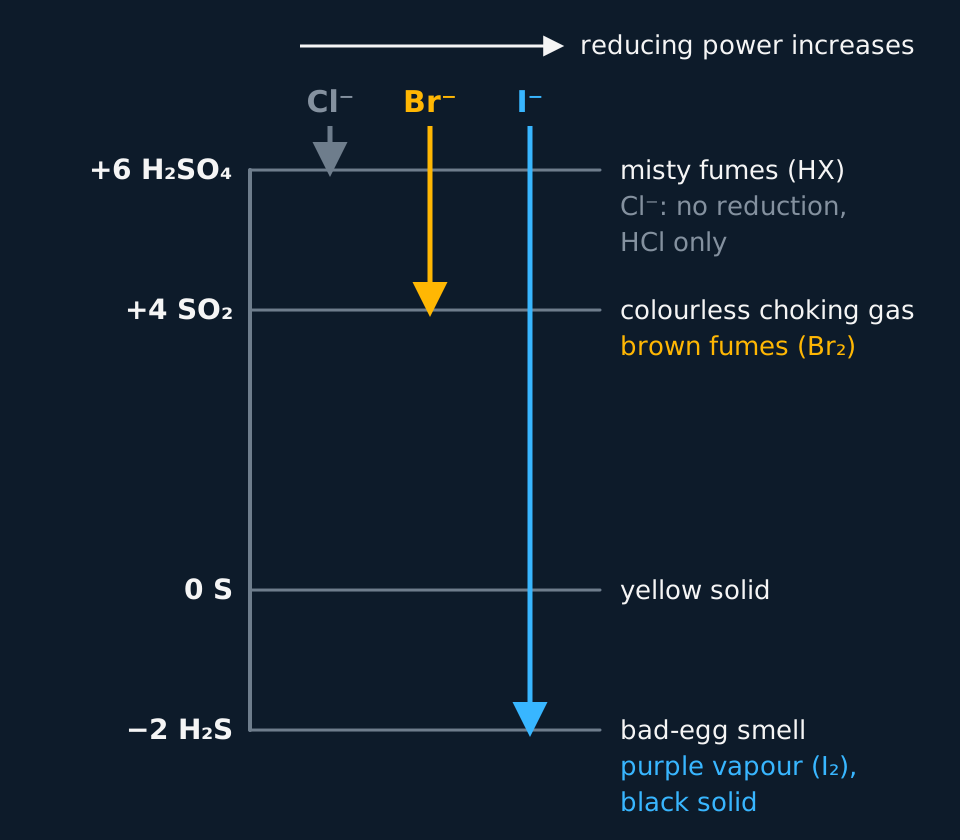
Concentrated sulfuric acid dripped onto solid sodium halides in a fume cupboard shows the trend in reducing ability as a series of observations. Every halide first takes part in an acid–base reaction, giving the hydrogen halide, which forms misty white fumes in moist air. What happens next depends on whether the halide ion is a strong enough reducing agent to reduce the sulfur in the acid, which is in oxidation state +6.
Chloride is too weak a reducing agent to reduce sulfuric acid, so the reaction stops at hydrogen chloride. It is not a redox reaction: nothing changes oxidation state.
NaCl(s) + H₂SO₄(l) → NaHSO₄(s) + HCl(g)Misty white fumes of hydrogen chloride.
Bromide goes one step further. Some of the hydrogen bromide formed reduces sulfuric acid to sulfur dioxide, sulfur going from +6 to +4, and is itself oxidised to bromine.
NaBr(s) + H₂SO₄(l) → NaHSO₄(s) + HBr(g)
2HBr(g) + H₂SO₄(l) → Br₂(g) + SO₂(g) + 2H₂O(l)Brown fumes of bromine and colourless, choking sulfur dioxide.
Iodide is the strongest reducing agent and reduces the sulfur further: to sulfur dioxide (+4), to solid sulfur (0) and to hydrogen sulfide (−2). Very little hydrogen iodide survives, so the misty fumes are slight.
NaI(s) + H₂SO₄(l) → NaHSO₄(s) + HI(g)
2HI(g) + H₂SO₄(l) → I₂(s) + SO₂(g) + 2H₂O(l)
6HI(g) + H₂SO₄(l) → 3I₂(s) + S(s) + 4H₂O(l)
8HI(g) + H₂SO₄(l) → 4I₂(s) + H₂S(g) + 4H₂O(l)
| Halide | Products | Observations | Sulfur goes to |
|---|---|---|---|
| NaCl | HCl | Misty white fumes | Stays +6 (not redox) |
| NaBr | HBr, Br₂, SO₂ | Misty fumes; brown gas (orange-brown fumes) | +4 in SO₂ |
| NaI | HI, I₂, SO₂, S, H₂S | Slight misty fumes; purple vapour and a black solid; a yellow solid; a smell of bad eggs | +4 in SO₂, 0 in S, −2 in H₂S |
Describe the drawing
A vertical ladder of sulfur oxidation states: plus six in sulfuric acid at the top, then plus four in sulfur dioxide, zero in sulfur and minus two in hydrogen sulfide. Three arrows start above the ladder. Chloride's stops at plus six: no reduction, hydrogen chloride only, misty fumes. Bromide's reaches plus four: choking sulfur dioxide and brown bromine fumes. Iodide's runs to minus two, past yellow sulfur, to the bad-egg smell of hydrogen sulfide, with purple iodine vapour and black solid. A side arrow shows reducing power increasing from chloride to iodide.
In an answer, pair each observation with the product it shows: 'misty fumes, HBr', 'brown fumes, Br₂', 'smell of bad eggs, H₂S'. An observation with no substance, or a substance with no observation, is half an answer.
The reaction with sodium chloride is a way of making hydrogen chloride in the laboratory. It cannot make pure hydrogen bromide or hydrogen iodide, because sulfuric acid oxidises them as they form. Concentrated phosphoric acid is used instead: it is an acid but not an oxidising agent, so the reaction stops at the hydrogen halide for all three. The difference between the two acids is the difference between an acid–base reaction and a redox one.
Building the hydrogen sulfide equation from half-equations
Iodide ions reduce sulfuric acid to hydrogen sulfide. Write the overall ionic equation from half-equations.
Show the working
Reduction: sulfur goes from +6 in H₂SO₄ to −2 in H₂S, a gain of 8 electrons. Balance oxygen with water and hydrogen with H⁺: H₂SO₄(l) + 8H⁺(aq) + 8e⁻ → H₂S(g) + 4H₂O(l).
Oxidation: 2I⁻(aq) → I₂(s) + 2e⁻. Multiply by 4 to release 8 electrons: 8I⁻(aq) → 4I₂(s) + 8e⁻.
Add, and the electrons cancel: H₂SO₄(l) + 8H⁺(aq) + 8I⁻(aq) → H₂S(g) + 4I₂(s) + 4H₂O(l). Check: 10 hydrogen, 4 oxygen and no net charge on each side.
The silver nitrate test
To identify a halide ion in solution, add dilute nitric acid and then a few drops of silver nitrate solution. Chloride, bromide and iodide each give a precipitate of the silver halide, and the colour suggests which: white for silver chloride, cream for silver bromide, yellow for silver iodide. Fluoride gives no precipitate, because silver fluoride is soluble.
Ag⁺(aq) + Cl⁻(aq) → AgCl(s)
Ag⁺(aq) + Br⁻(aq) → AgBr(s)
Ag⁺(aq) + I⁻(aq) → AgI(s)
The nitric acid removes carbonate and hydroxide ions, which would otherwise react with silver ions to form precipitates of their own and give a false positive. Hydrochloric acid cannot be used because it adds chloride ions, and sulfuric acid adds sulfate ions, which can precipitate silver sulfate.
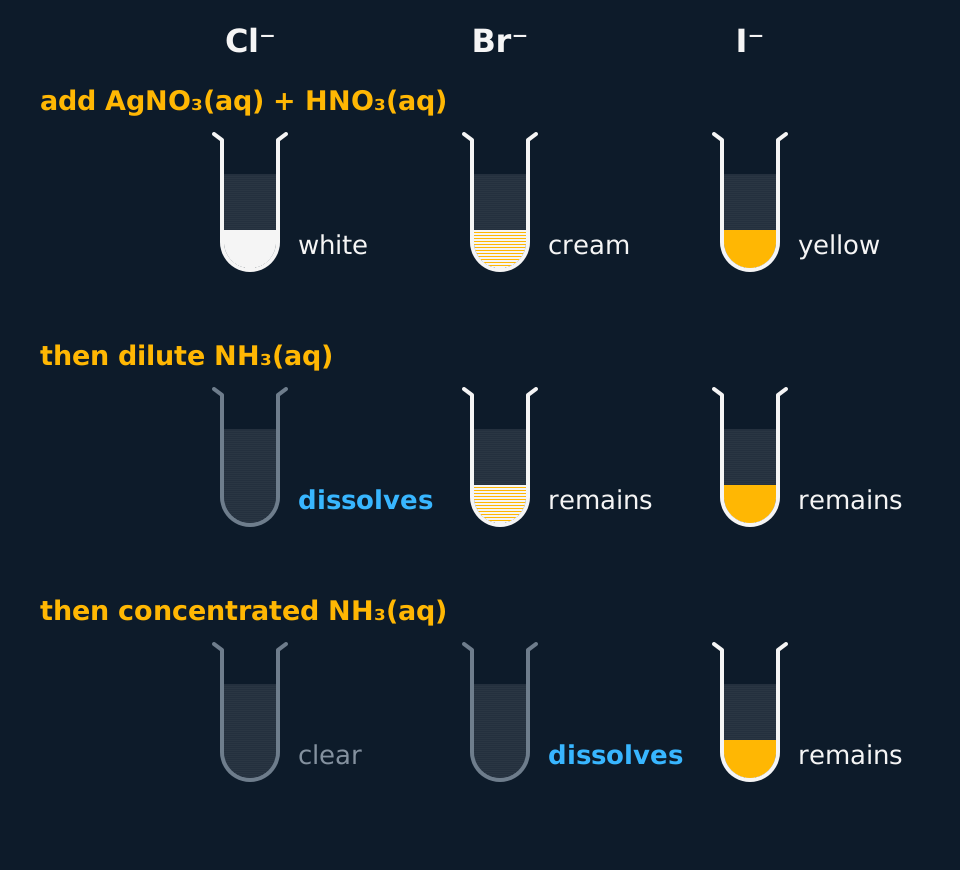
White, cream and pale yellow are close, so ammonia solution is used to confirm. Silver chloride dissolves in dilute ammonia. Silver bromide does not dissolve in dilute ammonia but dissolves in concentrated ammonia. Silver iodide does not dissolve even in concentrated ammonia. The ammonia forms a soluble complex ion with the silver ions, and the less soluble the silver halide, the more concentrated the ammonia needed.
AgCl(s) + 2NH₃(aq) → [Ag(NH₃)₂]⁺(aq) + Cl⁻(aq)
The precipitates are judged straight away. Silver halides are decomposed by light, and a white precipitate of silver chloride left on a sunny windowsill turns purple-grey within minutes as specks of silver form. That reaction was the basis of photographic film. A precipitate that has darkened is harder to tell from cream, which is a second reason for using the ammonia test.
2AgCl(s) → 2Ag(s) + Cl₂(g)Silver chloride decomposing in sunlight.
| Halide ion | With acidified AgNO₃(aq) | With dilute NH₃(aq) | With concentrated NH₃(aq) |
|---|---|---|---|
| F⁻ | No precipitate | Not applicable | Not applicable |
| Cl⁻ | White precipitate | Dissolves | Dissolves |
| Br⁻ | Cream precipitate | Does not dissolve | Dissolves |
| I⁻ | Yellow precipitate | Does not dissolve | Does not dissolve |
Describe the drawing
Three columns of test tubes headed chloride, bromide and iodide. After acidified silver nitrate they hold white, cream and yellow precipitates. After dilute ammonia the white silver chloride has dissolved to a clear solution while cream and yellow remain. After concentrated ammonia the cream silver bromide has dissolved too and only the yellow silver iodide remains.
Which halide? Weighing the precipitate
A 0.300 g sample of a pure sodium halide, NaX, is dissolved in water, acidified with dilute nitric acid and treated with excess silver nitrate solution. The precipitate is filtered, washed, dried in the dark and weighed: 0.547 g. Identify X. Ar values: Na 23.0, Ag 107.9.
Show the working
Each X⁻ ion ends up in one formula unit of AgX, so amount of NaX = amount of AgX. With x as the Ar of X: 0.300 ÷ (23.0 + x) = 0.547 ÷ (107.9 + x).
Cross-multiply: 0.300 × (107.9 + x) = 0.547 × (23.0 + x), so 32.37 + 0.300x = 12.58 + 0.547x.
Collect terms: 32.37 − 12.58 = 0.547x − 0.300x, so 19.79 = 0.247x and x = 80.1. The halogen with Ar closest to 80.1 is bromine, 79.9, so the salt is sodium bromide.
The precipitate should be cream, insoluble in dilute ammonia and soluble in concentrated ammonia. A mass and a colour that agree make the identification secure; the drying is done in the dark because light would decompose the silver bromide.
- Gravimetric analysis
- Finding the amount of a substance by converting it into a precipitate of known formula, which is filtered, dried and weighed.
- Acidified silver nitrate
- Silver nitrate solution to which dilute nitric acid has been added, used to test for halide ions.
- Complex ion
- A central metal ion bonded to one or more ligands by coordinate bonds, as in [Ag(NH₃)₂]⁺.
TRY IT: Two tests on one white solid
A white solid is a sodium halide. With concentrated sulfuric acid it gives misty fumes and a brown gas. Its solution, acidified with nitric acid, gives a precipitate with silver nitrate. Identify the solid, and describe the precipitate and what happens when ammonia is added.
Check your answer
The brown gas is bromine, so the halide ion was strong enough to reduce sulfuric acid to sulfur dioxide but did not give the purple vapour and smell of iodide. The solid is sodium bromide.
With silver nitrate it gives a cream precipitate of silver bromide, Ag⁺(aq) + Br⁻(aq) → AgBr(s). The precipitate does not dissolve in dilute ammonia but dissolves in concentrated ammonia.
Chlorine with water and with sodium hydroxide
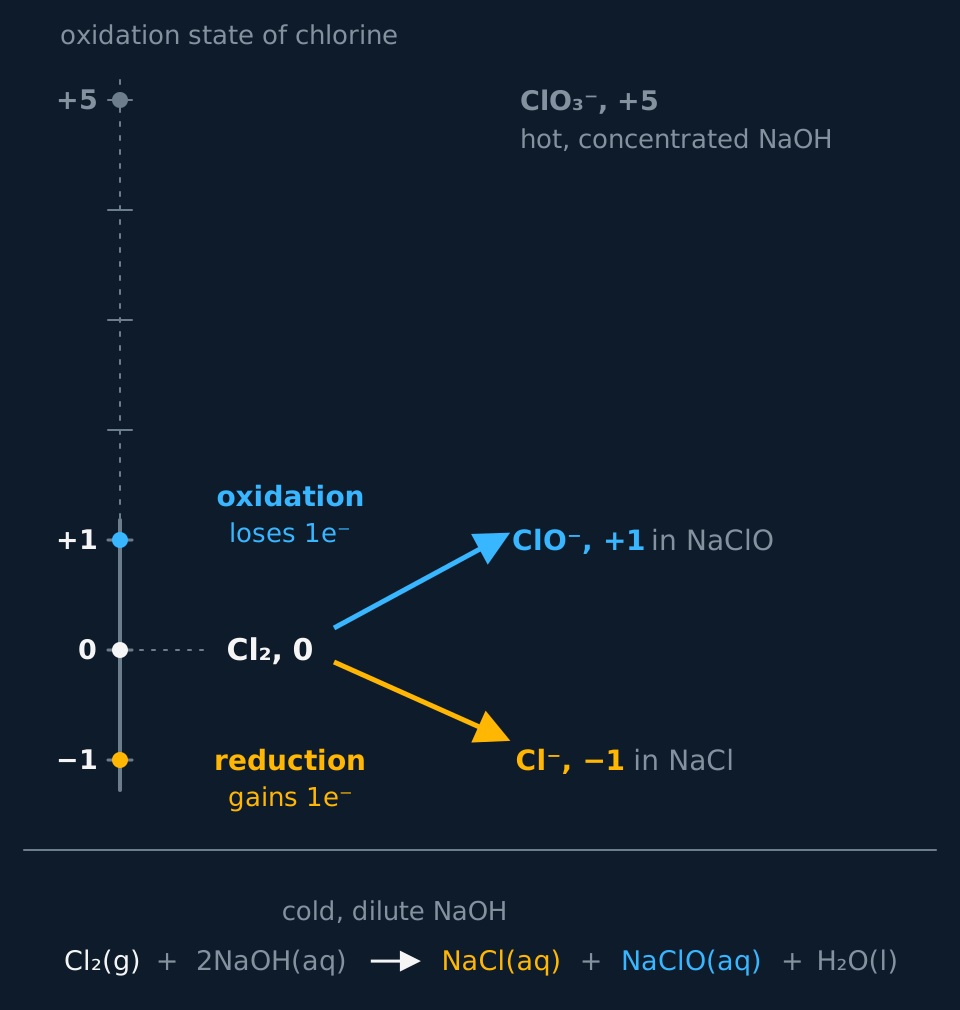
Chlorine dissolves in water and some of it reacts to give a mixture of hydrochloric acid and chloric(I) acid. One chlorine atom of each molecule goes from 0 to −1 in HCl and the other from 0 to +1 in HClO, so chlorine is oxidised and reduced in the same reaction: a disproportionation.
Cl₂(g) + H₂O(l) ⇌ HCl(aq) + HClO(aq)The reaction is reversible, so chlorine water holds Cl₂, HCl and HClO together.
Universal indicator in chlorine water turns red, because both acids are present, and then loses its colour, because chloric(I) acid is a bleach. In bright sunlight chlorine water slowly gives off oxygen: the light decomposes the chloric(I) acid, and the overall reaction leaves only hydrochloric acid.
2Cl₂(g) + 2H₂O(l) → 4HCl(aq) + O₂(g)
Describe the drawing
A vertical axis of chlorine's oxidation state from −1 to +1, with a faint extension up to +5. Cl₂ sits at 0. A cyan arrow rises to ClO⁻, in NaClO, at +1, labelled oxidation, loses one electron; an amber arrow falls to Cl⁻, in NaCl, at −1, labelled reduction, gains one electron. ClO₃⁻ is marked in grey at +5 for hot concentrated sodium hydroxide. Below, the equation for cold dilute sodium hydroxide, Cl₂ plus 2NaOH gives NaCl plus NaClO plus H₂O, coloured to match.
With cold dilute sodium hydroxide, chlorine disproportionates in the same way, but the alkali neutralises the acids as they form. The products are sodium chloride and sodium chlorate(I), NaClO, and the solution is household bleach.
Cl₂(aq) + 2NaOH(aq) → NaCl(aq) + NaClO(aq) + H₂O(l)
The name carries the oxidation state. In the ClO⁻ ion oxygen is −2 and the overall charge is −1, so chlorine is +1, written chlorate(I). In NaCl chlorine is −1. Starting from 0 in Cl₂, one atom has gone up by one and the other down by one, which is the check that the reaction is a disproportionation. Bleach is stored in opaque bottles because light decomposes chlorate(I) ions, and it is not mixed with acidic cleaners, because acid reverses the reaction and releases chlorine gas.
- Disproportionation
- A reaction in which the same element is simultaneously oxidised and reduced.
- Sodium chlorate(I)
- NaClO, the bleaching and disinfecting compound formed when chlorine reacts with cold dilute sodium hydroxide.
Chlorinating drinking water
Chlorine is added to most public water supplies in small, controlled amounts. The chloric(I) acid and chlorate(I) ions it forms oxidise and break down bacteria and other microorganisms, so diseases carried by water, such as cholera and typhoid, are not spread. Because a little chlorine stays in the water, it carries on disinfecting all the way to the tap. The same chemistry stops algae growing in swimming pools and storage tanks.
Against that, chlorine is a toxic gas that attacks the lungs, and it has to be transported and stored safely. In water it can react with organic matter to form chlorinated hydrocarbons, some of which are suspected of causing cancer. Ozone and ultraviolet light disinfect water without chlorine but leave nothing behind to protect it in the pipes.
The judgement made by water authorities is that the benefit to public health far outweighs the small risk from the concentrations used. Adding chlorine to everyone's water is also an ethical question, because people cannot choose not to drink it.
Identifying ions in solution: the test-tube practical
optional reading
Every board sets this practical: carry out simple test-tube reactions to identify cations and anions in aqueous solution, for Group 2 and ammonium ions and for halide, hydroxide, carbonate and sulfate ions. It is AQA required practical 4, OCR PAG 4 and Edexcel core practical 7.
Apparatus: test tubes in a rack; a dropping pipette for each reagent; a test-tube holder; a water bath at about 60 °C; red litmus paper; limewater with a delivery tube and bung, or a teat pipette to carry gas; a wash bottle of deionised water. Reagents, all dilute unless stated: nitric acid, hydrochloric acid, sulfuric acid, barium chloride, silver nitrate, sodium hydroxide, and ammonia solution both dilute and concentrated.
The anion tests are done in a fixed order. Carbonate comes first because carbonate ions give white precipitates with both barium and silver ions. Sulfate comes before the halides because silver sulfate can precipitate from a concentrated sulfate solution. Each test uses a fresh 1 cm³ portion of the unknown.
| Step | What to do | What is seen if the ion is present |
|---|---|---|
| 1 | Dip a strip of red litmus paper into 1 cm³ of the unknown | Red litmus turns blue: OH⁻ |
| 2 | Add dilute nitric acid dropwise; pass any gas through limewater | Effervescence, and the gas turns limewater milky: CO₃²⁻ |
| 3 | Add dilute hydrochloric acid until any fizzing stops, then a few drops of barium chloride solution | White precipitate: SO₄²⁻ |
| 4 | Add dilute nitric acid until any fizzing stops, then a few drops of silver nitrate solution | White, cream or yellow precipitate: Cl⁻, Br⁻ or I⁻ |
| 5 | Add dilute ammonia solution to the precipitate; if it stays, repeat on a fresh precipitate with concentrated ammonia in a fume cupboard | White precipitate soluble in dilute ammonia: Cl⁻. Cream precipitate soluble in concentrated ammonia: Br⁻. Yellow precipitate insoluble in concentrated ammonia: I⁻ |
| 6 | Add sodium hydroxide solution dropwise to 1 cm³ of the unknown, then in excess | White precipitate: Mg²⁺. Slight white precipitate: Ca²⁺. Very slight or none: Sr²⁺ or Ba²⁺ |
| 7 | Add dilute sulfuric acid dropwise to a fresh 1 cm³ | Dense white precipitate: Ba²⁺. White precipitate: Sr²⁺. Slight white precipitate: Ca²⁺. No change: Mg²⁺ |
| 8 | Add sodium hydroxide solution, warm in the water bath, and hold damp red litmus paper at the mouth of the tube without touching the glass | Damp red litmus turns blue as ammonia is given off: NH₄⁺ |
NH₄⁺(aq) + OH⁻(aq) → NH₃(g) + H₂O(l)The ammonium test: ammonia is the only common alkaline gas.
Ca(OH)₂(aq) + CO₂(g) → CaCO₃(s) + H₂O(l)Limewater turns milky as a white precipitate of calcium carbonate forms.
| Error | What goes wrong | How to avoid it |
|---|---|---|
| Acidifying with hydrochloric acid before silver nitrate | Chloride is added, so a white precipitate forms every time | Use dilute nitric acid |
| Acidifying with sulfuric acid before barium chloride | Sulfate is added, so a white precipitate forms every time | Use dilute hydrochloric or nitric acid |
| Not acidifying at all | Carbonate gives white BaCO₃ or a silver carbonate precipitate | Add acid until fizzing stops before the test reagent |
| Adding the reagent quickly, all at once | A slight precipitate is missed or misjudged | Add dropwise, view against a dark background, and compare with a tube of deionised water |
| Tap water or a shared pipette | Tap water contains Cl⁻ and Ca²⁺; a dirty pipette carries ions between tubes | Rinse with deionised water; one pipette per reagent |
| Dry litmus, or litmus touching the tube | Ammonia shows as alkaline only when it dissolves; sodium hydroxide on the glass turns the paper blue without ammonia | Dampen the paper and hold it in the mouth of the tube |
| Judging white against cream by eye | The colours are close, and silver halides darken in light | Confirm with ammonia, and look at the precipitate at once |
Record what is seen in the mark-scheme words: 'white precipitate', 'effervescence', 'no visible change'. 'Goes cloudy' and 'reacts' do not identify anything. When an unknown gives no result in a test, write that down too: a negative result is evidence, and it is often what decides between two ions. Where a result is doubtful, repeat it beside a known solution of the ion, run at the same concentration.
Risks. Concentrated ammonia gives off an irritating vapour and is used in a fume cupboard. Silver nitrate stains skin and is an irritant; barium chloride is harmful if swallowed; sodium hydroxide damages eyes even when dilute. Wear eye protection throughout. Check the CLEAPSS Hazcard for each substance and the school's own risk assessment; where they differ from this method, follow them.
Other boards: the hydrogen halides as acids, and chlorine with hot alkali
Edexcel also asks what the hydrogen halides do once they are made. Each is a colourless gas that is very soluble in water, and the misty fumes are droplets of acid formed as the gas dissolves in the water vapour of moist air. In water the hydrogen halide gives its proton to a water molecule. Hydrogen chloride, bromide and iodide ionise completely, so their solutions are strong acids; hydrogen fluoride, with its much stronger H–F bond, ionises only partly and is a weak acid.
HCl(g) + H₂O(l) → H₃O⁺(aq) + Cl⁻(aq)Hydrogen chloride dissolving to give hydrochloric acid.
A glass rod dipped in concentrated ammonia solution and held in the fumes gives dense white smoke. Ammonia is a base: it takes the proton from the hydrogen halide, and the ammonium halide forms as a cloud of tiny solid particles. The smoke confirms that the misty fumes are a hydrogen halide, but chloride, bromide and iodide all give it, so it does not say which.
NH₃(g) + HCl(g) → NH₄Cl(s)White smoke of ammonium chloride.
- Hydrogen halide
- A compound of hydrogen and a halogen, HX, which forms misty white fumes in moist air.
- Strong acid
- An acid that is completely dissociated into ions in aqueous solution.
Edexcel and Cambridge also examine chlorine with hot concentrated alkali. The disproportionation goes further: one chlorine atom in six rises from 0 to +5 in the chlorate(V) ion, and the other five fall to −1 in chloride. Cold dilute alkali gives chlorate(I), hot concentrated alkali chlorate(V), and the temperature is part of the answer.
3Cl₂(aq) + 6NaOH(aq) → 5NaCl(aq) + NaClO₃(aq) + 3H₂O(l)Hot, concentrated sodium hydroxide. Chlorine goes from 0 to +5 in NaClO₃ and from 0 to −1 in NaCl.
Cambridge examines the same ion tests in its practical paper, where the notes printed with the questions add tests for nitrate and sulfite ions and for hydrogen, oxygen, chlorine and sulfur dioxide, and describe silver bromide as partially soluble in dilute ammonia.
In the exam
- A six-mark answer on concentrated sulfuric acid and the halides is levelled: the top level of the scheme needs observations matched to products for all three halides, at least one redox equation, and the trend explained by the size of the halide ion.
- Nitric acid is added before silver nitrate to remove carbonate and hydroxide ions. The scheme does not accept hydrochloric acid, which adds the chloride ions being tested for.
- Give the ammonia results in full: 'cream precipitate, insoluble in dilute ammonia, soluble in concentrated ammonia' identifies bromide. A colour on its own does not identify the halide.
- Disproportionation is credited with the oxidation states: chlorine goes from 0 to −1 in HCl and from 0 to +1 in HClO or NaClO, both changes stated.
- An evaluation of chlorination needs a benefit (disinfects, prevents cholera and typhoid, residual effect), a risk (toxic gas, chlorinated organic compounds) and a conclusion weighing them.
Check yourself
A student adds concentrated sulfuric acid to a solid that is a mixture of sodium chloride and sodium iodide. Predict what she observes, and explain why the chloride and the iodide behave differently.
Answer
Both halides give hydrogen halide first, so misty white fumes appear, mainly hydrogen chloride, since most of the hydrogen iodide reacts further.
The iodide also produces purple vapour and a black solid (iodine), a yellow solid (sulfur) and a smell of bad eggs (hydrogen sulfide), with some sulfur dioxide. Iodide reduces the sulfur from +6 down to +4, 0 and −2.
Chloride does not reduce sulfuric acid. A chloride ion is smaller, so its outer electrons are closer to the nucleus and less shielded; they are held too strongly to be given to the sulfur. An iodide ion is larger and loses electrons more easily, so it is the stronger reducing agent.
Questions
Question 16 marks
Describe how test-tube reactions could be used to find out whether an unknown solution contains carbonate, sulfate or chloride ions. Give the order of the tests, the reagents and the observations, and explain the order.
Mark scheme
Indicative content
- test for carbonate first by adding dilute nitric acid: effervescence, and the gas turns limewater milky
- test a fresh portion for sulfate by adding dilute hydrochloric acid, then barium chloride solution: a white precipitate
- test a fresh portion for chloride by adding dilute nitric acid, then silver nitrate solution: a white precipitate
- the chloride is confirmed when the white precipitate dissolves in dilute ammonia, which neither bromide nor iodide precipitates do
- carbonate is tested first because carbonate ions give white precipitates with both barium and silver ions
- sulfate is tested before chloride because silver sulfate can precipitate, and the acids are chosen so as not to add the ion being tested for
Levels
- Level 3 (5–6 marks) all three tests are given in the right order with the reagents, the acids and the observations, the ammonia confirmation for chloride is included, and both reasons for the order are explained, carbonate interfering with both later tests and silver sulfate interfering with the chloride test; the answer explains why each acid is chosen
- Level 2 (3–4 marks) the three tests have the right reagents and observations; the order is only partly justified, the ammonia confirmation is left out, or an acid is chosen that adds the ion under test
- Level 1 (1–2 marks) one or two tests are described; the usual slip is to acidify the barium chloride test with sulfuric acid or the silver nitrate test with hydrochloric acid
Question 26 marksAQA · Edexcel · CAIE
Describe and explain the reactions of solid sodium chloride, sodium bromide and sodium iodide with concentrated sulfuric acid. Include observations, equations and the trend in the reducing ability of the halide ions.
Mark scheme
Indicative content
- with sodium chloride, misty white fumes of hydrogen chloride form, NaCl + H₂SO₄ → NaHSO₄ + HCl, an acid–base reaction that is not redox
- with sodium bromide, misty fumes of hydrogen bromide form first, and then brown fumes of bromine and colourless, choking sulfur dioxide
- 2HBr + H₂SO₄ → Br₂ + SO₂ + 2H₂O, in which sulfur is reduced from +6 to +4 and bromide is oxidised to bromine
- with sodium iodide there are few misty fumes, but purple vapour or a black solid of iodine, a yellow solid of sulfur and a bad-egg smell of hydrogen sulfide
- iodide reduces sulfur to +4 in SO₂, 0 in S and −2 in H₂S, for example 8HI + H₂SO₄ → 4I₂ + H₂S + 4H₂O
- reducing ability increases from chloride to iodide because the larger ion's outer electrons are further from the nucleus and more shielded, so lost more easily
Levels
- Level 3 (5–6 marks) the observations for all three halides are given and matched to the products, the chloride reaction is identified as acid–base only, the bromide and iodide reactions are shown with equations and the oxidation states of sulfur in each product, and the trend in reducing power is explained through the size and shielding of the halide ion
- Level 2 (3–4 marks) the observations for the three halides are mostly right and one equation carries oxidation states; the chloride reaction is not called acid–base, the sulfur products from iodide are incomplete, or the trend is unexplained
- Level 1 (1–2 marks) misty or brown fumes are mentioned; the chloride is often said to reduce the acid to sulfur dioxide, and no oxidation states are given
Question 34 marksAQA · Edexcel · CAIE
Explain the trend in the reducing ability of the halide ions from fluoride to iodide.
Mark scheme
- B1 reducing ability increases from fluoride to iodide
- B1 an iodide ion is larger, so its outer electrons are further from the nucleus
- B1 its outer electrons are more shielded by inner shells
- B1 they are less strongly attracted, so an iodide ion loses an electron more easily; reject 'iodine loses electrons'
All 21 questions with mark schemes, the other 18 set out in full on the question page.
Worth remembering
- Chloride with concentrated sulfuric acid is not redox: nothing changes oxidation state.
- Pair every observation with its product: brown fumes are Br₂, the bad-egg smell is H₂S.
- Acidify silver nitrate with nitric acid; hydrochloric adds chloride and sulfuric adds sulfate.
- Confirm the halide with ammonia; white, cream and yellow alone are too close to call.
- Call a reaction disproportionation only after giving both chlorine oxidation-state changes.
CHECK YOUR PROGRESS
Rate how confident you are with each objective for this lesson. Ratings are saved in this browser, on this device, unless you sign in.
- Explain why the reducing ability of the halide ions increases from fluoride to iodide.
- Describe and explain the reactions of solid sodium chloride, bromide and iodide with concentrated sulfuric acid, with equations, observations and the oxidation states of sulfur.
- Describe the silver nitrate test, including the ammonia test, and explain why the silver nitrate is acidified with nitric acid.
- Write equations for chlorine with water, in the dark and in sunlight, and with cold dilute sodium hydroxide, identifying disproportionation.
- Evaluate the use of chlorine in treating drinking water.
- Carry out test-tube tests to identify Group 2 ions, ammonium, hydroxide, carbonate, sulfate and halide ions in solution.
Open the full revision checklist to see every objective in the curriculum in one place.
Practise this lesson
WORKBOOK
The questions from this topic, on paper with room to work, and a separate book of mark schemes. Free to use; please do not redistribute or sell.
Used later in Reactions of aqua ions with hydroxide, ammonia and carbonate · Halogenoalkanes: nucleophilic substitution and rates of hydrolysis