Chemistry › Practicals › Identifying metal ions in solution: iron, copper and aluminium
Required practical 11: identifying metal-aqua ions (OCR PAG 4, Edexcel CP 15)
Identify Fe²⁺, Cu²⁺, Fe³⁺ and Al³⁺ from what sodium hydroxide, ammonia and sodium carbonate do to each, a little at a time and then in excess.
This is the method section of Reactions of aqua ions with hydroxide, ammonia and carbonate on a page of its own, with its variables, sample results, an evaluation and questions set on it. The chemistry behind it is in that lesson.
The capability this develops
This investigation is one instance of capability P04: Identifying ions in solution by test-tube reactions, which sets out the techniques it belongs to, the calculations it carries and the errors that cost marks in all of them. The notes behind the chemistry are in Ions in aqueous solution.
Where this sits on the specifications
Each qualification is mapped to its own specification one numbered heading at a time, against a document whose sha256 is recorded. These are the headings that list the lesson this method is taught in, on the four qualifications mapped. Each links to the route map the row belongs to.
| Qualification | Heading |
|---|---|
| AQA 7404/7405 | 3.2.6 Reactions of ions in aqueous solution |
| OCR Chemistry A H032/H432 | 5.3.1 Transition elements |
| OCR Chemistry A H032/H432 | 5.3.2 Qualitative analysis |
| Pearson Edexcel Chemistry 8CH0/9CH0 | 15.24 Cr3+, Fe2+, Fe3+, Co2+, Cu2+ with NaOH and NH3 |
| Pearson Edexcel Chemistry 8CH0/9CH0 | 15.25 ligand exchange against amphoteric behaviour |
| Pearson Edexcel Chemistry 8CH0/9CH0 | 15.26 ligand exchange with colour: Cu and Co |
| Cambridge International 9701 | 9.2 Periodicity of chemical properties of the elements in Period 3 |
| Cambridge International 9701 | 28.2 General characteristic chemical properties of the first set of transition elements, titanium to copper |
Three boards number their practical activities, and those lists were read here from the same specifications as the headings above. This investigation is filed on them as:
- AQA 7404/7405 required practical 11: Test-tube tests for transition metal ions
- OCR Chemistry A H032/H432 PAG 4: Qualitative analysis of ions
- Pearson Edexcel Chemistry 8CH0/9CH0 core practical 15: Inorganic and organic unknowns
Use your awarding organisation’s current specification and its practical handbook as the authority on which activities your course requires and how they are assessed.
Apparatus
Test tubes in a rack, a white tile or sheet of paper to set them against, a separate dropping pipette for each reagent, a 10 cm³ measuring cylinder, and limewater with a clean pipette for testing a gas. Solutions, each at about 0.1 mol dm⁻³: iron(II) sulfate, freshly made, or ammonium iron(II) sulfate; copper(II) sulfate; iron(III) chloride; aluminium sulfate. Reagents: sodium hydroxide at about 0.4 mol dm⁻³, aqueous ammonia at about 2 mol dm⁻³ and sodium carbonate at about 0.5 mol dm⁻³.
Safety
Sodium hydroxide at 0.4 mol dm⁻³ irritates the eyes and skin. Copper(II) sulfate is harmful if swallowed and toxic to aquatic life, so the residues go in the waste container, not the sink. Aqueous ammonia gives off ammonia gas, which irritates the eyes and airways: keep the bottle stoppered and the room ventilated. Wear eye protection throughout. Check the CLEAPSS Hazcard for each substance and the school's risk assessment before starting, and follow them where they differ from the advice here.
Variables
Independent variable
The reagent added to a fresh tube of the solution: sodium hydroxide, aqueous ammonia or sodium carbonate, a little at a time and then in excess.
Dependent variable
What is seen: the colour of the solution, the colour of any precipitate, whether it dissolves in excess, effervescence, and any change on standing.
Control variables
- The metal ion solutions, each at about 0.1 mol dm⁻³ and 1 cm³ in every tube, so a precipitate from an unknown is as dense as the one from its known.
- The reagent concentrations, sodium hydroxide at about 0.4 mol dm⁻³, ammonia at about 2 mol dm⁻³ and sodium carbonate at about 0.5 mol dm⁻³, because whether a hydroxide dissolves in excess depends on how concentrated the excess is.
- The way each reagent is added, drop by drop with shaking and then to half full, and the white tile every tube is viewed against.
- Time: the iron(II) tubes are described as they first appear and again after ten minutes, with a separate pipette for every reagent and a fresh iron(II) solution.
The identification table is a set of comparisons, and the knowns are run first so that the colours are seen with these reagents at these concentrations. An unknown is identified by holding it beside its matching known, so everything about the two tubes except the ion has to be the same.
Method
| Step | What to do | Why |
|---|---|---|
| 1 | Put about 1 cm³ of the metal ion solution into each of three test tubes, and record its colour against the white tile | The colour of the aqua ion is the first clue; pale colours show only against white |
| 2 | To the first tube add sodium hydroxide a drop at a time, shaking after each drop, until a precipitate forms; record its colour | Added slowly, the precipitate is seen before any excess can dissolve it |
| 3 | Keep adding sodium hydroxide, shaking, until the tube is about half full; record whether the precipitate dissolves | Excess means far more than the ion needs; a few extra drops do not dissolve aluminium hydroxide |
| 4 | Repeat steps 2 and 3 on the second tube with aqueous ammonia | Copper(II) hydroxide dissolves in excess ammonia; aluminium hydroxide does not |
| 5 | To the third tube add sodium carbonate a few drops at a time, watching the surface for bubbles; test any gas with limewater | Effervescence marks a 3+ ion; limewater turning milky shows the gas is carbon dioxide |
| 6 | Leave the iron(II) tubes for ten minutes and look again | The green precipitate darkens as air oxidises iron(II) to iron(III) |
| 7 | Repeat for each known solution, then for the unknowns, recording every observation in a results table as it happens | The knowns give a reference set made with the same reagents |
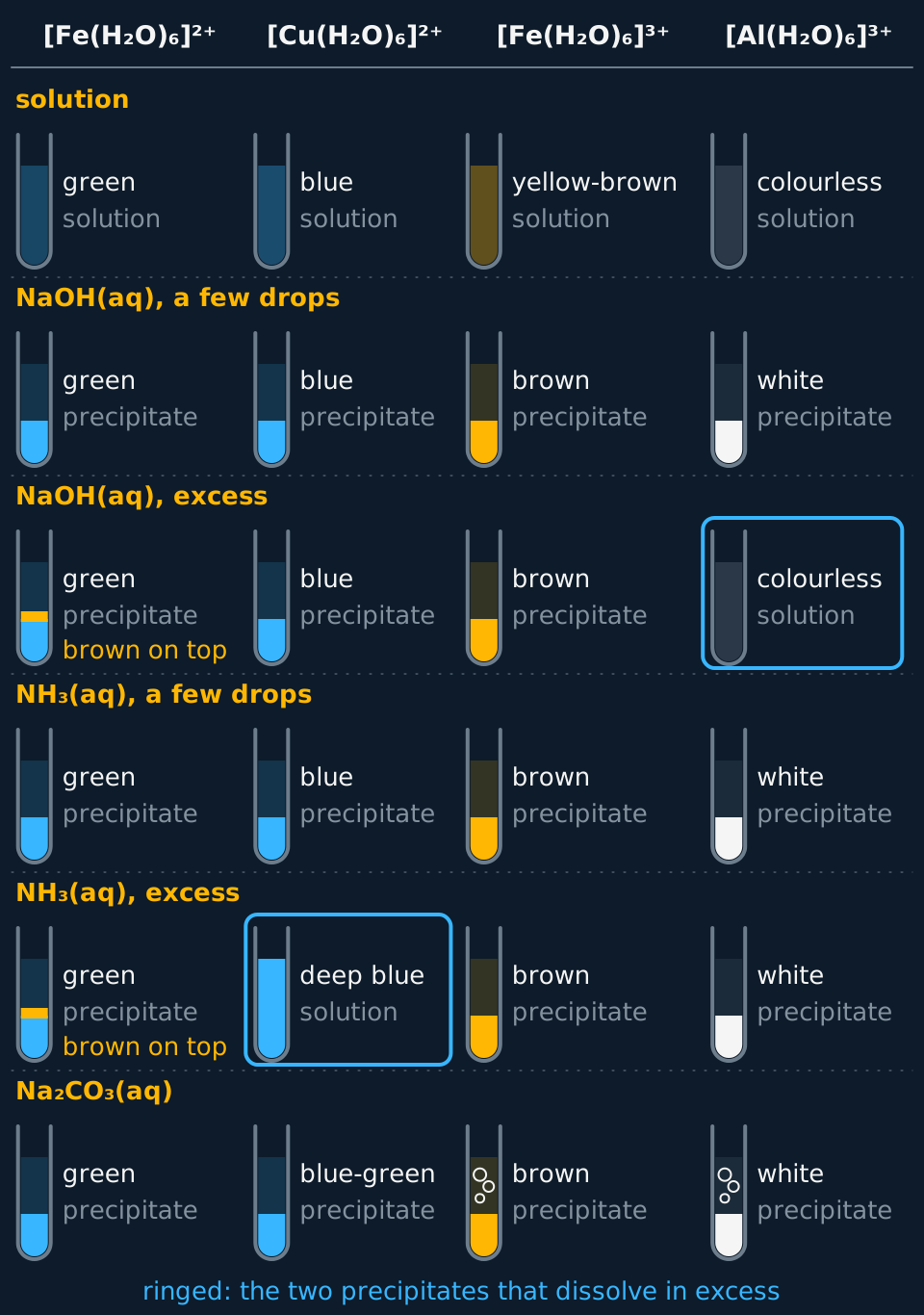
Describe the drawing
A grid of small test tubes: one column for each of the four aqua ions, iron(II), copper(II), iron(III) and aluminium, and one row for each test: the solution itself, sodium hydroxide a few drops and in excess, ammonia a few drops and in excess, and sodium carbonate. Each tube is labelled in words. Iron(II) gives a green solution and green precipitates throughout, brown at the surface in both excess cells. Copper(II) gives a blue solution, blue precipitates, a deep blue solution in excess ammonia and a blue-green carbonate. Iron(III) gives a yellow-brown solution and brown precipitates, with bubbles from carbonate. Aluminium gives a colourless solution and white precipitates, a colourless solution in excess hydroxide, and bubbles from carbonate. The two dissolving cells are ringed.
What is measured
Record what is seen in the words of the identification table: 'blue precipitate', 'dissolves in excess to a deep blue solution', 'no change'. Write 'no visible change' where nothing happens; a blank cell is not a result.
What is observed with the four known solutions is the identification table, and the knowns are run first so that the colours are seen with these reagents at these concentrations. A precipitate can look paler in a dilute solution, and a thin suspension is easier to judge against the white tile than against the bench. Hold each unknown tube beside the matching known before writing anything down.
Sample results
These are the idealised results: the identification table the lesson teaches, which is what each known solution gives. A dilute solution can give a paler precipitate.
| Aqua ion | Sodium hydroxide | Ammonia | Sodium carbonate |
|---|---|---|---|
| [Fe(H₂O)₆]²⁺, green solution | Green precipitate, darkens on standing in air; no change in excess | Green precipitate, darkens on standing; no change in excess | Green precipitate of FeCO₃ |
| [Cu(H₂O)₆]²⁺, blue solution | Blue precipitate; no change in excess | Blue precipitate; dissolves in excess to a deep blue solution | Blue-green precipitate of CuCO₃ |
| [Fe(H₂O)₆]³⁺, yellow-brown solution | Brown precipitate; no change in excess | Brown precipitate; no change in excess | Brown precipitate and effervescence |
| [Al(H₂O)₆]³⁺, colourless solution | White precipitate; dissolves in excess to a colourless solution | White precipitate; no change in excess | White precipitate and effervescence |
Evaluation
The limitations of the method, what each does to the result and in which direction, and the improvement a mark scheme credits.
| Limitation | What it does to the result | Improvement |
|---|---|---|
| Four ions are a short list | Other transition metal ions give results that overlap: chromium(III) gives a green precipitate with sodium hydroxide that dissolves in excess, which beside a dilute iron(II) tube is easy to misread | Run more known solutions, and confirm an identification with a second kind of evidence, such as the colour of the aqua ion itself or a flame test where the metal gives one |
| Effervescence with carbonate shows acidity, not charge | The test rests on the 3+ aqua ions being acidic enough to release carbon dioxide; an iron(II) solution that has been acidified to stop it oxidising fizzes too, and is recorded as 3+ | Check the pH of each solution first with indicator paper, and use solutions that have not been acidified, freshly made |
| A precipitate is judged against the colour of the solution it forms in | Copper(II) hydroxide is seen through blue solution and iron(III) hydroxide through yellow-brown, and a thin suspension takes its colour from both | Let the precipitate settle, or filter it, and describe the solid against the white tile; record the colour of the solution separately |
| "Dissolves in excess" depends on how much and how strong | Aluminium hydroxide dissolves in 0.4 mol dm⁻³ sodium hydroxide once the tube is half full, but a few drops of a dilute reagent leave it unchanged, and the result then reads like iron(III) | Add the reagent until the tube is half full, shake, and allow a minute; a precipitate that has not dissolved by then is recorded as insoluble |
Errors in carrying it out
Two observations are easy to get wrong. A brown precipitate from iron(III) and a green one from iron(II) that has stood for a while can look alike, so the iron(II) precipitate is described as it first appears. And a slight fizz with carbonate can be missed altogether; a stoppered tube with a delivery tube into limewater shows the gas even when the bubbles are few.
| Error | What it does to the result | How to avoid it |
|---|---|---|
| Sodium hydroxide poured into aluminium solution quickly | The white precipitate forms and redissolves where the alkali is concentrated, and is never seen | Add it a drop at a time and shake after each drop |
| Too little reagent added for 'excess' | Aluminium hydroxide or copper(II) hydroxide seems not to dissolve | Add until the tube is about half full, then shake |
| Iron(II) solution made the day before | Some iron(II) is already iron(III), so the precipitate is brown-green from the start | Use a freshly made solution, or ammonium iron(II) sulfate |
| One dropping pipette shared between reagents | Traces of one reagent reach another bottle and tube | Use one pipette per reagent and do not swap them |
| Bubbles with carbonate missed | A 3+ ion is recorded as 2+ | Watch the moment of mixing and test the gas with limewater |
Questions
Question 1 (6 marks)
Outline a method, using test-tube reactions, to show that a solution contains Cu²⁺(aq) and not Fe²⁺(aq), Fe³⁺(aq) or Al³⁺(aq). Give the expected observations and equations.
Mark scheme
Indicative content
- put about 1 cm³ of the solution in each of two test tubes and note that it is blue against a white tile
- add sodium hydroxide dropwise with shaking: a blue precipitate, which rules out the green, brown and white hydroxides of the other ions
- the equation for the first tube is [Cu(H₂O)₆]²⁺(aq) + 2OH⁻(aq) → [Cu(H₂O)₄(OH)₂](s) + 2H₂O(l), with state symbols
- to the second tube add aqueous ammonia dropwise and then in excess: a blue precipitate that dissolves to a deep blue solution
- the equation for the excess ammonia is [Cu(H₂O)₄(OH)₂](s) + 4NH₃(aq) → [Cu(NH₃)₄(H₂O)₂]²⁺(aq) + 2H₂O(l) + 2OH⁻(aq)
- excess means adding until the tube is about half full, with shaking, and eye protection is worn
Levels
- Level 3 (5–6 marks) the colour of the solution, the blue hydroxide precipitate that rules out the other three ions, the dissolving in excess ammonia to the deep blue complex and both equations with state symbols are all present, with the practical detail of dropwise addition and excess; the observations are matched to each ion excluded
- Level 2 (3–4 marks) sodium hydroxide and ammonia are used, with the blue precipitate and the deep blue solution in excess ammonia; one equation is missing or unbalanced, or the other three ions are never ruled out
- Level 1 (1–2 marks) a blue precipitate is reported with no equations, often said to dissolve in excess sodium hydroxide, and nothing shows how Fe²⁺, Fe³⁺ or Al³⁺ would look different
Question 2 (2 marks)
Suggest why a student who pours sodium hydroxide quickly into a solution of aluminium sulfate may record that no precipitate forms.
Mark scheme
- B1 where the alkali enters, the hydroxide is locally in excess
- B1 any white aluminium hydroxide that forms there redissolves at once, so the precipitate is never seen
Question 3 (4 marks)
Evaluate a student's plan to identify which of four solutions contains Fe²⁺, Cu²⁺, Fe³⁺ or Al³⁺ by adding a few drops of aqueous ammonia to each and noting only the colour of the precipitate.
Mark scheme
- B1 the plan works: the four precipitates are green, blue, brown and white, all different
- B1 the Fe(II) precipitate darkens on standing in air, so it should be observed straight away to avoid confusion with Fe(III)
- B1 adding ammonia in excess would confirm copper, whose precipitate dissolves to a deep blue solution
- B1 adding sodium hydroxide in excess, or sodium carbonate, would confirm aluminium, by the amphoteric hydroxide or effervescence
Question 4 (4 marks)
Describe what is seen when a few drops of sodium hydroxide solution are added to iron(II) sulfate solution and the tube is then left open to the air, and explain the change on standing.
Mark scheme
- B1 a green precipitate forms from the pale green solution
- B1 the precipitate darkens, turning brown at the surface first, on standing in air
- B1 oxygen from the air oxidises iron(II) to iron(III)
- B1 green [Fe(H₂O)₄(OH)₂] becomes brown [Fe(H₂O)₃(OH)₃], starting where the air reaches it; allow Fe(OH)₂ and Fe(OH)₃
Question 5 (3 marks)
Write equations for the reaction of [Al(H₂O)₆]³⁺ with sodium hydroxide, a little and then in excess, and state what is seen at each stage.
Mark scheme
[Al(H₂O)₆]³⁺ + 3OH⁻ → Al(H₂O)₃(OH)₃ + 3H₂O.
Al(H₂O)₃(OH)₃ + OH⁻ → [Al(OH)₄]⁻ + 3H₂O.
A white precipitate forms, then dissolves in excess to a colourless solution.
Question 6 (3 marks)
Explain why a solution of iron(III) ions effervesces with sodium carbonate but a solution of iron(II) ions gives a precipitate of iron(II) carbonate.
Mark scheme
Fe³⁺ has a higher charge density than Fe²⁺, so it polarises the O–H bonds of its water ligands more strongly and [Fe(H₂O)₆]³⁺ is the stronger acid.
It releases enough H⁺ for carbonate ions to react, giving carbon dioxide and the hydroxide precipitate: 2[Fe(H₂O)₆]³⁺ + 3CO₃²⁻ → 2Fe(H₂O)₃(OH)₃ + 3CO₂ + 3H₂O.
The iron(II) aqua ion is too weakly acidic, so carbonate ions simply precipitate it as FeCO₃.
Question 7 (2 marks)
Explain why the copper(II) hydroxide precipitate dissolves in excess ammonia but not in excess sodium hydroxide.
Mark scheme
Ammonia is a ligand and substitutes for water, forming the soluble deep blue complex [Cu(NH₃)₄(H₂O)₂]²⁺.
Hydroxide ions at this concentration form no soluble complex with copper(II), so the precipitate remains.
Question 8 (2 marks)
A green precipitate turns brown at its surface after a few minutes. Identify the ion originally present and explain the change.
Mark scheme
Fe²⁺, as the green precipitate of iron(II) hydroxide.
Oxygen in the air oxidises iron(II) to iron(III), so the surface becomes brown iron(III) hydroxide.
Question 9 (3 marks)
A colourless solution gives a white precipitate with sodium hydroxide that dissolves in excess, a white precipitate with ammonia that does not, and effervescence with sodium carbonate. Identify the ion and explain how each result rules out the others in the table.
Mark scheme
Al³⁺.
A colourless solution and a white precipitate rule out Fe²⁺, Cu²⁺ and Fe³⁺, whose solutions and precipitates are coloured.
Dissolving in excess hydroxide shows an amphoteric hydroxide, not dissolving in ammonia rules out copper, and effervescence with carbonate shows a 3+ ion.
Question 10 (2 marks)
Explain why each unknown tube is held beside the matching known tube before an observation is written down.
Mark scheme
The colour and depth of a precipitate depend on the concentration of the ion and of the reagent.
The known was made with the same reagents at a similar concentration, so it shows what this test gives here, and a pale precipitate from a dilute unknown is not misread.
Coverage maps are available for AQA 7404/7405, OCR Chemistry A H032/H432, Pearson Edexcel Chemistry 8CH0/9CH0 and Cambridge International 9701. Use the relevant route map to check what InkChemistry covers, and your awarding organisation’s current specification as the final authority on examinable content.