Chemistry › Ions in aqueous solution › Reactions of aqua ions with hydroxide, ammonia and carbonate
Reactions of aqua ions with hydroxide, ammonia and carbonate
Hydroxide ions and ammonia are bases, and each takes protons from the water ligands of a metal-aqua ion until the complex has no charge and precipitates. Carbonate does the same to a 3+ aqua ion, with effervescence, but gives the metal carbonate with a 2+ ion. The colour of the precipitate, and whether it dissolves in excess, identifies the ion. Aluminium hydroxide dissolves in excess sodium hydroxide because it is amphoteric; copper(II) hydroxide dissolves in excess ammonia because ammonia replaces water as the ligand.
Key terms Every definition in ions in aqueous solution, lesson by lesson
Before this Metal-aqua ions and the acidity of their solutions – hydrolysis, and why 3+ aqua ions are stronger acids than 2+ · Ligands, the shapes of complexes, isomerism and ligand substitution – ammonia replacing water around copper(II) · Halide ions, the silver nitrate test, concentrated sulfuric acid, and chlorine in water – test-tube reactions and recording observations
COMMON MISCONCEPTION
Ammonia solution is a weaker version of sodium hydroxide, so it does exactly what sodium hydroxide does, only less.
A few drops of either give the same hydroxide precipitate, because both are bases. In excess they differ. Excess sodium hydroxide dissolves the amphoteric Al(OH)₃ as [Al(OH)₄]⁻. Excess ammonia dissolves the copper precipitate instead, acting as a ligand to give deep blue [Cu(NH₃)₄(H₂O)₂]²⁺.
What you should be able to do
- Describe the reactions of the iron(II), copper(II), iron(III) and aluminium aqua ions with sodium hydroxide, ammonia and sodium carbonate, giving each observation in the words the mark scheme uses.
- Write each reaction as an acid–base reaction of the aqua ion, balanced and with state symbols.
- Explain why aluminium hydroxide dissolves in excess sodium hydroxide, and state what amphoteric means.
- Explain why copper(II) hydroxide dissolves in excess ammonia, and write the equation for the ligand substitution.
- Describe the reactions of the chromium(III), manganese(II) and cobalt(II) aqua ions with sodium hydroxide and ammonia.Edexcel · OCR A
- Carry out test-tube reactions to identify a metal ion in solution, and identify an unknown from its observations.
Every base does the same first thing
Sodium hydroxide solution and ammonia solution give the same blue precipitate with copper(II) sulfate solution. Two different reagents give one product because both are bases and the aqua ion is an acid. Added a drop at a time, either one forms a pale blue cloud where each drop lands, which settles as the blue precipitate.
A base removes protons from the water ligands, either directly or by removing the H₃O⁺ the hydrolysis has already made. Each proton lost turns a water ligand into a hydroxide ligand and lowers the charge on the complex by one. A 2+ ion loses two protons and a 3+ ion three, and the complex is then neutral. With no charge it is no longer held in solution by the water around it, so it precipitates.
[Cu(H₂O)₆]²⁺(aq) + 2OH⁻(aq) → [Cu(H₂O)₄(OH)₂](s) + 2H₂O(l)Two protons removed: two hydroxide ligands, four water ligands left, no charge.
The product is written with its remaining water ligands and in square brackets, [Cu(H₂O)₄(OH)₂](s), as mark schemes print it; Cu(OH)₂(s) is also accepted. Keep the brackets even though the complex has no charge: they show which water molecules are ligands.
Each of these precipitations can be undone. Add dilute acid to any of the hydroxide precipitates and the protons go back on to the hydroxide ligands, the charge returns, and the aqua ion dissolves again. Base pulls the hydrolysis one way and acid pulls it back, which is the evidence that the precipitate is still the same complex with some of its protons removed.
Whether anything more happens in excess depends on the reagent and the metal. Two cases matter: aluminium hydroxide in excess sodium hydroxide, and copper(II) hydroxide in excess ammonia. Every other precipitate here stays put.
- Brønsted–Lowry base
- A species that accepts a proton (an H⁺ ion) from another species.
- Precipitate
- An insoluble solid that forms when two solutions are mixed.
- Deprotonation
- The removal of a proton from a species; here, from a water ligand bonded to a metal ion, leaving a hydroxide ligand.
Sodium hydroxide
All four aqua ions give a hydroxide precipitate with a few drops of sodium hydroxide solution, and the colour of that precipitate is the first identification.
[Fe(H₂O)₆]²⁺(aq) + 2OH⁻(aq) → [Fe(H₂O)₄(OH)₂](s) + 2H₂O(l)Green precipitate, which darkens to brown on standing in air.
[Fe(H₂O)₆]³⁺(aq) + 3OH⁻(aq) → [Fe(H₂O)₃(OH)₃](s) + 3H₂O(l)Brown precipitate (orange-brown).
[Al(H₂O)₆]³⁺(aq) + 3OH⁻(aq) → [Al(H₂O)₃(OH)₃](s) + 3H₂O(l)White precipitate, which dissolves in excess.
Copper gives the blue precipitate already written. The iron(II) precipitate changes as it stands. Oxygen dissolved from the air oxidises iron(II) to iron(III), so green [Fe(H₂O)₄(OH)₂] turns to brown [Fe(H₂O)₃(OH)₃], starting at the surface where the air reaches it. A tube left for ten minutes has a brown layer on a dark green solid, and the mark scheme gives credit for 'darkens' or 'turns brown on standing'.
Add more sodium hydroxide, until there is far more than the aqua ion needs, and three of the precipitates do not change. The fourth, aluminium hydroxide, dissolves to a colourless solution. The neutral complex still has water ligands, and a high enough concentration of hydroxide ions takes a proton from one of them, giving a negative ion that is soluble.
[Al(H₂O)₃(OH)₃](s) + OH⁻(aq) → [Al(H₂O)₂(OH)₄]⁻(aq) + H₂O(l)Colourless solution. [Al(OH)₄]⁻ is accepted for the product.
Aluminium hydroxide reacts with acid too, taking up protons and returning to the aqua ion. Reacting with a base, it acts as an acid; reacting with an acid, it acts as a base. A substance that does both is amphoteric, and aluminium hydroxide is the amphoteric hydroxide to know by name.
Iron(III) hydroxide has the same kind of formula, [Fe(H₂O)₃(OH)₃], but excess sodium hydroxide at bench concentrations leaves it as a brown solid. That difference is what makes the test useful: of the four ions, only aluminium gives a precipitate that sodium hydroxide first makes and then removes.
[Al(H₂O)₃(OH)₃](s) + 3H⁺(aq) → [Al(H₂O)₆]³⁺(aq)The precipitate dissolves in dilute acid to a colourless solution.
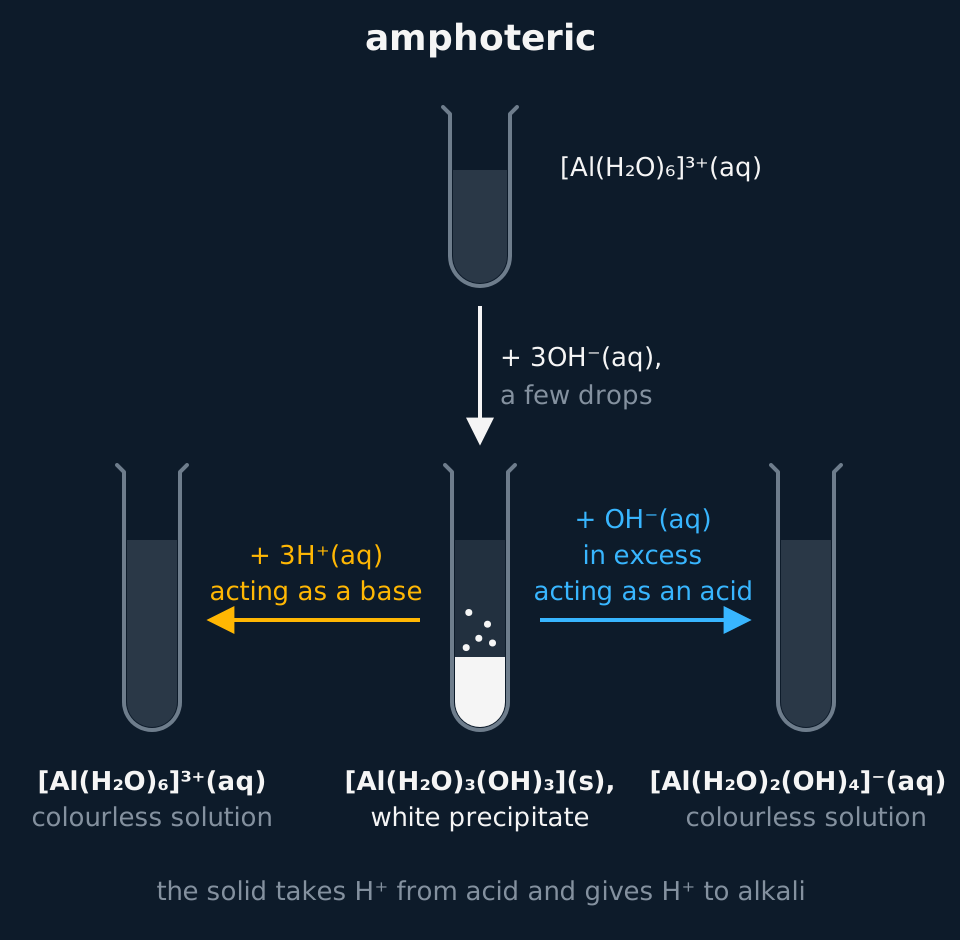
Describe the drawing
Amphoteric aluminium hydroxide. A small tube of colourless [Al(H₂O)₆]³⁺(aq) at the top has an arrow down, labelled plus three hydroxide ions, a few drops, to a middle tube holding a white precipitate of [Al(H₂O)₃(OH)₃]. From the middle tube an amber arrow labelled plus three H⁺ leads left to a tube of colourless [Al(H₂O)₆]³⁺(aq), the solid acting as a base; a cyan arrow labelled plus OH⁻ in excess leads right to a tube of colourless [Al(H₂O)₂(OH)₄]⁻(aq), the solid acting as an acid.
- Amphoteric
- Able to react both as an acid and as a base; aluminium hydroxide dissolves in acids and in excess alkali.
- Excess (of a reagent)
- More of a reagent than is needed to react with all of the other reactant present.
Ammonia: a base first, a ligand second
Aqueous ammonia is a weak base. Only a small fraction of the ammonia molecules in the bottle have taken a proton from water, so its solution holds far fewer hydroxide ions than sodium hydroxide of the same concentration.
NH₃(aq) + H₂O(l) ⇌ NH₄⁺(aq) + OH⁻(aq)The equilibrium lies well to the left.
It gives the same four precipitates as sodium hydroxide, with the same colours, because at first it does the same thing: it takes protons from the water ligands. The equations are written with ammonia itself as the base and the ammonium ion as the other product; write NH₄⁺ on the right, not water, or the equation does not balance.
[Fe(H₂O)₆]²⁺(aq) + 2NH₃(aq) → [Fe(H₂O)₄(OH)₂](s) + 2NH₄⁺(aq)Green precipitate, darkening on standing in air.
[Cu(H₂O)₆]²⁺(aq) + 2NH₃(aq) → [Cu(H₂O)₄(OH)₂](s) + 2NH₄⁺(aq)Blue precipitate.
[Fe(H₂O)₆]³⁺(aq) + 3NH₃(aq) → [Fe(H₂O)₃(OH)₃](s) + 3NH₄⁺(aq)Brown precipitate.
[Al(H₂O)₆]³⁺(aq) + 3NH₃(aq) → [Al(H₂O)₃(OH)₃](s) + 3NH₄⁺(aq)White precipitate.
In excess, ammonia and sodium hydroxide behave differently twice. Aluminium hydroxide does not dissolve in excess ammonia. The hydroxide ion concentration in ammonia solution is too low to take the fourth proton that sodium hydroxide takes. Zinc hydroxide, also white, dissolves in excess of both reagents, so excess ammonia is the test that separates a zinc solution from an aluminium one.
Copper(II) hydroxide does dissolve in excess ammonia, to a deep blue solution. Here ammonia stops acting as a base and acts as a ligand. Its nitrogen has a lone pair, and ammonia molecules are a similar size to water molecules, so four of them replace four of the ligands around copper. The coordination number stays at six. The four ammonia ligands lie in a square around the copper, with two water ligands above and below.
[Cu(H₂O)₄(OH)₂](s) + 4NH₃(aq) → [Cu(NH₃)₄(H₂O)₂]²⁺(aq) + 2H₂O(l) + 2OH⁻(aq)Deep blue solution. This is ligand substitution, not acid–base.
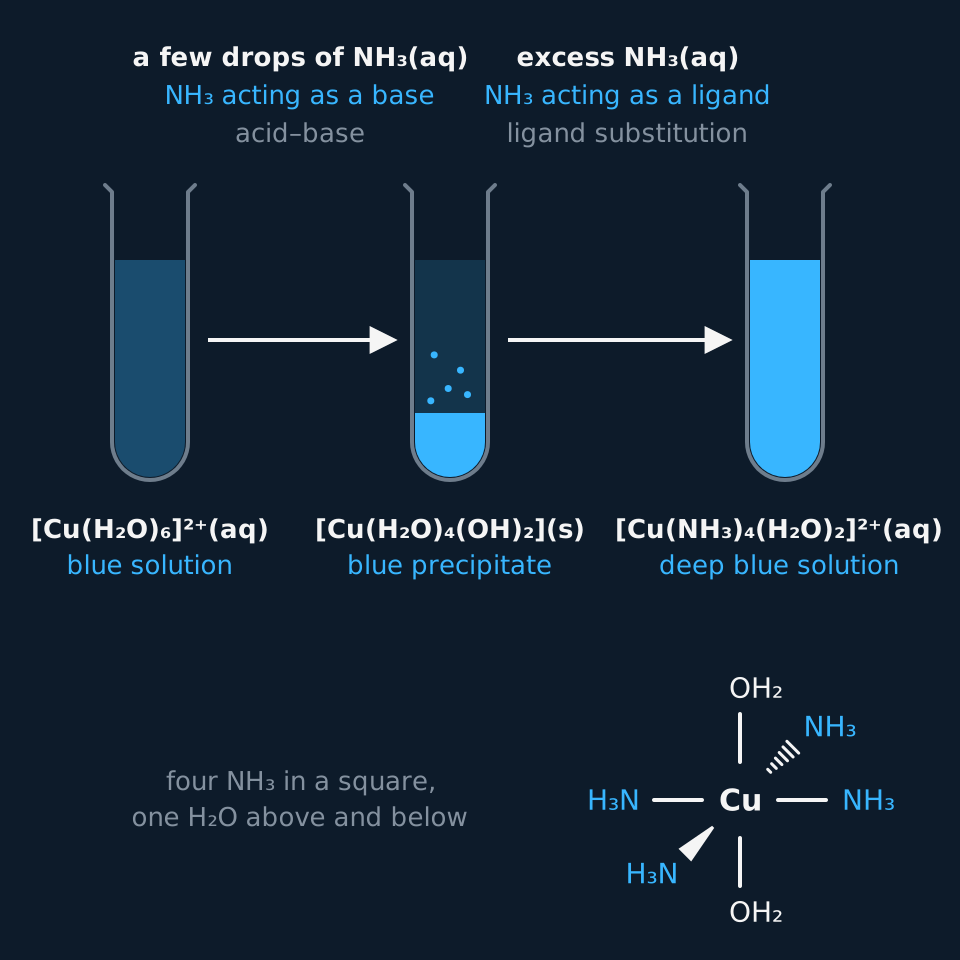
Describe the drawing
Three test tubes left to right joined by arrows. The first holds a blue solution of [Cu(H₂O)₆]²⁺, drawn paler than the deep blue to come. An arrow labelled a few drops of ammonia, ammonia acting as a base, acid–base, leads to the second tube, a blue precipitate of [Cu(H₂O)₄(OH)₂] settling in a pale liquid. An arrow labelled excess ammonia, ammonia acting as a ligand, ligand substitution, leads to the third tube, a clear deep blue solution of [Cu(NH₃)₄(H₂O)₂]²⁺. Beneath it an octahedral sketch shows copper at the centre with four ammonia ligands in a square and one water ligand above and one below.
The colour change is the evidence of a new ligand. Ammonia splits the copper d orbitals by a larger amount than water does, so the complex absorbs light of higher energy and the blue deepens. Iron(II), iron(III) and aluminium hydroxides are not dissolved by excess ammonia in a school laboratory.
- Ligand substitution
- A reaction in which one ligand in a complex ion is replaced by another, such as ammonia replacing water around copper(II).
- Weak base
- A base that is only partially protonated in solution; aqueous ammonia holds far fewer OH⁻ ions than sodium hydroxide of the same concentration.
Carbonate, and the whole table
Sodium carbonate divides the four ions by charge. The 2+ aqua ions are too weakly acidic to release carbon dioxide, so they give a carbonate precipitate and no gas; the 3+ ions are acidic enough to release carbon dioxide, and give the hydroxide.
[Cu(H₂O)₆]²⁺(aq) + CO₃²⁻(aq) → CuCO₃(s) + 6H₂O(l)Blue-green precipitate, no effervescence.
2[Al(H₂O)₆]³⁺(aq) + 3CO₃²⁻(aq) → 2[Al(H₂O)₃(OH)₃](s) + 3CO₂(g) + 3H₂O(l)White precipitate and effervescence.
Together the three reagents give each ion a pattern no other ion shares. The table is the one to learn, and the words in it are the mark scheme's.
Read an unknown in a fixed order. The colour of the solution narrows it first: green, blue and yellow-brown each point to one ion, and colourless to aluminium. The precipitate colour with a few drops of either base confirms it. The excess reagent then picks out the two ions that behave differently, and carbonate settles the charge whenever the colours leave doubt, as they can with a pale or partly oxidised iron solution.
| Aqua ion | Sodium hydroxide | Ammonia | Sodium carbonate |
|---|---|---|---|
| [Fe(H₂O)₆]²⁺, green solution | Green precipitate, darkens on standing in air; no change in excess | Green precipitate, darkens on standing; no change in excess | Green precipitate of FeCO₃ |
| [Cu(H₂O)₆]²⁺, blue solution | Blue precipitate; no change in excess | Blue precipitate; dissolves in excess to a deep blue solution | Blue-green precipitate of CuCO₃ |
| [Fe(H₂O)₆]³⁺, yellow-brown solution | Brown precipitate; no change in excess | Brown precipitate; no change in excess | Brown precipitate and effervescence |
| [Al(H₂O)₆]³⁺, colourless solution | White precipitate; dissolves in excess to a colourless solution | White precipitate; no change in excess | White precipitate and effervescence |
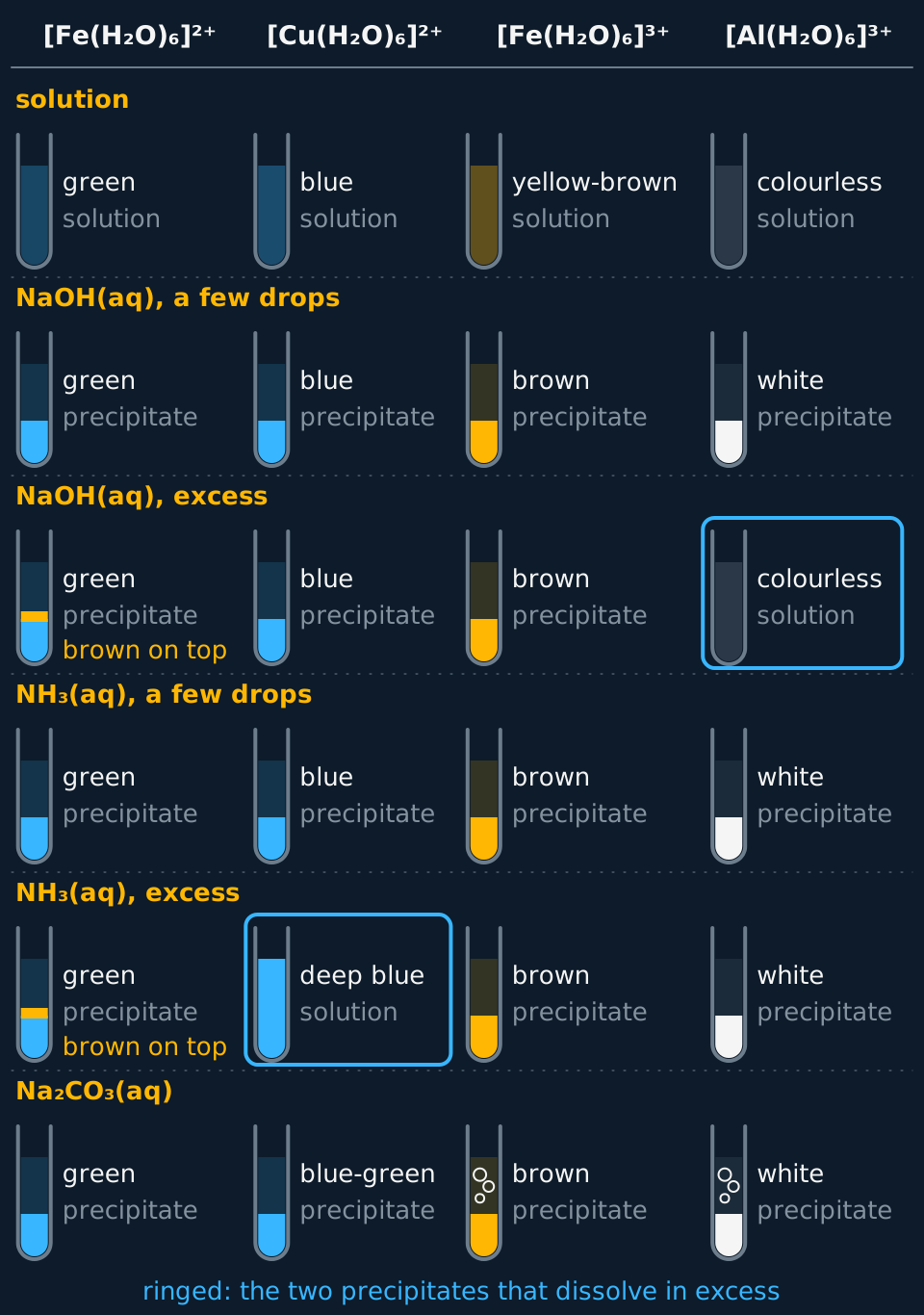
Describe the drawing
A grid of small test tubes: one column for each of the four aqua ions, iron(II), copper(II), iron(III) and aluminium, and one row for each test: the solution itself, sodium hydroxide a few drops and in excess, ammonia a few drops and in excess, and sodium carbonate. Each tube is labelled in words. Iron(II) gives a green solution and green precipitates throughout, brown at the surface in both excess cells. Copper(II) gives a blue solution, blue precipitates, a deep blue solution in excess ammonia and a blue-green carbonate. Iron(III) gives a yellow-brown solution and brown precipitates, with bubbles from carbonate. Aluminium gives a colourless solution and white precipitates, a colourless solution in excess hydroxide, and bubbles from carbonate. The two dissolving cells are ringed.
A colourless unknown
Solution Y is colourless. With sodium hydroxide it gives a white precipitate that dissolves in excess. With ammonia it gives a white precipitate that does not dissolve in excess. With sodium carbonate it gives a white precipitate and a gas that turns limewater milky. Identify the metal ion in Y and write the three equations for the first additions.
Show the working
A colourless solution and a white precipitate rule out iron and copper. The gas with carbonate shows an acidic aqua ion, so the ion is 3+. The precipitate dissolving in excess sodium hydroxide but not in excess ammonia is aluminium hydroxide behaving as an amphoteric hydroxide. Y contains [Al(H₂O)₆]³⁺.
With sodium hydroxide: [Al(H₂O)₆]³⁺(aq) + 3OH⁻(aq) → [Al(H₂O)₃(OH)₃](s) + 3H₂O(l).
With ammonia: [Al(H₂O)₆]³⁺(aq) + 3NH₃(aq) → [Al(H₂O)₃(OH)₃](s) + 3NH₄⁺(aq).
With sodium carbonate: 2[Al(H₂O)₆]³⁺(aq) + 3CO₃²⁻(aq) → 2[Al(H₂O)₃(OH)₃](s) + 3CO₂(g) + 3H₂O(l).
- Effervescence
- Bubbles of gas produced in a liquid by a reaction; here carbon dioxide, which turns limewater milky.
Identifying the metal ions: the test-tube practical
Every board sets this practical: carry out simple test-tube reactions to identify transition metal ions in aqueous solution. It is AQA required practical 11, OCR PAG 4 and Edexcel core practical 15.
Apparatus: test tubes in a rack, a white tile or sheet of paper to set them against, a separate dropping pipette for each reagent, a 10 cm³ measuring cylinder, and limewater with a clean pipette for testing a gas. Solutions, each at about 0.1 mol dm⁻³: iron(II) sulfate, freshly made, or ammonium iron(II) sulfate; copper(II) sulfate; iron(III) chloride; aluminium sulfate. Reagents: sodium hydroxide at about 0.4 mol dm⁻³, aqueous ammonia at about 2 mol dm⁻³ and sodium carbonate at about 0.5 mol dm⁻³.
| Step | What to do | Why |
|---|---|---|
| 1 | Put about 1 cm³ of the metal ion solution into each of three test tubes, and record its colour against the white tile | The colour of the aqua ion is the first clue; pale colours show only against white |
| 2 | To the first tube add sodium hydroxide a drop at a time, shaking after each drop, until a precipitate forms; record its colour | Added slowly, the precipitate is seen before any excess can dissolve it |
| 3 | Keep adding sodium hydroxide, shaking, until the tube is about half full; record whether the precipitate dissolves | Excess means far more than the ion needs; a few extra drops do not dissolve aluminium hydroxide |
| 4 | Repeat steps 2 and 3 on the second tube with aqueous ammonia | Copper(II) hydroxide dissolves in excess ammonia; aluminium hydroxide does not |
| 5 | To the third tube add sodium carbonate a few drops at a time, watching the surface for bubbles; test any gas with limewater | Effervescence marks a 3+ ion; limewater turning milky shows the gas is carbon dioxide |
| 6 | Leave the iron(II) tubes for ten minutes and look again | The green precipitate darkens as air oxidises iron(II) to iron(III) |
| 7 | Repeat for each known solution, then for the unknowns, recording every observation in a results table as it happens | The knowns give a reference set made with the same reagents |
Record what is seen in the words of the identification table: 'blue precipitate', 'dissolves in excess to a deep blue solution', 'no change'. Write 'no visible change' where nothing happens; a blank cell is not a result.
What is observed with the four known solutions is the identification table, and the knowns are run first so that the colours are seen with these reagents at these concentrations. A precipitate can look paler in a dilute solution, and a thin suspension is easier to judge against the white tile than against the bench. Hold each unknown tube beside the matching known before writing anything down.
Two observations are easy to get wrong. A brown precipitate from iron(III) and a green one from iron(II) that has stood for a while can look alike, so the iron(II) precipitate is described as it first appears. And a slight fizz with carbonate can be missed altogether; a stoppered tube with a delivery tube into limewater shows the gas even when the bubbles are few.
| Error | What it does to the result | How to avoid it |
|---|---|---|
| Sodium hydroxide poured into aluminium solution quickly | The white precipitate forms and redissolves where the alkali is concentrated, and is never seen | Add it a drop at a time and shake after each drop |
| Too little reagent added for 'excess' | Aluminium hydroxide or copper(II) hydroxide seems not to dissolve | Add until the tube is about half full, then shake |
| Iron(II) solution made the day before | Some iron(II) is already iron(III), so the precipitate is brown-green from the start | Use a freshly made solution, or ammonium iron(II) sulfate |
| One dropping pipette shared between reagents | Traces of one reagent reach another bottle and tube | Use one pipette per reagent and do not swap them |
| Bubbles with carbonate missed | A 3+ ion is recorded as 2+ | Watch the moment of mixing and test the gas with limewater |
Risk assessment. Sodium hydroxide at 0.4 mol dm⁻³ irritates the eyes and skin. Copper(II) sulfate is harmful if swallowed and toxic to aquatic life, so the residues go in the waste container, not the sink. Aqueous ammonia gives off ammonia gas, which irritates the eyes and airways: keep the bottle stoppered and the room ventilated. Wear eye protection throughout. Check the CLEAPSS Hazcard for each substance and the school's risk assessment before starting, and follow them where they differ from the advice here.
Other boards: chromium(III), manganese(II) and cobalt(II)
OCR A writes the precipitation equations in the simpler ionic form, Cu²⁺(aq) + 2OH⁻(aq) → Cu(OH)₂(s), and the aqua-ion form with its brackets earns the same credit. Cambridge's qualitative analysis notes, printed with its practical paper, are the reference for the observations.
AQA stops at four ions. OCR A adds manganese(II) and chromium(III), and Edexcel adds chromium(III) and cobalt(II). None of them needs a new rule. Hydroxide or ammonia takes protons until the complex is neutral and precipitates, and a precipitate dissolves again only if it is amphoteric or if ammonia replaces its ligands.
Chromium(III) does both. [Cr(H₂O)₆]³⁺ is violet, though a bottle of chromium(III) chloride solution usually looks green, because chloride ions have replaced some of the water ligands. A few drops of sodium hydroxide give a grey-green precipitate. Like aluminium hydroxide it is amphoteric: excess hydroxide takes three more protons from the water ligands and it dissolves to a dark green solution.
[Cr(H₂O)₆]³⁺(aq) + 3OH⁻(aq) → [Cr(H₂O)₃(OH)₃](s) + 3H₂O(l)Grey-green precipitate.
[Cr(H₂O)₃(OH)₃](s) + 3OH⁻(aq) → [Cr(OH)₆]³⁻(aq) + 3H₂O(l)Dark green solution in excess sodium hydroxide.
Ammonia gives the same grey-green precipitate. In excess it acts as a ligand, as it does with copper, but here it replaces all six ligands and gives purple [Cr(NH₃)₆]³⁺, the complex OCR names. The change is slow and needs concentrated ammonia; with dilute bench ammonia the precipitate stays, which is how Cambridge's qualitative analysis notes record it. Chromium(III) is a 3+ ion, so with sodium carbonate it fizzes and gives the grey-green hydroxide, exactly as aluminium does.
Manganese(II) is OCR's. [Mn(H₂O)₆]²⁺ is so pale a pink that the solution looks colourless in a test tube. Sodium hydroxide or ammonia gives a precipitate that is off-white for a moment and light brown almost at once, which is how OCR describes it. It darkens on standing, as oxygen from the air oxidises manganese(II) to a higher oxidation state, much as iron(II) hydroxide turns brown. It does not dissolve in excess of either reagent.
[Mn(H₂O)₆]²⁺(aq) + 2OH⁻(aq) → [Mn(H₂O)₄(OH)₂](s) + 2H₂O(l)Light brown precipitate, darkening in air. OCR accepts Mn²⁺(aq) + 2OH⁻(aq) → Mn(OH)₂(s).
Cobalt(II) is Edexcel's. [Co(H₂O)₆]²⁺ is pink. Sodium hydroxide gives a blue precipitate that turns pink on standing and slowly darkens in air; it does not dissolve in excess. Ammonia gives the same precipitate, and in excess concentrated ammonia six ammonia molecules replace all the ligands, giving a pale straw-coloured solution of [Co(NH₃)₆]²⁺. That solution darkens on standing, because air oxidises it to cobalt(III). Copper keeps two water ligands in its ammonia complex; cobalt and chromium take six ammonia ligands.
[Co(H₂O)₄(OH)₂](s) + 6NH₃(aq) → [Co(NH₃)₆]²⁺(aq) + 4H₂O(l) + 2OH⁻(aq)Pale straw-coloured solution, darkening in air.
| Aqua ion | Sodium hydroxide | Ammonia | Board |
|---|---|---|---|
| [Cr(H₂O)₆]³⁺, violet (chloride solution green) | Grey-green precipitate; dissolves in excess to a dark green solution | Grey-green precipitate; dissolves in excess concentrated ammonia to a purple solution | OCR A, Edexcel |
| [Mn(H₂O)₆]²⁺, very pale pink | Light brown precipitate, darkens in air; no change in excess | Light brown precipitate, darkens in air; no change in excess | OCR A |
| [Co(H₂O)₆]²⁺, pink | Blue precipitate, turns pink on standing; no change in excess | Blue precipitate; dissolves in excess concentrated ammonia to a pale straw-coloured solution, darkening in air | Edexcel |
- Aerial oxidation
- Oxidation of a substance by oxygen from the air; the hydroxides of iron(II), manganese(II) and cobalt(II) darken on standing because of it.
TRY IT: Chromium(III) with ammonia
Chromium(III) forms [Cr(H₂O)₆]³⁺. With a little ammonia solution it gives a grey-green precipitate, which dissolves in excess ammonia to a purple solution of [Cr(NH₃)₆]³⁺. Write both equations with state symbols.
Check your answer
Chromium(III) is a 3+ ion, so ammonia removes three protons and the neutral hydroxide precipitates, as it does for iron(III): [Cr(H₂O)₆]³⁺(aq) + 3NH₃(aq) → [Cr(H₂O)₃(OH)₃](s) + 3NH₄⁺(aq).
In excess, ammonia acts as a ligand and replaces all six ligands, three water and three hydroxide: [Cr(H₂O)₃(OH)₃](s) + 6NH₃(aq) → [Cr(NH₃)₆]³⁺(aq) + 3H₂O(l) + 3OH⁻(aq).
The equation balances: 27 hydrogen atoms and 6 oxygen atoms on each side, and zero overall charge on each side. OCR A examines this reaction; AQA does not, but its equations are written by the same rule.
In the exam
- An observation scores only when it is complete: the colour, the word 'precipitate' or 'solution', and what happens in excess. The scheme does not accept 'goes blue', which does not say which.
- Write the hydroxide product with its water ligands in square brackets, [Fe(H₂O)₃(OH)₃](s); schemes also accept Fe(OH)₃(s). Balance with water on the right for OH⁻ and with NH₄⁺ for NH₃.
- For aluminium in excess sodium hydroxide, the equation to [Al(H₂O)₂(OH)₄]⁻ earns the mark, and [Al(OH)₄]⁻ is accepted; use the word amphoteric.
- For copper in excess ammonia, name ligand substitution, give the deep blue solution, and write [Cu(NH₃)₄(H₂O)₂]²⁺ with all six ligands; [Cu(NH₃)₆]²⁺ is a different complex and is not credited.
- A method for the ion-identification practical is marked on technique as well as results: reagents added dropwise with shaking, then in excess, and any gas tested with limewater.
Check yourself
Three unlabelled solutions contain [Cu(H₂O)₆]²⁺, [Fe(H₂O)₆]³⁺ and [Al(H₂O)₆]³⁺. Only aqueous ammonia is available. Explain how it identifies all three, and write the equation for the reaction that makes copper different.
Answer
Add a few drops of ammonia to each. All three give a precipitate, because ammonia is a base and takes protons from the water ligands until each complex is neutral: blue from copper, brown from iron(III), white from aluminium. The colours alone separate the three.
Excess ammonia confirms copper. Its blue precipitate dissolves to a deep blue solution, because ammonia now acts as a ligand and replaces four ligands around the copper ion. The brown and white precipitates do not dissolve.
[Cu(H₂O)₄(OH)₂](s) + 4NH₃(aq) → [Cu(NH₃)₄(H₂O)₂]²⁺(aq) + 2H₂O(l) + 2OH⁻(aq). Sodium hydroxide would be needed to show aluminium hydroxide is amphoteric, but it is not needed to tell these three apart.
Questions
Question 16 marksAQA · CAIE
Outline a method, using test-tube reactions, to show that a solution contains Cu²⁺(aq) and not Fe²⁺(aq), Fe³⁺(aq) or Al³⁺(aq). Give the expected observations and equations.
Mark scheme
Indicative content
- put about 1 cm³ of the solution in each of two test tubes and note that it is blue against a white tile
- add sodium hydroxide dropwise with shaking: a blue precipitate, which rules out the green, brown and white hydroxides of the other ions
- the equation for the first tube is [Cu(H₂O)₆]²⁺(aq) + 2OH⁻(aq) → [Cu(H₂O)₄(OH)₂](s) + 2H₂O(l), with state symbols
- to the second tube add aqueous ammonia dropwise and then in excess: a blue precipitate that dissolves to a deep blue solution
- the equation for the excess ammonia is [Cu(H₂O)₄(OH)₂](s) + 4NH₃(aq) → [Cu(NH₃)₄(H₂O)₂]²⁺(aq) + 2H₂O(l) + 2OH⁻(aq)
- excess means adding until the tube is about half full, with shaking, and eye protection is worn
Levels
- Level 3 (5–6 marks) the colour of the solution, the blue hydroxide precipitate that rules out the other three ions, the dissolving in excess ammonia to the deep blue complex and both equations with state symbols are all present, with the practical detail of dropwise addition and excess; the observations are matched to each ion excluded
- Level 2 (3–4 marks) sodium hydroxide and ammonia are used, with the blue precipitate and the deep blue solution in excess ammonia; one equation is missing or unbalanced, or the other three ions are never ruled out
- Level 1 (1–2 marks) a blue precipitate is reported with no equations, often said to dissolve in excess sodium hydroxide, and nothing shows how Fe²⁺, Fe³⁺ or Al³⁺ would look different
Question 24 marks
Describe what is seen when a few drops of sodium hydroxide solution are added to iron(II) sulfate solution and the tube is then left open to the air, and explain the change on standing.
Mark scheme
- B1 a green precipitate forms from the pale green solution
- B1 the precipitate darkens, turning brown at the surface first, on standing in air
- B1 oxygen from the air oxidises iron(II) to iron(III)
- B1 green [Fe(H₂O)₄(OH)₂] becomes brown [Fe(H₂O)₃(OH)₃], starting where the air reaches it; allow Fe(OH)₂ and Fe(OH)₃
Question 34 marks
Give the equation, with state symbols, for the reaction of [Cu(H₂O)₆]²⁺ with a little aqueous ammonia and the observation, and name the type of reaction that occurs with a little ammonia and with excess ammonia.
Mark scheme
- B1 [Cu(H₂O)₆]²⁺(aq) + 2NH₃(aq) → [Cu(H₂O)₄(OH)₂](s) + 2NH₄⁺(aq)
- B1 a blue precipitate forms from the blue solution
- B1 with a little ammonia: an acid–base reaction, in which ammonia removes protons from the water ligands
- B1 with excess ammonia: ligand substitution, in which ammonia replaces ligands round the copper to give a deep blue solution
All 20 questions with mark schemes, the other 17 set out in full on the question page.
Worth remembering
- 'Goes blue' is not an observation: say precipitate or solution, and its colour.
- Ammonia equations balance with NH₄⁺ on the right; water there leaves them unbalanced.
- Aluminium hydroxide does not dissolve in excess ammonia; only excess sodium hydroxide dissolves it.
- [Cu(NH₃)₆]²⁺ is the wrong product: copper keeps two water ligands in excess ammonia.
- Iron(II) recorded after standing looks like iron(III); describe its precipitate as it first forms.
CHECK YOUR PROGRESS
Rate how confident you are with each objective for this lesson. Ratings are saved in this browser, on this device, unless you sign in.
- Describe the reactions of the iron(II), copper(II), iron(III) and aluminium aqua ions with sodium hydroxide, ammonia and sodium carbonate, giving each observation in the words the mark scheme uses.
- Write each reaction as an acid–base reaction of the aqua ion, balanced and with state symbols.
- Explain why aluminium hydroxide dissolves in excess sodium hydroxide, and state what amphoteric means.
- Explain why copper(II) hydroxide dissolves in excess ammonia, and write the equation for the ligand substitution.
- Describe the reactions of the chromium(III), manganese(II) and cobalt(II) aqua ions with sodium hydroxide and ammonia.Edexcel · OCR A
- Carry out test-tube reactions to identify a metal ion in solution, and identify an unknown from its observations.
Open the full revision checklist to see every objective in the curriculum in one place.
Practise this lesson
WORKBOOK
The questions from this topic, on paper with room to work, and a separate book of mark schemes. Free to use; please do not redistribute or sell.