Chemistry › Practicals › Orders of reaction: iodine and propanone
Required practical 7: orders from iodine and propanone (OCR PAGs 9 and 10, Edexcel CP 13)
Follow the acid-catalysed reaction of propanone with iodine with a colorimeter, then halve each concentration in turn to find every order.
This is the method section of Finding orders from initial rates, half-lives and graphs on a page of its own, with its variables, sample results, an evaluation and questions set on it. The chemistry behind it is in that lesson.
The capability this develops
This investigation is one instance of capability P03: Measuring rates and finding orders, which sets out the techniques it belongs to, the calculations it carries and the errors that cost marks in all of them. The notes behind the chemistry are in Rate equations.
Where this sits on the specifications
Each qualification is mapped to its own specification one numbered heading at a time, against a document whose sha256 is recorded. These are the headings that list the lesson this method is taught in, on the four qualifications mapped. Each links to the route map the row belongs to.
| Qualification | Heading |
|---|---|
| AQA 7404/7405 | 3.1.9.2 Determination of rate equation |
| OCR Chemistry A H032/H432 | 1.1 Practical skills assessed in a written examination |
| OCR Chemistry A H032/H432 | 5.1.1 How fast? |
| Pearson Edexcel Chemistry 8CH0/9CH0 | 16.3 choosing a rate technique |
| Pearson Edexcel Chemistry 8CH0/9CH0 | 16.4 initial-rate and continuous-monitoring methods |
| Pearson Edexcel Chemistry 8CH0/9CH0 | 16.5 rate and first-order half-life from graphs |
| Pearson Edexcel Chemistry 8CH0/9CH0 | 16.6 order from concentration–time and rate–concentration graphs |
| Pearson Edexcel Chemistry 8CH0/9CH0 | 16.7 order from initial rates |
| Pearson Edexcel Chemistry 8CH0/9CH0 | 16.8 iodination of propanone |
| Cambridge International 9701 | 26.1 Simple rate equations, orders of reaction and rate constants |
Three boards number their practical activities, and those lists were read here from the same specifications as the headings above. This investigation is filed on them as:
- AQA 7404/7405 required practical 7: Rate by initial-rate and continuous-monitoring methods
- OCR Chemistry A H032/H432 PAG 9: Rates of reaction – continuous monitoring method
- OCR Chemistry A H032/H432 PAG 10: Rates of reaction – initial rates method
- Pearson Edexcel Chemistry 8CH0/9CH0 core practical 13: Rates: 13a iodine–propanone by titration; 13b a clock reaction
Use your awarding organisation’s current specification and its practical handbook as the authority on which activities your course requires and how they are assessed.
Apparatus
A colorimeter with a blue filter and cuvettes; burettes or graduated pipettes for 2.00 mol dm⁻³ propanone, 1.00 mol dm⁻³ hydrochloric acid, 0.0100 mol dm⁻³ iodine in potassium iodide solution and distilled water; boiling tubes in a water bath at 25 °C with a thermometer; a stopclock. For the titration route, add a 10.0 cm³ pipette, conical flasks each holding 10 cm³ of 0.5 mol dm⁻³ sodium hydrogencarbonate, a burette of 0.00500 mol dm⁻³ sodium thiosulfate, and starch solution.
Safety
Risks. Propanone is highly flammable, so keep it away from flames. The product, iodopropanone, irritates the eyes and nose, so work in a well-ventilated room and do not smell the mixtures. Iodine solution stains skin and clothing. Wear eye protection throughout. Check the CLEAPSS Hazcards and the school's risk assessment before starting, and where they differ from the advice here, follow them.
Variables
Independent variable
Within a run, time: the absorbance is read every 30 s. Between runs, the starting concentration of one reactant, halved while the other two are held, so that the change in gradient belongs to that reactant alone.
Dependent variable
The absorbance of the mixture, converted to the concentration of iodine through the calibration graph. The gradient of concentration against time is the rate.
Control variables
- Temperature, held by the water bath at 25 °C, with both tubes equilibrated for ten minutes before mixing, because k changes by about a tenth for every degree.
- The total volume, 40.0 cm³ in every run, made up with water, so that halving one solution does not change the concentration of the other two.
- The colorimeter, its blue filter, the cuvette and the zero, set on the mixture without iodine, so that every absorbance measures iodine and nothing else.
- Propanone and acid in large excess, so their concentrations stay effectively constant through a run and only the iodine concentration falls.
In the continuous run the controls hold two of the three concentrations constant by excess, so the shape of the curve shows the order with respect to iodine alone. The initial-rate runs then change one concentration at a time, and making the volume up with water is what keeps the other two the same: 5.0 cm³ less propanone without 5.0 cm³ more water would dilute everything in the tube.
Method
| Step | What to do | Why |
|---|---|---|
| 1 | Measure the absorbance of iodine solutions of known concentration, 0.0005 to 0.0025 mol dm⁻³, with the blue filter, and plot absorbance against concentration | The calibration graph converts each absorbance into a concentration of iodine |
| 2 | Zero the colorimeter with a cuvette of the propanone and acid mixture containing no iodine | The reading then measures the iodine alone |
| 3 | Run 10.0 cm³ of propanone, 10.0 cm³ of acid and 10.0 cm³ of water into one boiling tube, and 10.0 cm³ of iodine solution into another; stand both in the water bath for 10 minutes | Both solutions start at 25 °C, since k depends on temperature |
| 4 | Pour the iodine into the propanone mixture, start the stopclock at the moment of mixing, shake, and fill a cuvette | Time zero is the moment every concentration has its starting value |
| 5 | Read the absorbance every 30 s for 10 minutes, or until the solution is colourless | Many readings fix the line and show whether it is straight or curved |
| 6 | Repeat with 5.0 cm³ of propanone and 15.0 cm³ of water, then with 5.0 cm³ of acid and 15.0 cm³ of water, then with 5.0 cm³ of iodine and 5.0 cm³ of extra water | One concentration is halved each time and the total volume stays at 40.0 cm³, so the others do not change |
| 7 | For the titration route, withdraw 10.0 cm³ of a larger mixture every 2 minutes and run it into sodium hydrogencarbonate; titrate the iodine with thiosulfate, adding starch near the end point | The hydrogencarbonate neutralises the acid catalyst, which stops the reaction in the sample |
Describe the drawing
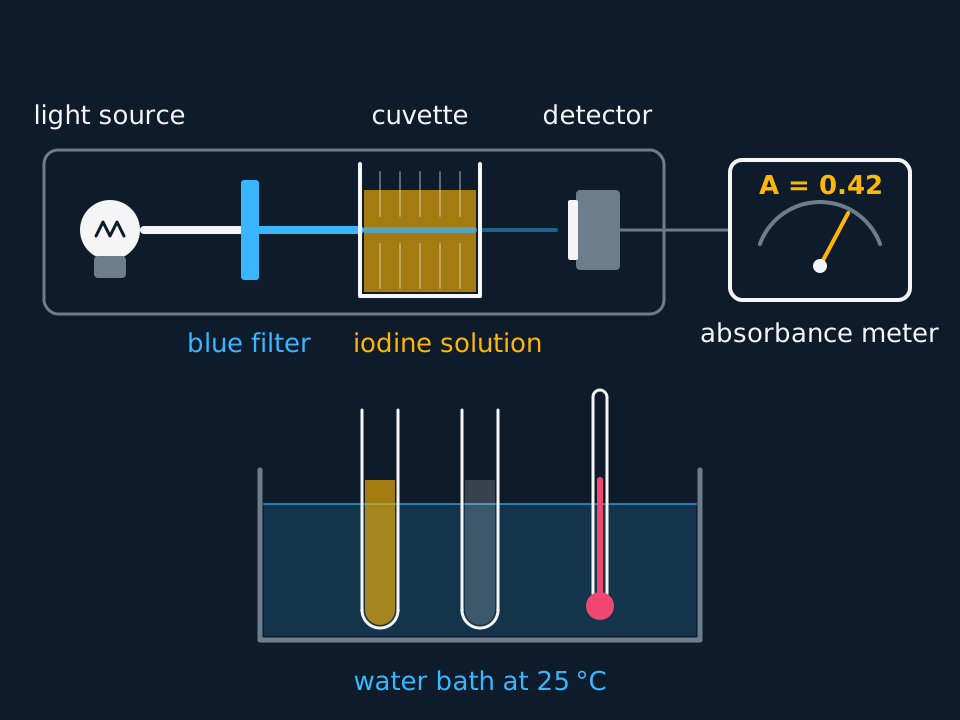
A colorimeter in cross-section with light travelling left to right: a white bulb, a blue filter, a square cuvette of pale yellow-brown iodine solution with its clear faces in the beam and its ribbed faces towards the reader, a photocell detector and a meter reading absorbance. The beam is white before the filter, blue after it and fainter after the cuvette. Below, a water bath at 25 degrees Celsius holds two boiling tubes and a thermometer.
What is measured
Propanone and acid are used in large excess, a hundred times or more the concentration of iodine, so their concentrations hardly change during a run. Iodine is the only concentration that falls, and one run followed with a colorimeter shows how its concentration changes with time. Further runs with different starting concentrations of propanone and of acid then give their orders by initial rates.
In the first run the mixture holds 0.500 mol dm⁻³ propanone, 0.250 mol dm⁻³ H⁺ and 0.00250 mol dm⁻³ iodine. In the titration route the iodine in each 10.0 cm³ sample reacts with thiosulfate, I₂(aq) + 2S₂O₃²⁻(aq) → 2I⁻(aq) + S₄O₆²⁻(aq), so a sample taken at the start needs 10.0 cm³ of the 0.00500 mol dm⁻³ solution.
Sample results
These readings from the first run are idealised; real ones scatter a little about the line.
| Time / s | 0 | 60 | 120 | 180 | 240 | 300 |
|---|---|---|---|---|---|---|
| Absorbance | 0.80 | 0.73 | 0.67 | 0.60 | 0.53 | 0.46 |
The absorbance falls by very nearly the same amount in every minute, so the graph of iodine concentration against time is a straight line and the rate does not change as the iodine is used up. The reaction is zero order with respect to iodine. The calibration gave an absorbance of 0.80 for 0.00250 mol dm⁻³, a factor of 320 dm³ mol⁻¹. The gradient is −0.34 ÷ 300 = −1.13 × 10⁻³ s⁻¹ in absorbance, and dividing by 320 gives a rate of 3.5 × 10⁻⁶ mol dm⁻³ s⁻¹.
The other runs complete the rate equation. Halving the propanone halves the gradient, and so does halving the acid: each is first order. Halving the iodine gives a line that starts at half the height and has the same gradient, which confirms zero order. The rate equation is rate = k[CH₃COCH₃][H⁺], and from the first run k = 3.5 × 10⁻⁶ ÷ (0.500 × 0.250) = 2.8 × 10⁻⁵ mol⁻¹ dm³ s⁻¹ at 25 °C.
Evaluation
The limitations of the method, what each does to the result and in which direction, and the improvement a mark scheme credits.
| Limitation | What it does to the result | Improvement |
|---|---|---|
| The calibration is assumed to hold in the reaction mixture | Iodine in potassium iodide is present as I₃⁻ as well as I₂, and the absorbance of a given amount of iodine depends on the iodide concentration; standards made in water alone give a different factor from the 320 dm³ mol⁻¹ that applies in the mixture | Make the calibration standards up in the same potassium iodide, acid and propanone as the runs, and zero the colorimeter on that mixture without iodine |
| Each order rests on one halving | A single ratio of gradients, 2.0 for propanone, cannot show whether a ratio of 1.8 is first order with error or something between first and second | Run three or four concentrations of each reactant and plot rate against concentration: a straight line through the origin is first order, a horizontal line zero order |
| The absorbance is read to 0.01 | In the sample results the fall per minute is 0.07, 0.06, 0.07, 0.07 and 0.07, and the 0.01 differences are the resolution of the meter rather than a change of rate; a gradient taken from two points 60 s apart, each ±0.01, puts ±0.02 on a fall of 0.07, an uncertainty of nearly 30% | Take the gradient from a line of best fit through all the points, and run until the solution is nearly colourless so that the total fall is large compared with 0.01 |
| The reaction makes its own catalyst | Hydrogen iodide is a product, so [H⁺] rises as iodine is used up; with 0.250 mol dm⁻³ acid and 0.00250 mol dm⁻³ iodine the rise is 1%, and the line stays straight only because the acid is in such excess | Keep the acid at a hundred times the iodine concentration or more, and say so when the zero order with respect to iodine is claimed |
Errors in carrying it out
Temperature is the error that matters most, because k depends on it steeply. For this reaction a rise of 1 °C near room temperature raises the rate by roughly a tenth, which is larger than the uncertainty in any volume. A late start to the stopclock matters less than it seems: the line is straight, so a late start moves the line sideways without changing its gradient.
| Limitation | Effect | Improvement |
|---|---|---|
| The cuvette warms inside the colorimeter | The rate rises during the run | Read quickly and check the temperature of the mixture at the end |
| Solutions not at the bath temperature when mixed | Each run is at a slightly different temperature | Equilibrate both tubes for the same time and check with a thermometer |
| Iodine is volatile | Iodine is lost from an open tube, not only by reaction | Keep tubes and cuvettes stoppered or covered |
| Fingerprints or scratches on the cuvette | Absorbance readings too high | Hold it by the ridged sides and wipe the clear faces |
| Delay between withdrawing and quenching a sample | The titre gives a concentration later than the recorded time | Run the sample straight into the hydrogencarbonate and record the time at that moment |
| Starch added too early | Iodine binds to the starch and the end point is blurred | Add starch only when the solution is pale yellow |
The orders are only as good as the comparison between runs. Every run should use the same stock solutions, the same bath and the same colorimeter, and any run that disagrees with its repeat should be repeated again before the order is decided.
Questions
Question 1 (6 marks)
Describe how to find the order with respect to propanone in the acid-catalysed reaction of propanone with iodine, using a colorimeter.
Mark scheme
Indicative content
- calibrate: measure the absorbance of iodine solutions of known concentration with a blue filter and plot a calibration graph
- bring the propanone, acid and water mixture and the iodine solution to the same temperature in a water bath before mixing
- mix, start the timer at the moment of mixing, and record the absorbance at regular intervals such as every 30 s
- convert absorbance to iodine concentration, plot it against time and find the gradient, which is the rate
- repeat with a different volume of propanone, made up with water to the same total volume so that the other concentrations and the temperature are unchanged
- compare the factor on the propanone concentration with the factor on the rate: halving propanone halves the rate, so it is first order
Levels
- Level 3 (5–6 marks) the calibration graph, the temperature control before mixing, the timing and regular absorbance readings, the conversion to concentration and the rate from the gradient, and the repeat with a different propanone concentration at the same total volume are all present, with the order deduced from the factors on concentration and rate
- Level 2 (3–4 marks) the colorimeter follows the iodine concentration with time and the run is repeated with a different propanone concentration; the calibration, the constant concentrations of iodine and acid, or the step from rates to order is not there
- Level 1 (1–2 marks) the colorimeter is said to measure the colour of iodine; the propanone concentration is often changed along with the total volume, so two things vary at once
Question 2 (3 marks)
Explain why propanone and hydrochloric acid are used in large excess when the reaction of propanone with iodine is followed with a colorimeter.
Mark scheme
- B1 with both in large excess their concentrations hardly change during the run
- B1 the only concentration that changes is that of iodine, which is the coloured species the colorimeter measures
- B1 so any change in rate during the run is due to iodine alone, and the graph shows the order with respect to iodine
Question 3 (2 marks)
Explain why samples withdrawn from the propanone and iodine reaction are run into sodium hydrogencarbonate solution before they are titrated.
Mark scheme
- B1 sodium hydrogencarbonate neutralises the H⁺ catalyst, which stops the reaction in the sample
- B1 so the titre gives the iodine concentration at the moment the sample was taken, not some time later
Question 4 (4 marks)
Compare following the iodine concentration in the propanone reaction with a colorimeter and by titration of quenched samples.
Mark scheme
- B1 the colorimeter gives many readings without disturbing the mixture, whereas titration removes samples and gives only a few points
- B1 the colorimeter reading is almost instant, whereas each titration sample must be quenched and any delay adds a timing error
- B1 titration needs no calibration, whereas the colorimeter needs a calibration graph to turn absorbance into concentration
- B1 titration end points are judged by eye with starch, whereas the colorimeter gives an objective reading
Question 5 (3 marks)
Explain why the colorimeter is zeroed with a cuvette of the propanone and acid mixture containing no iodine.
Mark scheme
Light absorbed by the cuvette and by the other components of the mixture is then counted as zero.
Every reading measures the absorbance of the iodine alone, so it converts to an iodine concentration through the calibration graph.
A colorimeter zeroed on water would add the same small offset to every reading, which does not change the gradient but makes every concentration too high.
Question 6 (3 marks)
In a second run the absorbance falls from 0.80 to 0.29 in 450 s, with the same calibration factor of 320 dm³ mol⁻¹. Calculate the rate in mol dm⁻³ s⁻¹.
Mark scheme
Fall in concentration = (0.80 − 0.29) ÷ 320 = 1.59 × 10⁻³ mol dm⁻³.
Rate = 1.59 × 10⁻³ ÷ 450.
= 3.5 × 10⁻⁶ mol dm⁻³ s⁻¹.
Question 7 (3 marks)
Explain how a graph of iodine concentration against time shows that the reaction is zero order with respect to iodine, and describe the graph that a first-order reaction would give.
Mark scheme
A straight line with a constant negative gradient: the rate does not change as [I₂] falls.
So the rate is independent of [I₂], which is zero order.
A first-order reaction gives a curve whose gradient falls as [I₂] falls, with a constant half-life.
Question 8 (3 marks)
Explain why halving the volume of propanone solution must be matched by adding 5.0 cm³ more water.
Mark scheme
The total volume must stay at 40.0 cm³.
Otherwise every concentration in the mixture, acid and iodine included, would rise, and a change in rate could not be attributed to propanone alone.
With the water added only [CH₃COCH₃] is halved, so a halved gradient shows first order with respect to propanone.
Question 9 (2 marks)
Explain why a blue filter is used in the colorimeter for this reaction.
Mark scheme
Iodine solution is yellow-brown because it absorbs blue light.
A filter of the colour absorbed gives the largest change in absorbance for a given change in iodine concentration, so the readings are most sensitive to it.
Question 10 (3 marks)
Deduce the units of k for rate = k[CH₃COCH₃][H⁺], and explain why the value found at 25 °C would be larger at 30 °C.
Mark scheme
k = rate ÷ ([CH₃COCH₃][H⁺]), so its units are mol dm⁻³ s⁻¹ ÷ (mol dm⁻³)² = mol⁻¹ dm³ s⁻¹.
k rises with temperature because a larger fraction of collisions have energy at or above the activation energy.
At roughly a tenth per degree, k at 30 °C would be about 1.6 times its value at 25 °C.
Coverage maps are available for AQA 7404/7405, OCR Chemistry A H032/H432, Pearson Edexcel Chemistry 8CH0/9CH0 and Cambridge International 9701. Use the relevant route map to check what InkChemistry covers, and your awarding organisation’s current specification as the final authority on examinable content.