Chemistry › Practicals › Functional group tests: alkenes, acids, aldehydes and alcohols
Required practical 6: functional group tests (OCR PAG 7, Edexcel CPs 7 and 15)
Tell an alkene, a carboxylic acid, an aldehyde and an alcohol apart with bromine water, sodium hydrogencarbonate, Tollens' reagent and acidified dichromate.
This is the method section of Test-tube reactions for functional groups, and high-resolution mass spectrometry on a page of its own, with its variables, sample results, an evaluation and questions set on it. The chemistry behind it is in that lesson.
The capability this develops
This investigation is one instance of capability P06: Testing for organic functional groups, which sets out the techniques it belongs to, the calculations it carries and the errors that cost marks in all of them. The notes behind the chemistry are in Organic analysis.
Where this sits on the specifications
Each qualification is mapped to its own specification one numbered heading at a time, against a document whose sha256 is recorded. These are the headings that list the lesson this method is taught in, on the four qualifications mapped. Each links to the route map the row belongs to.
| Qualification | Heading |
|---|---|
| AQA 7404/7405 | 3.3.6.1 Identification of functional groups by test-tube reactions |
| AQA 7404/7405 | 3.3.6.2 Mass spectrometry |
| OCR Chemistry A H032/H432 | 4.2.4 Analytical techniques |
| OCR Chemistry A H032/H432 | 6.1.2 Carbonyl compounds |
| OCR Chemistry A H032/H432 | 6.3.1 Chromatography and qualitative analysis |
| Pearson Edexcel Chemistry 8CH0/9CH0 | 1.10 Mr from the molecular ion |
| Pearson Edexcel Chemistry 8CH0/9CH0 | 6.25 bromine test for C=C |
| Pearson Edexcel Chemistry 8CH0/9CH0 | 7.1 mass spectra: Mr and fragments |
| Pearson Edexcel Chemistry 8CH0/9CH0 | 17.8 reactions of carbonyl compounds |
| Pearson Edexcel Chemistry 8CH0/9CH0 | 19.1 accurate relative molecular masses |
| Cambridge International 9701 | 17.1 Aldehydes and ketones |
| Cambridge International 9701 | 22.2 Mass spectrometry |
Three boards number their practical activities, and those lists were read here from the same specifications as the headings above. This investigation is filed on them as:
- AQA 7404/7405 required practical 6: Tests for alcohol, aldehyde, alkene and carboxylic acid
- OCR Chemistry A H032/H432 PAG 7: Qualitative analysis of organic functional groups
- Pearson Edexcel Chemistry 8CH0/9CH0 core practical 7: Inorganic and organic unknowns
- Pearson Edexcel Chemistry 8CH0/9CH0 core practical 15: Inorganic and organic unknowns
Use your awarding organisation’s current specification and its practical handbook as the authority on which activities your course requires and how they are assessed.
Apparatus
A rack of test tubes, dropping pipettes, a beaker of water at about 60 °C from a kettle as the water bath, a spatula and a test tube of limewater with a delivery tube.
Safety
Risk assessment. Tollens' reagent is made fresh and never stored: on standing it can deposit explosive silver compounds, so it is washed away with plenty of water as soon as the test is over. Potassium dichromate(VI) is toxic and a carcinogen; wear gloves. Bromine water and ammonia are harmful and irritant, and sodium hydroxide is corrosive to eyes; wear eye protection throughout. Check the CLEAPSS Hazcards and the school's risk assessment; where they differ from the advice here, follow them.
Variables
Independent variable
The reagent added to a fresh portion of each unknown: bromine water, sodium hydrogencarbonate, Tollens' reagent or Fehling's solution, and acidified potassium dichromate(VI).
Dependent variable
What is observed, recorded as a colour before and a colour after, a precipitate and its colour, or effervescence.
Control variables
- The volumes: about 1 cm³ of unknown, or five drops where the method says so, and the same volume of reagent in every tube.
- The water bath, at about 60 °C, and the time in it, five minutes, so that a slow test is given the same chance with every unknown.
- The water control beside each test, which shows the colour of the reagent with nothing added.
- A fresh portion of the unknown for every test, and Tollens' reagent made fresh for each use.
A test result is a change relative to the control, not a colour remembered from another tube. Each test is run on a fresh portion because a sample that has already had bromine water added would show a changed colour in the dichromate tube for the wrong reason.
Method
| Step | What to do | What is observed |
|---|---|---|
| 1 | Put about 1 cm³ of each unknown in a labelled tube. Run a tube of water beside each test as a control | The control shows the reagent's own colour to compare against |
| 2 | Add bromine water a drop at a time to a fresh sample and shake | Alkene: orange to colourless |
| 3 | Add a spatula of solid sodium hydrogencarbonate to a fresh sample; pass any gas into limewater | Carboxylic acid: effervescence, and the limewater turns milky |
| 4 | Make Tollens' reagent: to 2 cm³ of silver nitrate solution add one drop of sodium hydroxide solution, then dilute ammonia drop by drop until the brown precipitate just dissolves | A brown precipitate of silver oxide forms and then redissolves to a colourless solution |
| 5 | Add five drops of unknown to the Tollens' reagent and stand the tube in the water bath for five minutes | Aldehyde: a silver mirror on the glass |
| 6 | Alternatively, mix 1 cm³ each of Fehling's A and B, add five drops of unknown and warm in the water bath | Aldehyde: the blue solution gives a brick-red precipitate |
| 7 | Add five drops of unknown to 1 cm³ of potassium dichromate(VI) solution and 1 cm³ of dilute sulfuric acid; warm in the water bath | Primary or secondary alcohol, or aldehyde: orange to green |
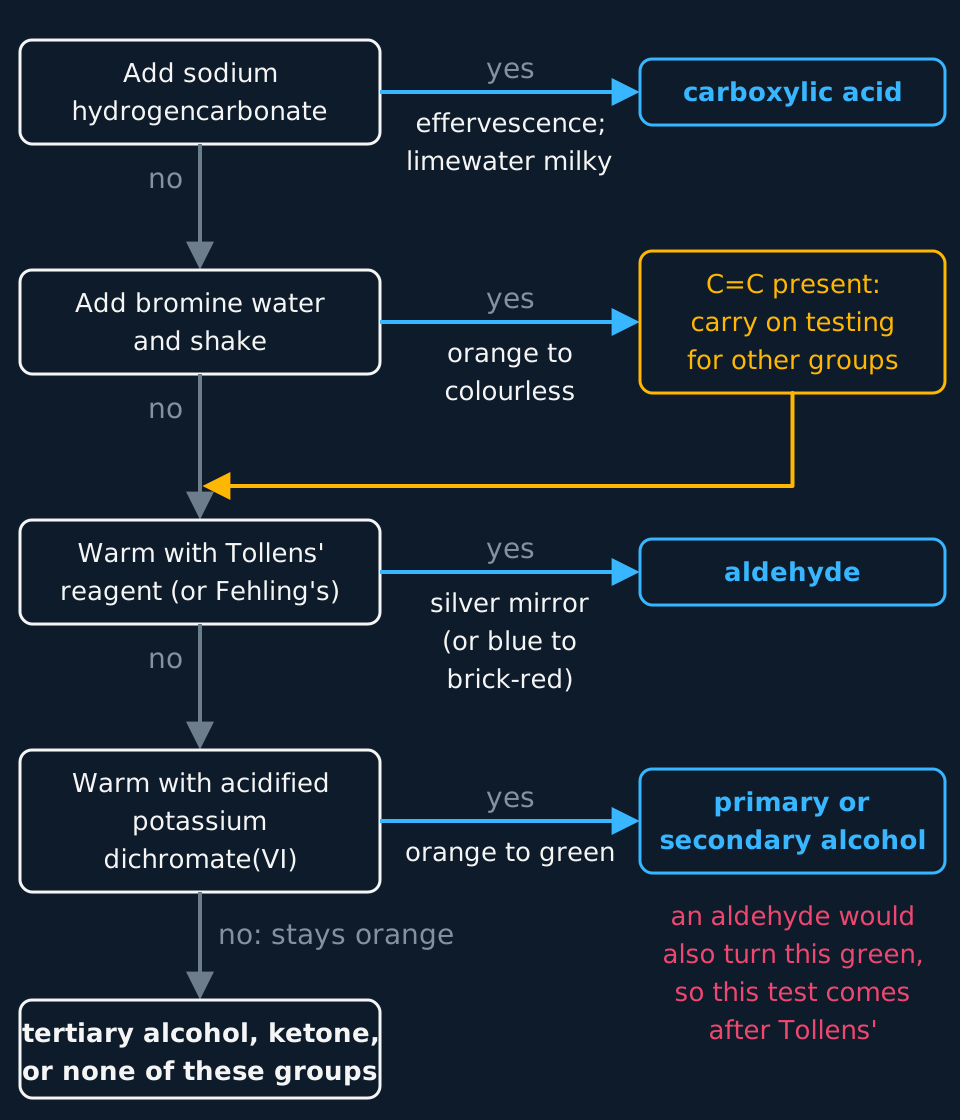
Describe the drawing
A decision tree of four test-tube tests running down the left. Sodium hydrogencarbonate first: effervescence that turns limewater milky means a carboxylic acid. Otherwise bromine water: orange to colourless shows a C=C, but the branch rejoins the tree because other groups may still be present. Then Tollens' reagent or Fehling's: a silver mirror or brick-red precipitate means an aldehyde. Last, acidified potassium dichromate(VI): orange to green means a primary or secondary alcohol, and staying orange leaves a tertiary alcohol, a ketone or none of these groups. A note warns that an aldehyde would also turn dichromate green, which is why that test comes after Tollens'.
What is measured
Record each observation as a colour before and a colour after, or as a precipitate with its colour. 'Changed colour' and 'it reacted' are not observations.
Sample results
These are the idealised results: what each test gives with a pure sample of the functional group. An old sample, a dirty tube or too long in the water bath gives a weaker result.
| Functional group | Test | What is observed |
|---|---|---|
| Alkene | Bromine water | Orange to colourless |
| Carboxylic acid | Sodium hydrogencarbonate, gas into limewater | Effervescence, and the limewater turns milky |
| Aldehyde | Tollens' reagent, warmed | A silver mirror on the glass |
| Aldehyde | Fehling's solution, warmed | The blue solution gives a brick-red precipitate |
| Primary or secondary alcohol, or aldehyde | Acidified potassium dichromate(VI), warmed | Orange to green |
Evaluation
The limitations of the method, what each does to the result and in which direction, and the improvement a mark scheme credits.
| Limitation | What it does to the result | Improvement |
|---|---|---|
| Bromine water is decolourised by more than alkenes | A phenol decolourises it too, and gives a white precipitate, so a tube that goes colourless is an alkene only if the other tests are negative | Read the four tests together: an unknown that decolourises bromine water and gives nothing with hydrogencarbonate, Tollens' reagent or dichromate is an alkene |
| A tertiary alcohol gives no result in any of the four tests | It does not react with dichromate, so it looks like an alkane or an ester, and the method cannot show that an O–H group is present | Add a small piece of sodium to a dry sample: any alcohol gives off hydrogen, and a tertiary alcohol is then the one that resists oxidation |
| Effervescence from a weak or dilute acid is easy to miss | A dilute carboxylic acid with solid hydrogencarbonate gives a few bubbles that stop quickly, and the limewater may not turn milky | Watch the surface at the moment of adding the solid, use a stoppered tube with a delivery tube into the limewater, and compare with the water control |
| A test identifies a functional group, not a compound | Every aldehyde gives a silver mirror and every alkene decolourises bromine water, so two unknowns with the same group give the same results | Identify the compound by a physical measurement: a melting point of a solid derivative, an infrared spectrum, or a mass spectrum for Mr and fragmentation |
Errors in carrying it out
The errors that matter are mostly about judging a colour. A silver mirror needs a clean, grease-free tube; in a dirty tube the silver comes down as a grey or black precipitate, which is still a positive result. A faint green in the dichromate tube is easier to judge against the orange of the water control. Heating too long drives off a volatile unknown before it has reacted, and a test-tube sample of an aldehyde left in air slowly oxidises, so old samples give weak results. Read the dichromate result only alongside the Tollens' result, because an aldehyde turns dichromate green as well.
Questions
Question 1 (6 marks)
Describe how to carry out the Tollens' and the acidified dichromate tests on an unknown organic liquid safely, and how to interpret the results.
Mark scheme
Indicative content
- Tollens' reagent is made fresh: sodium hydroxide added to silver nitrate, then dilute ammonia until the brown precipitate just dissolves
- a few drops of the unknown are added and the tube is warmed in a water bath, not over a flame, because the organic liquid is flammable
- a silver mirror shows an aldehyde; no change rules an aldehyde out
- for the second test the unknown is warmed in a water bath with potassium dichromate(VI) and dilute sulfuric acid
- orange to green shows a primary or secondary alcohol only if the Tollens' test was negative, because aldehydes also turn it green
- precautions: Tollens' residues are washed away at once because they can form explosive compounds, and gloves are worn because dichromate(VI) is toxic and carcinogenic
Levels
- Level 3 (5–6 marks) both tests are described with the preparation of the reagent, water-bath warming and the safety reasons, the observations and what each shows, including the point that a positive dichromate result identifies an alcohol only once an aldehyde has been ruled out; all the precautions named are matched to their reasons
- Level 2 (3–4 marks) both tests are described with observations and the water bath; preparing Tollens' reagent, disposing of its residues, or reading the two results together is not covered
- Level 1 (1–2 marks) one test is described with its positive result; a positive dichromate test is typically taken to prove an alcohol, and the tubes are heated over a flame
Question 2 (4 marks)
Outline a sequence of tests that would identify each of four unlabelled liquids: cyclohexene, propanal, propan-1-ol and ethanoic acid.
Mark scheme
- B1 sodium hydrogencarbonate gives effervescence only with ethanoic acid
- B1 bromine water turns from orange to colourless only with cyclohexene
- B1 Tollens' reagent, warmed, gives a silver mirror only with propanal
- B1 the remaining liquid, propan-1-ol, turns acidified dichromate(VI) from orange to green on warming; this test comes last because propanal would also turn it green
Question 3 (2 marks)
Explain why a green colour when an unknown is warmed with acidified potassium dichromate(VI) does not show that the unknown is an alcohol.
Mark scheme
- B1 the green colour shows only that dichromate(VI) has been reduced to Cr³⁺ by something that is oxidised
- B1 aldehydes are also oxidised by acidified dichromate, so the unknown could be an aldehyde as well as a primary or secondary alcohol
Question 4 (2 marks)
Suggest why a student testing propanal with Tollens' reagent sees a grey-black precipitate rather than a silver mirror, and state whether the result is positive.
Mark scheme
- B1 the test tube was not clean and grease-free, so the silver formed as a precipitate rather than a coating on the glass
- B1 silver has still been formed, so the result is positive for an aldehyde
Question 5 (2 marks)
Explain why a tube of water is run beside each test.
Mark scheme
The control shows the reagent's own colour with nothing added, so a change is judged against it rather than remembered.
A reagent that has itself deteriorated, old bromine water or cloudy Tollens' reagent, shows up in the control before the change is blamed on the unknown.
Question 6 (2 marks)
Explain why bromine water is added to the unknown a drop at a time, and state the colour change that shows an alkene.
Mark scheme
Each drop is decolourised while C=C bonds remain; a large volume added at once can be more bromine than the sample can react with, so the colour stays and the result is missed.
Orange to colourless.
Question 7 (3 marks)
Write equations for the reaction of ethanoic acid with sodium hydrogencarbonate and for the test on the gas given off, and state what is seen in the limewater.
Mark scheme
CH₃COOH + NaHCO₃ → CH₃COONa + H₂O + CO₂.
Ca(OH)₂(aq) + CO₂(g) → CaCO₃(s) + H₂O(l).
The limewater turns milky as a white precipitate of calcium carbonate forms.
Question 8 (3 marks)
Explain why Tollens' reagent is made fresh each time and washed away as soon as the test is over, and describe how it is made.
Mark scheme
On standing it can deposit explosive silver compounds, so it is never stored and is flushed away with plenty of water.
To 2 cm³ of silver nitrate solution add one drop of sodium hydroxide solution, giving a brown precipitate of silver oxide.
Add dilute ammonia drop by drop until the precipitate just redissolves, forming the colourless [Ag(NH₃)₂]⁺ complex.
Question 9 (2 marks)
Give the half-equation for the formation of the silver mirror and state what is oxidised.
Mark scheme
Ag⁺ + e⁻ → Ag.
The aldehyde is oxidised to a carboxylic acid (a carboxylate ion in the alkaline reagent).
Question 10 (3 marks)
Two unknowns, A and B, both decolourise bromine water. A also effervesces with sodium hydrogencarbonate; B gives no other positive result. Suggest what each contains.
Mark scheme
B contains a C=C double bond and no other group the tests detect: an alkene.
A contains a carboxylic acid group as well as a C=C double bond.
Accept any named compound with both groups, such as propenoic acid, CH₂=CHCOOH.
Coverage maps are available for AQA 7404/7405, OCR Chemistry A H032/H432, Pearson Edexcel Chemistry 8CH0/9CH0 and Cambridge International 9701. Use the relevant route map to check what InkChemistry covers, and your awarding organisation’s current specification as the final authority on examinable content.