Chemistry › Organic analysis › Test-tube reactions for functional groups, and high-resolution mass spectrometry
Test-tube reactions for functional groups, and high-resolution mass spectrometry
Four reagents pick out four functional groups: bromine water for an alkene, Tollens' reagent or Fehling's solution for an aldehyde, acidified dichromate for a primary or secondary alcohol, and sodium hydrogencarbonate for a carboxylic acid. High-resolution mass spectrometry then fixes the molecular formula, because no two formulae have the same precise mass.
Key terms Every definition in organic analysis, lesson by lesson
Before this Alkenes: structure, electrophilic addition and Markovnikov's rule – bromine adding across a C=C bond · Oxidation and elimination of alcohols – what acidified dichromate does to primary, secondary and tertiary alcohols · Time-of-flight mass spectrometry and relative atomic mass – how an ion's m/z is measured
COMMON MISCONCEPTION
If a compound turns acidified dichromate green, it has to be an alcohol.
Acidified dichromate turns green with anything that reduces it, and aldehydes do, going to carboxylic acids. Green says only that something was oxidised. A second test is needed: no silver mirror with Tollens' reagent rules out an aldehyde. A tertiary alcohol gives no colour change at all.
What you should be able to do
- State the reagent, the conditions and the observation for the tests for an alkene, an aldehyde, a primary or secondary alcohol and a carboxylic acid.
- Explain why an aldehyde reduces Tollens' reagent and Fehling's solution and a ketone does not.
- Identify an unknown compound from the results of a sequence of tests, taking account of reagents that respond to more than one group.
- Carry out the functional group tests practical safely, recording observations in the words a mark scheme uses.
- Calculate a precise relative molecular mass and use it to decide between molecular formulae with the same nominal mass.
- Describe the 2,4-dinitrophenylhydrazine test for a carbonyl group, and the use of the derivative's melting point.CAIE · Edexcel · OCR A
Four reagents, four functional groups
Each of four reagents reacts with one functional group and shows it with a colour change or a gas. Cyclohexene, propanal, propan-1-ol and ethanoic acid are all colourless liquids, and the four reagents tell them apart in a few minutes of test-tube work.
The test for an alkene is bromine water, which is orange. Shaken with an alkene it turns colourless, because bromine adds across the C=C double bond and the dibromo product is colourless. An alkane gives no change. Write 'orange to colourless' or 'decolourised'. 'Clear' is not the same word: a solution can be clear and still be orange.
C₆H₁₀(l) + Br₂(aq) → C₆H₁₀Br₂(l)Cyclohexene decolourises bromine water by electrophilic addition.
Two reagents test for an aldehyde. Tollens' reagent is a colourless solution of the complex ion [Ag(NH₃)₂]⁺. Warmed with an aldehyde in a water bath, it gives a silver mirror on the inside of the tube. The aldehyde is oxidised to a carboxylic acid and silver(I) is reduced to silver metal. Fehling's solution is a deep blue solution of copper(II) ions, kept in solution in alkali by a complexing agent. Warmed with an aldehyde, it gives a brick-red precipitate of copper(I) oxide, Cu₂O. A ketone does neither: Tollens' stays colourless and Fehling's stays blue.
[Ag(NH₃)₂]⁺(aq) + e⁻ → Ag(s) + 2NH₃(aq)Silver(I) is reduced; the electron comes from the aldehyde.
The difference between the two carbonyls comes from what is attached to the C=O carbon. An aldehyde has a hydrogen there, and oxidation replaces that C–H with C–OH, giving a carboxylic acid. A ketone has two carbons there, and oxidising it would mean breaking a C–C bond, which these mild oxidising agents cannot do.
Primary and secondary alcohols are shown by potassium dichromate(VI) acidified with dilute sulfuric acid, which is orange. Warmed with a primary or a secondary alcohol, it turns green, as Cr₂O₇²⁻ is reduced to Cr³⁺. A tertiary alcohol has no hydrogen on the carbon bearing the OH and is not oxidised, so the mixture stays orange. Aldehydes are oxidised too, so they also turn it green.
CH₃CH₂CH₂OH(l) + [O] → CH₃CH₂CHO(l) + H₂O(l)A primary alcohol oxidised to an aldehyde; [O] stands for the oxidising agent.
A carboxylic acid is shown by solid sodium hydrogencarbonate, or sodium carbonate solution, with which it gives effervescence. The gas is carbon dioxide and turns limewater milky. Alcohols and aldehydes are far too weakly acidic to react. Write 'effervescence' or 'bubbles'; 'a gas is produced' is a conclusion, since nobody sees a gas.
CH₃COOH(aq) + NaHCO₃(s) → CH₃COONa(aq) + H₂O(l) + CO₂(g)
| Group | Reagent and conditions | Positive result | Negative result |
|---|---|---|---|
| Alkene | Bromine water, shake at room temperature | Orange to colourless | Stays orange |
| Aldehyde | Tollens' reagent, warm in a water bath | Silver mirror | Stays colourless |
| Aldehyde | Fehling's solution, warm in a water bath | Blue solution to brick-red precipitate | Stays blue |
| Primary or secondary alcohol | Potassium dichromate(VI) and dilute sulfuric acid, warm | Orange to green | Stays orange |
| Carboxylic acid | Sodium hydrogencarbonate or sodium carbonate | Effervescence; gas turns limewater milky | No effervescence |
- Functional group
- The atom or group of atoms in a molecule that is responsible for its characteristic chemical reactions.
- Tollens' reagent
- An aqueous solution of [Ag(NH₃)₂]⁺ that is reduced to silver by an aldehyde, giving a silver mirror, but does not react with a ketone.
- Fehling's solution
- An alkaline solution of a copper(II) complex that is reduced by an aldehyde to a brick-red precipitate of copper(I) oxide.
Working through an unknown
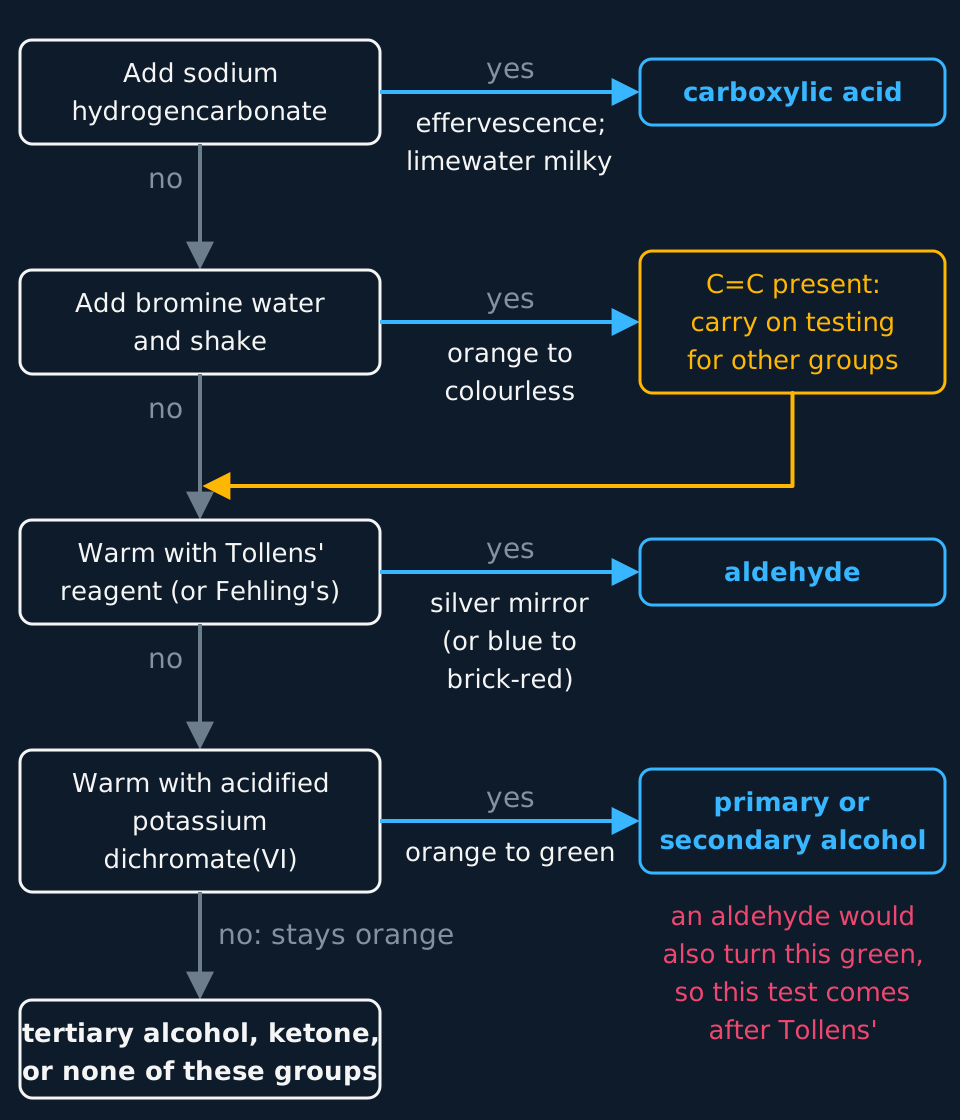
One reagent can respond to two groups, so the order in which the results are read matters. Acidified dichromate turns green with a primary alcohol, a secondary alcohol and an aldehyde. A green result means 'one of those three', and only the Tollens' or Fehling's result says whether an aldehyde is present.
Describe the drawing
A decision tree of four test-tube tests running down the left. Sodium hydrogencarbonate first: effervescence that turns limewater milky means a carboxylic acid. Otherwise bromine water: orange to colourless shows a C=C, but the branch rejoins the tree because other groups may still be present. Then Tollens' reagent or Fehling's: a silver mirror or brick-red precipitate means an aldehyde. Last, acidified potassium dichromate(VI): orange to green means a primary or secondary alcohol, and staying orange leaves a tertiary alcohol, a ketone or none of these groups. A note warns that an aldehyde would also turn dichromate green, which is why that test comes after Tollens'.
Dichromate alone cannot tell a primary alcohol from a secondary one, because both turn it green. Oxidise the alcohol with dichromate in distillation apparatus and test the distillate with Tollens' reagent. A primary alcohol gives an aldehyde, which distils off and forms a silver mirror. A secondary alcohol gives a ketone, which does not.
Naming three isomers of C₃H₆O from their test results
Three liquids X, Y and Z each have the formula C₃H₆O. X decolourises bromine water, gives no silver mirror and turns acidified dichromate green. Y does not decolourise bromine water and gives a silver mirror. Z gives no change with any of the three. None reacts with sodium hydrogencarbonate. Name each compound.
Show the working
C₃H₆O has one double bond or one ring. With one oxygen and no fizz with hydrogencarbonate, the candidates are propanal, propanone and prop-2-en-1-ol, CH₂=CHCH₂OH.
X decolourises bromine water, so it contains C=C. It gives no mirror, so the green dichromate result is not from an aldehyde: it is a primary or secondary alcohol. X is prop-2-en-1-ol, a primary alcohol with a C=C bond.
Y has no C=C and gives a silver mirror, so it is an aldehyde: propanal, CH₃CH₂CHO.
Z has no C=C, is not an aldehyde and is not oxidised by dichromate. Of the three, it is the ketone: propanone, CH₃COCH₃.
Required practical 6: tests for alcohol, aldehyde, alkene and carboxylic acid
AQA required practical; optional reading for other boards
AQA sets this as required practical 6. The apparatus is a rack of test tubes, dropping pipettes, a beaker of water at about 60 °C from a kettle as the water bath, a spatula and a test tube of limewater with a delivery tube. No flame is used anywhere: every organic liquid here is flammable.
| Step | What to do | What is observed |
|---|---|---|
| 1 | Put about 1 cm³ of each unknown in a labelled tube. Run a tube of water beside each test as a control | The control shows the reagent's own colour to compare against |
| 2 | Add bromine water a drop at a time to a fresh sample and shake | Alkene: orange to colourless |
| 3 | Add a spatula of solid sodium hydrogencarbonate to a fresh sample; pass any gas into limewater | Carboxylic acid: effervescence, and the limewater turns milky |
| 4 | Make Tollens' reagent: to 2 cm³ of silver nitrate solution add one drop of sodium hydroxide solution, then dilute ammonia drop by drop until the brown precipitate just dissolves | A brown precipitate of silver oxide forms and then redissolves to a colourless solution |
| 5 | Add five drops of unknown to the Tollens' reagent and stand the tube in the water bath for five minutes | Aldehyde: a silver mirror on the glass |
| 6 | Alternatively, mix 1 cm³ each of Fehling's A and B, add five drops of unknown and warm in the water bath | Aldehyde: the blue solution gives a brick-red precipitate |
| 7 | Add five drops of unknown to 1 cm³ of potassium dichromate(VI) solution and 1 cm³ of dilute sulfuric acid; warm in the water bath | Primary or secondary alcohol, or aldehyde: orange to green |
Record each observation as a colour before and a colour after, or as a precipitate with its colour. 'Changed colour' and 'it reacted' are not observations.
The errors that matter are mostly about judging a colour. A silver mirror needs a clean, grease-free tube; in a dirty tube the silver comes down as a grey or black precipitate, which is still a positive result. A faint green in the dichromate tube is easier to judge against the orange of the water control. Heating too long drives off a volatile unknown before it has reacted, and a test-tube sample of an aldehyde left in air slowly oxidises, so old samples give weak results. Read the dichromate result only alongside the Tollens' result, because an aldehyde turns dichromate green as well.
Risk assessment. Tollens' reagent is made fresh and never stored: on standing it can deposit explosive silver compounds, so it is washed away with plenty of water as soon as the test is over. Potassium dichromate(VI) is toxic and a carcinogen; wear gloves. Bromine water and ammonia are harmful and irritant, and sodium hydroxide is corrosive to eyes; wear eye protection throughout. Check the CLEAPSS Hazcards and the school's risk assessment; where they differ from the advice here, follow them.
High-resolution mass spectrometry
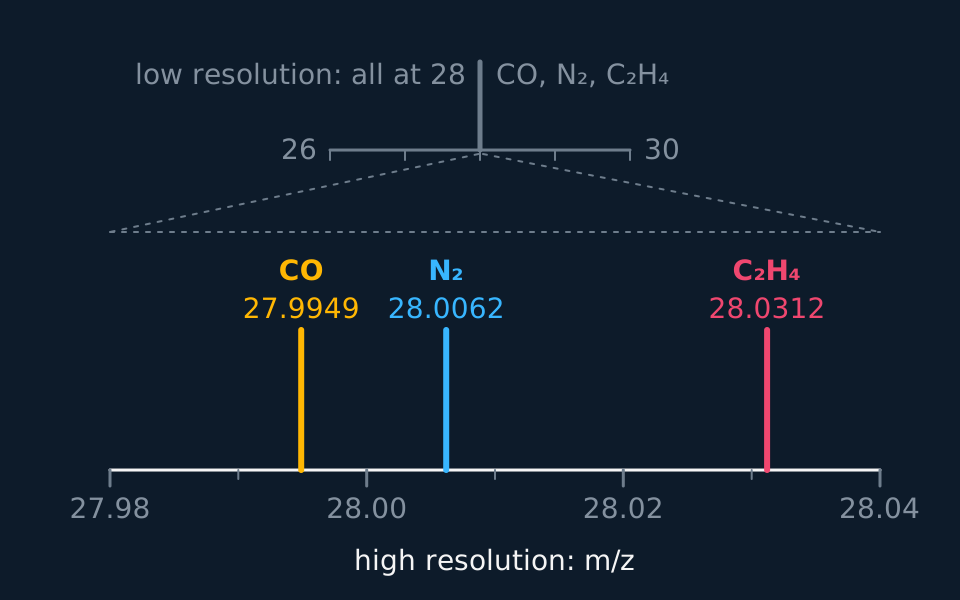
Nitrogen, carbon monoxide and ethene are three colourless gases with the same relative molecular mass to the nearest whole number, 28. A low-resolution mass spectrometer shows each of them as a molecular ion at m/z 28 and cannot tell them apart. A high-resolution instrument measures m/z to four decimal places, and at that precision the three are different.
They differ because atomic masses are not whole numbers. Carbon-12 is exactly 12 by definition, but every other isotope is slightly off a whole number, because the mass of a nucleus is not simply the sum of the masses of its protons and neutrons. The precise masses used are for the most abundant isotope of each element, not the relative atomic masses of the periodic table.
| Isotope | Precise relative mass |
|---|---|
| ¹H | 1.0078 |
| ¹²C | 12.0000 |
| ¹⁴N | 14.0031 |
| ¹⁶O | 15.9949 |
Adding these gives 2 × 14.0031 = 28.0062 for N₂, 12.0000 + 15.9949 = 27.9949 for CO and 2 × 12.0000 + 4 × 1.0078 = 28.0312 for C₂H₄. A molecular ion measured at 28.0313 can only be ethene.
Hydrogen and nitrogen sit slightly above a whole number and oxygen slightly below, so a molecule rich in hydrogen is a little heavier than its nominal mass and one rich in oxygen a little lighter. Formulae with the same nominal mass usually differ by 0.01 or more, and a high-resolution instrument measures to within about 0.001, so the match is unambiguous. The technique gives a molecular formula, not a structure: propanal and propanone have the same formula and the same precise mass, and only a test or a spectrum separates them.
Describe the drawing
A number line of m/z from 27.98 to 28.04 with three tall lines on it: CO at 27.9949, N₂ at 28.0062 and C₂H₄ at 28.0312, the second gap more than twice the first. Above it a small low-resolution axis from 26 to 30 shows a single line at 28 carrying all three formulae, with dashed lines opening that one line out into the high-resolution axis below.
- Molecular ion
- The ion formed when a molecule loses one electron, M⁺; its m/z gives the relative molecular mass.
- Precise relative molecular mass
- The relative molecular mass calculated from the precise masses of the most abundant isotopes, given to four decimal places.
C₃H₆O or C₂H₆N₂
A compound gives a molecular ion at m/z 58.0418 on a high-resolution mass spectrum. Show whether its formula is C₃H₆O or C₂H₆N₂.
Show the working
C₃H₆O: 3 × 12.0000 + 6 × 1.0078 + 15.9949 = 36.0000 + 6.0468 + 15.9949 = 58.0417.
C₂H₆N₂: 2 × 12.0000 + 6 × 1.0078 + 2 × 14.0031 = 24.0000 + 6.0468 + 28.0062 = 58.0530.
The measured 58.0418 differs from 58.0417 by 0.0001 and from 58.0530 by 0.0112. The formula is C₃H₆O, which fits propanal, propanone and prop-2-en-1-ol alike, and the test-tube reactions decide which.
TRY IT: Four formulae at m/z 44
A gas gives a molecular ion at m/z 44.0262. Decide whether it is CO₂, N₂O, C₃H₈ or C₂H₄O.
Check your answer
CO₂ = 12.0000 + 2 × 15.9949 = 43.9898. N₂O = 2 × 14.0031 + 15.9949 = 44.0011.
C₃H₈ = 36.0000 + 8 × 1.0078 = 44.0624. C₂H₄O = 24.0000 + 4 × 1.0078 + 15.9949 = 44.0261.
Only C₂H₄O lies within 0.0001 of the measured value, so the molecular formula is C₂H₄O. That fits ethanal and also epoxyethane; Tollens' reagent or an infrared spectrum decides which.
In an electron-impact spectrometer, a fast electron knocks an electron out of the molecule, giving the molecular ion. Its peak is the one with the highest m/z, ignoring a very small peak one unit beyond it from molecules containing carbon-13, and its m/z is the relative molecular mass. If the sample was ionised by electrospray instead, the peak is MH⁺, one proton heavier, and 1.0073 is subtracted: the proton, not the hydrogen atom, because the added H⁺ brings no electron with it.
M(g) + e⁻ → M⁺(g) + 2e⁻
Other boards: 2,4-DNP, triiodomethane, phenols and fragmentation
OCR assesses the four tests of required practical 6 in PAG 7, Edexcel within its core practicals, and Cambridge in its practical papers, with the same reagents and the same observations.
AQA's required practical stops at the four tests in the table. OCR, Edexcel and Cambridge also examine a test for the C=O group itself; Edexcel and Cambridge add a test for a methyl group next to it, and OCR a way of telling a phenol from a carboxylic acid.
2,4-Dinitrophenylhydrazine, 2,4-DNP or Brady's reagent, is used dissolved in methanol and sulfuric acid. A few drops of any aldehyde or ketone give a yellow or orange precipitate at room temperature. The NH₂ group of the reagent joins to the C=O carbon and a molecule of water is lost, giving a solid 2,4-dinitrophenylhydrazone. The C=O of a carboxylic acid or an ester does not react, so the test picks out aldehydes and ketones together, and Tollens' reagent then says which of the two is present.
CH₃COCH₃(l) + C₆H₃(NO₂)₂NHNH₂ → (CH₃)₂C=NNHC₆H₃(NO₂)₂(s) + H₂O(l)Propanone and 2,4-DNP condense, losing water. The reagent is in methanol and acid, so it carries no state symbol.
The precipitate also names the compound. Filtered off, recrystallised from ethanol and dried, the derivative has a sharp melting point, and each aldehyde and ketone gives a derivative with its own. The measured melting point is compared with a data table. This works where boiling points fail: propanal and propanone boil only 7 °C apart, but their derivatives melt about 30 °C apart. OCR sets both uses of the reagent, the test and the melting point; Edexcel and Cambridge set the test.
| Carbonyl compound | Boiling point / °C | Melting point of 2,4-DNP derivative / °C |
|---|---|---|
| Ethanal | 21 | 168 |
| Propanal | 49 | 155 |
| Propanone | 56 | 126 |
| Butanone | 80 | 116 |
Edexcel and Cambridge add the triiodomethane test, also called the iodoform test. The unknown is warmed with iodine solution and aqueous sodium hydroxide. A pale yellow precipitate of CHI₃, with an antiseptic smell, shows a CH₃CO group: ethanal and every methyl ketone give it. Propanone gives the precipitate and propanal does not, so the test separates those two isomers. Alcohols with a CH₃CH(OH) group, such as ethanol and butan-2-ol, give it too, because the alkaline iodine first oxidises them to a CH₃CO compound.
CH₃COCH₃(aq) + 3I₂(aq) + 4NaOH(aq) → CHI₃(s) + CH₃COONa(aq) + 3NaI(aq) + 3H₂O(l)The three hydrogens of one CH₃ group are replaced by iodine, then the C–C bond to the carbonyl carbon breaks.
OCR adds phenols. Phenol, C₆H₅OH, is a weak acid: it reacts with sodium hydroxide solution to form sodium phenoxide, but it is too weak an acid to release carbon dioxide from a carbonate or hydrogencarbonate. A compound that reacts with sodium hydroxide but gives no effervescence with sodium hydrogencarbonate is a phenol; a carboxylic acid does both.
C₆H₅OH(s) + NaOH(aq) → C₆H₅ONa(aq) + H₂O(l)
- 2,4-Dinitrophenylhydrazine
- Brady's reagent, which gives a yellow or orange precipitate with an aldehyde or a ketone; the melting point of the purified precipitate identifies the carbonyl compound.
- Triiodomethane test
- Warming with iodine and aqueous sodium hydroxide; a pale yellow precipitate of CHI₃ shows a CH₃CO group or a CH₃CH(OH) group.
AQA asks for the precise-mass calculation and not for fragment patterns, which OCR, Edexcel and Cambridge all examine. The molecular ion has excess energy and some break apart. A fragmentation gives one positive ion and one neutral radical, and only the ion is accelerated and detected.
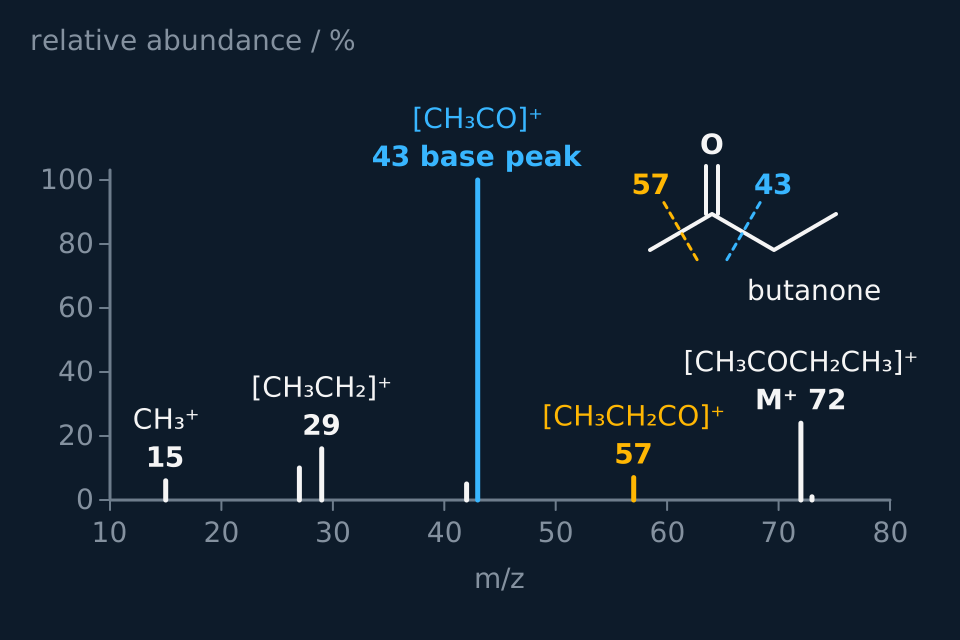
CH₃COCH₂CH₃⁺(g) → CH₃CO⁺(g) + •CH₂CH₃(g)Butanone losing an ethyl radical gives the ion at m/z 43.
Describe the drawing
A line mass spectrum of butanone with m/z from 10 to 80 along the bottom and relative abundance up the side. The tallest line, the base peak at 43, is CH₃CO⁺. The molecular ion M⁺ at 72 reaches about a quarter of its height, with a tiny M+1 line at 73. Smaller lines at 57, 29 and 15 are labelled CH₃CH₂CO⁺, CH₃CH₂⁺ and CH₃⁺; lines at 27 and 42 are unlabelled. A skeletal structure of butanone shows dashed cuts either side of the C=O carbon giving 43 and 57.
Read a fragment as a difference. From m/z 72, a peak at 57 is a loss of 15, a CH₃ group, leaving CH₃CH₂CO⁺; a peak at 43 is a loss of 29, an ethyl group, leaving CH₃CO⁺. The peaks at 29 and 15 are CH₃CH₂⁺ and CH₃⁺ themselves. Butanal, an isomer, has no CH₃CO group, yet it also gives a peak at 43, from CH₃CH₂CH₂⁺. Two different ions can share a nominal m/z, so a fragment is assigned from the structure, not the structure from one fragment.
- Fragmentation
- The breaking of a molecular ion into a positive ion and a neutral radical, of which only the ion is detected.
- Base peak
- The tallest peak in a mass spectrum, given a relative abundance of 100.
- M+1 peak
- The small peak one m/z unit above the molecular ion, from molecules containing one carbon-13 atom; its height relative to M gives the number of carbon atoms.
Cambridge also reads the two small peaks just beyond the molecular ion.
The M+1 peak comes from molecules that contain one carbon-13 atom. About 1.1% of carbon atoms are carbon-13, so each carbon in a molecule has a 1.1% chance of being one. A molecule with n carbon atoms gives an M+1 peak about n × 1.1 per cent of the height of the M peak, and turning that round counts the carbons.
n = (100 × height of M+1 peak) ÷ (1.1 × height of M peak)
Counting carbons from the M+1 peak
A compound gives a molecular ion at m/z 86 with relative abundance 12.0, and an M+1 peak at m/z 87 with relative abundance 0.80. Deduce the number of carbon atoms and suggest a molecular formula.
Show the working
n = (100 × 0.80) ÷ (1.1 × 12.0) = 80 ÷ 13.2 = 6.06.
Atoms come in whole numbers, so the molecule has 6 carbon atoms.
Six carbons account for 72 of the 86. The remaining 14 is fourteen hydrogens, the most six carbons can carry, so the formula is C₆H₁₄. Pentanal, C₅H₁₀O, also has M = 86, but its M+1 peak would be only 5 × 1.1 = 5.5% of the M peak, 0.66 here, not 0.80.
The M+2 peak shows chlorine or bromine. Chlorine is about 75% ³⁵Cl and 25% ³⁷Cl, so a compound with one chlorine atom gives two molecular ion peaks two units apart in the height ratio 3:1: chloroethane at m/z 64 and 66. Bromine is ⁷⁹Br and ⁸¹Br in nearly equal amounts, so one bromine atom gives two peaks of equal height: bromoethane at m/z 108 and 110. Two chlorine atoms give three peaks, at M, M+2 and M+4, in the ratio 9:6:1.
In the exam
- An observation mark needs the colour before and after: bromine water 'orange to colourless', dichromate 'orange to green', Fehling's 'blue solution to brick-red precipitate'. Schemes also accept 'decolourised' for bromine water.
- For Tollens' reagent, schemes accept 'silver mirror' and also 'grey or black precipitate'; for a ketone, 'no change' or 'no visible change' is the observation, and they reject 'no reaction', which is a conclusion.
- A tertiary alcohol leaves dichromate orange. State the reason as no hydrogen on the carbon bonded to the OH group.
- In a precise-mass question, show each sum to four decimal places and say which matches the measured m/z: the scheme gives the final mark for the comparison, not for the formula alone.
- Where the board sets them: 2,4-DNP gives a 'yellow or orange precipitate', and 'red' is allowed, with an aldehyde or ketone; alkaline iodine gives a 'pale yellow precipitate' with a CH₃CO or CH₃CH(OH) group.
Check yourself
A student has two bottles, one of butan-1-ol and one of butan-2-ol. She warms each with acidified potassium dichromate and both turn green, so she concludes the test cannot tell them apart. Explain how the same reagent can distinguish them.
Answer
Both are oxidised, which is why both turn the dichromate green. The difference is in what they are oxidised to.
Butan-1-ol is a primary alcohol and gives butanal; butan-2-ol is a secondary alcohol and gives butanone. Carry out each oxidation in distillation apparatus so the carbonyl product distils off as it forms.
Warm each distillate with Tollens' reagent. Butanal, an aldehyde, gives a silver mirror; butanone, a ketone, gives no change. The bottle whose distillate gives the mirror is butan-1-ol.
Questions
Question 16 marks
Describe how to carry out the Tollens' and the acidified dichromate tests on an unknown organic liquid safely, and how to interpret the results.
Mark scheme
Indicative content
- Tollens' reagent is made fresh: sodium hydroxide added to silver nitrate, then dilute ammonia until the brown precipitate just dissolves
- a few drops of the unknown are added and the tube is warmed in a water bath, not over a flame, because the organic liquid is flammable
- a silver mirror shows an aldehyde; no change rules an aldehyde out
- for the second test the unknown is warmed in a water bath with potassium dichromate(VI) and dilute sulfuric acid
- orange to green shows a primary or secondary alcohol only if the Tollens' test was negative, because aldehydes also turn it green
- precautions: Tollens' residues are washed away at once because they can form explosive compounds, and gloves are worn because dichromate(VI) is toxic and carcinogenic
Levels
- Level 3 (5–6 marks) both tests are described with the preparation of the reagent, water-bath warming and the safety reasons, the observations and what each shows, including the point that a positive dichromate result identifies an alcohol only once an aldehyde has been ruled out; all the precautions named are matched to their reasons
- Level 2 (3–4 marks) both tests are described with observations and the water bath; preparing Tollens' reagent, disposing of its residues, or reading the two results together is not covered
- Level 1 (1–2 marks) one test is described with its positive result; a positive dichromate test is typically taken to prove an alcohol, and the tubes are heated over a flame
Question 24 marksAQA · Edexcel
Calculate the precise relative molecular mass of a compound that, ionised by electrospray, gives an MH⁺ peak at m/z 89.0597 on a high-resolution mass spectrum, and show whether its formula is C₄H₈O₂ or C₅H₁₂O, using the data in the table and 1.0073 for the mass of a proton.
| Isotope | Precise relative mass |
|---|---|
| ¹H | 1.0078 |
| ¹²C | 12.0000 |
| ¹⁴N | 14.0031 |
| ¹⁶O | 15.9949 |
Mark scheme
- M1 MH⁺ carries one extra proton, so M = 89.0597 − 1.0073 = 88.0524; reject subtracting 1.0078, the mass of an H atom
- M1 C₄H₈O₂: 4 × 12.0000 + 8 × 1.0078 + 2 × 15.9949 = 88.0522
- M1 C₅H₁₂O: 5 × 12.0000 + 12 × 1.0078 + 15.9949 = 88.0885
- A1 M = 88.0524, no unit, which matches 88.0522 to within 0.0002, so the formula is C₄H₈O₂
Question 34 marksAQA · Edexcel
Deduce which of C₄H₆O, C₅H₁₀, C₃H₂O₂ and C₃H₆N₂ is the molecular formula of a compound whose molecular ion is at m/z 70.0419, using the precise masses in the table.
| Isotope | Precise relative mass |
|---|---|
| ¹H | 1.0078 |
| ¹²C | 12.0000 |
| ¹⁴N | 14.0031 |
| ¹⁶O | 15.9949 |
Mark scheme
- M1 C₄H₆O = 70.0417 and C₅H₁₀ = 70.0780
- M1 C₃H₂O₂ = 70.0054 and C₃H₆N₂ = 70.0530
- M1 only one value lies within 0.001 of the measured 70.0419; error carried forward from one wrong sum
- A1 the molecular formula is C₄H₆O, precise mass 70.0417
All 22 questions with mark schemes, the other 19 set out in full on the question page.
Worth remembering
- A test needs reagent, condition and observation together: 'Tollens' reagent' alone, without 'warm' and 'silver mirror', scores one mark of three.
- A green dichromate result taken as proof of an alcohol is wrong: an aldehyde turns it green too.
- Record effervescence, and limewater turning milky to name the gas; 'a gas is given off' is a conclusion.
- Use ¹H = 1.0078 and ¹²C = 12.0000 for precise masses; the periodic-table Ar values give a mass that matches nothing.
- Naming a compound from a precise mass alone overreaches: isomers share it, and a test or a spectrum decides between them.
CHECK YOUR PROGRESS
Rate how confident you are with each objective for this lesson. Ratings are saved in this browser, on this device, unless you sign in.
- State the reagent, the conditions and the observation for the tests for an alkene, an aldehyde, a primary or secondary alcohol and a carboxylic acid.
- Explain why an aldehyde reduces Tollens' reagent and Fehling's solution and a ketone does not.
- Identify an unknown compound from the results of a sequence of tests, taking account of reagents that respond to more than one group.
- Carry out the functional group tests practical safely, recording observations in the words a mark scheme uses.
- Calculate a precise relative molecular mass and use it to decide between molecular formulae with the same nominal mass.
- Describe the 2,4-dinitrophenylhydrazine test for a carbonyl group, and the use of the derivative's melting point.CAIE · Edexcel · OCR A
Open the full revision checklist to see every objective in the curriculum in one place.
Practise this lesson
WORKBOOK
The written questions from this topic, on paper with room to work, and a separate book of mark schemes. The 4 questions that are set on a diagram stay on this page, where the diagram can be drawn. Free to use; please do not redistribute or sell.
Used later in Chromatography: TLC, column and gas · Putting the analysis together: structure from spectra