Chemistry › Practicals › Organic preparation and purification: aspirin and ethyl ethanoate
Required practical 10: preparing aspirin and ethyl ethanoate (OCR PAGs 5 and 6, Edexcel CP 16)
Make aspirin and purify it by recrystallisation, testing it by its melting point, then make ethyl ethanoate and purify it by washing, drying and distillation.
This is the method section of Preparing, purifying and testing an organic solid and liquid on a page of its own, with its variables, sample results, an evaluation and questions set on it. The chemistry behind it is in that lesson.
The capability this develops
This investigation is one instance of capability P05: Preparing and purifying organic products, which sets out the techniques it belongs to, the calculations it carries and the errors that cost marks in all of them. The notes behind the chemistry are in Organic synthesis.
Where this sits on the specifications
Each qualification is mapped to its own specification one numbered heading at a time, against a document whose sha256 is recorded. These are the headings that list the lesson this method is taught in, on the four qualifications mapped. Each links to the route map the row belongs to.
| Qualification | Heading |
|---|---|
| AQA 7404/7405 | 3.3.9.2 Acylation |
| OCR Chemistry A H032/H432 | 4.2.3 Organic synthesis |
| OCR Chemistry A H032/H432 | 6.2.5 Organic synthesis |
| Pearson Edexcel Chemistry 8CH0/9CH0 | 6.39 preparing and purifying a liquid |
| Pearson Edexcel Chemistry 8CH0/9CH0 | 18.21 choosing procedures and controlling risk |
| Pearson Edexcel Chemistry 8CH0/9CH0 | 18.22 preparing and purifying organic compounds |
Three boards number their practical activities, and those lists were read here from the same specifications as the headings above. This investigation is filed on them as:
- AQA 7404/7405 required practical 10: Preparing a pure organic solid and liquid
- OCR Chemistry A H032/H432 PAG 5: Synthesis of an organic liquid
- OCR Chemistry A H032/H432 PAG 6: Synthesis of an organic solid
- Pearson Edexcel Chemistry 8CH0/9CH0 core practical 16: Preparation of aspirin
Use your awarding organisation’s current specification and its practical handbook as the authority on which activities your course requires and how they are assessed.
Apparatus
A balance reading to 0.01 g, measuring cylinders, a flask with a condenser that fits it both ways, a heating mantle or water bath, a thermometer, Büchner apparatus, a separating funnel and a melting point apparatus.
Safety
The anhydride, the concentrated acids and the ester's vapour are handled in a fume cupboard, and no flame is lit near ethanol or ethyl ethanoate.
Variables
Independent variable
What changes from the aspirin to the ester is the state of the product, a solid and then a liquid, and with it the way each is purified and tested.
Dependent variable
The mass of dry product, and so the percentage yield; the melting point range of the solid; and the boiling range over which the liquid is collected.
Control variables
- The limiting reactant, 2.00 g of 2-hydroxybenzoic acid or 12.0 cm³ of ethanoic acid, weighed or measured the same way, with the other reagent in excess.
- The reaction conditions: 15 minutes at about 80 °C under reflux for the aspirin, 20 minutes under reflux for the ester, with the catalyst added in the same amount.
- The purification: the minimum volume of hot solvent for the recrystallisation, the same washes for the ester, and drying to constant mass before weighing.
- The rate of heating in the melting point apparatus, slow near 135 °C, so that the sample and the thermometer are at the same temperature.
Yield and purity pull against each other. Every wash and every recrystallisation raises the purity and lowers the yield, so the quantities, times and solvent volumes are fixed in order that one preparation can be compared with another, or one student's with the class.
Method
C₇H₆O₃(s) + (CH₃CO)₂O(l) → C₉H₈O₄(s) + CH₃COOH(l)2-hydroxybenzoic acid and ethanoic anhydride give aspirin and ethanoic acid.
| Step | Solid: aspirin | Why |
|---|---|---|
| 1 | Weigh about 2.00 g of 2-hydroxybenzoic acid by difference into a 50 cm³ pear-shaped flask. | Its moles fix the theoretical yield. |
| 2 | In a fume cupboard add 4.0 cm³ of ethanoic anhydride and five drops of concentrated phosphoric acid, with anti-bumping granules. | The anhydride is in excess; the acid is the catalyst. |
| 3 | Fit a reflux condenser and heat in a water bath at about 80 °C for 15 minutes. | Keeps the volatile anhydride in the flask; the bath heats evenly and safely. |
| 4 | Cool, then add 20 cm³ of cold water a little at a time, and stand the flask in ice. | Water hydrolyses the excess anhydride; aspirin crystallises in the cold. |
| 5 | Filter under reduced pressure and rinse with a little ice-cold water. | Separates the crude solid from the acidic solution. |
| 6 | Recrystallise from the minimum volume of a hot ethanol and water mixture; cool slowly, then in ice. | Soluble impurities stay in solution. |
| 7 | Filter under reduced pressure, wash with a little ice-cold water and dry in a desiccator. | Removes clinging solution and water. |
| 8 | Weigh the dry product on a weighed watch glass. | Gives the actual yield. |
| 9 | Measure the melting point range in a capillary tube, heating slowly near 135 °C. | A sharp melting point at 135 °C shows purity. |
CH₃COOH(l) + CH₃CH₂OH(l) ⇌ CH₃COOCH₂CH₃(l) + H₂O(l)Esterification is an equilibrium, which caps the yield before any is lost.
| Step | Liquid: ethyl ethanoate | Why |
|---|---|---|
| 1 | Measure 12.0 cm³ of glacial ethanoic acid and 15.0 cm³ of ethanol into a 50 cm³ round-bottomed flask. | Excess ethanol pushes the equilibrium towards the ester. |
| 2 | Add 2 cm³ of concentrated sulfuric acid a drop at a time, swirling and cooling; add anti-bumping granules. | Mixing is exothermic; the acid is the catalyst. |
| 3 | Heat under reflux on a heating mantle for 20 minutes. | Gives the slow reaction time without loss of vapour. |
| 4 | Rearrange for distillation and collect everything that distils below 85 °C. | Separates the volatile crude ester from the acid and catalyst. |
| 5 | Shake with sodium carbonate solution in a separating funnel, venting often, until no more gas forms; discard the lower layer. | Removes the acids as salts in the aqueous layer. |
| 6 | Run the ester into a dry flask, add anhydrous calcium chloride and swirl until clear. | Removes water and ethanol. |
| 7 | Decant into a clean, dry flask and redistil, collecting 75 to 79 °C in a weighed sample bottle. | Only the ester boils in this range. |
| 8 | Weigh the bottle and its contents. | Gives the actual yield. |
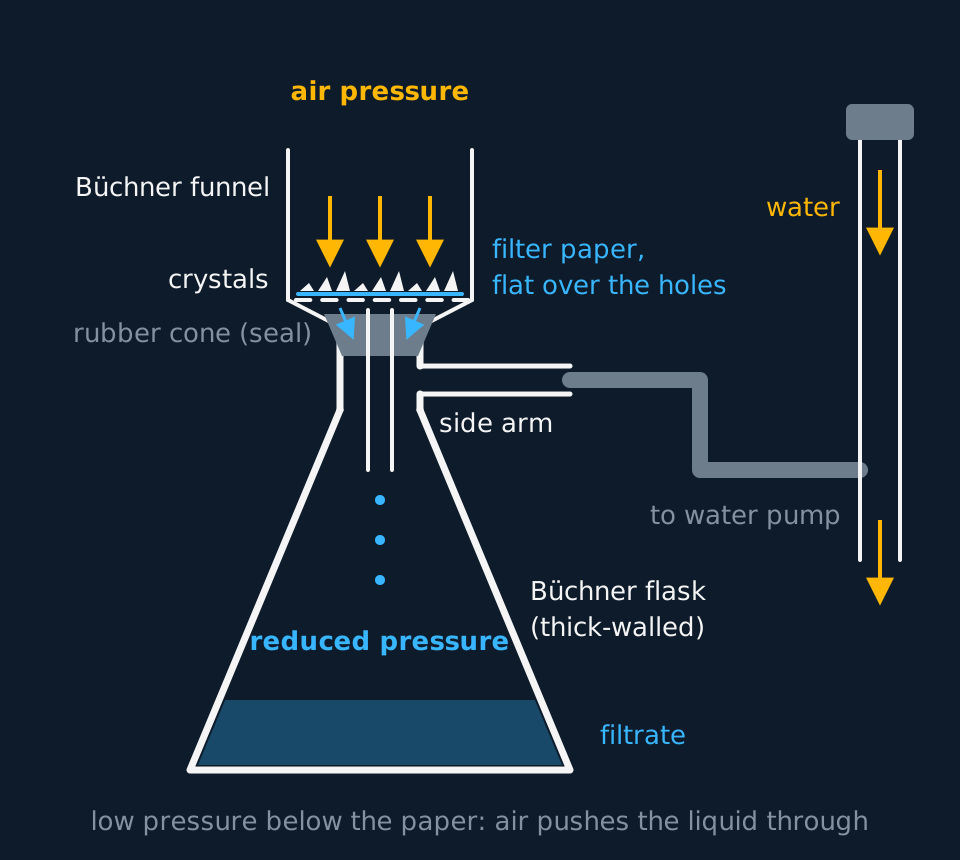
Describe the drawing
Filtration under reduced pressure in cross-section. A Büchner funnel with a flat perforated plate sits in a grey rubber cone in the neck of a thick-walled conical Büchner flask. A circle of filter paper lies flat on the plate, smaller than it but covering every hole, with a layer of white crystals on top. Amber arrows show air pressure pushing down on the solid; small cyan arrows show liquid drawn through the holes into the flask, where filtrate collects under reduced pressure. The side arm is joined by thick rubber tubing to a water pump on a tap.
What is measured
Four things are measured: the mass of the limiting reactant, or its volume and density; the mass of the dry product; the melting point range of the solid; and the temperature range over which the liquid was collected. A two-decimal-place balance is uncertain by ±0.01 g in each reading, so a mass found by difference carries ±0.02 g: 1.2% of a 1.72 g product. The thermometer reads to ±0.5 °C.
A pure solid melts sharply, over a range of 1 or 2 °C or less, at a temperature that matches the value in a data book. Pure aspirin melts at 135 °C. Impurities disrupt the regular lattice, so fewer and weaker attractions have to be overcome: an impure solid starts to melt lower and melts over a wider range. A sample of aspirin that melts from 128 to 132 °C is not yet pure.
Sample results
These readings are idealised: they are the numbers in the lesson's worked yield calculations and its melting point example.
| Product | Limiting reactant | Mass collected | Percentage yield |
|---|---|---|---|
| Aspirin | 2.00 g of 2-hydroxybenzoic acid | 1.72 g | 65.9% |
| Ethyl ethanoate | 12.0 cm³ of ethanoic acid | 6.20 g | 33.5% |
The paper lies flat and covers every hole. Follow the side arm to the pump: the lower pressure below the paper is what pulls the filtrate through and leaves a dry cake on top.
Evaluation
The limitations of the method, what each does to the result and in which direction, and the improvement a mark scheme credits.
| Limitation | What it does to the result | Improvement |
|---|---|---|
| Most of the ester is lost after the reaction, not to the equilibrium | The 33.5% in the sample results is well below the equilibrium yield, so most of the loss is in the distillation, the washes and the drying, not in the flask | Use a larger excess of the cheaper reactant, ethanol, or distil the ester off as it forms, both of which push the equilibrium towards the ester; and keep every transfer short |
| A melting point near 135 °C is only as good as the heating rate | Aspirin begins to decompose close to its melting point, and a fast run reads high, so one measurement cannot say whether the sample or the heating is at fault | Run a pure sample in the same apparatus at the same rate for comparison, and take a mixed melting point: a mixture of the product with pure aspirin melts sharply at 135 °C only if the two are the same compound |
| "Dry" is a judgement unless it is weighed | A product weighed while still damp with solvent gives a yield that is too high and a melting point that is low and wide, and the error is in the direction that looks like success | Dry to constant mass: weigh, dry again, reweigh, and accept the mass only when two weighings agree to 0.01 g |
| A boiling range is a weak test of purity | Ethanol boils at 78 °C and ethyl ethanoate at 77 °C, so a fraction collected at 75 to 79 °C can still hold ethanol, and the thermometer reads to only ±0.5 °C | Confirm purity by an infrared spectrum, where any ethanol or ethanoic acid left shows as a broad O–H absorption, or by gas chromatography |
Errors in carrying it out
The errors that matter are not the instruments'. For the solid, product is lost on every transfer and in the recrystallisation solvent, which lowers the yield; a product that is not fully dry weighs too much, so the yield comes out falsely high, and it melts low and over a range. Heating the melting point apparatus too quickly gives a melting point that reads high.
For the liquid, the equilibrium means the yield is well below 100% before any handling. Ester is lost to each aqueous wash, because it dissolves slightly in water, and by evaporation every time the flask is opened. Forgetting to vent the funnel can blow the stopper out. And because ethanol and ethyl ethanoate boil a degree apart, a fraction collected at the right temperature can still hold ethanol: the boiling range is a weaker test of purity than a melting point.
Heating too fast gives a melting point that reads high, because the sample lags behind the thermometer: by the time the last solid has melted, the block and the thermometer are already hotter. A wet sample melts low, because the water is itself an impurity. Running a second sample is cheap and shows whether the first reading can be trusted.
Questions
Question 1 (6 marks)
Describe how a sample of crude aspirin is purified by recrystallisation and how its purity is then tested.
Mark scheme
Indicative content
- dissolve the crude solid in the minimum volume of hot solvent, such as an ethanol and water mixture, so the solution is saturated
- filter the hot solution through a warmed funnel if any insoluble impurities remain, so the product does not crystallise in the funnel
- cool slowly to room temperature and then in ice, so the aspirin crystallises while soluble impurities stay in solution
- collect the crystals by filtration under reduced pressure in a Büchner funnel and wash with a little ice-cold solvent
- dry the crystals in a desiccator or a low oven, then pack a little of the powder into a capillary tube sealed at one end
- heat slowly near the expected value in a melting point apparatus; a sharp melting point at 135 °C shows the sample is pure
Levels
- Level 3 (5–6 marks) every stage of the recrystallisation is present with its reason: minimum hot solvent, hot filtration, slow cooling then ice, suction filtration, washing with ice-cold solvent and drying, followed by the melting point test with a sharp melting point at the expected value as the sign of purity
- Level 2 (3–4 marks) dissolving in minimum hot solvent, cooling and filtering are described and the melting point named; why the solvent is minimal, why the wash is ice-cold, or what a sharp melting point shows is left unsaid
- Level 1 (1–2 marks) the solid is dissolved and recrystallised, often in a large volume of solvent or washed with warm solvent, both of which lose product
Question 2 (3 marks)
Explain why crude ethyl ethanoate is washed with sodium carbonate solution, and why the separating funnel must be vented during the wash.
Mark scheme
- B1 sodium carbonate neutralises the unreacted ethanoic acid and the sulfuric acid catalyst
- B1 the acids become ionic salts that dissolve in the aqueous layer and are removed with it
- B1 the neutralisation releases carbon dioxide, which builds up pressure that could force out the stopper unless it is released through the tap
Question 3 (3 marks)
Suggest what a melting range of 126 to 131 °C shows about a student's aspirin, two possible causes, and what the student should do next.
Mark scheme
- B1 the range is wide and below 135 °C, so the sample is impure
- B1 it may still contain unreacted 2-hydroxybenzoic acid or ethanoic acid, or it may not be fully dry
- B1 the student should dry it to constant mass and recrystallise again, then repeat the melting point
Question 4 (3 marks)
Evaluate a student's claim that a sample of ethyl ethanoate must be pure because it distilled between 76 and 78 °C.
Mark scheme
- B1 the range matches the boiling point of ethyl ethanoate, 77 °C, and shows that high-boiling impurities have been left behind
- B1 ethanol boils at 78 °C, inside the same range, so the fraction could still contain ethanol
- B1 the claim is not justified: a boiling range is a weak test here, and an infrared spectrum with no broad O–H, or a gas chromatogram with one peak, would be needed
Question 5 (3 marks)
2.50 g of 2-hydroxybenzoic acid (Mr 138.0) gives 2.05 g of aspirin (Mr 180.0). Calculate the percentage yield.
Mark scheme
n(2-hydroxybenzoic acid) = 2.50 ÷ 138.0 = 0.0181 mol.
Theoretical mass of aspirin = 0.0181 × 180.0 = 3.26 g, since the ratio is 1 : 1.
Percentage yield = 2.05 ÷ 3.26 × 100 = 62.9% (accept 63%).
Question 6 (2 marks)
Explain why the crude aspirin is filtered under reduced pressure rather than through a filter paper in a funnel.
Mark scheme
Filtration under reduced pressure is much faster.
The pump pulls the solution through the cake, leaving the solid much drier and so easier to dry fully before weighing.
Question 7 (2 marks)
Explain why the ethanoic anhydride is added in a fume cupboard and why it is used in excess.
Mark scheme
Its vapour is corrosive and irritates the eyes and airways, so it is handled where the vapour is drawn away.
In excess, the 2-hydroxybenzoic acid is the limiting reactant and reacts completely, so its mass fixes the theoretical yield.
Question 8 (3 marks)
12.0 cm³ of glacial ethanoic acid (density 1.05 g cm⁻³, Mr 60.0) is the limiting reactant. Show that a yield of 6.20 g of ethyl ethanoate (Mr 88.0) is 33.5%.
Mark scheme
Mass of ethanoic acid = 12.0 × 1.05 = 12.6 g, so n = 12.6 ÷ 60.0 = 0.210 mol.
The ratio is 1 : 1, so the theoretical mass of ester = 0.210 × 88.0 = 18.5 g.
Percentage yield = 6.20 ÷ 18.48 × 100 = 33.5% (accept 33.6%).
Question 9 (2 marks)
Explain the purpose of the anhydrous calcium chloride and how a student knows when enough has been added.
Mark scheme
It removes dissolved water from the ester, and some of the ethanol, so the liquid is dry before it is distilled.
The liquid turns from cloudy to clear, and added solid no longer clumps but runs freely.
Question 10 (2 marks)
Explain why the ester mixture is heated under reflux for 20 minutes before it is distilled.
Mark scheme
Esterification is slow, so the mixture must be heated for some time to approach equilibrium.
Under reflux the vapours of ethanol, ethanoic acid and ester condense and run back into the flask, so nothing is lost while it heats.
Coverage maps are available for AQA 7404/7405, OCR Chemistry A H032/H432, Pearson Edexcel Chemistry 8CH0/9CH0 and Cambridge International 9701. Use the relevant route map to check what InkChemistry covers, and your awarding organisation’s current specification as the final authority on examinable content.