Chemistry › Organic synthesis › Preparing, purifying and testing an organic solid and liquid
Preparing, purifying and testing an organic solid and liquid
What comes out of an organic reaction is never pure: it holds unreacted starting materials, by-products, catalyst and water. A solid is cleaned by recrystallisation and tested by its melting point; a liquid is washed in a separating funnel, dried and redistilled. Both end in a percentage yield, and the steps that lose product are the ones that make it pure.
Key terms Every definition in organic synthesis, lesson by lesson
Before this Apparatus, techniques and safety: the twelve required practicals in outline – reflux and distillation apparatus · Reacting masses, percentage yield and atom economy – the yield calculation · Carboxylic acids, esters and biodiesel – esterification and why it is reversible · Acylation: acyl chlorides and acid anhydrides – the aspirin synthesis
COMMON MISCONCEPTION
Recrystallising just means letting the product crystallise again, so the more solvent I use to dissolve it, the cleaner it comes out.
Use the minimum of hot solvent that just dissolves the crude solid. Purity comes from the impurities staying dissolved while the product crystallises on cooling. Extra solvent keeps more product dissolved too, so it passes through the filter and the yield falls. Cooling in ice before filtering recovers more of it.
What you should be able to do
- Explain why organic reactions are heated under reflux, and when distillation is used instead.
- Describe how an impure organic solid is purified by recrystallisation, giving the reason for each step.
- Explain how a melting point shows whether a solid is pure, and describe how it is measured.
- Describe how an organic liquid is purified by washing, drying and redistillation, giving the reason for each step.
- Calculate the percentage yield of a preparation from masses or volumes and densities.
Heating without losing the product
Organic reactions are slow, and their reactants and products are often volatile and flammable. Ethyl ethanoate boils at 77 °C and ethanol at 78 °C, so an esterification heated in an open flask for the twenty minutes it needs loses much of both to the air of the laboratory long before the reaction is over. Organic mixtures are therefore heated in a way that keeps every molecule in the flask.
Heating under reflux does that. A condenser stands vertically on the flask with cold water flowing in at the bottom and out at the top, so that its whole length stays cold. Vapour rising from the boiling mixture condenses on the inner tube and runs back into the flask. The mixture can boil for as long as the reaction needs without boiling dry or losing a product. The top of the condenser is left open, because heating a sealed system builds pressure until something gives.
Two habits go with reflux. Anti-bumping granules give bubbles somewhere to form, so the liquid boils smoothly rather than in sudden violent bursts. And the heat comes from an electric heating mantle or a water bath, never a Bunsen flame, because organic vapours catch fire.
Distillation is the other arrangement. The condenser slopes down and away from the flask, so vapour that condenses is collected rather than returned. A thermometer with its bulb level with the side arm reads the temperature of the vapour leaving, which is the boiling point of whatever is distilling. Distillation is used to remove a product as it forms, as when an aldehyde is distilled out of a dichromate oxidation before it can be oxidised further, and to separate a liquid product from a mixture by its boiling point.
- Heating under reflux
- Heating a reaction mixture with a vertical condenser so that volatile substances condense and return to the flask, allowing prolonged heating without loss.
- Distillation
- Separating a liquid from a mixture by boiling it and condensing the vapour in a separate vessel, collected at its boiling point.
Purifying a solid
A crude solid out of a reaction is wet with the reaction mixture and mixed with unreacted starting material and by-products. The first job is to separate it from the liquid. Filtration under reduced pressure uses a Büchner funnel, a flat perforated funnel with a circle of filter paper over its holes, sitting in a rubber cone on a Büchner flask, a thick-walled flask with a side arm. The side arm goes to a water pump, which lowers the pressure underneath so that atmospheric pressure pushes the liquid through quickly and leaves the solid almost dry.
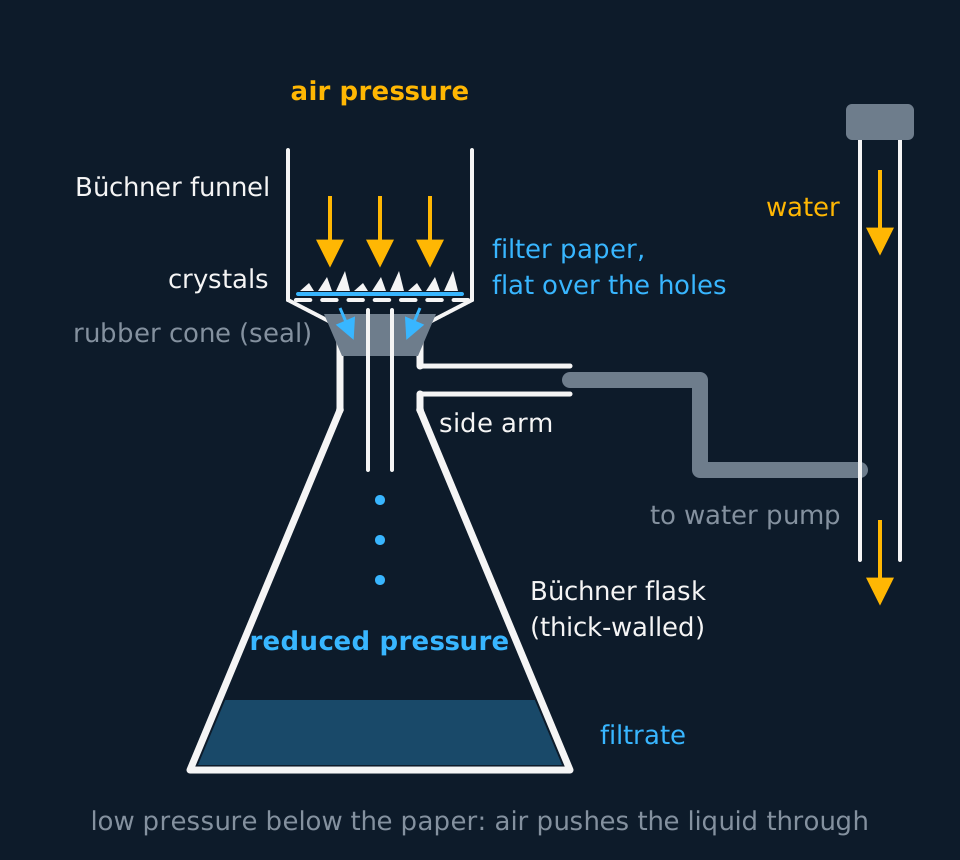
Describe the drawing
Filtration under reduced pressure in cross-section. A Büchner funnel with a flat perforated plate sits in a grey rubber cone in the neck of a thick-walled conical Büchner flask. A circle of filter paper lies flat on the plate, smaller than it but covering every hole, with a layer of white crystals on top. Amber arrows show air pressure pushing down on the solid; small cyan arrows show liquid drawn through the holes into the flask, where filtrate collects under reduced pressure. The side arm is joined by thick rubber tubing to a water pump on a tap.
Recrystallisation then removes the impurities, and it works because the product dissolves far better in a hot solvent than in the same solvent cold. Each step has a reason, and the reason is what a question on the method asks for.
The crude solid is dissolved in the minimum volume of hot solvent, added a little at a time to the solid near the solvent's boiling point. That makes a solution that is saturated while hot, so that as much of the product as possible comes out when it cools. Every extra cubic centimetre of solvent holds some product in solution for good, and lowers the yield.
If anything stays undissolved, the hot solution is filtered through a fluted filter paper in a funnel that has been warmed, so that the product does not crystallise in the funnel. The insoluble impurities stay on the paper.
The filtrate is then left to cool slowly to room temperature, and then in ice. The product's solubility falls and it crystallises. The soluble impurities stay dissolved, because there is far too little of each to saturate the solvent even when cold. Slow cooling gives larger crystals with less of the solution trapped among them.
The crystals are collected by filtration under reduced pressure and washed with a small volume of ice-cold solvent. That rinses off the solution of impurities left clinging to the surface, and the solvent is cold so that it dissolves as little of the product as possible. Last, the crystals are dried: on a watch glass in a desiccator, or in an oven set well below their melting point.
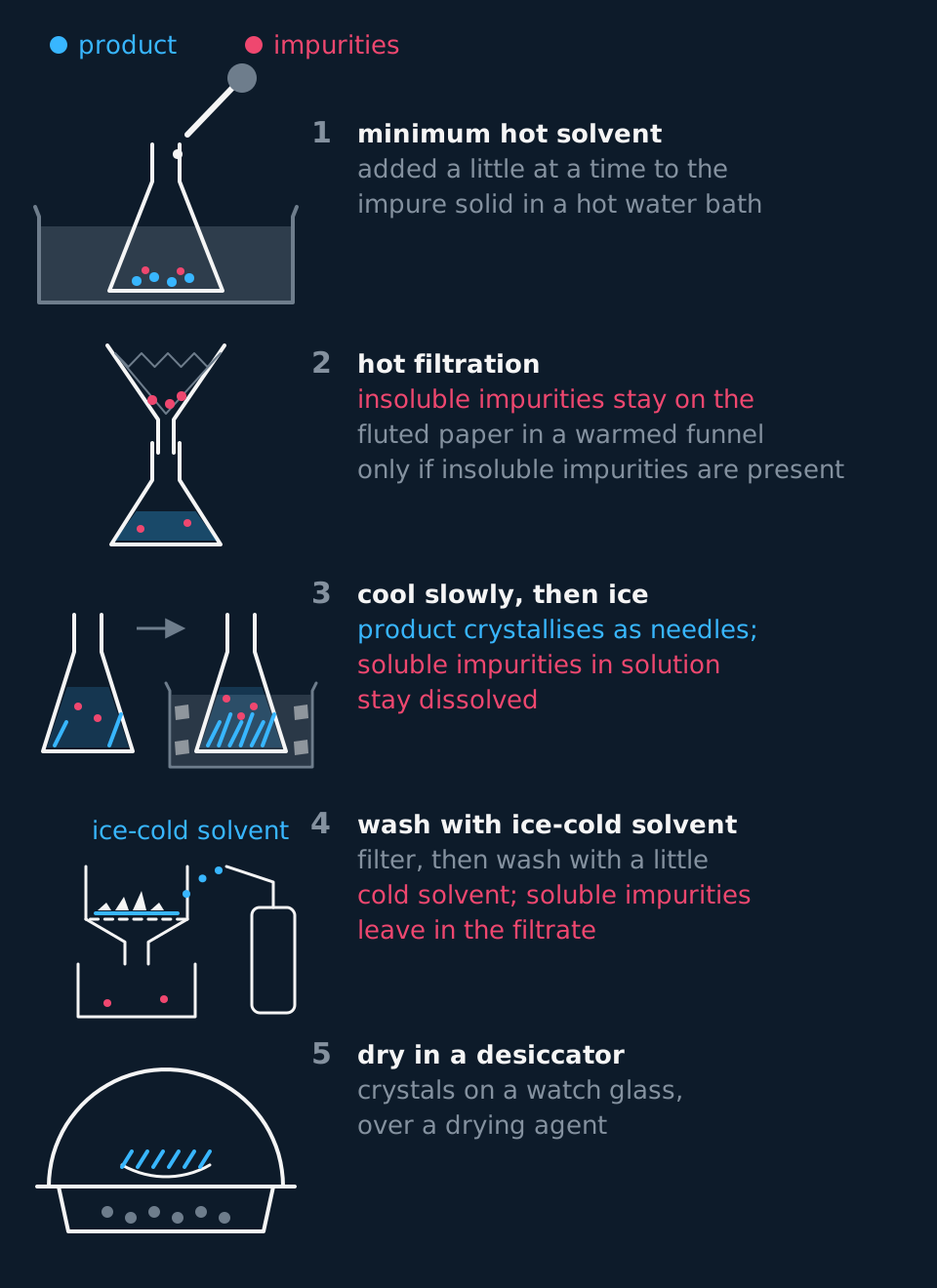
Describe the drawing
Five steps of recrystallisation drawn down the page, with the product in cyan and impurities in coral. One: hot solvent is dripped from a pipette onto the impure solid in a conical flask standing in a hot water bath, the minimum volume to dissolve it. Two: hot filtration through fluted paper, which keeps coral specks of insoluble impurity, needed only if such impurities are present. Three: the filtrate cools on the bench and then in ice, and cyan needle crystals grow while coral dots of soluble impurity stay dissolved. Four: Büchner filtration, the crystals washed with a little ice-cold solvent from a wash bottle, the soluble impurities going through into the filtrate. Five: the crystals dry on a watch glass in a desiccator.
- Recrystallisation
- Purifying a solid by dissolving it in the minimum volume of hot solvent, cooling so the product crystallises while impurities stay in solution, then filtering, washing and drying.
- Filtration under reduced pressure
- Filtration through a Büchner funnel with a pump lowering the pressure in the flask below, which is faster and leaves a drier solid.
Testing a solid: the melting point
A pure solid melts sharply, over a range of 1 or 2 °C or less, at a temperature that matches the value in a data book. Pure aspirin melts at 135 °C. Impurities disrupt the regular lattice, so fewer and weaker attractions have to be overcome: an impure solid starts to melt lower and melts over a wider range. A sample of aspirin that melts from 128 to 132 °C is not yet pure.
The measurement uses a capillary tube sealed at one end, with 2 to 3 mm of the dry, finely powdered solid tapped down into it. The tube goes into an electrically heated melting point apparatus, or is strapped to a thermometer in a Thiele tube of oil. The temperature is raised quickly to about 10 °C below the expected melting point and then slowly, about 1 °C a minute, so that the sample and the thermometer are at the same temperature. Two readings are taken: where the first liquid appears, and where the last solid disappears.
Heating too fast gives a melting point that reads high, because the sample lags behind the thermometer: by the time the last solid has melted, the block and the thermometer are already hotter. A wet sample melts low, because the water is itself an impurity. Running a second sample is cheap and shows whether the first reading can be trusted.
- Melting point of a pure solid
- The single temperature, reached sharply, at which a pure solid turns to liquid; impurities lower it and widen the range.
Purifying a liquid
The ester distilled out of an esterification smells right but is not pure. It carries some unreacted ethanoic acid and ethanol, water, and a trace of the sulfuric acid catalyst. Three operations clean it: washing in a separating funnel, drying, and distilling again.
A separating funnel holds two liquids that do not mix, one floating on the other. The denser liquid is the lower layer. Ethyl ethanoate has a density of 0.90 g cm⁻³ and floats on water, but many halogenoalkanes are denser than water and sink, so the layers are identified from densities, or by adding a little water and seeing which layer grows.
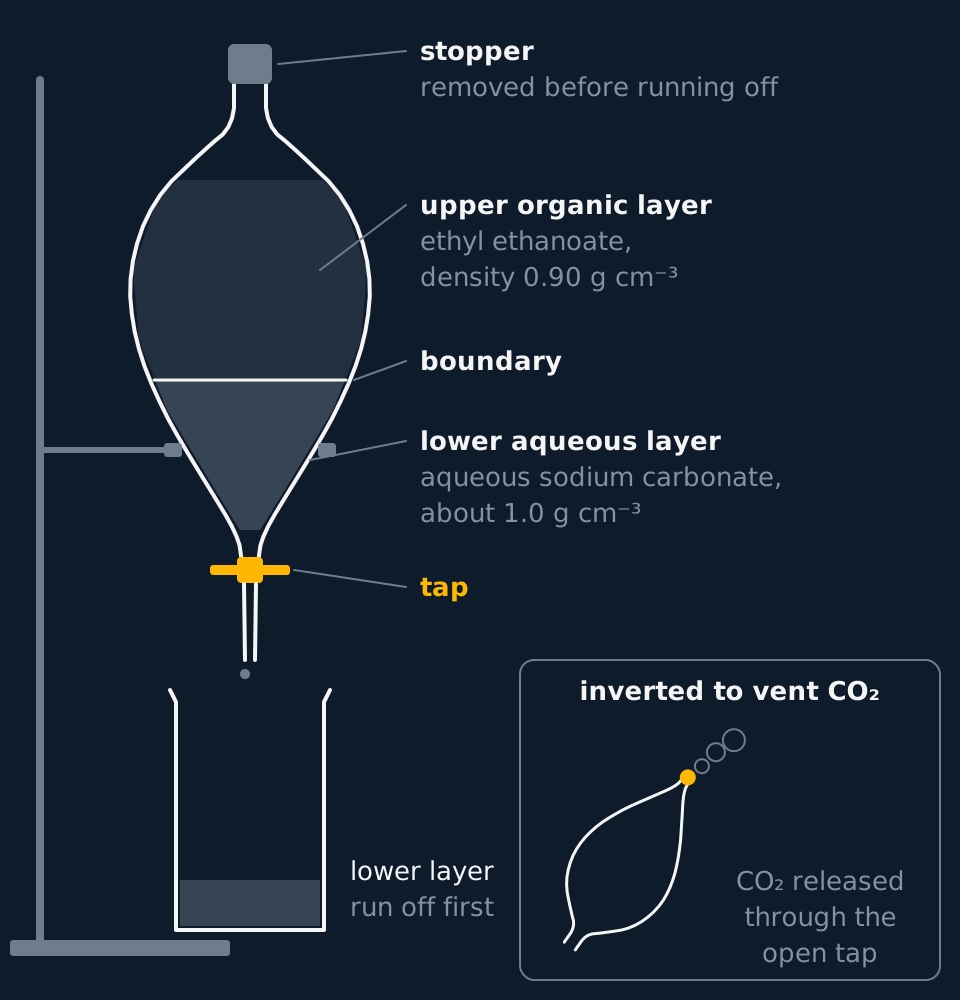
Describe the drawing
A pear-shaped separating funnel held in a clamp ring, with a stopper at the top and an amber tap at the bottom above a beaker. It holds two colourless layers shown as pale tints with a clear horizontal boundary: the upper organic layer of ethyl ethanoate, density 0.90 g cm⁻³, and the lower aqueous layer of sodium carbonate solution, about 1.0 g cm⁻³, which runs off first into the beaker. An inset shows the funnel turned upside down with its tap pointing up and away, and a puff of carbon dioxide released through the open tap.
To wash the crude ester, it is shaken in the funnel with sodium carbonate solution. The carbonate neutralises the ethanoic acid and sulfuric acid, turning them into ionic salts that dissolve in the water layer. The reaction gives off carbon dioxide, so the funnel is stoppered, inverted, and the tap opened to let the gas out before and between gentle shakes. Washing continues until no more gas forms. The funnel then stands until the layers separate, the stopper is removed, and the lower aqueous layer is run off and discarded.
2CH₃COOH(aq) + Na₂CO₃(aq) → 2CH₃COONa(aq) + H₂O(l) + CO₂(g)Washing removes acid by converting it into a salt that stays in the aqueous layer.
The washed ester is cloudy, because tiny drops of water are suspended in it. It is run into a dry conical flask and a drying agent, anhydrous magnesium sulfate or anhydrous calcium chloride, is added and swirled. The salt takes up water as water of crystallisation. More is added until fresh drying agent no longer clumps and the liquid turns clear. Calcium chloride also binds ethanol, which suits ethyl ethanoate, whose boiling point is too close to ethanol's for distillation to separate them well. The dried liquid is decanted or filtered away from the solid.
Last, the liquid is redistilled and only the fraction boiling within a degree or two of the product's boiling point is collected, 75 to 79 °C for ethyl ethanoate. Anything distilling earlier or later is a different substance and goes into a separate flask.
The boiling temperature is the liquid's test of purity, as the melting point is the solid's. It is read during the redistillation, with the thermometer bulb level with the side arm, once the reading is steady and distillate drips from the condenser. A pure liquid distils at a steady temperature close to the data-book value; a mixture distils over a rising range. Boiling points fall as atmospheric pressure falls, so a reading about a degree low on a day of low pressure is not by itself a sign of impurity.
- Immiscible
- Describes two liquids that do not mix and form two separate layers.
- Drying agent
- An anhydrous salt, such as magnesium sulfate or calcium chloride, that removes water from an organic liquid by absorbing it as water of crystallisation.
- Boiling temperature
- The temperature at which the vapour pressure of a liquid equals atmospheric pressure; a pure liquid distils at a steady temperature matching its data-book value.
Required practical 10
AQA's required practical 10 has two parts: the preparation of a pure organic solid with a test of its purity, and the preparation of a pure organic liquid. The two methods use aspirin, made from 2-hydroxybenzoic acid and ethanoic anhydride, and ethyl ethanoate, made from ethanol and ethanoic acid.
C₇H₆O₃(s) + (CH₃CO)₂O(l) → C₉H₈O₄(s) + CH₃COOH(l)2-hydroxybenzoic acid and ethanoic anhydride give aspirin and ethanoic acid.
| Step | Solid: aspirin | Why |
|---|---|---|
| 1 | Weigh about 2.00 g of 2-hydroxybenzoic acid by difference into a 50 cm³ pear-shaped flask. | Its moles fix the theoretical yield. |
| 2 | In a fume cupboard add 4.0 cm³ of ethanoic anhydride and five drops of concentrated phosphoric acid, with anti-bumping granules. | The anhydride is in excess; the acid is the catalyst. |
| 3 | Fit a reflux condenser and heat in a water bath at about 80 °C for 15 minutes. | Keeps the volatile anhydride in the flask; the bath heats evenly and safely. |
| 4 | Cool, then add 20 cm³ of cold water a little at a time, and stand the flask in ice. | Water hydrolyses the excess anhydride; aspirin crystallises in the cold. |
| 5 | Filter under reduced pressure and rinse with a little ice-cold water. | Separates the crude solid from the acidic solution. |
| 6 | Recrystallise from the minimum volume of a hot ethanol and water mixture; cool slowly, then in ice. | Soluble impurities stay in solution. |
| 7 | Filter under reduced pressure, wash with a little ice-cold water and dry in a desiccator. | Removes clinging solution and water. |
| 8 | Weigh the dry product on a weighed watch glass. | Gives the actual yield. |
| 9 | Measure the melting point range in a capillary tube, heating slowly near 135 °C. | A sharp melting point at 135 °C shows purity. |
CH₃COOH(l) + CH₃CH₂OH(l) ⇌ CH₃COOCH₂CH₃(l) + H₂O(l)Esterification is an equilibrium, which caps the yield before any is lost.
| Step | Liquid: ethyl ethanoate | Why |
|---|---|---|
| 1 | Measure 12.0 cm³ of glacial ethanoic acid and 15.0 cm³ of ethanol into a 50 cm³ round-bottomed flask. | Excess ethanol pushes the equilibrium towards the ester. |
| 2 | Add 2 cm³ of concentrated sulfuric acid a drop at a time, swirling and cooling; add anti-bumping granules. | Mixing is exothermic; the acid is the catalyst. |
| 3 | Heat under reflux on a heating mantle for 20 minutes. | Gives the slow reaction time without loss of vapour. |
| 4 | Rearrange for distillation and collect everything that distils below 85 °C. | Separates the volatile crude ester from the acid and catalyst. |
| 5 | Shake with sodium carbonate solution in a separating funnel, venting often, until no more gas forms; discard the lower layer. | Removes the acids as salts in the aqueous layer. |
| 6 | Run the ester into a dry flask, add anhydrous calcium chloride and swirl until clear. | Removes water and ethanol. |
| 7 | Decant into a clean, dry flask and redistil, collecting 75 to 79 °C in a weighed sample bottle. | Only the ester boils in this range. |
| 8 | Weigh the bottle and its contents. | Gives the actual yield. |
The apparatus for both is a short list: a balance reading to 0.01 g, measuring cylinders, a flask with a condenser that fits it both ways, a heating mantle or water bath, a thermometer, Büchner apparatus, a separating funnel and a melting point apparatus. The anhydride, the concentrated acids and the ester's vapour are handled in a fume cupboard, and no flame is lit near ethanol or ethyl ethanoate.
Four things are measured: the mass of the limiting reactant, or its volume and density; the mass of the dry product; the melting point range of the solid; and the temperature range over which the liquid was collected. A two-decimal-place balance is uncertain by ±0.01 g in each reading, so a mass found by difference carries ±0.02 g: 1.2% of a 1.72 g product. The thermometer reads to ±0.5 °C.
The errors that matter are not the instruments'. For the solid, product is lost on every transfer and in the recrystallisation solvent, which lowers the yield; a product that is not fully dry weighs too much, so the yield comes out falsely high, and it melts low and over a range. Heating the melting point apparatus too quickly gives a melting point that reads high.
For the liquid, the equilibrium means the yield is well below 100% before any handling. Ester is lost to each aqueous wash, because it dissolves slightly in water, and by evaporation every time the flask is opened. Forgetting to vent the funnel can blow the stopper out. And because ethanol and ethyl ethanoate boil a degree apart, a fraction collected at the right temperature can still hold ethanol: the boiling range is a weaker test of purity than a melting point.
Percentage yield
Every preparation ends with the percentage yield: the mass of pure product obtained as a percentage of the mass the equation says the limiting reactant could give. The theoretical mass comes from the moles of the limiting reactant, which for a liquid comes from its volume and density.
The yield of aspirin
A student starts with 2.00 g of 2-hydroxybenzoic acid, C₇H₆O₃, and obtains 1.72 g of dry, recrystallised aspirin, C₉H₈O₄. Ethanoic anhydride is in excess. Calculate the percentage yield. Mr of C₇H₆O₃ = 138.0; Mr of C₉H₈O₄ = 180.0.
Show the working
Moles of 2-hydroxybenzoic acid = 2.00 ÷ 138.0 = 0.01449 mol.
The equation is 1 : 1, so the theoretical yield of aspirin is 0.01449 mol, a mass of 0.01449 × 180.0 = 2.609 g.
Percentage yield = 1.72 ÷ 2.609 × 100 = 65.9%, to three significant figures to match the data.
The yield of ethyl ethanoate from volumes
12.0 cm³ of ethanoic acid (density 1.05 g cm⁻³, Mr 60.0) reacts with 15.0 cm³ of ethanol (density 0.789 g cm⁻³, Mr 46.0). After purification 6.20 g of ethyl ethanoate (Mr 88.0) is collected. Calculate the percentage yield.
Show the working
Mass of ethanoic acid = 12.0 × 1.05 = 12.6 g, so moles = 12.6 ÷ 60.0 = 0.210 mol.
Mass of ethanol = 15.0 × 0.789 = 11.8 g, so moles = 11.8 ÷ 46.0 = 0.257 mol.
The reaction is 1 : 1, so ethanoic acid, with fewer moles, is limiting. Theoretical ester = 0.210 mol, a mass of 0.210 × 88.0 = 18.5 g.
Percentage yield = 6.20 ÷ 18.5 × 100 = 33.5%.
A yield of a third looks poor, and it is typical of a school esterification. The equilibrium leaves acid and alcohol unreacted, and handling does the rest: every step that makes the product cleaner leaves some of it behind, in a wash, in the drying agent or in the air.
TRY IT: Where a yield went over 100%
A student makes aspirin from 2.00 g of 2-hydroxybenzoic acid and reports a yield of 2.75 g. Calculate the percentage yield and suggest two explanations.
Check your answer
The theoretical yield is 2.609 g, so the percentage yield is 2.75 ÷ 2.609 × 100 = 105%.
More than 100% means the solid weighed is not all aspirin. It may still be wet with water or solvent, because it was weighed before it was dry, or it may still contain unreacted 2-hydroxybenzoic acid or ethanoic acid.
Drying to constant mass and recrystallising again would fix both, and a melting point below 135 °C over a wide range would confirm that the sample was impure.
- Percentage yield
- The actual mass of product obtained divided by the theoretical mass from the limiting reactant, multiplied by 100.
Other boards: the practical numbers and steam distillation
OCR assesses the same two preparations through its Practical Endorsement: PAG 5 is the synthesis of an organic liquid and PAG 6 the synthesis of an organic solid, and ethyl ethanoate and aspirin meet them as they stand. An unfamiliar preparation, such as 1-bromobutane from butan-1-ol, uses the same techniques in the same order, and a question may ask which technique each stage uses and why.
Edexcel's core practical 16 is the preparation of aspirin, with its melting point as the test of purity, and its specification names the boiling temperature as the check on a liquid product, measured during redistillation in the way described for ethyl ethanoate. Its liquid preparation, core practical 6, uses the same separating funnel, drying agent and distillation to purify a halogenoalkane, 2-chloro-2-methylpropane.
Cambridge sets no list of practicals. Paper 3 tests the skills at the bench, and Paper 5 asks for a method to be planned and its results evaluated on paper, so a Cambridge candidate needs every reason in the recrystallisation and washing steps, written out, and the reason a melting point shows purity.
Edexcel also names steam distillation, which separates a liquid that does not mix with water and boils too high to distil without decomposing. Steam is blown through the mixture. Each of two immiscible liquids exerts its own vapour pressure, so the mixture boils when the two add up to atmospheric pressure, below 100 °C. After nitrobenzene is reduced and alkali added, phenylamine, which boils at 184 °C, comes over with the steam at about 98 °C, leaving the tin salts behind. The cloudy distillate is then separated in a separating funnel.
- Steam distillation
- Distilling an organic liquid that is immiscible with water together with steam, so that it distils below 100 °C, well below its own boiling point.
In the exam
- A recrystallisation answer is credited step by step, and only with the right words: the scheme wants the minimum volume of hot solvent, and 'dissolve in solvent' without both words does not score.
- Purity from a melting point needs both parts: a sharp melting point and agreement with the data-book value. 'It melts at the right temperature' alone earns one of the two marks at most.
- For the separating funnel with a carbonate, give the method of venting, inverting the funnel and opening the tap, and the reason, carbon dioxide building up pressure.
- A yield from volumes carries method marks for mass = volume × density and for choosing the limiting reactant, and later marks are awarded on an error carried forward from a wrong mass.
- 'Add a drying agent' needs a name, anhydrous magnesium sulfate or calcium chloride, and the sign that drying is complete: the liquid turns clear and fresh solid no longer clumps.
Check yourself
A student recrystallises 3 g of crude aspirin from 40 cm³ of hot solvent, when 10 cm³ would have dissolved it. Explain what happens to the yield and to the purity, and how the melting point of the dried product compares with that of a correctly recrystallised sample.
Answer
With four times the minimum volume the solution is far from saturated when hot, so on cooling much of the aspirin stays dissolved and goes through the filter in the filtrate.
The yield falls sharply. The purity is not harmed: the impurities are even further from saturating the solvent and stay in solution.
So the product, once dry, should melt as sharply and at the same temperature as a correctly recrystallised sample, near 135 °C. Using too much solvent costs product, not purity.
Questions
Question 16 marks
Describe how a sample of crude aspirin is purified by recrystallisation and how its purity is then tested.
Mark scheme
Indicative content
- dissolve the crude solid in the minimum volume of hot solvent, such as an ethanol and water mixture, so the solution is saturated
- filter the hot solution through a warmed funnel if any insoluble impurities remain, so the product does not crystallise in the funnel
- cool slowly to room temperature and then in ice, so the aspirin crystallises while soluble impurities stay in solution
- collect the crystals by filtration under reduced pressure in a Büchner funnel and wash with a little ice-cold solvent
- dry the crystals in a desiccator or a low oven, then pack a little of the powder into a capillary tube sealed at one end
- heat slowly near the expected value in a melting point apparatus; a sharp melting point at 135 °C shows the sample is pure
Levels
- Level 3 (5–6 marks) every stage of the recrystallisation is present with its reason: minimum hot solvent, hot filtration, slow cooling then ice, suction filtration, washing with ice-cold solvent and drying, followed by the melting point test with a sharp melting point at the expected value as the sign of purity
- Level 2 (3–4 marks) dissolving in minimum hot solvent, cooling and filtering are described and the melting point named; why the solvent is minimal, why the wash is ice-cold, or what a sharp melting point shows is left unsaid
- Level 1 (1–2 marks) the solid is dissolved and recrystallised, often in a large volume of solvent or washed with warm solvent, both of which lose product
Question 24 marks
Explain why a mixture of ethanol, ethanoic acid and concentrated sulfuric acid is heated under reflux rather than in an open flask, why anti-bumping granules are added, and why the top of the condenser is left open.
Mark scheme
- B1 the reaction is slow, so the mixture must be heated for a long time, and the reactants and ester are volatile
- B1 the vertical condenser condenses the vapour and returns it to the flask, so nothing is lost and the mixture cannot boil dry
- B1 anti-bumping granules let bubbles form smoothly, so the liquid boils evenly rather than in sudden violent bursts
- B1 a closed system would build up pressure as it is heated and could burst or blow apart; reject 'to let air in'
Question 34 marks
Explain why, when recrystallising crude aspirin, a student warms the funnel before the hot filtration, and why the final crystals are washed with a small volume of ice-cold solvent.
Mark scheme
- B1 the solution is saturated while hot and the product is much less soluble in cooler solvent
- B1 a cold funnel would cool the solution, so the product would crystallise in the funnel and paper and be lost with the insoluble impurities
- B1 the wash removes the solution of soluble impurities left on the surface of the crystals
- B1 the solvent is ice-cold and the volume small so that as little of the product as possible dissolves; accept 'to keep the yield high'
All 21 questions with mark schemes, the other 18 set out in full on the question page.
Worth remembering
- A sealed reflux apparatus or a Bunsen flame under organic vapour is unsafe.
- Extra hot solvent lowers the yield, not the purity.
- A warm wash dissolves crystals; the wash is a little ice-cold solvent.
- A wet product weighs too much and melts low: dry it before both.
- The limiting reactant comes from moles, never from volumes or masses.
CHECK YOUR PROGRESS
Rate how confident you are with each objective for this lesson. Ratings are saved in this browser, on this device, unless you sign in.
- Explain why organic reactions are heated under reflux, and when distillation is used instead.
- Describe how an impure organic solid is purified by recrystallisation, giving the reason for each step.
- Explain how a melting point shows whether a solid is pure, and describe how it is measured.
- Describe how an organic liquid is purified by washing, drying and redistillation, giving the reason for each step.
- Calculate the percentage yield of a preparation from masses or volumes and densities.
Open the full revision checklist to see every objective in the curriculum in one place.
Practise this lesson
WORKBOOK
The written questions from this topic, on paper with room to work, and a separate book of mark schemes. The 3 questions that are set on a diagram stay on this page, where the diagram can be drawn. Free to use; please do not redistribute or sell.